Biology IX RO
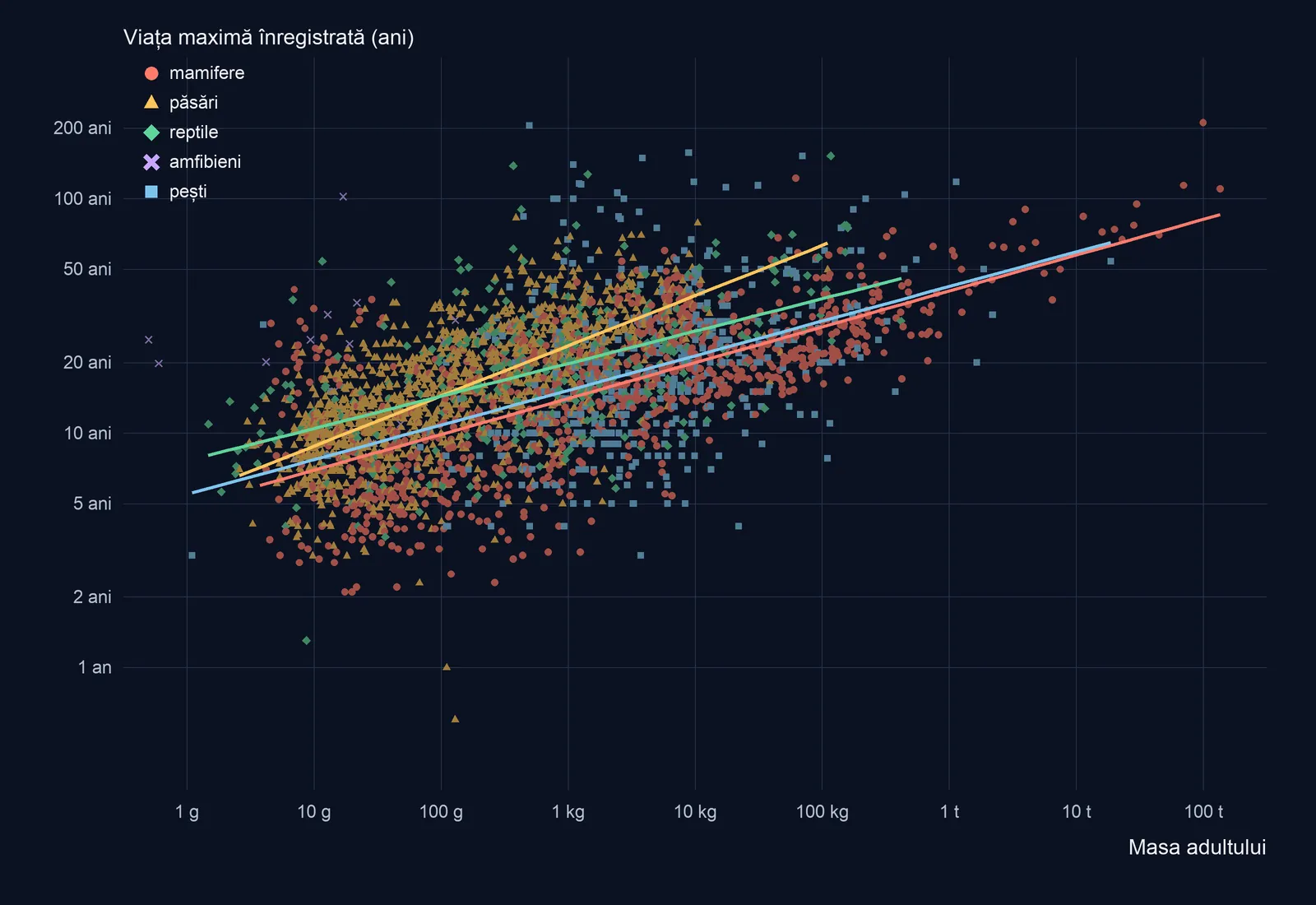
A cloud of 3,123 points: adult mass from 0.5 g to 136 t across, maximum recorded lifespan up, with mammals, birds, reptiles, amphibians and fish mixed together and four trend lines rising to the right.

Chapter 8 · Animals: forms, functions, environments

Why are a sea sponge, a bee and a bear all animals?

Size
from 1 mm to 30 m
Level
organism
Time
hundreds of millions of years

Each dot is a vertebrate species: how much an adult weighs and how long the oldest known individual lived. There are 3,123 species from the AnAge database, from salamanders of half a gram to the blue whale. Touch a dot to weigh the animal.

A bat and a mouse weigh the same

The greater mouse-eared bat, known in Romanian as the common bat, weighs 28.55 g. The yellow-necked mouse, a rodent of Romania’s forests, weighs 29.4 g. Both also live in Romania.

How long did the oldest known individual of each species live?

From half a gram to 136 tonnes

The oldest known greater mouse-eared bat lived 37.1 years, in the wild. The oldest yellow-necked mouse, 4.5 years, in captivity. The bat lived 8.2 times longer.

The chart shows 997 mammals, 1,330 birds, 355 reptiles, 18 amphibians and 423 fish. The lightest species is a North American salamander, at 0.5 g; the heaviest, the blue whale, at 136 t, which is 272 million times heavier.

On each axis, one gridline means ten times more than the one before. The lifespan shown is the species’ record, not its usual lifespan: 50% of the records come from captivity, where animals are shielded from predators and hunger.

Larger animals usually live longer

The Eurasian shrew, at 9 g, lived at most 3.2 years. The brown bear, at 277.5 kg, lived 40 years, and the African bush elephant, at 4.8 t, 65 years.

The line is the equation AnAge uses for mammals: t = 4.88 · M0.153, with M in grams and t in years. For a mass ten times larger, the predicted lifespan is 1.42 times as long.

The brown bear sits close to the line: 1.2 times the lifespan its mass predicts. The points scatter on both sides, though: the line shows a tendency, not a rule.

Most bats and most birds live longer than the mammal line predicts

The white circles mark the 96 species of bats. Of these, 88 species have a record above the mammal line, and half of all 96 live at least 1.7 times longer than their mass predicts. Brandt’s bat, at 7 g, lived 41 years, 6.2 times longer than its mass predicts.

Birds have their own line, higher up: at 100 g, the bird line gives 14.4 years and the mammal line 9.9 years. 82% of the bird species on the chart have a record above the mammal line.

What do the two groups have in common? Bats and most birds fly. Hypothesis: an animal that easily escapes predators lives long enough for the pace of its ageing to matter. A study across the bat family tree found that species that hibernate live longer; among both hibernating and non-hibernating species, those that use caves live longer (Wilkinson and Adams, 2019).

Some cold-blooded animals have outlived every mammal of their size in AnAge

The beluga sturgeon of the Danube weighs 1.14 t as an adult, and its age record is 118 years, 2.7 times longer than the fish line predicts. The Aldabra giant tortoise: 117.2 kg as an adult, a record of 152 years. In a deep-sea fish of the Pacific, Sebastes aleutianus, the adult weighs only 495 g, and the age record is 205 years. The Greenland shark has 392 years in AnAge, but no mass, so it appears only on the left-hand axis.

Mammals keep their bodies warm: in the 381 species with a body temperature in AnAge, it lies between 30.7 °C and 40.1 °C. Lines drawn through AnAge’s metabolic-rate measurements (343 species of mammals and only 14 species of reptiles, measured at 16.4–32.4 °C) give an estimate: at rest, a 1 kg mammal uses about 16 times as much energy as a 1 kg reptile.

A slow metabolism does not automatically mean a long life: at 1 t, the fish line gives 42 years and the mammal line 40 years.

No class stands above another

The lit band shows the masses that both mammals and fish reach: from 3.77 g to 18.7 t, 6.7 orders of magnitude. Within the same band, the points of the classes mix.

Humans, with 122.5 years, live 4.6 times longer than their mass predicts. Even so, 9 species on the chart have lived longer still: five fish, three reptiles and one mammal, the bowhead whale, with 211 years. The largest species, the blue whale, has a record of 110 years.

Each class has small and large species, with short and long lives. A “ladder of progress”, with one class always above the others, does not appear on the chart: lifespan is compared species by species, like any other trait.

Now you explain

The naked mole-rat weighs 35 g, about as much as a house mouse (20.5 g). It does not fly. Its record is 31 years, 3.7 times longer than the mammal line predicts; the house mouse’s is 4 years. It lives in colonies, in tunnels underground, in the Horn of Africa.

Which idea from the bats and birds would fit here? What would you compare to check it?

Compare with an answer

Closed tunnels shield it from most predators, as flight shields bats and birds. The same hypothesis fits: where few animals die of outside causes, evolution can favour bodies that age more slowly. To check it, you would compare, at the same mass, several species that live underground with their relatives at the surface. The chart shows an association, not a cause.

The lesson on birds and mammals, with the worked example and questions

Measurements and calculation. Each dot is a species from AnAge, Build 15, with its adult mass, its maximum recorded lifespan and data quality “acceptable” or “high” by AnAge’s criteria: 3,123 species, all vertebrates (AnAge’s invertebrate species have no adult mass). The lifespan is the species’ record, not its usual lifespan; 50% of the records come from captivity. The mammal line is the equation published by AnAge, t = 4.88 · M0.153 (without cetaceans); the lines for birds, reptiles and fish are calculated by least squares on the points on the chart; no line is drawn for amphibians. The four lampreys (cyclostomes) are counted with the fish. Data: AnAge, Human Ageing Genomic Resources, licence CC BY 3.0.

Sources and credits. Data: AnAge, The Animal Ageing and Longevity Database, Build 15, Human Ageing Genomic Resources (Tacutu et al. 2013 and de Magalhães et al. 2024, Nucleic Acids Research), dataset: source; licence CC BY 3.0, licence text: source; changes: only species with an adult mass, a maximum lifespan and data quality “acceptable” or “high” were kept, the classes were grouped into school groups, Romania markers were added, and the trend lines for birds, reptiles and fish were calculated from these data.

The same data, as a table
Mass and maximum recorded lifespan for 25 well-known species (AnAge, Build 15). Last column: the recorded lifespan divided by the lifespan the class line predicts.
SpeciesClassAdult massMaximum recorded lifespan (years)Record setAgainst the class line (×)
Human Homo sapiensmammal62.03 kg122.5captivity4.6
Brown bear Ursus arctosmammal277.5 kg40captivity1.2
Grey wolf Canis lupusmammal26.63 kg20.6captivity0.9
Eurasian lynx Lynx lynxmammal23 kg26captivity1.1
Chamois Rupicapra rupicapramammal37.5 kg17.6captivity0.7
Red deer Cervus elaphusmammal200 kg31.5captivity1.0
European bison Bison bonasusmammal610 kg26.4captivity0.7
Greater mouse-eared bat Myotis myotismammal28.55 g37.1wild4.6
Brandt’s bat Myotis brandtiimammal7 g41wild6.2
Eurasian shrew Sorex araneusmammal9 g3.2captivity0.5
House mouse Mus musculusmammal20.5 g4captivity0.5
Yellow-necked mouse Apodemus flavicollismammal29.4 g4.5captivity0.5
African bush elephant Loxodonta africanamammal4.8 t65captivity1.3
Blue whale Balaenoptera musculusmammal136 t110wild–
Bowhead whale Balaena mysticetusmammal100 t211wild–
European white stork Ciconia ciconiabird3.35 kg39wild1.3
Great white pelican Pelecanus onocrotalusbird9.52 kg51captivity1.3
Rock dove Columba liviabird358.7 g35captivity1.8
Common carp Cyprinus carpiofish10.6 kg47captivity2.2
Beluga sturgeon Huso husofish1.14 t118wild2.7
Sebastes aleutianus, a deep-sea fish of the Pacificfish495 g205wild15.0
Long-nosed viper Vipera ammodytesreptile220 g22captivity1.4
Mediterranean spur-thighed tortoise Testudo graecareptile1.43 kg127captivity6.1
Aldabra giant tortoise Aldabrachelys giganteareptile117.2 kg152captivity4.0
European fire salamander Salamandra salamandraamphibian19.1 g24captivity–
68 more species with a common name
SpeciesClassAdult massMaximum recorded lifespan (years)Record setAgainst the class line (×)
Greater horseshoe bat Rhinolophus ferrumequinummammal22.88 g30.5wild3.9
Lesser mouse-eared bat Myotis blythiimammal23 g33wild4.2
Noctule Nyctalus noctulamammal27.75 g12wild1.5
Naked mole-rat Heterocephalus glabermammal35 g31captivity3.7
Least weasel Mustela nivalismammal46.9 g9.1captivity1.0
Fat dormouse Glis glismammal125 g8.7captivity0.9
Norway rat Rattus norvegicusmammal300 g3.8captivity0.3
Black-bellied hamster Cricetus cricetusmammal506.7 g3.6captivity0.3
Eurasian red squirrel Sciurus vulgarismammal600 g14.8captivity1.1
European pine marten Martes martesmammal1.3 kg18.2captivity1.2
Red fox Vulpes vulpesmammal4.132 kg21.3captivity1.2
European hare Lepus europaeusmammal4.175 kg10.7captivity0.6
Wild cat Felis silvestrismammal5.5 kg19captivity1.0
European otter Lutra lutramammal6.75 kg18.2captivity1.0
European badger Meles melesmammal13 kg18.6captivity0.9
Western roe deer Capreolus capreolusmammal21.67 kg17.5captivity0.8
Domestic dog Canis familiarismammal40 kg27captivity1.1
Chimpanzee Pan troglodytesmammal44.98 kg68captivity2.7
Harbour porpoise Phocoena phocoenamammal52.5 kg20.4captivity–
Wild boar Sus scrofamammal130 kg27captivity0.9
Bottlenosed dolphin Tursiops truncatusmammal200 kg51.6captivity–
Horse Equus caballusmammal300 kg57captivity1.7
Giraffe Giraffa camelopardalismammal800 kg39.5captivity1.0
Asiatic elephant Elephas maximusmammal3.178 t79.6captivity1.7
Hippopotamus Hippopotamus amphibiusmammal3.75 t61.2captivity1.2
Ruby-throated hummingbird Archilochus colubrisbird3.1 g9.1wild1.3
European robin Erithacus rubeculabird17.3 g19.3wild2.0
Great tit Parus majorbird17.9 g15.4wild1.5
Barn swallow Hirundo rusticabird18.3 g16not recorded1.6
House sparrow Passer domesticusbird25.3 g23not recorded2.1
Budgerigar Melopsittacus undulatusbird30 g21captivity1.9
Common swift Apus apusbird37.6 g21.1wild1.8
European starling Sturnus vulgarisbird74 g22.9wild1.7
Common blackbird Turdus merulabird103.2 g21.8wild1.5
Red junglefowl (the ancestor of the chicken) Gallus gallusbird779.8 g30captivity1.3
Common raven Corvus coraxbird1.041 kg69captivity2.9
Eurasian eagle-owl Bubo bubobird2.686 kg68captivity2.3
Western capercaillie Tetrao urogallusbird2.95 kg18captivity0.6
Greylag goose Anser anserbird3.308 kg31captivity1.0
Great cormorant Phalacrocorax carbobird3.629 kg32.1wild1.0
Golden eagle Aquila chrysaetosbird4.8 kg48captivity1.5
Common crane Grus grusbird5.5 kg43wild1.3
White-tailed sea-eagle Haliaeetus albicillabird6.697 kg42captivity1.2
Wandering albatross Diomedea exulansbird7.047 kg50wild1.4
Mute swan Cygnus olorbird8.3 kg40wild1.1
Ostrich Struthio camelusbird111 kg50captivity0.8
Slow worm Anguis fragilisreptile11.65 g54captivity5.1
European green lizard Lacerta viridisreptile21.5 g10not recorded0.9
European grass snake Natrix natrixreptile96.25 g20captivity1.4
Northern palaearctic viper Vipera berusreptile279 g19captivity1.1
Reticulated python Python reticulatusreptile32 kg29.4captivity0.9
Nile crocodile Crocodylus niloticusreptile94.2 kg56captivity1.5
American alligator Alligator mississippiensisreptile150 kg77captivity1.9
Green sea turtle Chelonia mydasreptile160 kg75not recorded1.9
Plethodon cinereus, an eastern red-backed salamander from North Americaamphibian0.5 g25wild–
Olm, a cave-dwelling amphibian Proteus anguinusamphibian17 g102wild–
Eurasian perch Perca fluviatilisfish2.612 kg22wild1.3
European eel Anguilla anguillafish3.629 kg88captivity4.8
Sterlet Acipenser ruthenusfish8.8 kg46.1captivity2.2
Zander Sander luciopercafish11 kg16wild0.7
Northern pike Esox luciusfish15.62 kg30wild1.3
Atlantic salmon Salmo salarfish25.74 kg13wild0.5
Star sturgeon Acipenser stellatusfish44 kg27wild1.0
Russian sturgeon Acipenser gueldenstaedtiifish63.25 kg46wild1.6
Acipenser fulvescens, a lake sturgeon from North Americafish70 kg152wild5.3
Sheatfish Silurus glanisfish168.3 kg60captivity1.8
Great white shark Carcharodon carchariasfish1.87 t50wild1.1
Whale shark Rhincodon typusfish18.7 t54wild0.8
All 3,123 species, by class
ClassSpeciesMassMaximum lifespan (years)Trend line
Mammals9973.77 g – 136 t2.1 – 211t = 4.88 · M0.153 (AnAge)
Birds1,3302.6 g – 111 kg0.6 – 83t = 5.37 · M0.214
Reptiles3551.475 g – 420 kg1.3 – 152t = 7.61 · M0.138
Amphibians180.5 g – 358.1 g7.8 – 102no line drawn (too few species)
Fish4231.1 g – 18.7 t3 – 205t = 5.48 · M0.148

Species with a recorded lifespan but no mass in AnAge (not on the chart): European frog (27 years), brown trout (38 years), Greenland shark (392 years), European pond turtle (120 years), common European toad (40 years), yellow-bellied toad (29 years), northern crested newt (28 years), marsh frog (11 years).

Data: AnAge, Build 15 (Human Ageing Genomic Resources; Tacutu et al. 2013, de Magalhães et al. 2024), licence CC BY 3.0; filtered by quality and grouped into school classes.

Lessons of the chapter

six lessons of the common core, for every track and profile, and another two lessons, for Natural Sciences (CS).

Your track

  1. 8.1Sponges and cnidarians: how an animal lives without organs How can a sponge count as an animal when the adult sits stuck to a rock, with no mouth, no stomach and no muscles?
  2. 8.2Worms: flat, round and segmented, free-living or parasitic What do the earthworm in the garden, the planarian under the stones of a stream and the tapeworm in a human gut have in common, apart from a long body?
  3. 8.3Molluscs: snails, bivalves and cephalopods, built to the same plan What do a Roman snail, a mussel and an octopus have in common, three animals that look nothing alike?
  4. 8.4Arthropods: arachnids, crustaceans and insects, with their skeleton on the outside Why is a spider not an insect, even though both have jointed legs and a hard outer covering?
  5. 8.5Fish, amphibians and reptiles: vertebrates with a variable body temperature What do a carp, a frog and a lizard have in common, and why can only the lizard lay its eggs far from water?
  6. 8.6Birds and mammals: vertebrates with a constant body temperature A bat flies, a whale swims, and a penguin cannot fly at all. How do you recognise a bird, and how do you recognise a mammal?
Another two lessons, for Natural Sciences (CS)
  1. 8.7Invertebrate diversity: pollinators, filter feeders, pests and invasive species CSHow can a small animal with no skeleton change a whole sea, or a country’s harvest?
  2. 8.8Vertebrate diversity: how many species each class has, and why there is no ladder of progress CSWhich is ‘more evolved’: a carp, a frog or a bear?

Test tomorrowten questions from chapter 8For the class: projector, worksheets, shared test