
Chapter 8 · AnimalsLesson 8.5
Fish, amphibians and reptiles: vertebrates with a variable body temperature
What do a carp, a frog and a lizard have in common, and why can only the lizard lay its eggs far from water?
- Size
- from 1 mm to 30 m
- Level
- organism
- Time
- hundreds of millions of years
Before you read: what do you think?
The beluga sturgeon (Huso huso) swims up the Danube from the Black Sea to breed. What is the greatest age ever recorded for this species?
See the answer
Over 100 years: the maximum recorded age is 118 years. For comparison, the greatest age reached by a human is 122 years.
Pick up a fish at the market and press along its back: under the flesh you can feel a row of hard bones linked together. You have the same kind of row, from the nape of your neck down to the level of your hips. It is the backbone, and the animals that have one are called vertebrates.
What all vertebrates have in common
Vertebrates have an internal skeleton, of bone or cartilage, that grows along with the animal. Its axis is the backbone (vertebral column), made of small bones called vertebrae. The spinal cord runs through the canal in the vertebrae, and the brain is enclosed in the skull. The body usually has two pairs of limbs: fins in fish, legs in the other groups.
Fish, amphibians and reptiles are poikilothermic animals: their body temperature follows the temperature of their surroundings. A lizard is not always cold, though. In the morning it basks in the sun until it warms up, and at midday it hides in the shade. The advantage is that it needs less food: a reptile gets by on about a tenth of the calories needed by a mammal of the same size, which makes its own heat. The comparison is about food in everyday life; the energy used at rest, measured in the lab at a set temperature, is a different measure and gives a different ratio. The drawback shows in winter: frogs, lizards and snakes become sluggish and spend the cold months hidden away, torpid.
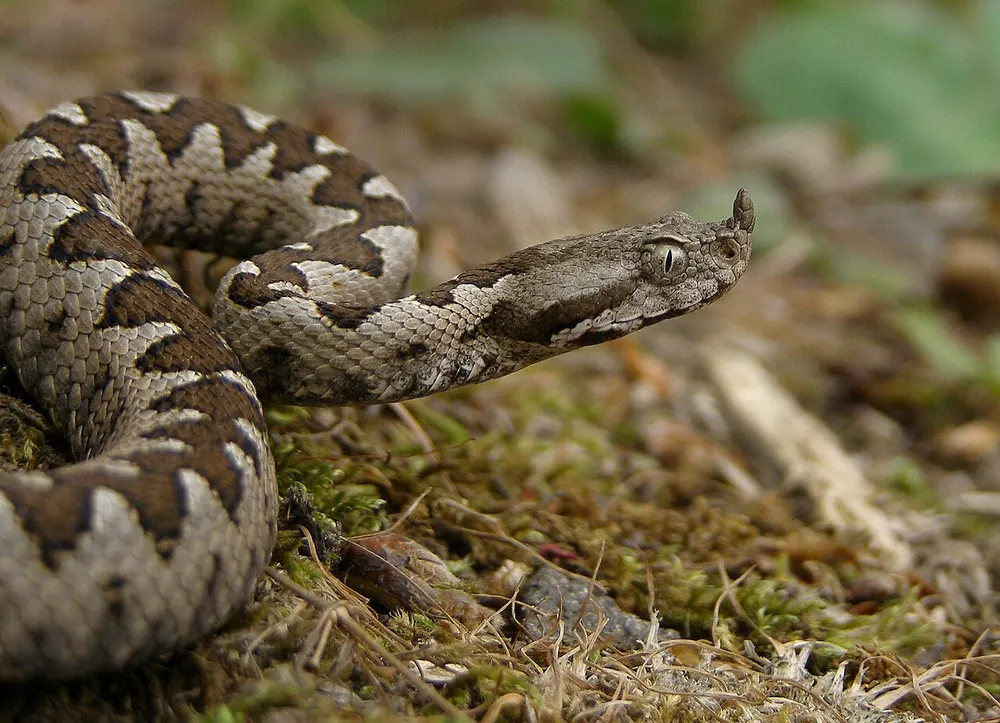
Photo: Mircea Nita, Public domain, source. Resized.

Fish: a body built for water
A fish’s body is streamlined and covered in scales and mucus. The tail fin drives the body forward, the paired fins (pectoral and pelvic) steer and brake it, and the unpaired fins (dorsal and anal) keep it upright. Many bony fish have a gas-filled swim bladder, which lets them stay at the depth they want without effort.
Fish breathe through gills: water comes in through the mouth, passes between the red filaments full of blood vessels and leaves under the operculum, the gill cover. Oxygen dissolved in the water passes into the blood. The heart has two chambers, an atrium and a ventricle, and the blood makes a single circuit: heart, gills, body, heart. Along the flanks runs the lateral line, a row of sense organs that detect movements in the water, so a fish can sense a predator or a nearby shoal even in the dark.
In most fish fertilisation is external: the female releases her eggs, the roe, into the water and the male sprays them with milt, his seminal fluid. The common carp (Cyprinus carpio) breeds this way. There are exceptions: in sharks fertilisation is internal. Fish are divided into cartilaginous fish (sharks and rays), with a skeleton of cartilage, and bony fish (carp, pike, trout), with a skeleton of bone. By diet, some are predators, like the pike, and others omnivores, like the carp.
Amphibians: a life between water and land
Frogs, newts and salamanders have thin skin, with no scales, kept moist by mucus. Oxygen and water pass in through it, which is why an amphibian dries out quickly in the sun and lives in damp places. The adult breathes through its lungs and through its skin.
A frog lays its eggs, which have no shell, in water, where they are fertilised. Out of the egg comes a tadpole, which lives like a fish: it has a tail and breathes through gills. Gradually its back legs grow, then its front legs, the gills are replaced by lungs and the tail is absorbed. This transformation of the body is called metamorphosis. The tadpole eats mainly algae, while the adult frog catches insects with its sticky tongue.
The amphibian heart has three chambers: two atria and one ventricle. The blood makes two circuits, one through the lungs and one through the body, but it mixes a little in the shared ventricle. Amphibians eat a great many insects and are food for storks, herons, snakes and fish, so they link water and land in food chains.
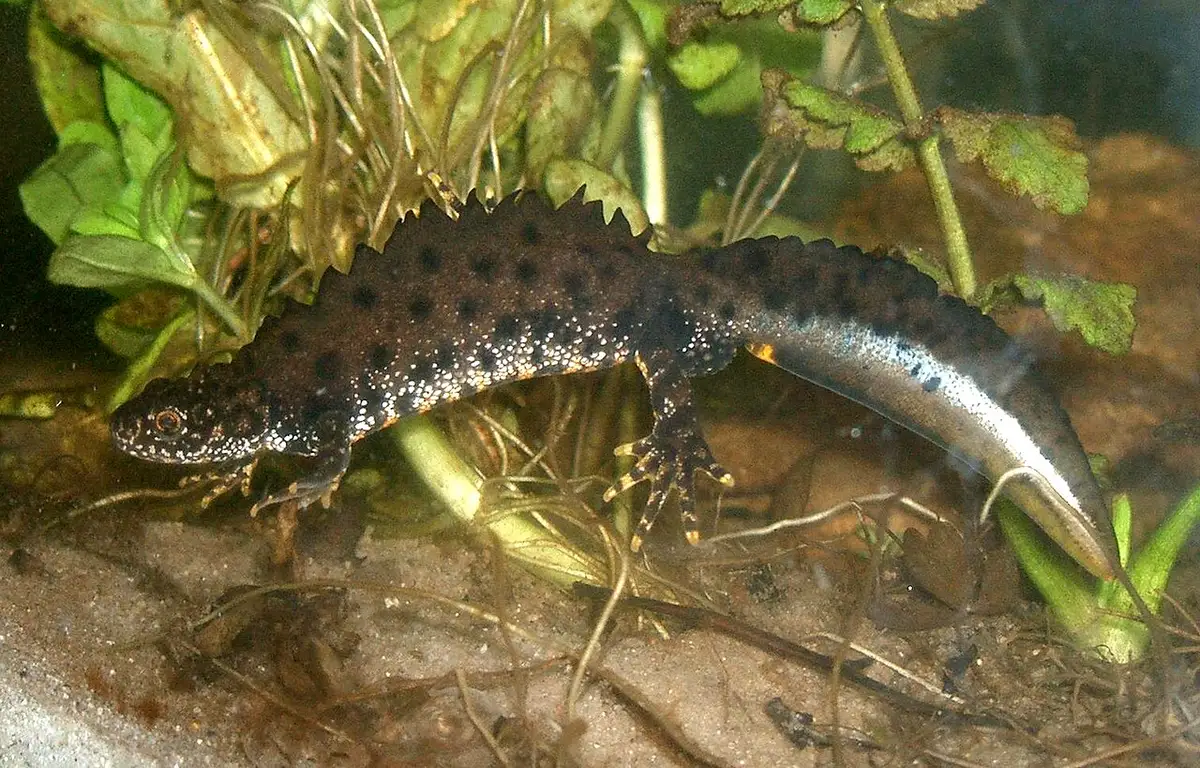
Photo: Rainer Theuer, Public domain, source. Resized.

Reptiles: the shelled egg freed reproduction from water
Lizards, snakes, tortoises, turtles and crocodiles have dry skin covered in horny scales, made of keratin and fats, which stop water loss. They breathe only through their lungs. The heart has three chambers, but the ventricle is partly divided by a wall, so the blood mixes less than in amphibians; crocodiles have a four-chambered heart.
Fertilisation is internal, and the eggs have a shell and are laid on land. Inside the egg, the embryo floats in a fluid enclosed by a membrane called the amnion, so it develops as if in its own small pool, with no need for a lake. Some lizards and some snakes keep their eggs inside the body and give birth to live young. Most reptiles are predators: lizards eat insects, snakes catch rodents, frogs and birds.
For the curious
A snake has no legs, but it is still a tetrapod, a vertebrate from the line of four-limbed animals. The ancestors of snakes had legs, which were lost over time. Relatedness is judged by the history of the group, and the number of limbs today is only one feature among many.
Worked example
Which is the fish, which the amphibian, which the reptile
Three animals look at first sight like something they are not. The eel has a long, snake-like body. The salamander has four legs and a tail, like a lizard. The slow worm (Anguis fragilis) has no legs at all.
Step 1: find out how the adult breathes. The eel has gills under an operculum and fins, so it is a fish. Step 2: touch the skin. The salamander has moist skin with no scales and releases its larvae into water, so it is an amphibian. Step 3: look at the scales and at reproduction. The slow worm has horny scales and breathes through lungs, so it is a reptile, a legless lizard to be precise.
The conclusion: body shape is misleading. Animals are classified by a set of features: breathing, skin, heart, reproduction.
Activity at home: on a whole fish bought for cooking, count the paired and unpaired fins, lift the operculum and look at the red gills, then find the lateral line on the flank.
In Romania
The beluga, the fish that moves from the sea into the Danube
The beluga sturgeon (Huso huso) lives in the Black Sea, where it hunts fish, and enters the Danube in spring to spawn, mostly in April and May. A fish that lives in the sea and breeds in a river is called anadromous. The beluga grows slowly and can live a very long time: the maximum recorded age is 118 years.
Of the six sturgeon species that lived in the Danube, the ship sturgeon and the European sturgeon have vanished from the river. The other four, the beluga, the Russian sturgeon, the stellate sturgeon and the sterlet, are critically endangered or endangered. Romania has banned sturgeon fishing permanently, in the Danube and at sea, and a sturgeon caught by accident must be released at once.
Romania has 23 species of reptiles and 19 species of amphibians. For 12 of the reptile species, the country lies at the edge of their range. One of them is the nose-horned viper (Vipera ammodytes), a species of warm climates, which in Romania lives in sunny places, for instance along the Jiu river in the Defileul Jiului National Park (the Jiu Gorge).
In short
- Vertebrates have an internal skeleton, with a backbone made of vertebrae, a skull that protects the brain and, usually, two pairs of limbs.
- Fish, amphibians and reptiles are poikilothermic: their body temperature follows that of their surroundings, and the animal regulates it through its behaviour.
- Fish have scales, fins, gills, a lateral line and a two-chambered heart; most have external fertilisation; they are divided into cartilaginous and bony fish.
- Amphibians have moist skin they breathe through, a three-chambered heart and shell-less eggs laid in water; the tadpole, with gills, becomes an adult through metamorphosis.
- Reptiles have horny scales, breathe only through their lungs, have internal fertilisation and eggs with a shell and an amnion, which develop on land.
Common mistakes
WrongCold-blooded animals always have a cold body.
RightTheir temperature follows their surroundings: a lizard warmed by the sun can have a body warmer than the air. That is why the correct term is poikilothermic, meaning with a variable temperature.
WrongA tadpole is a small frog.
RightA tadpole has a tail, breathes through gills and eats mainly algae. It becomes a frog only after metamorphosis, when its legs grow and its lungs appear.
WrongAll fish lay eggs that are fertilised in the water.
RightExternal fertilisation is the most common, but sharks have internal fertilisation. The rule depends on the species, not on the whole group.
Check yourself
Seven questions. For the first six you see the explanation at once, with the paragraph of the lesson that supports it; for the written ones you compare with a good answer.
How many chambers does a fish’s heart have, and how does the blood flow?
Answer
c) Two chambers, a single circuit. A fish’s heart has an atrium and a ventricle and sends the blood through the gills, then through the body, back to the heart: a single circuit.
What allows reptiles to lay their eggs far from water?
Answer
a) The eggs have a shell, and the embryo develops in the fluid enclosed by the amnion. The shell limits water loss, and the amnion keeps the embryo in its own fluid.
Why does an adult frog live in damp places, even though it breathes through lungs?
Answer
b) Because it also breathes through its thin skin, which has to stay moist. An amphibian’s skin is permeable: oxygen and water pass in through it, but water is also lost through it.
What does a fish use its lateral line for?
Answer
c) It senses movements in the water, such as an approaching predator. The lateral line is a sense organ for vibrations and currents in the water; it works in the dark too.
Put the stages in a frog’s development in order.
Answer
The correct order:
- The shell-less egg, laid and fertilised in water
- The tadpole with a tail, which breathes through gills
- The back legs appear
- The front legs appear, and the gills are replaced by lungs
- The tail is absorbed and the adult frog emerges
Metamorphosis gradually turns an aquatic larva into an adult that also lives on land.
Put each feature with the group it belongs to.
Answer
Fish: Lateral line and fins; A two-chambered heart.
Amphibians: Moist skin that takes in oxygen; A larva that breathes through gills and goes through metamorphosis.
Reptiles: Horny scales made of keratin; A shelled egg laid on land.
Fish are tied to water by their gills; amphibians depend on water through their skin and their larva; reptiles solved water loss with scales and the egg with an amnion.
On a cold April morning, a lizard lies motionless on a sunny stone. An hour later it dashes off quickly when you come near. Explain why.
A good answer
The lizard is poikilothermic: its body temperature follows the temperature of its surroundings. In the morning its body was cold and its muscles worked slowly. Basking in the sun, it warmed up, and the processes in its body, including muscle contraction, sped up, so it could run off fast.
A complete answer names the term poikilothermic, links body temperature to the speed of the body’s processes and shows that the animal regulates its temperature through its behaviour.
Terms
- vertebrates
- Animals with an internal skeleton and a backbone made of vertebrae.
- poikilotherms
- Animals whose body temperature changes with the temperature of their surroundings.
- gills
- Organs for breathing in water, with thin filaments and many blood vessels, through which dissolved oxygen passes into the blood.
- lateral line
- A row of sense organs along the flanks of fish that detect movements and vibrations in the water.
- metamorphosis
- The transformation of a larva’s body into an adult, for example a tadpole into a frog.
- amnion
- A membrane in the egg of reptiles, birds and mammals that encloses the embryo in a protective fluid.
- swim bladder
- A gas-filled organ in many bony fish, which they use to control their buoyancy.
Sources and link to the programme
- OpenStax – Biology 2e, 29.2 Fishes – cartilaginous and bony fish, lateral line, swim bladder
- OpenStax – Biology 2e, 29.3 Amphibians – the moist, permeable skin of amphibians, breathing through the skin, metamorphosis
- OpenStax – Biology 2e, 29.4 Reptiles – scales with keratin and lipids that reduce water loss, the amniotic egg, viviparous reptiles, ectothermy and about 10% of the food needs of an endotherm of the same size, limbs lost in snakes
- OpenStax – Biology 2e, 40.1 Overview of the Circulatory System – the two-chambered heart and single circuit in fish, the three-chambered heart in amphibians and most reptiles, the partial septum, the four-chambered heart in crocodiles
- FishBase – Huso huso (morun) – the beluga: anadromous, enters rivers from March, mostly in April and May; feeds mainly on fish at sea; maximum reported age 118 years; critically endangered (IUCN)
- AnAge – Huso huso – maximum longevity 118 years (in the wild)
- AnAge – Homo sapiens – maximum human longevity: 122.5 years
- WWF România – În plasa braconierilor (report, 2026) – of six native Danube sturgeon species, the ship sturgeon and the European sturgeon have disappeared; the beluga, Russian sturgeon and stellate sturgeon are critically endangered, the sterlet endangered; Romania has a permanent fishing ban, in the river and at sea, and accidental catches are released at once
- Cogălniceanu et al. (2013), ZooKeys 341 – Diversity and distribution of reptiles in Romania – 23 reptile species in Romania, 12 of which reach the edge of their range here, among them Vipera ammodytes
- Cogălniceanu et al. (2013), ZooKeys 296 – Diversity and distribution of amphibians in Romania – 19 amphibian species in Romania; Triturus cristatus among the species mapped
- Covaciu-Marcov et al. (2009), North-Western Journal of Zoology – The herpetofauna of the Jiului Gorge National Park – the nose-horned viper in the Defileul Jiului National Park, along the Jiu, in the low-lying areas, a species tied to a warm climate with sub-Mediterranean influences
From the programme: “Vertebrates: fish, amphibians, reptiles, birds, mammals - general characteristics – comparative overview (morphology, nutrition, relation, reproduction), examples of representative species, habitats, importance in ecosystems” (common core). Specific competences addressed: 1.1, 1.2, 2.2.