Chapter 8 · AnimalsLesson 8.6
Birds and mammals: vertebrates with a constant body temperature
A bat flies, a whale swims, and a penguin cannot fly at all. How do you recognise a bird, and how do you recognise a mammal?
- Size
- from 1 mm to 30 m
- Level
- organism
- Time
- hundreds of millions of years
Before you read: what do you think?
In 2016, researchers used drones to count the nests of great white pelicans in the Danube Delta. How many pairs did they find?
See the answer
Around 17,000 pairs, about four times more than earlier estimates for Romania had suggested. The colony is hard to reach by boat, and photographs taken from the air made it possible to count the nests one by one.
In winter, at −10 °C, a sparrow sits on a branch and a cat sleeps on the snow. Both have warm bodies, while a frog or a lizard at the same temperature would be lying torpid underground. Birds and mammals make their own heat and hold on to it.
Heat made by the body itself
Birds and mammals are homeothermic animals: they keep their body temperature almost constant, however hot or cold it is outside. The heat comes from burning food in the cells, and feathers and hair hold it in. Thanks to it, these animals stay active at night, in winter and in cold regions.
The price is food: a homeothermic animal eats many times more than a reptile of the same size. To get oxygen quickly to every cell, the heart has four chambers, two atria and two ventricles. Oxygen-rich blood no longer mixes at all with oxygen-poor blood. The four-chambered heart appeared separately in birds and in mammals, from different ancestors.
Birds: feathers, wings and a light body
Only birds have feathers. Contour feathers give the body its shape and the wing its surface, while the down beneath them holds in heat. The front limbs have turned into wings, and the powerful flight muscles are attached to the keel of the breastbone.
The body is light. Many birds have hollow bones (pneumatic bones), empty inside and strengthened by thin struts of bone. Heavy toothed jaws are replaced by a horny beak. The lungs are connected to air sacs, which fill the spaces between the organs, and air passes through the lungs in one direction only. This way a bird gets plenty of oxygen even during the effort of flight.
The beak shows what a bird eats: the pelican fishes with the pouch under its beak, the owl tears its prey with its hooked beak, the tit picks up insects and seeds. Food passes through the crop, where it is stored, and then the gizzard, a muscular stomach that grinds it. Fertilisation is internal. The female lays eggs with a chalky shell, which the parents incubate, warming them with their own bodies. Not all birds fly: the ostrich runs, and the penguin swims with its wings.
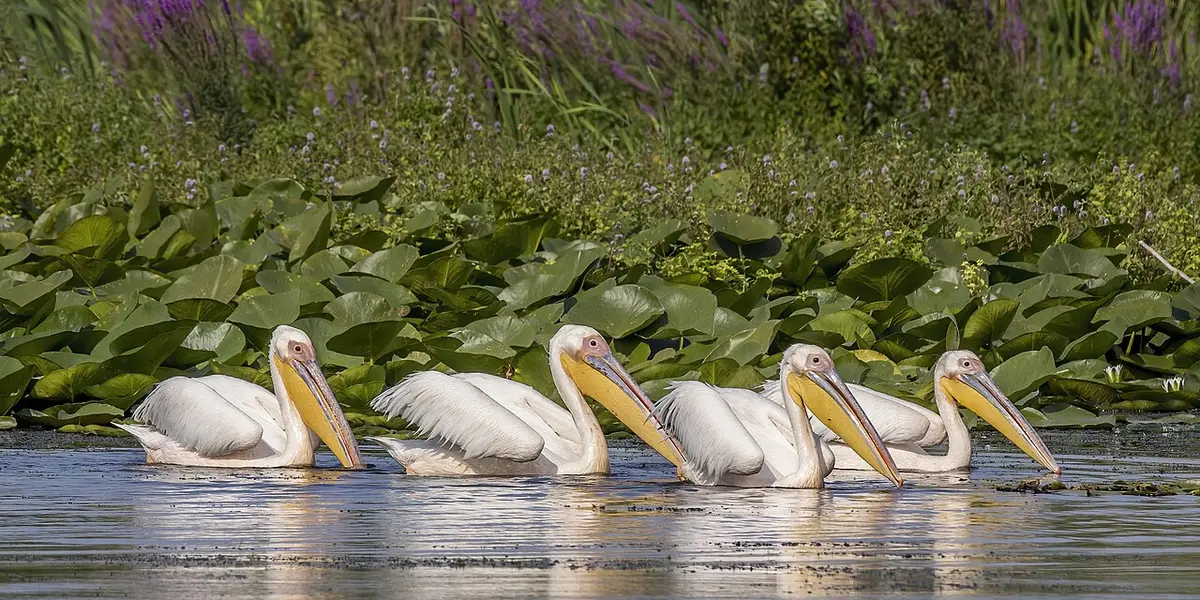
Photo: Charles J. Sharp, CC BY-SA 4.0, source. Resized.

Mammals: hair, milk and different teeth
Mammals have bodies covered in hair, made of keratin, like feathers and scales. Females have mammary glands and feed their young on milk. The chest cavity is separated from the abdominal cavity by the diaphragm, a muscle that inflates the lungs when it contracts; birds have no diaphragm.
Most mammals have differentiated teeth: incisors for cutting, canines for gripping and tearing, premolars and molars for chewing. The shape of the teeth reveals the diet: the wolf has long canines, the roe deer has broad molars for grass, and the squirrel’s incisors grow throughout its life.
By the way their young are born, living mammals form three groups. Monotremes, the platypus and the echidnas of Australia, lay eggs but feed their young on milk. In marsupials, such as the kangaroo, the young is born very small and grows in the pouch, a fold of skin on the mother’s belly. In placental mammals, the group with the most species, which includes humans, the embryo develops in the uterus and receives food through the placenta.
Same environments, different solutions
A bat flies with a membrane of skin stretched between the long fingers of its hand, while a bird flies with a wing made of feathers. Dolphins and whales have fish-like bodies, but they breathe air with lungs and suckle their young. The environment produces similar shapes, and classification is based on the whole set of features.
In ecosystems, these animals have clear roles. The wolf and the owl are predators that keep the numbers of deer and rodents in check. Bats by night and swallows by day eat large numbers of insects. Fruit-eating birds scatter seeds, and some birds and some bats pollinate flowers.
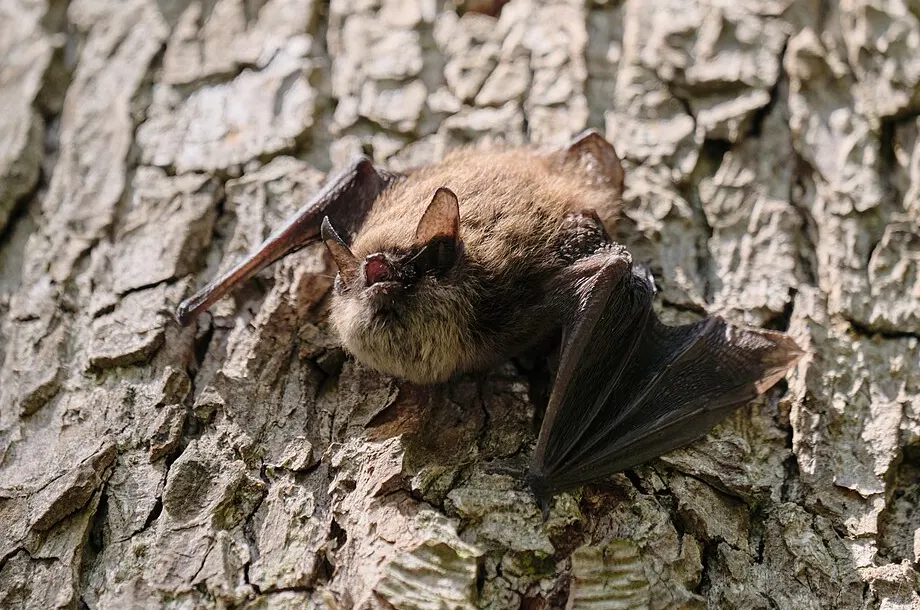
Photo: Toter Alter Mann, CC BY-SA 4.0, source. Cropped and resized.

| Species | Class | Adult mass | Maximum recorded lifespan (years) | Record set | Against the class line (×) |
|---|---|---|---|---|---|
| Human Homo sapiens | mammal | 62.03 kg | 122.5 | captivity | 4.6 |
| Brown bear Ursus arctos | mammal | 277.5 kg | 40 | captivity | 1.2 |
| Grey wolf Canis lupus | mammal | 26.63 kg | 20.6 | captivity | 0.9 |
| Eurasian lynx Lynx lynx | mammal | 23 kg | 26 | captivity | 1.1 |
| Chamois Rupicapra rupicapra | mammal | 37.5 kg | 17.6 | captivity | 0.7 |
| Red deer Cervus elaphus | mammal | 200 kg | 31.5 | captivity | 1.0 |
| European bison Bison bonasus | mammal | 610 kg | 26.4 | captivity | 0.7 |
| Greater mouse-eared bat Myotis myotis | mammal | 28.55 g | 37.1 | wild | 4.6 |
| Brandt’s bat Myotis brandtii | mammal | 7 g | 41 | wild | 6.2 |
| Eurasian shrew Sorex araneus | mammal | 9 g | 3.2 | captivity | 0.5 |
| House mouse Mus musculus | mammal | 20.5 g | 4 | captivity | 0.5 |
| Yellow-necked mouse Apodemus flavicollis | mammal | 29.4 g | 4.5 | captivity | 0.5 |
| African bush elephant Loxodonta africana | mammal | 4.8 t | 65 | captivity | 1.3 |
| Blue whale Balaenoptera musculus | mammal | 136 t | 110 | wild | – |
| Bowhead whale Balaena mysticetus | mammal | 100 t | 211 | wild | – |
| European white stork Ciconia ciconia | bird | 3.35 kg | 39 | wild | 1.3 |
| Great white pelican Pelecanus onocrotalus | bird | 9.52 kg | 51 | captivity | 1.3 |
| Rock dove Columba livia | bird | 358.7 g | 35 | captivity | 1.8 |
| Common carp Cyprinus carpio | fish | 10.6 kg | 47 | captivity | 2.2 |
| Beluga sturgeon Huso huso | fish | 1.14 t | 118 | wild | 2.7 |
| Sebastes aleutianus, a deep-sea fish of the Pacific | fish | 495 g | 205 | wild | 15.0 |
| Long-nosed viper Vipera ammodytes | reptile | 220 g | 22 | captivity | 1.4 |
| Mediterranean spur-thighed tortoise Testudo graeca | reptile | 1.43 kg | 127 | captivity | 6.1 |
| Aldabra giant tortoise Aldabrachelys gigantea | reptile | 117.2 kg | 152 | captivity | 4.0 |
| European fire salamander Salamandra salamandra | amphibian | 19.1 g | 24 | captivity | – |
68 more species with a common name
| Species | Class | Adult mass | Maximum recorded lifespan (years) | Record set | Against the class line (×) |
|---|---|---|---|---|---|
| Greater horseshoe bat Rhinolophus ferrumequinum | mammal | 22.88 g | 30.5 | wild | 3.9 |
| Lesser mouse-eared bat Myotis blythii | mammal | 23 g | 33 | wild | 4.2 |
| Noctule Nyctalus noctula | mammal | 27.75 g | 12 | wild | 1.5 |
| Naked mole-rat Heterocephalus glaber | mammal | 35 g | 31 | captivity | 3.7 |
| Least weasel Mustela nivalis | mammal | 46.9 g | 9.1 | captivity | 1.0 |
| Fat dormouse Glis glis | mammal | 125 g | 8.7 | captivity | 0.9 |
| Norway rat Rattus norvegicus | mammal | 300 g | 3.8 | captivity | 0.3 |
| Black-bellied hamster Cricetus cricetus | mammal | 506.7 g | 3.6 | captivity | 0.3 |
| Eurasian red squirrel Sciurus vulgaris | mammal | 600 g | 14.8 | captivity | 1.1 |
| European pine marten Martes martes | mammal | 1.3 kg | 18.2 | captivity | 1.2 |
| Red fox Vulpes vulpes | mammal | 4.132 kg | 21.3 | captivity | 1.2 |
| European hare Lepus europaeus | mammal | 4.175 kg | 10.7 | captivity | 0.6 |
| Wild cat Felis silvestris | mammal | 5.5 kg | 19 | captivity | 1.0 |
| European otter Lutra lutra | mammal | 6.75 kg | 18.2 | captivity | 1.0 |
| European badger Meles meles | mammal | 13 kg | 18.6 | captivity | 0.9 |
| Western roe deer Capreolus capreolus | mammal | 21.67 kg | 17.5 | captivity | 0.8 |
| Domestic dog Canis familiaris | mammal | 40 kg | 27 | captivity | 1.1 |
| Chimpanzee Pan troglodytes | mammal | 44.98 kg | 68 | captivity | 2.7 |
| Harbour porpoise Phocoena phocoena | mammal | 52.5 kg | 20.4 | captivity | – |
| Wild boar Sus scrofa | mammal | 130 kg | 27 | captivity | 0.9 |
| Bottlenosed dolphin Tursiops truncatus | mammal | 200 kg | 51.6 | captivity | – |
| Horse Equus caballus | mammal | 300 kg | 57 | captivity | 1.7 |
| Giraffe Giraffa camelopardalis | mammal | 800 kg | 39.5 | captivity | 1.0 |
| Asiatic elephant Elephas maximus | mammal | 3.178 t | 79.6 | captivity | 1.7 |
| Hippopotamus Hippopotamus amphibius | mammal | 3.75 t | 61.2 | captivity | 1.2 |
| Ruby-throated hummingbird Archilochus colubris | bird | 3.1 g | 9.1 | wild | 1.3 |
| European robin Erithacus rubecula | bird | 17.3 g | 19.3 | wild | 2.0 |
| Great tit Parus major | bird | 17.9 g | 15.4 | wild | 1.5 |
| Barn swallow Hirundo rustica | bird | 18.3 g | 16 | not recorded | 1.6 |
| House sparrow Passer domesticus | bird | 25.3 g | 23 | not recorded | 2.1 |
| Budgerigar Melopsittacus undulatus | bird | 30 g | 21 | captivity | 1.9 |
| Common swift Apus apus | bird | 37.6 g | 21.1 | wild | 1.8 |
| European starling Sturnus vulgaris | bird | 74 g | 22.9 | wild | 1.7 |
| Common blackbird Turdus merula | bird | 103.2 g | 21.8 | wild | 1.5 |
| Red junglefowl (the ancestor of the chicken) Gallus gallus | bird | 779.8 g | 30 | captivity | 1.3 |
| Common raven Corvus corax | bird | 1.041 kg | 69 | captivity | 2.9 |
| Eurasian eagle-owl Bubo bubo | bird | 2.686 kg | 68 | captivity | 2.3 |
| Western capercaillie Tetrao urogallus | bird | 2.95 kg | 18 | captivity | 0.6 |
| Greylag goose Anser anser | bird | 3.308 kg | 31 | captivity | 1.0 |
| Great cormorant Phalacrocorax carbo | bird | 3.629 kg | 32.1 | wild | 1.0 |
| Golden eagle Aquila chrysaetos | bird | 4.8 kg | 48 | captivity | 1.5 |
| Common crane Grus grus | bird | 5.5 kg | 43 | wild | 1.3 |
| White-tailed sea-eagle Haliaeetus albicilla | bird | 6.697 kg | 42 | captivity | 1.2 |
| Wandering albatross Diomedea exulans | bird | 7.047 kg | 50 | wild | 1.4 |
| Mute swan Cygnus olor | bird | 8.3 kg | 40 | wild | 1.1 |
| Ostrich Struthio camelus | bird | 111 kg | 50 | captivity | 0.8 |
| Slow worm Anguis fragilis | reptile | 11.65 g | 54 | captivity | 5.1 |
| European green lizard Lacerta viridis | reptile | 21.5 g | 10 | not recorded | 0.9 |
| European grass snake Natrix natrix | reptile | 96.25 g | 20 | captivity | 1.4 |
| Northern palaearctic viper Vipera berus | reptile | 279 g | 19 | captivity | 1.1 |
| Reticulated python Python reticulatus | reptile | 32 kg | 29.4 | captivity | 0.9 |
| Nile crocodile Crocodylus niloticus | reptile | 94.2 kg | 56 | captivity | 1.5 |
| American alligator Alligator mississippiensis | reptile | 150 kg | 77 | captivity | 1.9 |
| Green sea turtle Chelonia mydas | reptile | 160 kg | 75 | not recorded | 1.9 |
| Plethodon cinereus, an eastern red-backed salamander from North America | amphibian | 0.5 g | 25 | wild | – |
| Olm, a cave-dwelling amphibian Proteus anguinus | amphibian | 17 g | 102 | wild | – |
| Eurasian perch Perca fluviatilis | fish | 2.612 kg | 22 | wild | 1.3 |
| European eel Anguilla anguilla | fish | 3.629 kg | 88 | captivity | 4.8 |
| Sterlet Acipenser ruthenus | fish | 8.8 kg | 46.1 | captivity | 2.2 |
| Zander Sander lucioperca | fish | 11 kg | 16 | wild | 0.7 |
| Northern pike Esox lucius | fish | 15.62 kg | 30 | wild | 1.3 |
| Atlantic salmon Salmo salar | fish | 25.74 kg | 13 | wild | 0.5 |
| Star sturgeon Acipenser stellatus | fish | 44 kg | 27 | wild | 1.0 |
| Russian sturgeon Acipenser gueldenstaedtii | fish | 63.25 kg | 46 | wild | 1.6 |
| Acipenser fulvescens, a lake sturgeon from North America | fish | 70 kg | 152 | wild | 5.3 |
| Sheatfish Silurus glanis | fish | 168.3 kg | 60 | captivity | 1.8 |
| Great white shark Carcharodon carcharias | fish | 1.87 t | 50 | wild | 1.1 |
| Whale shark Rhincodon typus | fish | 18.7 t | 54 | wild | 0.8 |
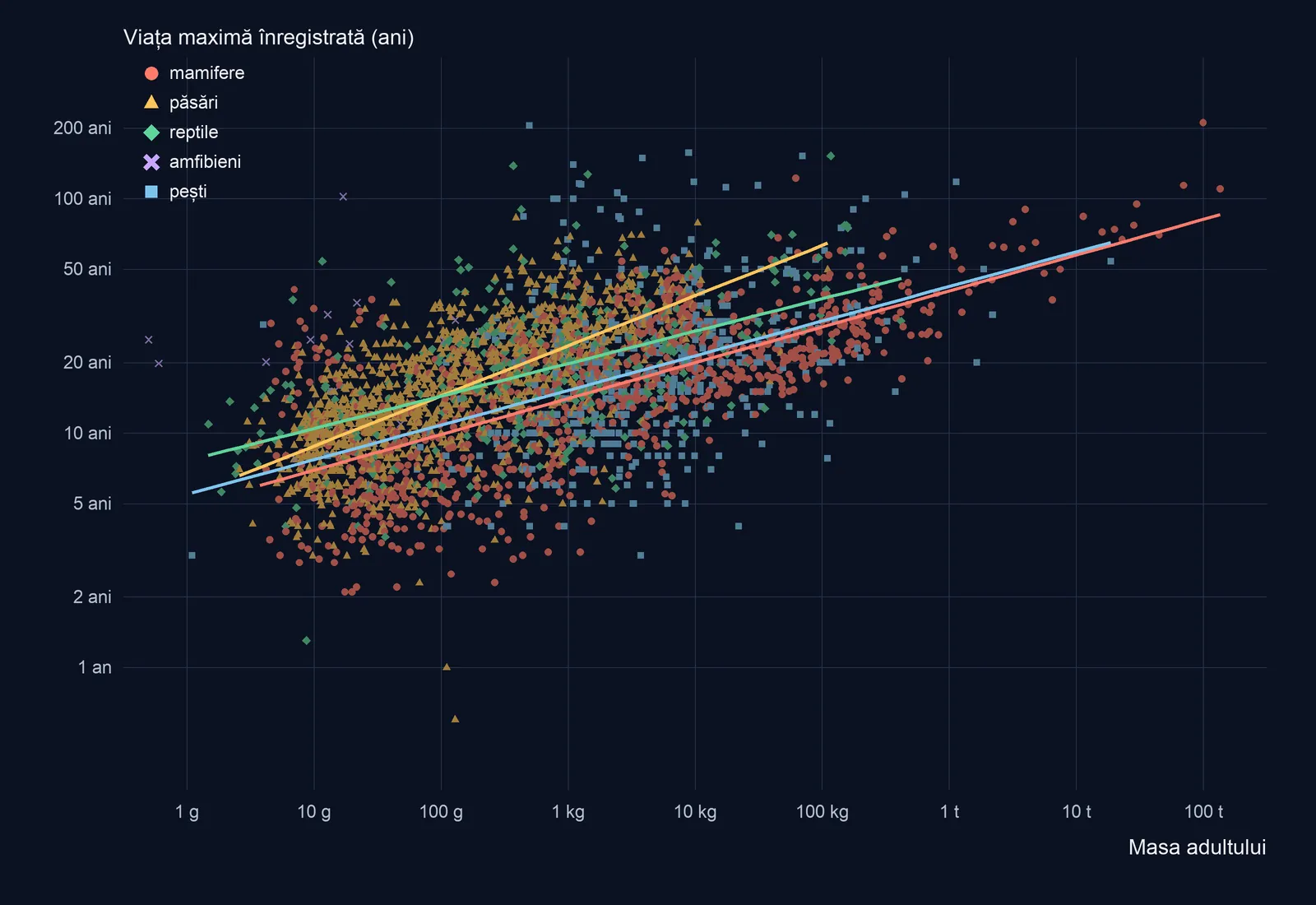
All 3,123 species, by class
| Class | Species | Mass | Maximum lifespan (years) | Trend line |
|---|---|---|---|---|
| Mammals | 997 | 3.77 g – 136 t | 2.1 – 211 | t = 4.88 · M0.153 (AnAge) |
| Birds | 1,330 | 2.6 g – 111 kg | 0.6 – 83 | t = 5.37 · M0.214 |
| Reptiles | 355 | 1.475 g – 420 kg | 1.3 – 152 | t = 7.61 · M0.138 |
| Amphibians | 18 | 0.5 g – 358.1 g | 7.8 – 102 | no line drawn (too few species) |
| Fish | 423 | 1.1 g – 18.7 t | 3 – 205 | t = 5.48 · M0.148 |
Species with a recorded lifespan but no mass in AnAge (not on the chart): European frog (27 years), brown trout (38 years), Greenland shark (392 years), European pond turtle (120 years), common European toad (40 years), yellow-bellied toad (29 years), northern crested newt (28 years), marsh frog (11 years).
Data: AnAge, Build 15 (Human Ageing Genomic Resources; Tacutu et al. 2013, de Magalhães et al. 2024), licence CC BY 3.0; filtered by quality and grouped into school classes.
Measurements and calculation. Each dot is a species from AnAge, Build 15, with its adult mass, its maximum recorded lifespan and data quality “acceptable” or “high” by AnAge’s criteria: 3,123 species, all vertebrates (AnAge’s invertebrate species have no adult mass). The lifespan is the species’ record, not its usual lifespan; 50% of the records come from captivity. The mammal line is the equation published by AnAge, t = 4.88 · M0.153 (without cetaceans); the lines for birds, reptiles and fish are calculated by least squares on the points on the chart; no line is drawn for amphibians. The four lampreys (cyclostomes) are counted with the fish. Data: AnAge, Human Ageing Genomic Resources, licence CC BY 3.0.
Sources and credits. Data: AnAge, The Animal Ageing and Longevity Database, Build 15, Human Ageing Genomic Resources (Tacutu et al. 2013 and de Magalhães et al. 2024, Nucleic Acids Research), dataset: source; licence CC BY 3.0, licence text: source; changes: only species with an adult mass, a maximum lifespan and data quality “acceptable” or “high” were kept, the classes were grouped into school groups, Romania markers were added, and the trend lines for birds, reptiles and fish were calculated from these data.
Worked example
Bat, penguin, dolphin, platypus
Four animals seem to break the rules. For each one, look for the features that do not depend on the environment.
The bat flies, but it has hair and teeth and suckles its young, so it is a mammal. The penguin cannot fly, but it has feathers and a beak and lays eggs with a chalky shell, so it is a bird. The dolphin lives in water, but it breathes with lungs and suckles its young, so it is a mammal. The platypus lays eggs, but it has fur and produces milk, so it is a mammal, a monotreme.
The rule that follows: feathers are enough to recognise a bird, and milk is enough to recognise a mammal. Flying, swimming or laying eggs is not enough.
Activity: take a chicken or pigeon feather. Split apart the fine strands on one side of the shaft with your fingernail, then draw them gently between your fingers: they hook back together, because they have microscopic hooks.
In Romania
The Delta’s pelicans and the bats of the caves
The great white pelican (Pelecanus onocrotalus) nests in the Danube Delta in a colony that is hard to reach, around lakes Hrecișca and Buhaiova. The drone count in 2016 found around 17,000 pairs, about four times more than earlier estimates for Romania, of 4,100–4,500 pairs. Researchers link the large colony to how undisturbed the place is and to the good nesting sites.
Bats are the only mammals capable of powered flight. Romania has 32 species of bats; Britain has 17, and Norway 10. Some Romanian caves are home to more than 20 species of bats. Romania’s bats feed mainly on insects, so a large colony eats a great many mosquitoes and moths every night.
In short
- Birds and mammals are homeothermic: they make their heat from food, keep it in with feathers or hair and have a four-chambered heart.
- Birds have feathers, wings, hollow bones, a toothless beak, air sacs connected to the lungs, a crop and a gizzard; they lay eggs with a chalky shell and incubate them.
- Mammals have hair, mammary glands, a diaphragm and, usually, differentiated teeth (incisors, canines, premolars, molars).
- Living mammals are monotremes (they lay eggs), marsupials (the young grows in a pouch) and placental mammals (the embryo is fed through the placenta).
- An animal is classified by its whole set of features: the bat and the dolphin are mammals, the penguin and the ostrich are birds.
Common mistakes
WrongA bat is a bird, because it flies.
RightA bat has hair and teeth and suckles its young, so it is a mammal. Its wing is a membrane of skin between its fingers, with no feathers.
WrongAll mammals give birth to live young.
RightThe platypus and the echidnas lay eggs, but they are mammals: they have hair and feed their young on milk.
WrongA whale is a big fish.
RightA whale breathes air with lungs, is homeothermic and suckles its calf, so it is a mammal adapted to life in water.
Check yourself
Seven questions. For the first six you see the explanation at once, with the paragraph of the lesson that supports it; for the written ones you compare with a good answer.
Which feature is found only in birds?
Answer
b) Feathers. Reptiles also lay shelled eggs, bats and insects also fly, and mammals also have a four-chambered heart. Only birds have feathers.
Why does a homeothermic animal need more food than a reptile of the same size?
Answer
b) Because it makes its heat by burning food in its cells. Body heat comes from burning food; a reptile takes its heat from the sun and its surroundings, so it gets by on less food.
The platypus lays eggs. Why is it still a mammal?
Answer
c) Because it has hair and feeds its young on milk. Milk and hair are mammal features. Eggs do not make it a bird: monotremes are mammals that lay eggs.
What do a bird’s air sacs do?
Answer
b) Make air pass through the lungs in one direction and lighten the body. The air sacs are connected to the lungs and fill the spaces between the organs; air crosses the lungs in one direction only. Food is stored in the crop.
The 2016 drone count found around 17,000 pairs of great white pelicans, and the earlier estimate for Romania was 4,100–4,500 pairs. How many times larger is the new figure than the middle of the old range (4,300)? Round to one decimal place.
timesAnswer
4 times. 17,000 ÷ 4,300 ≈ 3.95, which is about 4. That is why the authors say the figure is four times higher.
Put each feature with the group it belongs to.
Answer
Birds: Hollow bones; A gizzard that grinds food; Chalky-shelled eggs, incubated.
Mammals: Diaphragm; Mammary glands; Incisors, canines, premolars and molars.
The diaphragm, mammary glands and differentiated teeth are mammal features; hollow bones, the gizzard and the egg with a chalky shell are bird features.
A classmate says: ‘The dolphin lives in water, has fins and a long body, so it is a fish.’ What arguments would you use to convince them that the dolphin is a mammal?
A good answer
The dolphin breathes air with lungs and comes up to the surface to breathe, while a fish breathes through gills. It is homeothermic, and the female gives birth to live young and suckles them with milk from mammary glands. The fish-like shape is an adaptation to swimming, and classification is based on the whole set of features.
A complete answer names at least two mammal features (lungs, milk, mammary glands, homeothermy) and explains that body shape reflects the environment, not relatedness.
Practical work for this lesson
- Identify the example and keep the exception – Case study on characters, 30–35 minutes
Terms
- homeotherms
- Animals that keep their body temperature almost constant by making heat from food.
- hollow bones
- Bones that are empty inside, strengthened by thin struts, which lighten a bird’s body; also called pneumatic bones.
- air sacs
- Air-filled pouches connected to a bird’s lungs, which make air cross the lungs in one direction only.
- gizzard
- The muscular stomach of birds, in which food is ground up.
- mammary glands
- Glands in mammals that produce the milk on which the young are fed.
- diaphragm
- A muscle that separates the chest cavity from the abdominal cavity in mammals and helps with breathing.
- differentiated teeth
- Teeth of different shapes, incisors, canines, premolars and molars, each with its own job.
- monotremes
- Mammals that lay eggs and feed their young on milk, such as the platypus and the echidnas.
Sources and link to the programme
- OpenStax – Biology 2e, 29.5 Birds – homeothermic birds, contour feathers and down, pneumatic bones (not in all birds), air sacs, the keel of the sternum, toothless keratin beak, the flightless ostrich
- OpenStax – Biology 2e, 29.6 Mammals – hair of keratin, mammary glands, diaphragm absent in birds, heterodont teeth, egg-laying monotremes (the platypus and four species of echidna), marsupials with a pouch, placental mammals; the four-chambered heart arose independently in birds and mammals
- Mackelprang, Goller (2013), Journal of Experimental Biology 216: 3611–3619 – Ventilation patterns of the songbird lung/air sac system – on breathing in, air enters mainly the rear sacs, and air from the lung moves into the front sacs; on breathing out, air from the rear sacs passes through the lung, and air from the front sacs leaves through the trachea
- OpenStax – Biology 2e, 39.3 Breathing – birds’ air sacs and one-way airflow through the lungs; the diaphragm in mammals
- OpenStax – Biology 2e, 40.1 Overview of the Circulatory System – the four-chambered heart in birds and mammals, complete separation of oxygenated and deoxygenated blood
- OpenStax – Biology 2e, 29.4 Reptiles – reptiles get by on about 10% of the food needed by an endothermic animal of the same size
- OpenStax – Biology 2e, 34.1 Digestive Systems – the crop and gizzard of birds
- Marinov et al. (2017), Scientific Annals of the Danube Delta Institute – Monitoring the Great White Pelican breeding population using drones in the Danube Delta (abstract on DOAJ) – the great white pelican colony in the Danube Delta: 17,000 pairs in 2016 (15,000–19,000), four times the earlier estimate for Romania (4,100–4,500), lakes Hrecișca and Buhaiova, the role of remoteness and of nesting sites
- Asociația pentru Protecția Liliecilor din România (CBRC) – Bats of Romania – 32 bat species in Romania, 17 in Britain, 10 in Norway; caves with more than 20 species
- IPBES (2016) – Summary for policymakers, Pollinators, pollination and food production – pollinators include birds and bats
From the programme: “Vertebrates: fish, amphibians, reptiles, birds, mammals - general characteristics – comparative overview (morphology, nutrition, relation, reproduction), examples of representative species, habitats, importance in ecosystems” (common core). Specific competences addressed: 1.1, 1.2, 2.2.