
Chapter 8 · AnimalsLesson 8.1
Sponges and cnidarians: how an animal lives without organs
How can a sponge count as an animal when the adult sits stuck to a rock, with no mouth, no stomach and no muscles?
- Size
- from 1 mm to 30 m
- Level
- organism
- Time
- hundreds of millions of years
Before you read: what do you think?
A hydra touches a water flea with a tentacle and paralyses it with a stinging cell. How long does that cell take to fire?
See the answer
Less than a millionth of a second. Filmed at 1,430,000 frames per second, the discharge of a hydra’s stinging capsule took just 700 nanoseconds. It is one of the fastest movements ever measured in a living organism.
A sponge has no mouth, stomach, muscles or nerves, and the adult stays fixed in one spot. It is still an animal: it feeds on other organisms, and its cells have no cell wall. Hydras and jellyfish go a step further: they have a cavity in which they digest their prey, and cells that paralyse it on contact.
Sponges: a body with water flowing through it
A sponge’s body looks like a sack full of holes. Water enters through thousands of pores in the wall, reaches a central cavity and leaves through a large opening at the top called the osculum. Most sponges have no symmetry: their body cannot be divided into similar halves.
The current of water is driven by choanocytes, cells that line the cavity. Each choanocyte has a flagellum surrounded by a collar. The beating flagella pull water in through the pores, and the collars trap food particles: bacteria, microscopic algae, organic debris. That is why sponges are filter feeders. Digestion takes place inside the cells.
The same water brings oxygen and carries away carbon dioxide and wastes, by diffusion from one cell to the next. The body is held up by spicules, tiny mineral needles, and by fibres of spongin, an elastic protein.
A sponge’s cells divide up the work, but they do not form true tissues, let alone organs. For this reason sponges are considered the animals with the simplest organisation.
How sponges reproduce
Most sponges are hermaphrodites: the same individual makes both eggs and sperm. The egg hatches into a larva with flagella that swims freely, settles on a surface and becomes a new sponge. The adult never moves again.
Sponges also reproduce asexually, by fragmentation (a broken-off piece grows into a whole sponge) and by budding. Freshwater sponges, such as the lake sponge (Spongilla lacustris), make gemmules: clusters of cells sealed in a tough coat that survive the winter or a drought and grow into a new sponge when conditions improve. Most sponge species live in the sea; only a few live in rivers and lakes.
Cnidarians: two layers of cells and a cavity for food
School textbooks call hydras, jellyfish, sea anemones and corals coelenterates. The name is historical; biologists today call them cnidarians, after their stinging cells. Like any school group, the name gathers animals by visible similarities and does not always match a branch of the tree of life.
Cnidarians are diploblastic: their body forms from two germ layers, which give an outer layer, the epidermis, and an inner one that lines the digestive cavity. Between them lies a jelly-like substance, the mesoglea, which is very thick in jellyfish. They have radial symmetry: like a wheel, the body can be cut into similar halves along several planes through the centre.
Inside is the gastrovascular cavity, with a single opening that serves as both mouth and anus. Prey is digested first in the cavity, by enzymes, and then inside the cells that line it. The mouth is ringed by tentacles armed with cnidocytes, stinging cells. Each cnidocyte has a capsule from which, at a touch, a thread shoots out that pierces and injects a toxic substance. The nerves form a net spread through the whole body, with no brain. Oxygen passes in by diffusion.
The polyp and the medusa
Cnidarians have two body forms. The polyp is a tube fixed to a surface, with its mouth and tentacles pointing up. The medusa is a floating bell, with its mouth and tentacles pointing down.
The freshwater hydra lives in ponds and lakes and exists only as a polyp. It reproduces mainly by budding: a bud grows on its body, forms tentacles and breaks off as a new hydra. It also reproduces sexually, and pieces cut from it can rebuild a whole animal, a process called regeneration.
The moon jellyfish (Aurelia aurita) goes through both forms. Adult jellyfish reproduce sexually; the egg hatches into a larva that settles and becomes a polyp. The polyp buds off small medusae, which grow and float free. Sea anemones and corals are polyps only and live in the sea. Many corals form colonies, and microscopic algae live inside their cells, exchanging substances with them. Cnidarians are predators: sea anemones, for instance, catch shrimps and small fish with their tentacles.
For the curious
Hydra regeneration was described in 1744 by the naturalist Abraham Trembley. To find out whether the polyp was an animal or a plant, he cut it in two and was surprised to see each half grow into a complete polyp. Only the way the polyp moved, step by step, convinced him it was an animal.
A hydra’s stinging capsule fires in 700 nanoseconds, with an acceleration up to 5,410,000 times that of free fall. The measurement was published in 2006, after filming at 1,430,000 frames per second.
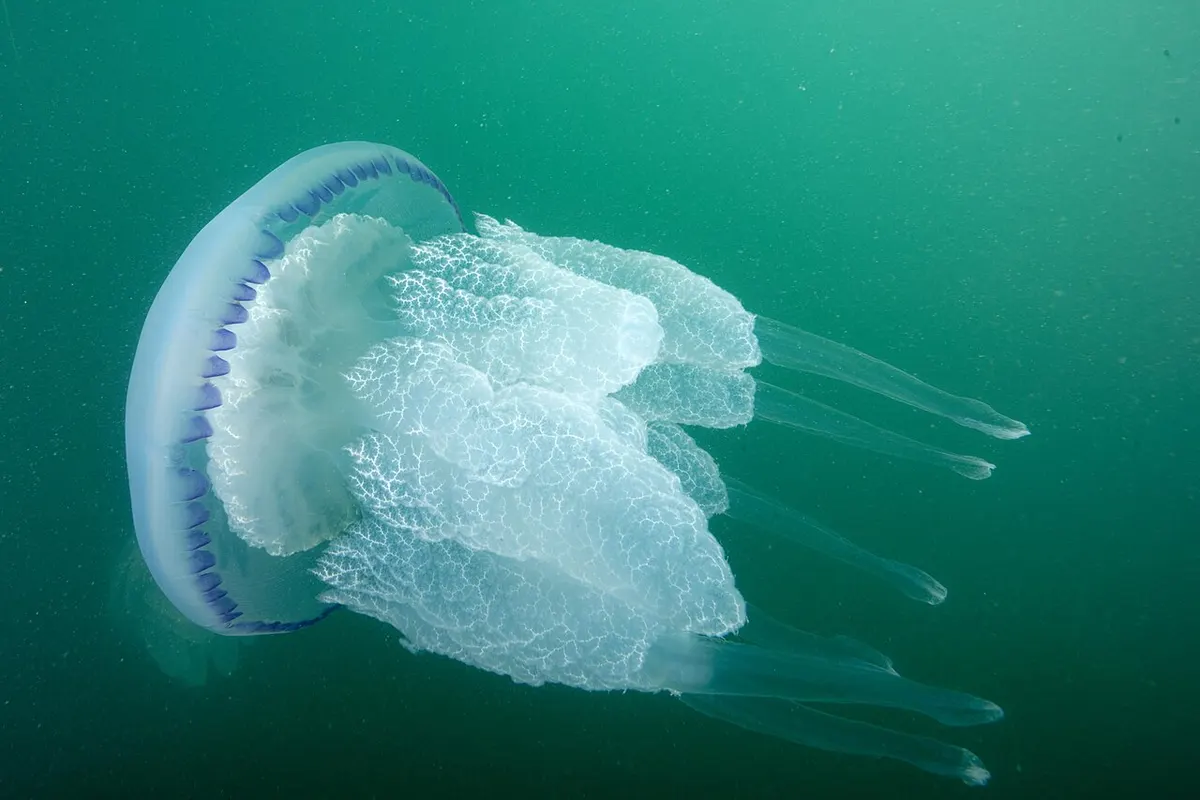
Photo: Olivier Dugornay (IFREMER), CC BY 4.0, source. Resized.

Worked example
Four animals, two groups
You are given four descriptions. A: an animal fixed to a stone in a river, its body full of holes, with no tentacles. B: a small pond animal shaped like a tube, with tentacles around the mouth and a bud on one side. C: a transparent bell floating in the sea, with tentacles around the rim. D: a fixed marine animal with many coloured tentacles around its mouth, living alone, with no skeleton shared with others.
Step 1: look for pores and a current of water. Only A has a body riddled with pores and no tentacles, so A is a sponge.
Step 2: look for tentacles and a cavity with a single opening. B, C and D have them, so they are cnidarians.
Step 3: work out the form. B and D are fixed, mouth up, so they are polyps: B is a budding hydra, D is a sea anemone. C floats mouth down, so it is a medusa.
The conclusion rests on a combination of features. Staying fixed does not on its own tell you which group an animal belongs to: A and D both stay put and belong to different groups.
In Romania
Black Sea jellyfish and Danube sponges
Two large jellyfish live off the Romanian coast. The moon jellyfish (Aurelia aurita), with its transparent bell, had the largest biomass of the four jelly-like species tracked in Romanian waters in 2021 by researchers from the ‘Grigore Antipa’ Institute in Constanța, a marine research institute. The barrel jellyfish (Rhizostoma pulmo), the largest jellyfish in the Black Sea, turns up in large numbers near the shore at the end of summer, in August and September. Like all cnidarians it has cnidocytes, which is why you should not touch it.
Sponges also live in Romania’s fresh waters, though they are easy to miss, looking like crusts on stones and wood. During the 2013 international expedition along the Danube, sponges were found on the Romanian stretch of the river too, and at Hârșova, a town on that stretch, a species rare in the Danube was identified. The commonest sponges in the Danube belong to the species Ephydatia fluviatilis, a close relative of the lake sponge.
In short
- Adult sponges are fixed, most of them have no symmetry, no true tissues and no organs; water enters through pores and leaves through the osculum.
- Choanocytes, cells with a flagellum and a collar, create the current of water and trap food: sponges are filter feeders, with digestion inside the cells.
- Sponges reproduce sexually (a swimming larva) and asexually (fragmentation, budding, and gemmules in freshwater species such as Spongilla lacustris).
- Cnidarians are diploblastic and have radial symmetry, a gastrovascular cavity with a single opening and tentacles with cnidocytes (stinging cells).
- Cnidarians have two forms: the fixed polyp (hydra, sea anemone, corals) and the floating medusa (Aurelia aurita); the hydra reproduces by budding and can regenerate.
Common mistakes
WrongA sponge is a plant or an alga, because it does not move.
RightA sponge is an animal: it feeds on other organisms, its cells have no cell wall and its larva swims. The adult staying fixed does not make it a plant.
WrongThe medusa and the polyp are two different species.
RightIn many cnidarians, such as Aurelia aurita, the polyp and the medusa are forms of the same species at different stages of its life. The hydra exists only as a polyp.
WrongThe hydra has a stomach and an intestine, with a separate mouth and anus.
RightThe hydra has a single cavity, the gastrovascular cavity, with a single opening: food goes in and undigested remains come out through the same opening.
Check yourself
Six questions. For the first five you see the explanation at once, with the paragraph of the lesson that supports it; for the written ones you compare with a good answer.
What do a sponge’s choanocytes do?
Answer
b) Create the current of water and trap food particles. Choanocytes have a flagellum that moves the water and a collar that traps food. The venomous thread belongs to the cnidocytes of cnidarians, and sponges have no blood vessels.
How do undigested remains leave a hydra’s body?
Answer
c) Through the same opening that food comes in by. The gastrovascular cavity of cnidarians has a single opening, which is both mouth and anus. Pores are a feature of sponges.
Which statement about the freshwater hydra is correct?
Answer
b) It exists only as a polyp and reproduces mainly by budding. The hydra is a freshwater cnidarian that stays a polyp all its life. It reproduces by buds and can regenerate from pieces.
What does it mean that cnidarians are diploblastic?
Answer
c) Their body forms from two germ layers. ‘Diploblastic’ refers to the two germ layers from which the body forms. The polyp and the medusa are body forms, and the cavity has a single opening.
Choose the group each feature belongs to.
Answer
Sponges: Body with pores and an osculum; Choanocytes with a flagellum and collar; Gemmules that survive the winter.
Cnidarians: Tentacles with cnidocytes; Radial symmetry; Polyp and medusa forms.
Pores, choanocytes and gemmules belong to sponges. Cnidocytes, radial symmetry and the two body forms are features of cnidarians.
A pond dries out every summer, and in autumn, when it fills with water again, lake sponges reappear on the same stones. Explain where they come from, using what you know about how freshwater sponges reproduce.
A good answer
Before the drought, the sponges made gemmules, clusters of cells sealed in a tough coat. The gemmules stayed on the stones through the drought while the adult sponges died. When the water returned, a new sponge grew from each gemmule. This is asexual reproduction that lets the sponge survive unfavourable periods.
A complete answer names gemmules, says that they withstand harsh conditions and that new sponges form from them when conditions improve.
Terms
- osculum
- The large opening at the top of a sponge’s body, through which water leaves.
- choanocyte
- A sponge cell with a flagellum surrounded by a collar, which moves water and traps food.
- gemmule
- A cluster of cells with a tough coat, made by freshwater sponges, from which a new sponge forms.
- diploblastic
- Describes an animal whose body forms from two germ layers.
- radial symmetry
- An arrangement of body parts around a centre, so that the body can be cut into similar halves along several planes.
- gastrovascular cavity
- The digestive cavity of cnidarians, with a single opening that is both mouth and anus.
- cnidocyte
- A stinging cell of cnidarians, with a capsule from which a thread shoots out and pierces the prey.
- budding
- Asexual reproduction in which a new individual grows on the parent’s body and then breaks off or stays in the colony.
Sources and link to the programme
- OpenStax – Biology 2e, 28.1 Phylum Porifera – pores, osculum, central cavity, flagellated choanocytes that pull water in and trap food, intracellular digestion, diffusion, spicules and spongin, absence of true tissues, fixed adults, hermaphroditism, swimming larva, fragmentation and budding, gemmules in freshwater sponges
- OpenStax – Biology 2e, 27.2 Features Used to Classify Animals – sponges are asymmetrical; cnidarians have radial symmetry and are diploblastic
- OpenStax – Biology 2e, 28.2 Phylum Cnidaria – cnidocytes and nematocysts, two germ layers and mesoglea, gastrovascular cavity with a single opening, extracellular digestion, nerve net, diffusion, polyp and medusa, life cycle with a planula, polyps and medusae produced by budding, the hydra exists only as a polyp, sea anemones and corals only as polyps, symbiotic algae in corals
- Lander University, Invertebrate Anatomy OnLine – Hydra – the hydra is a freshwater cnidarian, polyp only, with budding and gonads
- Nüchter et al., Current Biology 16 (2006) – Nanosecond-scale kinetics of nematocyst discharge – nematocyst discharge in the hydra in 700 ns, acceleration up to 5,410,000 g, filming at 1,430,000 frames per second
- Arizona State University, Embryo Project – Regeneration – Abraham Trembley’s regeneration experiments on the hydra, published in 1744
- Harcotă et al., Annals on Biology, Academia Oamenilor de Știință din România (2022) – Black Sea macrozooplankton in 2021 – Aurelia aurita dominated the biomass of gelatinous macrozooplankton in Romanian waters in the two 2021 expeditions (authors from the ‘Grigore Antipa’ National Institute for Marine Research and Development)
- Newsweek România (30 July 2024) – jellyfish in the Black Sea, according to the Grigore Antipa Institute – Rhizostoma pulmo, the largest jellyfish in the Black Sea, turns up in large numbers near the shore at the end of summer (August–September)
- Avian et al. (2022), PLOS ONE 17(8): e0272023 – A novel endocast technique… in Rhizostoma pulmo – in adult Rhizostoma pulmo the central mouth is ‘almost sealed’; food enters through openings on the oral arms
- Pesterau, Sirbu, Cadar, European Journal of Medicine and Natural Sciences (2024) – Rhizostoma pulmo is native to the Black Sea basin
- Andjus et al., Journal of Limnology 77 (2018) – Freshwater sponges in the Danube and Sava rivers – sampling in Joint Danube Survey 3 (2013); sponges also found on the Romanian stretch of the Danube; Trochospongilla horrida at Hârșova; Ephydatia fluviatilis is the predominant species in the Danube (about 80% of samples); Spongilla lacustris present in the basin
From the programme: “Animals. Invertebrates: sponges, cnidarians (coelenterates), worms (flat, round, segmented), molluscs (snails, bivalves, cephalopods), arthropods (arachnids, crustaceans, insects) - general characteristics – comparative overview (morphology, nutrition, relation, reproduction), examples of representative species, habitats, importance in ecosystems” (common core). Specific competences addressed: 1.1, 1.2, 2.2.