Chapter 7 · PlantsLesson 7.6CS
Communication between plants: chemical signals, mycorrhizae and what has been proved so far
An article says that trees “talk” to each other through a network of fungi. What did researchers actually measure?
- Size
- from 1 mm to 62.5 m
- Level
- organism
- Time
- hundreds of millions of years
Before you read: what do you think?
In 2023, three researchers checked the claim that old trees send food and defence signals through fungi mainly to their own seedlings. What published evidence did they find?
See the answer
None. The review by Karst, Jones and Hoeksema, published in Nature Ecology & Evolution, found that the claim has no published, peer-reviewed evidence, even though it turns up often in popular books and articles.
In a 1983 experiment, poplar seedlings had some of their leaves torn off. Within two days, their leaves held more substances that can make feeding harder for insects. The same change appeared in the undamaged poplars kept in the same enclosure, as if something had passed from the wounded plants to the intact ones.
What “communication” means for plants
In biology, communication between plants means that a substance released by one plant measurably changes the activity of another plant. The plant releasing the substance has no intention, and the plant responding “understands” nothing: certain molecules switch on the production of other substances in its cells. To make such a claim, three things have to be shown: what substance was released, what changed in the neighbouring plant and by what route the substance got there.
Signals through the air: what experiments have shown
In 1983, Ian Baldwin and Jack Schultz tore off 7% of the foliage of some poplar seedlings. Within 52 hours, their leaves held more phenolic compounds, substances that make feeding harder for insects; so did the undamaged poplars in the same enclosure. The experiment had flaws in its method and was not accepted as firm proof.
In 2000, Richard Karban and colleagues clipped branches of sagebrush in the wild. The clipped sagebrush released a volatile compound, a form of methyl jasmonate. Wild tobacco plants next to it had their leaves eaten far less by grasshoppers and caterpillars, for three seasons, than plants next to unclipped sagebrush. A barrier that blocked contact through the soil did not change the result; one that blocked the air cancelled it. So the substance travelled through the air.
Plants under attack can also attract the attackers’ enemies. Maize chewed by caterpillars releases volatile compounds, and a parasitic wasp learns to find the caterpillars by this smell.
Allelopathy: substances that hold back the neighbours’ growth
Allelopathy is the effect a plant has on the plants around it through substances it releases. The classic example is the black walnut (Juglans nigra): its buds, nut hulls and roots contain juglone, which in the laboratory stops many plants, such as tomatoes, from germinating and growing. The common walnut in Romania (Juglans regia) also produces juglone, but in relatively small amounts. In the garden, the evidence is weaker: lists of sensitive plants are based on observation, and in the soil juglone is bound to particles and broken down by microorganisms. Healthy plants grow under many walnut trees.
Through fungi: what has been measured and what is disputed
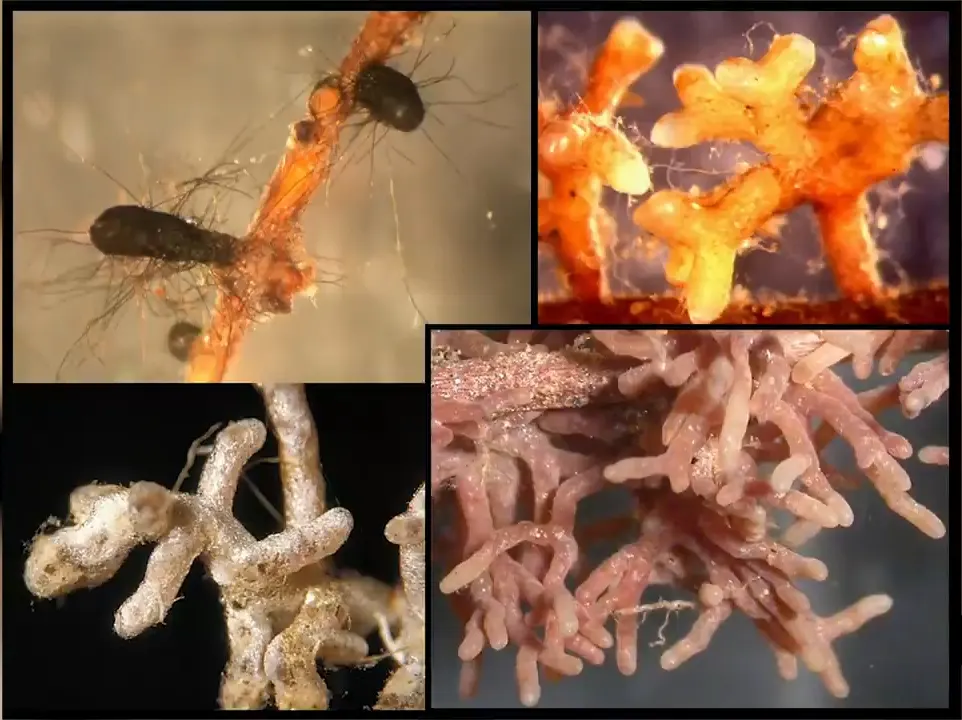
The roots of most plants live in partnership with fungi, an association called mycorrhiza. The fungus receives sugars from the plant, and the plant receives mainly phosphates and other mineral salts, gathered by the fungal hyphae from a larger volume of soil. The hyphae of a single fungus can link the roots of several plants: this is a common mycorrhizal network.
In 1997, Suzanne Simard and colleagues labelled young birch and Douglas fir trees in the field with forms of carbon that are easy to trace (isotopes). Carbon moved in both directions, and the Douglas fir’s net gain was, on average, 6% of the labelled carbon it had fixed by photosynthesis. The size of the gain changed when the Douglas fir was shaded. Nearby thuja seedlings, which did not form the same type of mycorrhiza, received very little labelled carbon, which, according to the authors, suggests that the transfer happened mainly through hyphae. The 2023 review shows, however, that field results like these can have other explanations too, such as a route through the soil.
In 2013, Zdenka Babikova and colleagues grew broad bean plants linked by mycorrhiza. When aphids fed on one of them, the unattacked plants linked to it by hyphae released volatile compounds that repelled aphids and attracted the wasps that parasitise them. The result comes from a pot experiment with a single plant species.
In 2023, Justine Karst, Melanie Jones and Jason Hoeksema reviewed three popular claims. The idea that common networks are widespread in forests and the idea that transfer through them helps seedlings have insufficient evidence: field results vary widely and have other explanations too. For the idea that old trees send food and signals mainly to their own seedlings there is not a single published, peer-reviewed study.

Worked example
How Karban found the route the substance takes
The hypothesis: tobacco next to clipped sagebrush is eaten less because it receives a substance from the sagebrush. Two routes are possible: through the air or through the soil.
Step 1: a barrier in the soil is placed between the sagebrush and the tobacco. The difference in leaf damage remains, so the soil is not needed. Step 2: a barrier that blocks the air is put in place. The difference disappears, so the air is needed. Step 3: another explanation was that the tobacco got more light after the sagebrush was clipped; the researchers showed that light did not explain the result.
The conclusion is limited to what was tested: clipped sagebrush, wild tobacco and the insects at that site. For other species, the experiment has to be repeated.
In Romania
The walnut in the yard and the old-growth beech forests
If tomatoes planted under the walnut in your yard grow worse than those in the middle of the garden, juglone is a possible explanation, but the laboratory evidence comes mainly from the black walnut, and the common walnut (Juglans regia) produces less. A garden is not an experiment: under a walnut there is also shade, roots that take up water, and fallen leaves.
Beech forms mycorrhizae with a great many species of fungi: in one forest in Germany, about 75 species were found on beech roots. In 2017, eight old-growth beech forests in Romania, with a total area of 24,679 hectares, joined the UNESCO World Heritage list, among them the Șinca old-growth forest, the Slătioara old-growth forests and forests in the Domogled–Valea Cernei, Semenic–Cheile Carașului, Cheile Nerei–Beușnița and Cozia national parks. If hyphae do link the beeches in these forests, nobody has measured how much carbon passes along that route or what it does to the seedlings.
In short
- Communication between plants means that a substance released by one plant measurably changes the activity of another, without intention.
- Experiments show that wounded plants release volatile compounds to which neighbouring plants respond with defences (clipped sagebrush and tobacco, 2000), and that plants under attack attract the attackers’ enemies.
- In allelopathy, released substances hold back the neighbours’ growth; walnut juglone certainly works in the laboratory, but its effect in the garden is debated.
- A mycorrhiza is the partnership between roots and fungi: the fungus receives sugars, the plant receives phosphates and other salts; hyphae can link several plants into a common mycorrhizal network.
- Simard (1997) measured carbon transfer in both directions between birch and Douglas fir; Karst, Jones and Hoeksema (2023) showed that sweeping claims about forest networks go beyond the evidence.
Common mistakes
WrongTrees help and warn each other through fungi, like over the internet.
RightCarbon transfers and chemical responses have been measured in particular experiments. They have not been shown to be intentional, and the idea that trees preferentially feed their own seedlings has no published evidence.
WrongIf two roots are linked to the same fungus, they must be passing food to each other.
RightA physical link, the transfer of a substance and an effect on the plant are three different claims; each has to be measured separately.
WrongA walnut tree poisons every plant beneath it.
RightJuglone stops many plants germinating in the laboratory, but in the soil it is bound and broken down; healthy plants grow under many walnut trees.
Check yourself
Six questions. For the first five you see the explanation at once, with the paragraph of the lesson that supports it; for the written ones you compare with a good answer.
What did Karban’s barrier experiment (2000) show?
Answer
b) That the substance travelled through the air. The soil barrier did not change the result, the one that blocked the air cancelled it; light was ruled out, and plants have no intentions.
What does the fungus receive from the plant in a mycorrhiza?
Answer
c) Sugars. The plant gives sugars made by photosynthesis; the fungus brings it phosphates and other mineral salts.
Which claim about mycorrhizal networks in forests has not a single published, peer-reviewed study behind it, according to the 2023 review?
Answer
d) Old trees send food and signals mainly to their own seedlings. The first three have experimental evidence; a preference for their own seedlings has no published evidence.
In Simard’s experiment, the Douglas fir’s net gain was, on average, 6% of the labelled carbon fixed by photosynthesis. If a seedling had fixed 50 g of labelled carbon, how many grams would the net gain have been? (sample calculation)
gAnswer
3 g. 6% of 50 g = 0.06 × 50 = 3 g. The 50 g figure is only for the calculation.
Sort the statements by how well they are supported.
Answer
Measured in experiments: Tobacco next to clipped sagebrush is eaten less by insects; Carbon passes in both directions between birch and Douglas fir; Juglone stops germination in the laboratory.
Evidence insufficient or absent: Transfer through the network generally helps seedlings in forests; Mother trees preferentially feed their own seedlings.
The first three are experimental results, limited to the species tested; the last two are generalisations that the 2023 review found unsupported or without evidence.
A documentary says: “Old beeches feed their seedlings through fungi, like a mother.” Write what an experiment would have to measure to support this claim, and rephrase it without words that suggest intentions.
A good answer
The experiment would have to show that the seedlings are linked to the old beech by the same fungus, that carbon labelled in the old beech reaches the seedlings along the hyphae and not through the soil, that the seedlings receive more than they give, and that this gain raises their survival. For “like a mother”, it would have to show that its own seedlings receive more than the seedlings of other beeches. A correct wording: “Carbon might pass through hyphae from a large beech to seedlings linked to the same network; in beech forests, this route has not been measured.”
A complete answer separates the physical link, the transfer and the effect on the seedlings, asks for a control for the soil route and avoids the words “feed”, “help” and “talk” as intentional actions.
Terms
- volatile compound
- A substance that passes easily into the air and can spread from one plant to another.
- allelopathy
- The effect a plant has on the plants around it through substances it releases.
- juglone
- A substance from walnut trees that, in the laboratory, stops many plants germinating and growing.
- mycorrhiza
- The partnership between a plant’s roots and a fungus: the fungus receives sugars, the plant receives mineral salts.
- common mycorrhizal network
- A link formed when the hyphae of a single fungus partner the roots of several plants.
- phenolic compounds
- Substances made by plants, many with a bitter taste, that make feeding harder for insects.
Sources and link to the programme
- Baldwin & Schultz (1983), Science 221: 277–279 – Rapid changes in tree leaf chemistry induced by damage (PubMed) – poplars with 7% of the foliage torn off: more phenolic compounds within 52 hours, and the same in undamaged poplars in the same enclosure
- Karban et al. (2000), Oecologia 125: 66–71 – Communication between plants: induced resistance in wild tobacco following clipping of neighboring sagebrush (PubMed) – clipped sagebrush releases a form of methyl jasmonate; neighbouring tobacco eaten less by grasshoppers and caterpillars for three seasons; soil barrier without effect, air barrier cancels the effect; light ruled out; earlier demonstrations had flaws in method
- Turlings, Tumlinson & Lewis (1990), Science 250: 1251–1253 – Exploitation of herbivore-induced plant odors by host-seeking parasitic wasps (PubMed) – maize chewed by caterpillars releases volatile terpenoids; the parasitic wasp learns to find its hosts by them
- Khamare, Chen & Marble (2022), Frontiers in Plant Science – Allelopathy and its application as a weed management tool: a review – the definition of allelopathy; juglone, the allelopathic compound of walnut
- University of Wisconsin–Madison Extension – Black walnut toxicity – juglone in the buds, hulls and roots of black walnut; tomatoes among the sensitive plants; the plant lists are based on observation, not on tests
- University of Wisconsin – Mahr (2004), Landscaping in spite of black walnuts – black walnut and J. cinerea produce a lot of juglone; English walnut (Juglans regia) produces relatively small amounts
- Washington State University Extension – Chalker-Scott (2019), Do black walnut trees have allelopathic effects on other plants? – field evidence for walnut allelopathy is weak; laboratory tests do not show what happens in the soil; juglone is bound and broken down in the soil; healthy plants under many walnut trees
- OpenStax – Biology 2e, 31.3 Nutritional Adaptations of Plants – mycorrhiza: the fungus gets sugars from the plant, the plant gets mainly phosphates and other minerals; the partnership occurs in most land plants
- Simard et al. (1997), Nature 388: 579–582 – Net transfer of carbon between ectomycorrhizal tree species in the field – reciprocal isotope labelling in the field; carbon transfer in both directions between Betula papyrifera and Pseudotsuga menziesii; net gain of the Douglas fir, on average 6% of the carbon fixed by photosynthesis; the effect of shading; Thuja plicata, without ectomycorrhiza, took up little
- Babikova et al. (2013), Ecology Letters 16: 835–843 – Underground signals carried through common mycelial networks (PubMed) – broad bean plants (Vicia faba) linked by mycorrhiza: unattacked plants linked to those with aphids produced volatile compounds that repel aphids and attract parasitoids (experiment with a single plant species)
- Karst, Jones & Hoeksema (2023), Nature Ecology & Evolution 7: 501–511 – Positive citation bias and overinterpreted results lead to misinformation on common mycorrhizal networks in forests – the three claims: the spread of networks in forests and the benefit to seedlings have insufficient evidence; preferential transfer to their own seedlings has no published, peer-reviewed evidence; the correction of 15 March 2023 concerns only four additional references
- Lang, Seven & Polle (2011), Mycorrhiza 21: 297–308 – Host preferences and differential contributions of deciduous tree species shape mycorrhizal species richness – about 75 taxa of ectomycorrhizal fungi on beech roots, in a mixed forest in Germany
- Cotidianul (10 July 2017) – Pădurile din România au fost incluse în Patrimoniul Mondial Natural al UNESCO – the 41st session, Kraków, 2017; 24,679.4 ha; the eight Romanian forests and the national parks they lie in
From the programme: “Plant diversity: representative species of ecological and economic importance, interactions and adaptations, communication between plants (through chemical signals and through fungi)” (specialism, Natural Sciences). Specific competences addressed: 1.2, 2.2, 3.2, 5.1.