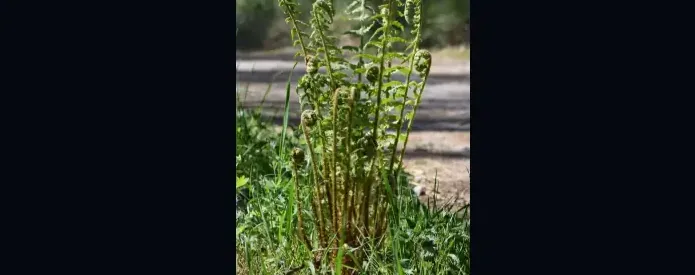
Chapter 7 · PlantsLesson 7.5CS
Plant diversity: adaptations to the environment and ecological and economic importance
How does a plant come to catch insects, or to live with no roots in the soil, lodged in the branch of an apple tree?
- Size
- from 1 mm to 62.5 m
- Level
- organism
- Time
- hundreds of millions of years
Before you read: what do you think?
The waterwheel plant (Aldrovanda vesiculosa) is an aquatic plant that catches small animals in water. What has happened to its known populations in Romania?
See the answer
Almost nine in ten. Researchers at the Danube Delta Institute in Tulcea could no longer find 89% of the known populations, and in 2021–2023 the plant was found in only six localities. The causes are nutrient-laden water and falling water levels.
In winter, when apple trees and poplars are bare, you can see round green clumps in their crowns: this is mistletoe. It has no roots in the ground, and it doesn’t fall out of the tree. Its modified roots grow into the branch and reach the tree’s conducting vessels.
What an adaptation is
An adaptation is an inherited feature of a population that raises the chances of survival and reproduction in a particular environment. Adaptations arise through natural selection, over many generations: individuals with a useful feature leave more offspring. A plant does not choose its shape and does not “get ready” for drought. A feature that helps in one environment can be a drawback in another: broad leaves catch a lot of light, but they also lose a lot of water.
Drought, water, salt and cold
Plants of dry places are called xerophytes. They have a thick cuticle, which cuts water loss, stomata sunken into the leaf, hairs that slow the air next to the leaf, or leaves reduced to spines, as in cacti, where the fleshy stem stores water.
Water plants are called hydrophytes. Many have tissues with large air-filled spaces, through which oxygen reaches the roots in the mud, and broad floating leaves covered with a waxy layer that water does not cling to.
Plants of salty soils are called halophytes. Salicornia, found on the shores of seas and salt lakes, has fleshy stems that look jointed and leaves reduced to tiny scales, and it can tolerate being covered by salt water.
In the cold and at altitude, conifers have small, waxy needles, and larch sheds its needles in autumn and stays bare all winter, which means less drying out of the foliage in the frozen months. Mountain pine grows low along the ground, with branches several metres long spread over the ground, in the subalpine zone of the Carpathians, generally between 1,600 and 2,200 m.
Plants that catch animals and plants that live on others
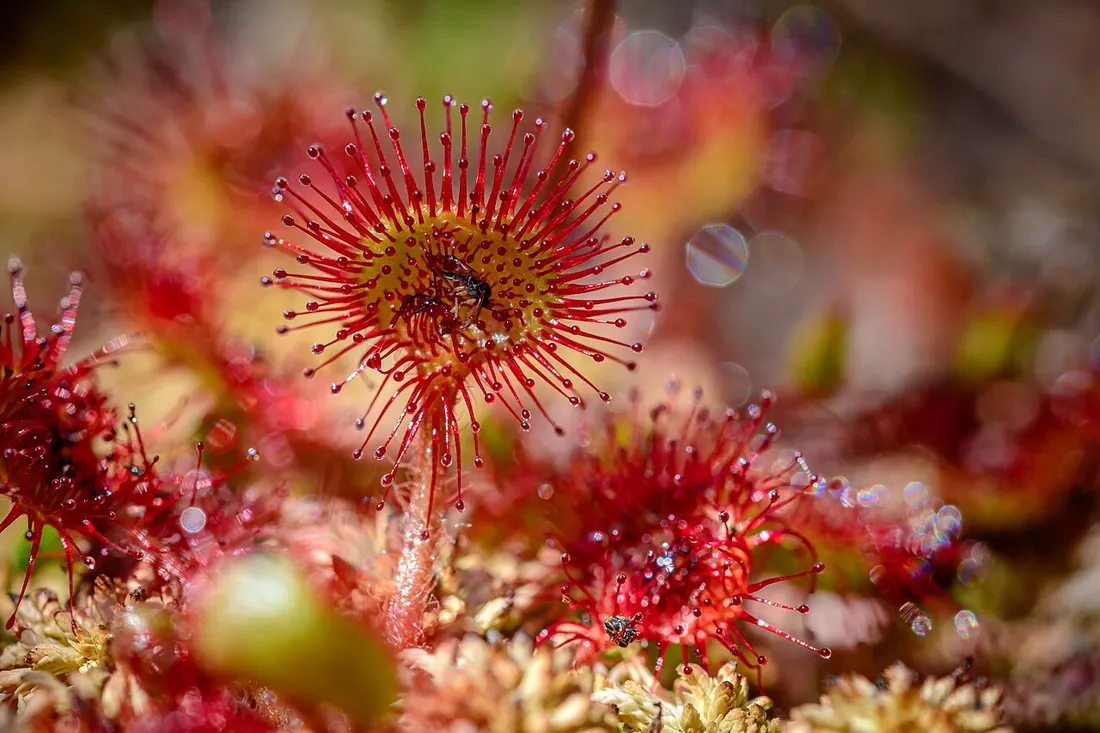
Carnivorous plants live on soils or in waters poor in mineral salts and top up their minerals from the small animals they catch. They still photosynthesise. In the Venus flytrap, the leaf snaps shut when an insect touches its sensitive hairs twice within about 20 seconds. The round-leaved sundew (Drosera rotundifolia) has hairs with sticky droplets, and the waterwheel plant catches small animals under water, in the traps at the tips of its leaves.
Parasitic plants take their food from another plant, called the host. Dodder (Cuscuta) is a yellow plant with no green leaves that twines around the host’s stem; from it grow suckers that push into the stem and connect to the host’s conducting vessels. Mistletoe (Viscum album) is a hemiparasite: it has green leaves and photosynthesises, but takes water and mineral salts from the tree’s vessels, mostly apple, lime, hawthorn and poplar. Its seeds are spread by birds, which eat its berries.

Species that ecosystems and people depend on
Some species create the habitat that others live in. Oak and beech form forests where thousands of species live, and common reed (Phragmites australis) forms reed beds that shelter waterbirds and give fish places to breed.
Other plants matter economically: cereals provide staple food, spruce gives timber and paper, flax and cotton give textile fibres, and many plants are used as raw material for medicines.
A plant brought in from another region that spreads on its own and harms local species, people or crops is called an invasive species. In Romania, Law no. 62/2018 requires landowners to destroy common ragweed (Ambrosia artemisiifolia) by mowing, pulling or herbicide, between its emergence and the appearance of the first flower heads, by 30 June each year at the latest.
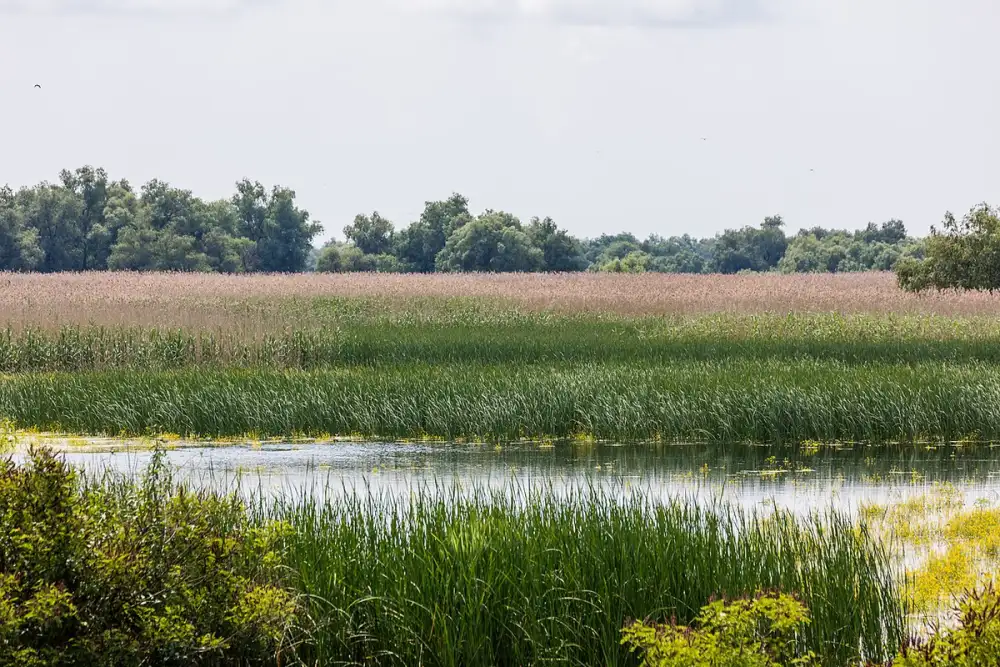
Photo: Diego Delso, CC BY-SA 4.0, source. Resized.

Worked example
Reading a field result
The study of the waterwheel plant in Romania, published in 2024, reports that 89% of the populations known earlier could no longer be found in the period 2008–2021.
Question 1: what percentage was still found? 100% − 89% = 11%. Question 2: if 100 populations had been known, how many would still have been found? 11 out of 100. The second calculation is an example: the exact number of old populations is in the original paper.
Question 3: what does “could no longer be found” mean? That the plant was not seen where it had been recorded, even though it was looked for. A small underwater plant can escape researchers, so the result shows a sharp decline, not a proven disappearance from every site.
In Romania
The reed beds of the Delta and a carnivorous plant close to vanishing
The Danube Delta has the largest expanse of reed in the world, recorded by Guinness World Records in 2016: 1,563 km², across Romania and Ukraine. Common reed is a hydrophyte: its stems grow from rhizomes rooted in the flooded mud.
The waterwheel plant (Aldrovanda vesiculosa), a rootless aquatic carnivorous plant with leaves arranged in rings that end in traps, used to be known from ponds in several regions of the country. A study by the Danube Delta National Institute for Research and Development in Tulcea, published in 2024, shows that 89% of the known populations could no longer be found between 2008 and 2021, and in 2021–2023 the species was found in only six localities. The causes are eutrophication, the enrichment of water with nutrients, and falling water levels. The authors propose moving some plants to suitable ponds as a first conservation measure.
In short
- An adaptation is an inherited feature of a population, arising through natural selection, that raises the chances of survival and reproduction in an environment.
- Xerophytes (cacti) have a thick cuticle, sunken stomata, hairs or spines; hydrophytes (common reed) have air spaces in their tissues; halophytes (Salicornia) tolerate salty soils.
- Carnivorous plants (round-leaved sundew, waterwheel plant, Venus flytrap) photosynthesise and top up their minerals from the animals they catch.
- Dodder is a parasite and takes its food from the host’s vessels; mistletoe is a hemiparasite: it photosynthesises and takes water and mineral salts from the tree.
- Oak, beech and common reed form habitats for many species; cereals, timber and fibres matter economically; common ragweed is an invasive species controlled by law.
Common mistakes
WrongThe cactus turned its leaves into spines so as not to lose water.
RightA plant does not choose its shape. Plants with reduced leaves survived and reproduced better in the desert, and the feature spread through the population over many generations.
WrongCarnivorous plants don’t photosynthesise; they live only on insects.
RightThey have chlorophyll and photosynthesise. From the animals they catch they take mainly mineral salts, which are lacking in the soil or water they live in.
Check yourself
Six questions. For the first five you see the explanation at once, with the paragraph of the lesson that supports it; for the written ones you compare with a good answer.
What does mistletoe take from the tree it lives on?
Answer
c) Water and mineral salts, because it photosynthesises itself. Mistletoe has green leaves and photosynthesises; it is a hemiparasite. Dodder, with no green leaves, takes organic food from its host.
Why do carnivorous plants catch insects?
Answer
b) To top up the mineral salts that are lacking in their environment. They live on soils or in waters poor in mineral salts; photosynthesis still gives them their organic matter.
Which statement describes an adaptation correctly?
Answer
d) An inherited feature of the population, spread by natural selection because it raised the chances of survival and reproduction. Adaptation is about populations and generations; a plant has no intentions, and a feature that helps in one environment can be a drawback in another.
The Danube Delta reed bed covers 1,563 km². How many hectares is that? (1 km² = 100 ha)
haAnswer
156,300 ha. 1,563 × 100 = 156,300 ha.
Put each plant in its group.
Answer
Adapted to drought or salt: Cactus; Salicornia.
Adapted to water: Common reed; Waterwheel plant.
Parasite or hemiparasite: Dodder; Mistletoe.
The cactus is a xerophyte, Salicornia is a halophyte; common reed and the waterwheel plant live in water; dodder is a parasite, mistletoe a hemiparasite.
A neighbour wants to dig a channel that would lower the water in a pond with reeds and waterwheel plants, to make room for a garden. Explain what could happen to the two plants, and why.
A good answer
Common reed is a hydrophyte that grows from rhizomes in flooded mud, and the waterwheel plant floats in shallow water. Falling water levels are one of the causes of the waterwheel plant’s disappearance in Romania, and the reed bed would shrink as the mud dried out. With them would go the shelter for waterbirds and the breeding places for fish.
A complete answer links each plant to its adaptation to water, names falling water levels as a documented threat and mentions the role of reed as a habitat.
Terms
- adaptation
- An inherited feature of a population, arising through natural selection, that raises the chances of survival and reproduction in an environment.
- xerophytes
- Plants adapted to dry places, with a thick cuticle, sunken stomata, hairs or reduced leaves.
- hydrophytes
- Plants adapted to life in water or in flooded mud.
- halophytes
- Plants that live on salty soils.
- hemiparasite
- A plant that photosynthesises but takes water and mineral salts from another plant, like mistletoe.
- invasive species
- A species brought in from another region that spreads on its own and harms local species, people or crops.
- eutrophication
- The enrichment of water with nutrients, which leads to algae multiplying out of control and to a lack of oxygen.
Sources and link to the programme
- OpenStax – Biology 2e, 30.4 Leaves – xerophytes: cuticle, sunken stomata, hairs that reduce transpiration, leaves reduced to spines and succulent stems in cacti; hydrophytes: aerenchyma, broad floating leaves, waxy cuticle; needle-like leaves in conifers
- OpenStax – Biology 2e, 31.3 Nutritional Adaptations of Plants – parasitic plants (dodder with suckers connected to the host’s vessels), photosynthetic hemiparasites that take water and minerals, carnivorous plants on poor soils, the Venus flytrap closing when its hairs are touched
- Washington University in St. Louis – Threshold decision-making in the Venus flytrap (rezumat) – the Venus flytrap closes its trap only after two touches of the sensory hairs within about 20 seconds
- Wikipedia – Viscum album – mistletoe: a hemiparasite on apple, lime, hawthorn, poplar; haustorium connected to the host’s vessels; seeds spread by birds
- Wikipedia – Salicornia – Salicornia: a succulent halophyte of salt marshes and shores, leaves reduced to scales, tolerates immersion in salt water
- European Atlas of Forest Tree Species (JRC, 2016) – Larix decidua – shedding its needles reduces the drying of larch foliage in winter
- European Atlas of Forest Tree Species (JRC, 2016) – Pinus mugo – mountain pine: a shrub with sprawling branches that spread up to 10 m, abundant in the subalpine zone of the Carpathians between 1,600 and 2,200 m
- Agerpres (19 June 2025) – Roua-cerului în Tinovul Mohoș – the round-leaved sundew (Drosera rotundifolia), an insect-eating plant that catches insects with a sticky secretion
- Chirilă et al. (2024), Botanica Serbica 48(1): 47–60 – Aldrovanda vesiculosa in Romania – the waterwheel plant: an endangered aquatic plant; 89% of populations not found in 2008–2021; in 2021–2023 only in six localities in Dobrogea, Transylvania and Oltenia; causes: eutrophication and falling water levels; translocation proposed as a conservation measure; authors from the Danube Delta National Institute in Tulcea
- Guinness World Records – Largest reed bed – the Danube Delta, the largest expanse of reed: 1,563 km², Romania and Ukraine, 2016
- Legea nr. 62/2018 privind combaterea buruienii ambrozia (text published by Institutul de Biologie București) – landowners’ duty to destroy Ambrosia artemisiifolia by mowing, pulling or herbicide, between emergence and the first flower heads, by 30 June at the latest
From the programme: “Plant diversity: representative species of ecological and economic importance, interactions and adaptations, communication between plants (through chemical signals and through fungi)” (specialism, Natural Sciences). Specific competences addressed: 1.2, 2.1, 4.1, 5.1.