
Chapter 7 · PlantsLesson 7.4
Angiosperms: flower, fruit and seed; monocotyledons and dicotyledons
Why is a bean pod a fruit while a pine cone is not, even though both have seeds inside?
- Size
- from 1 mm to 62.5 m
- Level
- organism
- Time
- hundreds of millions of years
Before you read: what do you think?
How many species of flowering plants are known?
See the answer
Over 300,000. Flowering plants are the most species-rich group of plants: almost all the plants that human food depends on, from wheat to apples, belong to it.
Slice a green bean pod lengthways: inside, the beans sit attached to the edge of the pod, side by side. The pod formed from the bottom part of a flower, and the beans from tiny bodies inside it. In gymnosperms, the seeds were not enclosed in an ovary; in flowering plants, they grow enclosed.
The flower and its parts
Angiosperms are the flowering plants, whose ovules are enclosed in an ovary. The flower sits on a stalk called the peduncle, whose widened top is the receptacle. Four kinds of parts are attached to the receptacle, from the outside inwards.
The sepals, usually green, together form the calyx and protect the flower in bud. The petals, often coloured, form the corolla and attract pollinating insects. The stamens are the male organs: each has a thin stalk, called the filament, and an anther, in which pollen forms. In the centre is the pistil, the female organ, made of the stigma, the sticky part that receives pollen, the style, a narrow stalk, and the ovary, which holds the ovules.
Not all flowers have large, coloured petals. The flowers of wind-pollinated plants, such as wheat, maize or oak, are small and greenish. In maize and oak, the stamens and the pistil are in separate flowers, but on the same plant: some flowers have only stamens, others only a pistil.
From pollination to fruit
Pollen reaches the stigma carried by insects, by the wind or by other animals. From the pollen grain grows a pollen tube, which makes its way through the style to an ovule. Two male gametes travel down it. One joins the female gamete and forms the zygote, from which the embryo grows. The other joins another cell in the ovule and forms the seed’s food-storage tissue. This fertilisation with two gametes is called double fertilisation and is characteristic of angiosperms.
After fertilisation, the ovule becomes the seed, and the ovary grows and becomes the fruit. The fruit protects the seeds and helps them spread: many fleshy fruits are eaten by animals, which leave the seeds somewhere else. In some fruits, such as the apple, the receptacle takes part too.
Kitchen names don’t always match botanical ones. The bean pod is the fruit, and the beans are the seeds. An acorn is a fruit with, usually, a single seed. Tomatoes and cucumbers are fruits too, because they form from the ovary and contain seeds.
Monocotyledons and dicotyledons
The embryo in a seed has one or two embryonic leaves, called cotyledons. By that number, angiosperms are divided into two large groups, which can also be recognised by their root, leaf and flower.
Monocotyledons have a single cotyledon, fibrous roots (a tuft of roots all of the same thickness), leaves with parallel veins and flower parts in threes or multiples of three. Examples: wheat, maize, rice, tulip, lily. Dicotyledons have two cotyledons, usually a main root with branches (a taproot), leaves with branching, net-like veins and flower parts in fours or fives or multiples of these. Examples: bean, apple, oak, sunflower, rose.
The split into two groups is the one used in school. DNA research shows that dicotyledons do not form a single natural group; most of them, however, belong to one large group, called the eudicots.
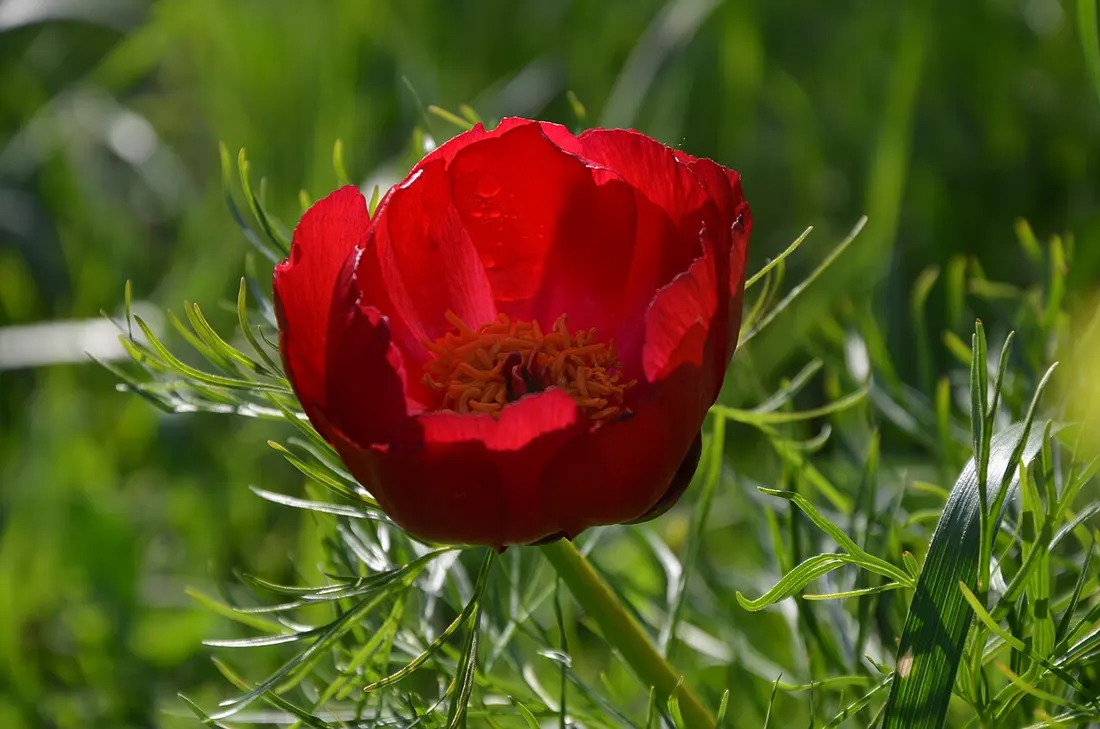
Photo: Milanaranim, CC BY-SA 4.0, source. Resized.

The six groups of plants compared
All the groups in this chapter are autotrophic: they make their organic substances by photosynthesis, with chlorophyll. They differ in how they take in water and mineral salts. Algae receive them over the whole surface of the thallus, from the water they live in. Mosses take them in mainly through their tiny leaves and anchor themselves with rhizoids. Ferns, gymnosperms and angiosperms absorb them through roots and carry them through conducting vessels up to the leaves.
They also differ in reproduction. Algae, mosses and ferns reproduce by spores, and their fertilisation takes place in water or in a film of water; that is why they live in water or in damp, shady places. Gymnosperms and angiosperms have pollen and seeds, and fertilisation no longer depends on water; they also grow in dry places. Only angiosperms have flowers and fruits.
Why flowering plants matter
Wheat, maize, rice, potatoes, beans, sunflowers and fruit trees are angiosperms, and so are oak and beech, which form the hill forests. Oak and beech are large trees that can reach 30–40 m in height. Flowering plants feed pollinating insects with nectar and pollen, and the insects carry their pollen from one flower to another.
Worked example
Which group does the plant belong to?
You are given two plants with the soil washed off their roots. Plant A has a tuft of thin roots, all alike, and long, narrow leaves with parallel veins. Plant B has a thick root from which thinner roots branch off, and its leaves have veins that branch into a network.
Step 1: the root. A tuft of fibrous roots points to a monocotyledon, a main root to a dicotyledon. Step 2: the leaf. Parallel veins confirm the monocotyledon, a network confirms the dicotyledon. Step 3, if the plant has flowers: count the petals. A multiple of three points to monocotyledons, four or five to dicotyledons.
Conclusion: A is a monocotyledon (a wheat stalk, for example), B is a dicotyledon (a bean plant, for example). Use several features at once: a particular species can have a feature unusual for its group.
In Romania
Wheat, maize and the steppe peony of Zău de Câmpie
Two monocotyledons take up most of Romania’s fields. In 2024, according to provisional data from the National Institute of Statistics, wheat was grown on 2,266 thousand hectares and grain maize on 2,120 thousand hectares, out of 5,066 thousand hectares under cereals. For maize, Romania had the largest cultivated area in the European Union.
A dicotyledon with large flowers is the steppe peony (Paeonia tenuifolia). At Zău de Câmpie, in Mureș County, the Romanian botanist Alexandru Borza set up a reserve of 2.5 hectares in 1932, later extended to 3.5 hectares. The 2014 inventory counted about 20,000 plants on the upper plot, and the lower plot holds over 30,000. The peonies flower in April–May, and each flower stays open for only about seven days.
In short
- Angiosperms have flowers, and their ovules are enclosed in the ovary.
- A flower has a peduncle and receptacle, a calyx (sepals), a corolla (petals), stamens (filament and anther, where pollen forms) and a pistil (stigma, style, ovary with ovules).
- Pollen germinates on the stigma and forms a pollen tube; in double fertilisation, one male gamete forms the zygote with the female gamete, and the other forms the seed’s food-storage tissue.
- After fertilisation, the ovule becomes the seed and the ovary becomes the fruit: the pod is the fruit of the bean, the beans are the seeds.
- Monocotyledons (wheat, maize, tulip) have one cotyledon, fibrous roots, parallel veins and flower parts in threes; dicotyledons (bean, apple, oak, sunflower) have two cotyledons, a taproot, net-like veins and flower parts in fours or fives.
- Flowering plants provide most of humanity’s food and feed pollinating insects.
Common mistakes
WrongThe beans are the fruit, and the pod is just a shell.
RightThe pod formed from the ovary, so it is the fruit. The beans formed from ovules and are the seeds.
WrongWheat and maize have no flowers, because they have no coloured petals.
RightThey have small, greenish, wind-pollinated flowers, with stamens and pistils; in maize, the flowers with stamens and those with pistils are separate, on the same plant. Large, coloured petals are found mostly in insect-pollinated flowers.
WrongPollen lands on the stigma, and that is fertilisation.
RightThat is pollination. Fertilisation happens later, in the ovule, after the pollen tube has grown through the style and carried the male gametes there.
Check yourself
Eight questions. For the first seven you see the explanation at once, with the paragraph of the lesson that supports it; for the written ones you compare with a good answer.
Which part of the flower does the fruit form from?
Answer
c) The ovary. The ovules become seeds, and the ovary becomes the fruit; in some fruits, such as the apple, the receptacle takes part too.
Where does pollen form?
Answer
a) In the anthers. The anther is the top part of the stamen, the male organ of the flower.
A plant has leaves with parallel veins and fibrous roots. What are its flowers most likely to be like?
Answer
d) With parts in threes or multiples of three. Parallel veins and fibrous roots point to a monocotyledon, with flower parts in threes.
What is double fertilisation?
Answer
b) The joining of one male gamete with the female gamete and of the other male gamete with another cell in the ovule. The first male gamete forms the zygote, the second forms the seed’s food-storage tissue.
In 2024, Romania grew cereals on 5,066 thousand hectares, of which 2,266 thousand hectares were wheat. What percentage of the cereal area did wheat take up? Round to one decimal place.
%Answer
44.7 %. 2,266 ÷ 5,066 × 100 ≈ 44.7%.
Put each plant or feature in the right group.
Answer
Monocotyledons: Maize; Tulip; A single cotyledon.
Dicotyledons: Sunflower; Leaves with net-like veins; Oak.
Monocotyledons have one cotyledon and parallel veins (maize, tulip); dicotyledons have two cotyledons and net-like veins (sunflower, oak).
Put the stages in order, from flower to fruit.
Answer
The correct order:
- Pollen forms in the anthers
- Pollen reaches the stigma (pollination)
- The pollen tube grows through the style to the ovule
- The male gametes join cells in the ovule (double fertilisation)
- The ovule becomes the seed, and the ovary becomes the fruit
Pollination comes before the pollen tube forms; fertilisation takes place in the ovule; the fruit and seed form after fertilisation.
An apple tree in blossom is covered with a fine net that insects cannot get through. The spring is cold and still. Explain why the tree produces very few apples, and what would happen to a field of maize in the same conditions, but with wind.
A good answer
Apple flowers are pollinated mainly by insects; without them, pollen does not reach the stigma, no pollen tube forms, fertilisation does not happen and the ovary does not become a fruit. Maize has small flowers without coloured petals, pollinated by the wind; with wind, pollen reaches the stigmas even without insects, so grains can form.
A complete answer links pollination to fertilisation and fertilisation to the forming of the fruit, and compares insect-pollinated flowers with wind-pollinated ones.
Terms
- angiosperms
- Flowering plants, whose ovules are enclosed in an ovary and whose seeds are enclosed in a fruit.
- stamen
- The male organ of the flower, made of a filament and an anther, in which pollen forms.
- pistil
- The female organ of the flower, made of the stigma, style and ovary.
- fruit
- An organ formed from the ovary after fertilisation, which encloses and protects the seeds.
- double fertilisation
- The fertilisation typical of angiosperms, in which one male gamete forms the zygote and the other forms the seed’s food-storage tissue.
- cotyledon
- A seed leaf of the embryo; by the number of cotyledons, angiosperms are monocotyledons or dicotyledons.
- pollen tube
- A tube that grows from the pollen grain through the style and carries the male gametes to the ovule.
Sources and link to the programme
- OpenStax – Biology 2e, 26.3 Angiosperms – the structure of the flower (calyx, corolla, stamens with filament and anther, pistil with stigma, style, ovary, receptacle); the ovary becomes the fruit, and in some fruits the receptacle takes part too; double fertilisation; over 300,000 species; the comparison of monocots and eudicots (cotyledons, veins, roots, flower parts) and examples
- OpenStax – Biology 2e, 30.4 Leaves – parallel veins in monocotyledons and net-like veins in dicotyledons
- INS – Producția vegetală la principalele culturi în anul 2024, provisional data, press release no. 77/31 March 2025 (copy published by agrointel.ro) – 2024: cereals 5,066 thousand ha, wheat 2,266 thousand ha, grain maize 2,120 thousand ha; wheat 44.7% of the cereal area; Romania first in the EU for area under grain maize
- Purdue University, Agronomy – Tassel emergence and pollen shed (Corny News Network) – in maize, the male and female flowers develop separately on the same plant (a monoecious plant)
- JRC – European Atlas of Forest Tree Species: Quercus robur and Quercus petraea in Europe – pedunculate and sessile oaks grow up to 30–40 m tall; they are monoecious and wind-pollinated, with male flowers in catkins and separate female flowers
- JRC – European Atlas of Forest Tree Species: Fagus sylvatica in Europe – beech usually reaches 30–40 m, locally up to 50 m
- Agerpres (2 May 2019) – Reportaj Mureș: bujorul de stepă de la Zău de Câmpie – Paeonia tenuifolia; the reserve set up in 1932 by Alexandru Borza, 2.5 ha, extended to 3.5 ha; about 20,000 plants on the upper plot (2014 inventory) and over 30,000 on the lower plot; flowering April–May, each flower about seven days
From the programme: “Plants: red algae, green algae, mosses, ferns, gymnosperms, angiosperms – general features – comparative overview (morphology, nutrition, reproduction), examples of representative species, habitats, importance in ecosystems” (common core). Specific competences addressed: 1.1, 2.2, 3.1.