Chapter 7 · PlantsLesson 7.3
Gymnosperms: plants whose seeds are not enclosed in a fruit
Why does a fir cone never fall to the ground whole, like a spruce cone, and why is neither of them a fruit?
- Size
- from 1 mm to 62.5 m
- Level
- organism
- Time
- hundreds of millions of years
Before you read: what do you think?
How tall is the tallest fir ever measured in Romania?
See the answer
Over 60 m: a fir in the old-growth forest at Șinca Veche, in Brașov County, was measured in 2013 at 62.5 m. A trunk that tall needs wood strengthened with lignin, which carries water from the soil all the way to the top.
In autumn, under a spruce in the Bucegi mountains, you find whole cones as long as your palm. Under a fir a few steps away you find none, only loose scales and winged seeds. Fir cones stand upright on the branches and come apart there, scale by scale.
Seeds and pollen: reproduction without water
Mosses and ferns need water for fertilisation, and their spore is a single cell that sprouts only in a damp spot. Seed plants have solved both problems. A seed contains an embryo, a small plant made of many cells, a food store for it and a protective coat. It can stay dormant until it finds good conditions to germinate.
The male gamete travels sealed inside a pollen grain, a tiny structure with a coat that resists drying out, which reaches the female organ without water. The transfer of pollen from the male organ to the female one is called pollination. The joining of the male gamete with the female gamete is called fertilisation. They are two separate stages: in pine, fertilisation happens more than a year after pollination.
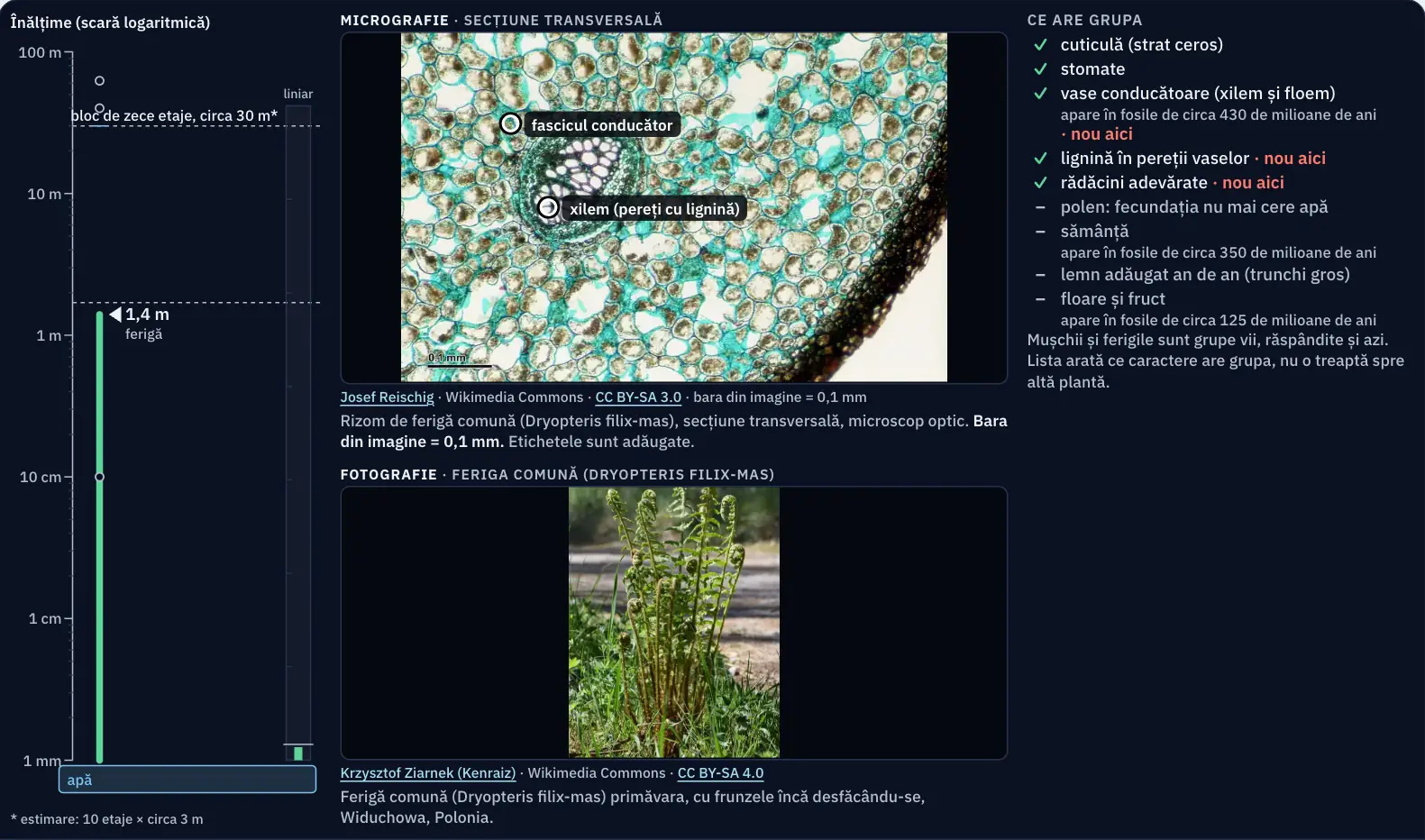
| Group | Example | Height (from the sources) | cuticle (waxy layer) | stomata | vascular tissue (xylem and phloem) | lignin in the walls of the vessels | true roots | pollen: fertilisation no longer needs water | seed | wood added year by year (thick trunk) | flower and fruit |
|---|---|---|---|---|---|---|---|---|---|---|---|
| Green alga | Spirogyra (water silk) | no height of its own: water supports its thallus | no | no | no | no | no | no | no | no | no |
| Moss | common haircap moss (Polytrichum commune) | usually 5–10 cm, rarely over 30 cm | yes | in mosses, only on the sporophyte | no | no | no | no | no | no | no |
| Fern | male fern (Dryopteris filix-mas) | fronds up to 140 cm long | yes | yes | yes | yes | yes | no | no | no | no |
| Gymnosperm | silver fir (Abies alba) and Norway spruce (Picea abies) | Norway spruce usually reaches 50–60 m at most; tallest silver fir measured in Romania: 62.5 m | yes | yes | yes | yes | yes | yes | yes | yes | no |
| Angiosperm | pedunculate oak (Quercus robur) and European beech (Fagus sylvatica) | oak and beech usually reach 30–40 m; beech, in some places, up to 50 m | yes | yes | yes | yes | yes | yes | yes | yes | yes |
| Image | What it shows | Scale | Author, licence and changes |
|---|---|---|---|
| Micrograph, green alga | One cell from a filament of Spirogyra (water silk), under the light microscope, with one or more ribbon-shaped chloroplasts twisted into a spiral. Not a section: the filament is a single row of cells joined end to end. | black bar in the corner = 0.02 mm, according to the author’s description | Jon Houseman and Matthew Ford, CC BY-SA 4.0; resized |
| Photograph, green alga | Masses of Spirogyra on the surface and inside a pond of still water (Japan). | – | Phonon.b, CC BY-SA 4.0; resized |
| Micrograph, moss | Cross-section through the stem of a moss (the species is not identified by the author), light microscope. In the centre, a bundle of simple conducting cells without lignin; this is not true vascular tissue. | black bar in the corner = 0.2 mm, according to the author’s description | Jon Houseman and Matthew Ford, CC BY-SA 4.0; resized |
| Photograph, moss | Common haircap moss (Polytrichum commune), seen from above, Bruges, Belgium. | – | Hans Hillewaert, CC BY-SA 4.0; resized |
| Micrograph, fern | Cross-section through the rhizome of the male fern (Dryopteris filix-mas), bright-field light microscope. The vascular bundle has xylem with strengthened walls, surrounded by phloem. | bar in the image = 0.1 mm | Josef Reischig, CC BY-SA 3.0; resized |
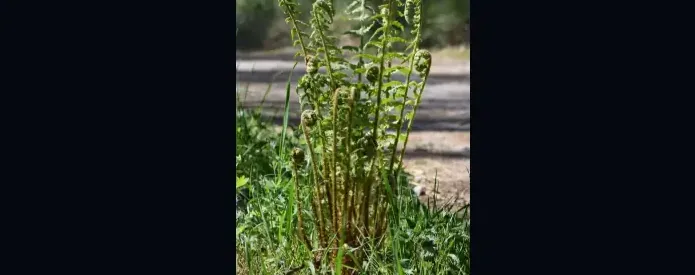
| Photograph, fern | Male fern (Dryopteris filix-mas) in spring, its fronds still unrolling, Widuchowa, Poland. | – | Krzysztof Ziarnek (Kenraiz), CC BY-SA 4.0; resized; cropped at the top by 8% of the height |
| Micrograph, gymnosperm | Cross-section through the wood of a three-year-old pine stem (Pinus), light microscope. The wood is made mainly of tracheids, crossed by rays of living cells (parenchyma); the resin canal is surrounded by cells that produce resin. Fir wood is also made mainly of tracheids, but has no resin canals. | no scale bar; magnification under the microscope as stated by the source: 100× | Berkshire Community College Bioscience Image Library, CC0; resized |
| Photograph, gymnosperm | Silver fir (Abies alba) in the Silesian Beskids, Poland. The road at its foot gives an idea of its height. | – | Crusier, CC BY-SA 3.0; resized |
| Micrograph, angiosperm | Cross-section through oak wood (Quercus), light microscope, stained with haematoxylin and safranin. The large, round vessels are in the wood formed in spring; between them are fibres with thick walls and tracheids. | no scale bar; magnification under the microscope as stated by the source: 40× | Berkshire Community College Bioscience Image Library, CC0; resized |
| Photograph, angiosperm | The centuries-old oak of Cajvana, Suceava county (Quercus robur). The people beside the trunk give the scale. | – | Cristian-Mihail Miehs, public domain; resized |


Micrograph and photograph. The micrographs and photographs are real, from Wikimedia Commons, with the author and licence on each image. The heights come from the lessons of the chapter and their sources (for oak and beech, from the European atlas of forest tree species, JRC 2016). The ruler is logarithmic, with a linear strip beside it that keeps the true proportions; the 1.7 m person is a reference mark, and the height of the block of flats is an estimate: 10 storeys × about 3 m. The labels on the micrographs were added. The magnification that the source states for the pine and oak wood refers to the microscope, not to the image on screen.
Sources and credits. Jon Houseman and Matthew Ford, “Spirogyra filaments.jpg”, Wikimedia Commons, file page: source; licence CC BY-SA 4.0, licence text: source; changes: resized. Phonon.b, “Spirogyra water surface and water inside.jpg”, Wikimedia Commons, file page: source; licence CC BY-SA 4.0, licence text: source; changes: resized. Jon Houseman and Matthew Ford, “Moss stem.jpg”, Wikimedia Commons, file page: source; licence CC BY-SA 4.0, licence text: source; changes: resized. Hans Hillewaert, “Polytrichum commune .jpg”, Wikimedia Commons, file page: source; licence CC BY-SA 4.0, licence text: source; changes: resized. Josef Reischig, “Rhizome (255 02) Male fern (Dryopteris filix-mas); cross-section.jpg”, Wikimedia Commons, file page: source; licence CC BY-SA 3.0, licence text: source; changes: resized. Krzysztof Ziarnek (Kenraiz), “Dryopteris filix-mas kz03.jpg”, Wikimedia Commons, file page: source; licence CC BY-SA 4.0, licence text: source; changes: resized; cropped at the top by 8% of the height. Berkshire Community College Bioscience Image Library, “Gymnosperm Stem Resin Duct in Three Year Pinus (36279470746).jpg”, Wikimedia Commons, file page: source; licence CC0, licence text: source; changes: resized. Crusier, “Abies alba Wisła 1.jpg”, Wikimedia Commons, file page: source; licence CC BY-SA 3.0, licence text: source; changes: resized. Berkshire Community College Bioscience Image Library, “Woody Dicot Stem Cross Section Quercus Wood 40x (34991087693).jpg”, Wikimedia Commons, file page: source; licence CC0, licence text: source; changes: resized. Cristian-Mihail Miehs, “Stejarul multisecular din Cajvana.jpg”, Wikimedia Commons, file page: source; in the public domain; changes: resized.
What gymnosperms have in common
The name gymnosperms means “naked seeds”: the ovules, and later the seeds, are not enclosed in an ovary and, in most of them, sit exposed on the scales of a cone. That is why gymnosperms have no fruits. The best-known gymnosperms are the conifers: pine, spruce, fir, larch.
The same tree usually carries small male cones, which release clouds of pollen in spring, and larger female cones, with the ovules on their scales. The pollen is carried by the wind. After fertilisation, the ovule becomes the seed, often with a little wing that helps it fly.
The leaves are usually needle-like (needles) or small and scale-like. Needles have a small surface area, a thick waxy layer and sunken stomata, which cut water loss in frost and drought; snow slides off them easily. Many conifers have resin: on spruce, drops of resin are often visible on the bark of the trunk and branches. Their wood, called softwood, is made mainly of tracheids, long, narrow cells that conduct water.
How to tell them apart in the forest
Scots pine (Pinus sylvestris) has its needles in pairs, 5–7 cm long, and cones 5–8 cm long that ripen in the year after pollination. Norway spruce (Picea abies) has short needles, 1–2.5 cm, sharp and four-sided, attached singly to the branch; the cones, 12–15 cm long, hang down and fall whole. Silver fir (Abies alba) has flat, glossy needles with two white stripes on the underside; the cones stand upright on the branches and come apart on the tree.
European larch (Larix decidua) has soft needles in bunches of 20–40, which turn yellow and fall in autumn: it is the only conifer growing wild in Romania that stands leafless in winter. Swiss stone pine (Pinus cembra) has its needles in fives and large, wingless, edible seeds. Mountain pine (Pinus mugo) is a shrub no more than a few metres tall, with sprawling branches, at the upper edge of the forest. Common juniper (Juniperus communis) has fleshy cones, like small blue-black berries. Yew (Taxus baccata) has a red, fleshy coat around its seed, called an aril, the only part of the plant that is not poisonous; the leaves, bark and seeds are highly toxic.
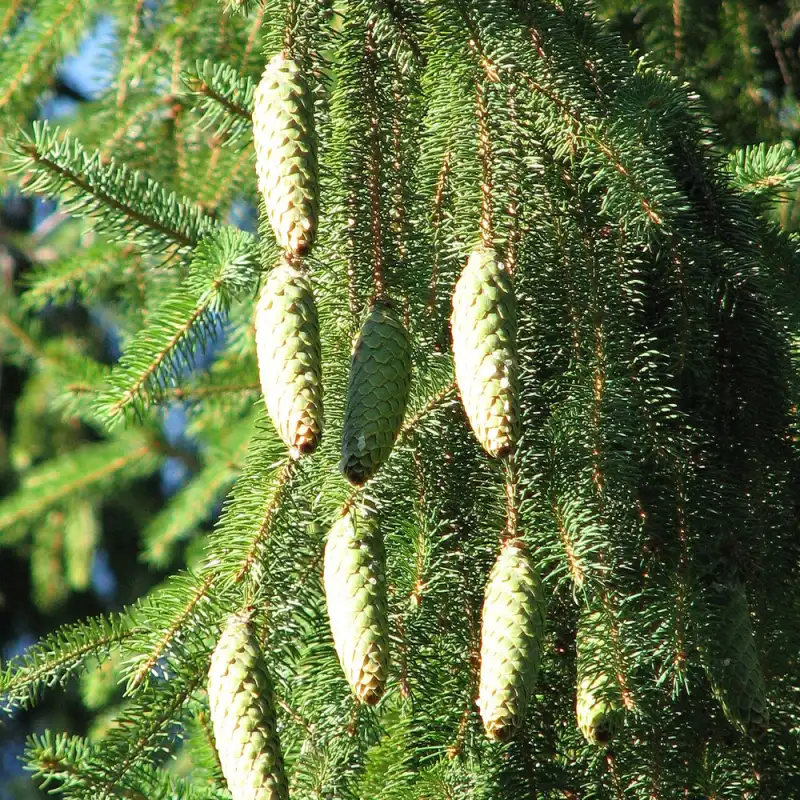
Photo: Cristian Bortes, CC BY 2.0, source. Cropped and resized.

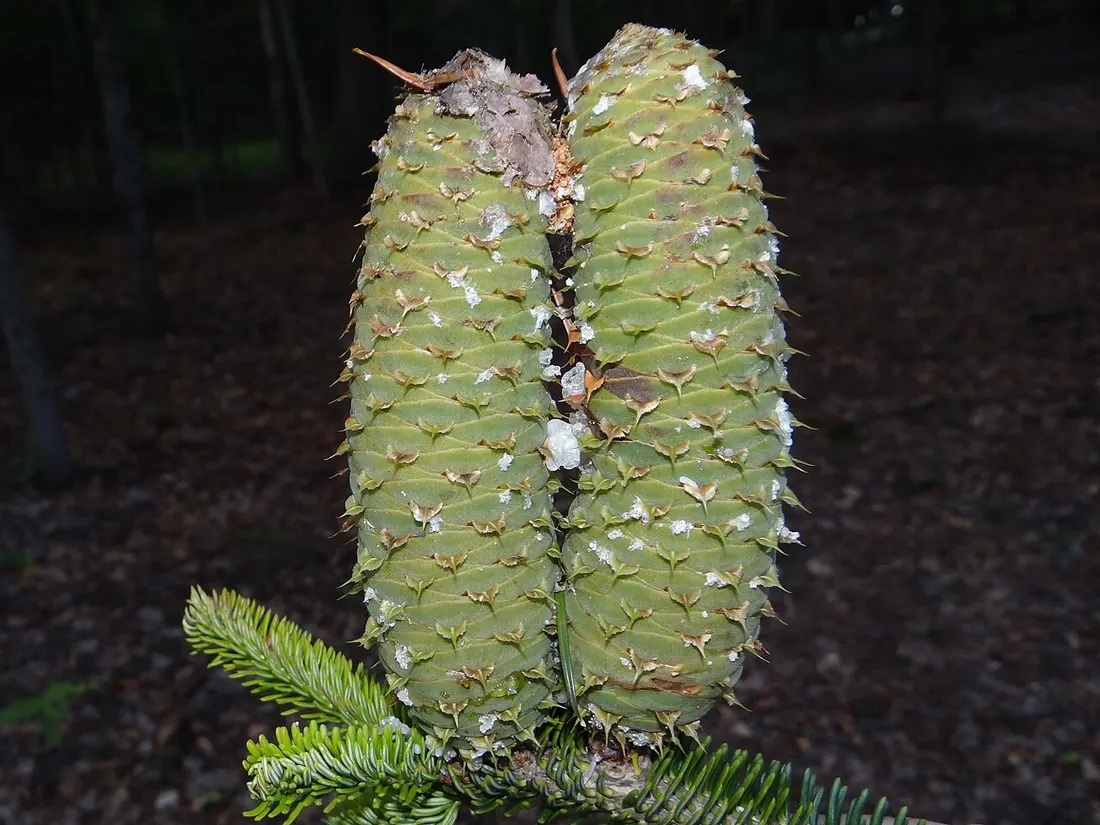
Photo: Jerzy Opioła, CC BY-SA 3.0, source. Resized.

Why conifers matter
Spruce is the conifer of greatest economic importance in Europe: its wood is used in building, for furniture and for making paper. Fir gives a light wood with no resin canals, good for joinery. Turpentine is obtained from larch resin. Conifer forests store a lot of carbon and give food and shelter to many animals: the nutcracker, a bird of the crow family, hides over 25,000 Swiss stone pine seeds every year, and young trees grow from the ones it forgets.
Worked example
Identify the conifer from a twig
You are given three twigs without cones. The question to start with: how are the needles arranged on the twig?
Twig A has its needles in pairs, almost a hand’s length long: it is a pine. Twig B has single needles, short and sharp, that roll between your fingers because they have four sides: it is a spruce. Twig C has single, flat needles that don’t prick, with two white stripes underneath: it is a fir.
If the needles had been in dense, soft bunches, and the twig had been picked in autumn with yellow needles, it would have been a larch. In fives, a Swiss stone pine. The cone gives the final check: hanging, and whole under the tree, for spruce; upright on the branch for fir.
In Romania
The spruce forests of the Carpathians, the stone pines of Retezat and the fir at Șinca
In Retezat National Park, spruce forests grow between 1,400 and 1,800 m, above the beech and mixed forests. The tree line lies, on average, at 1,800 m; above it, in the subalpine zone, mountain pine climbs to 2,000–2,200 m. The park administration considers Retezat’s Swiss stone pine population probably the most representative in the Carpathians.
Yew is protected in Romania as a natural monument, and cutting it down is banned. Rare and very slow-growing, it seldom exceeds 20 m.
For height, the record goes to the fir. In 2013, a team from the Faculty of Forestry of the Ștefan cel Mare University of Suceava, studying the old-growth forest at Șinca Veche, in Brașov County, together with WWF Romania, measured a fir of 62.5 m: the tallest fir measured in Romania up to then. For comparison, spruce usually reaches at most 50–60 m.
In short
- A seed contains an embryo, a food store and a protective coat; pollen carries the male gamete without needing water.
- Pollination is the transfer of pollen to the female organ, and fertilisation is the joining of the gametes; in pine, fertilisation happens over a year after pollination.
- Gymnosperms have seeds not enclosed in an ovary, in most of them on the scales of the female cones, so they have no fruits; pollen forms in male cones and is carried by the wind.
- Conifers usually have needle-like or scale-like leaves, resin and wood made of tracheids.
- Examples: pine (needles in pairs), spruce (four-sided needles, hanging cones), fir (flat needles with two white stripes, upright cones), larch (loses its needles in autumn), Swiss stone pine (needles in fives), mountain pine, juniper and yew (toxic, protected).
- Conifers give timber, paper and resins, store carbon and feed animals.
Common mistakes
WrongA pine cone is the fruit of the pine.
RightA fruit forms from the ovary of a flower, and pine has neither flowers nor an ovary. The seeds sit exposed on the scales of the cone.
WrongPollination and fertilisation are the same thing.
RightPollination is the transfer of pollen; fertilisation is the joining of the gametes and comes later. In pine, more than a year passes between them.
WrongAll conifers are evergreen.
RightLarch is a conifer that loses all its needles in autumn, after they turn yellow.
Check yourself
Seven questions. For the first six you see the explanation at once, with the paragraph of the lesson that supports it; for the written ones you compare with a good answer.
Why do gymnosperms have no fruits?
Answer
b) Because their seeds are not enclosed in an ovary. A fruit comes from an ovary. In gymnosperms the ovules, and later the seeds, are not enclosed in an ovary; in most of them they sit exposed on the scales of the cones.
Under a tree you find whole cones, hanging from the branches or fallen on the ground, 12–15 cm long, and the needles are sharp and four-sided. What tree is it?
Answer
d) Spruce. Fir has upright cones that come apart on the branch, and flat needles; pine has its needles in pairs; larch has soft needles in bunches.
Which conifer loses its needles in autumn?
Answer
a) Larch. European larch (Larix decidua) is the only conifer growing wild in Romania that loses all its needles in autumn and spends the winter without them.
What is pollination?
Answer
c) The transfer of pollen to the female organ. Pollination is the transfer; fertilisation, the joining of the gametes, comes after it.
The fir at Șinca Veche is 62.5 m tall. A well-grown common haircap moss is 10 cm tall. How many times taller is the fir than the moss?
timesAnswer
625 times. 62.5 m = 6,250 cm; 6,250 ÷ 10 = 625.
Put the stages of reproduction in pine in order.
Answer
The correct order:
- The male cones release pollen
- The wind carries the pollen to the female cones (pollination)
- The male gamete joins the female gamete (fertilisation), over a year after pollination
- The ovule becomes the seed, on the cone scale
- The cone dries, opens and releases the winged seeds
Pollination comes more than a year before fertilisation; the seed forms after fertilisation and is released when the cone opens.
A pupil says: “Fir and fern both have conducting vessels, so they reproduce in the same way.” Explain what is wrong, using the words pollen, seed and water.
A good answer
Both plants have vessels, but they reproduce differently. A fern makes spores, and its male gamete swims, so it needs water for fertilisation. A fir makes pollen, which carries the male gamete through the air, on the wind, so fertilisation does not depend on water. After fertilisation, the fir forms seeds, with an embryo, food and a coat, which can wait for good conditions; a fern spore is a single cell that sprouts only in a damp spot.
A complete answer compares the spore with the seed and links pollen to fertilisation without water.
Practical work for this lesson
- A key for four example plants – Guided identification on cards, 30–40 minutes
Terms
- seed
- A structure containing an embryo, a food store and a protective coat, formed from the ovule after fertilisation.
- pollen grain
- A tiny structure with a tough coat that carries the male gamete in seed plants.
- pollination
- The transfer of pollen from the male organ to the female organ.
- fertilisation
- The joining of the male gamete with the female gamete, which produces the zygote.
- gymnosperms
- Plants with seeds not enclosed in an ovary, usually borne on the scales of cones.
- cone
- A group of scales arranged around an axis, carrying pollen (male cone) or ovules and seeds (female cone).
- needle-like leaves
- Long, narrow leaves shaped like needles, with a small surface area and a thick waxy layer.
Sources and link to the programme
- OpenStax – Biology 2e, 26.1 Evolution of Seed Plants – the seed: embryo, food store, coat, dormancy; pollen reaches the female organs without water; the spores of ferns and mosses depend on moisture
- OpenStax – Biology 2e, 26.2 Gymnosperms – “naked seeds”, not enclosed in an ovary; conifers dominant, needle-like or scale-like leaves that cut water loss and shed snow; male and female cones, wind-carried pollen; fertilisation over a year after pollination; larch loses its leaves; wood of tracheids, “softwood”
- European Atlas of Forest Tree Species (JRC, 2016) – Picea abies – Norway spruce: 50–60 m; needles 1–2.5 cm, four-sided, stiff; cylindrical cones 12–15 cm, hanging; Europe’s most important conifer economically; wood for building, paper, furniture
- European Atlas of Forest Tree Species (JRC, 2016) – Abies alba – silver fir: over 60 m, needles with two white bands on the underside, upright cones that break up on the tree, resin-free wood good for joinery, present in the Carpathians
- European Atlas of Forest Tree Species (JRC, 2016) – Pinus sylvestris – Scots pine: needles in pairs, 5–7 cm, with sunken stomata and a waxy layer; cones 5–8 cm, developing in the year after pollination; wind pollination
- European Atlas of Forest Tree Species (JRC, 2016) – Larix decidua – European larch: a conifer that loses its leaves (needles) in autumn, needles in bunches of 20–40, turpentine from the resin, present in the Carpathians
- European Atlas of Forest Tree Species (JRC, 2016) – Pinus cembra – Swiss stone pine: needles in fives, large wingless edible seeds; the nutcracker gathers over 25,000 seeds a year, and young trees grow from forgotten stores; present in the Carpathians
- European Atlas of Forest Tree Species (JRC, 2016) – Pinus mugo – mountain pine: a shrub up to 5 m, with sprawling branches, abundant in the subalpine zone of the Carpathians
- European Atlas of Forest Tree Species (JRC, 2016) – Juniperus communis – common juniper: fleshy, berry-like, purple-black cones
- European Atlas of Forest Tree Species (JRC, 2016) – Taxus baccata – yew: extremely toxic, the red aril the only non-toxic part, no resin, rarely over 20 m, in decline
- EUFORGEN – Picea abies (Norway spruce) – Norway spruce, Europe’s most important conifer economically; spruce forests play an important part in carbon storage
- Parcul Natural Bucegi – Tisa (European yew) – yew is a natural monument in Romania, strictly protected by law; its toxicity
- Administrația Parcului Național Retezat – Habitate – spruce forests between 1,400 and 1,800 m; the tree line on average at 1,800 m; mountain pine up to 2,000–2,200 m; the Swiss stone pine population probably the most representative in the Carpathians
- HotNews (4 November 2013) – the tallest fir measured in Romania, at Șinca Veche – a fir of 62.5 m measured by the Faculty of Forestry of the Ștefan cel Mare University of Suceava, with WWF Romania, in the Șinca Veche old-growth forest (Brașov); the tallest fir measured in Romania up to then
- Fărcaș, Tanțău, Turtureanu (2013), Contribuții Botanice 48 – Larix decidua Mill. in Romania: current and past distribution – Larix decidua is described in the wild flora of Romania (subsp. decidua and subsp. carpatica), with natural populations in Ceahlău, Ciucaș, Bucegi, Lotru and Trascău
From the programme: “Plants: red algae, green algae, mosses, ferns, gymnosperms, angiosperms – general features – comparative overview (morphology, nutrition, reproduction), examples of representative species, habitats, importance in ecosystems” (common core). Specific competences addressed: 1.1, 2.2, 3.1.