Chapter 7 · PlantsLesson 7.2
Mosses and ferns: the first land plants, and why mosses stay small
Why does a moss never grow as tall as a fern, even though both live in the same damp corner of a forest?
- Size
- from 1 mm to 62.5 m
- Level
- organism
- Time
- hundreds of millions of years
Before you read: what do you think?
What share of the volume of a strand of peat moss (Sphagnum) is taken up by dead, empty cells that fill with water?
See the answer
Around 80%. The tiny leaves of peat moss have large, dead cells with pores that fill with water, and between them run thin rows of living green cells. That is why a carpet of peat moss stays wet long after the rain.
At the foot of a spruce tens of metres tall, on a damp root, sits a little cushion of moss a few centimetres high. Next to it, a fern has leaves longer than a metre. All three are green land plants, but only the spruce and the fern have vessels that carry water up from the soil to the leaves.
What a plant needed to live on land
An alga sits in water: the water holds it up, brings it mineral salts and keeps it from drying out. On land, a plant loses water by evaporation, has to take water from the soil and has to hold itself upright. Land plants have a waxy layer on the surface of their leaves and stems, called the cuticle, which slows water loss.
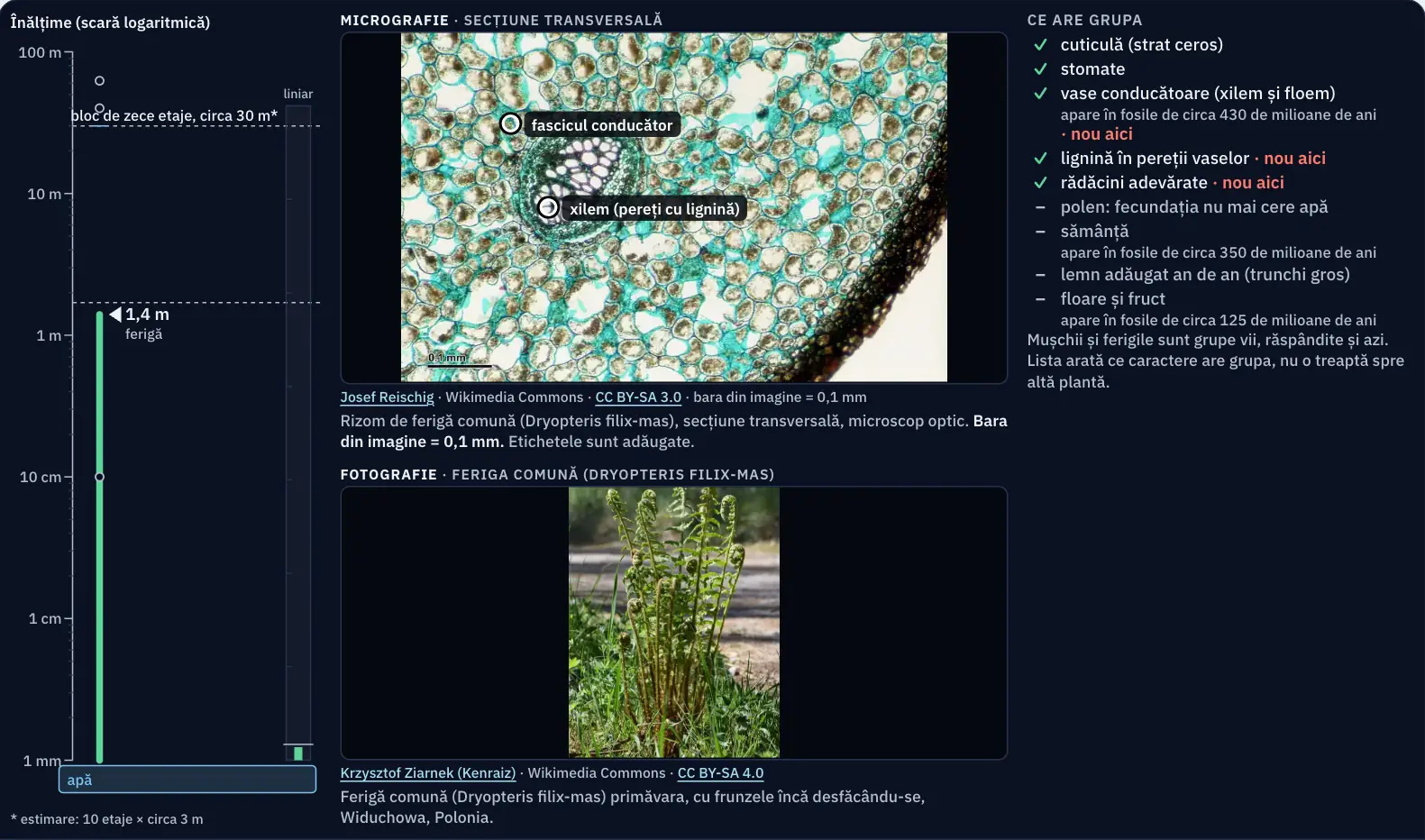
In ferns, conifers and flowering plants, water rises through conducting vessels. Xylem is the tissue that carries water and mineral salts from the root to the leaves. Phloem carries the sugars made by photosynthesis to every part of the plant. The walls of xylem cells are strengthened with lignin, a rigid substance that water cannot pass through. Lignin makes the stem hard and keeps the vessels open. Plants that have xylem and phloem are called vascular plants.
All land plants pass through two generations that follow one another: one that produces gametes (the gametophyte) and one that produces spores (the sporophyte). This sequence is called alternation of generations. In mosses, the green plant you see is the gametophyte; in ferns, the large plant is the sporophyte.
Mosses: no vessels, no lignin, tied to water
Common haircap moss (Polytrichum commune), frequent in damp places in mountain forests, has a tiny stem with tiny green leaves arranged on it in a spiral. It holds on to the soil by rhizoids, thin threads that anchor the plant. Rhizoids are not roots: water and salts enter mainly straight through the tiny leaves. Mosses have no lignin and no true vessels; some species have only simple conducting cells in the tiny stem.
Without vessels, water passes from cell to cell, and that route works only over short distances. Without lignin, the tiny stem cannot hold up a tall body. That is why common haircap moss, one of the largest mosses, is usually 5–10 cm tall and only rarely passes 30 cm.
A moss’s male gametes have flagella and swim to the female gamete through a film of water, after rain or dew, for example. From the zygote, on the tip of the green plant, grows the sporogonium: a thin stalk carrying a capsule in which spores form. The sporogonium does not make all the food it needs by itself and stays attached to the green plant. The spores fall on a damp spot and grow into new plants.
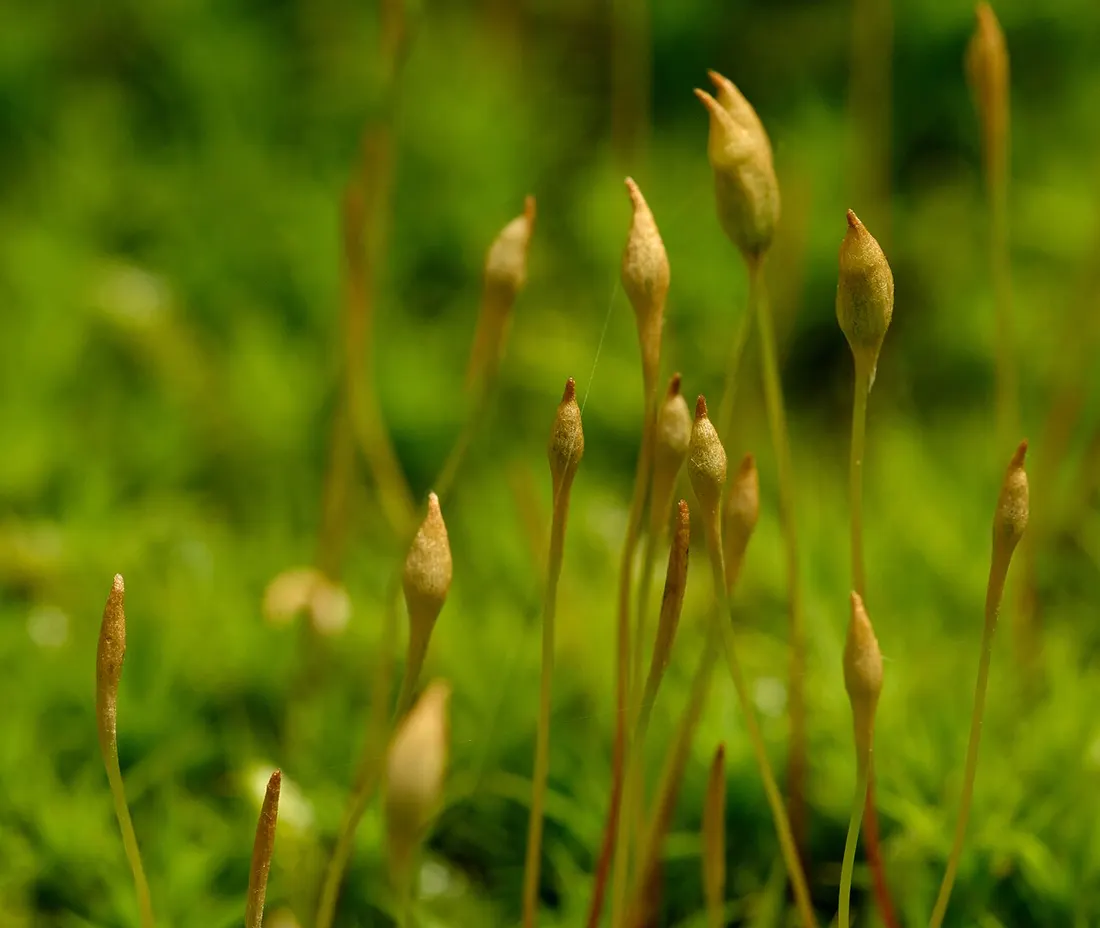
Photo: Marie-Lan Nguyen, CC BY 2.5, source. Cropped and resized.

Ferns: conducting vessels, roots and large leaves
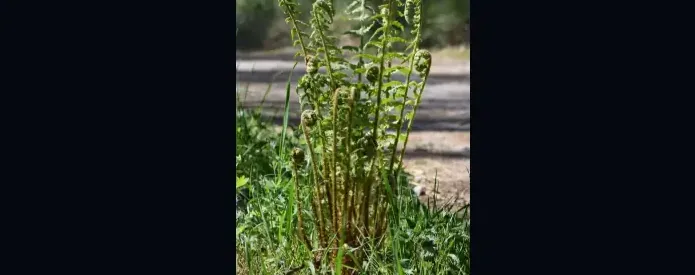
The male fern (Dryopteris filix-mas) has an underground stem, called a rhizome, from which grow roots and a tuft of large, divided leaves up to 140 cm long. The roots, stem and leaves have xylem and phloem. In summer, brown dots appear on the underside of the leaves: these are sori, groups of sporangia in which the spores form.
A spore that falls on damp soil does not grow straight into a fern. It grows into a prothallus, a heart-shaped green plate a few millimetres across, on which the gametes form. The male gamete swims to the female gamete here too, so ferns also need water for fertilisation. A new fern grows from the zygote.
The seedless vascular plants also include field horsetail (Equisetum arvense), with stems divided into nodes and small leaves arranged in rings, and stag’s-horn clubmoss (Lycopodium clavatum), which carries its spores in spikes at the tips of its branches.
From a few centimetres to tens of metres
A plant’s height shows what structures it has. A moss, with no vessels, stays a few centimetres tall. The male fern, with xylem strengthened by lignin, holds up leaves more than a metre long. In the geological period called the Carboniferous, relatives of horsetails and clubmosses formed swamp forests with trees over 30 m tall. The remains of these forests, buried and transformed, became a large part of the world’s coal deposits.
A spruce or fir 50–60 m tall also needs a thick trunk of wood, that is, lignified xylem added year after year. It reproduces by pollen, which carries the male gamete without water, and by seeds, which contain an embryo with a food store and can wait for good conditions to germinate.
For the curious
Peat moss (Sphagnum) has tiny leaves in which large, dead cells with pores take up around 80% of the plant’s volume. Its cell walls make the surrounding water acidic, and its remains rot very slowly. The layer of dead plants that builds up year after year in acidic, oxygen-poor water is called peat. Peatlands cover at least 3% of the Earth’s land, but they hold over 600 billion tonnes of carbon in the soil, more than all other types of vegetation put together, forests included.
| Group | Example | Height (from the sources) | cuticle (waxy layer) | stomata | vascular tissue (xylem and phloem) | lignin in the walls of the vessels | true roots | pollen: fertilisation no longer needs water | seed | wood added year by year (thick trunk) | flower and fruit |
|---|---|---|---|---|---|---|---|---|---|---|---|
| Green alga | Spirogyra (water silk) | no height of its own: water supports its thallus | no | no | no | no | no | no | no | no | no |
| Moss | common haircap moss (Polytrichum commune) | usually 5–10 cm, rarely over 30 cm | yes | in mosses, only on the sporophyte | no | no | no | no | no | no | no |
| Fern | male fern (Dryopteris filix-mas) | fronds up to 140 cm long | yes | yes | yes | yes | yes | no | no | no | no |
| Gymnosperm | silver fir (Abies alba) and Norway spruce (Picea abies) | Norway spruce usually reaches 50–60 m at most; tallest silver fir measured in Romania: 62.5 m | yes | yes | yes | yes | yes | yes | yes | yes | no |
| Angiosperm | pedunculate oak (Quercus robur) and European beech (Fagus sylvatica) | oak and beech usually reach 30–40 m; beech, in some places, up to 50 m | yes | yes | yes | yes | yes | yes | yes | yes | yes |
| Image | What it shows | Scale | Author, licence and changes |
|---|---|---|---|
| Micrograph, green alga | One cell from a filament of Spirogyra (water silk), under the light microscope, with one or more ribbon-shaped chloroplasts twisted into a spiral. Not a section: the filament is a single row of cells joined end to end. | black bar in the corner = 0.02 mm, according to the author’s description | Jon Houseman and Matthew Ford, CC BY-SA 4.0; resized |
| Photograph, green alga | Masses of Spirogyra on the surface and inside a pond of still water (Japan). | – | Phonon.b, CC BY-SA 4.0; resized |
| Micrograph, moss | Cross-section through the stem of a moss (the species is not identified by the author), light microscope. In the centre, a bundle of simple conducting cells without lignin; this is not true vascular tissue. | black bar in the corner = 0.2 mm, according to the author’s description | Jon Houseman and Matthew Ford, CC BY-SA 4.0; resized |
| Photograph, moss | Common haircap moss (Polytrichum commune), seen from above, Bruges, Belgium. | – | Hans Hillewaert, CC BY-SA 4.0; resized |
| Micrograph, fern | Cross-section through the rhizome of the male fern (Dryopteris filix-mas), bright-field light microscope. The vascular bundle has xylem with strengthened walls, surrounded by phloem. | bar in the image = 0.1 mm | Josef Reischig, CC BY-SA 3.0; resized |
| Photograph, fern | Male fern (Dryopteris filix-mas) in spring, its fronds still unrolling, Widuchowa, Poland. | – | Krzysztof Ziarnek (Kenraiz), CC BY-SA 4.0; resized; cropped at the top by 8% of the height |
| Micrograph, gymnosperm | Cross-section through the wood of a three-year-old pine stem (Pinus), light microscope. The wood is made mainly of tracheids, crossed by rays of living cells (parenchyma); the resin canal is surrounded by cells that produce resin. Fir wood is also made mainly of tracheids, but has no resin canals. | no scale bar; magnification under the microscope as stated by the source: 100× | Berkshire Community College Bioscience Image Library, CC0; resized |
| Photograph, gymnosperm | Silver fir (Abies alba) in the Silesian Beskids, Poland. The road at its foot gives an idea of its height. | – | Crusier, CC BY-SA 3.0; resized |
| Micrograph, angiosperm | Cross-section through oak wood (Quercus), light microscope, stained with haematoxylin and safranin. The large, round vessels are in the wood formed in spring; between them are fibres with thick walls and tracheids. | no scale bar; magnification under the microscope as stated by the source: 40× | Berkshire Community College Bioscience Image Library, CC0; resized |
| Photograph, angiosperm | The centuries-old oak of Cajvana, Suceava county (Quercus robur). The people beside the trunk give the scale. | – | Cristian-Mihail Miehs, public domain; resized |


Micrograph and photograph. The micrographs and photographs are real, from Wikimedia Commons, with the author and licence on each image. The heights come from the lessons of the chapter and their sources (for oak and beech, from the European atlas of forest tree species, JRC 2016). The ruler is logarithmic, with a linear strip beside it that keeps the true proportions; the 1.7 m person is a reference mark, and the height of the block of flats is an estimate: 10 storeys × about 3 m. The labels on the micrographs were added. The magnification that the source states for the pine and oak wood refers to the microscope, not to the image on screen.
Sources and credits. Jon Houseman and Matthew Ford, “Spirogyra filaments.jpg”, Wikimedia Commons, file page: source; licence CC BY-SA 4.0, licence text: source; changes: resized. Phonon.b, “Spirogyra water surface and water inside.jpg”, Wikimedia Commons, file page: source; licence CC BY-SA 4.0, licence text: source; changes: resized. Jon Houseman and Matthew Ford, “Moss stem.jpg”, Wikimedia Commons, file page: source; licence CC BY-SA 4.0, licence text: source; changes: resized. Hans Hillewaert, “Polytrichum commune .jpg”, Wikimedia Commons, file page: source; licence CC BY-SA 4.0, licence text: source; changes: resized. Josef Reischig, “Rhizome (255 02) Male fern (Dryopteris filix-mas); cross-section.jpg”, Wikimedia Commons, file page: source; licence CC BY-SA 3.0, licence text: source; changes: resized. Krzysztof Ziarnek (Kenraiz), “Dryopteris filix-mas kz03.jpg”, Wikimedia Commons, file page: source; licence CC BY-SA 4.0, licence text: source; changes: resized; cropped at the top by 8% of the height. Berkshire Community College Bioscience Image Library, “Gymnosperm Stem Resin Duct in Three Year Pinus (36279470746).jpg”, Wikimedia Commons, file page: source; licence CC0, licence text: source; changes: resized. Crusier, “Abies alba Wisła 1.jpg”, Wikimedia Commons, file page: source; licence CC BY-SA 3.0, licence text: source; changes: resized. Berkshire Community College Bioscience Image Library, “Woody Dicot Stem Cross Section Quercus Wood 40x (34991087693).jpg”, Wikimedia Commons, file page: source; licence CC0, licence text: source; changes: resized. Cristian-Mihail Miehs, “Stejarul multisecular din Cajvana.jpg”, Wikimedia Commons, file page: source; in the public domain; changes: resized.
Worked example
How much water peat moss holds
Dried peat moss is sold in flower shops for use in pots. Weigh a handful of dry moss, leave it in a bowl of water for ten minutes, take it out, let it drain for one minute and weigh it again.
Sample calculation, with numbers chosen for the exercise: the dry moss weighs 10 g and the wet moss 160 g. The water held is 160 − 10 = 150 g, that is, 150 ÷ 10 = 15 times the mass of the dry moss.
Repeat with a handful of dry tree leaves or with cotton wool. The difference comes from the dead, empty cells in the tiny leaves of Sphagnum, which fill with water. For a reliable result, repeat three times and work out the mean.
In Romania
Tinovul Mohoș, a peat bog in a crater
In the Harghita Mountains, on the Ciomatu massif, there are two volcanic craters side by side: the younger holds Lake Sfânta Ana, and the older, formed about 50,000 years ago, holds Tinovul Mohoș. “Tinov” is the name used in Transylvania for a peat-moss bog.
The floor of the Mohoș crater once held a volcanic lake. After the last ice age, about 10,000 years ago, the lake was gradually covered by a floating layer of peat moss. Over thousands of years, the remains of this moss turned into peat: today Tinovul Mohoș covers about 80 hectares, the peat is up to 10 m thick in places, and its volume is estimated at about three million cubic metres. The water is very acidic, with a pH between 3.1 and 3.9, and plant remains barely decompose.
The botanical reserve, protected at national level, is home to 20 red-listed plant species, among them the round-leaved sundew (Drosera rotundifolia), a plant that catches insects. Visits are allowed only with a guide, on wooden boardwalks, so that the moss layer is not trampled.
In short
- Land plants have a cuticle and pass through an alternation of two generations: the gametophyte produces gametes, the sporophyte produces spores.
- Xylem carries water and mineral salts from the root to the leaves, phloem carries sugars; lignin strengthens the walls of the vessels and holds the plant up.
- Mosses, such as common haircap moss, have rhizoids, a tiny stem and tiny leaves, have no true vessels and no lignin, and so stay small; the green plant is the gametophyte, and the sporogonium with its capsule produces spores.
- Ferns (the male fern, horsetail, clubmoss) are vascular plants with roots, a stem (often a rhizome) and leaves; spores form in sori, and a prothallus grows from the spore.
- In mosses and in ferns the male gamete swims, so fertilisation needs water.
- Peat moss forms peat, and the Carboniferous forests, with relatives of horsetails and clubmosses, formed coal.
Common mistakes
WrongMoss has little roots that take up water.
RightMoss has rhizoids, which anchor it. Water and salts enter mainly straight through the tiny leaves, and moss has no true conducting vessels.
WrongThe brown dots under a fern leaf are seeds or a disease.
RightThey are sori, groups of sporangia in which spores form. Ferns have no seeds.
WrongBecause it has conducting vessels, a fern no longer needs water to reproduce.
RightThe vessels carry water through the plant. At fertilisation, the fern’s male gamete swims to the female gamete, so it needs a film of water, as in mosses.
Check yourself
Seven questions. For the first six you see the explanation at once, with the paragraph of the lesson that supports it; for the written ones you compare with a good answer.
Why doesn’t a moss grow as tall as a tree?
Answer
b) Because it has no conducting vessels and no lignin to carry water and hold up a tall body. Without vessels, water passes from cell to cell only over short distances; without lignin, the tiny stem cannot hold up a tall body.
What are the sori on the underside of a fern leaf?
Answer
c) Groups of sporangia in which spores form. Ferns reproduce by spores, formed in sporangia grouped into sori.
What does lignin do?
Answer
b) It strengthens the walls of xylem cells, holds the plant up and keeps the vessels open. Lignin is rigid and waterproof. Sugars are carried by the phloem, and moss anchors itself by rhizoids.
Which part of common haircap moss produces spores?
Answer
c) The capsule of the sporogonium. The sporogonium grows from the zygote on the tip of the green plant, and spores form in its capsule. The prothallus belongs to ferns.
A handful of dry peat moss weighs 8 g, and after ten minutes in water it weighs 120 g. How many times greater is the mass of the water held than the mass of the dry moss?
timesAnswer
14 times. Water held: 120 − 8 = 112 g. The ratio: 112 ÷ 8 = 14.
Put each feature with the group it belongs to.
Answer
Mosses only: Rhizoids in place of roots; Sporogonium with a capsule.
Ferns only: Xylem and phloem; Sori on the underside of the leaf.
Both: The male gamete swims in water; Reproduction by spores.
Mosses have rhizoids and a sporogonium; ferns have vessels and sori. Both groups make spores and need water for fertilisation.
Moss grows on a stone wall in town, but ferns don’t. On the wall of a mountain fortress, shady and wet, both grow. Explain what each one needs, and why moss can also live on the drier wall, even though it stays small.
A good answer
Both need water for fertilisation, because the male gamete swims. Moss takes up water straight through its tiny leaves and anchors itself with rhizoids, so it can use the rain and dew that wet the surface of the wall, but without vessels and lignin it stays a few centimetres tall. A fern has roots and vessels that carry water up to large leaves, but its roots need cracks filled with damp soil, which are found mostly on the shady wall.
A complete answer links water to fertilisation in both groups, and names rhizoids and uptake through the tiny leaves in moss, and roots and vessels in the fern.
Practical work for this lesson
- A key for four example plants – Guided identification on cards, 30–40 minutes
Terms
- xylem
- Conducting tissue that carries water and mineral salts from the root to the leaves.
- phloem
- Conducting tissue that carries the sugars made by photosynthesis to every part of the plant.
- lignin
- A rigid, waterproof substance that strengthens the walls of xylem cells and holds the plant up.
- rhizoids
- Thin threads that anchor a moss to the soil; they are not roots.
- sporogonium
- The spore-producing generation of a moss: a stalk with a capsule, grown on the green plant.
- sori
- Groups of sporangia on the underside of fern leaves.
- prothallus
- The small, heart-shaped green plate that grows from a fern spore and on which the gametes form.
- alternation of generations
- The sequence, in a plant’s life, of a generation that produces gametes (gametophyte) and one that produces spores (sporophyte).
Sources and link to the programme
- OpenStax – Biology 2e, 25.1 Early Plant Life – the cuticle, lignin, conducting vessels and plant height; alternation of generations in all land plants
- OpenStax – Biology 2e, 25.3 Bryophytes – mosses: dominant gametophyte, anchoring rhizoids, uptake through the tiny leaves, no lignin or tracheids, simple conducting cells, sporophyte with seta and capsule fed by the gametophyte, male gametes with flagella and dependence on water
- OpenStax – Biology 2e, 25.4 Seedless Vascular Plants – xylem, phloem, lignin and height; ferns: fronds, sori, rhizome, heart-shaped prothallus, swimming gametes; horsetails and clubmosses; Carboniferous trees over 30 m tall and coal deposits
- Flora Finder – Polytrichum commune – common haircap moss is usually 5–10 cm tall and can exceed 30 cm; damp places
- Royal Forestry Society – Male fern (Dryopteris filix-mas), Woodland Plant ID Guide – male fern leaves can reach 140 cm in good conditions
- van Breemen (1995), How Sphagnum bogs down other plants, Trends in Ecology & Evolution – hyaline cells take up about 80% of the volume of peat moss; acidity from the cell walls; very slow decomposition and peat formation
- IUCN – Peatlands and climate change (issues brief) – peatlands cover at least 3% of the land and store over 600 gigatonnes of carbon, more than all other types of vegetation, forests included
- Discover Hargita – Tinovul Mohoș – the area of 80 hectares, the peat layer up to 10 m thick, the volume of about 3 million m³
- Agerpres (19 June 2025) – Harghita: Roua-cerului poate fi admirată în Tinovul Mohoș – the two craters (Sfânta Ana and Mohoș), the age of the crater (about 50,000 years), the lake covered by floating moss after the ice age, pH 3.1–3.9, three million m³ of peat, botanical reserve of national importance, 20 red-listed species, round-leaved sundew, visits on wooden walkways
From the programme: “Plants: red algae, green algae, mosses, ferns, gymnosperms, angiosperms – general features – comparative overview (morphology, nutrition, reproduction), examples of representative species, habitats, importance in ecosystems” (common core). Specific competences addressed: 1.1, 1.2, 2.2.