Chapter 7 · Plants: built for life
What did a plant need to be able to live on land?
- Size
- from 1 mm to 62.5 m
- Level
- organism
- Time
- hundreds of millions of years
At the foot of a spruce tens of metres tall sits a cushion of moss a few centimetres high. Both are green land plants. The ruler beside the text runs from 1 mm to 100 m; at each stop you see, under the microscope, the real stem of the plant and what had to exist for it to stand so high.
Common haircap moss rarely grows taller than 30 cm
Common haircap moss (Polytrichum commune), one of the largest mosses, is usually 5–10 cm tall and only rarely grows past 30 cm. The dotted line on the ruler is a person 1.7 m tall.
The green band shows how tall it usually grows, and the small tick above it, the tallest ever found.
Why is there no moss as tall as a person?
In water, an alga needs neither a skeleton nor pipes
Spirogyra (water silk) forms green masses in ponds, made of filaments of cells joined end to end, each cell with one or more chloroplasts twisted into a spiral. Its body is called a thallus: it has no root, stem, leaves or vascular tissue.
Water supports its body and brings it mineral salts. Taken out of the water, the alga collapses and dries out: it has no supporting tissue and no cuticle.
Green algae are close relatives of land plants. An alga is not an unfinished tree: it is suited to life in water.
A moss has a cuticle, but no true vascular tissue and no lignin
On land, a plant loses water by evaporation. A moss has a cuticle on its surface, a waxy layer that slows the loss of water. Stomata, the pores that open and close, appear in mosses only on the sporogon, the sporophyte.
In the micrograph, the centre of the stem has only simple conducting cells, as the author of the image marked them. Without vascular tissue, water passes from cell to cell, and this route works well only over short distances. Without lignin, the stem has nothing to support a tall body. These two missing features limit the height of mosses.
The first bryophytes, the liverworts, relatives of the mosses, probably appeared about 450 million years ago. Mosses still live today, from the foot of spruce trees to peat bogs.
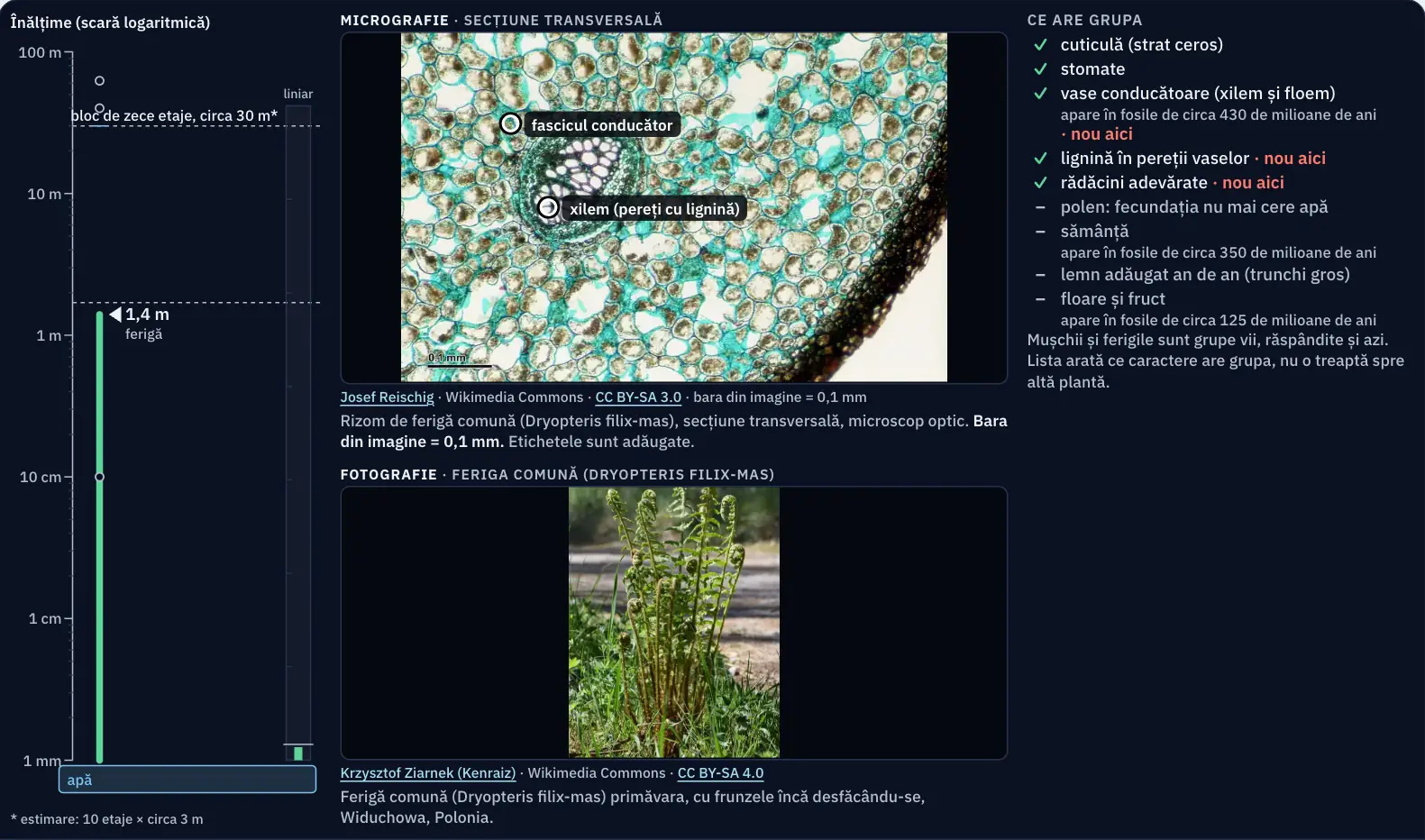
With vascular tissue and lignin, the fern lifts fronds up to 140 cm long
The male fern (Dryopteris filix-mas) has true roots, an underground stem called a rhizome, and fronds up to 140 cm long. The micrograph of the rhizome shows a vascular bundle.
Xylem carries water and mineral salts from the roots towards the leaves, and lignin makes its walls hard and keeps them open. The first fossils with vascular tissue are about 430 million years old.
A fern has no seeds: it multiplies by spores, formed in sori, the brown dots on the underside of the fronds. The male gamete swims to the female gamete, so fertilisation needs water. That is why ferns grow mostly in damp, shaded places.
Pollen and seed cut reproduction loose from water
Silver fir and spruce are gymnosperms: the ovules, and later the seeds, sit uncovered on the scales of the cone, not enclosed in an ovary. Pollen carries the male gamete without water, and the seed holds an embryo, food for it and a protective coat. The first seed plants appear in fossils about 360 million years old.
Pollination, the transport of pollen, and fertilisation, the union of gametes, are two separate steps: in pine, fertilisation takes place more than a year after pollination.
To reach 50–60 m, the height a spruce usually attains, a plant also needs a thick trunk of wood: xylem with lignin, added year after year. The wood of conifers is made mainly of tracheids; the micrograph shows pine wood, with a resin canal.
The tallest silver fir measured in Romania until then stood at 62.5 m: at Șinca Veche, Brașov county, measured in 2013, according to HotNews, a Romanian news site, which quotes the team of “Ștefan cel Mare” University of Suceava and WWF Romania.
Flower and fruit are about reproduction; height is about wood
Oak and beech, which form the forests of the hills, are angiosperms: they have flowers, and their ovules are enclosed in the ovary, which after fertilisation becomes a fruit. The first flowering plants appear in fossils about 125 million years old.
Oak wood has, besides fibres and tracheids, wide vessels: the round holes in the micrograph.
On the ruler, the oak does not outgrow the fir. A group that appeared later has other characters, without being “taller” or “better”; mosses, ferns and conifers live alongside it.
Now explain it yourself: trees without seeds
In the period called the Carboniferous, relatives of horsetails and clubmosses formed swamp forests with trees over 30 m tall. They had no seeds and no pollen.
What allowed them to grow so tall? And why did they live in swamps?
Compare with an answer
They had vascular tissue with lignin: the vessels lifted the water to the top, and the lignin strengthened the stem. Height depends on vascular tissue and lignin. Without pollen and seeds, the male gamete had to swim, so fertilisation needed water: that is why they grew in wet places.
The lesson on gymnosperms: the seed, pollen and the conifers of Romania


