Chapter 1 · Method and the microscopeLesson 1.1
The scientific method: from observation to hypothesis and conclusion
Where do the maggots on a piece of meat left outside come from, and how can you find out for certain, without guessing?
- Size
- from 1 mm to 1 nm
- Level
- cell and cell structures
- Time
- one lesson in the lab
Before you read: what do you think?
In 1668 Francesco Redi put meat into six jars: two left open, two covered with gauze, which lets air through, and two sealed tight. In which jars did maggots appear on the meat?
See the answer
Only in the open jars. The gauze let air through but kept the flies out, and the meat beneath it stayed free of maggots. Air was not the cause: the maggots were fly larvae, hatched from eggs laid on the meat.
Leave a piece of meat uncovered in summer and within a few days white maggots are wriggling on it. From Antiquity until the 17th century, many learned people concluded that maggots are born from rotting meat. In 1668 the Italian physician Francesco Redi put the idea to the test with six jars and showed that it was wrong.
What you observed and what you think explains it
An observation is what you notice directly, with your senses or with an instrument: “maggots appeared on the uncovered meat”, “plant A is 18 cm tall, plant B is 12 cm”. A good observation says what, where, when and, if possible, how much. An explanation tries to answer the question “why?”: “the maggots were born from the meat”, “plant A got more light”. You check an observation by looking again; an explanation has to be put to the test.
The same observation can have several explanations. Two plants on a windowsill may differ in height because they got different amounts of light, but also because they were sown on different days, are different varieties or were watered differently. That two things happen together does not show that one causes the other.
The idea that a living organism can arise from non-living matter, from rotting meat for instance, is called spontaneous generation. The Greek philosopher Aristotle set it out in the 4th century BC, and in the Middle Ages it was widely accepted, because everyday observations seemed to confirm it.
The question, the hypothesis and the prediction
Research starts from a testable question, one that can be answered by observation or by experiment. “What is life?” is not such a question. “Do maggots appear on meat if flies cannot reach it?” is one: it says what changes (whether flies can get to the meat) and what is watched (whether maggots appear).
A hypothesis is a proposed explanation for an observation, one that can be tested. Redi’s hypothesis was that the maggots come from eggs laid on the meat by flies. It must be possible to prove a scientific hypothesis wrong: there must be a result which, if it turns up, shows that the hypothesis is wrong. A claim such as “maggots appear because of a force that cannot be detected” cannot be tested, so it is not a scientific hypothesis.
A prediction follows from the hypothesis, usually written in the form “If…, then…”: if the maggots come from flies’ eggs, then meat the flies cannot reach will stay free of maggots. The prediction states in advance what should be observed, and the result of the experiment is compared with it.
Redi’s six jars
Redi put meat into six jars. Two were left open, two were covered with gauze and two were sealed tight. Maggots appeared only in the open jars. In the gauze-covered jars and the sealed ones, the meat stayed free of maggots.
The gauze-covered jars answered an objection. Someone could have said that no maggots appear in the sealed jars because there is no air. Gauze lets air through and keeps flies out. Since no maggots appeared there either, air was not the explanation; what made the difference was whether flies could reach the meat.
Redi concluded that maggots are fly larvae and appear only if flies can lay their eggs on the meat. The open jars, left in ordinary conditions, were the standard of comparison for the others. Redi’s experiment was one of the first to contradict spontaneous generation.
The stages of the scientific method
The scientific method is the way a problem is investigated in the natural sciences: you start from observations, and explanations are tested against data. Its stages, in order, are: observation, question, hypothesis, prediction, experiment, data analysis, conclusion and communication of the results.
The conclusion says whether the results support or disprove the hypothesis, and only for the conditions tested. A single experiment does not prove a hypothesis for ever: it makes it more credible or rejects it. If the hypothesis is disproved, the researcher proposes another and goes through the stages again. An unexpected result can change the question itself, so in practice the stages do not always run in a straight line.
Communication, through papers, books or talks, makes results checkable: other researchers can repeat the experiment and may or may not get the same result.
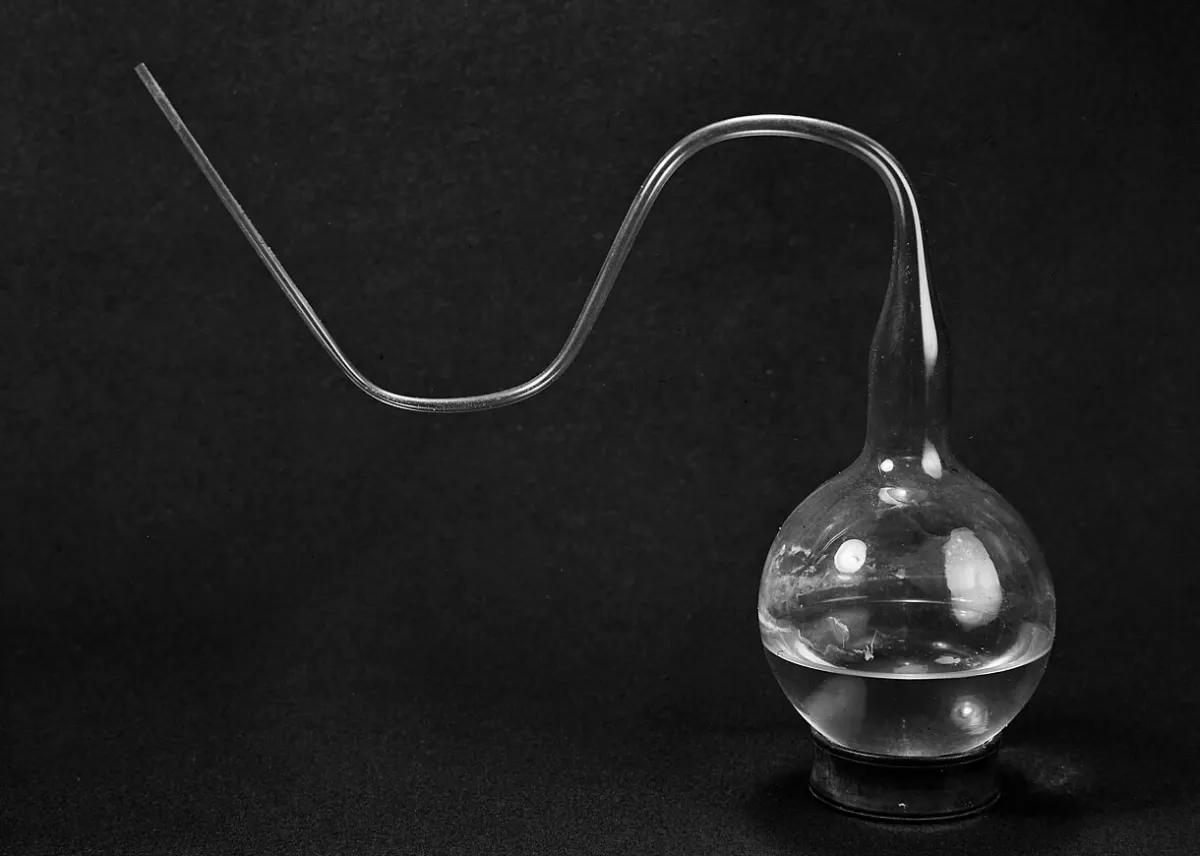
Photo: Wellcome Images, CC BY 4.0, source. Lightly cropped and resized.

Worked example
Spot the stages in Pasteur’s experiment
Observation: broth that has been boiled and left open to the air turns cloudy after a few days, because microorganisms multiply in it. Question: where do they come from, if boiling had killed those in the broth?
Louis Pasteur’s hypothesis: microorganisms get into the broth from the air. Prediction: if air reaches the broth but the microorganisms in the air are stopped on the way, the boiled broth stays clear.
Experiment: Pasteur boiled broth in flasks with long, curved necks, known as “swan-necked” flasks. Air could move in and out, while microorganisms got trapped in the bends of the neck. Result: as long as the neck stayed intact, the broth stayed sterile; once the neck was broken, microorganisms got in and the broth turned cloudy.
Conclusion: the microorganisms in the broth come from other microorganisms, carried by the air. Communication: in 1862 the Paris Academy of Sciences awarded Pasteur the Alhumbert Prize for these experiments, and in 1864 he summed up the conclusion in a lecture: life comes only from life.
In Romania
Victor Babeș and the cattle with red urine
Victor Babeș (1854–1926), a physician born in Vienna, moved to Bucharest in 1887, where he founded the departments of pathological anatomy and of bacteriology at the Faculty of Medicine. That same year the Institute of Bacteriology and Pathology was set up in Bucharest; today it is the “Victor Babeș” National Institute. In 1885 he had published in Paris, together with André Victor Cornil, a treatise on bacteriology that won a prize from the French Academy of Sciences.
In 1888 Babeș studied sick cattle in Romania that were passing red urine (haemoglobinuria), a sign that their red blood cells were being destroyed. His observation: under the microscope, the red blood cells of the sick animals contained microorganisms. His proposed explanation: these microorganisms cause the disease.
Others tested the hypothesis and added to it. Between 1889 and 1893, researchers in the United States showed that the parasite behind a similar cattle disease in Texas is carried by ticks. In 1893 the parasite was named Babesia bovis, after Babeș.
In short
- An observation describes what you notice, with your senses or with instruments; an explanation proposes a reason and has to be tested.
- A testable question says what changes and what is watched; a hypothesis is a proposed explanation that can be tested and disproved.
- A prediction is written “If…, then…” and says in advance what should be observed if the hypothesis is right.
- The stages of the scientific method are: observation, question, hypothesis, prediction, experiment, data analysis, conclusion and communication of the results.
- Redi (1668) used open, gauze-covered and sealed jars to show that the maggots on meat come from flies’ eggs; Pasteur used swan-necked flasks to show that the microorganisms in broth come from the air.
- A conclusion supports or disproves the hypothesis only for the conditions tested; a single experiment does not prove it for ever.
Common mistakes
WrongThe hypothesis is the definite answer to the question, and the experiment just confirms it.
RightThe hypothesis is a proposed explanation, and it may turn out to be wrong. The experiment can support it or disprove it.
WrongIf maggots always appear on rotten meat, the meat must be producing them.
RightTwo things happening together do not show a cause. Redi showed, by comparison, that maggots appear only where flies can reach the meat.
WrongIf the experiment came out as you predicted, the hypothesis is proved for ever.
RightA favourable result makes the hypothesis more credible, and only for the conditions tested. Later experiments may contradict it.
Check yourself
Seven questions. For the first six you see the explanation at once, with the paragraph of the lesson that supports it; for the written ones you compare with a good answer.
Which of these statements is an observation?
Answer
b) Plant A is 18 cm tall and plant B is 12 cm. The measured heights describe what can be seen. The other options propose a reason or a general rule and would need to be tested.
What was the job of the gauze-covered jars in Redi’s experiment?
Answer
c) They let air in and kept flies out, to see whether air produces the maggots. The gauze separated the two factors: air got in, flies did not. The meat stayed free of maggots, so air was not the cause.
Which of the sentences below is a scientific hypothesis?
Answer
c) The maggots on meat come from eggs laid by flies. The hypothesis about flies’ eggs proposes an explanation and can be disproved: if maggots also appeared on covered meat, it would be wrong. The first option cannot be tested, and the other two are observations.
What happened to the broth in Pasteur’s flasks after their necks were broken?
Answer
b) It turned cloudy, because microorganisms from the air reached it. With the neck intact, microorganisms stayed trapped in the bends. Once it was broken, they reached the broth and multiplied.
Put the stages of the scientific method in order.
Answer
The correct order:
- Observation
- Question
- Hypothesis
- Prediction
- Experiment
- Conclusion
The observation gives rise to the question; the hypothesis proposes an answer; the prediction says what should be observed; the experiment tests it; the conclusion compares the result with the hypothesis.
Sort the statements: observations or explanations?
Answer
Observation: The broth in the open flask turned cloudy after three days; The sick cattle pass red urine; In the sealed jars, the meat has no maggots.
Explanation: Microorganisms got into the broth from the air; The microorganisms in the red blood cells cause the disease.
Observations describe what is noticed; explanations say why it happened and have to be tested.
A pupil notices that mould appears sooner on bread kept in a bag somewhere warm than on bread kept in the fridge. Write a testable question, a hypothesis and a prediction in the form “If…, then…”.
A good answer
Question: does mould appear sooner on bread at room temperature than at fridge temperature? Hypothesis: a higher temperature makes the mould spores on the bread develop faster. Prediction: if I keep slices of the same loaf in identical bags, one somewhere warm and one in the fridge, then mould will appear first on the warm slice.
A complete answer names what changes (the temperature) and what is watched (the day mould appears), gives an explanation that could turn out wrong and a prediction in the form “If…, then…”.
Terms
- observation
- Something noticed directly, with the senses or with an instrument, about an object or an event.
- testable question
- A question that can be answered by observation or by experiment, because it says what changes and what is watched.
- hypothesis
- A proposed explanation for an observation, which can be tested and disproved.
- prediction
- The result expected if the hypothesis is right, usually written in the form “If…, then…”.
- conclusion
- The statement of whether the results support or disprove the hypothesis, for the conditions tested.
- scientific method
- The sequence of stages by which a problem is investigated: observation, question, hypothesis, prediction, experiment, analysis, conclusion, communication.
- spontaneous generation
- The idea, disproved by experiment, that living organisms can arise from non-living matter.
Sources and link to the programme
- OpenStax – Biology 2e, 1.1 The Science of Biology – the stages of the scientific method; the hypothesis as an explanation that can be tested and disproved; the “If…, then…” prediction; the real process is not linear
- OpenStax – Microbiology, 3.1 Spontaneous Generation – Aristotle and spontaneous generation; Redi’s 1668 experiment (six jars: two open, two with gauze, two sealed; maggots only in the open ones); Pasteur’s swan-necked flasks, the 1862 Alhumbert Prize, the 1864 lecture
- CDC – Emerging Infectious Diseases (2024), Victor Babeș – Babeș: born in Vienna in 1854, died in Bucharest in 1926; the treatise with Cornil and the Montyon Prize; the move to Bucharest in 1887 and the departments he founded; the 1887 institute; microorganisms in the red blood cells of cattle (1888), haemoglobinuria; ticks (1889–1893) and the 1893 name
From the programme: “The scientific method. Research ethics. Observation and experiment in biology: formulating the hypothesis, defining the variables, choosing the methods, collecting and analysing the data, formulating conclusions, communicating the results” (common core). Specific competences addressed: 1.1, 1.2, 2.2.