Atlantic · locks · Pacific
The Panama Canal: six locks lift ships across an isthmus
A ship climbs to Gatun Lake, crosses the continental divide and descends to the Pacific. Its passage explains why the French sea-level plan gave way to locks, and why freshwater now limits traffic.
The gate closes behind the freighter. Water enters the chamber; the ship rises with it. Ahead, Gatun Lake waits about 26 metres above sea level.
One transit, six steps
Rise by steps. Cross the lake. Descend to the ocean.
The canal is about 80 kilometres long. The profile follows the lock sequence, not exact distances or elevations.
Three locks lift the ship
The gates close and freshwater flows into the chambers. The ship rises with the water, one step at a time.
Sources: S02
Through Gaillard Cut
The canal cuts through the divide at Culebra, also called Gaillard Cut. Slopes slide; shovels and trains keep earth moving out of a channel that must stay navigable.
Sources: S03
One step down
At Pedro Miguel, one lock lowers the ship from Gatun Lake toward Miraflores Lake.
Sources: S02
Two more steps
At Miraflores, two locks finish the descent. A Panamax ship may be 294.1 metres long and 32.3 metres wide; those are vessel dimensions, not chamber clearance.
Sources: S02
Atlantic entranceThe transit begins at the Atlantic entrance.
The problem behind the shape
Why lift ships instead of cutting through the whole isthmus?
THE DIVIDE
The ridge sets the problem
A sea-level cut meets the terrain and the Chagres.
The continental divide crosses Panama. The Chagres River can turn a worksite into floodplain; a sea-level canal would have needed a deep cut through the divide and control of the river.
GATUN
Water becomes the stair
The dam holds water; the chamber lifts the ship with it.
Locks change the problem. Gatun Dam holds water in a lake; the chambers lift ships with that water and carry them over the isthmus. The system does not bypass the terrain. It uses it.
THE CHOICE
The board advises; Roosevelt decides
In 1906, locks win a disputed choice.
In 1906, a majority of the U.S. Board of Consulting Engineers recommended a sea-level canal. President Theodore Roosevelt chose locks. There was no unanimous lesson learned from the French failure: the American choice remained contested.
The elegant solution carries a dependency with it: every lift releases freshwater from the lake.
Two campaigns, two projects
The French dug for sea level; the Americans chose a lake and locks
FIRST CAMPAIGN
A ceremonial gesture starts in 1880
Lesseps bets on a sea-level canal.
In 1880, French work begins with a ceremonial first earthwork. The company campaign runs from 1881 to 1889; digging at Culebra begins on 20 January 1882. Ferdinand de Lesseps rejects lock and tunnel schemes in favour of a sea-level canal.
THE COST
Ground and finances give way
Legal dissolution follows the shareholders’ vote.
Tropical rain, unstable ground, landslides, disease, workforce turnover, optimistic estimates and financial weakness accumulate. A late switch to locks cannot save the company. The company’s finances fail in late 1888. Shareholders vote for dissolution in January 1889; legal dissolution and liquidation follow on 4 February.
THE SCANDAL
The scandal comes after the works
Baïhaut’s conviction does not extend to others.
Engineering failure and financial scandal are separate beats. The political scandal breaks later, in 1892–93. Former public-works minister Charles Baïhaut was convicted in 1893 after admitting he received money; allegations against others do not become convictions by association.
VOLUMES
Two campaigns, two excavation totals
Cubic yards record excavation; they do not count lives.
The U.S. company resumes work in 1904. By 1 July 1914, it reports 238,845,587 cubic yards excavated; the French campaign excavated about 30 million cubic yards. Those totals belong to separate campaigns and do not, on their own, say how many lives each cost.
French company
Ceremonial first earthwork.
French company campaign begins.
Digging begins at Culebra.
Legal dissolution and liquidation.
U.S. project
The United States resumes work.
Roosevelt chooses locks after a majority recommends sea level.
Alexander La Valley makes the first complete passage by a self-propelled ocean-going vessel.
Ancon makes the official opening transit.
After opening
The Torrijos–Carter treaties are signed.
At noon, final operational and administrative control passes to Panama.
Agua Clara and Cocolí open; COSCO Shipping Panama makes the first transit through the new locks.
These are dated milestones; the two campaigns’ excavation volumes and death records remain separate measures. Any French–U.S. alignment is schematic, not an exact historical alignment.
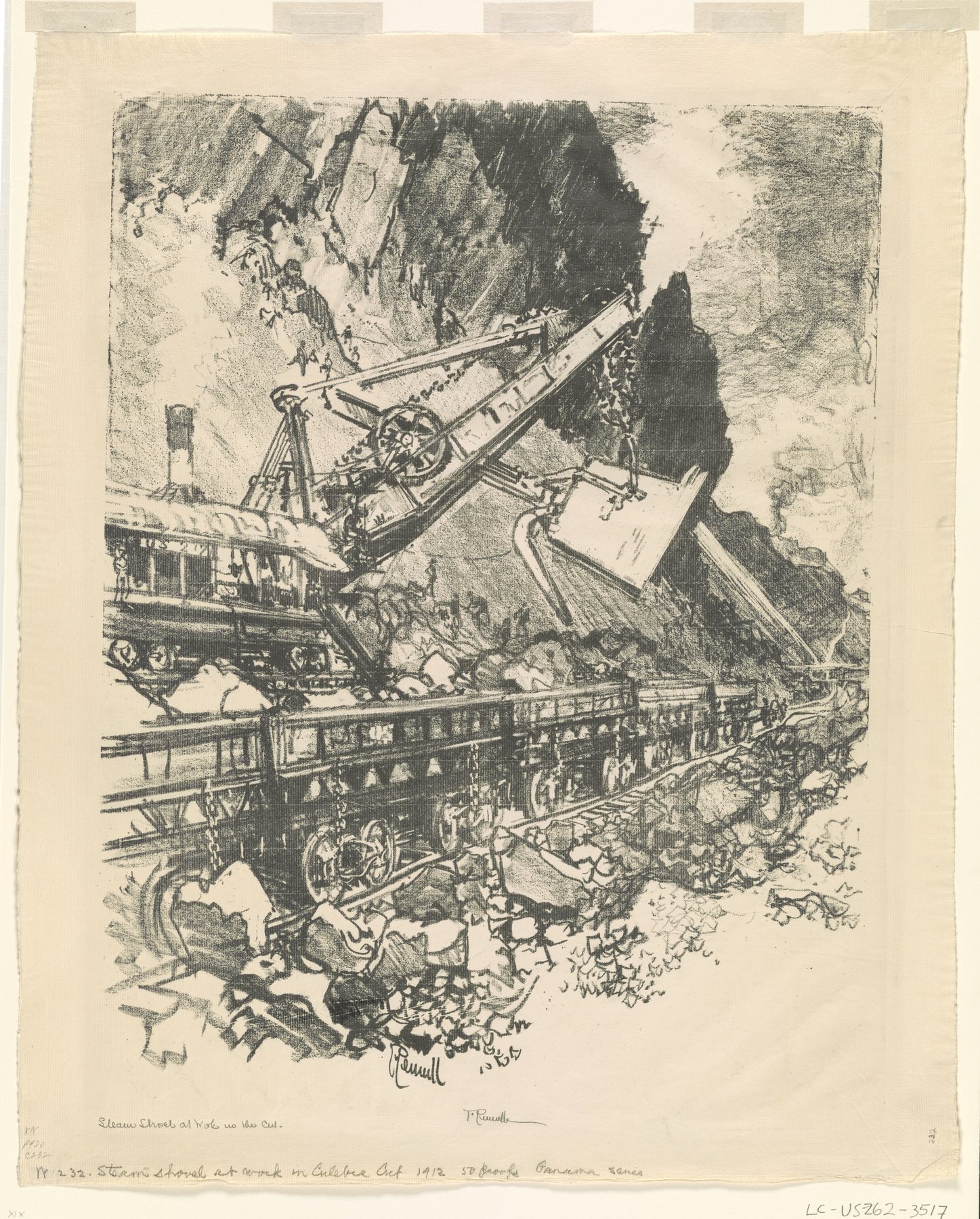
Pennell’s signed lithograph shows a steam shovel at work in the Culebra Cut.
Joseph Pennell· 1912· Public domain·Wikimedia Commons

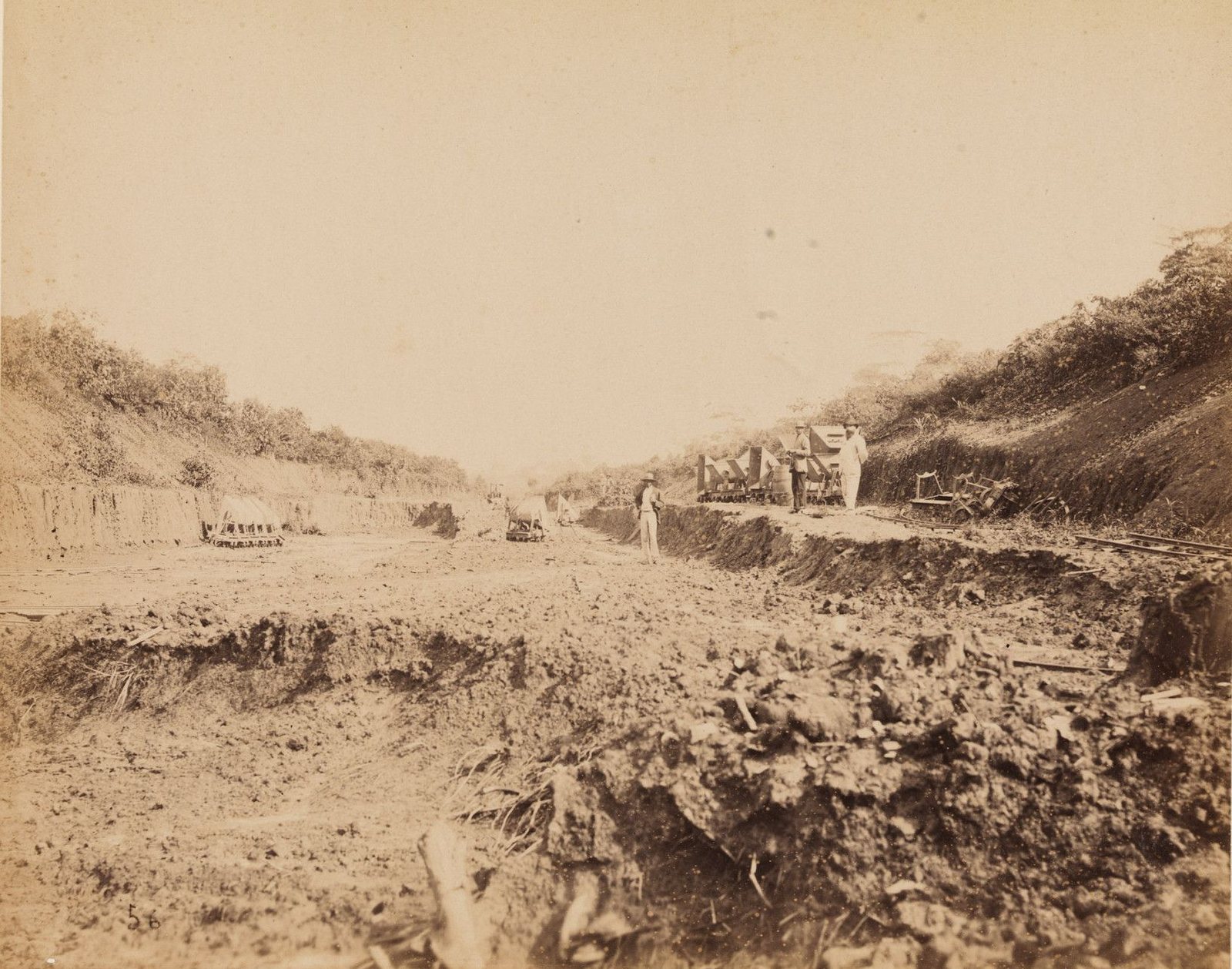
A French worksite from the sea-level canal campaign.
Unknown photographer· August 1886· Public domain·Wikimedia Commons
.jpg)
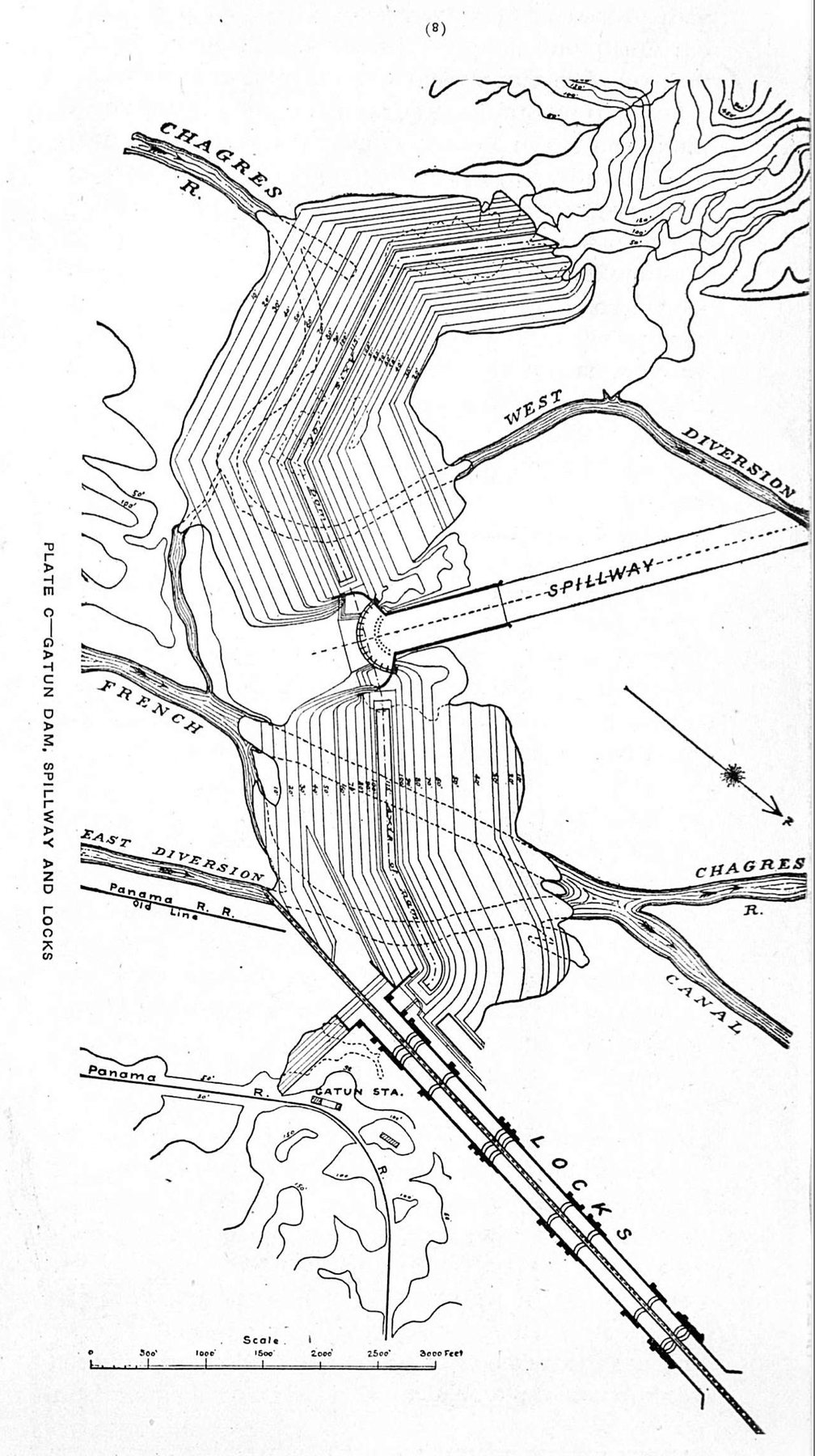
Plate C, a site plan in the 1913 handbook, draws Gatun Dam and the spillway separately from the locks.
Secretary of the Isthmian Canal Commission· 1913· Public domain·Wikimedia Commons

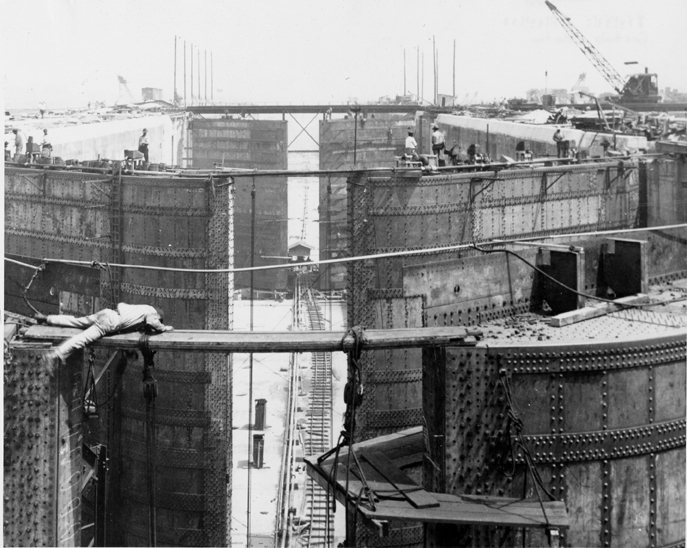
The lock takes shape as a passage with gates.
Unknown author· 12 March 1912· Public domain·Wikimedia Commons

Instead of one endless cut, the U.S. project raises a lake — and moves the argument from earth to water.
Workers and records
How many lives did the projects cost? The records measure different things
THE REGISTER
One register counts deaths in hospital
Ancon records people who died there.
Two incompatible totals are often given for the French campaign. The Ancon Hospital register records 5,527 deaths in the hospital from 1881 to 1888.
THE ESTIMATE
Gorgas estimates a wider total
Incomplete information does not become a census.
William Gorgas estimated 22,189 labourer deaths in 1881–89 from incomplete information. That estimate is not a census, and it does not mean the dead were French nationals. The true total is unknown.
U.S. CAMPAIGN
Deaths are not a rate
5,609 deaths and 56,307 workers are different measures.
For U.S. construction, the Panama Canal Authority reports 5,609 deaths from disease and accidents. Separately, 56,307 people worked on the project during 1904–13. That employment count is not a person-years denominator and should not be divided into the deaths to produce a comparable rate.
THE METHODS
Gorgas changes the ground game
Havana supplies methods against mosquitoes.
William Gorgas brought methods used in Havana: draining standing water, larvicide, oiling water surfaces, screening, fumigation and inspection.
THE REPORT
Yellow fever leaves one last uncertainty
Cases and deaths belong to a defined reporting period.
The U.S. Public Health Service report for 1 July 1904–4 February 1905 records 32 yellow-fever cases and nine deaths. The last reported Panama City case was in November 1905; the diagnosis of the final Colón case in May 1906 is uncertain.
Deaths recorded at the hospital; not a workforce total.
Incomplete estimate, not a census or a nationality count.
Deaths from disease and accidents; a different campaign and record.
Water kept the works moving; it was also where a public-health campaign had to begin.
Independence and treaty
The canal crosses Panama; engineers were not the only people making decisions
INDEPENDENCE
Panama proclaims independence
On 18 November, a nonresident negotiator signs for the provisional government.
Panama proclaims independence on 3 November 1903. The Hay–Bunau-Varilla Treaty is signed on 18 November: Philippe Bunau-Varilla, a French canal promoter and nonresident negotiator, signs for Panama’s provisional government.
POWER
The treaty carries a power imbalance
Local aspiration and outside pressure share the record.
The independence movement was local. U.S. naval presence constrained Colombia’s response, while the treaty gave the United States highly unequal terms over the Canal Zone. Saying Washington simply “created” Panama erases Panamanian aspirations; saying the treaty was made without coercion erases the balance of power.
HANDOVER
Control passes in stages
Two treaties begin a transition that ends in 1999.
Two Torrijos–Carter treaties are signed on 7 September 1977. The transition begins then; the Canal Zone ends in 1979, and the final operational and administrative handover takes place at noon on 31 December 1999.
Original English transcription
Isthmian Canal Convention.
Preamble
The United States of America and the Republic of Panama being desirous to insure the construction of a ship canal across the Isthmus of Panama to connect the Atlantic and Pacific Oceans, […]
Article I. The United States guarantees and will maintain the independence of the Republic of Panama.
Article II. The Republic of Panama grants to the United States in perpetuity the use, occupation and control of a zone of land and land under water for the construction, maintenance, operation, sanitation and protection of said Canal of the width of ten miles …
concluded and signed by their respective Plenipotentiaries at Washington, on the eighteenth day of November, one thousand nine hundred and three
Nearly a century later, Panama takes over the canal — but the ship that made the first passage arrived much earlier.
Two dates, two firsts
La Valley crosses first; Ancon makes the official opening transit
THE FIRST PASSAGE
La Valley completes the first crossing
A self-propelled ocean-going vessel passes on 7 January.
On 7 January 1914, Alexander La Valley becomes the first self-propelled ocean-going vessel to make a complete passage. On 15 August, Ancon makes the official opening transit.
THE OPENING
Ancon makes the official transit
15 August is another first, on another date.
The grand celebration planned for the opening is curtailed as the First World War begins. In photographs, Ancon can look like the start of the story; the chronology gives it its exact place: the official opening passage, not the first complete transit.
THE CHAMBER
A narrow margin, measured in metres
Chamber dimensions are not ship dimensions.
The original lock chambers are 304.8 metres long and 33.53 metres wide. A Panamax ship measuring 294.1 by 32.3 metres fits with little room to spare, but chamber dimensions are not vessel dimensions. The canal is about 80 kilometres from sea to sea.
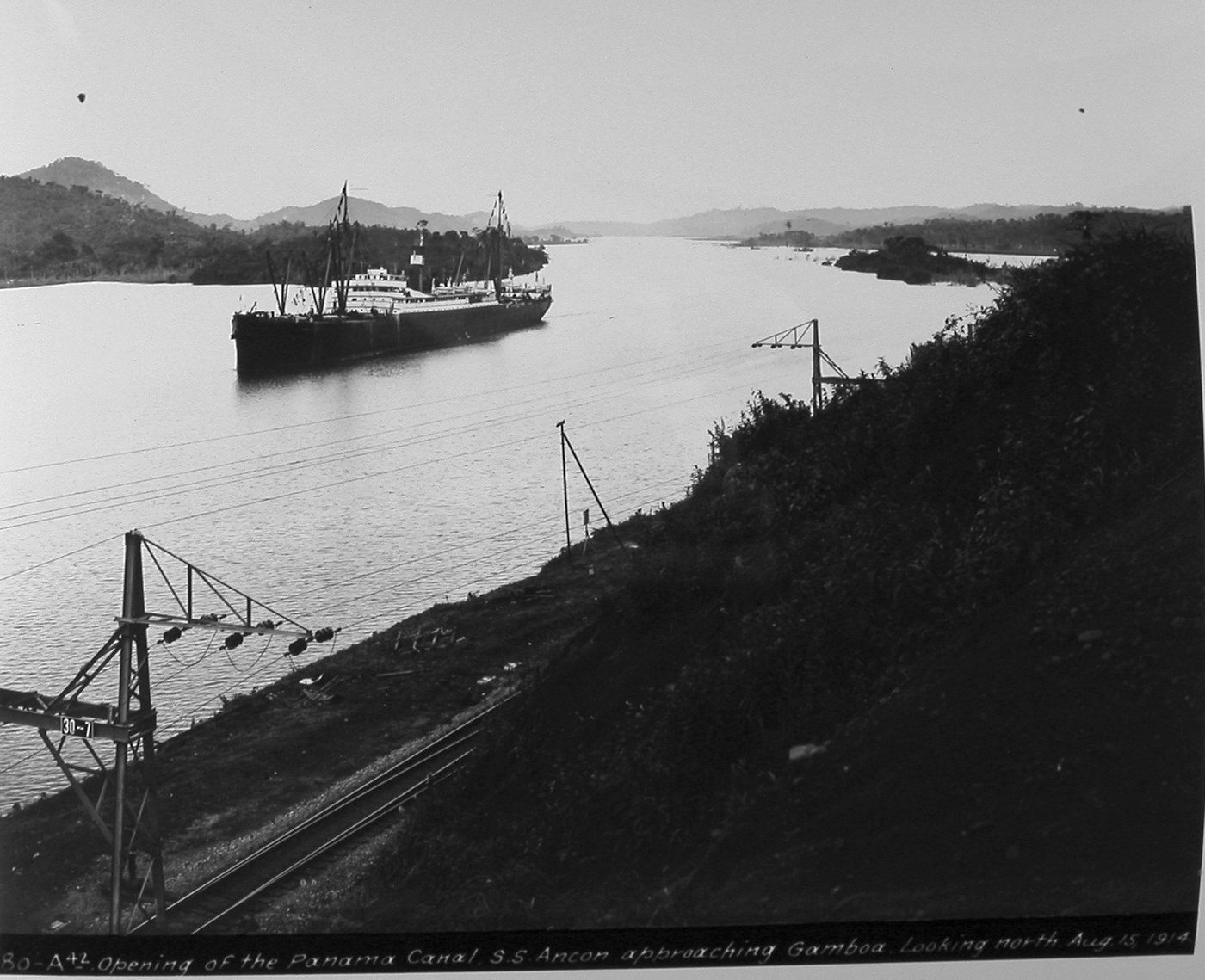
Ancon approaches Gamboa on 15 August 1914, during the official opening transit.
Panama Canal Company· 15 August 1914· Public domain·Wikimedia Commons

Bars compare lengths; each pair lists length × width.
A century later, the canal widens its chambers — without escaping the water budget.
A wider passage
In 2016, a second scale of locks opens
THE OPENING
Agua Clara and Cocolí enter service
A COSCO transit opens the new route on 26 June.
Agua Clara and Cocolí open on 26 June 2016. COSCO Shipping Panama makes the first transit of the new route. The larger chambers change which vessels can pass; they do not change the canal’s dependence on freshwater.
THE PROGRAMME
A programme estimate is not a contract
One covers the full programme; one covers the new locks.
A 2006 estimate for the full programme was in the US$5.25 billion class. The new-lock contract was about US$3.1 billion.
CAPITALIZATION
ACP reports capitalization separately
Fiscal year 2016 is the scope of this figure.
ACP-reported capitalization for the expansion in fiscal year 2016 was B/.5.676 billion.
THE CLAIM
A claim is not the final cost
GUPC claimed; a separate 76-day claim was rejected.
In 2014, GUPC claimed US$1.6 billion in additional costs; a later, separate dispute rejected one US$98,988,574 claim covering 76 days. These figures have different scopes and reporting dates; they cannot be subtracted to produce one definitive “overrun”.
THE NEW CHAMBERS
NeoPanamax gets a larger chamber
427 by 55 metres measures the lock, not a ship.
A NeoPanamax vessel can use the new 427-by-55-metre chambers. Those are chamber dimensions, not the dimensions of a particular ship.
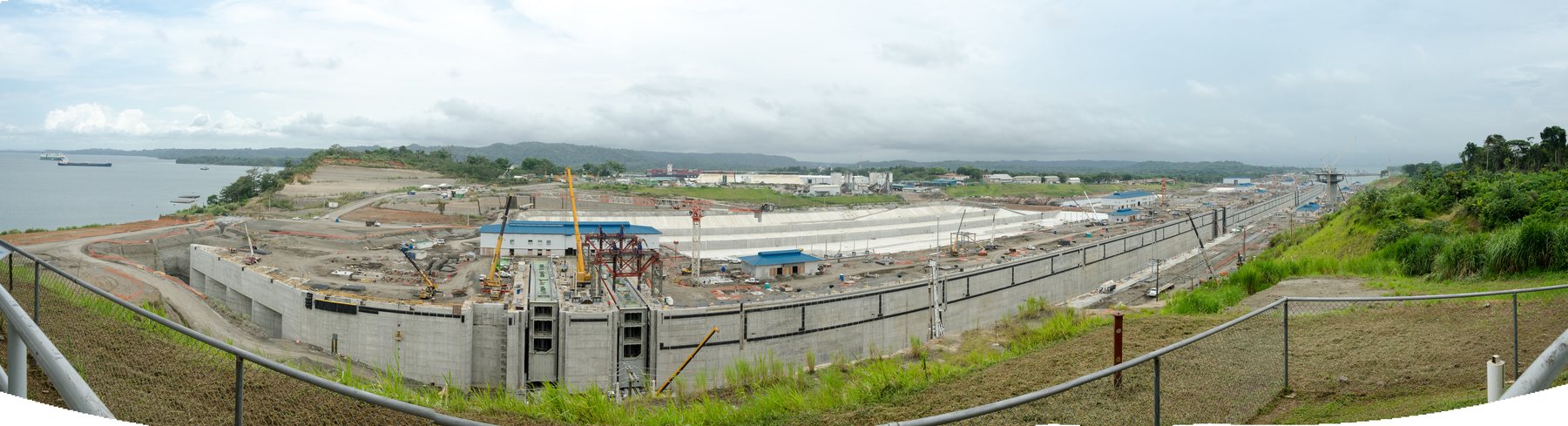
The Agua Clara site belongs to the expansion project inaugurated in 2016.
Keith Yahl· 9 July 2015· CC BY 2.0·Wikimedia Commons
.jpg)
The gates are larger. Every passage still draws on a measure of water.
Freshwater infrastructure
The canal has a water budget, and each number has a date
THE CAP
Drought tightens the schedule
Planned bookings and announced transits are not the same measure.
On 30 July 2023, ACP cuts daily transits from 36 to 32. A booking plan in autumn 2023 would have fallen to 18 a day from 1 February 2024; November rain changes the plan. ACP reports 22 scheduled slots a day in late 2023, then 24 a day from 16 January 2024. The 18-slot level was not reached.
DRAFT
The draft limit rises again
45 ft in May; 50 ft from 15 August 2024.
In May 2024, the maximum permitted draft rises to 45 feet. From 15 August 2024, the limit rises to 50 feet; from 1 September, scheduled reservations reach 36 transits a day.
THE BUDGET
The lake pays for every lift
Lock water has a separate salinity allocation.
In fiscal year 2024, Gatun Lake’s average level is 81.98 feet, and water used for locks totals 2,015 cubic hectometres: 1,943 for lockages and 72 for salinity mitigation. ACP says the basin’s reservoirs supply water to about 2.5 million people.
RESTRICTIONS
September lowers the cap in two steps
The 6 October snapshot keeps both dates in view.
As of 6 October 2026, restrictions stand at 34 daily transits from 3 September, then 32 from 15 September. A planned 47.5-foot draft reduction for 1 October was postponed.
THE ADVISORY
The 28 September advisory raises the limit
49.0 ft takes effect immediately; 33/day remains planned for 15 October.
On 28 September, ACP immediately raised the maximum authorized draft for vessels transiting the NeoPanamax locks to 49.0 feet. ACP announced 33 a day from 15 October, a scheduled increase that was still in the future on 6 October.
RÍO INDIO
The reservoir is still a proposal
ACP projects a 2027 tender; preparatory work continues.
Río Indio remains a proposed reservoir, not a built lake. In its July 2026 update, ACP projected a 2027 tender; design, environmental assessment and resettlement work remain under way.
- 36 → 32daily cap
- 18 → 22planned path toward 18/day revised after November rain; 18 was not reached
- 24/dayfrom this date
- 45 ftmaximum permitted draft
- 50 ftmaximum permitted draft
- 36/dayscheduled reservations
- 81.98 ftGatun Lake average level
- 2,015 hm³lock water: 1,943 lockages + 72 for salinity
- 34/daydaily restriction
- 32/daydaily restriction
- 49.0 ftNeoPanamax maximum authorized draft, effective immediately
- 47.5 ftplanned reduction postponed
- 33/dayscheduled future increase as of 6 October
The ship reaches the ocean. The water that lifted it stays part of the passage.
Today’s map
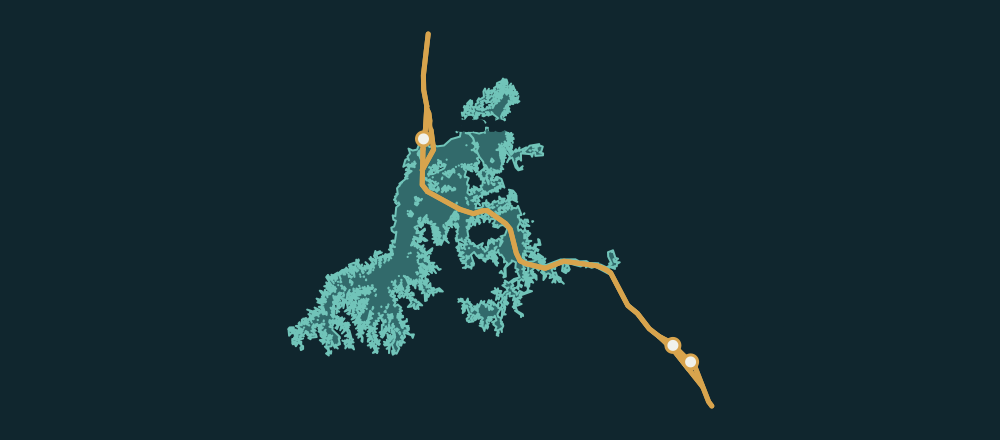
The Panama Canal on today’s map
Current canal, Gatun Lake and lock geometry from an OpenStreetMap extract dated 2026-10-06.
Sources
Sources
Links to the sources used for the dates, records and measurements on this page.
- S01operator history pageACP — canal history and how it works
- S02operator technical pageACP — design of the locks
- S03operator history articleACP — Culebra Cut
- S04operator construction historyACP — French construction
- S051902 periodical articlePopular Science Monthly (1902) — Tribunal civil de la Seine dissolution judgment, 4 February 1889
- S06archives guideU.S. National Archives — Record Group 185
- S07municipal history articleCity of Paris — Panama verdict account (Baïhaut sentence, 20 March 1893)
- S08Congressional Record excerptCongressional Record — 1913 Senate debate
- S091915 bookWilliam C. Gorgas — Sanitation in Panama, 1915
- S10operator construction historyACP — end of construction
- S11public-health reportU.S. Public Health Service — 1905 report, CDC archive
- S12operator construction historyACP — American construction
- S131913 bookBert E. Mills — The Panama Canal, 1913
- S14treaty textFRUS — Hay–Bunau-Varilla Treaty text
- S15National Assembly news articleNational Assembly of Panama — independence proclaimed, 3 November 1903
- S16State Department history essayU.S. State Department — canal history
- S17operator treaty pageACP — Torrijos–Carter treaties
- S18Federal Register documentFederal Register — canal transfer, 30 December 1999
- S19operator expansion explainerACP — the expanded canal
- S20operator press releaseACP — 2016 inauguration
- S21OAS press releaseOrganization of American States — 2006 program estimate
- S22SEC filing exhibitSEC-filed account — GUPC dispute
- S23operator account of a dispute-resolution rulingACP — ruling on GUPC’s US$98,988,574 claim
- S24operator annual reportACP — FY2023 annual report
- S25operator news articleACP — October 2023, driest since 1950
- S26operator press releaseACP — January 2024 transit increase
- S27operator press releaseACP — 45-foot draft, May 2024
- S28operator annual reportACP — FY2024 annual report, water resources
- S29operator announcementACP — 2026 measures for reduced precipitation
- S30operator press releaseACP — postponement of NeoPanamax draft adjustment, 2026
- S31operator announcementACP — 2026 announcement on draft and daily transits
- S32operator project pageACP — proposed Río Indio project
- S33OpenStreetMap map pageOpenStreetMap — current Panama Canal map
- S34operator financial report, PDFACP — FY2016 financial statements (expansion capitalization)