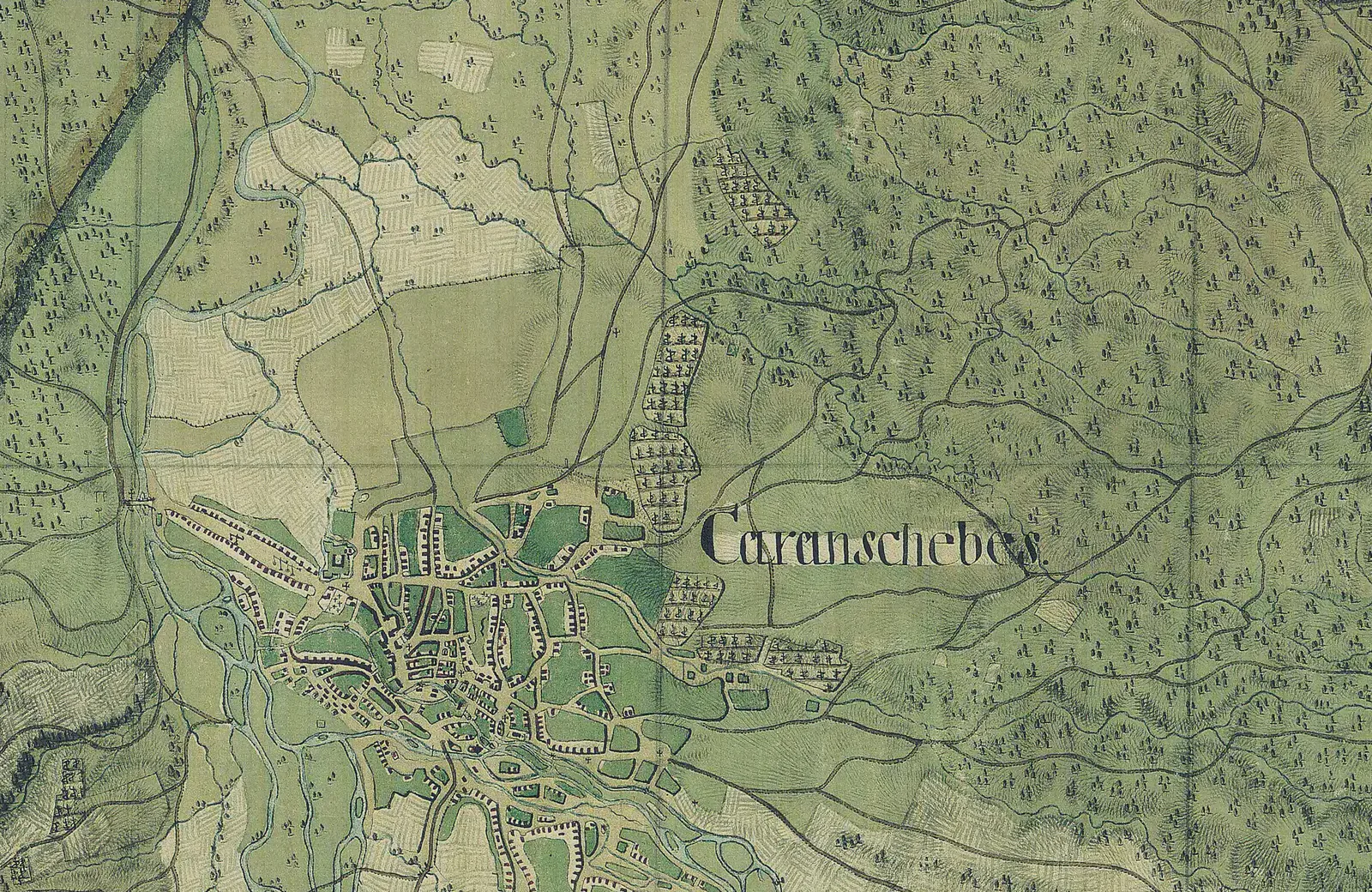
The Caransebeș district as the emperor's surveyors drew it between 1769 and 1772. Josephine survey, Section 134.
The question
Later accounts of the night of 20–21 September 1788 at Caransebeș describe thousands of men lost after troops fired on one another. Reports from 1788 confirm the panic and friendly fire. The sources examined give no count of the night’s dead.
The map compares the march with the selected town at the same scale: a march of 29.2–34.3 km that set out from Illova, halted at a bridge, and dissolved into wild firing. Each halt carries the words of the report that attests it — the emperor's letter, the camp's official report, the October 1788 papers.
The accounts give four tallies: about 150, 563, 1,200 and over 10,000. The first three come from sources opened below; the fourth is quoted through them, with no source reference. None of them counts the night's dead.
Choose a tally and read what each source counts. The map draws the selected number to scale, as a yardstick. The distance comparison then tests a statement by the emperor against today’s geography.
The map above is the Banat land survey of 1769–1772, Section 134, with Caransebeș at the meeting of the Timiș and the Sebeș. It is almost two decades older than the night.
Your town
Type your town or village. The night's map centres on it, at true scale.
The selected town stays in your browser and is not sent to a search service.
Read the steps; the map keeps pace.
What the map shows
A true-scale schematic: the Illova–Caransebeș night march laid over the chosen place, with the halts from the reports. North is up; the scale bar is drawn below. The dashed circle tries the “six leagues” remark at the Austrian-mile scale — one of two readings.
Illova · 20 September, evening — Two columns set out for Caransebeș
The bridge · night — The halt at the bridge
The columns · after nine — Troops fire on one another
The post road · toward dawn — Calm, then flight
Lugoj · 21 September, before daybreak — The second panic
Caransebeș · 21 September, daytime — At dawn, the real enemy
The night, halt by halt
20–21 September 1788. The infantry moves off at nine in the evening (the main-army journal, via Gramm 2008). What follows is told by reports, each with its date.
Illova · 20 September, evening
Two columns set out for Caransebeș
The army breaks camp at Illova and marches all night toward Caransebeș in two columns. The order is to arrive without the enemy's knowledge. Until the bridge, everything proceeds in the greatest order.
The bridge · night
The halt at the bridge
The columns halt to let the rearguard close up. The men ground their packs; some fall asleep. Later retellings put a brandy cart here. No 1788 report mentions a brandy cart.
The columns · after nine
Troops fire on one another
A false alarm — frightened Wallachians, in the emperor's account — throws the hussars onto the infantry. The columns fire into one another; guns, wagons and tents overturn. Five days later the emperor writes: his men fired on one another.
The post road · toward dawn
Calm, then flight
Order is restored and the columns reach the camp near Caransebeș at dawn. But fear runs ahead: servants and fugitives carry it to Lugoj, crying that all is lost, and the road to Temeswar (Timișoara) is pillaged.
Lugoj · 21 September, before daybreak
The second panic
At Lugoj, where the baggage stands, Wallachians cry that the Turks are coming. Two imperial regiments meet in the dark, take each other for Turks, and fire on each other. The 7 October paper also prints the misheard shout: halt, taken for allah.
Caransebeș · 21 September, daytime
At dawn, the real enemy
Toward daybreak the Turks catch the rearguard. This time the fighting is real: the rearguard withdraws in good order and throws them back from Caransebeș with losses, taking three standards (the London paper, October 1788). The official report's estimated 150 dead and wounded belong to this battle — not to the night; the London paper prints the same figure for the fight near Caransebeș.
The reckoning: how many dead do you count?
Four figures claim the night, plus the fifth option — the one the sources support. Press a figure: the map draws it at scale over your town and says what it actually counts.
The map draws each figure at the same scale. The hollow circle is the only one the sources allow.
Send the verdict
The reckoning: six leagues
The emperor writes that fear was carried “six leagues” (translated from French) behind, to Lugoj. Today's geography can check the sentence.
From Caransebeș to Lugoj, today's road falls in 43.2–47.1 km on the old-landmark route — Caransebeș–Sacu–Lugoj, 39.2 km summed from the map, lengthened by 10–20% for windings. The test band is the straight-line one: 42.2–46.1 km.
Six French leagues are 26.7 km: they reach Lugoj from nowhere. Six Austrian miles are 45.5 km — squarely on the Caransebeș–Lugoj road band, 42.2–46.1 km. The implied league, 7.36 km, falls near the Austrian post mile, of 7.6 km — but which unit the emperor had in mind stays unknown: compatibility is not identification.
The comparison has a further limit. From the panic site near Slatina to Lugoj is 55.8 km in a straight line — over 60 km by road. Six leagues do not cover that distance in either of the two reference measures. The reckoning shows only that the six-leagues remark fits the Caransebeș–Lugoj road counted in Austrian miles — not where the flight started.
The same arithmetic catches the rumours swelling — with a reservation: the tallies cover different ground. Lost guns are 3 in the emperor's night tally and 15 in the paper's uncertain retreat reports — 5.0 times as many. Ammunition carts are 14 in Criste and 64 in the paper — 4.6 times. And against the rearguard's estimated 150 dead and wounded, the 1968 over-10,000 men lost are 66.7 times — a comparison across different kinds of tally. And the loss reckoned in money — 136,717 gulden 43 kreuzer, pay chest included — is the only figure of its kind met in the opened material (Gramm 2008, after Kotasek).
The Caransebeș–Lugoj road band, with the two meanings of the “six leagues”. The hatched bar is the road's margin over the straight line.
Haversine distances between map-checked landmarks (Nominatim, 12 October 2026), lengthened by 15–35% in the hills and 10–20% on the plain. League and mile values are reference values: the French common league, 4.4453 km; the Austrian post mile, 7.5859 km.
The ledger: what each report says
Ten claims of the night, eight reports. A filled dot means “says”; a hollow ring, “silent”; a cross, “contradicts”. Below the table, each report speaks in its own words.
Joseph II, 26.09.1788
Hofbericht, 23.09.1788
Real-Zeitung, 07.10.1788
Polit. Journal, X.1788
Eur. Magazine, X.1788
Schlosser, 1843
Gross-Hoffinger, 1847
Criste, 1904
Night march on Caransebeș
●
●
●
●
●
●
●
●
False alarm, frightened troops
●
●
●
●
●
●
●
●
Our men fire on our men
●
○
●
●
●
●
●
●
Brandy cart, quarrel over drink
○
○
○
○
○
○
●
●
The “Turks!” cry
○
○
●
●
○
○
●
●
Halt heard as allah
○
○
●
○
○
○
●
○
The emperor parted from his suite
○
○
○
○
○
●
●
○
Flight and pillage to Lugoj
●
○
●
●
●
○
●
●
3 guns lost
●
○
○
✕
○
○
○
●
A number for the night's dead
○
○
○
○
○
○
○
○
The cross at the guns confronts tallies with different coverage: 3 of the night (the emperor), 15 of the retreat (the paper, uncertain).
The reports, in their own words
“…his men fired on one another… luckily no Turk pursued us, otherwise the whole army would have been lost… all the tents and kettles with much baggage were lost, but also three guns.”
“On the 21st the army broke camp at Illova in 2 columns for Caransebeș… a false alarm… seized the train sent ahead toward Caransebeș with such dismay… Our loss in the rearguard may amount to 150 men dead and wounded.”
“Our men ran in the darkness into another regiment. The officers of the first shouted: halt! halt! The second believed they heard the Turkish cry allah!, fired and slew many of their comrades.”
“Two imperial regiments ran into each other, took each other for Turks, and fired on each other for a time, so that on both sides many were killed and wounded… 15 guns and 64 ammunition carts are reported, among other things… 1,200 wounded soldiers were brought to the fortress at Arad in those days.”
“…two columns crossing each other in the dark, and a false alarm of the approach of the enemy, gave rise to a confusion, in which some corps of Austrian infantry fired at each other, and the bat men and servants were struck with such a panic, that, throwing off the loads from their horses, and out of the carriages, they fled precipitately, so that many officers lost their baggage, and some regiments their field equipage.”
“The regiments fired upon one another… He was in fact separated from his suite and wandered about ignorant of his way… accompanied by a single individual, he came to Karansebes.”
“Some hussars quarrelled with several soldiers of the free corps over a cart of brandy… shouted loudly ‘Turks! Turks!’… the command ‘Halt! Halt!’ frightened them still more, for it was taken for the allah-cry of the attacking Turks.”
“…up to 1,000 knapsacks and 600 coats… two 3-pounders, one 6-pounder and 14 ammunition carts, 20 air rifles, 24 jäger with 1 officer and 538 men lost, of whom most however returned… and by the troops' unhappy firing several officers and men of various regiments were shot dead and others wounded.”
The verdict
The night was real; its count survives in none of the opened material. Here is what stands after each figure is asked what it counts.
about 150 dead and wounded
of the rearguard's daytime battle
falls
563 missing
of the 538, most returned
shaky
1,200 wounded
taken to Arad “in those days” (translated) of the retreat
shaky
over 10,000 men lost
the 1968 figure, without a source
falls
No figure
no source counts the night's dead
stands
The only row that stands is the one without a figure: no report of 1788 and no archive-based history counts the dead of the night of 20–21 September. The daytime fight near Caransebeș has the same tally in two sources: about 150 dead and wounded in the camp report (23 September) and 150 in the London paper (October) — of the day, not of the night. On 22 September, after order was restored, 8 Wallachians were hanged — the only execution mentioned in the verified passages.
Send the verdict
What to take with you
Next time a too-good story gives too round a number, ask who counted it, and when. Here the answer was: nobody, in the material opened to this day.
And the map above — the Caransebeș district drawn by the emperor's surveyors — deserves a long look: it is the ground everything happened on, seen by the men who measured it.
Sources and method
Every number on the page comes from a source opened in October 2026: the emperor's letter (Arneth, 1872), the camp report and the 1788 papers, Schlosser (1843), Gross-Hoffinger (1847), the War Archive history (1904), the Mayer (1997) and Gramm (2008) theses.
The 10,000 is quoted via Mayer, who quotes Bernard (1968) and shows it has no source reference. The 1831 military magazine, Bernard, Blanning and the Kotasek dissertation were not opened directly; the page puts nothing in their mouths.
Distances are haversines between map-checked landmarks, lengthened by stated margins for windings. League and mile values are reference values, not facts about the night.
No hour but nine in the evening; no name of any dead; no detail of gore. Where the sources fall silent, the page falls silent.
Reports of 1788
Joseph II to Leopold, 26 September 1788 (Arneth, vol. II, pp. 198–199)
Hofbericht, Sacu, 23 September 1788 (printed in the Erlangen Real-Zeitung, 7 October)
Erlangen Real-Zeitung, no. 80, 7 October 1788, pp. 724–728
Politisches Journal, October 1788, pp. 1058–1059
The European Magazine, October 1788, pp. 307–308 — Vienna, 27 September and 4 October: the retreat, the firing among friends, 150 of the fight near Caransebeș
Retellings and histories
F. C. Schlosser, History of the Eighteenth Century, 1843 (English translation 1844, vol. 6, pp. 162–163)
A. J. Gross-Hoffinger, History of Joseph II, 1847, pp. 292–294
O. Criste, Wars under Joseph II, 1904, ch. IX, pp. 301–308
M. Z. Mayer, McGill thesis, 1997, pp. 61–62
E. R. Gramm, Vienna thesis, 2008, pp. 82–84
Map
Josephinische Landaufnahme, Banat, Section 134 (the Caransebeș district), 1769–1772 — Österreichisches Staatsarchiv, Kriegsarchiv, public domain, via Wikimedia Commons