Romania's bears · September 2026
Is there an alternative to shooting Romania's bears?
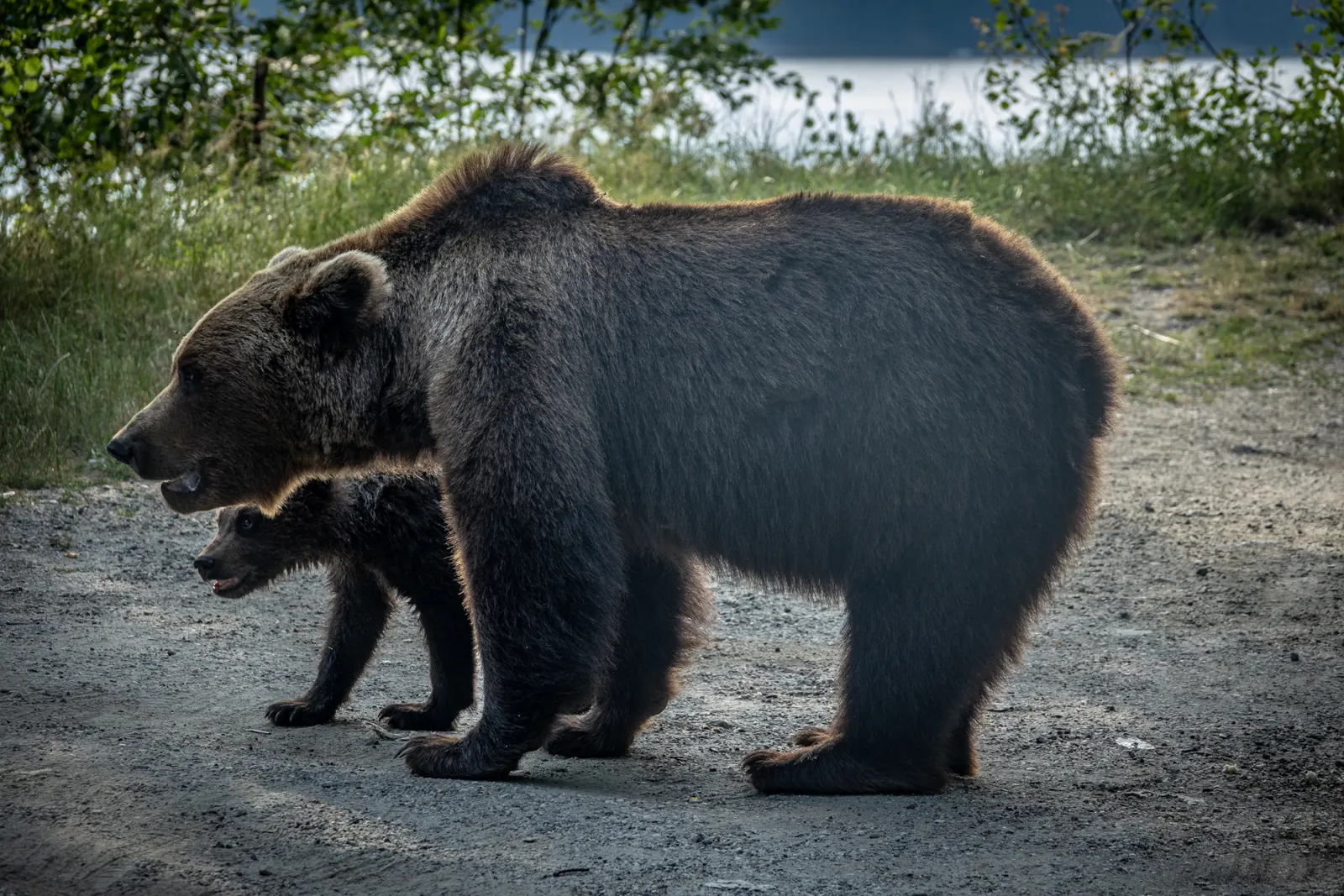
A female bear and her cub at the edge of the Transfăgărășan road, by Lake Vidraru, in August 2021. Photo: Hayenne, 2021, Wikimedia Commons, CC BY-SA 4.0

Partly. We found no alternative that replaces shooting entirely: in every comparable system we checked, from Slovenia to Canada and Japan, bear management includes shooting some animals, and the alternatives Romania has tried were too small or failed.
But the quota Parliament voted for is not a plan either. Bill L43/2026, passed again by Parliament in September, would allow up to 969 bears a year to be shot. It rests on an 'optimum' of 4,000 taken from a 2002 hunting table, quotas of this kind have so far hit mostly trophy bears, and its effect on the population cannot be measured directly before the census due around 2029. Effects on conflict can be tracked sooner, if the state publishes comparable series. Shepherds and livestock keepers are the most exposed, and the state still has no programme for them.
The two answers, at their strongest
The two sides rarely answer each other. Below, each position as its best advocate would put it. Every claim points to the section where it is tested, and the verdict on all ten is at the end.
Side A
There are too many bears, so they have to be shot
The argument, made publicly by Vlad Coroamă in August 2026: the problem is systemic, because the total number of bears exceeds what the habitat can hold, and hungry bears will end up in people's way however many fences are built.
- A1
Romania has the largest bear population in the European Union: between 10,657 and 12,787 in 2023, according to the genetic census, calculated with its most cautious model. tested in: How many bears there really are
- A2
Brașov and Harghita hold 27–30 bears per 100 km², more than even the table used to set the 'optimal' number allows for the best habitat. That is also where conflicts cluster. tested in: Where the 'optimum of 4,000' comes from
- A3
More bears mean more damage. In Covasna, Harghita and Vrancea, attacks on livestock rise with bear numbers, and in New Jersey hunting and the shooting of problem bears went together with fewer reports. tested in: What shooting does and does not do
- A4
The alternatives have failed in Romania: relocated bears come back, the state sanctuary is 17% built, and the electric-fence programme was stuck for two years. tested in: What prevention does and does not do
- A5
No country with many bears has solved the conflict through prevention alone. Slovenia's experts calculated that shooting only problem bears would let the population grow by 50% in three years. tested in: What Canada, Japan and the neighbours do
Side B
The conflict comes from food and from how bears are managed
The argument of conservation groups and some researchers: bears enter villages and attack where they find easy food, and hunting quotas hit different bears from the ones causing trouble.
- B1
The 'optimum of 4,000 bears' does not measure what the forest can feed. It is a 2002 scoring table for hunting grounds that, in the form published by the forestry research institute, awards points for feeding bears. tested in: Where the 'optimum of 4,000' comes from
- B2
The prevention quota does not target the bears that come into villages. Most bears shot under the 2024 quota carried trophies of over 250 points, which means large males from the forest, while in 2023–2024 only 5 of the 80 bears in the quota for village bears were used. tested in: What shooting does and does not do
- B3
In the literature reviewed, there is no experiment showing that hunting reduces bear attacks on people. tested in: What shooting does and does not do
- B4
People are attacked where bears find food: at sheepfolds, along the Transfăgărășan road, next to rubbish and orchards. That is where keeping food away from bears works. tested in: Who is attacked, where and why
- B5
The state does not publish how many bears it kills and will not be able to measure the quotas' effect on the population directly before the next census. tested in: The quota over fifteen years
How many bears there really are
The number that matters now comes from the genetic census run by Romania's national forestry research institute, "Marin Drăcea", with EU money. Between autumn 2022 and early 2025, collectors gathered 24,056 samples of hair and droppings, from which the laboratory identified 4,655 different bears. From recaptures of these genetic profiles, the model estimates that between 10,657 and 12,787 bears lived in Romania in 2023, with a mean of 11,651. The report says it chose, among its models, the one giving the most cautious lower bound; other models gave more. The Ministry of Environment published it in December 2025 as working material, and the study has not yet been through independent scientific review.
For anyone who thinks hunters inflated the count, this is a good answer: each bear's identity comes from DNA, not from tracks or sightings at feeding sites. For anyone who thinks bears tripled in a few years, it is a warning. The old estimates were made differently and cannot be put on the same line as the new one.
The old estimates cannot be put on the same line as the genetic census: they were made by counting tracks and bears seen at feeding sites.
Almost all of the history above was written by hunting-ground managers, who counted tracks and bears seen at feeding sites. In the 1950s there were about 860 bears. By 1988 the population had reached nearly 8,000, built deliberately with artificial feeding and cubs released in the special hunting grounds set up in 1976. Between 2005 and 2016, the reported numbers hovered around 6,000. A study published in 2016 showed that, between 2005 and 2012, these reports exceeded the biologically plausible maximum in 32% of cases, and that they were more inflated the more hunting there was.
The last step of the curve is the most misleading. The official estimate for 2022 was 7,536–8,093, and its upper value had been obtained by projecting the 2007 figure forward at an average European growth rate. Moving to 11,651 in a single year would mean growth of 44%, more than three times the highest published rate for brown bears (13.6% a year). Part of the "explosion" is therefore a change of method. The old counts undercounted nationally even while they inflated locally, and real growth after the 2016 ban on trophy hunting is likely but cannot be measured with the data available.
The hunters' counts have not stopped. In Hunedoara, the spring 2026 evaluation reported 1,077 bears, roughly double the 526 estimated genetically for the same county.
Sources for this section: genetic census, synthesis report (Romanian); national action plan 2018, population history (Romanian); Popescu et al. 2016; Ministry of Environment, 2023 estimate (Romanian); Hunedoara, 2026 count (Romanian).
Where the 'optimum of 4,000' comes from
"All my specialist colleagues say the optimal number for the bear population in Romania is somewhere around 4,000," said the environment minister, Mircea Fechet, in April 2025. The explanatory memorandum of bill L43/2026, which allows up to 969 bears a year to be shot, calls the same number "the optimal carrying capacity of the habitat". That is where the idea comes from that Romania has three times more bears than nature can hold: 11,651 divided by 4,000 gives 2.9.
The number does not come from measuring the food in the forests. It comes from the scoring keys approved by Order 393 of 2002, which give each hunting ground up to 1,000 points. Relief, forest and natural food count, but so does "hunting culture": in the key published by INCDS in 2019, a ground that feeds bears more than 5 kilograms a day per animal in spring and autumn earns 50 points. Tourism, grazing, sheepdogs and poaching lower the score. The score puts the ground in a class, and the class gives it a fixed density: 21–25 bears per 100 km² for the best, 11–15 for the most common. Added up over 542 hunting grounds, those densities gave a total of 4,002 bears in 2019, 398 fewer than the 2002 calculation.
Romania's hunting law defines the optimum as the number of bears that keeps the species conserved, "causes minimum damage and poses no risk to the human population". It is a tolerance target, set hunting ground by hunting ground. The 2005 management plan that the national action plan cites as the source of the 4,000 was never adopted by any legal act.
Mean density estimated genetically for 2023. Some counties share one estimate. Neamț, Suceava, Vrancea and Covasna are probably underestimated, according to the study's authors. BN + MM: Bistrița-Năsăud and Maramureș; CS + GJ + TM: Caraș-Severin, Gorj, Timiș.
The side that wants fewer bears has a real point here. In Brașov and Harghita, the genetically measured density exceeds even what the table allows for the best habitat, and in the Prahova valley and around Postăvarul local concentrations are several times higher. A tolerance limit is also a legitimate idea: a society can decide how many bears it accepts near villages. But then it should be called a decision about tolerance, not a law of nature, and in most counties density sits inside the range the table itself considers normal.
There is also a legal limit. In its 2019–2024 report to the European Commission, Romania gave 5,960 bears as its favourable reference population, the minimum for a population to stay healthy in the long run. Cutting to 4,000 would take the population below the value the Romanian state itself declared, and would raise a serious problem under Article 16 of the Habitats Directive: an exception to strict protection must be justified, it must be shown that no satisfactory alternative exists, and it must not prevent the population being kept at a favourable conservation status. The EU Court of Justice has required these conditions to be shown with the best available data.
Sources for this section: Agerpres, Fechet, 10 April 2025 (Romanian); INCDS habitat-scoring guide, 2019 (Romanian); zoning study, 2025 (Romanian); Romania's Article 17 report; Habitats Directive, Article 16.
Who is attacked, where and why
The most repeated official figure, 26 dead and 274 people "disfigured" in 20 years, appears earliest, among the sources found, in a March 2024 press release, when the environment minister was asking Brussels to relax bear protection. It gives no years and no table, and it was still unchanged in the 2026 law's explanatory memorandum, although more people had died by then. There is no official year-by-year series of bear victims.
The map below starts from the registry Vlad Coroamă published in August 2026, re-checked case by case and completed from local news. It holds 66 attacks between 1 January 2024 and 14 September 2026, with 71 victims, 8 of whom died. It is a minimum: the press mostly reports serious cases, foreign tourists and helicopter rescues. Colour shows what the person attacked was doing.
- shepherds and livestock keepers, at the sheepfold or with animals 17
- at work in fields or forest, hunting, gathering 9
- tourists feeding, photographing or approaching bears at the roadside 13
- tourists or hikers on foot 6
- locals near home or on the road 12
- activity not reported 9
1,958 bear alerts; 1,866 could be mapped. The circle grows with the number of alerts sent for the locality.
List of attacks
| Date | Place | County | What the person was doing | Victims |
|---|---|---|---|---|
| 2024 (no exact date) | Aluniș | Prahova | activity not reported | 1 injured |
| 13 January 2024 | near Șoard | Mureș | at work in fields or forest, hunting, gathering | 1 injured |
| 25 January 2024 | near Brateiu | Sibiu | shepherds and livestock keepers, at the sheepfold or with animals | 1 injured |
| 18 February 2024 | near Vărșag | Harghita | tourists or hikers on foot | 1 injured |
| 10 March 2024 | Munții Nemira | Bacău / Covasna | tourists or hikers on foot | 1 injured |
| 22 April 2024 | near Arefu | Argeș | tourists feeding, photographing or approaching bears at the roadside | 1 injured |
| 25 May 2024 | near Arefu | Argeș | tourists feeding, photographing or approaching bears at the roadside | 1 injured |
| 29 May 2024 | Băgaciu | Mureș | shepherds and livestock keepers, at the sheepfold or with animals | 1 killed |
| 23 June 2024 | Slănic-Moldova | Bacău | tourists or hikers on foot | 2 injured |
| 9 July 2024 | near Bușteni | Prahova | tourists or hikers on foot | 1 killed |
| 19 July 2024 | near Rucăr | Argeș | shepherds and livestock keepers, at the sheepfold or with animals | 1 injured |
| 22 July 2024 | Sântioana | Bistrița-Năsăud | at work in fields or forest, hunting, gathering | 2 injured |
| 7 August 2024 | Dumbrava | Mureș | shepherds and livestock keepers, at the sheepfold or with animals | 1 injured |
| 13 August 2024 | near Cetățuia | Harghita | at work in fields or forest, hunting, gathering | 1 injured |
| 23 August 2024 | near Cetățuia | Harghita | activity not reported | 1 injured |
| 28 August 2024 – 29 August 2024 | Colibița | Bistrița-Năsăud | locals near home or on the road | 1 injured |
| 3 September 2024 | near Ieud | Maramureș | locals near home or on the road | 1 injured |
| 22 September 2024 | Crizbav | Brașov | locals near home or on the road | 2 injured |
| 24 September 2024 | near Arefu | Argeș | tourists feeding, photographing or approaching bears at the roadside | 1 injured |
| 1 October 2024 | near Vama | Suceava | at work in fields or forest, hunting, gathering | 1 injured |
| 20 October 2024 | near Monor | Bistrița-Năsăud | at work in fields or forest, hunting, gathering | 1 injured |
| 25 October 2024 | near Lutu Roșu | Prahova | locals near home or on the road | 1 injured |
| 17 November 2024 | near Corbeni | Argeș | activity not reported | 1 injured |
| 24 January 2025 | near Vâlcele | Covasna | at work in fields or forest, hunting, gathering | 1 injured |
| 30 March 2025 | Predeal | Brașov | locals near home or on the road | 1 injured |
| 27 May 2025 | near Arefu | Argeș | tourists feeding, photographing or approaching bears at the roadside | 1 injured |
| 27 May 2025 – 28 May 2025 | near Arefu | Argeș | tourists feeding, photographing or approaching bears at the roadside | 1 injured |
| 28 May 2025 | near Arefu | Argeș | tourists feeding, photographing or approaching bears at the roadside | 1 injured |
| 15 June 2025 | near Domnești | Argeș | at work in fields or forest, hunting, gathering | 1 injured |
| 23 June 2025 | near Dămuc | Neamț | shepherds and livestock keepers, at the sheepfold or with animals | 1 injured |
| 3 July 2025 | near Arefu | Argeș | tourists feeding, photographing or approaching bears at the roadside | 1 killed |
| 7 July 2025 | near Berevoești | Argeș | shepherds and livestock keepers, at the sheepfold or with animals | 1 injured |
| 13 July 2025 | near Lerești | Argeș | shepherds and livestock keepers, at the sheepfold or with animals | 1 injured |
| 15 August 2025 – 22 August 2025 | near Jimbor | Bistrița-Năsăud | locals near home or on the road | 1 injured |
| 29 August 2025 | near Homorod | Brașov | locals near home or on the road | 1 injured |
| 29 August 2025 | near Pătești | Vâlcea | shepherds and livestock keepers, at the sheepfold or with animals | 1 injured |
| 13 September 2025 | near Dubiștea de Pădure | Mureș | at work in fields or forest, hunting, gathering | 1 injured |
| 16 September 2025 | near Lerești | Argeș | shepherds and livestock keepers, at the sheepfold or with animals | 1 injured |
| 23 September 2025 | Lunca Vișagului | Cluj | activity not reported | 1 injured |
| 17 October 2025 | near Bicaz-Chei | Neamț | locals near home or on the road | 1 killed |
| 25 October 2025 | near Brașov | Brașov | tourists or hikers on foot | 1 injured |
| 16 February 2026 | near Maiad | Mureș | shepherds and livestock keepers, at the sheepfold or with animals | 1 injured |
| 1 March 2026 | near Berislăvești | Vâlcea | activity not reported | 1 injured |
| 22 March 2026 | near Măgherani | Mureș | tourists or hikers on foot | 1 injured |
| 27 April 2026 – 3 May 2026 | near Lupeni | Harghita | locals near home or on the road | 1 killed |
| 30 April 2026 | near Tronari | Buzău | activity not reported | 1 injured |
| 7 May 2026 – 8 May 2026 | near Bichigiu | Bistrița-Năsăud | shepherds and livestock keepers, at the sheepfold or with animals | 1 killed |
| 8 May 2026 | near Barcani | Covasna | locals near home or on the road | 1 injured |
| 21 May 2026 | near Bichigiu | Bistrița-Năsăud | activity not reported | 1 injured |
| 27 May 2026 | near Arefu | Argeș | tourists feeding, photographing or approaching bears at the roadside | 1 injured |
| 27 May 2026 | Podenii Noi | Prahova | activity not reported | 1 injured |
| 29 May 2026 | near Arefu | Argeș | tourists feeding, photographing or approaching bears at the roadside | 1 injured |
| 5 June 2026 – 6 June 2026 | near Prod | Sibiu | locals near home or on the road | 1 killed |
| 8 June 2026 | near Arefu | Argeș | tourists feeding, photographing or approaching bears at the roadside | 2 injured |
| 8 June 2026 | near Arefu | Argeș | tourists feeding, photographing or approaching bears at the roadside | 1 injured |
| 11 June 2026 – 12 June 2026 | near Belin | Covasna | shepherds and livestock keepers, at the sheepfold or with animals | 1 killed |
| 15 June 2026 | near Casinu Nou | Harghita | shepherds and livestock keepers, at the sheepfold or with animals | 2 injured |
| 15 June 2026 | near Arefu | Argeș | tourists feeding, photographing or approaching bears at the roadside | 1 injured |
| 16 June 2026 | near Mărgineni | Brașov | shepherds and livestock keepers, at the sheepfold or with animals | 1 injured |
| 16 June 2026 | near Arefu | Argeș | tourists feeding, photographing or approaching bears at the roadside | 1 injured |
| 12 July 2026 | near Lerești | Argeș | shepherds and livestock keepers, at the sheepfold or with animals | 1 injured |
| 4 August 2026 | near Scutaru | Bacău | at work in fields or forest, hunting, gathering | 1 injured |
| 6 August 2026 – 7 August 2026 | near Lerești | Argeș | shepherds and livestock keepers, at the sheepfold or with animals | 1 injured |
| 20 August 2026 | near Boița | Sibiu | shepherds and livestock keepers, at the sheepfold or with animals | 1 injured |
| 2 September 2026 | near Sângeorgiu de Pădure | Mureș | locals near home or on the road | 1 injured |
| 14 September 2026 | Șuici | Argeș | activity not reported | 1 injured |
Most attacks do not happen in villages. Shepherds and livestock keepers are the largest group, 17 cases, and another 9 involve people at work in fields or forests. A 2019 international study of brown bear attacks worldwide between 2000 and 2015 found that Romania accounted for 45% of the attacks recorded in Europe, and that half of the Romanian victims with known details were shepherds, farmers or cattle herders. In at least 8 cases, the person was attacked while chasing or harassing a bear that had attacked their animals or crops. The authors note that this pattern differs sharply from other brown-bear countries, where people are attacked mostly during leisure. In the 2024–2026 registry, shepherds and farmers are 19 of 66 cases: the largest group, but not half.
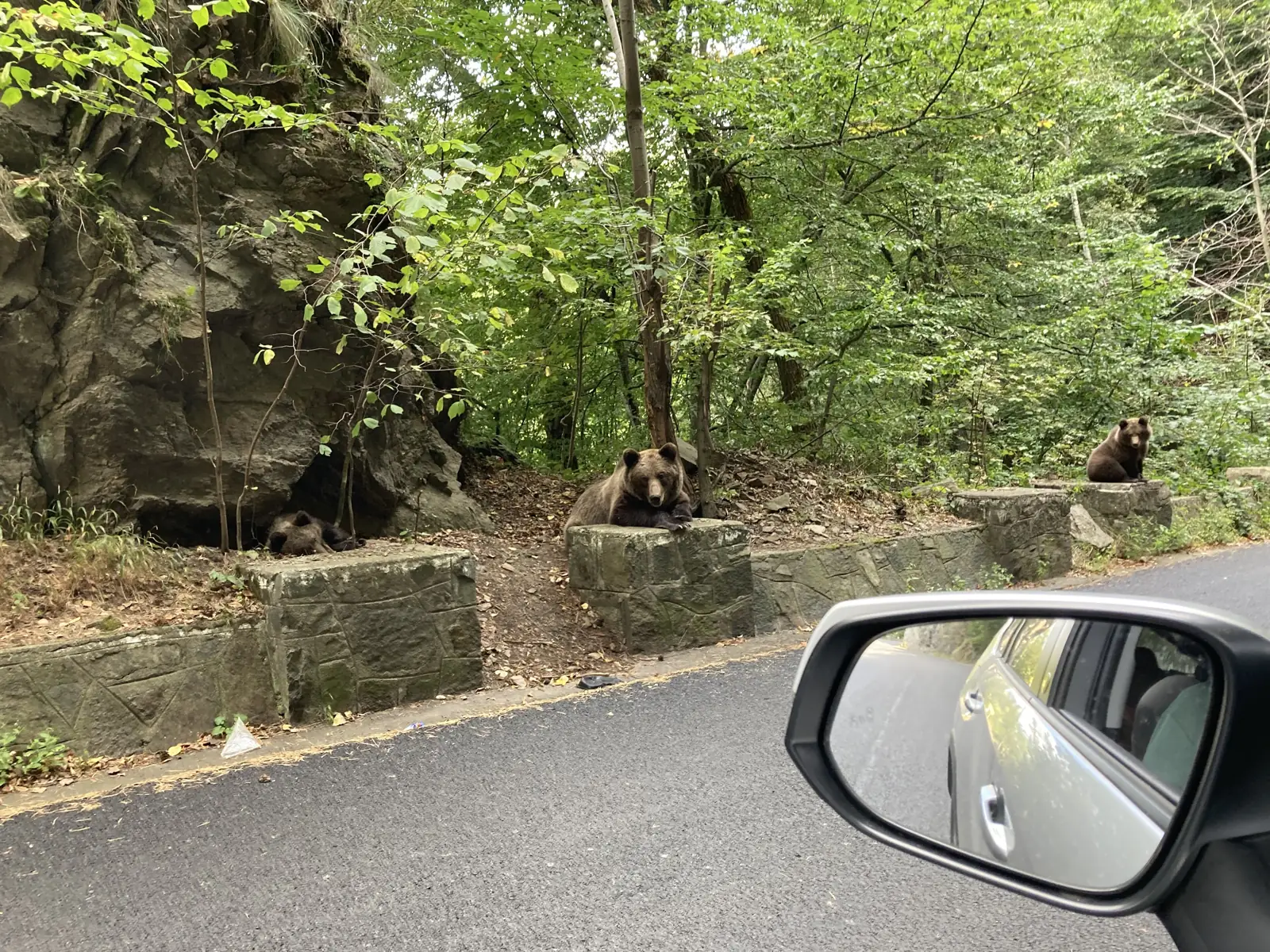
The second group is almost entirely one road. Argeș county has 22 of the 66 attacks, and 13 of them are tourists who were feeding, photographing or approaching bears along the Transfăgărășan road near the Vidraru dam. The hospital in Curtea de Argeș treated 5 people injured by bears in all of 2025 and 8 bitten by 8 June 2026. Between 27 May and 12 July 2026, a joint commission set up by the Argeș prefect issued 9 fines for feeding bears on this road, 106,500 lei in total.
Villages and towns have fewer attacks but most of the alerts. RO-Alert, the emergency phone warning system, sent 1,958 bear alerts between February and July 2026, nearly 70% of all alerts in the country, and 59% went out in the evening or at night, between 20:00 and 6:00. A 2023 study found that 10 of 319 towns accounted, in 2015–2020, for 77% of emergency calls about bears. Alerts measure bears seen and reported, not extra bears: county emergency inspectorates send alerts by different rules.
Are attacks rising? The press registry finds 24 injured in 2024, 16 in 2025 and 23 by mid-September 2026. The official figure does not say which injuries it counts, so the two cannot be compared directly. The 8 deaths in under three years are above the official average of 1.3 a year. Only one, on the Jepii Mici trail in the Bucegi mountains, has a published forensic finding; two more have strong circumstantial evidence, and five are attributed to bears by police or mayors. At Băgaciu, for example, police spoke only of a "possible attack by a wild animal". The instruments changed at the same time: a bear-specific emergency system was created in 2018, and press articles about bears rose from 23 in 2016 to 430 in 2021. The data are consistent with a rise, but they do not allow its pace to be measured reliably.
Sources for this section: Ministry of Environment, 26 March 2024; checked list of attacks; Bombieri et al. 2019; Pop et al. 2023, emergency calls; Neagu et al. 2022, press coverage; RO-Alert warnings by month.
What shooting does and does not do
The legislation uses a misleading term. The "prevention quota" does not mean fences or bins. It is the maximum number of bears hunters may shoot in a year in hunting grounds: 426 a year in 2024 and 2025 under Law 242/2024, and 859 for 2026 under bill L43/2026, if it is promulgated. There is a separate "intervention quota", of 55 and then 110 bears, for animals causing trouble. The Constitutional Court treated these levels as maximum numbers, not obligations.
Status of the law on 25 September 2026. L43/2026 was passed again by the Senate on 26 August and by the Chamber of Deputies on 16 September, after the President’s request for reconsideration. On 21 September it was lodged for the period in which it can be challenged at the Constitutional Court. It had not been promulgated or published in the Official Gazette. Chamber of Deputies record (Romanian).
The hunting-ground manager pays the state 300, 500 or 700 euros for each bear shot under the prevention quota, depending on the skull's score, and keeps the pelt. On its 2013 price list, the state forest company Romsilva charged 3,500 euros for a bear hunt with a trophy of up to 350 points and 6,000 for one of up to 400. The 2024 law banned shooting bears over 400 points under the quota. Bill L43/2026 drops the ban and only requires hunting grounds with two or three bears in the quota to take at least one under 400 points, and those with four or five to take at least two. It does ban shooting females with cubs up to two years old.
Which bears were shot? The press reported, from official data, 381 bears shot under the prevention quota, nearly 90% of the 426 allowed (B1TV and Greennews count them for 2024, Euronews for "the last 10 months"). Euronews writes that most carried trophies of over 250 points, and according to Forest Guard data quoted by B1TV, 13 had over 400 points, the threshold the law forbade (with a 5% tolerance). A large trophy usually indicates a mature male. That does not prove the bear never entered settlements; the problem is that public data do not link bears shot under the prevention quota to particular incidents. The difference also shows in how much of each quota gets used: between September 2023 and June 2024, of the intervention quota of 80 bears, 14 interventions were requested and 5 carried out, while 118 of the 140 prevention bears were shot. Village bears are handled another way: between September 2021 and October 2025 there were 2,680 interventions, including 2,125 bears chased away, 224 relocated, 37 euthanised and 145 shot. Those are the only actions aimed at a particular bear.
Does hunting reduce attacks?
In the literature we reviewed, we found no experiment testing this, for any bear species. The studies that exist compare years and regions, and they point both ways.
- No effect was seen in Wisconsin, where hunters shot younger bears and fewer males than the bears trapped at complaint sites; in British Columbia; and in the 2019 worldwide comparison, where the difference between countries with and without bear hunting was not significant.
- An effect was seen in New Jersey, where hunting and the shooting of problem bears went together with fewer reports.
- The results conflict in Ontario, where one study found no link between previous harvests and conflict and another found more problem-bear activity after the spring hunt was stopped, and in Minnesota, where complaints first fell along with two years of abundant food and an agency policy that discouraged calls, while the population, cut by hunting, fell only a few years later.
- Density matters locally. A study of 756 attacks on livestock in Covasna, Harghita and Vrancea between 2008 and 2016 found more damage where managers reported more bears, and close to the forest.
- Food matters more in villages, according to a Romanian study that compared the two explanations: from more than 10,000 reports, bears show up in human spaces where there is rubbish and food waste, and the density of bears around had no significant effect. The study is a preprint, not yet reviewed.
The honest conclusion is that the evidence is mixed: where hunting went together with less conflict, other things changed at the same time, and a harvest that keeps the population stable has shown no measurable effect. Romania's quota is designed as neither, because it has no rule that revises or stops it according to yearly counts of bears and conflicts. The only numerical target invoked, the "optimum" of 4,000, comes from the scoring table.
The pro-cull side keeps one argument that is hard to test but plausible: bears that are no longer hunted lose their fear of people. Hokkaido's authorities use it for the years after 1990, when spring shooting of bears stopped, and the Romanian study on rubbish mentions it as a possible explanation for the years after the 2007 and 2016 bans. It has not been measured anywhere. And hunting carries its own risk: in Sweden and Norway, 33 of the 44 people injured or killed by bears between 1977 and 2016 were hunting.
There is also a legal condition. In 2019, in the case of Finland's wolves, the EU Court of Justice ruled that an exception to strict protection requires showing, on the best available scientific data, that there is no satisfactory alternative. A fixed number of bears voted by Parliament for the whole country fits that requirement poorly, and the European Commission replied in 2024, to a question from Euronews Romania, that trophy hunting of bears is contrary to EU law.
Sources for this section: Senate record of L43/2026 (Romanian); HotNews, use of the 2023–2024 quotas (Romanian); Euronews, trophy bears (Romanian); B1TV, Forest Guard data (Romanian); Obbard 2014; Treves 2010; Garshelis 2020; Pop 2023, livestock damage; Munteanu 2025, preprint; Støen et al. 2018, Scandinavia; EU Court of Justice, Tapiola case, C-674/17; Euronews, the European Commission's position, 2024 (Romanian).
What prevention does and does not do
A meta-analysis published in 2020 gathered 77 evaluations of methods for protecting against bears, from 48 studies, and calculated how much each reduced damage. It is the best comparison available, and it has big limits: 49 of the cases are from the United States, most concern the American black bear, and some methods have only four or five evaluations.
Relocation is measured only where the bear was taken from. Source: Khorozyan and Waltert, Scientific Reports, 2020; 77 evaluations from 48 studies, most about the American black bear.
Electric fences have the best and most consistent result among the methods evaluated more than a few times: damage fell by 97% in the median case, with an interval that never goes below 79%. They work only if they are maintained. In 2022 Romania bought 1,140 fences, at 2,298.85 lei each before VAT. They were installed by INCDS, Romsilva and a hunters' association and handed to hunting-ground managers, at sheepfolds, farms, apiaries and orchards. Cameras installed later caught bears getting past the fences 26 times, and 21 of those were the same fence, in an orchard where the grass had not been cut. Nobody counted the damage before, so the effect cannot be calculated.
Locking away food and rubbish, including bear-proof bins, has a weaker and more scattered result in the meta-analysis, from only four evaluations, because it depends on people. The best study, in Durango, Colorado, compared neighbourhoods with and without bins and found 60% fewer cases of rubbish scattered by bears; conflicts fell as compliance rose to about 60% of residents. In Yosemite, bear incidents fell from 1,584 in 1998 to 76 in 2015 after the park received, from 1999, 500,000 dollars a year for staff, lockers and enforcement of food-storage rules. In Trentino, the province spent 4.2 million euros on bins in 2024 and 2025 and allocated another 2.4 million for 2026, and bears raiding bins fell from 77 cases in 2023 to 2 in 2025; the province also credits the removal of a few problem bears.
Why moving bears does not work
In the meta-analysis, relocation reduces damage at the place the bear was taken from, but says nothing about what happens next. The zoning study commissioned by Romania's Ministry of Environment followed four relocated bears by GPS: one came back from the Bucegi to Poiana Brașov in three days, the second time in one day, and was shot; a female moved from Brașov to the Lotru mountains crossed seven counties and settled at Păltiniș, with the same behaviour. The study's conclusion for bears used to people, written in capitals, is that relocation is not a viable solution in the medium and long term. In 2024, the gendarmes in Prahova county carried out 744 bear interventions and relocated a single bear. In July 2026, a female euthanised at Poiana Brașov had, according to the town hall, already been captured and relocated a year earlier.
The case of Băile Tușnad
Băile Tușnad is the example both sides cite. In 2021 the spa town received between 149 and 240 RO-Alert warnings a year, depending on the source. In 2023 it received 6 or 8. The drop came before the bear-proof bins WWF bought in 2024, and after a package of measures in 2021: the first intervention in town under the new ordinance, which removed a female with three cubs that was causing a lot of damage, cutting fruit trees on public land, clearing overgrown vegetation, and an intervention team that, according to the mayor, stood guard on more than 500 nights over four years. Tușnad combined taking food away from bears with removing the bears that had learned to come into town. No single measure explains the result.
What the state has done
The national electric-fence programme for households opened in April 2023 with 70 million lei. The first applications were approved in May 2025, and by January 2026 1,635 beneficiaries had been approved for 24.3 million lei. The rules for paying out only appeared in March and April 2026, and the amount actually paid is not public. The centre at Timișu de Sus, meant for orphaned cubs and problem bears that can no longer be relocated, was 17% built in September 2026. The 2026 national budget for reimbursing every town's bear call-outs is 100,000 lei, while Brașov alone contracted call-outs worth 50,900 lei for seven months.
Feeding remains part of the system. The scoring table rewards it, and the 2025 zoning study keeps it in some management zones. In Slovenia, where bears are fed all year, food put out by people made up 34% of the energy in bears' diet in 1993–1998 and about 20% today, and conflicts stayed frequent. The Slovenian ministry's experts argue that stopping feeding would create new conflicts. The science has not settled this dispute.
Sources for this section: Khorozyan and Waltert 2020; Johnson et al. 2018, Durango; Yosemite, bear incidents; Trentino, large carnivore report 2025 (Italian); fence monitoring report (Romanian); Adevărul, Băile Tușnad, 2024 (Romanian); Informația Harghitei, Băile Tușnad (Romanian); WWF Romania, Băile Tușnad (Romanian); AFM, electric fences (Romanian); Ministry of Environment 2026 budget.
The quota over fifteen years
Bill L43/2026 would allow, for 2026, up to 859 bears to be shot under the prevention quota and 110 under the intervention quota, or 969, and the same levels apply in 2027. The 2024 quotas were used to nearly 90%. On top come the bears removed in villages through interventions: 104 in roughly the first ten months of 2025, or about 120 over a full year. If both quotas were used in full, the scenario comes to about 1,090 bears a year (859 + 110 + about 120, our calculation), roughly 9% of the census's mean estimate.
What that number does to the population depends on the natural growth rate, which nobody has measured in Romania. In Sweden, between 1998 and 2007, the population grew by 4.6% a year. The fastest rate published for brown bears is 13.6%. If both the 2016 and the 2023 estimates were right, the implied rate would be 9% a year, but part of that difference is the change of method. The model below starts in 2023, subtracts 436 bears a year for 2024–2026 (the documented pace; the new quotas were not in force in 2026) and applies the chosen number from 2027, year after year.
A simplified calculation for comparing scenarios, not a forecast: next year’s population is this year’s multiplied by the growth rate, minus the bears removed. Removals and growth stay constant. It leaves out the limit of the habitat, sex and age structure, bears killed on roads or by poachers, and any yearly recount. The assumptions in full.
With 1,090 bears removed a year from 2027 and natural growth of 5% a year, the population falls below the minimum reported to the EU (5,960) in 2037. It falls below 4,000 in 2039. At this growth rate, keeping the population at its 2027 level would take about 580 removals a year.
Population in 2037, for a few combinations
| Bears removed a year, from 2027 | growth 4.6% | growth 5% | growth 7% | growth 9% |
|---|---|---|---|---|
| 0 | 19,600 | 20,700 | 27,100 | 35,200 |
| 436 | 13,600 | 14,500 | 20,200 | 27,600 |
| 1,090 | 4,500 | 5,200 | 9,900 | 16,100 |
| 1,600 | 0 | 0 | 1,800 | 7,100 |
At 5% growth a year, close to Sweden's, the scenario of 1,090 bears a year, applied from 2027, nearly halves the population in ten years and takes it below the 5,960 reported to the EU in 2037. At 9% a year, the same quota lets it grow slowly. The difference between the two scenarios is a parameter nobody knows, and the next intensive census is planned for around 2029. Until then, both sides argue for a fixed quota or against it without being able to see its effect on the population.
The model is deliberately simple. It does not know that a population grows more slowly near the limit of its habitat, nor that bears also die on roads or to poachers. Nor does it know how many females are in the quota, although females drive growth: the census estimated 3,258–4,467 females, and the quota has no limit by sex. It still shows what matters: with a fixed number, every year the population shrinks makes the same number weigh more. That is why a fixed number without a yearly count is risky for both sides. The President's reconsideration request proposed that the 2026 levels should not apply automatically in 2027 without an assessment. Parliament rejected the proposal.
Sources for this section: Kindberg et al. 2011, Sweden; the President's reconsideration request (Romanian); bill L43/2026, adopted text (Romanian).
What Canada, Japan and the neighbours do
Both sides use foreign examples, usually by halves. The first difference is how many people live among the bears. In the area where bears live, Romania has 62 people per square kilometre. British Columbia has 0.4 and Sweden 5. The fair comparisons are Slovakia, Slovenia and the Italian Alps, where people live just as close to bears.
Source: Bombieri et al., Scientific Reports, 2019, Table 1.
Canada: kills many bears and measures little
"Canada doesn't shoot bears" is an argument that does not hold. In British Columbia, the provincial conservation service killed on average about 480 black bears a year between 2012 and 2024, and hunters take about 4,700 more. For every bear moved, about 27 were killed. The Bear Smart programme, often cited as a model, has 12 certified communities and has never been evaluated before and after, and in 2025–2026 the province was not taking applications. The provincial government says the number of conflicts follows mainly how good the berry year is. What can be copied from Canada is how it publishes data: bears killed by the conservation service appear by month back to 2012, and by community for 2024–2025. The empty space cannot be copied.
Japan: the biggest cull and the worst year
Between April 2025 and March 2026, Japan killed 14,618 bears under permit, a record, and also had a record number of victims: 238 people attacked, 13 of whom died. The bad years, 2023 and 2025, were also years when the beech trees of the north-east produced almost no nuts. Food explains the year-to-year swings better than shooting does, and the Japanese data can show neither that shooting works nor that it fails. Japan changed the law: since September 2025 a mayor can order a bear shot in a residential area if four conditions are met, including that no faster method without a gun exists and that people nearby are safe. In the first seven months, 57 bears were shot this way. The plan for 2030 foresees 2,500 municipal staff working on bear capture, three times as many as today. Japan's 2025 figures are still provisional. What can be copied: the written rule for shooting in towns, with a named decision-maker, and the monthly tables of victims, captures and shootings, published for each prefecture.
The neighbours with the same density
Slovenia, with about 954 bears in 2025, is the favourite argument of those who want quotas: in some years it removes about a fifth of the population, it usually has at most two attacks a year (three in 2019) and no death on the official list since 2000. But the quota comes with a genetic census every eight years and yearly modelling, management zones, a 112 emergency protocol, bear-proof bins and compensation of about 173,000 euros a year. Courts have suspended the quotas four times, although the ministry eventually won all four cases, and of the 206 bears approved for 2025–2026 only 22 had been shot before the latest suspension.
Slovakia declared an extraordinary situation in dozens of districts after the 2024 attacks and legally shot 213 bears in 2025, about a fifth of the 1,056 estimated genetically. Attacks did not fall: according to the state conservation agency's data as cited by a group challenging the cull in court, there were 11 in 2024 and 17 in 2025 (to 9 December), and the ministry has published no figures showing a decline. The "1,900 attacks" the minister quoted to the international press was most likely the number of bear reports (1,950 in 2024).
Sweden set hunting quotas of 465 bears in 2025 and 394 in 2026, from a population provisionally estimated at about 2,450 in 2023, and has very few attacks, but 5 people per square kilometre live in bear country, and most of those injured are hunters. Trentino and Switzerland, held up as examples of coexistence, shoot bears too. Switzerland has shot two bears in all, in 2008 and 2013, and has no "zero bears" policy; the Swiss government says its readiness to shoot dangerous bears, together with damage prevention, is what makes the other bears accepted.
| Where | Bears | Bears removed by people | Victims | What they use |
|---|---|---|---|---|
| Romania | 10,657–12,787 (2023) | up to 969 a year under bill L43/2026, plus interventions; the real total is not published | 66 attacks and 8 deaths, 2024 – Sept 2026 (minimum, from the press) | hunting quotas, interventions in towns, RO-Alert, fence grants |
| Slovenia | 954 (2025) | 230 in 2023; quotas often suspended temporarily by courts | usually at most 2 attacks a year, no death on the official list since 2000 | genetic census every 8 years, management zones, 112 team, bins, year-round feeding |
| Slovakia | 1,056 (genetic estimate) | 213 in 2025 | 11 attacks in 2024, 17 in 2025 | state of emergency, intervention teams expanded in 2025, bins in the Tatras |
| Sweden | about 2,450 (provisional, 2023) | quotas of 465 (2025) and 394 (2026) | most of those injured are hunters | licensed hunting; the legal minimum is 1,400 |
| Trentino (Italy) | 118 (2025) | 3 in 2024, none in 2025 | one death in 2023 | bear-proof bins (4.2 million euros in 2024–2025, 2.4 million allocated for 2026), full compensation, guard dogs, removal of a few problem bears |
| Switzerland | no resident bears | 2 bears shot in all (2008, 2013) | no attacks found | written rules: inconspicuous bear, problem bear, risk bear |
| Hokkaido (Japan) | 12,190 (2024) | about 2,139 captured under permit (2025) | 49 victims, 9 deaths in 2016–2025 | captures, emergency shooting in towns since 2025 |
| Honshu (Japan), black bear | about 46,000 | 12,479 in 2025 | 232 victims, 11 deaths in 2025 | mass captures, police rifles, 2,500 staff planned by 2030 |
| British Columbia, black bear | 120,000–160,000 (2001 estimate) | about 480 a year by the conservation service, plus about 4,700 hunted | rare | Bear Smart (unevaluated), fines for feeding, few relocations |
Years differ between countries, and victim counts are not defined the same way. For Japan, 2025 means the fiscal year April 2025 – March 2026.
Sources for this section: Bombieri 2019, Table 1; British Columbia, statistics; Japan, casualties by year (Japanese); Japan, emergency shooting (Japanese); Slovenia, expert basis for bear management (Slovenian); Slovenia, the 206-bear permit (Slovenian); Slovakia, bears killed in 2025 (Slovak); Slovakia, attacks (Aevis, Slovak); Sweden, bear population (Swedish); Switzerland, Konzept Bär (German); Trentino, 2025 report (Italian).
A plan with money and deadlines
If you took both sides seriously, you would end up with a package that contains both shooting and prevention, each put where the evidence says it works. Below are the measures in the order the evidence supports them, with the costs we have and realistic timelines. Costs marked "calculated" are multiplications we made from public prices, not official budgets.
| Measure | What it addresses | What we know about the effect | Cost | Timeline |
|---|---|---|---|---|
| Monthly public data: bears killed under the quota and in interventions, with sex, weight and place; attacks; team response times | Makes both positions checkable | Japan and British Columbia already publish such tables | small: the intervention register exists, but we did not find it published | 3–6 months |
| Permanently paid teams in the towns with the most calls, with a response deadline and a sanction for not turning up | Bears in towns and resorts | Tușnad; the Slovenian team went out 359 times in one year | today: 100,000 lei a year for the whole country; Slovakia planned 802,334 euros in 2026 for its central teams | 1 year |
| Maintained electric fences, dogs and night enclosures at sheepfolds and apiaries | Shepherds and livestock keepers, the most exposed | Best measured result: 97% less damage (median); in Slovakia night enclosures cut the risk to 4% | calculated: 6.2–78 million lei for one fence at each of the 5,216 compensation claims of 2023–2025 | 1–2 seasons; a measure in the 2028 farm plan |
| Compulsory bear-proof bins, fines for rubbish left within reach, fruit trees and scraps cleared in problem areas | Bears used to human food | Durango: −60% scattered rubbish; Yosemite: −95% incidents; Trentino: 77 bin raids down to 2 a year, together with removing a few bears | calculated: about 3,560 lei per container (Tușnad) to 9,244 lei per bear-proof enclosure for a large bin (Lepșa, estimated value) | 2–5 years |
| Feeding stopped: fines enforced on tourist roads and feeding taken out of the scoring table | Tourists on the Transfăgărășan and bears used to people | Clear for feeding by tourists; disputed for supplementary feeding by hunting grounds | almost nothing | immediately for fines, one year for the rule |
| Quick removal of problem bears, by written criteria and with a named decision-maker | Bears that repeatedly enter yards and houses | Local, short-term effect, but present in every comparable system checked | existing fees: 400 lei to chase a bear away; a relocation costs about 1,650 lei plus transport, a removal 3,300–4,100 lei | immediately |
| A quota tied to a yearly count and a target above 5,960, revised after the 2029 census | Density in Brașov, Harghita and the Prahova valley | Evidence that hunting reduces conflict is mixed; no quota has been evaluated against conflicts | income: 300–700 euros per bear, paid to the state by managers | 2027–2029 |
For comparison, for 2025 damage the state owed almost 14 million lei, of which it had paid 10 million by the end of January 2026. Between 2023 and 2025, 5,216 compensation claims were approved. An electric-fence kit with 500 metres of wire and a solar panel, enough for about 165 metres of three-strand fence, costs about 1,200 lei retail, without the battery and posts. A kit for each compensation claim approved in three years would cost about 6.2 million lei at retail prices, less than half of a single year's compensation, or up to 78 million at the grant programme's maximum, about five and a half years of compensation. In France, for wolves, the state spends about eight times more on protecting flocks, including shepherds' wages, than on compensation.
What Romania has that others do not
The friend who started this discussion asked whether Romania has advantages of its own. It has several. It has a modern genetic census, while Slovakia's count is still disputed and British Columbia never had one; its value depends on repeating it with the same method. It has RO-Alert, used for bears every evening from May to July 2026. It has the largest bear population in the EU, which gives it the strongest case for European money. State-aid rules now allow small and medium farms 100% funding both for compensation and for fences and dogs, and the farm plan after 2027 can include a measure for flocks, as Slovenia's and France's do. It has a tradition of Carpathian sheepdogs, for which conservation groups recommend 4–6 dogs per sheepfold. And it has bears on 744 hunting grounds whose managers have technical staff who can join the intervention teams under a contract with the town hall. Those people could be paid for maintained fences and for the quick removal of problem bears.
Sources for this section: ProTV, 2025 compensation (Romanian); CAP Strategic Plan, version 9.1 (Romanian); Regulation (EU) 2022/2472; Adevărul, the Tușnad bins (Romanian).
Who is right
The same ten claims from the start, after checking.
- A1Supported
Romania has the largest bear population in the European Union: between 10,657 and 12,787 in 2023, according to the genetic census, calculated with its most cautious model.
The genetic census is the strongest number yet: 24,056 samples analysed in a laboratory and the model that gives the most cautious lower bound. The objection that 'hunters inflated the count' does not apply here.
- A2Partly supported
Brașov and Harghita hold 27–30 bears per 100 km², more than even the table used to set the 'optimal' number allows for the best habitat. That is also where conflicts cluster.
True for Brașov (29.9) and Harghita (27.4), above the 21–25 of the table's best class. Nationally, the gap between 4,000 and 11,651 comes partly from the 'optimum' having been summed over 542 hunting grounds, while bears now live on 744, and partly from densities higher than the table's.
- A3Partly supported
More bears mean more damage. In Covasna, Harghita and Vrancea, attacks on livestock rise with bear numbers, and in New Jersey hunting and the shooting of problem bears went together with fewer reports.
Density does matter locally for livestock damage. For hunting the evidence is mixed: in New Jersey it went together with fewer reports, in Minnesota complaints first fell along with two years of abundant food and a policy that discouraged calls, and no effect was seen in Wisconsin or British Columbia. No such study exists for brown bears.
- A4Partly supported
The alternatives have failed in Romania: relocated bears come back, the state sanctuary is 17% built, and the electric-fence programme was stuck for two years.
Relocation really has failed, here and elsewhere. Fences and bins have not been tried at a scale where results could be measured: the fences went to hunting-ground managers, and grants for households waited 25–33 months for approval, with payments not published.
- A5Supported
No country with many bears has solved the conflict through prevention alone. Slovenia's experts calculated that shooting only problem bears would let the population grow by 50% in three years.
Every comparable system checked here (Slovenia, Slovakia, Sweden, British Columbia, Japan, Trentino, Switzerland) and Băile Tușnad removes bears. The Slovenian projection is a calculation, not an observation, and among the cases researched we found none relying on prevention alone with as many people living among bears as in Romania.
- B1Supported
The 'optimum of 4,000 bears' does not measure what the forest can feed. It is a 2002 scoring table for hunting grounds that, in the form published by the forestry research institute, awards points for feeding bears.
The documents say so directly: the scoring key, as published by INCDS in 2019, gives up to 50 points for feeding bears, and the 2005 plan cited as the source was never approved. The minimum Romania itself reported to the EU for a healthy population is 5,960.
- B2Partly supported
The prevention quota does not target the bears that come into villages. Most bears shot under the 2024 quota carried trophies of over 250 points, which means large males from the forest, while in 2023–2024 only 5 of the 80 bears in the quota for village bears were used.
By law, the prevention quota is shot in hunting grounds and is not tied to any particular bear; bears identified in villages are handled through interventions, a separate mechanism. Public data do not allow a full check, though: the trophy share comes from the press, and after Law 242 interventions increased, with 104 bears removed in 2025 and intervention quotas used in Mureș and Sibiu.
- B3Supported
In the literature reviewed, there is no experiment showing that hunting reduces bear attacks on people.
In the literature we reviewed, we found no experiment. Its absence does not prove hunting useless: correlational studies point both ways.
- B4Partly supported
People are attacked where bears find food: at sheepfolds, along the Transfăgărășan road, next to rubbish and orchards. That is where keeping food away from bears works.
True of sheepfolds, the Transfăgărășan and town bears. But density matters too, and some attacks, in the forest or on mountain trails, have nothing to do with food from people.
- B5Supported
The state does not publish how many bears it kills and will not be able to measure the quotas' effect on the population directly before the next census.
We found no published national record of bears shot, and the next intensive census is planned six years after the first, around 2029.
You are right if you say there is no alternative that leaves out shooting. Every comparable system we checked removes bears, and at the density of Brașov or Harghita some of them cannot stay. You are also right if you say that shooting, as bill L43/2026 provides for it, is not a plan: its number comes from a hunting table, quotas so far have hit mostly trophies, and its effect on the population cannot be measured directly before 2029. The two sides argue about how many bears should be shot. The evidence says more about which bears, where, and with what else.
The practical question becomes: what should each side ask for in order to agree? Whoever wants fewer bears should also want a yearly count, because otherwise they cannot know whether they stopped in time, and should want problem bears removed the same night rather than trophy males from the forest. Whoever wants fewer bears shot should accept that bears which have learned to enter houses will be killed, and ask in return for money for sheepfolds, bins and teams that arrive in time.
How this page was made
Attacks. The starting point is the registry Vlad Coroamă published on 23 August 2026 (42 attacks, 2024 to 23 August 2026). Each case was searched again in the press and in police, emergency-service and Agerpres releases, and the list was extended month by month for January 2024 to September 2026. The result has 66 attacks with victims; 47 have at least two independent sources. Two cases were excluded: a shepherd who dislocated his leg while running away and one hurt by his own firecracker. On the map, each attack is placed at the nearest locality named in the source; cases in the forest or on mountains are approximated to the commune. Victims' names and ages do not appear on the page.
Alerts. RO-Alert data come from the General Inspectorate for Emergency Situations, published on data.gov.ro under CC BY 4.0. Bear alerts were identified from the message text for February–July 2026, the only period with individual records. 1,866 of 1,958 could be mapped.
Density. County densities are the mean values of the spatial model in the 2023 genetic census, per 100 km² of favourable habitat. For Bistrița-Năsăud and Maramureș, and for Caraș-Severin, Gorj and Timiș, the report gives one shared estimate. The report says Neamț, Suceava, Vrancea and Covasna are probably underestimated. County outlines come from geoBoundaries (CC BY 4.0).
Model. Next year's population is this year's population times the growth rate, minus the bears removed. It starts from 11,651 bears in 2023 (the 10,657–12,787 interval is the shaded band). For 2024, 2025 and 2026 it subtracts 436 bears a year, the average of the 768 tissue samples from bears shot under the quota in 2024–2025 and the 104 bears removed through interventions in 2025; for 2026, when the new quotas were not in force, it keeps the same pace. The chosen number applies from 2027. It does not include deaths on roads, poaching, or the natural slowing of growth.
Evidence. The chart of methods reproduces the median values and 95% confidence intervals from Khorozyan and Waltert (2020), Table 2 and Figure 1. Studies on hunting are cited from their published abstracts. Prices come from public procurement and sellers' websites, as of 25 September 2026.
Related projects on this site: RO-Alert warnings, month by month, what Parliament rejected from the quota law and Romania's bears, wolves and lynx against the rest of Europe.
Sources
- INCDS 'Marin Drăcea', synthesis report of the genetic study, November 2025 (Romanian)
- INCDS, synthesis report of the brown bear management zoning study, November 2025 (Romanian)
- Ministry of Environment, preliminary census results, 10 April 2025 (Romanian)
- Ministry of Environment, electric fence monitoring report, December 2025 (Romanian)
- INCDS / LIFE FOR BEAR, guide to scoring bear habitat, 2019 (Romanian)
- National action plan for the conservation of the brown bear, Order 625/2018 (Romanian)
- European Environment Agency, Romania's Article 17 report, 2019–2024
- Romanian Senate, record of L43/2026
- Explanatory memorandum of bill L43/2026 (Romanian)
- Agerpres, Mircea Fechet: the optimal number is 4,000, 10 April 2025 (Romanian)
- Ministry of Environment, release of 26 March 2024 (26 dead, 274 injured)
- Vlad Coroamă, public post of 23 August 2026 with the registry of bear attacks 2024–2026 (Romanian)
- The checked list of attacks used on this page (JSON)
- General Inspectorate for Emergency Situations, monthly RO-Alert messages, data.gov.ro (CC BY 4.0)
- Bombieri et al., Brown bear attacks on humans: a worldwide perspective, Scientific Reports, 2019
- Khorozyan and Waltert, meta-analysis of interventions against bear damage, Scientific Reports, 2020
- Popescu et al., hunters' estimates and their plausibility, Journal of Applied Ecology, 2016
- Pop et al., livestock predation by bears in Covasna, Harghita and Vrancea, Conservation Science and Practice, 2023
- Pop et al., emergency calls about bears, Ecosphere, 2023
- Munteanu et al., bears in human spaces (preprint), bioRxiv, 2025
- Obbard et al., hunting and conflict in Ontario, Ursus, 2014
- Treves et al., hunting and complaints in Wisconsin, Ursus, 2010
- Garshelis et al., Minnesota, PLOS ONE, 2020
- Johnson et al., bear-resistant containers in Durango, Journal of Wildlife Management, 2018
- Neagu et al., bears in the Romanian press, Nature Conservation, 2022
- Environment Fund Administration (AFM), electric-fence programme, 23 January 2026 (Romanian)
- Ministry of Environment, 2026 budget (Romanian)
- Romania's CAP Strategic Plan 2023–2027, version 9.1 (Romanian)
- Regulation (EU) 2022/2472 on state aid in agriculture
- Japan Ministry of the Environment, bear casualties by fiscal year (Japanese)
- Government of British Columbia, black bear conflict statistics
Photographs
- A female bear and her cub at the edge of the Transfăgărășan road, by Lake Vidraru, in August 2021. Photo: Hayenne, 2021, Wikimedia Commons, CC BY-SA 4.0
- Bears waiting on the Transfăgărășan roadside wall, seen from a car, in September 2023. On this road, bears learn to wait for food from tourists. Photo: Stoschmidt, 2023, Wikimedia Commons, CC BY-SA 4.0
