Stoichiometric calculations
Chapter 1
The language of chemistry and the mole – how to count what you cannot see
How do you count what you cannot see?
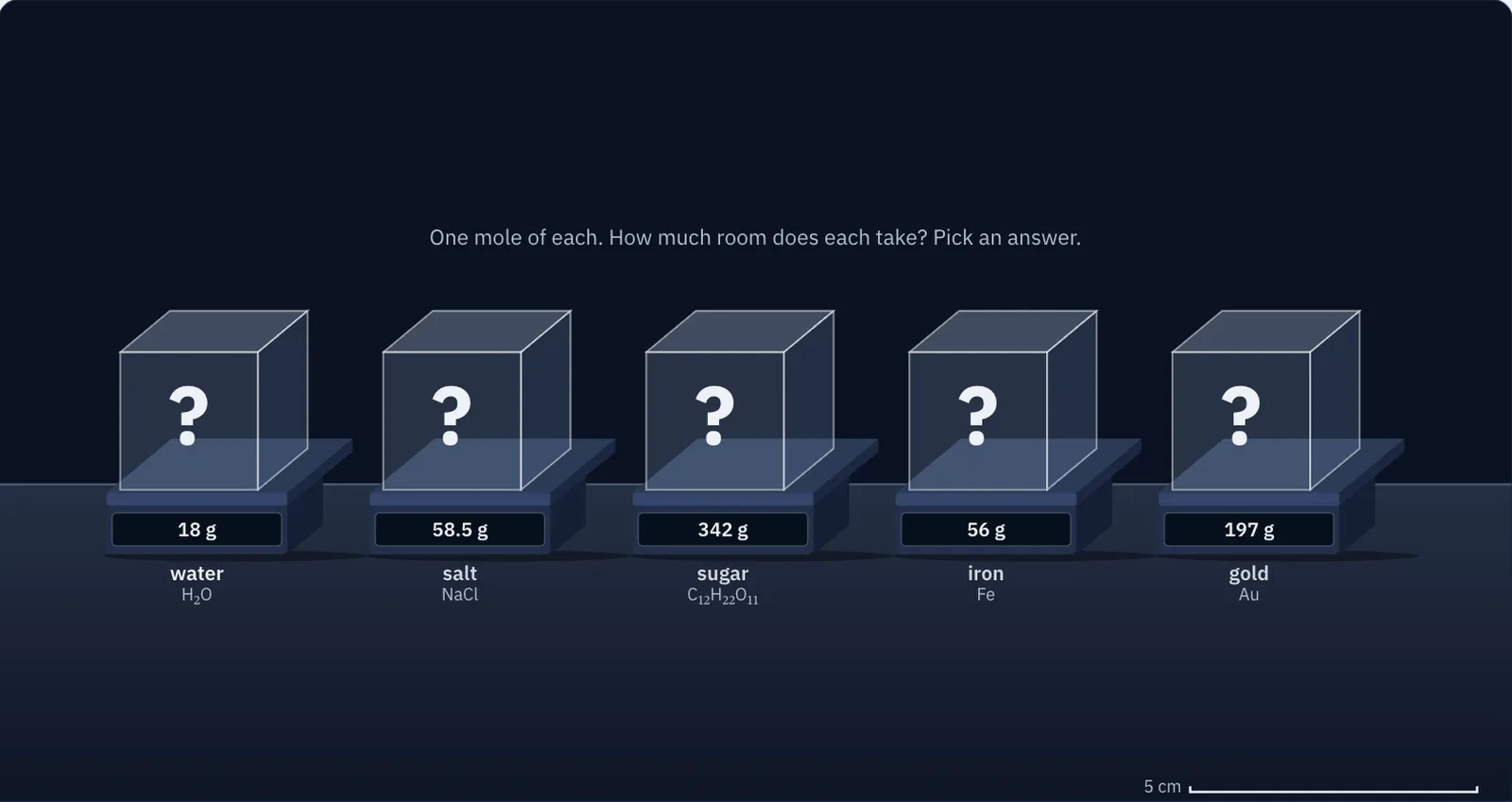
On a kitchen balance you can put, one after another, 18 g of water, 58.5 g of salt, 342 g of sugar, 56 g of iron and 197 g of gold. Every heap holds the same number of particles: one mole. The picture shows the five heaps to scale, still covered. Start with a prediction, then change the mass on the balance.
One mole of water or one mole of gold: which takes up more room?
Each of the five balances holds one mole, covered. Gold weighs 11 times as much as water: 197 g against 18 g.
Which heap takes up more room?
One mole of water is a little more than a tablespoon
What you see. One mole of water weighs 18 g. With a density of 1.0 g/cm³ it takes up 18 cm³, that is 18 mL, the size of a cube 2.6 cm on a side.
The dotted cube in the corner is a tablespoon, 14.8 mL. The water overshoots it by about a fifth (1.22 tablespoons).
How it is written. M(H₂O) = 2 · 1 + 16 = 18 g/mol, so 18 g of water is 1 mol.
The same number of particles, five different masses
Each balance holds one mole: 6.022·10²³ particles. Its mass in grams is the molar mass: H₂O 18 g/mol, NaCl 58.5 g/mol, C₁₂H₂₂O₁₁ 342 g/mol, Fe 56 g/mol, Au 197 g/mol.
The particles being counted come in three kinds: molecules (water and sugar), formula units (salt is a lattice of Na⁺ and Cl⁻ ions, with no NaCl molecules) and atoms (iron and gold).
Each particle has a mass of its own
What you see. The same number of particles, different masses on the balance.
What the particles do. A disc above a heap is one particle; its area shows its mass. A sugar molecule weighs 19 times as much as a water molecule. One water particle weighs 2.99·10⁻²³ g, one gold atom 3.27·10⁻²² g.
How it is written. mass of one particle = M ÷ NA, for example 197 g ÷ 6.022·10²³ = 3.27·10⁻²² g.
Volumes differ too: gold takes up less room than water
The volume of one mole is the mass divided by the density: V = m ÷ ρ. For gold, 197 g ÷ 19.3 g/cm³ = 10.2 cm³; for water, 18 g ÷ 1.0 g/cm³ = 18 cm³. Water takes up 1.8 times as much room.
Sugar takes up the most (215 cm³), iron the least (7.1 cm³). The dotted line shows how much room the water takes. Salt and sugar are drawn as a compact solid, without the air between crystals; a heap in the kitchen would be bigger.
Drag the mass: 9 g of water is half a mole
Tap a block and drag it sideways, or use the ½ mol buttons. The balance shows the mass, and the dotted outlines show how much one whole mole would be.
How it is written. n = m ÷ M = 9 ÷ 18 = 0.5 mol. N = n · NA = 0.5 · 6.022·10²³ = 3.011·10²³ molecules.
6.022·10²³ cannot be counted
Counting one particle per second, you would need 1.9·10¹⁶ years for a single mole (a year has 365.25 days). The Universe is about 13.77 billion years old: the count would take 1.4 million times its age.
That is why particles are not counted one by one: the mass is measured on a balance, and the number is calculated from it with N = n · NA. One mole of water weighs 18 g and one mole of gold 197 g, with the same number of particles.
Now you explain: one kilogram of sugar
A bag of sugar weighs 1 kg. How many moles of sucrose, C₁₂H₂₂O₁₁, are in it, and how many molecules? Put the bag on the balance, then choose what to find out.
Compare with an answer
M(C₁₂H₂₂O₁₁) = 12 · 12 + 22 · 1 + 11 · 16 = 342 g/mol. n = m ÷ M = 1,000 ÷ 342 ≈ 2.92 mol. N = n · NA ≈ 2.92 · 6.022·10²³ ≈ 1.76·10²⁴ molecules. Check: 1,000 g is a little under three times 342 g, so a little under three moles.
The lesson on the mole · The lesson on percentage composition