Chapter 1 · The language of chemistry and the moleLesson 1.4TC Core curriculum (1 hour a week) · beyond your profile
Stoichiometric calculations will be carried out using the chemical formula and the equation of a chemical reaction, with purity, yield, excess of a reactant, percentage concentration by mass and molar concentration of solutions
How much lime comes from a tonne of limestone? Calculations from equations
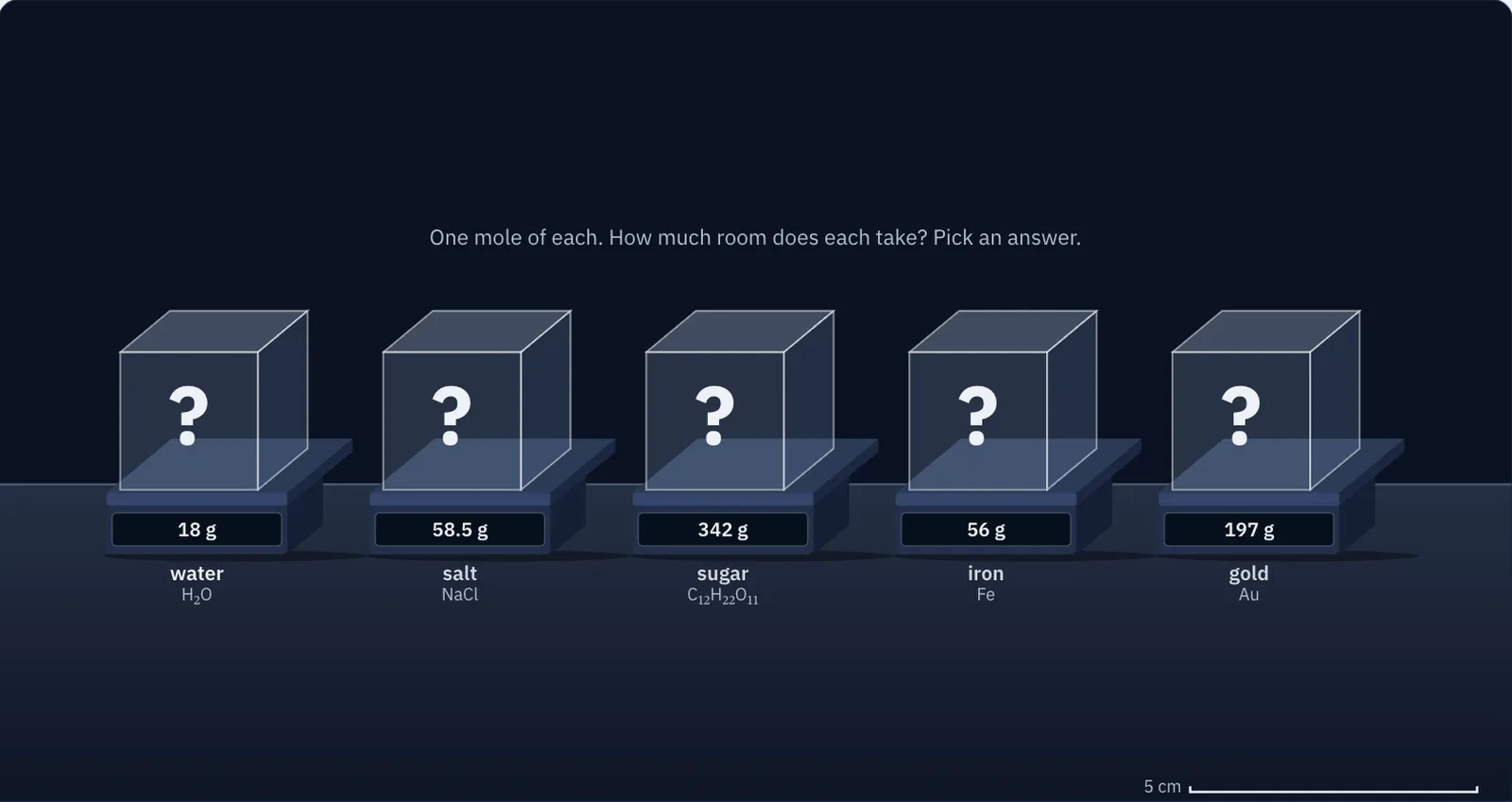
Strongly heated, a tonne of limestone gives lime and releases a gas. How much lime is made, and how much CO₂ enters the air?
Before you read: what do you think?
A tonne of pure limestone, CaCO₃, decomposes completely on heating into quicklime, CaO, and carbon dioxide. What mass of lime remains?
See the answer
560 kg remains. The rest, 440 kg, escapes as CO₂, a gas. Total mass is conserved: 560 + 440 = 1,000 kg.
At cement and lime plants, limestone is heated strongly in kilns. Quicklime remains from the stone, and some of its mass escapes into the air as a gas. The reaction equation tells you exactly how much stays and how much leaves.
Coefficients give mole ratios
A reaction equation is read in moles. In methane combustion, the coefficients show that 1 mol of CH₄ reacts with 2 mol of O₂ to give 1 mol of CO₂ and 2 mol of H₂O:
CH₄(g) + 2O₂(g) → CO₂(g) + 2H₂O(l)
Coefficients give mole ratios, not mass ratios in grams: 2O₂ means 2 mol, or 64 g of oxygen. Mass is conserved because atoms are conserved: 16 g of CH₄ and 64 g of O₂ give 44 g of CO₂ and 36 g of H₂O, and 16 + 64 = 80 g and 44 + 36 = 80 g.
The four steps in any calculation from an equation
There are four steps: balance the equation, find the amount of the known substance, use the mole ratio from the coefficients, then convert to the required mass or volume. The equation must be balanced, or the mole ratio will be wrong. Use the known data to find the amount: n = m ÷ M for a mass, n = V ÷ VM for a gas at normal conditions. Use the ratio of coefficients to find the required amount: n(required) = n(known) · required coefficient ÷ known coefficient. Finally, m = n · M or V = n · VM.
A calculation example for the reaction of zinc with hydrochloric acid, shown by the teacher in the laboratory, with hydrogen released:
Zn(s) + 2HCl(aq) → ZnCl₂(aq) + H₂(g)
From 6.5 g of Zn: n(Zn) = 6.5 ÷ 65 = 0.1 mol. The Zn : H₂ ratio is 1 : 1, so n(H₂) = n(Zn) = 0.1 mol and V = 0.1 · 22.4 = 2.24 L at normal conditions. Acid consumed: n(HCl) = 2 · 0.1 = 0.2 mol, or m = 0.2 · 36.5 = 7.3 g.
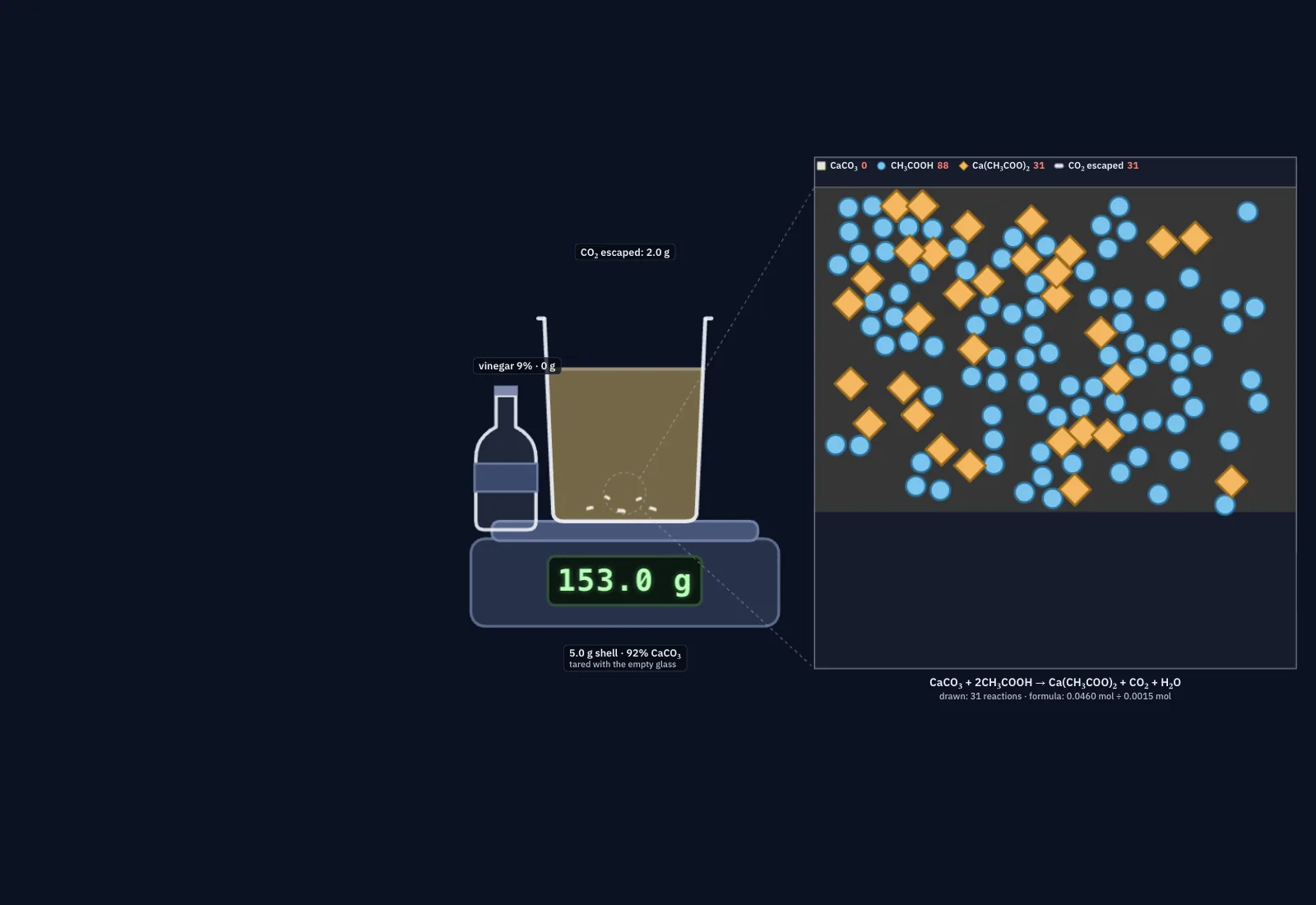
| Vinegar poured (g) | Balance (g) | CO₂ escaped (g) | Limiting reactant | Acetic acid left (mol) | Reactions drawn |
|---|---|---|---|---|---|
| 0 | 5.0 | 0.0 | — | 0.000 | 0 |
| 10 | 14.7 | 0.3 | the acid | 0.000 | 5 |
| 20 | 24.3 | 0.7 | the acid | 0.000 | 10 |
| 30 | 34.0 | 1.0 | the acid | 0.000 | 15 |
| 40 | 43.7 | 1.3 | the acid | 0.000 | 20 |
| 50 | 53.4 | 1.6 | the acid | 0.000 | 25 |
| 60 | 63.0 | 2.0 | the acid | 0.000 | 30 |
| 70 | 73.0 | 2.0 | the shell | 0.013 | 31 |
| 100 | 103.0 | 2.0 | the shell | 0.058 | 31 |
| 150 | 153.0 | 2.0 | the shell | 0.133 | 31 |
| Shell (g) | CaCO₃ in the shell | CO₂ escaped with 150 g of vinegar (g) | Balance (g) |
|---|---|---|---|
| 2 | 92% | 0.8 | 151.2 |
| 5 | 92% | 2.0 | 153.0 |
| 10 | 92% | 4.0 | 156.0 |
| 5 | 95% | 2.1 | 152.9 |
| 5 | 100% | 2.2 | 152.8 |
Shell of 5.0 g with 92% CaCO₃ (4.6 g, 0.046 mol) and vinegar with 9% acetic acid by mass (the assumption of the exercise). Calculated; the balance is tared with the empty glass. The equation: CaCO₃ + 2CH₃COOH → Ca(CH₃COO)₂ + CO₂ + H₂O. One drawn particle stands for 0.0015 mol.
Calculation. An exact calculation from the atomic masses of the book, for 5 g of shell with 92% CaCO₃ (the white shells analysed in the cited study had 91%, the brown ones 95%; the literature cited by the study gives 92–97%) and vinegar with 9% acetic acid by mass, the assumption of the exercise: labels in Romania say “9%” or “9 degrees”. The rest of the shell does not react in the calculation. The balance is tared with the empty glass. The drop on a real balance can be smaller than the calculated one, because some of the CO₂ stays dissolved in the liquid. Atoms and molecules have no colour: they are drawn enormously enlarged and far fewer than in reality, one particle for every 0.0015 mol; the water in the vinegar is not drawn.
Sources and credits. Strength of the vinegar: the Carrefour România product title, “Oțet 9% 1 L Vinalcool”, and the Auchan România page, “Oțet de Bistrița, 9 grade, 1 L” (read on 2026-11-16); the mass basis of the 9% is the assumption of the exercise. CaCO₃ content of the shell: values quoted from C. O. Ogah, K. U. Nwaeze, O. O. Adetifa, Journal of Basic and Social Pharmacy Research 2(2), 27–34 (2021): 91% for the white shells and 95% for the brown ones they analysed, 92–97% in the literature they cite. Atomic masses: CIAAW, the rounded values of the book.
For gases, volumes follow the coefficients
At the same temperature and pressure, gas volumes are in the ratio of the coefficients. In methane combustion, 1 m³ of CH₄ needs 2 m³ of O₂ and gives 1 m³ of CO₂. To find mass, go through moles.
Calculation example: 1 m³ of methane at normal conditions is 1,000 L, so n(CH₄) = 1,000 ÷ 22.4 ≈ 44.64 mol. The CH₄ : CO₂ ratio is 1 : 1, so n(CO₂) = 44.64 mol, and m(CO₂) = 44.64 · 44 ≈ 1,964 g, or nearly 2 kg of CO₂ for every cubic metre of methane burned.
For the curious
The gas at the meter is not pure methane and is not measured at normal conditions, so the result above is a calculation example, not a bill. The calculation shows only the order of magnitude: one cubic metre of pure methane at normal conditions gives nearly 2 kg of CO₂ when burned.
The same calculation as a proportion or in industrial units
The calculation can also be written as a proportion. Below each formula, write its mass from the equation (the coefficient multiplied by the molar mass), and above it, the data from the problem. For CaCO₃ → CaO + CO₂: below CaCO₃ write 100 g, below CaO write 56 g; given 1,000 kg of CaCO₃ and looking for x kg of CaO, x = 1,000 · 56 ÷ 100 = 560 kg. The result is the same as with the mole method.
Industrial problems use kilograms, tonnes and cubic metres. With molar masses in kg/kmol, the calculation stays the same: amount is measured in kmol, mass in kg, gas volume in m³, and 1 kmol of gas occupies 22.4 m³ at normal conditions. Finally, check the balance: the mass of products must equal the mass of reactants consumed.
Worked example
Lime and CO₂ from a tonne of pure limestone
Pure limestone is CaCO₃. What mass of quicklime and what mass and volume of CO₂ at normal conditions come from 1 t of CaCO₃?
CaCO₃(s) → CaO(s) + CO₂(g)
The mole ratio CaCO₃ : CaO : CO₂ is 1 : 1 : 1. M(CaCO₃) = 40 + 12 + 3 · 16 = 100 g/mol, or 100 kg/kmol. Amount: n = 1,000 ÷ 100 = 10 kmol.
Mass of lime: M(CaO) = 40 + 16 = 56 g/mol, so m(CaO) = 10 · 56 = 560 kg. Mass of CO₂: M(CO₂) = 12 + 2 · 16 = 44 g/mol, so m(CO₂) = 10 · 44 = 440 kg. Volume of CO₂: V = 10 · 22.4 = 224 m³.
Check: 560 + 440 = 1,000 kg, the mass of limestone. The volume of 224 m³ is calculated at normal conditions; the gas from the kiln is hot and occupies much more.
In Romania
How much CO₂ leaves limestone in cement plants
Heidelberg Materials România has three cement plants: Tașca, near Bicaz, Chișcădaga, near Deva, and Fieni. In kilns at plants like these, limestone decomposes into CaO and CO₂ before clinker forms; clinker is ground to make cement.
The IPCC methodology starts with clinker containing 64.6% CaO. Each tonne of clinker then needs 0.646 t of CaO, and the equation CaCO₃ → CaO + CO₂ gives 0.646 · 44 ÷ 56 ≈ 0.51 t of CO₂ released from limestone, close to the 0.507 t in the IPCC guidance. A 2022 estimate puts CO₂ from cement produced in Romania at over 13 million tonnes a year; that includes fuel burned in the kiln as well as limestone.
In short
- Equation coefficients give mole ratios (and, for gases under the same conditions, volume ratios), not mass ratios in grams.
- The steps: balance the equation; find the amount of the known substance (n = m ÷ M or n = V ÷ VM); use the mole ratio from the coefficients; find the required mass or volume (m = n · M, V = n · VM).
- Mass is conserved: the sum of the masses of the reactants equals the sum of the masses of the products.
- CaCO₃ → CaO + CO₂: 100 g of pure limestone gives 56 g of quicklime and 44 g of CO₂.
- At normal conditions, 1 kmol of gas occupies 22.4 m³; burning one cubic metre of methane gives one cubic metre of CO₂, or nearly 2 kg.
Common mistakes
WrongIf the equation is CH₄ + 2O₂ → CO₂ + 2H₂O, then 1 g of CH₄ needs 2 g of O₂.
RightCoefficients give mole ratios: 1 mol of CH₄, or 16 g, needs 2 mol of O₂, or 64 g.
Wrong1 t of limestone produces 1 t of lime.
RightSome mass escapes as gas: 1 t of CaCO₃ gives 560 kg of CaO and 440 kg of CO₂.
WrongYou can calculate from an unbalanced equation.
RightThe mole ratio comes from the coefficients, so balance the equation first.
Test yourself
7 questions. For the first 6 you see the explanation at once, with the paragraph of the lesson that supports it; for the written ones you compare with a good answer.
How many moles of O₂ react with 3 mol of CH₄ in complete combustion?
Answer
b) 6 mol. The CH₄ : O₂ ratio is 1 : 2, so 3 · 2 = 6 mol.
What do the coefficients in a balanced chemical equation show?
Answer
c) The ratio of amounts in moles. Coefficients give mole ratios and, for gases under the same conditions, volume ratios too.
What volume of O₂ is consumed when 1 m³ of methane burns completely at the same temperature and pressure?
Answer
d) 2 m³. The gas volumes are in the ratio of the coefficients, 1 : 2.
What mass of quicklime, CaO, in kg, comes from 500 kg of pure CaCO₃? Given M(CaCO₃) = 100 g/mol and M(CaO) = 56 g/mol.
kgAnswer
280 kg. n(CaCO₃) = 500 ÷ 100 = 5 kmol; the 1 : 1 ratio gives 5 kmol of CaO, or 5 · 56 = 280 kg.
What volume of hydrogen, in litres, is released at normal conditions from 13 g of zinc if all the zinc reacts? Given M(Zn) = 65 g/mol.
LAnswer
4.48 L. n(Zn) = 13 ÷ 65 = 0.2 mol; n(H₂) = 0.2 mol; V = 0.2 · 22.4 = 4.48 L.
Put the steps of a calculation from a reaction equation in order.
Answer
The correct order:
- Write the balanced reaction equation
- Calculate the amount of the known substance in moles
- Use the ratio of coefficients to find the moles of the required substance
- Convert the moles to mass or volume
The calculation goes from the given mass to moles, then through the mole ratio to the required substance, then to the required mass or volume.
A classmate calculated that 1 t of pure limestone gives 1 t of lime because “the equation has coefficients 1 : 1 : 1”. Explain the mistake and the masses of lime and CO₂ actually produced.
A good answer
The 1 : 1 : 1 ratio is a ratio of moles, not grams. One mole of CaCO₃ has a mass of 100 g and gives one mole of CaO, 56 g, and one mole of CO₂, 44 g. From 1 t of limestone come 560 kg of lime and 440 kg of CO₂.
A complete answer distinguishes moles from grams, uses the molar masses 100, 56 and 44 and checks conservation of mass: 560 + 440 = 1,000 kg.
Terms
- chemical equation
- A way of writing a reaction using reactant and product formulas and balanced coefficients.
- stoichiometric coefficient
- The number before a formula in an equation, showing the mole ratio.
- mole ratio
- The ratio of the coefficients of two substances in an equation.
- reactant
- A substance consumed in a reaction.
- product
- A substance formed in a reaction.
- quicklime
- Calcium oxide, CaO, obtained by strongly heating limestone.
Sources and link to the programme
- OpenStax – Chemistry 2e, 4.3 Reaction Stoichiometry – coefficients as mole ratios and the method of calculation from an equation: from mass to moles, through the mole ratio, to the required mass
- IPCC – Cement Production (Good Practice Guidance, 3.1) – clinker with 64.6% calcium oxide; the factor 0.785, the ratio of molar masses CO₂ : CaO; 0.507 t of CO₂ per tonne of clinker
- Heidelberg Materials – România – the three cement plants in Romania: Tașca, Chișcădaga and Fieni
- World Cement – Every year Romania emits over 13 million tons of carbon dioxide from cement production – over 13 million tonnes of CO₂ a year from cement produced in Romania, for about 15 million tonnes of cement
- NIST – CODATA: molar volume of ideal gas (273,15 K, 101,325 kPa) – molar volume of an ideal gas at 1 atm and 273.15 K: 22.414 L/mol, rounded to 22.4 L/mol
From the programme: “Stoichiometric calculations will be carried out using the chemical formula and the equation of a chemical reaction, with purity, yield, excess of a reactant, percentage concentration by mass and molar concentration of solutions” (TC: Core curriculum (1 hour a week)). Specific competences followed: 5.1, 4.3.