Chapter 2 · Chemical reactionsLesson 2.1TC Core curriculum (1 hour a week) · beyond your profile
For the content area Classification of reactions in inorganic chemistry, reactions will be classified according to the given criteria, and different examples of chemical reactions will be presented for each type. For Exothermic and endothermic reactions, examples will also include the decomposition of some nitrates and carbonates
What stays the same when one substance becomes another
Steel wool burns, gas from the cooker disappears, quicklime is slaked in water. What is conserved in these reactions, and how is it written?
Before you read: what do you think?
The teacher places a tuft of steel wool on one pan of a balanced set of scales and lights it. What happens to the scales after the wool burns?
See the answer
The pan falls. Iron combines with oxygen from the air, and the product contains the mass of the iron plus the mass of the oxygen. Mass does not appear from nowhere: the oxygen came from the air.
A craftsperson puts lumps of quicklime into a bucket of water. The water gets very hot, the lumps crumble, and a white paste remains: slaked lime, used to whitewash walls. Two substances have produced others, and only heat and a little steam have left the bucket.
Mass is conserved, even when substances disappearWhat you see
The teacher lights a tuft of steel wool on one pan of a balanced set of scales. The wool burns with sparks and turns black, and the pan falls: the product weighs more than the original steel. The iron has combined with oxygen from the air, and the mass of the oxygen has added to the mass of the iron.
Gases must be counted just like solids. In a bottle where vinegar reacts with bicarbonate of soda, sealed with a balloon over the opening, the scales show almost the same mass before and after the reaction. In an open bottle, the mass falls because carbon dioxide escapes into the air. You can try this at home with a plastic bottle, a teaspoon of bicarbonate of soda and kitchen vinegar.
The law of conservation of mass states that, in a closed system, the mass of the reacting substances equals the mass of the substances formed. Antoine Lavoisier (1743–1794) promoted this principle for a decade, carefully weighing every substance in a reaction, including the gases.
For the curious
In an open system, mass can change, but only because something enters or leaves: oxygen joins the iron, or carbon dioxide escapes from the bottle. The law still holds, because the total mass, counting everything that enters and leaves, stays the same.
Atoms rearrange: they do not appear or disappearWhat the particles do
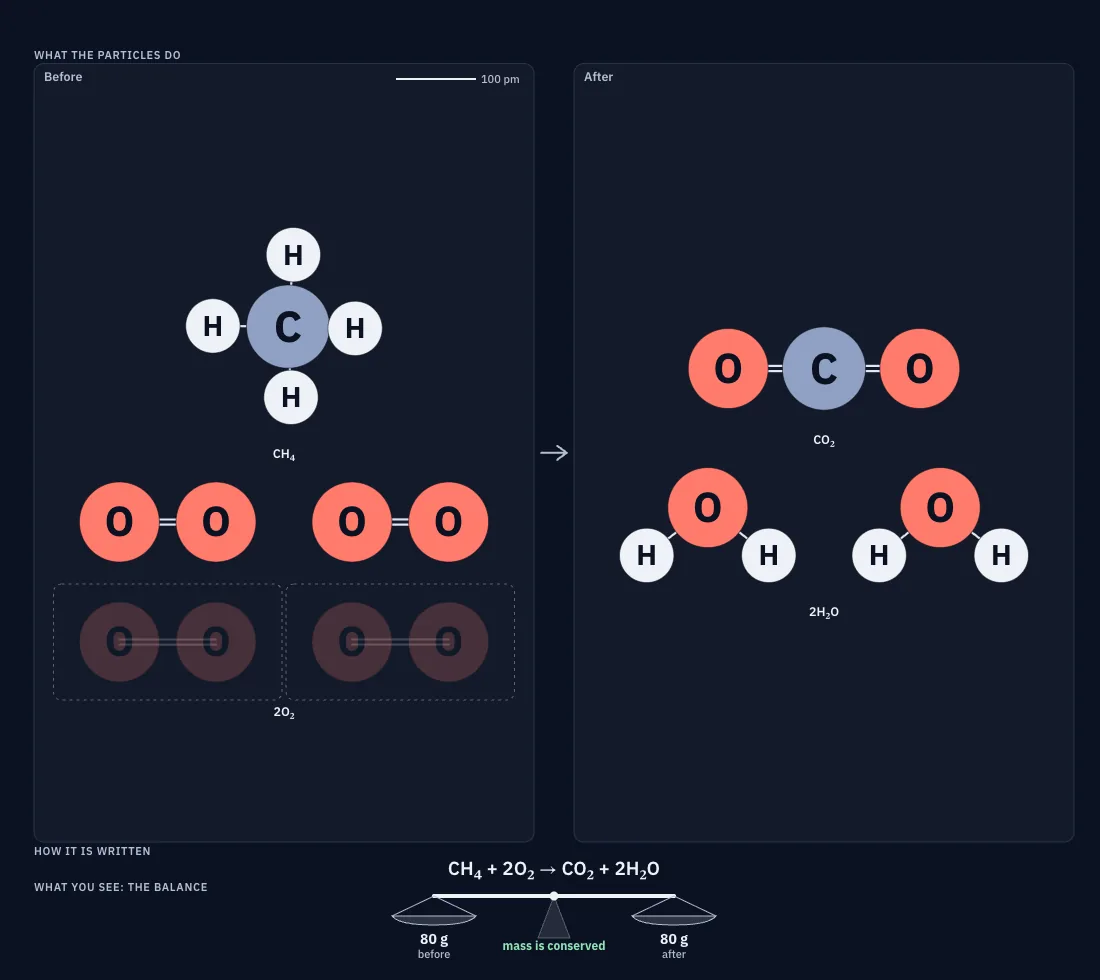
A chemical reaction breaks some bonds between atoms and forms others. The atoms remain the same: their nuclei do not change, so the number of atoms of each element is the same before and after. The starting substances are called reactants, and those formed are called products.
Total mass is conserved because each atom keeps its mass and the number of atoms stays the same. The number of molecules can change: in the reaction between hydrogen and oxygen, three molecules give two.
2H₂ + O₂ → 2H₂O
How to read a chemical equationHow it is written
A chemical equation describes a reaction using symbols and formulas. Reactants stand to the left of the arrow, products to the right. The slaking of lime is written like this:
CaO(s) + H₂O(l) → Ca(OH)₂(s)
The letters in brackets show the physical state: (s) solid, (l) liquid, (g) gas, (aq) dissolved in water.
A subscript is the small number after a symbol and is part of the formula: H₂O has two hydrogen atoms for every oxygen atom. A coefficient is the number written before a formula and multiplies the whole formula: 3Ca(OH)₂ means three units of Ca(OH)₂, or 3 calcium atoms, 6 oxygen atoms and 6 hydrogen atoms. Coefficients show the ratio of particles and of amounts of substance. The mass ratio is calculated separately, using molar masses.
Balancing by countingHow it is written
A balanced equation has the same number of atoms of each element on the left and right. Balancing follows four steps: write the formulas of all substances correctly, count the atoms of each element on each side, add coefficients starting with an element that appears in only one formula on each side and leaving hydrogen and oxygen until last, then check the count and keep the smallest whole-number coefficients.
Only coefficients change when balancing. Changing a subscript would change the substance: H₂O₂ is hydrogen peroxide, a different substance from water. A coefficient of 1 is not written.
For the curious
Equations with ions need a second check, for charge. In Zn + Cu²⁺ → Zn²⁺ + Cu, the atoms match and the total charge is 2+ on both sides.
| Balanced equation | Atoms, left | right | Particles | Mass |
|---|---|---|---|
| CH₄ + 2O₂ → CO₂ + 2H₂O | C 1 | 1, H 4 | 4, O 4 | 4 | 3 | 3 | 80 g | 80 g |
| 2H₂ + O₂ → 2H₂O | H 4 | 4, O 2 | 2 | 3 | 2 | 36 g | 36 g |
| N₂ + 3H₂ → 2NH₃ | H 6 | 6, N 2 | 2 | 4 | 2 | 34 g | 34 g |
| 4Fe + 3O₂ → 2Fe₂O₃ | O 6 | 6, Fe 4 | 4 | 7 | 2 | 320 g | 320 g |
| C₃H₈ + 5O₂ → 3CO₂ + 4H₂O | C 3 | 3, H 8 | 8, O 10 | 10 | 6 | 7 | 204 g | 204 g |
| 4Al + 3O₂ → 2Al₂O₃ | O 6 | 6, Al 4 | 4 | 7 | 2 | 204 g | 204 g |
| With a single CH₄ and | What forms | Mass, left | right |
|---|---|---|
| 0 O₂ molecules | nothing: the CH₄ stays | 16 g | 16 g |
| one O₂ molecule | CO₂ and 4 unbound hydrogen atoms | 48 g | 48 g |
| two O₂ molecules | CO₂ and 2H₂O, nothing unbound | 80 g | 80 g |
| three O₂ molecules | CO₂ and 2H₂O, one O₂ molecule unchanged | 112 g | 112 g |
| Steel wool, calculated with 4Fe + 3O₂ → 2Fe₂O₃ | Before | After |
|---|---|---|
| Open air, on the pan: only the iron and the product | 224 g | 320 g |
| Sealed jar: everything in the jar | 320 g | 320 g |
Diagram and calculation. Diagram: atoms have no colour, and a real reaction goes through intermediate steps. Atoms and molecules are drawn enormously enlarged and far fewer than in reality; the size of the discs is chosen by the drawing. The distances between atomic centres come from data: measured for H₂, N₂ and O₂, calculated for the other molecules. They are drawn in projection, so in molecules that are not flat (CH₄, NH₃, C₃H₈) a bond looks shorter than it is. The atom counts and the masses are calculated from the particles drawn, with the book's rounded atomic masses; one mole is counted for each molecule drawn. The rule by which the atoms regroup in the picture (CO₂ first, then H₂O, and whatever has nothing to bond with stays unbound) is a choice of the drawing, not a mechanism; an extra O₂ molecule stays O₂, which is also what happens in reality. The oxides of iron and aluminium are ionic solids: the drawing shows them as a group of atoms, without bonds and without scale. The burning of steel wool is a demonstration done by the teacher only, and the Fe₂O₃ in the calculation is one of the oxides that form.
Sources and credits. Distances between atoms in H₂ (74.1 pm), N₂ (109.8 pm) and O₂ (120.8 pm): measured re values, cited from the NIST Chemistry WebBook, constants of diatomic molecules (Huber and Herzberg). Geometries of the CH₄, CO₂, H₂O, NH₃ and C₃H₈ molecules: values cited from the 3D conformers calculated by PubChem, CID 297, 280, 962, 222 and 6334. Atomic masses: CIAAW, the rounded values used in the book.
The four types of reaction from lower secondary school
By the way their atoms rearrange, reactions fall into four types: combination, decomposition, displacement and double displacement.
Combination: two or more substances form one, as in CaO + H₂O → Ca(OH)₂. Decomposition: one substance forms two or more, as in 2H₂O₂ → 2H₂O + O₂. Displacement: one element takes the place of another in a compound, as in Fe + CuSO₄ → FeSO₄ + Cu. Double displacement: two compounds exchange parts, as in AgNO₃ + NaCl → AgCl + NaNO₃.
The reaction type can be read from the number of substances on each side of the arrow and the position of each element before and after the reaction.
Worked example
Burning propane
Propane, C₃H₈, is a fuel gas sold in cylinders. It burns in oxygen to produce carbon dioxide and water. Balance the equation and check that mass is conserved.
The scheme is C₃H₈ + O₂ → CO₂ + H₂O. Carbon: three atoms on the left, so 3CO₂. Hydrogen: eight atoms on the left, so 4H₂O. Oxygen: there are 3 · 2 + 4 · 1 = 10 atoms on the right, so 5O₂ on the left.
C₃H₈ + 5O₂ → 3CO₂ + 4H₂O
Check: C 3 = 3, H 8 = 8, O 10 = 10. The molar masses are M(C₃H₈) = 44 g/mol, M(O₂) = 32 g/mol, M(CO₂) = 44 g/mol and M(H₂O) = 18 g/mol. For 1 mol of propane, the reactants weigh 1 · 44 + 5 · 32 = 204 g, and the products 3 · 44 + 4 · 18 = 204 g. The masses are equal, though the numbers of molecules are not: six on the left, seven on the right.
In Romania
Gas found at Sărmășel instead of potassium
In 1909, at Sărmășel in Mureș county, a well searching for potassium salts at a depth of over 300 metres struck natural gas, which burst freely to the surface. The event marked the start of Romania’s gas industry. Gas from the Transylvanian Basin fields is mainly methane, CH₄.
Methane burns in a cooker according to the equation CH₄ + 2O₂ → CO₂ + 2H₂O. One mole of methane consumes two moles of oxygen. With M(CH₄) = 16 g/mol, the reactants weigh 16 + 2 · 32 = 80 g, and the products 44 + 2 · 18 = 80 g.
In short
- Reactants are the substances consumed, products are those formed; a chemical equation writes them as formulas separated by an arrow.
- In a reaction, the number of atoms of each element is conserved, so total mass is conserved (the law of conservation of mass, Lavoisier).
- A subscript is part of a formula, a coefficient multiplies the whole formula; only coefficients change when balancing.
- Balance by counting: count the atoms of each element on each side, add the smallest whole-number coefficients, then check.
- Physical state is shown by (s), (l), (g), (aq); the types from lower secondary school are combination, decomposition, displacement and double displacement.
Common mistakes
WrongBurnt steel wool weighs less because it has burned.
RightIt weighs more. The iron has combined with oxygen from the air, and the mass of the oxygen has added to the mass of the product.
WrongTo balance H₂ + O₂ → H₂O, I write H₂O₂ on the right.
RightSubscripts do not change when balancing, because H₂O₂ is a different substance, hydrogen peroxide. The coefficients change: 2H₂ + O₂ → 2H₂O.
WrongThe number of molecules is conserved in every reaction.
RightThe number of atoms of each element is conserved. The number of molecules can rise or fall: in 2H₂ + O₂ → 2H₂O, three molecules give two.
Test yourself
7 questions. For the first 6 you see the explanation at once, with the paragraph of the lesson that supports it; for the written ones you compare with a good answer.
What is always conserved in a chemical reaction?
Answer
b) The number of atoms of each element. Atoms rearrange, but they do not appear or disappear. Molecules, substances and bonds can change.
What can be changed to balance a chemical equation?
Answer
d) The coefficients before the formulas. A changed subscript means a different substance. Coefficients change only how many units of each substance react.
Why does the mass of an open bottle fall when vinegar reacts with bicarbonate of soda inside it?
Answer
c) Carbon dioxide escapes into the air. The gas formed leaves the bottle, taking its mass with it. If the bottle is sealed, mass is conserved.
For 1 mol of propane, the equation C₃H₈ + 5O₂ → 3CO₂ + 4H₂O shows reactants with a mass of 204 g. What mass of products forms, in grams? Use M(CO₂) = 44 g/mol and M(H₂O) = 18 g/mol.
gAnswer
204 g. 3 · 44 + 4 · 18 = 132 + 72 = 204 g, equal to the mass of the reactants.
Put the steps for balancing a chemical equation in order.
Answer
The correct order:
- Write the formulas of all substances correctly
- Count the atoms of each element on each side
- Add coefficients, leaving hydrogen and oxygen until last
- Check the count and keep the smallest whole-number coefficients
Correct formulas come first, because the subscripts must not change afterwards. Counting shows what is missing. Add coefficients next, then check.
Put each reaction into its type.
Answer
Combination: 2Mg + O₂ → 2MgO; CaO + H₂O → Ca(OH)₂.
Decomposition: CaCO₃ → CaO + CO₂; 2H₂O₂ → 2H₂O + O₂.
Displacement: Zn + 2HCl → ZnCl₂ + H₂; Fe + CuSO₄ → FeSO₄ + Cu.
Double displacement: NaOH + HCl → NaCl + H₂O; AgNO₃ + NaCl → AgCl + NaNO₃.
Combination has one substance on the right, decomposition has one on the left, displacement has an element and a compound on the left, and double displacement has two compounds on each side.
A classmate puts 5 g of bicarbonate of soda and vinegar in an open bottle on a set of scales and sees the mass fall. They say the law of conservation of mass is false. How do you answer?
A good answer
The law applies to a closed system. In the open bottle, the carbon dioxide formed escapes into the air, taking its mass with it. If the bottle is sealed with a balloon, the mass stays almost the same. The mass of the gas that escaped, added to the mass left in the bottle, equals the starting mass.
A complete answer says the system is open, names the gas that escapes and shows how to check (the sealed bottle).
Terms
- reactant
- A substance consumed in a chemical reaction, written to the left of the arrow.
- product
- A substance formed in a chemical reaction, written to the right of the arrow.
- chemical equation
- A way of writing a chemical reaction using the formulas of reactants and products, joined by an arrow.
- coefficient
- A number written before a formula in an equation, showing how many units of that substance react.
- subscript
- A small number written below and after a symbol, showing how many atoms of that element are in a unit of the substance.
- law of conservation of mass
- In a closed system, the mass of the reacting substances equals the mass of the substances formed.
- balancing the equation
- Choosing coefficients so that the equation has the same number of atoms of each element on both sides.
Sources and link to the programme
- OpenStax – Chemistry 2e, 4.1 Writing and balancing chemical equations – a balanced equation respects conservation of matter; subscripts are part of a substance’s identity, coefficients can be read as ratios; symbols (s), (l), (g), (aq); CH₄ + 2O₂ → CO₂ + 2H₂O
- OpenStax – Chemistry 2e, 4.2 Classifying chemical reactions – the equation AgNO₃ + NaCl → AgCl + NaNO₃ (precipitation) and displacement examples
- Science History Institute – Antoine-Laurent Lavoisier – Lavoisier (1743–1794) promoted the principle of conservation of mass for a decade, weighing every substance in a reaction, including gases; Traité élémentaire de chimie, 1789
- AACT – Investigating mass change – steel wool gains mass after burning through oxidation of iron; pupils usually predict a decrease
- Flinn Scientific – Steely wools of fire – the steel wool demonstration: mass gain from iron combining with oxygen
- Romgaz – Istoric – 1909, Sărmășel: natural gas burst out from a depth of over 300 m in a well drilled for potassium salts
- Wikipedia – Sărmășel – Sărmășel is in Mureș county
- EMERG – The energy potential of natural gas fields from Transylvanian Basin – gas from the Transylvanian Basin is mainly methane, with heavier fractions below 2%
- Petrom – Fișă de securitate, butelii propan – propane (C₃H₈) is sold as a fuel gas in cylinders
- University of California IPM – Bordeaux mixture (Pest Note) – slaking quicklime in water releases enough heat to boil the water
From the programme: “For the content area Classification of reactions in inorganic chemistry, reactions will be classified according to the given criteria, and different examples of chemical reactions will be presented for each type. For Exothermic and endothermic reactions, examples will also include the decomposition of some nitrates and carbonates” (TC: Core curriculum (1 hour a week)). Specific competences followed: 3.1, 5.1.