Chemistry 9 RO
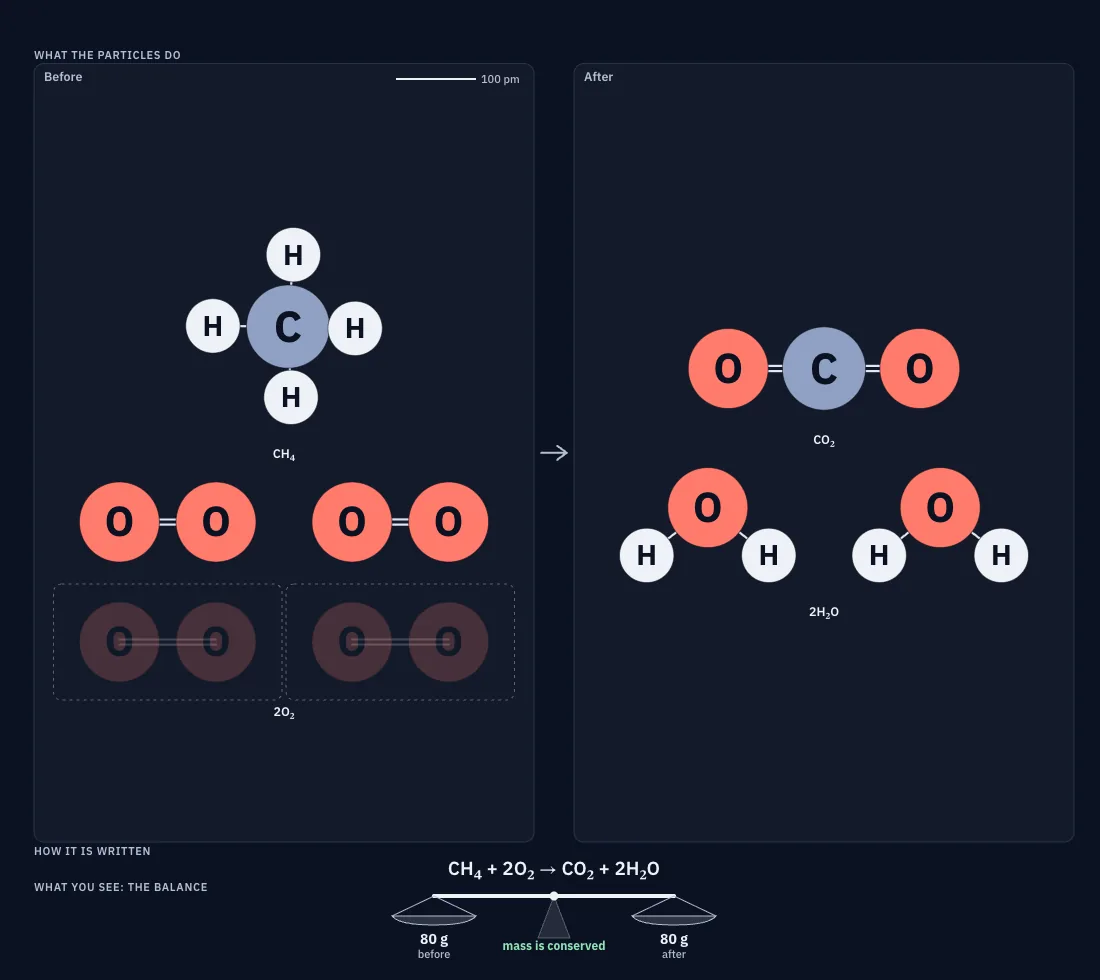
Two panels: on the left one methane molecule, CH₄, with one carbon atom and four hydrogen atoms, and two oxygen molecules, O₂; on the right one carbon dioxide molecule, CO₂, and two water molecules, H₂O. Below them, the equation CH₄ + 2O₂ → CO₂ + 2H₂O and a balance in equilibrium, with 80 g on both sides.

Classification of reactions in inorganic chemistry

Chapter 2

Chemical reactions – what changes and what stays the same

What changes and what stays the same when two substances react?

Cooker gas burns in air and forms carbon dioxide and water. The picture beside this text counts the atoms: one methane molecule, CH₄, and a row of oxygen molecules, O₂, waiting. Start with a prediction, then add oxygen.

How many oxygen molecules does one methane need?

What you see. The flame of a gas cooker: methane combines with oxygen from the air. What the particles do. A CH₄ molecule has 5 atoms, one of carbon and four of hydrogen. In the picture four O₂ molecules wait, each with two oxygen atoms.

How many O₂ molecules does one CH₄ need, so that no atom is left unbound?

A single O₂ is not enough: atoms are left unbound

Burning breaks the bonds between the atoms of the reactants and makes new ones. With one O₂ molecule, its two oxygen atoms bond to carbon and form CO₂. The four hydrogen atoms have nothing to bond with and stay unbound, drawn with a broken outline.

The rule belongs to the drawing: CO₂ first, then H₂O. In a real flame other substances form along the way, so “unbound” is a count, not a product.

You can also tap a molecule in the waiting row.

With two O₂ molecules nothing is left unbound

What the particles do. The four oxygen atoms brought by two O₂ molecules are shared out: two go to the carbon, one to each pair of hydrogen atoms. The result is CO₂ and 2H₂O.

Count. For each element the counters show the atoms before and after: C 1 | 1, H 4 | 4, O 4 | 4. The molecules now number 3 | 3, but that is a coincidence: in 2H₂ + O₂ → 2H₂O, three molecules give two. Atoms are conserved; the number of molecules can change.

Coefficients count the molecules

How it is written. The two O₂ molecules and the two H₂O molecules are written with the number in front: CH₄ + 2O₂ → CO₂ + 2H₂O. A coefficient of 1 is not written. A coefficient multiplies the whole formula; the subscript ₂ in O₂ is part of it.

With three O₂ molecules, the third takes no part: it stays O₂, unchanged, so it does not appear in the equation of the reaction. The equation is written the same way, with two for O₂.

Mass is conserved: 16 + 64 = 44 + 36

What you see. The balance under the picture compares the mass on the left with the mass on the right, taking one mole of each molecule drawn. The molar masses are those of the lesson: M(CH₄) = 16 g/mol, M(O₂) = 32 g/mol, M(CO₂) = 44 g/mol, M(H₂O) = 18 g/mol.

On the left: 16 + 2 · 32 = 80 g. On the right: 44 + 2 · 18 = 80 g. The atoms are conserved and each keeps its mass, so the balance stays level. It stays level with a single O₂ too (48 g), because unbound atoms weigh something as well.

Steel wool burnt in air weighs more

The teacher lights a tuft of steel wool on one pan of the balance, and the pan goes down. Here it is only a calculation, with 4Fe + 3O₂ → 2Fe₂O₃: steel wool in fact gives a mixture of iron oxides, and Fe₂O₃ is one of them.

On the pan, the iron weighs 4 · 56 = 224 g and the product 2 · 160 = 320 g: 96 g more, which is exactly the mass of the three moles of O₂ taken from the air, 3 · 32. In a sealed jar, everything inside weighs 320 g before and 320 g after.

Now you explain: propane from a gas bottle

Propane, C₃H₈, burns in a cooker fed from a gas bottle. The picture shows the scheme with every coefficient equal to 1, and the counters do not match: C 3 | 1, H 8 | 2, O 2 | 3.

Explain, in a few sentences, how you find the coefficients and why only the coefficients change when you balance.

Compare with an answer

Carbon: 3 atoms on the left, so 3CO₂. Hydrogen: 8 atoms, so 4H₂O. Oxygen: on the right there are 3 · 2 + 4 = 10 atoms, so 5O₂. The balanced equation is C₃H₈ + 5O₂ → 3CO₂ + 4H₂O. A changed subscript means a different substance: H₂O₂ is hydrogen peroxide, not water.

The lesson on the chemical equation · The lesson on calculations from equations

Diagram and calculation. Diagram: atoms have no colour, and a real reaction goes through intermediate steps. Atoms and molecules are drawn enormously enlarged and far fewer than in reality; the size of the discs is chosen by the drawing. The distances between atomic centres come from data: measured for H₂, N₂ and O₂, calculated for the other molecules. They are drawn in projection, so in molecules that are not flat (CH₄, NH₃, C₃H₈) a bond looks shorter than it is. The atom counts and the masses are calculated from the particles drawn, with the book's rounded atomic masses; one mole is counted for each molecule drawn. The rule by which the atoms regroup in the picture (CO₂ first, then H₂O, and whatever has nothing to bond with stays unbound) is a choice of the drawing, not a mechanism; an extra O₂ molecule stays O₂, which is also what happens in reality. The oxides of iron and aluminium are ionic solids: the drawing shows them as a group of atoms, without bonds and without scale. The burning of steel wool is a demonstration done by the teacher only, and the Fe₂O₃ in the calculation is one of the oxides that form.

Sources and credits. Distances between atoms in H₂ (74.1 pm), N₂ (109.8 pm) and O₂ (120.8 pm): measured re values, cited from the NIST Chemistry WebBook, constants of diatomic molecules (Huber and Herzberg). Geometries of the CH₄, CO₂, H₂O, NH₃ and C₃H₈ molecules: values cited from the 3D conformers calculated by PubChem, CID 297, 280, 962, 222 and 6334. Atomic masses: CIAAW, the rounded values used in the book.

The same data, as a table
Balanced equationAtoms, left | rightParticlesMass
CH₄ + 2O₂ → CO₂ + 2H₂OC 1 | 1, H 4 | 4, O 4 | 43 | 380 g | 80 g
2H₂ + O₂ → 2H₂OH 4 | 4, O 2 | 23 | 236 g | 36 g
N₂ + 3H₂ → 2NH₃H 6 | 6, N 2 | 24 | 234 g | 34 g
4Fe + 3O₂ → 2Fe₂O₃O 6 | 6, Fe 4 | 47 | 2320 g | 320 g
C₃H₈ + 5O₂ → 3CO₂ + 4H₂OC 3 | 3, H 8 | 8, O 10 | 106 | 7204 g | 204 g
4Al + 3O₂ → 2Al₂O₃O 6 | 6, Al 4 | 47 | 2204 g | 204 g
With a single CH₄ andWhat formsMass, left | right
0 O₂ moleculesnothing: the CH₄ stays16 g | 16 g
one O₂ moleculeCO₂ and 4 unbound hydrogen atoms48 g | 48 g
two O₂ moleculesCO₂ and 2H₂O, nothing unbound80 g | 80 g
three O₂ moleculesCO₂ and 2H₂O, one O₂ molecule unchanged112 g | 112 g
Steel wool, calculated with 4Fe + 3O₂ → 2Fe₂O₃BeforeAfter
Open air, on the pan: only the iron and the product224 g320 g
Sealed jar: everything in the jar320 g320 g

Lessons of the chapter

Lessons: 6 lessons TC. The badge of each lesson says which profile it belongs to.

Which profile are you on?

  1. 2.1What stays the same when one substance becomes another TC · beyond your profileFor the content area Classification of reactions in inorganic chemistry, reactions will be classified according to the given criteria, and different examples of chemical reactions will be presented for each type. For Exothermic and endothermic reactions, examples will also include the decomposition of some nitrates and carbonatesSteel wool burns, gas from the cooker disappears, quicklime is slaked in water. What is conserved in these reactions, and how is it written?
  2. 2.2What number does sulfur have in sulfuric acid? TC · beyond your profileOxidation numberOxygen in water and in hydrogen peroxide is counted differently. How do you find the oxidation number of each atom in a formula?
  3. 2.3How to tell whether a reaction changes oxidation numbers TC · beyond your profileReactions without / with a change in oxidation numberAn iron nail in a blue solution becomes coated with copper, while two colourless solutions produce a white solid. What sets the two reactions apart?
  4. 2.4When a reaction warms its surroundings and when it cools them TC · beyond your profileExothermic and endothermic reactionsWhy does a fire warm you while a glass of bicarbonate and lemon turns cold?
  5. 2.5Why some reactions take months and others a moment TC · beyond your profileSlow reactions, fast reactions; catalystsWhy does a nail rust slowly while a spark ignites gas in a moment?
  6. 2.6Why mineral water bubbles when you open the bottle TC · beyond your profileIrreversible reactions, reversible reactionsWhen you open sparkling mineral water, where does the gas in the bubbles come from?

Test tomorrowten questions from chapter 2For the class: projector, sheets, shared test