Chapter 2 · Chemical reactionsLesson 2.5TC Core curriculum (1 hour a week) · beyond your profile
Slow reactions, fast reactions; catalysts
Why some reactions take months and others a moment
Why does a nail rust slowly while a spark ignites gas in a moment?
Before you read: what do you think?
Put a slice of raw potato on a plate and drip 3% hydrogen peroxide from a pharmacy bottle onto it. What happens?
See the answer
Bubbles appear: oxygen. Hydrogen peroxide decomposes on its own, but very slowly. Potato contains an enzyme, catalase, which makes it decompose much faster without being used up.
A nail left in the rain rusts slowly, over days or months. Gas from a cylinder burns the moment a spark reaches it. Silver nitrate solution gives a white precipitate the moment it touches salt water. All three are chemical reactions, but they happen at very different rates. What determines the rate, and how can it be changed?
What does reaction rate mean?What you see
The rate of a reaction shows how quickly a reactant is used up or a product forms: how much substance disappears or appears each second. In practice, you compare the time taken to reach the same result, for example until the bubbles stop or a precipitate appears.
Rusting of iron is a slow reaction: a change in a nail is visible after days or months. Precipitation of silver chloride, AgNO₃ + NaCl → AgCl + NaNO₃, is fast: the white precipitate appears as soon as the solutions mix. An explosion of a gas and air mixture is an even faster reaction.
Rate does not depend on the sign of the heat change. Rusting releases heat, so it is exothermic, yet it takes months. Bicarbonate with lemon absorbs heat and bubbles within seconds.
For the curious
When concentrations are measured, the mean rate of consumption of a reactant is calculated as v = Δc ÷ Δt, in mol/(L·s), with Δc taken as positive. If a reactant falls from 0.50 to 0.30 mol/L in 40 s, v = 0.20 ÷ 40 = 0.005 mol/(L·s).
What can speed up a reaction?What you see
At a higher temperature, many reactions go faster: food spoils more slowly in a fridge. For many reactions the rate roughly doubles for every 10 °C rise, but the rule does not apply to all.
A higher concentration increases the rate. Limestone in statues deteriorates faster where the air contains more sulfur dioxide.
A larger contact surface also increases the rate. Large pieces of iron react with acids more slowly than iron powder; large pieces of wood smoulder, while sawdust burns explosively. You can see the effect at home: put a whole effervescent tablet in a glass of cold water and a crushed one in an identical glass. Time how long it takes until no bubbles are visible. Repeat with warm water and compare the four times.
Collisions, a threshold and another pathWhat the particles do
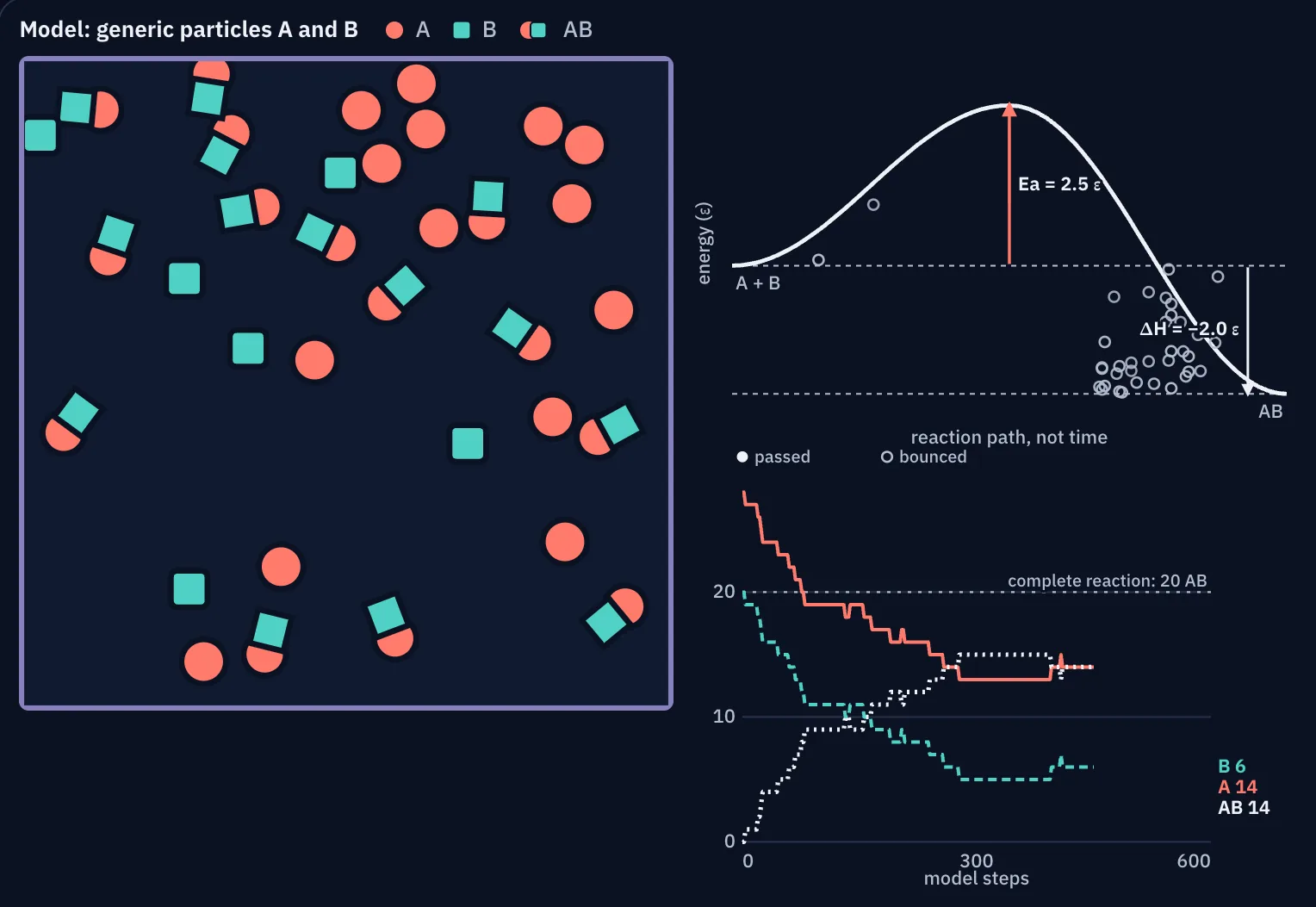
A reaction takes place when particles collide with enough energy to cross the threshold. The threshold is called activation energy. A higher temperature means more collisions cross the threshold. Higher concentration and a larger surface make collisions more frequent.
A catalyst is a substance that increases the rate of a reaction and remains in the same amount at the end. It gives the reaction another path, with a lower activation energy. On an energy–reaction path diagram, the reactants and products stay at the same levels, while the peak between them falls.
The diagram shows what a catalyst does not do. It does not change ΔH, because the levels at either end have not moved. The same amount of reactant gives the same amount of product in less time. It is not a source of energy. It lowers the threshold for both directions of a reaction.
For the curious
The decomposition of hydrogen peroxide releases heat: from the enthalpies of formation, ΔH = 2 · (−285.83) − 2 · (−187.78) ≈ −196 kJ for the equation as written. The value is the same with or without a catalyst. The volume of 22.4 L/mol applies at 0 °C and 1 atm; at 25 °C and 1 atm, one mole of gas occupies about 24 L, because V = n · R · T ÷ p = 0.082 · 298 ≈ 24.4 L.
| Case | Threshold Ea | At equilibrium (mean over steps 2,000–4,000, eight runs) | Steps to reach 90% of equilibrium | Reactions per 100 steps (formed / split) | A–B collisions that pass the threshold |
|---|---|---|---|---|---|
| T = 1.0 ε, no catalyst | 2.5 ε | A 11.5, B 3.5, AB 16.5 | 363 | 0.9 / 0.9 | 7.3% (formula e^(−Ea/T): 8.2%) |
| T = 1.0 ε, with catalyst | 1.3 ε | A 11.4, B 3.4, AB 16.6 | 96 | 3.3 / 3.4 | 25.0% (formula e^(−Ea/T): 27.3%) |
| T = 2.0 ε, no catalyst | 2.5 ε | A 15.8, B 7.8, AB 12.2 | 65 | 14.2 / 14.1 | 24.1% (formula e^(−Ea/T): 28.7%) |
| T = 2.0 ε, with catalyst | 1.3 ε | A 15.6, B 7.6, AB 12.4 | 20 | 27.8 / 27.9 | 45.5% (formula e^(−Ea/T): 52.2%) |
| After this many steps | T = 1.0 ε, no catalyst | T = 1.0 ε, with catalyst | T = 2.0 ε, no catalyst | T = 2.0 ε, with catalyst | T = 0.6 ε, no catalyst |
|---|---|---|---|---|---|
| 0 | A 28, B 20, AB 0 | A 28, B 20, AB 0 | A 28, B 20, AB 0 | A 28, B 20, AB 0 | A 28, B 20, AB 0 |
| 100 | A 19, B 11, AB 9 | A 14, B 6, AB 14 | A 17, B 9, AB 11 | A 15, B 7, AB 13 | A 27, B 19, AB 1 |
| 200 | A 17, B 9, AB 11 | A 13, B 5, AB 15 | A 17, B 9, AB 11 | A 14, B 6, AB 14 | A 24, B 16, AB 4 |
| 400 | A 11, B 3, AB 17 | A 12, B 4, AB 16 | A 17, B 9, AB 11 | A 13, B 5, AB 15 | A 19, B 11, AB 9 |
| 800 | A 11, B 3, AB 17 | A 14, B 6, AB 14 | A 14, B 6, AB 14 | A 13, B 5, AB 15 | A 17, B 9, AB 11 |
| 1,600 | A 13, B 5, AB 15 | A 11, B 3, AB 17 | A 22, B 14, AB 6 | A 15, B 7, AB 13 | A 16, B 8, AB 12 |
| 3,200 | A 12, B 4, AB 16 | A 9, B 1, AB 19 | A 17, B 9, AB 11 | A 19, B 11, AB 9 | A 12, B 4, AB 16 |
Model. Model: generic particles A and B, no real reaction. The particles move in a flat box with walls at temperature T; time is in model steps, not seconds, and energies are in ε, the unit of the model. If the energy of a collision between A and B, measured along the line of centres, is at least Ea (2.5 ε, 1.3 ε with the catalyst), AB forms; AB splits when it is hit with at least Ea + 2.0 ε, the threshold seen from the AB side; otherwise the particles bounce off. The curves and numbers are the particles and reactions counted in the box: with only 48 particles, the curves wobble. The fraction of collisions that pass the threshold is counted and set beside the value e^(−Ea/T) of an ideal gas; the count comes out lower, because the reaction removes the high-energy collisions from the mixture. The particles are drawn hugely enlarged, with no real colour and far fewer than in reality; their shapes tell them apart, not colour: A a disc, B a square, AB a disc and a square joined.
Sources and credits. No third-party data: everything the picture shows is calculated on the page, by the model described above, from the starting values given above. The shape of the energy crest is the one of the book's model.
Catalysts you may encounterHow it is written
Hydrogen peroxide decomposes according to the equation:
2H₂O₂ → 2H₂O + O₂
In a bottle the reaction is so slow that it cannot be seen. Manganese dioxide, MnO₂, iron(III) oxide, potassium iodide, KI, and catalase from potato or liver speed it up. The teacher does the demonstration with concentrated hydrogen peroxide and MnO₂: concentrated hydrogen peroxide is corrosive, and manganese dioxide is harmful. The teacher put a little MnO₂ in tall cylinders with detergent, and a column of foam rose as oxygen was released quickly. With potato or liver, the same process is slower. In the same way, 2KClO₃ → 2KCl + 3O₂ takes place with the help of MnO₂, but it is a demonstration for the teacher only, because chlorate is a strong oxidising agent and impurities can cause explosions.
A car’s catalytic converter contains platinum, palladium and rhodium on a support. Platinum and palladium oxidise carbon monoxide and unburnt hydrocarbons, while rhodium reduces nitrogen oxides:
2CO + O₂ → 2CO₂
2NO + 2CO → N₂ + 2CO₂
Ammonia is made from nitrogen and hydrogen, N₂ + 3H₂ ⇌ 2NH₃, over an iron catalyst with additives, at 400–500 °C and above 100 bar. The double arrow shows that the reaction can also go in reverse.
A substance that slows a reaction is called an inhibitor. Ascorbic acid (vitamin C, E 300) is added to food as an antioxidant to slow the oxidation of fats and juices.
For the curious
Enzymes are biological catalysts. Catalase in cells breaks down hydrogen peroxide into water and oxygen. The same thing happens when hydrogen peroxide reaches living tissue: catalase breaks it down quickly and foam appears.
Worked example
Oxygen from a bottle of hydrogen peroxide
A bottle contains 100 g of 3% hydrogen peroxide. What volume of oxygen, at normal conditions, is released when the hydrogen peroxide decomposes completely, and what role does the catalyst play?
The mass of dissolved substance, md, is 3 · 100 ÷ 100 = 3 g of H₂O₂. M(H₂O₂) = 2 · 1 + 2 · 16 = 34 g/mol, so n(H₂O₂) = 3 ÷ 34 ≈ 0.088 mol.
From the equation 2H₂O₂ → 2H₂O + O₂, two moles of H₂O₂ give one mole of O₂. Hence n(O₂) = 0.088 ÷ 2 ≈ 0.044 mol and V(O₂) = 0.044 · 22.4 ≈ 0.99 L, rounded to two decimal places.
Order of magnitude: 100 g of solution occupies nearly 100 mL, while the gas occupies nearly 1 L, ten times as much. With a catalyst the reaction is fast and the fizzing is visible. The catalyst does not appear in the calculation: the same volume of oxygen is released without it, but so slowly that it goes unnoticed.
In Romania
Ammonia from Azomureș
Azomureș, in Târgu Mureș, produces ammonia, nitric acid and ammonium nitrate. Ammonia is made from natural gas, so production at the plant has stopped and restarted several times in recent years as gas prices changed. At its rated capacity, the plant consumed about 3.5 million cubic metres of gas a day.
Ammonia is made from nitrogen and hydrogen, N₂ + 3H₂ ⇌ 2NH₃. Without a catalyst, the reaction is too slow at temperatures at which ammonia can form. Haber–Bosch plants use an iron-based catalyst with additives, at 400–500 °C and above 100 bar, and unconverted gas returns to the reactor.
In short
- The rate of a reaction shows how quickly a reactant is used up or a product forms.
- Rusting is slow, precipitation of AgCl is fast, and an explosion of gas with air is even faster; rate does not depend on the sign of ΔH.
- Rate increases with temperature, concentration and contact surface area.
- A catalyst increases the rate by providing a path with lower activation energy; it is not consumed overall, does not change ΔH and does not yield more product from the same amount of reactant.
- Examples: MnO₂ and catalase for 2H₂O₂ → 2H₂O + O₂; Pt, Pd and Rh in the catalytic converter; iron in ammonia synthesis. An inhibitor slows the reaction.
Common mistakes
WrongThe catalyst is used up and that is why the reaction goes faster.
RightThe catalyst remains in the same amount at the end. It provides another path, with a lower activation energy.
WrongA catalyst makes a reaction yield more product.
RightThe same amount of reactant forms the same amount of product, with or without a catalyst. A catalyst shortens the time and, in a reversible reaction, does not shift the equilibrium.
WrongA reaction that releases a lot of heat is also fast.
RightRusting releases heat and takes months. Rate and the sign of ΔH are different things.
Test yourself
7 questions. For the first 6 you see the explanation at once, with the paragraph of the lesson that supports it; for the written ones you compare with a good answer.
What happens to ΔH of a reaction when a catalyst is added?
Answer
d) It does not change. The catalyst lowers the peak between reactants and products, but does not move their energy levels.
At the end of a catalysed reaction, what has happened to the catalyst?
Answer
a) It remains in the same amount. The catalyst takes part in another reaction path, but remains in the same amount at the end.
Which of these changes does not increase the rate of reaction between a solid and an acid?
Answer
c) Lowering the acid concentration. A lower concentration means fewer collisions, so the rate is lower.
How many grams of H₂O₂ are in 250 g of 3% hydrogen peroxide?
gAnswer
7.5 g. md = 3 · 250 ÷ 100 = 7.5 g of H₂O₂.
A 200 g sample of 3% hydrogen peroxide decomposes completely. What volume of oxygen is released at normal conditions, in litres, rounded to one decimal place? Take M(H₂O₂) = 34 g/mol and VM = 22.4 L/mol.
LAnswer
2.0 L. m(H₂O₂) = 6 g and n = 6 ÷ 34 ≈ 0.176 mol; n(O₂) = 0.088 mol and V = 0.088 · 22.4 ≈ 2.0 L.
Do the chemical reactions and processes below take place slowly or quickly under ordinary conditions? Sort them by rate.
Answer
Slow reaction: A nail rusting; Hydrogen peroxide decomposing in a bottle.
Fast reaction: Precipitation of AgCl; Explosion of a gas and air mixture.
Rusting and the decomposition of hydrogen peroxide without a catalyst take a long time. Precipitation and explosion are almost instantaneous.
A friend says a catalyst “gives energy” to the reaction, which is why it goes fast. Explain what the catalyst actually does in terms of activation energy and the energy of the reactants and products.
A good answer
The catalyst does not give energy. It provides another reaction path with a lower activation energy: a lower peak on the diagram. The reactants and products stay at the same levels, so ΔH does not change, and the same amount of reactant gives the same amount of product. More collisions cross the threshold, so the reaction goes faster.
A complete answer says that the threshold falls, ΔH stays the same and the amount of product is the same.
Terms
- reaction rate
- The amount of reactant consumed or product formed per unit of time.
- activation energy
- The energy particles must overcome for a reaction to take place.
- catalyst
- A substance that increases the rate of a reaction and remains in the same amount at the end.
- inhibitor
- A substance that slows a reaction.
- catalase
- An enzyme in living cells that rapidly breaks down hydrogen peroxide into water and oxygen.
- contact surface
- The surface where reactants meet; it increases when a solid is broken up.
Sources and link to the programme
- OpenStax – Chemistry 2e, 12.2 Factors Affecting Reaction Rates – temperature, concentration and contact surface area; rates doubling for every 10 °C for many reactions; hydrogen peroxide decomposes slowly and faster in the presence of a catalyst
- OpenStax – Chemistry 2e, 12.7 Catalysis – a catalyst provides an alternative mechanism with lower activation energy
- OpenStax – Chemistry 2e, 13.3 Shifting Equilibria: Le Châtelier’s Principle – a catalyst lowers activation energies in both directions and does not change the equilibrium constant
- OpenStax – Chemistry 2e, Appendix G: Standard Thermodynamic Properties – enthalpies of formation for H₂O₂(l), H₂O(l) and Fe₂O₃ (rusting is exothermic)
- RSC Education – Testing for catalase enzymes – oxygen released from hydrogen peroxide in the presence of liver, potato or celery
- RSC Education – Hydrogen peroxide decomposition using different catalysts – demonstration with concentrated hydrogen peroxide, MnO₂, iron(III) oxide, potato and liver; hazards of concentrated hydrogen peroxide and MnO₂
- RSC Education – The evolution of catalytic converters – platinum and palladium oxidise CO and hydrocarbons, rhodium reduces NOₓ; equations 2CO + O₂ → 2CO₂ and 2NO + 2CO → N₂ + 2CO₂
- LibreTexts – Oxoacids and their Salts (Housecroft) – potassium chlorate decomposes with the help of MnO₂; impurities can cause explosions
- Asociația Internațională a Îngrășămintelor – Haber-Bosch (HABER.pdf) – iron-based catalyst with promoters, 400–500 °C, above 100 bar, unconverted gas is recirculated
- Fertilizer Daily – Azomures restarts fertilizer production after year-long shutdown – gas consumption at rated capacity, 3.5 million cubic metres per day; production restarted in July 2025 after a shutdown of nearly a year
- Economedia – Producția de la Azomureș a fost oprită din nou (3 decembrie 2025) – production stopped again after October 2025 because a long-term gas contract was lacking
- RSC Education – Elephant’s toothpaste (Education in Chemistry, noiembrie 2017) – potassium iodide, manganese dioxide and iron(III) oxide as examples of catalysts for hydrogen peroxide decomposition
- Wikipedia (ro) – Azomureș – the plant’s units: ammonia, nitric acid, ammonium nitrate
- RSC Education – Food additives and E numbers – antioxidants, including ascorbic acid (E 300), slow food deterioration
From the programme: “Slow reactions, fast reactions; catalysts”; “For the content area Classification of reactions in inorganic chemistry, reactions will be classified according to the given criteria, and different examples of chemical reactions will be presented for each type. For Exothermic and endothermic reactions, examples will also include the decomposition of some nitrates and carbonates” (TC: Core curriculum (1 hour a week)). Specific competences followed: 1.1, 2.1, 4.1, 6.1.