Chapter 2 · Chemical reactionsLesson 2.6TC Core curriculum (1 hour a week) · beyond your profile
Irreversible reactions, reversible reactions
Why mineral water bubbles when you open the bottle
When you open sparkling mineral water, where does the gas in the bubbles come from?
Before you read: what do you think?
A bottle of sparkling mineral water stands closed on a table. When you open it, bubbles appear. Where does the gas come from?
See the answer
Carbon dioxide was dissolved in the water under pressure. Some of it reacts with water to form carbonic acid, but the reaction also goes in reverse. When the pressure falls, CO₂ escapes from the water.
Sparkling mineral water sits still in a closed bottle. Open the cap and bubbles appear. Close the bottle and, after a while, the bubbles stop. The same reaction can go either way, depending on the conditions, and it also builds stalactites in caves.
Reactions that go to completionWhat you see
Burnt paper does not turn back into paper. If you mix solutions of silver nitrate and sodium chloride, a white AgCl precipitate forms and remains. If you pour vinegar onto an eggshell, bubbles of gas form on the shell and it gets thinner:
CaCO₃ + 2CH₃COOH → Ca(CH₃COO)₂ + H₂O + CO₂
Such reactions are called irreversible: they go in one direction, shown by the single arrow, until one of the reactants runs out. In an open vessel, the gas escapes into the air and cannot react back. Combustion and precipitation are classic examples. The word “irreversible” describes ordinary laboratory and kitchen conditions; it is not an absolute ban.
Reactions that also go backwardsWhat you see
Carbon dioxide dissolves in water, and some of it combines with water to give carbonic acid, H₂CO₃. The reaction also goes in reverse: carbonic acid breaks down again into CO₂ and water.
CO₂ + H₂O ⇌ H₂CO₃
In a closed bottle, the gas is held in the water under pressure. When the bottle is open, CO₂ escapes and the reaction goes to the left. That is why mineral water left open loses its bubbles.
A reaction that can go in both directions is called reversible and is written with the double arrow ⇌. A second example is the dissolving of limestone by water containing dissolved CO₂, giving calcium hydrogencarbonate, a salt that exists only in solution:
CaCO₃ + CO₂ + H₂O ⇌ Ca(HCO₃)₂
If the solution loses CO₂, like mineral water in an open bottle, the reaction goes to the left and CaCO₃ is deposited again.
For the curious
Calcium hydrogencarbonate cannot be taken out of solution as a solid: when isolation is attempted, it breaks down into CaCO₃, CO₂ and water. In textbooks, the formation of carbonic acid is also written in stages: CO₂(g) ⇌ CO₂(aq), then CO₂(aq) + H₂O ⇌ H₂CO₃(aq).
Dynamic equilibrium: nothing stands stillWhat the particles do
In a closed vessel, reactants form products, and products form reactants again. At first the forward reaction dominates. As products accumulate, the reverse reaction speeds up. After a while, the two rates become equal and the concentrations stop changing: the system has reached dynamic equilibrium.
The word “dynamic” matters. At equilibrium both reactions continue at the particle level, every moment. Products form as fast as they break down, so the mixture appears unchanged. Equilibrium does not mean equal amounts of reactants and products: they can be very different, but they are constant.
In an open vessel, a gaseous product escapes into the air and equilibrium is practically never reached. A catalyst speeds up both directions and shortens the time taken to reach equilibrium. It does not change the composition of the mixture at equilibrium.
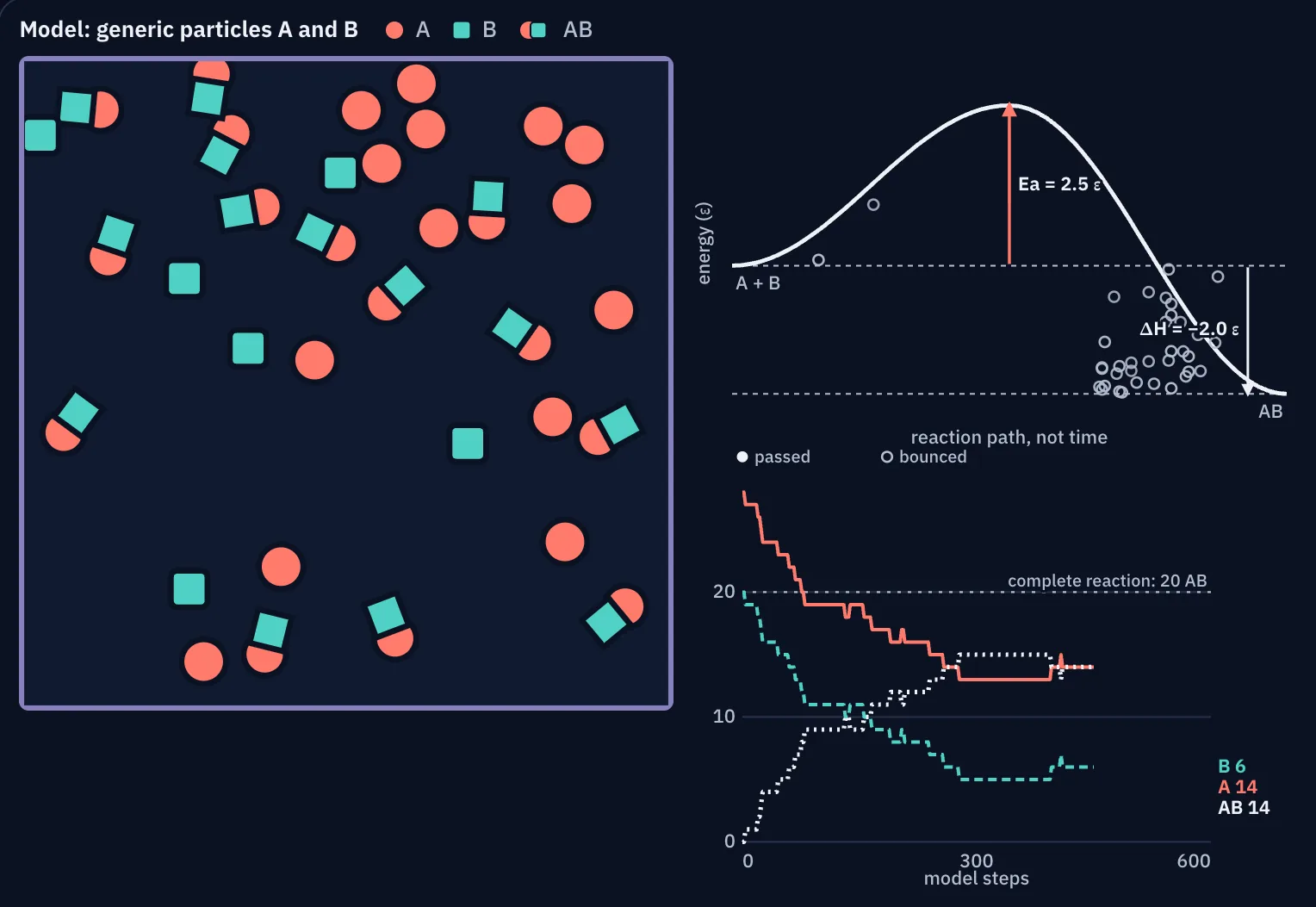
| Case | Threshold Ea | At equilibrium (mean over steps 2,000–4,000, eight runs) | Steps to reach 90% of equilibrium | Reactions per 100 steps (formed / split) | A–B collisions that pass the threshold |
|---|---|---|---|---|---|
| T = 1.0 ε, no catalyst | 2.5 ε | A 11.5, B 3.5, AB 16.5 | 363 | 0.9 / 0.9 | 7.3% (formula e^(−Ea/T): 8.2%) |
| T = 1.0 ε, with catalyst | 1.3 ε | A 11.4, B 3.4, AB 16.6 | 96 | 3.3 / 3.4 | 25.0% (formula e^(−Ea/T): 27.3%) |
| T = 2.0 ε, no catalyst | 2.5 ε | A 15.8, B 7.8, AB 12.2 | 65 | 14.2 / 14.1 | 24.1% (formula e^(−Ea/T): 28.7%) |
| T = 2.0 ε, with catalyst | 1.3 ε | A 15.6, B 7.6, AB 12.4 | 20 | 27.8 / 27.9 | 45.5% (formula e^(−Ea/T): 52.2%) |
| After this many steps | T = 1.0 ε, no catalyst | T = 1.0 ε, with catalyst | T = 2.0 ε, no catalyst | T = 2.0 ε, with catalyst | T = 0.6 ε, no catalyst |
|---|---|---|---|---|---|
| 0 | A 28, B 20, AB 0 | A 28, B 20, AB 0 | A 28, B 20, AB 0 | A 28, B 20, AB 0 | A 28, B 20, AB 0 |
| 100 | A 19, B 11, AB 9 | A 14, B 6, AB 14 | A 17, B 9, AB 11 | A 15, B 7, AB 13 | A 27, B 19, AB 1 |
| 200 | A 17, B 9, AB 11 | A 13, B 5, AB 15 | A 17, B 9, AB 11 | A 14, B 6, AB 14 | A 24, B 16, AB 4 |
| 400 | A 11, B 3, AB 17 | A 12, B 4, AB 16 | A 17, B 9, AB 11 | A 13, B 5, AB 15 | A 19, B 11, AB 9 |
| 800 | A 11, B 3, AB 17 | A 14, B 6, AB 14 | A 14, B 6, AB 14 | A 13, B 5, AB 15 | A 17, B 9, AB 11 |
| 1,600 | A 13, B 5, AB 15 | A 11, B 3, AB 17 | A 22, B 14, AB 6 | A 15, B 7, AB 13 | A 16, B 8, AB 12 |
| 3,200 | A 12, B 4, AB 16 | A 9, B 1, AB 19 | A 17, B 9, AB 11 | A 19, B 11, AB 9 | A 12, B 4, AB 16 |
Model. Model: generic particles A and B, no real reaction. The particles move in a flat box with walls at temperature T; time is in model steps, not seconds, and energies are in ε, the unit of the model. If the energy of a collision between A and B, measured along the line of centres, is at least Ea (2.5 ε, 1.3 ε with the catalyst), AB forms; AB splits when it is hit with at least Ea + 2.0 ε, the threshold seen from the AB side; otherwise the particles bounce off. The curves and numbers are the particles and reactions counted in the box: with only 48 particles, the curves wobble. The fraction of collisions that pass the threshold is counted and set beside the value e^(−Ea/T) of an ideal gas; the count comes out lower, because the reaction removes the high-energy collisions from the mixture. The particles are drawn hugely enlarged, with no real colour and far fewer than in reality; their shapes tell them apart, not colour: A a disc, B a square, AB a disc and a square joined.
Sources and credits. No third-party data: everything the picture shows is calculated on the page, by the model described above, from the starting values given above. The shape of the energy crest is the one of the book's model.
How to write and read itHow it is written
The single arrow → shows a reaction that practically goes to completion. The double arrow ⇌ shows that both directions matter. Two classic examples:
N₂ + 3H₂ ⇌ 2NH₃
H₂ + I₂ ⇌ 2HI
The synthesis of ammonia is exothermic in the forward direction, with ΔH ≈ −92 kJ for the equation as written. The reverse direction is therefore endothermic, with ΔH ≈ +92 kJ. In ammonia factories, unconverted gas returns to the reactor, over an iron catalyst.
At equilibrium, the mixture contains all the species in the equation, reactants and products, in constant amounts. No reactant is completely used up. That is why a reversible reaction in a closed vessel never gives as much product as the calculation for a complete reaction predicts.
For the curious
How far a reversible reaction goes at a given temperature is expressed by a quantity called the equilibrium constant. For H₂ + I₂ ⇌ 2HI, its value at 448 °C is approximately 50.5, and the numbers in the worked example come from it.
Worked example
How much hydrogen iodide forms
In a closed vessel at 448 °C, 1.00 mol of H₂ and 1.00 mol of I₂ are placed together. The equilibrium calculation for this temperature gives, at equilibrium, a mixture with 0.22 mol of H₂, 0.22 mol of I₂ and 1.56 mol of HI. How much HI would form if the reaction were irreversible, and what is the conversion of hydrogen?
Irreversible reaction: from the equation H₂ + I₂ ⇌ 2HI, one mole of H₂ gives two moles of HI, so 1.00 mol of H₂ and 1.00 mol of I₂ would give 2.00 mol of HI.
Real reaction: H₂ consumed = 1.00 − 0.22 = 0.78 mol, and HI formed = 2 · 0.78 = 1.56 mol, as in the mixture. Conversion is 0.78 ÷ 1.00 · 100 = 78%.
Check: the hydrogen atoms amount to 2 · 0.22 + 1.56 = 2.00 mol, the same as at the start (2 · 1.00). Conclusion: 1.56 mol of HI forms out of a possible 2.00 mol. There are 0.22 mol of H₂ and 0.22 mol of I₂ left, because the reverse reaction restores H₂ and I₂ as fast as the forward reaction consumes them.
In Romania
The stalactites of Peștera Urșilor
Peștera Urșilor cave, in the Apuseni Mountains, was discovered on 17 September 1975, when a blast in a marble quarry near the village of Chișcău opened it up. It is 1,500 m long and has a temperature of 10 °C; it has been open to visitors since 1980.
The surrounding rock is marble and limestone, mostly CaCO₃. Groundwater contains dissolved CO₂ and dissolves a little limestone, according to the equation CaCO₃ + CO₂ + H₂O ⇌ Ca(HCO₃)₂. The drop reaches the cave air and loses CO₂, like mineral water from an open bottle. The reaction then goes to the left and CaCO₃ is deposited: this is how stalactites grow. The same equation, in two directions, in the same place.
In short
- An irreversible reaction goes in one direction, shown by →, until a reactant runs out; combustion and precipitation are examples.
- A reversible reaction goes in both directions and is written with ⇌: CO₂ + H₂O ⇌ H₂CO₃, N₂ + 3H₂ ⇌ 2NH₃, H₂ + I₂ ⇌ 2HI.
- Dynamic equilibrium occurs in a closed vessel when the forward reaction rate equals the reverse reaction rate; both reactions continue.
- At equilibrium concentrations are constant, though not necessarily equal; reactants are not completely used up.
- A catalyst speeds up both directions and does not shift equilibrium; stalactites form when water containing Ca(HCO₃)₂ loses CO₂ and the reaction goes backwards.
Common mistakes
WrongAt equilibrium, the reaction has stopped.
RightBoth reactions continue. Concentrations stop changing because the rates in the two directions are equal.
WrongAt equilibrium, reactants and products are present in equal amounts.
RightEquilibrium means equal rates, not equal amounts. In the HI example, there are 1.56 mol of HI and 0.22 mol of H₂.
WrongA catalyst shifts equilibrium towards the products.
RightA catalyst speeds up both directions and shortens the time taken to reach equilibrium. The composition at equilibrium stays the same.
Test yourself
7 questions. For the first 6 you see the explanation at once, with the paragraph of the lesson that supports it; for the written ones you compare with a good answer.
What is equal at dynamic chemical equilibrium?
Answer
b) The rates of the forward and reverse reactions. Equal rates make the mixture appear unchanged, even though both reactions continue.
What does a catalyst do in a reversible reaction at equilibrium?
Answer
d) Speeds up both directions and does not change the composition at equilibrium. The catalyst lowers the threshold for both directions. Equilibrium is reached faster, but with the same composition.
Which reaction is practically irreversible under ordinary conditions?
Answer
a) Burning paper. Burnt paper does not turn back into paper. The other three reactions also go in reverse.
A reaction reaches equilibrium in a closed vessel. Which statement is correct?
Answer
c) Both reactions continue at equal rates. Chemical equilibrium is dynamic: nothing stops, and the rates are equal.
The reversible reaction H₂ + I₂ ⇌ 2HI takes place in a closed vessel. You start with 1.00 mol of H₂ and an amount of I₂, and at equilibrium 0.22 mol of H₂ remains. What percentage of the initial hydrogen has been converted into HI?
%Answer
78 %. H₂ consumed = 1.00 − 0.22 = 0.78 mol, and 0.78 ÷ 1.00 · 100 = 78%.
Put the stages of stalactite formation in order.
Answer
The correct order:
- Groundwater contains dissolved CO₂
- The water dissolves a little limestone and forms Ca(HCO₃)₂
- The drop reaches the cave air
- The drop loses CO₂ and the reaction goes to the left
- CaCO₃ is deposited and the stalactite grows
Limestone dissolves with CO₂ in the water. Deposition occurs when CO₂ escapes into the air.
A bottle of mineral water is opened and bubbles appear. If you close it again, the bubbles stop after a while. Explain what happens to the reaction CO₂ + H₂O ⇌ H₂CO₃ in the two situations.
A good answer
When the bottle is opened, CO₂ escapes into the air and the reaction goes to the left: carbonic acid breaks down into CO₂ and water. When the bottle is closed, the gas no longer escapes, and the two directions reach equal rates again: a dynamic equilibrium.
A complete answer says that the reaction goes in both directions and that dynamic equilibrium is established in a closed vessel.
Terms
- irreversible reaction
- A reaction that goes in one direction until a reactant runs out.
- reversible reaction
- A reaction that can go in both directions; it is written with ⇌.
- dynamic equilibrium
- A state of a closed system in which the forward and reverse reactions have equal rates and concentrations stop changing.
- conversion
- The percentage of a reactant that has been transformed.
- calcium hydrogencarbonate
- The salt Ca(HCO₃)₂, which exists only in solution.
Sources and link to the programme
- OpenStax – Chemistry 2e, 13.1 Chemical Equilibria – reversible reactions and dynamic equilibrium: rates are equal and concentrations remain constant
- OpenStax – Chemistry 2e, 13.3 Shifting Equilibria: Le Châtelier’s Principle – CO₂ + H₂O ⇌ H₂CO₃ in carbonated drinks; a catalyst speeds up both directions without changing the equilibrium constant
- OpenStax – Chemistry 2e, 13.4 Equilibrium Calculations – equilibrium constant for H₂ + I₂ ⇌ 2HI, 50.5 at 448 °C
- LibreTexts – Hydrogen, Oxygen and Water (Dickerson) – equilibrium constant 50.53 for H₂ + I₂ ⇌ 2HI at 448 °C
- OpenStax – Chemistry 2e, Appendix G: Standard Thermodynamic Properties – enthalpy of formation of NH₃(g), −45.9 kJ/mol, giving ΔH ≈ −92 kJ for ammonia synthesis
- Asociația Internațională a Îngrășămintelor – Haber-Bosch (HABER.pdf) – ammonia synthesis over an iron catalyst; unconverted gas is recirculated
- Chemguide – Group 1: compounds – calcium hydrogencarbonate exists only in solution and breaks down into CaCO₃, CO₂ and water
- U.S. National Park Service – Speleothems (Great Basin) – groundwater contains much dissolved CO₂; on contact with cave air it loses CO₂ like an open carbonated drink, and calcite is deposited
- Showcaves – Peștera Urșilor – discovered on 17 September 1975 in a marble quarry at Chișcău; 10 °C, 1,500 m, opened to the public in 1980
From the programme: “Irreversible reactions, reversible reactions”; “For the content area Classification of reactions in inorganic chemistry, reactions will be classified according to the given criteria, and different examples of chemical reactions will be presented for each type. For Exothermic and endothermic reactions, examples will also include the decomposition of some nitrates and carbonates” (TC: Core curriculum (1 hour a week)). Specific competences followed: 1.1, 2.1, 4.1, 6.1.