Chapter 3 · Redox and cellsLesson 3.1TC Core curriculum (1 hour a week) · beyond your profile
Oxidation, reduction
What happens to iron when it rusts: oxidation and reduction
A nail left in the rain turns brown and crumbles. What happened to the iron atoms?
Before you read: what do you think?
The teacher puts a clean iron nail in a blue copper(II) sulfate solution. After a few minutes, the nail has a reddish coating and the blue solution fades. What is the reddish coating?
See the answer
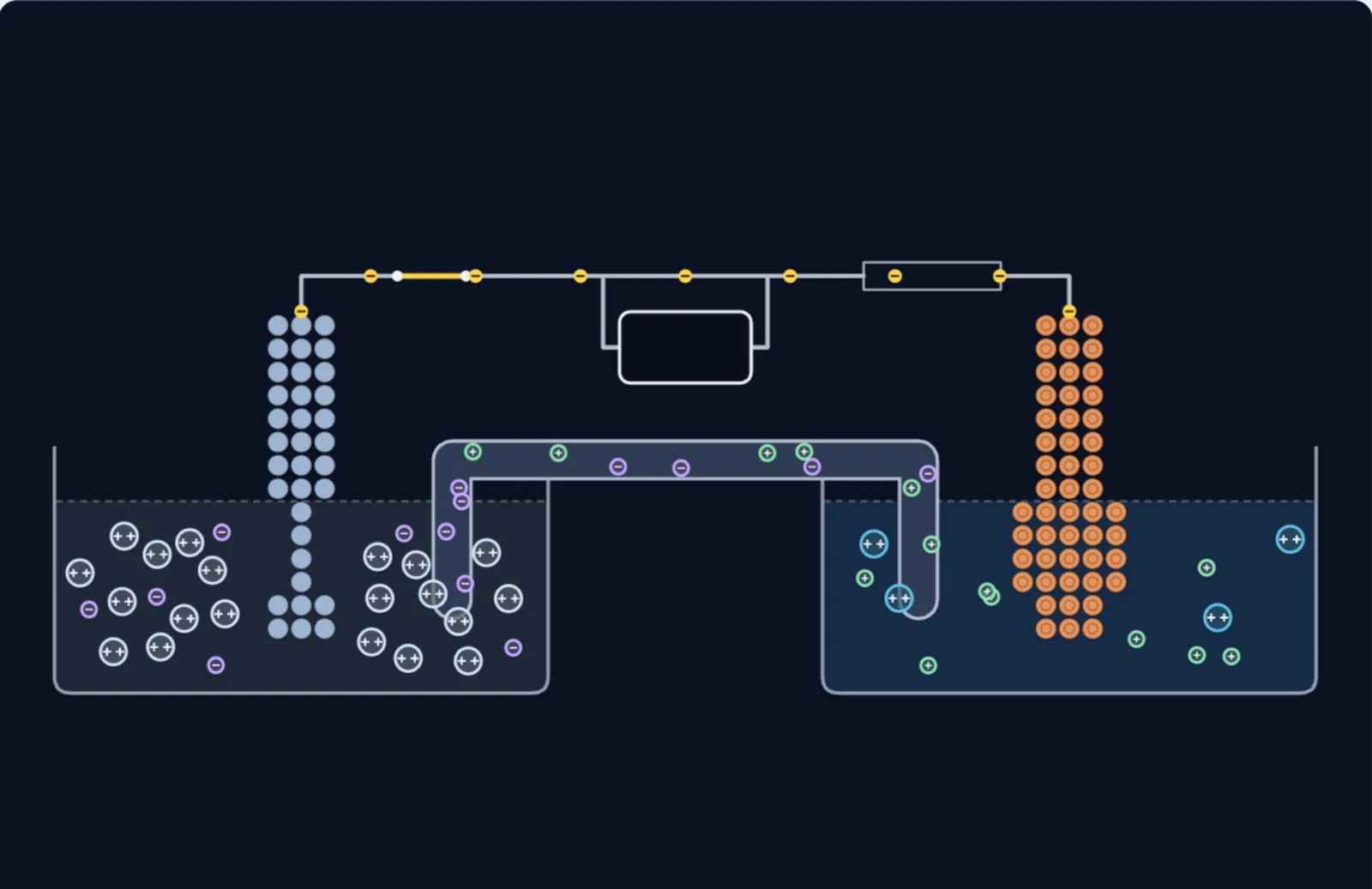
The reddish coating is copper metal. Iron atoms enter the solution as Fe²⁺ ions and give up electrons; Cu²⁺ ions gain those electrons and deposit as metal. Oxygen takes no part, so oxidation means more than combination with oxygen.
A nail left outside in the rain develops a dull, reddish-brown coating within a few weeks. The coating crumbles away. The clean nail was iron; the coating is a new substance. Iron needs both oxygen and water to rust. Chemistry has a word for what happens to the iron, oxidation, and a second, reduction, for what happens elsewhere at the same time.
Rusting and burning magnesium: two combinations with oxygenWhat you see
The teacher burns a ribbon of magnesium in class: the white flame is so bright that you must not look directly at it. A white powder, magnesium oxide, remains. An iron nail, by contrast, rusts slowly in damp air. In both cases a metal combines with oxygen. You can also watch rusting at home: put one nail halfway into water in a glass and leave another dry in the same place. After a few days only the nail in water develops brown spots.
2Mg + O₂ → 2MgO
4Fe + 3O₂ + 6H₂O → 4Fe(OH)₃
For a long time, chemistry defined oxidation as a substance combining with oxygen, and reduction as the loss of oxygen from a compound, as in CuO + H₂ → Cu + H₂O. The old definition still holds in these cases. It does not explain why zinc placed in copper sulfate solution becomes coated with copper when no oxygen takes part.
The general definition: who gives up electrons and who gains themWhat the particles do
When magnesium burns, each magnesium atom gives up two electrons and becomes an Mg²⁺ ion; oxygen atoms gain electrons and become O²⁻ ions. The same exchange of electrons takes place in copper sulfate solution: zinc atoms enter the solution as Zn²⁺ ions, while Cu²⁺ ions gain electrons and deposit as metal.
Oxidation is the loss of electrons. Reduction is the gain of electrons. Each is written as a half-reaction, the half of the reaction that shows one exchange:
Zn → Zn²⁺ + 2e⁻ (oxidation)
Cu²⁺ + 2e⁻ → Cu (reduction)
Electrons do not remain free in the solution: the copper ions gain as many as the zinc gives up. Oxidation and reduction therefore always happen together, in the same reaction, and such a reaction is called a redox reaction. Adding the half-reactions gives its equation; the electrons cancel:
Zn + Cu²⁺ → Zn²⁺ + Cu
For the curious
Real rust is hydrated iron(III) oxide: Fe₂O₃ with a variable number of water molecules bound to it. The formula Fe(OH)₃ in the equation above is the simplification used in class. The first step in rusting is also oxidation: Fe → Fe²⁺ + 2e⁻. Unlike the green patina on copper, rust flakes off and exposes fresh iron, which continues to corrode.
How oxidation numbers reveal oxidationHow it is written
In covalent compounds, electrons do not pass completely from one atom to another, so it is hard to say who gave up what. In such cases the oxidation number (N.O.) is used: it is a bookkeeping convention, not a measured charge. A simple ion has an N.O. equal to its charge (Zn²⁺ has +2), and in a compound the sum of oxidation numbers equals the charge of the species. There is one rule: oxidation is an increase in oxidation number, and reduction is a decrease.
In class, an oxidation number is written with the sign first, and an ionic charge with the sign last (Fe³⁺, but N.O. +3). The half-reaction for iron in rust looks like this:
Fe⁰ → Fe⁺³ + 3e⁻
In Fe(OH)₃ the oxidation numbers are: Fe +3, O −2, H +1; their sum is 0, like the charge of the compound. In the rusting equation, the N.O. of iron rises from 0 to +3 (oxidation), while that of oxygen falls from 0 to −2 (reduction). Hydrogen stays at +1 in water and in Fe(OH)₃.
This gives a test for any equation: a reaction is redox if the oxidation number of at least one element changes. The reaction HCl + NaOH → NaCl + H₂O is not redox: hydrogen stays at +1, oxygen at −2, sodium at +1 and chlorine at −1. Neither the heat released nor the water formed makes it redox; only the oxidation numbers matter.
Worked example
An iron nail in copper sulfate solution
A nail containing 5.6 g of iron reacts completely with copper(II) sulfate solution. What mass of copper is deposited? (A calculation example: in the laboratory the nail does not usually dissolve completely.)
The ionic equation: Fe + Cu²⁺ → Fe²⁺ + Cu. The oxidation number of iron rises from 0 to +2 (oxidation), while that of copper falls from +2 to 0 (reduction).
The half-reactions are Fe → Fe²⁺ + 2e⁻ and Cu²⁺ + 2e⁻ → Cu: each iron atom gives up two electrons, and each Cu²⁺ ion gains two.
M(Fe) = 56 g/mol, so n(Fe) = 5.6 ÷ 56 = 0.1 mol. Electrons given up: 0.1 · 2 = 0.2 mol. The Fe : Cu ratio is 1 : 1, so n(Cu) = 0.1 mol and m(Cu) = 0.1 · 64 = 6.4 g.
Check: one mole of copper (64 g) weighs more than one mole of iron (56 g), so the mass deposited must be a little greater than the mass of iron consumed. 6.4 g > 5.6 g, so the result is plausible.
In Romania
The Cernavodă railway bridge and the paint that keeps water away from steel
The railway bridge over the Danube at Cernavodă has been in use since November 1987 and is 1,600 m long. In 2015, the site manager described three major jobs: repainting after sandblasting for corrosion protection, replacing the superstructure and strengthening damaged elements. The paint had worn away and the bridge had cracks; in almost 30 years only minor maintenance had been done.
The work was planned to take eight months. Trains were limited to 30 km/h over 3.5 km, and some were diverted over the old bridge, built to Anghel Saligny’s plans. The paint coating keeps water and oxygen away from the steel, stopping iron oxidation before it starts; when the paint wears away, rusting begins. A European project worth 34 million euros covers the Cernavodă bridge and two others at Fetești, so the sum is for more than paint.
In short
- Oxidation is the loss of electrons and an increase in oxidation number; reduction is the gain of electrons and a decrease in oxidation number.
- Oxidation and reduction always happen together: electrons given up by one species are gained by another. The reaction is called a redox reaction.
- Half-reactions show each exchange separately: Zn → Zn²⁺ + 2e⁻ (oxidation) and Cu²⁺ + 2e⁻ → Cu (reduction). Added together, they give the equation Zn + Cu²⁺ → Zn²⁺ + Cu.
- The old definition, involving oxygen, is a special case: burning magnesium and rusting iron are oxidations, but oxygen is not essential (Zn + Cu²⁺).
- A reaction is redox if the oxidation number of at least one element changes. An oxidation number is a convention, not a measured charge.
Common mistakes
WrongOxidation means that a substance combines with oxygen.
RightThat is the old definition. Oxidation is the loss of electrons; zinc is oxidised in copper sulfate solution without oxygen taking part in the reaction.
WrongIn the reaction Zn + Cu²⁺ → Zn²⁺ + Cu, only zinc changes.
RightCopper changes too: Cu²⁺ ions gain the electrons given up by zinc and are reduced. Oxidation never occurs alone.
WrongThe oxidation number +4 of carbon in CO₂ means that the molecule contains C⁴⁺ ions.
RightAn oxidation number is a bookkeeping convention. The bonds in CO₂ are covalent; there are no C⁴⁺ ions.
Test yourself
7 questions. For the first 6 you see the explanation at once, with the paragraph of the lesson that supports it; for the written ones you compare with a good answer.
What does the half-reaction Zn → Zn²⁺ + 2e⁻ describe?
Answer
a) Oxidation of zinc: loss of electrons. Zinc gives up two electrons, and its oxidation number rises from 0 to +2. Loss of electrons is oxidation.
Which reaction is a redox reaction?
Answer
d) 2Mg + O₂ → 2MgO. Only in 2Mg + O₂ → 2MgO do oxidation numbers change: magnesium from 0 to +2, oxygen from 0 to −2. In the other three, each element keeps the same oxidation number.
In the reaction Zn + Cu²⁺ → Zn²⁺ + Cu, Cu²⁺ ions act as:
Answer
c) a species that is reduced because it gains electrons. Each Cu²⁺ ion gains two electrons and becomes a copper atom. Gaining electrons is reduction, and the oxidation number falls from +2 to 0.
A nail contains 2.8 g of iron. How many moles of electrons does the iron give up when it is completely oxidised to Fe²⁺? Given M(Fe) = 56 g/mol.
molAnswer
0.1 mol. n(Fe) = 2.8 ÷ 56 = 0.05 mol, and each atom gives up two electrons: 0.05 · 2 = 0.1 mol.
What mass of copper, in grams, is deposited when 11.2 g of iron reacts completely with copper(II) sulfate solution? Given M(Fe) = 56 g/mol and M(Cu) = 64 g/mol.
gAnswer
12.8 g. n(Fe) = 11.2 ÷ 56 = 0.2 mol; the Fe : Cu ratio is 1 : 1, so n(Cu) = 0.2 mol and m(Cu) = 0.2 · 64 = 12.8 g.
Oxidation or reduction? Place each description under the right process.
Answer
Oxidation: Zn → Zn²⁺ + 2e⁻; Oxidation number rises; Fe²⁺ → Fe³⁺ + e⁻.
Reduction: Cu²⁺ + 2e⁻ → Cu; Oxidation number falls; The atom gains electrons.
Loss of electrons (an increase in N.O.) is oxidation; gain of electrons (a decrease in N.O.) is reduction.
A classmate says oxidation cannot happen without oxygen. Give a counterexample and use half-reactions to show what is oxidised and what is reduced.
A good answer
Zinc placed in copper(II) sulfate solution: without oxygen, zinc becomes coated with copper. Zn → Zn²⁺ + 2e⁻ is oxidation (zinc gives up electrons, N.O. rises from 0 to +2), and Cu²⁺ + 2e⁻ → Cu is reduction (the copper ion gains electrons, N.O. falls from +2 to 0). Oxidation means loss of electrons; oxygen is just one possible partner.
A complete answer gives a reaction without oxygen, writes both half-reactions and links oxidation to loss of electrons and an increase in oxidation number.
Terms
- oxidation
- Loss of electrons; an increase in the oxidation number of an element.
- reduction
- Gain of electrons; a decrease in the oxidation number of an element.
- redox reaction
- A reaction in which both oxidation and reduction occur, so the oxidation number of at least one element changes.
- half-reaction
- Half of a redox reaction: it shows oxidation or reduction separately, with electrons given up or gained.
- oxidation number
- A signed integer assigned by convention to an atom in a chemical species to account for electrons given up or gained.
- rust
- Reddish-brown hydrated iron(III) oxide, formed when iron is in contact with oxygen and water.
Sources and link to the programme
- OpenStax – Chemistry 2e, 17.1 Review of redox chemistry – redox reactions as reactions with changes in oxidation number; oxidation as an increase, reduction as a decrease in oxidation number; decomposition of molten sodium chloride without oxygen
- OpenStax – Chemistry 2e, 17.6 Corrosion – iron rusts when exposed to oxygen and water; Fe → Fe²⁺ + 2e⁻ as the first step; rust is hydrated iron(III) oxide, Fe₂O₃·xH₂O; paint keeps water and oxygen out; rust flakes off and exposes fresh iron
- OpenStax – Chemistry 2e, 4.2 Classifying chemical reactions – single displacement reactions as redox reactions; metals oxidised by solutions of other metals’ salts
- Royal Society of Chemistry – Displacement reactions between metals and their salts – a more reactive metal displaces a less reactive metal from a compound; the experiment is done in a laboratory with protection
- Royal Society of Chemistry – How does burning magnesium affect its mass? – magnesium burns in air and forms magnesium oxide; do not look directly at the flame
- Digi24 – Pod feroviar reparat după 28 de ani, traficul deviat pe podul lui Anghel Saligny (29 septembrie 2015) – the Cernavodă railway bridge, in use since November 1987, 1,600 m; the work: repainting after sandblasting, replacement of the superstructure, strengthening; eight months; 30 km/h over 3.5 km; a 34 million euro project for three bridges
From the programme: “Oxidation, reduction”; “Reactions without / with a change in oxidation number” (TC: Core curriculum (1 hour a week)). Specific competences followed: 1.1, 1.2, 2.2, 3.1, 4.2, 5.2.