Chapter 3 · Redox and cellsLesson 3.2TC Core curriculum (1 hour a week) · beyond your profile
Competence: Recognising reactions with a change in oxidation number found in natural or technological/industrial processes
Zinc displaces copper from solution, but copper cannot displace zinc: the activity series of metals
Why does galvanised sheet steel last for years on a roof, even when scratched?
Before you read: what do you think?
The teacher puts a copper wire into a solution of zinc sulfate. What happens after a few hours?
See the answer
Nothing happens. Zinc loses electrons more easily than copper, so zinc displaces copper from solution, but copper cannot displace zinc. The reaction goes in one direction.
Galvanised roofing is steel coated with a thin layer of zinc. If a scratch reaches the steel, the steel can remain protected because the surrounding zinc is consumed first. The same thing happens in a beaker: zinc displaces copper from a solution, while copper cannot do the reverse.
One metal displaces another from solutionWhat you see
The teacher puts a piece of zinc into a blue solution of copper sulfate. The zinc becomes coated with reddish copper, and the blue colour fades. The same happens with iron: the nail becomes coated with copper, and the solution turns pale green. Copper placed in a solution of silver nitrate becomes coated with silver, and the solution turns blue.
Zn + CuSO₄ → ZnSO₄ + Cu
Fe + CuSO₄ → FeSO₄ + Cu
Cu + 2AgNO₃ → Cu(NO₃)₂ + 2Ag
The reverse attempts produce nothing: copper in zinc sulfate solution remains unchanged. Observations like these led to the activity series of metals, in which a metal displaces any metal below it from a salt solution:
K, Ca, Na, Mg, Al, Zn, Fe, Ni, Sn, Pb, (H), Cu, Hg, Ag, Pt, Au
Hydrogen is not a metal, but it has a place in the series as a reference: it separates metals that release hydrogen with acids from those that do not. The metals K, Ca and Na react first with the water in the solution, so the rule does not apply to them in aqueous solutions.
What is oxidised and what is reducedWhat the particles do
The reaction between copper and silver nitrate can be written in terms of ions: Cu + 2Ag⁺ → Cu²⁺ + 2Ag. Copper atoms lose electrons and become Cu²⁺ ions (oxidation, N.O. from 0 to +2). Ag⁺ ions each gain an electron and become silver atoms (reduction, N.O. from +1 to 0).
The metal higher in the series loses electrons more easily, and ions of the metal lower down gain them more easily. That is what “active” means: the more active metal is oxidised. In the reaction with iron, iron becomes Fe²⁺, not Fe³⁺, and the sulfate formed is FeSO₄.
For the curious
The order in the series almost matches the order of standard electrode potentials, measured in volts. The potential of the Zn²⁺/Zn pair is −0.7618 V, that of Cu²⁺/Cu is +0.34 V, and that of Au³⁺/Au is +1.498 V. Hydrogen has a value of 0 by definition. Mercury (+0.851 V) and silver (+0.7996 V) have similar values, and mercury comes after silver in the table of potentials; their order in the classroom series is a textbook convention.
| Metal | Reduction half-reaction | E° (V) | Paired with another metal |
|---|---|---|---|
| Mg | Mg²⁺ + 2e⁻ → Mg | −2.37 (published: −2.372) | negative pole against the metals after it |
| Al | Al³⁺ + 3e⁻ → Al | −1.66 (published: −1.662) | negative pole against the metals after it |
| Zn | Zn²⁺ + 2e⁻ → Zn | −0.76 (published: −0.7618) | negative pole against the metals after it |
| Fe | Fe²⁺ + 2e⁻ → Fe | −0.45 (published: −0.447) | negative pole against the metals after it |
| Ni | Ni²⁺ + 2e⁻ → Ni | −0.26 (published: −0.257) | negative pole against the metals after it |
| Sn | Sn²⁺ + 2e⁻ → Sn | −0.14 (published: −0.1375) | negative pole against the metals after it |
| Pb | Pb²⁺ + 2e⁻ → Pb | −0.13 (published: −0.1262) | negative pole against the metals after it |
| Cu | Cu²⁺ + 2e⁻ → Cu | +0.34 (published: +0.337) | negative pole against the metals after it |
| Ag | Ag⁺ + e⁻ → Ag | +0.80 (published: +0.7996) | positive pole against all the others |
| Table voltage (V): negative pole on the left, positive pole in the top row | Al | Zn | Fe | Ni | Sn | Pb | Cu | Ag |
|---|---|---|---|---|---|---|---|---|
| Mg | 0.71 | 1.61 | 1.92 | 2.11 | 2.23 | 2.25 | 2.71 | 3.17 |
| Al | 0.90 | 1.21 | 1.40 | 1.52 | 1.54 | 2.00 | 2.46 | |
| Zn | 0.31 | 0.50 | 0.62 | 0.64 | 1.10 | 1.56 | ||
| Fe | 0.19 | 0.31 | 0.32 | 0.78 | 1.25 | |||
| Ni | 0.12 | 0.13 | 0.59 | 1.06 | ||||
| Sn | 0.01 | 0.47 | 0.94 | |||||
| Pb | 0.46 | 0.93 | ||||||
| Cu | 0.46 |
| Quantity | Value | How it is obtained |
|---|---|---|
| Voltage of the Zn | Cu cell | 1.10 V | +0.34 − (−0.76), from the table at 1 mol/L and 25 °C |
| Rounding | once, to two decimals | the voltage is the difference of the published values, rounded once; for 7 of 36 pairs it differs by 0.01 V from the difference of the rounded potentials of the first table (Mg–Pb, Al–Pb, Zn–Pb, Fe–Cu, Ni–Cu, Sn–Cu, Pb–Cu) |
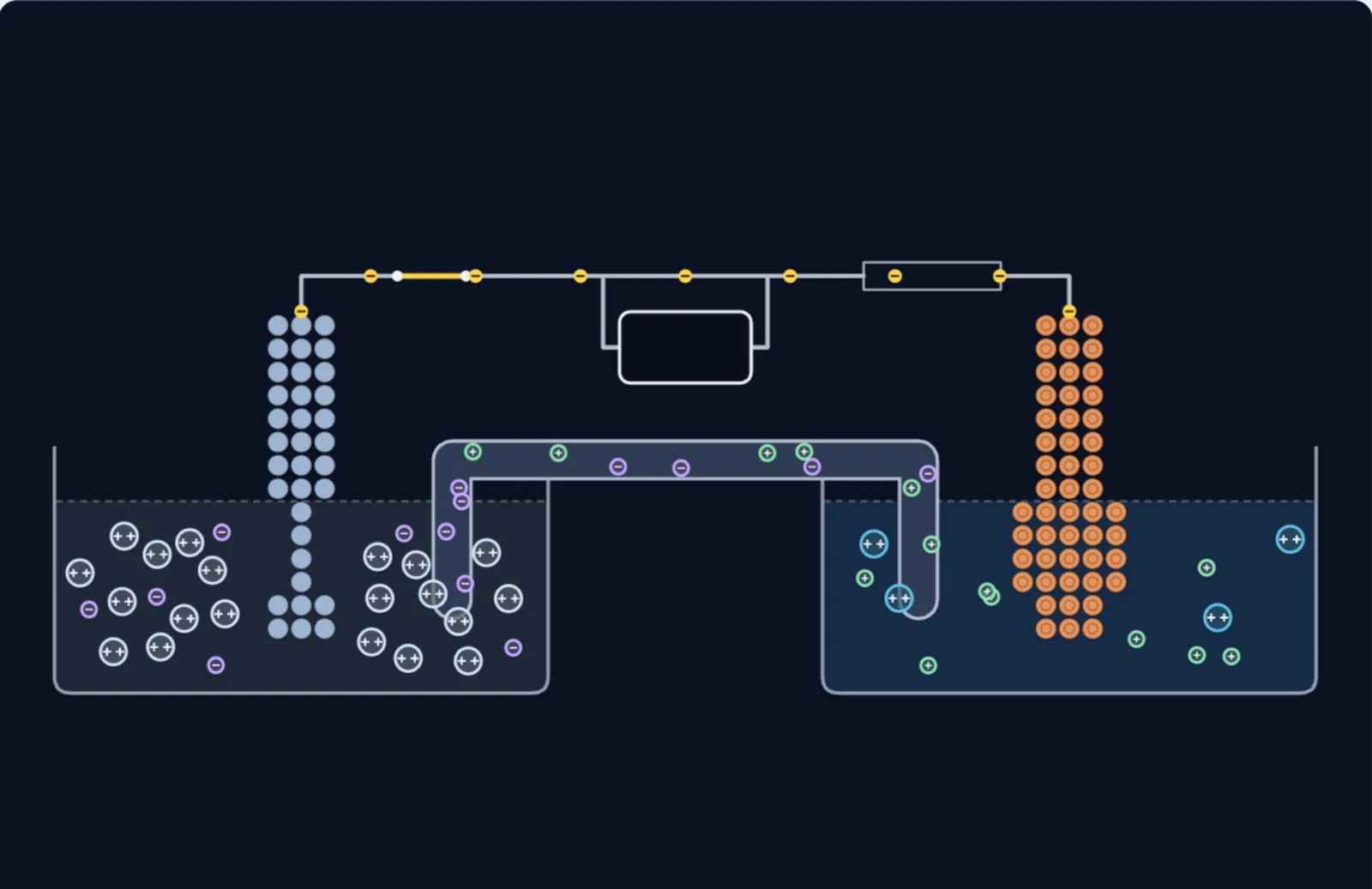
| The voltmeter | 1.10 V | connected between the two strips: with the bridge in place it shows the table voltage, whether the switch is open or closed; without the bridge it shows nothing |
| The lemon cell | Zn → Zn²⁺ + 2e⁻ at the zinc; 2H⁺ + 2e⁻ → H₂ at the copper | the zinc is used up, the copper is not; there are no Cu²⁺ ions in the solution, so the voltage is not the one in the table of the Daniell cell |
| Cell notation | (−) Zn | Zn²⁺ || Cu²⁺ | Cu (+) | anode on the left, cathode on the right; | the boundary between electrode and solution, || the bridge |
| Overall equation | Zn + Cu²⁺ → Zn²⁺ + Cu | Zn → Zn²⁺ + 2e⁻ and Cu²⁺ + 2e⁻ → Cu |
| Zinc used up, amount | 0.10 mol | worked example |
| Electrons through the wire | 0.20 mol, about 1.2·10²³ | n(e⁻) = 2 · 0.10 mol |
| Mass of zinc used up | 6.5 g | 0.10 mol · 65 g/mol |
| Mass of copper deposited | 6.4 g | 0.10 mol · 64 g/mol |
| A 3,000 mAh battery (worked example) | 10,800 C, 0.112 mol of electrons, 0.78 g of lithium | Q = 3,000 · 3.6 C; n = Q ÷ F, with F = 96,485 C/mol; m = n · 7 g/mol. Estimate: one electron for each Li⁺ ion and the whole capacity on the label |
| What this lithium is | the lithium that passes from one electrode to the other in one full charge | one Li⁺ ion per electron; it is not all the lithium in the battery |
Calculation and diagram. The voltages and potentials are table values, at 1 mol/L and 25 °C; a real cell with a current through it gives less. The voltmeter in the picture shows the table value, not a measurement. The movement, number and position of the particles are a drawing: each dot stands for billions of particles, and the counters count only what is drawn (eight zinc atoms in one run). The numbers in the battery calculation are worked out in front of you, from the number you type. Atoms and ions have no colour: they are drawn enormously enlarged and far fewer than in reality, and the charge is shown by the sign + or −. In the wire only the electrons that pass are drawn; the sulfate ions in the beakers are not drawn, and the ions in the bridge are drawn generically. A demonstration done by the teacher.
Sources and credits. Standard electrode potentials: nine measured values, cited from OpenStax, Chemistry 2e, Appendix L and checked against the Wikipedia data page “Standard electrode potential”. The reactions at the electrodes of a lemon cell: Wikipedia, “Lemon battery”, cited. The Faraday constant: F = NA · e, with the exact values from the SI definition (NIST, CODATA). School atomic masses: CIAAW, rounded as in the book.
Metals and acids: why copper releases no hydrogen with hydrochloric acidHow it is written
Most metals before hydrogen react with dilute acids (hydrochloric acid, dilute sulfuric acid) to produce a salt and hydrogen. Those after hydrogen do not release hydrogen.
Zn + 2HCl → ZnCl₂ + H₂
Fe + 2HCl → FeCl₂ + H₂
Copper, silver and gold do not release hydrogen with hydrochloric acid. One mole of zinc produces one mole of hydrogen, and at normal conditions one mole of gas occupies 22.4 L. The oxidising acids, nitric acid and concentrated sulfuric acid, do not follow the rule: copper reacts with them, but other products are released instead of hydrogen.
From the series to a cell and the protection of iron
If two different metals sit in an acidic solution and are connected by a wire, the more active metal is oxidised and sends electrons through the wire to the other. The more active metal is the negative electrode of the cell. A galvanised nail and a copper wire inserted apart in the same lemon form such a cell: zinc is oxidised, Zn → Zn²⁺ + 2e⁻, while at the copper the H⁺ ions in the juice gain electrons: 2H⁺ + 2e⁻ → H₂. The copper is not consumed. Do not eat the lemon afterwards.
The same mechanism protects iron. A zinc coating or a block of zinc or magnesium connected to a buried pipe or tank is oxidised in place of the iron: this is sacrificial protection. The Daniell cell, also made from zinc and copper, is studied separately.
Worked example
Will it react, and how much silver is deposited?
For each pair, decide whether a reaction takes place: (a) Zn in FeSO₄ solution; (b) Ag in CuSO₄ solution; (c) Cu in dilute hydrochloric acid. Then calculate the mass of silver deposited when 6.4 g of copper reacts completely with silver nitrate.
(a) Zinc is before iron in the series, so a reaction takes place: Zn + Fe²⁺ → Zn²⁺ + Fe. (b) Silver is after copper: it does not react. (c) Copper is after hydrogen: it does not react.
For Cu + 2AgNO₃ → Cu(NO₃)₂ + 2Ag: n(Cu) = 6.4 ÷ 64 = 0.1 mol. From the equation, 2 mol of Ag are deposited for every 1 mol of Cu, so n(Ag) = 0.1 · 2 = 0.2 mol. The mass of silver is m(Ag) = 0.2 · 108 = 21.6 g.
Check: for every copper atom, two silver atoms are deposited, and a silver atom is heavier than a copper atom (108 compared with 64). The mass deposited must therefore be several times greater than 6.4 g: 21.6 g is plausible.
In Romania
Native gold from Brad
Gold is at the end of the series: it does not lose its electrons in air, water or ordinary acids, so it occurs in nature as a metal, called native gold. The Gold Museum in Brad, Hunedoara County, holds over 1,300 pieces of native gold from the Metaliferi Mountains and elsewhere.
Iron and zinc, high in the series, are found in the crust almost entirely in ores, that is, in compounds; the metal is obtained from them by reduction reactions. A metal’s place in the series tells you, broadly, whether it is found as a pure metal or in ore.
In short
- In the activity series of metals (K, Ca, Na, Mg, Al, Zn, Fe, Ni, Sn, Pb, (H), Cu, Hg, Ag, Pt, Au), a metal displaces any metal below it from a salt solution.
- The more active metal is oxidised (loses electrons), and the ions of the less active metal are reduced: in Zn + CuSO₄ → ZnSO₄ + Cu, zinc is oxidised and copper is reduced.
- Metals before hydrogen release hydrogen with dilute acids (Zn + 2HCl → ZnCl₂ + H₂); copper, silver and gold do not react with hydrochloric acid.
- Iron forms Fe²⁺ ions in these reactions: Fe + CuSO₄ → FeSO₄ + Cu.
- The more active metal is the negative electrode in a cell and protects iron by sacrificial protection, being oxidised in its place.
Common mistakes
WrongCopper reacts with dilute hydrochloric acid and releases hydrogen.
RightCopper is after hydrogen in the series and does not release hydrogen with hydrochloric acid. It reacts with oxidising acids, but no hydrogen is released.
WrongIf I put iron in copper sulfate solution, iron(III) sulfate forms.
RightIron(II) sulfate, FeSO₄, forms: iron loses two electrons, not three, in this reaction.
WrongAny metal displaces any other metal from a solution of its salt.
RightOnly a metal before the other in the series displaces it. Copper does not displace zinc from zinc sulfate.
Test yourself
7 questions. For the first 6 you see the explanation at once, with the paragraph of the lesson that supports it; for the written ones you compare with a good answer.
Which pair produces a visible reaction?
Answer
b) Zn in CuSO₄ solution. Zinc is before copper in the series, so it displaces copper from solution. In the other three pairs, the metal added is after the metal in solution.
Why does copper release no hydrogen with dilute hydrochloric acid?
Answer
d) Because it is after hydrogen in the activity series. Only metals before hydrogen release hydrogen with dilute acids; copper is after hydrogen.
In the reaction Cu + 2AgNO₃ → Cu(NO₃)₂ + 2Ag, what is oxidised?
Answer
a) Copper, which loses electrons. Copper goes from N.O. 0 to +2, so it loses electrons and is oxidised. Ag⁺ ions gain electrons and are reduced.
What mass of silver, in grams, is deposited when 3.2 g of copper reacts completely with silver nitrate? Use M(Cu) = 64 g/mol and M(Ag) = 108 g/mol.
gAnswer
10.8 g. n(Cu) = 3.2 ÷ 64 = 0.05 mol; 2 mol of Ag are deposited for every 1 mol of Cu, so n(Ag) = 0.1 mol and m(Ag) = 0.1 · 108 = 10.8 g.
What volume of hydrogen, in litres, at normal conditions, is released when 6.5 g of zinc reacts completely with dilute hydrochloric acid? Use M(Zn) = 65 g/mol and VM = 22.4 L/mol.
LAnswer
2.24 L. n(Zn) = 6.5 ÷ 65 = 0.1 mol; one mole of zinc produces one mole of hydrogen, so V = 0.1 · 22.4 = 2.24 L.
Put the metals in the order of the activity series, from most active to least active.
Answer
The correct order:
- Mg
- Zn
- Fe
- Cu
- Ag
The order in the series is K, Ca, Na, Mg, Al, Zn, Fe, Ni, Sn, Pb, (H), Cu, Hg, Ag, Pt, Au.
A steel pipe is buried in the ground and connected to a block of magnesium. Explain, using half-equations, why the pipe rusts more slowly.
A good answer
Magnesium is more active than iron, so it is oxidised first: Mg → Mg²⁺ + 2e⁻. Electrons pass through the connection to the pipe, and dissolved oxygen is reduced at its surface, while the iron is not oxidised. The pipe does not lose electrons, so it is not oxidised. The magnesium block is consumed and replaced from time to time: this is sacrificial protection.
A complete answer compares their places in the series, writes the oxidation of magnesium and says that the sacrificial metal is consumed.
Terms
- activity series of metals (reactivity series)
- A sequence of metals ordered by how easily they lose electrons in aqueous solution; a metal displaces metals below it from solution.
- active metal
- A metal high in the series that is easily oxidised.
- displacement reaction
- A reaction in which one element takes the place of another in a compound, as zinc displaces copper in CuSO₄.
- negative electrode
- The electrode of a cell where oxidation takes place; it is the more active metal.
- sacrificial protection
- Protection of a metal by connecting it to a more active metal, which is oxidised in its place.
- native gold
- Gold found in nature as a metal, not in compounds.
Sources and link to the programme
- Royal Society of Chemistry – Displacement reactions between metals and their salts – a more reactive metal displaces a less reactive metal from a compound; the order of reactivity is deduced from the pairs that react
- OpenStax – Chemistry 2e, 4.2 Classifying chemical reactions – Zn + 2HCl → ZnCl₂ + H₂ and Cu + 2AgNO₃ → Cu(NO₃)₂ + 2Ag as redox displacement reactions; Cu²⁺ ions colour the solution blue
- OpenStax – Chemistry 2e, Appendix L: Standard electrode (half-cell) potentials – standard potentials of the Zn²⁺/Zn (−0.7618 V), Cu²⁺/Cu (+0.34 V), Hg²⁺/Hg (+0.851 V), Ag⁺/Ag (+0.7996 V) and Au³⁺/Au (+1.498 V) pairs
- OpenStax – Chemistry 2e, 17.6 Corrosion – galvanising with zinc; iron remains protected even when the zinc coating is broken; buried pipes and tanks protected by connection to zinc or magnesium; sacrificial anodes
- Australian National University – How to make a lemon battery – galvanised nail as negative electrode and copper as positive electrode; zinc is oxidised and sends electrons through the wire; lemons are not eaten after the experiment
- Goodisman, J. Chem. Educ. 78 (2001) 516–518 – Observations on lemon cells (rezumat, Syracuse University SURFACE) – in a fruit cell the more active metal dissolves, and hydrogen forms at the other metal (copper)
- Wikipedia – Lemon battery – at the copper, H⁺ ions in the juice gain electrons and form hydrogen, 2H⁺ + 2e⁻ → H₂, which escapes as bubbles; zinc is oxidised
- Puterea.ro – Muzeul aurului, peste 1300 de piese din aur nativ – the native gold collection of the Gold Museum in Brad: over 1300 pieces
- Wikipedia – Muzeul Aurului din Brad – over 1,300 exhibits of native gold, from the Metaliferi Mountains and elsewhere
From the programme: “Recognising reactions with a change in oxidation number found in natural or technological/industrial processes” (TC: Core curriculum (1 hour a week)). Specific competences followed: 1.1, 1.2, 2.1, 2.2, 4.1.