Chapter 2 · Chemical reactionsLesson 2.4TC Core curriculum (1 hour a week) · beyond your profile
Exothermic and endothermic reactions
When a reaction warms its surroundings and when it cools them
Why does a fire warm you while a glass of bicarbonate and lemon turns cold?
Before you read: what do you think?
You pour lemon juice over a spoonful of sodium hydrogencarbonate in a glass and hold a thermometer in the mixture. Bubbles appear immediately. What does the thermometer show?
See the answer
The temperature falls. Citric acid in the lemon reacts with the hydrogencarbonate, and the reaction absorbs heat from the surroundings. The bubbles resemble boiling, but they are carbon dioxide and say nothing about heat.
Gas burns on the stove and the pot above it heats up. In a lime works kiln, limestone must be kept at about 900 °C to decompose; without fuel the reaction stops. In one case the reaction gives out heat, in the other it needs heat. The sign of the heat can be read from the equation, from ΔH, and from the thermometer.
The thermometer shows which way heat flowsWhat you see
A chemical reaction changes the temperature of the mixture in which it takes place. If the mixture warms up, the reaction has released heat to its surroundings: the glass, the air, your hand. A reaction like this is called exothermic. The combustion of methane on a stove, the neutralisation of an acid with a base and the slaking of quicklime (CaO + H₂O) are exothermic.
If the mixture cools down, the reaction has taken heat from the surroundings. It is endothermic. Bicarbonate of soda with lemon juice is a safe example to try at home: the glass feels cold, even though bubbles are visible. The bubbles are carbon dioxide and say nothing about heat.
The decomposition of limestone, CaCO₃, is endothermic: the kiln must be heated continuously or the reaction stops. The heat exchanged with the surroundings is called the thermal effect of the reaction. Melting ice also absorbs heat, but it is not a chemical reaction: the water remains H₂O and only changes state.
Where the heat comes from: bonds broken, bonds formedWhat the particles do
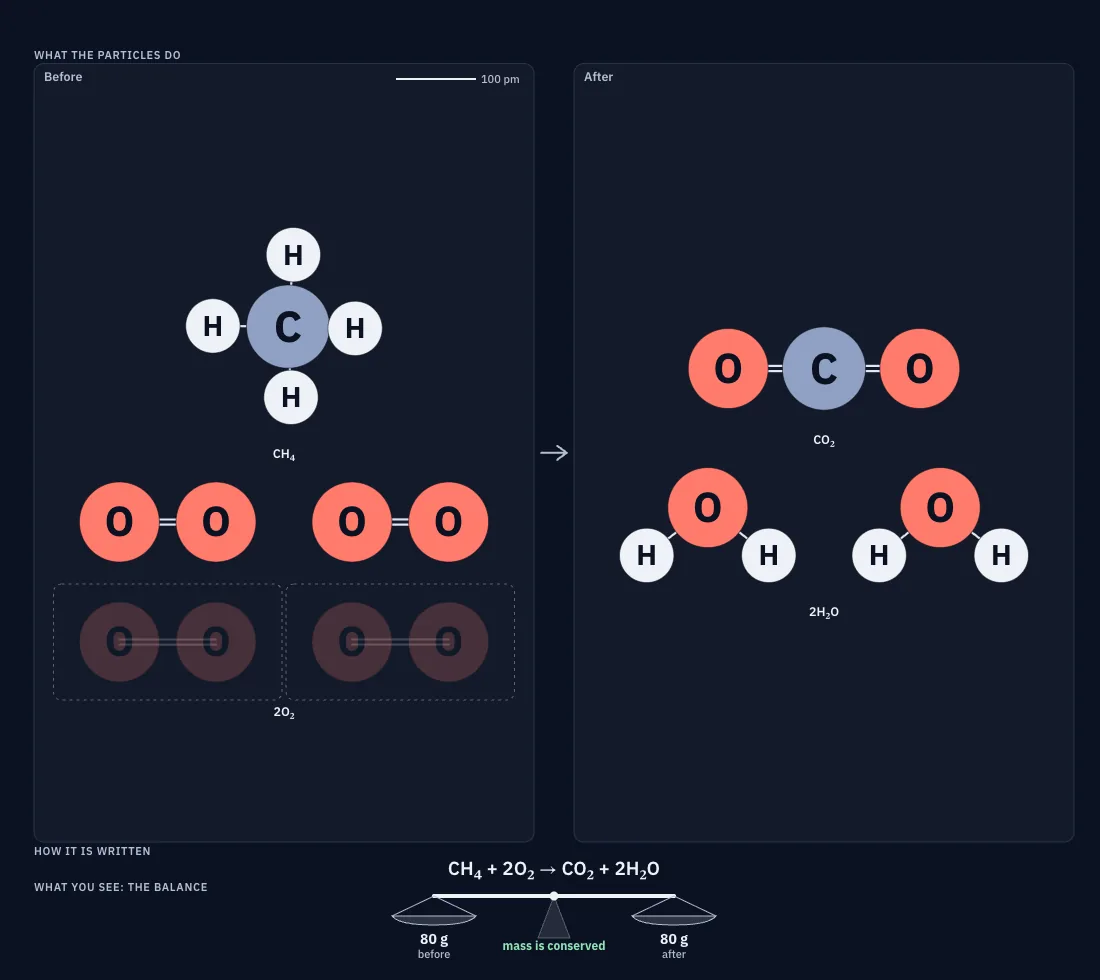
In a reaction, bonds between the reactant particles break and new bonds form in the products. Breaking bonds takes energy; forming them releases energy. The balance between the two decides whether the reaction is exothermic or endothermic.
When methane burns, forming CO₂ and H₂O releases more energy than is spent breaking apart CH₄ and O₂. The difference goes to the surroundings as heat. For the decomposition of CaCO₃, the balance has the opposite sign: breaking apart the carbonate takes more energy than forming CaO and CO₂ releases, and the difference comes from the kiln flame.
There is another energy involved, distinct from the balance: activation energy, the threshold a reaction must cross to begin. Gas on a stove burns exothermically, but needs a spark. Once it starts, the heat released takes the next particles over the threshold and the reaction continues on its own. Heating a mixture to make it react therefore does not show that the reaction is endothermic: the heat may supply only the activation energy.
An energy–reaction pathway diagram shows both quantities. The reactants are at one energy level, the products at another, with a peak between them. In an exothermic reaction the products lie below the reactants; in an endothermic one they lie above. The height of the peak is the activation energy, a different quantity from the heat of reaction.
For the curious
The heat of a reaction can be calculated from enthalpies of formation: ΔH is the sum of the products’ enthalpies of formation minus the sum of the reactants’, each multiplied by its coefficient in the equation. For slaking lime: (−985.2) − (−634.9) − (−285.83) ≈ −64.5 kJ per mole.
How it is written: ΔH and the thermochemical equationHow it is written
The heat of a reaction at constant pressure is written ΔH and given in kJ for the amounts in the equation. In an exothermic reaction ΔH < 0, because the system loses energy. In an endothermic reaction ΔH > 0.
CH₄(g) + 2O₂(g) → CO₂(g) + 2H₂O(l)
ΔH = −890.8 kJ: burning one mole of methane releases 890.8 kJ. The neutralisation HCl(aq) + NaOH(aq) → NaCl(aq) + H₂O(l) has ΔH = −58 kJ for one mole of HCl. Slaking quicklime, CaO(s) + H₂O(l) → Ca(OH)₂(s), has ΔH ≈ −64.5 kJ for one mole of CaO.
CaCO₃(s) → CaO(s) + CO₂(g)
ΔH = +178 kJ: the decomposition of one mole of CaCO₃ absorbs 178 kJ. For MgCO₃ → MgO + CO₂ the value is +117 kJ per mole, so magnesium carbonate needs less heat. If the equation is multiplied by 2, ΔH doubles. If the reaction is written in reverse, ΔH changes sign: CaO + CO₂ → CaCO₃ releases 178 kJ per mole.
Carbonates and nitrates on heating
Group II metal carbonates, such as MgCO₃ and CaCO₃, decompose on heating into an oxide and carbon dioxide. Sodium and potassium carbonates are much more stable to heat. Sodium hydrogencarbonate, NaHCO₃, however, decomposes easily on heating:
2NaHCO₃ → Na₂CO₃ + CO₂ + H₂O
Nitrates also decompose on heating, though not all in the same way. Sodium and potassium nitrates give a nitrite and oxygen: 2KNO₃ → 2KNO₂ + O₂. Copper nitrate gives copper oxide, nitrogen dioxide and oxygen: 2Cu(NO₃)₂ → 2CuO + 4NO₂ + O₂. Silver nitrate gives metallic silver: 2AgNO₃ → 2Ag + 2NO₂ + O₂. All need strong heating; for copper nitrate, ΔH = +424 kJ for the equation as written. Nitrogen also changes oxidation number, so these reactions are also classified as reactions with a change in N.O.
Nitrogen dioxide, NO₂, is a brown gas that irritates the respiratory tract. That is why nitrate decomposition is a demonstration done by the teacher: the teacher does it in a laboratory fume cupboard, while pupils watch from a distance as the salt is heated, the brown gas appears and the solid remains. Pupils do not repeat it at home.
For the curious
For copper nitrate, tabulated enthalpies of formation (Cu(NO₃)₂ −302.9 kJ/mol, CuO −157.3 kJ/mol, NO₂ +33.2 kJ/mol) give 2 · (−157.3) + 4 · 33.2 − 2 · (−302.9) = +424 kJ for the equation 2Cu(NO₃)₂ → 2CuO + 4NO₂ + O₂.
Worked example
A tonne of limestone in a kiln
One tonne (10⁶ g) of pure limestone, CaCO₃, decomposes completely. What masses of CaO and CO₂ are produced, and how much heat does the reaction absorb?
M(CaCO₃) = 40 + 12 + 3 · 16 = 100 g/mol, so n = 10⁶ ÷ 100 = 10⁴ mol. The equation CaCO₃ → CaO + CO₂ shows a 1 : 1 : 1 ratio, so 10⁴ mol of CaO and 10⁴ mol of CO₂ are produced.
M(CaO) = 40 + 16 = 56 g/mol and m(CaO) = 10⁴ · 56 = 5.6·10⁵ g = 560 kg. M(CO₂) = 12 + 2 · 16 = 44 g/mol and m(CO₂) = 10⁴ · 44 = 4.4·10⁵ g = 440 kg. Check: 560 + 440 = 1,000 kg; mass is conserved.
The heat absorbed is Q = 10⁴ · 178 = 1.78·10⁶ kJ, or 1.78 GJ. An order-of-magnitude check: the same energy is released by burning 1.78·10⁶ ÷ 890.8 ≈ 2,000 moles of methane, or 2,000 · 16 = 32,000 g = 32 kg. A tonne of stone therefore needs the energy from 32 kg of gas, excluding heat lost from the kiln.
In Romania
From limestone to cement at Fieni
The cement factory at Fieni, in Dâmbovița county, was founded in March 1914. Cement is made from limestone and clay: the ground mixture enters a rotary kiln heated to 1,450 °C, and the limestone is rich in calcium carbonate. This is how Romanian cement producers, including Heidelberg Materials România, describe the process.
The first transformation in the kiln is CaCO₃ → CaO + CO₂, with ΔH = +178 kJ/mol. It needs fuel throughout operation, as the calculation for a tonne of limestone shows. The reaction also releases CO₂, 440 kg for every tonne of pure limestone, excluding the carbon dioxide from burning the fuel. In a lime kiln, limestone reaches about 900 °C.
In short
- An exothermic reaction releases heat to the surroundings and has ΔH < 0; an endothermic reaction takes heat from the surroundings and has ΔH > 0.
- Breaking bonds takes energy, forming them releases energy; the balance between the two decides the sign of ΔH.
- Activation energy is the starting threshold and differs from the heat of reaction: a spark can ignite an exothermic reaction.
- Exothermic: combustion of methane (−890.8 kJ/mol), neutralisation, slaking quicklime. Endothermic: CaCO₃ → CaO + CO₂ (+178 kJ/mol), MgCO₃ → MgO + CO₂ and decomposition of nitrates.
- Nitrates decompose in different ways: 2KNO₃ → 2KNO₂ + O₂, 2Cu(NO₃)₂ → 2CuO + 4NO₂ + O₂, 2AgNO₃ → 2Ag + 2NO₂ + O₂; the teacher does the demonstration because NO₂ is toxic.
Common mistakes
WrongIf I have to heat the mixture to make it react, the reaction is endothermic.
RightHeating may supply only the activation energy. Gas on a stove needs a spark and still burns exothermically.
WrongGas bubbles show that the reaction releases heat, as in boiling.
RightHydrogencarbonate and lemon bubble and cool down. Heat is read from the thermometer or from ΔH; bubbles do not reveal it.
WrongAn exothermic reaction happens quickly, an endothermic one slowly.
RightThe sign of ΔH says nothing about speed. Iron rusting is exothermic and takes months.
Test yourself
7 questions. For the first 6 you see the explanation at once, with the paragraph of the lesson that supports it; for the written ones you compare with a good answer.
In a glass, sodium hydrogencarbonate reacts with lemon juice, bubbles appear and the glass cools. How is the reaction classified?
Answer
a) Endothermic, because it takes heat from the surroundings. The cooling mixture shows that the reaction absorbs heat from the surroundings. The bubbles are carbon dioxide and do not indicate the sign of the heat.
What does ΔH = +178 kJ mean for the equation CaCO₃(s) → CaO(s) + CO₂(g)?
Answer
d) The decomposition of one mole of CaCO₃ absorbs 178 kJ. ΔH > 0 means an endothermic reaction: heat is absorbed for the amounts in the equation.
Which equation correctly describes the decomposition of potassium nitrate on heating?
Answer
b) 2KNO₃ → 2KNO₂ + O₂. Sodium and potassium nitrates give a nitrite and oxygen. Nitrogen dioxide appears with copper nitrate, whereas potassium nitrate does not produce it.
8 g of methane, CH₄, is burned; its complete combustion has ΔH = −890.8 kJ for one mole of CH₄. Given M(CH₄) = 16 g/mol, how much heat is released, in kJ, rounded to one decimal place?
kJAnswer
445.4 kJ. n = 8 ÷ 16 = 0.5 mol, and Q = 0.5 · 890.8 = 445.4 kJ.
200 kg of pure CaCO₃ decomposes completely. What mass of CaO is produced, in kg? Given M(CaCO₃) = 100 g/mol and M(CaO) = 56 g/mol.
kgAnswer
112 kg. 200 kg = 2,000 moles of CaCO₃ and produces 2,000 moles of CaO, or 2,000 · 56 = 112,000 g = 112 kg.
Are the chemical processes below exothermic or endothermic? Place each process in the right category.
Answer
Exothermic: Combustion of methane; Neutralisation of HCl with NaOH; Slaking quicklime.
Endothermic: Decomposition of CaCO₃; Decomposition of MgCO₃; Decomposition of copper nitrate.
Combustion, neutralisation and slaking lime have ΔH < 0. The decomposition of carbonates and nitrates on heating absorbs heat.
A classmate says: “Limestone must be heated to decompose, so decomposition is endothermic. Gas must be lit with a spark, so combustion is endothermic too.” Where is the mistake?
A good answer
Heating and the spark supply the activation energy, the starting threshold, and say nothing about the balance. The sign of the heat can be read from ΔH or from the thermometer once the reaction has started: during combustion the mixture gets very hot (ΔH < 0); for CaCO₃ decomposition, heat must be supplied continuously (ΔH > 0).
A complete answer separates activation energy from heat of reaction and gives one clue for each case.
Terms
- exothermic reaction
- A reaction that releases heat to the surroundings; ΔH < 0.
- endothermic reaction
- A reaction that absorbs heat from the surroundings; ΔH > 0.
- thermal effect
- The heat exchanged with the surroundings in a chemical reaction.
- enthalpy of reaction (ΔH)
- The heat of a reaction at constant pressure, in kJ for the amounts in the equation.
- activation energy
- The energy threshold that must be crossed for a reaction to start.
- thermal decomposition
- The decomposition of a substance through heating.
Sources and link to the programme
- OpenStax – Chemistry 2e, 5.3 Enthalpy – enthalpy of combustion of methane (−890.8 kJ/mol); enthalpy of neutralisation of HCl with NaOH (−58 kJ per mole of HCl); exothermic and endothermic reactions
- OpenStax – Chemistry 2e, Appendix G: Standard Thermodynamic Properties – enthalpies of formation used to calculate ΔH for slaking lime (≈ −64.5 kJ/mol) and decomposition of copper nitrate (+424 kJ for the equation as written)
- Chemguide – Thermal decomposition of the Group 2 carbonates and nitrates – enthalpies of decomposition: MgCO₃ +117 kJ/mol, CaCO₃ +178 kJ/mol; Group II nitrates give an oxide, NO₂ and O₂
- Chemguide – Group 1: compounds – sodium and potassium nitrates give a nitrite and oxygen; decomposition of sodium hydrogencarbonate
- LibreTexts – Silver nitrate – decomposition of silver nitrate into metallic silver, oxygen and nitrogen dioxide
- Wikipedia – Copper(II) nitrate – equation for decomposition of copper nitrate into copper oxide, NO₂ and O₂
- EPA – Basic Information about NO2 – nitrogen dioxide irritates the respiratory system
- RSC Education – Cool it (citric acid and bicarbonate of soda) – the mixture of citric acid and sodium hydrogencarbonate is an endothermic reaction
- Agenția Europeană de Mediu – Lime production (ghidul EMEP/CORINAIR) – in lime kilns, limestone reaches temperatures of up to 900 °C and releases CO₂
- Heidelberg Materials România – Procese de producție – cement is made from limestone and clay in a rotary kiln heated to 1,450 °C
- Wikipedia (ro) – Fieni – the cement factory in Fieni, founded on 10/23 March 1914
From the programme: “Exothermic and endothermic reactions”; “For the content area Classification of reactions in inorganic chemistry, reactions will be classified according to the given criteria, and different examples of chemical reactions will be presented for each type. For Exothermic and endothermic reactions, examples will also include the decomposition of some nitrates and carbonates” (TC: Core curriculum (1 hour a week)). Specific competences followed: 1.1, 2.1, 4.1, 6.1.