Chapter 8 · Between moleculesLesson 8.3MI Mathematics–informatics (2 hours) · beyond your profile
The influence of intermolecular interactions on melting point, boiling point and solubility
Why water boils at 100 °C and H₂S at −60 °C
Hydrogen sulfide, H₂S, has larger molecules than water, yet it boils at −60 °C and water at 100 °C. What determines how high a substance’s boiling point is and what dissolves in what?
Before you read: what do you think?
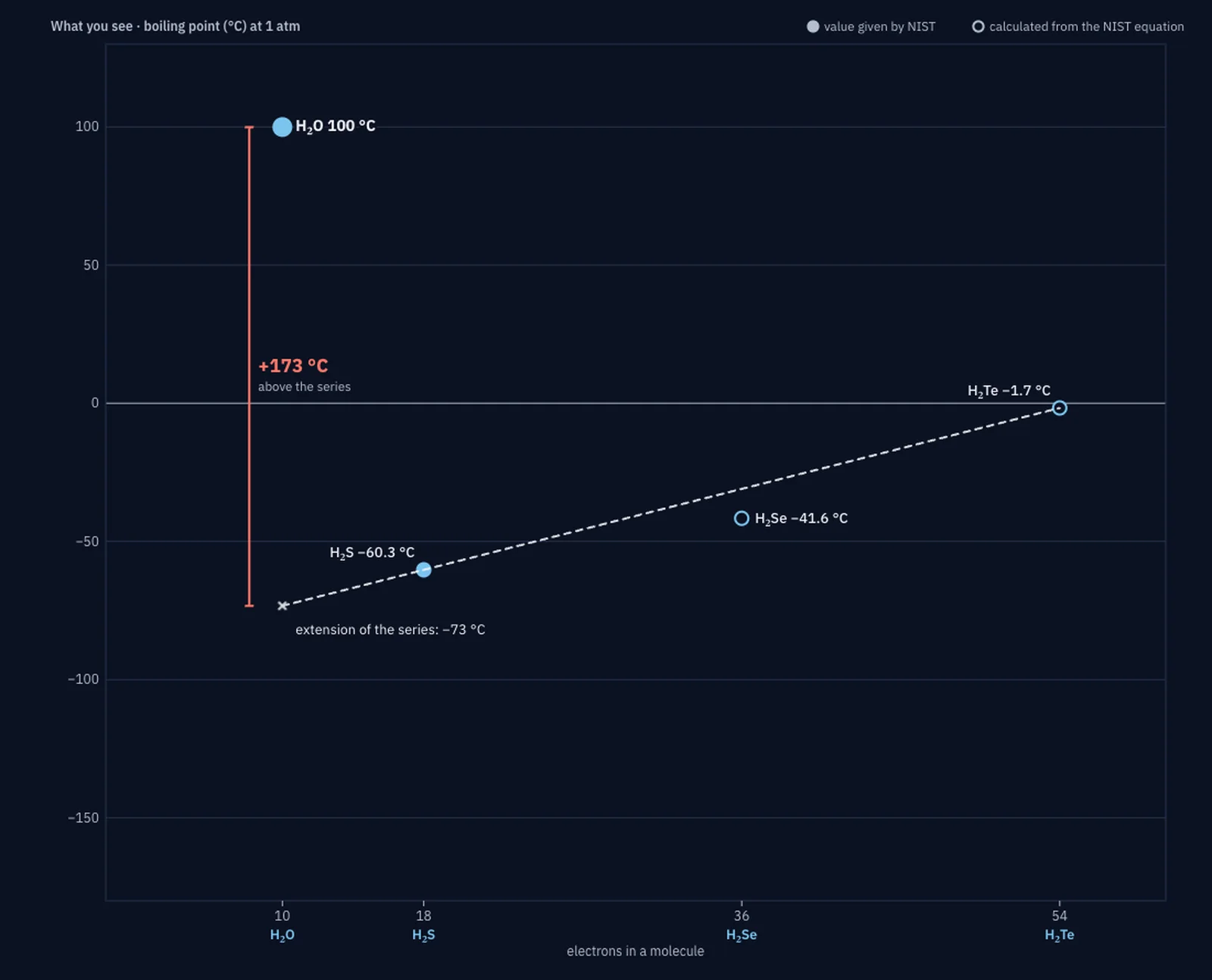
In the series H₂Te, H₂Se, H₂S, the boiling point falls with the number of electrons: −1.7 °C, −41.6 °C and −60.3 °C. What temperature would the same trend predict for H₂O, which has only 10 electrons?
See the answer
The trend predicts approximately −73 °C. Water boils at 100 °C, 173 °C higher, because its molecules form hydrogen bonds, while H₂S, H₂Se and H₂Te do not form them to a comparable extent.
Put oil and vinegar in a glass and shake: droplets form, then join back into two layers. Put sugar in vinegar and it disappears; in oil it does not dissolve. The same thing determines the result in boiling and dissolving: the attractions between molecules.
Stronger attractions, higher temperaturesWhat the particles do
When a substance melts, its molecules leave their fixed positions in the crystal; when it boils, they move completely apart. In both cases, intermolecular interactions break, while covalent bonds within molecules remain intact. Stronger interactions need more energy to break, so melting and boiling points are higher.
Four hydrides with the same number of electrons, 10, make a clear comparison because their London forces are similar. Methane, CH₄, boils at −161.5 °C, ammonia, NH₃, at −33 °C, hydrogen fluoride, HF, at 19.5 °C, and water, H₂O, at 100 °C. Methane is non-polar and has only London forces, while NH₃, HF and H₂O form hydrogen bonds. Melting points follow the same order: CH₄ −182.5 °C, NH₃ −77.7 °C, H₂O 0 °C.
Water breaks the trendWhat the particles do
The hydrides H₂S, H₂Se and H₂Te have 18, 36 and 54 electrons. Their boiling points rise with the number of electrons, as expected from London forces: H₂S boils at −60.3 °C, H₂Se at −41.6 °C, H₂Te at −1.7 °C. The points for H₂Se and H₂Te are calculated from NIST vapour pressure parameters.
Extend the trend to H₂O, which has 10 electrons, and the result is well below 0 °C. Water, however, boils at 100 °C. The difference comes from hydrogen bonds between water molecules, which oxygen forms much more readily than sulfur, selenium or tellurium. Extending the trend is a calculation model; 100 °C is a measurement.
| Substance | Group | Electrons | Boils at, °C | How it was obtained |
|---|---|---|---|---|
| H₂O | 16 | 10 | 100 | NIST fluid properties |
| H₂S | 16 | 18 | −60.3 | given by NIST |
| H₂Se | 16 | 36 | −41.6 | calculated from the NIST equation |
| H₂Te | 16 | 54 | −1.7 | calculated from the NIST equation (0.46 K outside its range) |
| NH₃ | 15 | 10 | −33.3 | NIST fluid properties |
| PH₃ | 15 | 18 | −87.3 | calculated from the NIST equation (0.15 K outside its range) |
| AsH₃ | 15 | 36 | −61.9 | calculated from the NIST equation (0.15 K outside its range) |
| HF | 17 | 10 | 19.5 | given by NIST |
| HCl | 17 | 18 | −84.8 | calculated from the NIST equation |
| HBr | 17 | 36 | −66.5 | calculated from the NIST equation |
| HI | 17 | 54 | −34.6 | calculated from the NIST equation (0.42 K outside its range) |
| CH₄ | 14 | 10 | −161.5 | NIST fluid properties |
| SiH₄ | 14 | 18 | −111.5 | calculated from the NIST equation |
| GeH₄ | 14 | 36 | −88.8 | calculated from the NIST equation (0.04 K outside its range) |
| Group | The line passes through | Value of the line at 10 electrons, °C | Measured, °C | Difference, °C |
|---|---|---|---|---|
| 16 | H₂S and H₂Te | −73 | 100 | +173 |
| 15 | PH₃ and AsH₃ | −99 | −33.3 | +65 |
| 17 | HCl and HI | −96 | 19.5 | +116 |
| 14 | SiH₄ and GeH₄ | −122 | −161.5 | −40 |
| Substance | Boils at / density |
|---|---|
| ethanol, CH₃CH₂–OH | 78.2 °C |
| dimethyl ether, CH₃–O–CH₃ | −24.8 °C |
| ice at 0 °C, density | 0.917 g/cm³ |
| liquid water at 0 °C, density | 0.9998 g/cm³ |
With 10 electrons, water boils at 100 °C, which is 173 °C above −73 °C, the value of the line through H₂S and H₂Te. Average O–H bond energy: 464 kJ/mol; one hydrogen bond: about 20 kJ/mol.
Measurements, calculation and diagram. The filled points are boiling points given by NIST at normal pressure. The points with an empty ring are calculated from the vapour-pressure equation that NIST fitted to old measurements (Stull, 1947); for H₂Te, PH₃, AsH₃, GeH₄ and HI the temperature falls at most half a kelvin outside the range of the equation. The dashed line and the difference are a calculation: the line passes through the lightest and the heaviest hydride of the group with period three or higher, and is extended down to ten electrons. The molecules are a diagram without a scale: atoms have no colour, and they are drawn greatly enlarged and far fewer than in reality. For SnH₄ and SbH₃ NIST gives no boiling point, so they are missing.
Sources and credits. Values quoted from: NIST Chemistry WebBook, SRD 69 (National Institute of Standards and Technology), pages consulted in 2026 and listed under Sources (the boiling points; the density of liquid water, from the fluid properties). Ethanol and dimethyl ether: PubChem (NIH), compounds 702 and 8254. Density of ice: PubChem, compound 962. Average O–H bond energy: OpenStax, Chemistry 2e, section 7.5.
Like dissolves likeWhat the particles do
Dissolving breaks attractions between particles of the substance and between solvent molecules, and forms attractions between the substance and the solvent. Dissolving occurs readily when the new attractions are of the same kind and strength as those broken. The classroom rule: ionic and polar substances dissolve in polar solvents, such as water, and non-polar substances in non-polar solvents.
Oil consists of non-polar molecules, with only London forces between them. Water molecules are held together by strong hydrogen bonds that oil molecules cannot replace, so oil collects in a separate layer. Sugar has –OH groups, forms hydrogen bonds with water and dissolves.
An emulsifier stabilises an emulsion: it stops oil droplets joining together. A soap molecule has a non-polar end, a hydrocarbon chain, and an ionic end, a carboxylate group, so it bonds to both oil and water.
Iodine in water and in a non-polar solventWhat you see
Iodine, I₂, has non-polar molecules. Little dissolves in water: 0.03 g per 100 mL, at 20 °C. In n-heptane, a non-polar solvent, 1.73 g dissolves per 100 g, at 25 °C, tens of times more. Iodine gives violet solutions in carbon tetrachloride or chloroform. The demonstration is done by the teacher because these solvents are toxic.
The rule has limits. Water dissolves 36.0 g of NaCl per 100 g, but calcium carbonate, also an ionic substance, is practically insoluble: approximately 0.001 g per 100 g of water. How strongly the crystal holds its ions also matters.
For the curious
The ratio of the two solubilities is 36.0 : 0.001 = 36,000. The force holding Ca²⁺ and CO₃²⁻ ions in the crystal is greater than the energy gained by hydrating them, while for NaCl the balance favours dissolving.
Worked example
What boiling point would water have if it followed H₂S, H₂Se, H₂Te?
Extend the line between H₂S and H₂Te to H₂O and compare it with the measured value.
Step 1, electron count: H₂S has 16 + 2 = 18; H₂Te has 52 + 2 = 54; H₂O has 8 + 2 = 10.
Step 2, slope: (−1.7 − (−60.3)) ÷ (54 − 18) = 58.6 ÷ 36 ≈ 1.63 °C per electron.
Step 3, extrapolation: H₂O has 10 − 18 = −8 electrons relative to H₂S, so −60.3 + (−8) · 1.63 ≈ −73 °C.
Step 4, comparison: water boils at 100 °C, or 100 − (−73) = 173 °C higher. Order-of-magnitude check: the whole H₂S–H₂Te series spans only 58.6 °C, so water’s deviation is nearly three times that range. Water is therefore considered an exception, caused by hydrogen bonds.
In Romania
Salad dressing and a drop of detergent
In a Romanian kitchen, sunflower oil and vinegar form two layers. Homemade mayonnaise is an exception: egg yolk is the emulsifier that keeps oil droplets in vinegar, and the mixture looks uniform.
A safe observation: pour 50 mL of water and 50 mL of oil into each of two jars and shake them. Add a drop of washing-up liquid to one jar and shake again. Without detergent, the layers separate quickly; with detergent, oil droplets stay spread through the water longer. The oil remains undissolved in both jars; detergent makes the droplets more stable.
In short
- Stronger intermolecular interactions mean higher melting and boiling points; melting and boiling break attractions between molecules, leaving bonds within molecules intact.
- The series CH₄ −161.5 °C, NH₃ −33 °C, HF 19.5 °C, H₂O 100 °C (all with 10 electrons) shows the effect of hydrogen bonds.
- The series H₂S −60.3 °C, H₂Se −41.6 °C, H₂Te −1.7 °C rises with the number of electrons; water breaks the trend, at 173 °C above the extrapolated value, because of hydrogen bonds.
- Like dissolves like: ionic and polar substances dissolve in polar solvents, non-polar substances in non-polar solvents.
- The rule has limits: CaCO₃ is ionic, yet practically insoluble in water; iodine, which is non-polar, dissolves slightly in water and much better in heptane.
Common mistakes
WrongWater boils at 100 °C because O–H bonds are very strong.
RightBoiling breaks hydrogen bonds between molecules. Water vapour still consists of H₂O molecules, with their O–H bonds intact.
WrongEvery ionic substance dissolves in water because water is polar.
RightNaCl dissolves at 36.0 g per 100 g of water, but CaCO₃ hardly dissolves at all. The rule is a trend, not a law.
WrongOil does not dissolve in water because it is lighter.
RightOil floats because it has a lower density, but its failure to dissolve has another cause: its non-polar molecules cannot replace the hydrogen bonds between water molecules. It dissolves in non-polar solvents.
Test yourself
8 questions. For the first 7 you see the explanation at once, with the paragraph of the lesson that supports it; for the written ones you compare with a good answer.
Methane, ammonia, hydrogen fluoride and water each have 10 electrons. Why does methane boil at a much lower temperature than the others?
Answer
b) Methane forms no hydrogen bonds, only London forces. With the same number of electrons, London forces are similar; NH₃, HF and H₂O also have hydrogen bonds.
Why does the boiling point rise along the series H₂S, H₂Se, H₂Te?
Answer
a) London forces grow with the number of electrons. H₂S, H₂Se and H₂Te have 18, 36 and 54 electrons; London forces grow with the number of electrons.
In which solvent does iodine, I₂, dissolve best?
Answer
b) n-Heptane. Iodine has non-polar molecules and dissolves better in non-polar solvents such as n-heptane.
Why does oil not dissolve in water?
Answer
b) Because oil molecules cannot replace the hydrogen bonds between water molecules. Only London forces act between oil molecules; these are weaker than hydrogen bonds in water.
Extending the H₂S–H₂Te trend gives −73 °C for water. Water boils at 100 °C. How many °C higher is its boiling point than the trend predicts?
°CAnswer
173 °C. 100 − (−73) = 173 °C.
Put the substances with 10 electrons in order from lowest to highest boiling point.
Answer
The correct order:
- CH₄
- NH₃
- HF
- H₂O
The boiling points are −161.5; −33; 19.5 and 100 °C.
Where does each substance dissolve well?
Answer
In water: NaCl; sugar.
In n-heptane (non-polar): iodine I₂; oil.
NaCl is ionic, sugar forms hydrogen bonds with water; iodine and oil have non-polar molecules.
Calcium carbonate is ionic, and water is a polar solvent. Explain why calcium carbonate is nevertheless practically insoluble in water.
A good answer
The rule “like dissolves like” is a trend. In calcium carbonate, Ca²⁺ and CO₃²⁻ ions are held in the crystal by very strong attractions, and the energy gained by hydrating them does not match those attractions. For NaCl the balance is different, so 36.0 g dissolves per 100 g of water, compared with approximately 0.001 g for CaCO₃.
A complete answer says that the rule is a guide and compares crystal lattice energy with hydration energy.
Terms
- boiling point
- The temperature at which a liquid turns to gas throughout, at a given pressure.
- melting point
- The temperature at which a solid turns to liquid, at a given pressure.
- emulsion
- A mixture of two immiscible liquids, in which one is dispersed as droplets in the other.
- emulsifier
- A substance that stops droplets in an emulsion joining together.
- non-polar solvent
- A solvent made of non-polar molecules, such as n-heptane.
- miscible
- Describes liquids that mix in any proportion.
Sources and link to the programme
- NIST Chemistry WebBook – Hydrogen sulfide – boiling point of H₂S, 212.87 K (−60.3 °C)
- NIST Chemistry WebBook – Hydrogen selenide – Antoine equation for H₂Se (Stull, 1947): boiling point calculated at 1 atm, 231.5 K (−41.6 °C)
- NIST Chemistry WebBook – Hydrogen telluride – Antoine equation for H₂Te (Stull, 1947): boiling point calculated at 1 atm, 271.5 K (−1.7 °C)
- NIST Chemistry WebBook – Methane – methane: boiling 111.7 K (−161.5 °C), melting 90.6 K (−182.5 °C)
- NIST Chemistry WebBook – Ammonia – ammonia: boiling 239.8 K (−33.3 °C), from NIST fluid data
- NIST Chemistry WebBook – Hydrogen fluoride – boiling point of HF, 292.7 K (19.5 °C)
- NIST Chemistry WebBook – Fluid properties, Water (1 atm) – liquid–vapour transition of water at 1 atm at 373.12 K (99.97 °C)
- OpenStax – Chemistry 2e, 10.1 Intermolecular Forces – hydrogen bonds explain high boiling points; London forces grow with molecular size
- OpenStax – Chemistry 2e, 11.5 Colloids – emulsifiers (soap, egg yolk in mayonnaise); the soap molecule with a non-polar end and an ionic end
- PubChem – Iodine – iodine solubility: 0.03 g/100 mL water at 20 °C; 1.73 g/100 g n-heptane at 25 °C; violet solutions in carbon tetrachloride and chloroform
- PubChem – Sodium chloride – NaCl solubility, 36.0 g per 100 g of water, at 25 °C
- PubChem – Calcium carbonate – calcium carbonate, practically insoluble in water (0.001%, NIOSH)
From the programme: “The influence of intermolecular interactions on melting point, boiling point and solubility” (MI: Mathematics–informatics (2 hours)). Specific competences followed: 1.4, 2.4, 2.5, 4.4, 5.4, 6.4.