Intermolecular interactions
Chapter 8
Between molecules – why water boils at 100 °C
Why does water boil at 100 °C when its molecules are so small?
Three hydrides from the same family, H₂S, H₂Se and H₂Te, boil at temperatures that rise in order. Water, H₂O, is the fourth in the family, but its place on the graph is empty. Choose where you think it boils, then compare with the measurement. The difference between the two shows what holds water molecules together.
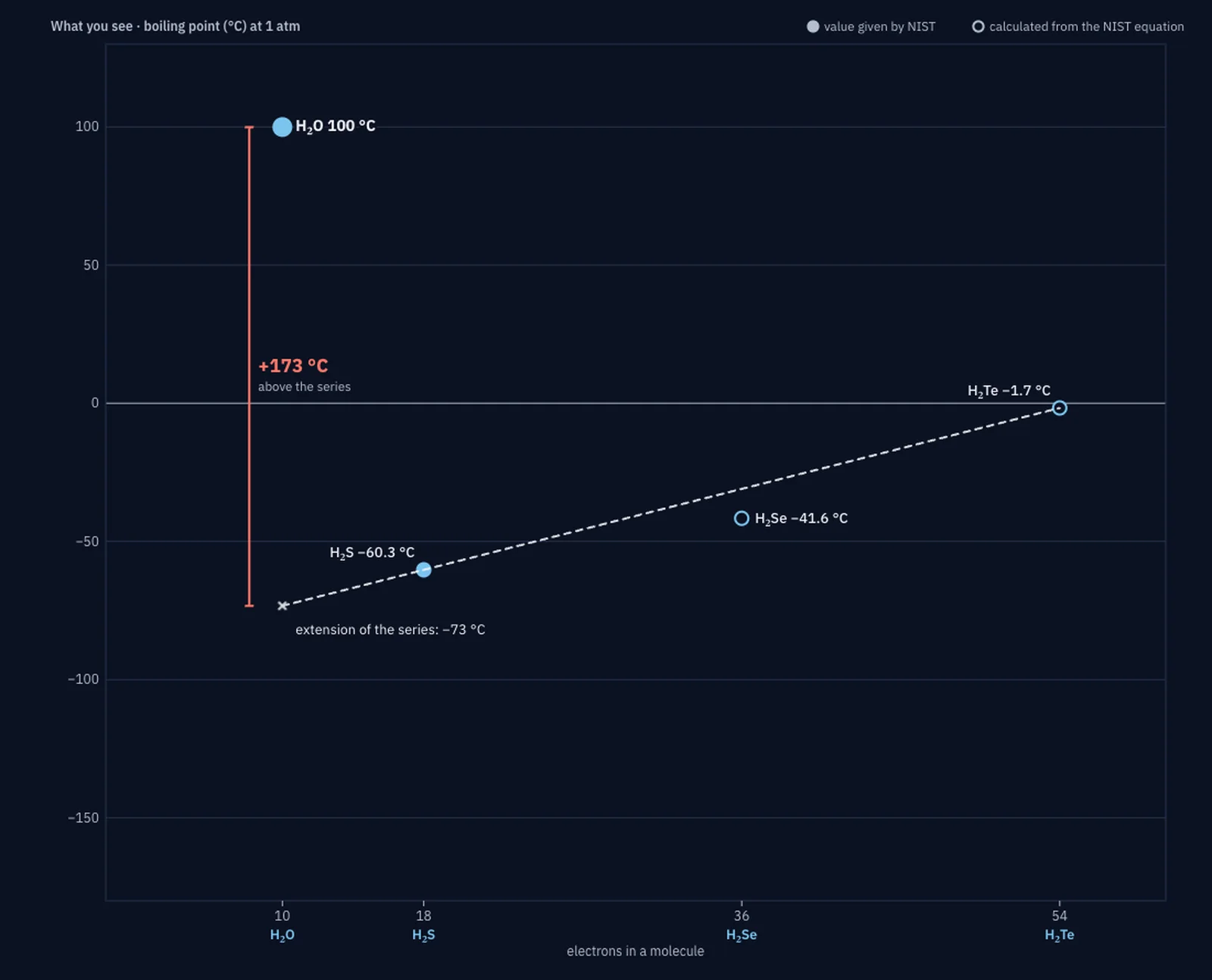
H₂S, H₂Se and H₂Te boil higher and higher, along an almost straight line
The number of electrons in the molecule runs along the horizontal axis; the temperature at which the substance boils at normal pressure runs up the vertical axis. H₂S boils at −60.3 °C, H₂Se at −41.6 °C and H₂Te at −1.7 °C. In this series, the more electrons a molecule has, the stronger the London forces between the molecules.
Water has only 10 electrons, fewer than any of them. Where should it boil, if it followed the series? Drag the point on the H₂O column or choose a zone.
Water boils at 100 °C, which is 173 °C above the extension of the series
The dashed line is a calculation: it joins H₂S and H₂Te and continues down to 10 electrons. The slope is about 1.63 °C per electron, and water has eight electrons fewer than H₂S, so the line gives −73 °C.
The measured value is 100 °C. The difference is 100 − (−73) = 173 °C, almost three times the whole range covered by the three hydrides. The white bar on the graph is your choice, if you made one.
Water does not follow the series. The reason lies in the way the molecules hold on to one another.
Water molecules hold on to one another through hydrogen bonds
A hydrogen bonded to oxygen carries a partial positive charge (δ+), and the neighbouring oxygen has lone pairs with a partial negative charge (δ−). The hydrogen attracts the pair: this is the hydrogen bond, written O–H···O and drawn with dots. The O–H bond inside the molecule is drawn as a line.
The average energy of an O–H bond is about 464 kJ/mol, that of a hydrogen bond about 20 kJ/mol, about 23 times weaker. When water boils, the attractions between molecules break; the molecules stay whole, and the vapour is still H₂O.
Ammonia and hydrogen fluoride stand out from the series like water; methane does not
The same calculation, for three more groups: the line passes through the lightest and the heaviest hydride of period three or higher and is extended down to ten electrons.
NH₃ boils at −33.3 °C, 65 °C above its line, and HF at 19.5 °C, 116 °C above. In both, the hydrogen is bonded to a very electronegative atom (nitrogen, fluorine) and hydrogen bonds form.
CH₄ boils at −161.5 °C, 40 °C below the SiH₄–GeH₄ line. The hydrogen in methane is bonded to carbon, so only London forces act between the molecules. The line is a simple model, and the point for methane falls below it.
The extension of the series predicts −73 °C for water: a gas at 20 °C
A substance that boils below 20 °C, at normal pressure, is a gas at room temperature. H₂S, at −60.3 °C, is a gas. On the extension of the series, water would boil at −73 °C.
So the extension predicts a gas at 20 °C. Measured, with its hydrogen bonds, water is liquid between 0 °C and 100 °C, at 1 atm. The extension is a simple calculation, not a measurement; it shows how much the attractions between molecules matter.
In ice, the same bonds make an open network: 0.917 g/cm³
At 0 °C, ice has a density of 0.917 g/cm³ and liquid water 0.9998 g/cm³. The same mass takes up about 9% more volume as ice: 100 g of ice take up 109 cm³, while 100 g of liquid water take up 100 cm³.
In ice, hydrogen bonds hold the molecules in rings of six, with empty space in the middle. In liquid water, the bonds break and re-form all the time, and the molecules come closer. That is why ice floats. The diagram shows a single ring, in one plane.
Now you explain: ethanol or dimethyl ether?
Ethanol and dimethyl ether have the same formula, C₂H₆O. Which boils higher? Look at where the hydrogens sit in each molecule.
Lesson on the hydrogen bond, with the worked example of ethanol and the ether
Lesson on boiling points and solubility