Chapter 6 · Ionic and metallic bondsLesson 6.4MI Mathematics–informatics (2 hours) · beyond your profile
Properties of ionic substances: state of matter, melting point, variation of melting points for: - sodium fluoride, sodium chloride - sodium fluoride, potassium fluoride - sodium fluoride, magnesium oxide - sodium fluoride, magnesium fluoride, aluminium fluoride
Why magnesium oxide melts above 2,800 °C and salt at 801 °C
Table salt melts at 801 °C, while magnesium oxide melts only above 2,800 °C. What makes their ions hold together so strongly?
Before you read: what do you think?
Sodium fluoride, NaF, melts at 996 °C. Magnesium oxide, MgO, has ions with twice the charge: Mg²⁺ and O²⁻. How much higher is the melting point of MgO than that of NaF?
See the answer
MgO melts at 2,832 °C, which is 1,836 °C higher than NaF. The attraction between ions increases with the product of their charges: for MgO the product is four times that for NaF.
An industrial electrolysis cell for aluminium operates at about 960 °C. The alumina used to make the metal would melt only at 2,054 °C, while table salt melts at 801 °C. These differences come from the ions: their charges and the distances between them.
Five melting pointsWhat you see
The five ionic substances compared here are solids at room temperature. The melting points below come from the NIST-JANAF tables, at a pressure of 0.1 MPa (1 bar), converted from kelvin to degrees Celsius using t = T − 273.
In ascending order: NaCl 801 °C, KF 858 °C, NaF 996 °C, MgF₂ 1,263 °C, MgO 2,832 °C.
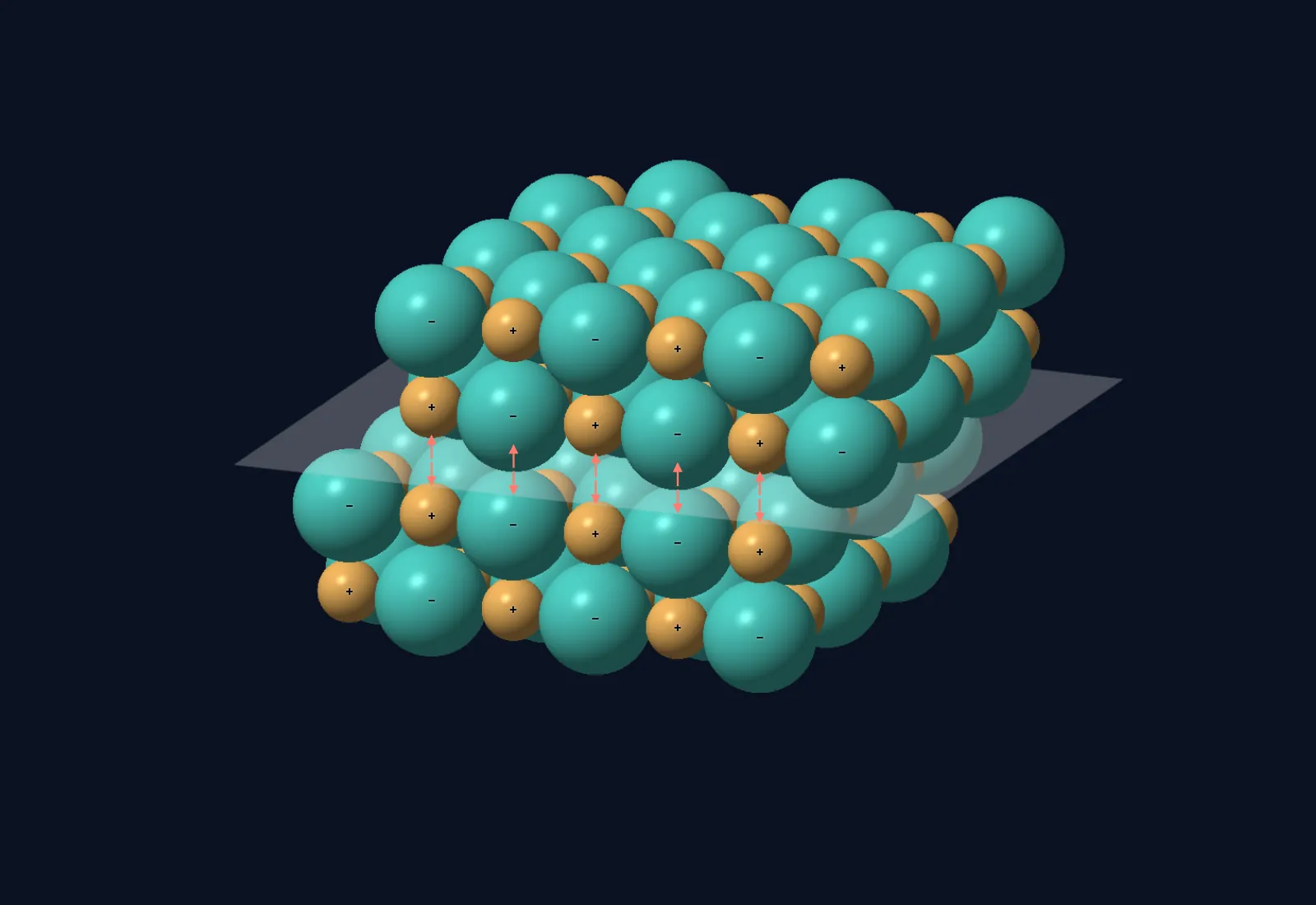
The temperatures are high because each ion is attracted to many oppositely charged ions in the lattice. On melting, the lattice order breaks down, but the ions keep their charges and remain in contact; that is why melts conduct electricity.
Other tables give slightly different values: NaF also appears at 993 °C, while MgO appears at 2,825 °C and 2,852 °C. These differences are small compared with those between substances, so the order stays the same.
For the curious
Subtracting 273 is the classroom approximation. The exact relation is t/°C = T/K − 273.15; with it NaCl (1,073.8 K) gives 800.65 °C, still 801 °C to the nearest whole number.
What matters: charge and distance between ionsWhat the particles do
To melt an ionic crystal, the attraction between ions must be weakened. This attraction increases with the charges of the ions and decreases with the distance between them. The distance between two touching ions is the sum of their radii, and ion radii increase down a group.
The effective ionic radii (Shannon, coordination 6) are: Na⁺ 102 pm, K⁺ 138 pm, Mg²⁺ 72 pm, Al³⁺ 53.5 pm, F⁻ 133 pm, Cl⁻ 181 pm, O²⁻ 140 pm, so the distances between touching ions are NaCl 283 pm, KF 271 pm, NaF 235 pm, MgO 212 pm.
NaF and NaCl have the same charges, 1+ and 1−. The F⁻ ion is smaller than Cl⁻ because fluorine is above chlorine in group 17. The distance between ions is smaller in NaF, the attraction is stronger, and NaF melts at a higher temperature: 996 °C compared with 801 °C.
NaF and KF have the same anion. The K⁺ ion is larger than Na⁺ because potassium is below sodium in group 1. In KF the distance is greater and melting occurs at a lower temperature: 858 °C compared with 996 °C.
In MgO, the Mg²⁺ and O²⁻ ions have twice the charge of Na⁺ and F⁻, so the product of the charges is four times as large. Lattice energy shows the effect: 3,900 kJ/mol for MgO, compared with 1,023 kJ/mol for LiF, which also has 1+ and 1− ions, at nearly equal distances between ions (LiF: 76 + 133 = 209 pm, with Li⁺ 76 pm; MgO: 72 + 140 = 212 pm). MgO melts at 2,832 °C, which is 1,836 °C above NaF.
For the curious
The effect of distance also shows at the same charge: the lattice energy is 2,957 kJ/mol for MgF₂ and 2,327 kJ/mol for MgI₂, with F⁻ smaller than I⁻. The force between two point charges is proportional to the product of the charges and inversely proportional to the square of the distance (Coulomb’s law); a real crystal sums the attractions and repulsions between many ions, so the law gives a trend, not a formula for melting point.
NaF, MgF₂, AlF₃: the trend and the detail
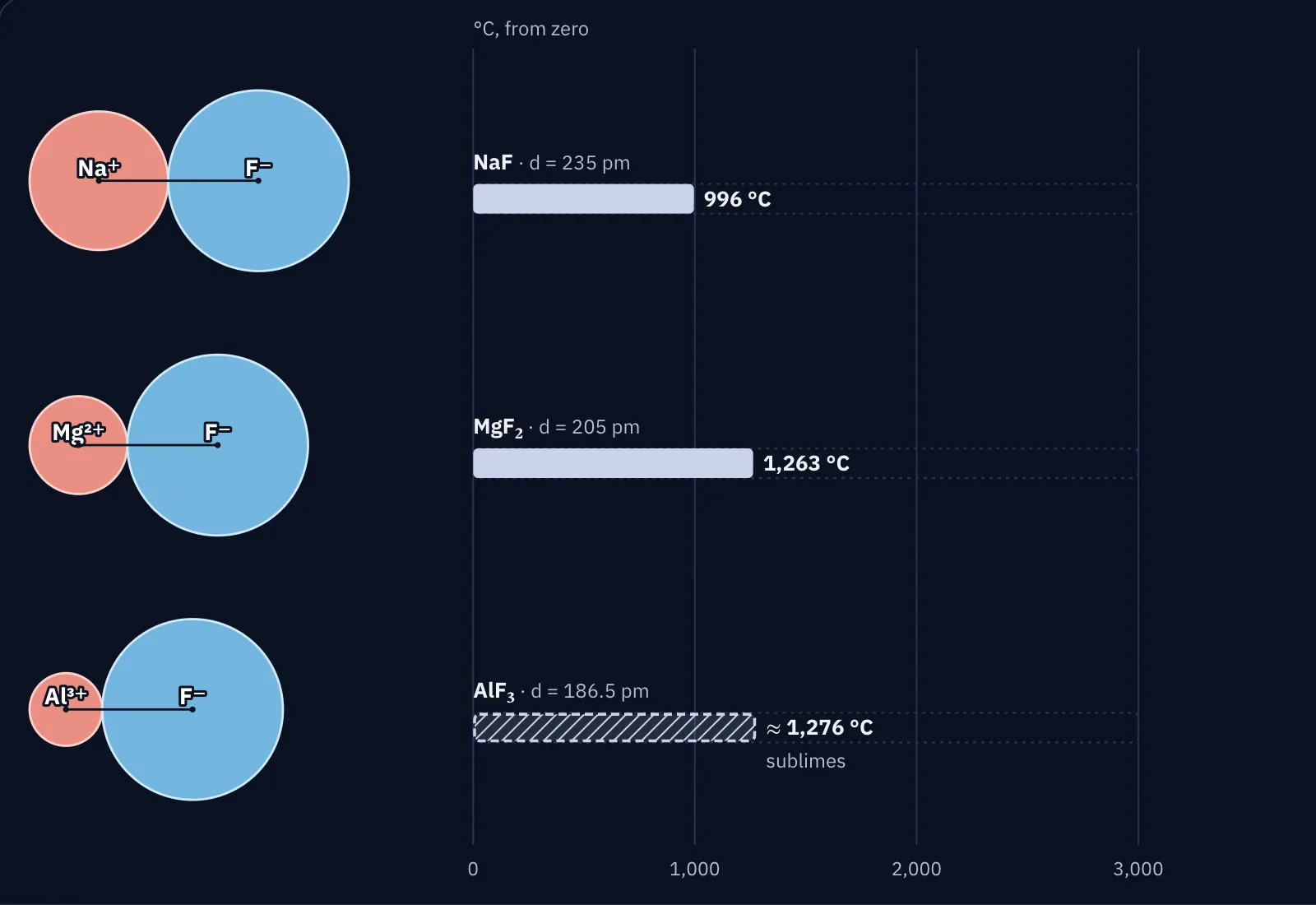
In this series the anion is the same, F⁻, while the cation charge increases: Na⁺ (1+), Mg²⁺ (2+), Al³⁺ (3+). The temperatures rise in the same order: NaF 996 °C, MgF₂ 1,263 °C, and about 1,276 °C is given for AlF₃. The trend: NaF < MgF₂ < AlF₃.
The detail: AlF₃ sublimes at normal pressure, passing directly from solid to gas without becoming liquid. The CRC Handbook, 81st edition, cited in a European Chemicals Agency dossier, gives 1,276 °C for sublimation; other sources list 1,290–1,291 °C as a melting point. The number for AlF₃ does not measure the same change as for the other four substances, so its place in the ranking is less certain. The firm conclusion is the trend: the greater the cation charge, the stronger the attraction in the lattice and the higher the temperature at which the lattice breaks down.
| Substance | Cation (radius) | Anion (radius) | Charges | Distance between centres | T (K) | t (°C) | Note |
|---|---|---|---|---|---|---|---|
| NaF (sodium fluoride) | Na⁺ 102 pm | F⁻ 133 pm | 1+ and 1− | 235 pm | 1,269 | 996 | melts |
| NaCl (sodium chloride) | Na⁺ 102 pm | Cl⁻ 181 pm | 1+ and 1− | 283 pm | 1,073.8 | 801 | melts |
| KF (potassium fluoride) | K⁺ 138 pm | F⁻ 133 pm | 1+ and 1− | 271 pm | 1,131 | 858 | melts |
| MgF₂ (magnesium fluoride) | Mg²⁺ 72 pm | F⁻ 133 pm | 2+ and 1− | 205 pm | 1,536 | 1,263 | melts |
| MgO (magnesium oxide) | Mg²⁺ 72 pm | O²⁻ 140 pm | 2+ and 2− | 212 pm | 3,105 | 2,832 | melts |
| AlF₃ (aluminium fluoride) | Al³⁺ 53.5 pm | F⁻ 133 pm | 3+ and 1− | 186.5 pm | — | ≈ 1,276 | sublimes; not a melting point |
| Pair | What changes | Values |
|---|---|---|
| NaF · NaCl | Same cation, different anion: F⁻ or Cl⁻. | NaCl 801 °C < NaF 996 °C |
| NaF · KF | Same anion, different cation: Na⁺ or K⁺. | KF 858 °C < NaF 996 °C |
| NaF · MgO | Ion charges: 1+ and 1−, against 2+ and 2−. | NaF 996 °C < MgO 2,832 °C |
| NaF · MgF₂ · AlF₃ | Same anion, F⁻; charge of the cation: 1+, 2+, 3+. | NaF 996 °C < MgF₂ 1,263 °C < AlF₃ ≈ 1,276 °C (sublimation) |
Measurements and diagram. The melting points are measured, from the NIST-JANAF tables at 1 bar (t = T − 273, as in the lesson); for AlF₃ the value of about 1,276 °C is a sublimation, with a dotted bar, not a melting. The ions are drawn to scale from the Shannon effective ionic radii (coordination number 6), and the distance between the centres is the sum of the radii, calculated; for MgF₂ and AlF₃ only one cation and one F⁻ anion are drawn, although the formulas have two and three F⁻ ions. Atoms and ions have no colour: they are drawn hugely enlarged and far fewer than in a crystal. The bars start at zero and have the same scale in all the pairs.
Sources and credits. Melting points: NIST-JANAF Thermochemical Tables (source and the pages for NaCl, KF, MgF₂, MgO), work of the US government, public domain; queried on 16.11.2026. Sublimation of AlF₃: CRC Handbook of Chemistry and Physics, 81st edition, cited in the ECHA dossier at source. Effective ionic radii: R. D. Shannon, Acta Cryst. A32, 751 (1976), the table at source; the numbers are measured facts, cited at the source.
Worked example
From kelvin to degrees Celsius and from data to explanation
The NIST-JANAF table gives NaF 1,269 K, KF 1,131 K and NaCl 1,073.8 K. Put the substances in order and explain the differences between pairs.
Conversion, using t = T − 273: NaF 1,269 − 273 = 996 °C; KF 1,131 − 273 = 858 °C; NaCl 1,073.8 − 273 ≈ 801 °C.
Ascending order: NaCl < KF < NaF.
Differences: NaF − NaCl = 996 − 801 = 195 °C. Same charge, smaller anion in NaF: F⁻ compared with Cl⁻.
NaF − KF = 996 − 858 = 138 °C. Same anion, smaller cation in NaF: Na⁺ compared with K⁺.
Check: in both pairs the substance that melts at the higher temperature has smaller ions, so the distance is shorter and the attraction stronger.
In Romania
Cryolite in the Slatina plant
At the ALRO aluminium plant in Slatina, primary aluminium is made by electrolysis of alumina, Al₂O₃. Alumina melts at 2,054 °C (2,327 K), too high for an ordinary furnace. The Hall–Héroult process dissolves it in a bath of molten cryolite, Na₃AlF₆, which melts at 1,012 °C (1,285 K). Additions of AlF₃ and CaF₂ lower the bath temperature to 920–970 °C, and the cells operate at around 960 °C.
The bath of molten ionic salts conducts electricity because the ions are mobile. Because of the price of electricity, the company says it uses only about 30% of its electrolysis capacity.
In short
- The attraction between ions increases with their charges and decreases with the distance between them; the melting point follows this attraction.
- NaF (996 °C) melts at a higher temperature than NaCl (801 °C): F⁻ is smaller than Cl⁻. NaF melts at a higher temperature than KF (858 °C): Na⁺ is smaller than K⁺.
- MgO (2,832 °C) melts 1,836 °C above NaF: the 2+ and 2− charges give a product of charges four times as large.
- The order NaF < MgF₂ < AlF₃ follows the cation charge (1+, 2+, 3+), but AlF₃ sublimes at about 1,276 °C; it does not melt at normal pressure.
- The values are from NIST-JANAF, at 1 bar; other tables give slightly different values.
Common mistakes
WrongThe melting point of an ionic compound depends only on the charge of the cation.
RightThe charges of both ions and the distance between them matter. NaF and NaCl have the same charges, but melt at 996 °C and 801 °C because their radii differ.
WrongAlF₃ melts at 1,290 °C, like any salt, so it goes straight into the ranking.
RightAt normal pressure AlF₃ sublimes at about 1,276 °C. This number is not a melting point comparable with those of the other salts.
WrongAn ionic substance melts when the bonds between atoms in a molecule break.
RightIonic compounds do not contain molecules. On melting, the attraction between ions weakens and the ions lose their fixed positions in the lattice.
Test yourself
7 questions. For the first 6 you see the explanation at once, with the paragraph of the lesson that supports it; for the written ones you compare with a good answer.
Why does NaF melt at a higher temperature than NaCl?
Answer
c) Because the F⁻ ion is smaller than Cl⁻, so the attraction between ions is stronger. The charges are the same, 1+ and 1−. The distance between ions is smaller in NaF, so the attraction is stronger.
What is the main explanation for the very high melting point of MgO?
Answer
b) The Mg²⁺ and O²⁻ ions have twice the charge, so the product of the charges is four times as large. Attraction increases with the charges of the ions; for MgO the product of the charges is 2 · 2 = 4, for NaF it is 1 · 1 = 1.
What happens to AlF₃ at normal pressure when it is heated towards 1,276 °C?
Answer
d) It sublimes, passing directly from solid to gas. AlF₃ does not become liquid at normal pressure; the temperature given is not a melting point.
According to the NIST-JANAF tables, magnesium oxide melts at 3,105 K. What is its melting point in °C, using t = T − 273?
°CAnswer
2,832 °C. 3,105 − 273 = 2,832 °C.
How many degrees Celsius higher is the melting point of NaF than that of KF? Use 996 °C and 858 °C.
°CAnswer
138 °C. 996 − 858 = 138 °C. The Na⁺ ion is smaller than K⁺, so the attraction in NaF is stronger.
Put the substances in ascending order of melting point.
Answer
The correct order:
- NaCl (801 °C)
- KF (858 °C)
- NaF (996 °C)
- MgF₂ (1,263 °C)
- MgO (2,832 °C)
The order follows the distance between ions (NaCl, KF, NaF) and then the charges (MgF₂, MgO).
Without a table, predict which melts at a higher temperature, CaO or NaF, and justify your answer in two or three sentences. Say what you would check in a table before stating a number.
A good answer
CaO, because the Ca²⁺ and O²⁻ ions have twice the charge of Na⁺ and F⁻, so the attraction between ions is much stronger, even if the distances differ slightly. The rule gives a trend; exact temperatures are read from a table, with the source and pressure stated, because tables differ.
A complete answer uses the ion charges, mentions distance and says that the rule is a trend, not a formula for calculation.
Terms
- melting point
- The temperature at which a solid becomes liquid, at a given pressure.
- lattice energy
- The energy needed to separate one mole of an ionic solid into gaseous ions.
- ionic radius
- The size of an ion, used to calculate the distance between neighbouring ions in a crystal.
- sublimation
- The direct change of a solid into a gas without becoming liquid.
- cryolite
- A double fluoride of sodium and aluminium, Na₃AlF₆, in which alumina is dissolved to make aluminium.
Sources and link to the programme
- NIST-JANAF Thermochemical Tables – NaCl (cr,l) – NaCl: crystal–liquid transition at 1,073.8 K, at 0.1 MPa
- NIST-JANAF Thermochemical Tables – NaF (cr,l) – NaF: crystal–liquid transition at 1,269 K
- NIST-JANAF Thermochemical Tables – KF (cr,l) – KF: crystal–liquid transition at 1,131 K
- NIST-JANAF Thermochemical Tables – MgF₂ (cr,l) – MgF₂: crystal–liquid transition at 1,536 K
- NIST-JANAF Thermochemical Tables – MgO (cr,l) – MgO: crystal–liquid transition at 3,105 K
- NIST-JANAF Thermochemical Tables – Na₃AlF₆, criolit (cr,l) – cryolite: melting at 1,285 K
- NIST-JANAF Thermochemical Tables – Al₂O₃ (cr,l) – alumina: melting at 2,327 K
- OpenStax – Chemistry 2e, 7.5 Strengths of Ionic and Covalent Bonds – lattice energy increases with charge and decreases with distance between ions: LiF 1,023 kJ/mol, MgO 3,900 kJ/mol, MgF₂ 2,957 kJ/mol, MgI₂ 2,327 kJ/mol
- Wikipedia – Ionic radius (tabelul razelor ionice efective Shannon, 1976) – effective ionic radii at coordination 6, with O²⁻ radius = 140 pm: Li⁺ 76, Na⁺ 102, K⁺ 138, Mg²⁺ 72, Al³⁺ 53.5, F⁻ 133, Cl⁻ 181, O²⁻ 140 pm
- NIST – Guide for the Use of the International System of Units, Appendix B.9 (conversia exactă kelvin–grade Celsius) – t/°C = T/K − 273.15; subtracting 273 is an approximation
- OpenStax – Chemistry 2e, 6.5 Periodic Variations in Element Properties – radii of ions with the same sign increase down a group
- ENFO – Aluminium fluoride (dosar de înregistrare ECHA) – AlF₃: sublimation at 1,276 °C according to CRC Handbook (81st ed.); other sources give 1,291 °C as a melting point
- PubChem – Sodium fluoride (temperatura de topire) – other database values: NaF 993–996 °C
- PubChem – Magnesium oxide (temperatura de topire) – other database values: MgO 2,800–2,825 °C
- J. Braz. Chem. Soc. – Studies on the Hall-Heroult aluminum electrowinning process – electrolysis cell at 960 °C; cryolite melted at 1,011 °C, lowered to 920–970 °C with AlF₃ and CaF₂
- ALRO – Value chain – electrolysis plant at Slatina; use of about 30% of electrolysis capacity because of the price of energy
- ALRO – Sustainability Report 2024 – ALRO primary aluminium division: anode, electrolysis and foundry plants; primary aluminium production by electrolysis of alumina
From the programme: “Properties of ionic substances: state of matter, melting point, variation of melting points for: - sodium fluoride, sodium chloride - sodium fluoride, potassium fluoride - sodium fluoride, magnesium oxide - sodium fluoride, magnesium fluoride, aluminium fluoride” (MI: Mathematics–informatics (2 hours)). Specific competences followed: 2.4, 5.3, 5.4.