Chapter 12 · Chemistry problemsLesson 12.1TC Core curriculum (1 hour a week) · beyond your profile
Stoichiometric calculations will be carried out using the chemical formula and the equation of a chemical reaction, with purity, yield, excess of a reactant, percentage concentration by mass and molar concentration of solutions
How much limestone reacts and how much product do you get?
A piece of limestone weighs 500 g. How many grams of lime can you get from it?
Before you read: what do you think?
Limestone has a purity of 80%, and the process has a yield of 90%. What fraction of the product from pure limestone of the same mass do you get?
See the answer
You get 72%. The percentages apply one after the other, each to the amount left from the previous step, so they are multiplied. Subtraction or averaging gives the wrong result.
A 500 g piece of limestone looks like one material, but part of its mass is clay, sand and other minerals rather than calcium carbonate. Only the carbonate reacts. And some of what can react is lost along the way, in the kiln, during cooling or during weighing.
Quarried limestone is not pure calcium carbonate
Limestone contains calcium carbonate, CaCO₃, mixed with clay, sand and other minerals. Only CaCO₃ enters the calculation from the equation; the rest is called impurities. Purity p is the mass of pure substance in 100 g of sample:
p = mpure · 100 ÷ msample
The same formula gives the pure mass: mpure = msample · p ÷ 100. Limestone of 80% purity contains 80 g of CaCO₃ in every 100 g of rock: mpure = 100 · 80 ÷ 100 = 80 g. The 20 g of impurities appear in no equation.
The basic rule: apply purity before the equation. Problems state, or ask you to assume, that the impurities do not react in that reaction. For rock salt, limestone or ores, purity shows how much of the rock is useful substance; the rest is rock with no value for that reaction. A batch may be sold as “limestone” or “salt” even with 10% impurities; that is why problems give purity separately.
For the curious
A product is often made in several stages, and the yield of each stage applies to what remains from the previous one. With yields of 90% and 80%, the overall yield is 90 · 80 ÷ 100 = 72% of the theoretical amount of final product, calculated stoichiometrically from the initial reactant.
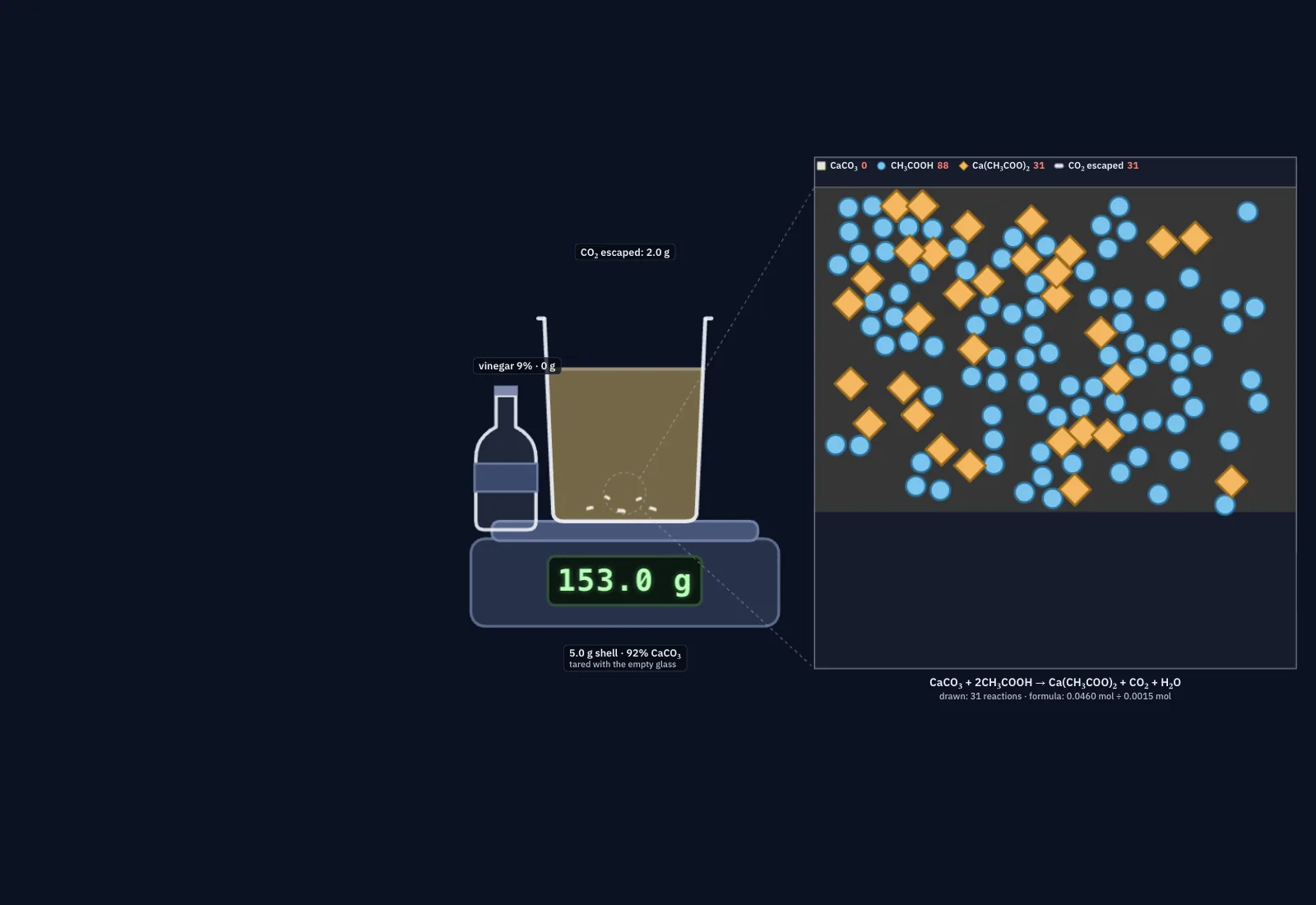
| Vinegar poured (g) | Balance (g) | CO₂ escaped (g) | Limiting reactant | Acetic acid left (mol) | Reactions drawn |
|---|---|---|---|---|---|
| 0 | 5.0 | 0.0 | — | 0.000 | 0 |
| 10 | 14.7 | 0.3 | the acid | 0.000 | 5 |
| 20 | 24.3 | 0.7 | the acid | 0.000 | 10 |
| 30 | 34.0 | 1.0 | the acid | 0.000 | 15 |
| 40 | 43.7 | 1.3 | the acid | 0.000 | 20 |
| 50 | 53.4 | 1.6 | the acid | 0.000 | 25 |
| 60 | 63.0 | 2.0 | the acid | 0.000 | 30 |
| 70 | 73.0 | 2.0 | the shell | 0.013 | 31 |
| 100 | 103.0 | 2.0 | the shell | 0.058 | 31 |
| 150 | 153.0 | 2.0 | the shell | 0.133 | 31 |
| Shell (g) | CaCO₃ in the shell | CO₂ escaped with 150 g of vinegar (g) | Balance (g) |
|---|---|---|---|
| 2 | 92% | 0.8 | 151.2 |
| 5 | 92% | 2.0 | 153.0 |
| 10 | 92% | 4.0 | 156.0 |
| 5 | 95% | 2.1 | 152.9 |
| 5 | 100% | 2.2 | 152.8 |
Shell of 5.0 g with 92% CaCO₃ (4.6 g, 0.046 mol) and vinegar with 9% acetic acid by mass (the assumption of the exercise). Calculated; the balance is tared with the empty glass. The equation: CaCO₃ + 2CH₃COOH → Ca(CH₃COO)₂ + CO₂ + H₂O. One drawn particle stands for 0.0015 mol.
Calculation. An exact calculation from the atomic masses of the book, for 5 g of shell with 92% CaCO₃ (the white shells analysed in the cited study had 91%, the brown ones 95%; the literature cited by the study gives 92–97%) and vinegar with 9% acetic acid by mass, the assumption of the exercise: labels in Romania say “9%” or “9 degrees”. The rest of the shell does not react in the calculation. The balance is tared with the empty glass. The drop on a real balance can be smaller than the calculated one, because some of the CO₂ stays dissolved in the liquid. Atoms and molecules have no colour: they are drawn enormously enlarged and far fewer than in reality, one particle for every 0.0015 mol; the water in the vinegar is not drawn.
Sources and credits. Strength of the vinegar: the Carrefour România product title, “Oțet 9% 1 L Vinalcool”, and the Auchan România page, “Oțet de Bistrița, 9 grade, 1 L” (read on 2026-11-16); the mass basis of the 9% is the assumption of the exercise. CaCO₃ content of the shell: values quoted from C. O. Ogah, K. U. Nwaeze, O. O. Adetifa, Journal of Basic and Social Pharmacy Research 2(2), 27–34 (2021): 91% for the white shells and 95% for the brown ones they analysed, 92–97% in the literature they cite. Atomic masses: CIAAW, the rounded values of the book.
Why you never get everything the equation predicts
The equation gives the theoretical amount of product, the amount that would form if all the reactant became the desired product. At the end of a reaction, the actual amount is weighed; it is usually smaller. Yield η is their ratio:
η = mactual · 100 ÷ m_theoretical
Yield falls for three reasons: the reaction is reversible and stops at equilibrium, with reactants left over; some product is lost during separation, filtration or transfer; some reactants form other products in side reactions. A yield above 100% points to a calculation error or a product that is still wet or impure.
Ammonia synthesis, N₂ + 3H₂ ⇌ 2NH₃, is reversible: in a single pass through the reactor, about 15% of the gas mixture forms ammonia. The ammonia is separated by cooling, and the remaining gases return to the reactor, pass after pass. The yield of one pass and the yield of the whole process are two different numbers.
From the definition, mactual = m_theoretical · η ÷ 100.
The order of steps when a problem has both purity and yield
Forwards, from sample to product: (1) use purity to find the pure mass; (2) convert it to moles; (3) use the equation to find the moles of product and its theoretical mass; (4) use yield to find the actual mass.
In reverse, from the desired product mass to the sample required, the steps run backwards: (1) use the actual mass to find the theoretical mass, m_theoretical = mactual · 100 ÷ η; (2) convert it to moles of product and, using the equation, to moles of reactant; (3) find the pure mass of reactant; (4) use purity to find the sample mass, msample = mpure · 100 ÷ p. In the reverse problem, purity and yield make the required sample heavier than the pure mass: if you got a smaller mass, you multiplied instead of dividing.
The percentages are neither added nor subtracted. A purity of 80% and a yield of 90% give 80 · 90 ÷ 100 = 72% of the theoretical product from a pure sample of the same mass.
Worked example
80% pure limestone, 90% yield
In a lime kiln, limestone decomposes: CaCO₃ → CaO + CO₂. From 500 g of limestone with a purity of 80%, quicklime, CaO, is obtained at a yield of 90%. What mass of CaO is obtained?
Pure mass: mpure = 500 · 80 ÷ 100 = 400 g CaCO₃.
Moles: M(CaCO₃) = 40 + 12 + 3 · 16 = 100 g/mol, so n = 400 ÷ 100 = 4 mol.
The equation gives one mole of CaO for one mole of CaCO₃, so 4 moles of CaO form in theory. M(CaO) = 40 + 16 = 56 g/mol, and m_theoretical = 4 · 56 = 224 g.
Yield: mactual = 224 · 90 ÷ 100 = 201.6 g.
Check: 500 g of pure limestone would theoretically give 500 · 56 ÷ 100 = 280 g of CaO. Purity and yield leave 72% of that: 280 · 72 ÷ 100 = 201.6 g. Answer: 201.6 g of CaO.
In Romania
Rock salt from Slănic
The rock salt deposit at Slănic Prahova is over 90% halite, NaCl; the rest is anhydrite, gypsum, other salts and clay minerals. A 1,000 kg batch of rock salt with a purity of 90% contains mpure = 1,000 · 90 ÷ 100 = 900 kg of NaCl and 100 kg of other minerals.
If brine is prepared from such a batch, the calculation starts with the 900 kg of NaCl, not the 1,000 kg. Another batch, with a purity of 94%, would give 1,000 · 94 ÷ 100 = 940 kg.
In short
- Purity is the mass of pure substance in 100 g of sample: p = mpure · 100 ÷ msample; only the pure mass enters the equation.
- Yield is the ratio of the actual mass to the theoretical mass of the same product: η = mactual · 100 ÷ m_theoretical.
- Yield is below 100% because of reversible reactions, losses during separation and side reactions.
- The forward problem: sample mass, then pure mass, moles, equation, theoretical mass, actual mass.
- The reverse problem runs backwards: m_theoretical = mactual · 100 ÷ η and msample = mpure · 100 ÷ p; the required sample is heavier than the pure mass.
- Multiply purity and yield: 80% and 90% give 72%.
Common mistakes
WrongIf purity is 80% and yield is 90%, 20% + 10% = 30% is lost.
RightYield applies to what remains after purity: 0.80 · 0.90 = 0.72, or 72% of the product from pure limestone of the same mass.
WrongThe mass of limestone goes straight into the equation.
RightOnly CaCO₃ reacts. First calculate the pure mass, mpure = msample · p ÷ 100, then convert it to moles.
WrongA yield of 110% means the reaction created substance.
RightTotal mass is conserved. A yield above 100% points to a wet or impure product or a calculation error.
Test yourself
8 questions. For the first 7 you see the explanation at once, with the paragraph of the lesson that supports it; for the written ones you compare with a good answer.
What does a purity of p = 92% mean?
Answer
a) 92 g of pure substance in 100 g of sample. Purity refers to the mass of the sample, not the mass of impurities.
For limestone of 80% purity, what mass is converted to moles to use the equation CaCO₃ → CaO + CO₂?
Answer
c) The pure mass of CaCO₃, calculated from purity. Only the pure substance appears in the equation; the impurities do not react.
A reaction theoretically produces 20 g of product, and 15 g is weighed at the end. What is the yield?
Answer
b) 75%. η = 15 · 100 ÷ 20 = 75%. The actual mass is compared with the theoretical mass.
Which reason does NOT explain a yield below 100%?
Answer
d) Mass is lost because the conservation law does not apply to incomplete reactions. Total mass is always conserved; yield falls because less of the desired product forms or is recovered.
A 40 g sample of rock salt contains 12 g of impurities. What is the purity of the sample, as a percentage?
%Answer
70 %. The pure mass is 40 − 12 = 28 g, and p = 28 · 100 ÷ 40 = 70%. The denominator is the sample mass, not the mass of pure substance.
What mass of limestone of 80% purity must decompose (CaCO₃ → CaO + CO₂) to give 112 g of CaO at a yield of 80%? M(CaO) = 56 g/mol, M(CaCO₃) = 100 g/mol. Answer in grams.
gAnswer
312.5 g. m_theoretical = 112 · 100 ÷ 80 = 140 g of CaO, or 2.5 mol. The equation gives 2.5 moles of CaCO₃ = 250 g of pure mass. Sample: 250 · 100 ÷ 80 = 312.5 g.
Put the steps of the reverse problem in order: what mass of impure sample is needed to obtain a given mass of product?
Answer
The correct order:
- Find the theoretical mass from the actual mass of product and the yield
- Convert the theoretical mass of product to moles
- Use the ratio from the equation to find the moles of reactant
- Convert the moles of reactant to pure mass
- Find the sample mass from the pure mass and the purity
The steps run in the opposite direction to the forward problem: from product to reactant, then from pure substance to impure sample.
A classmate calculated the mass of CaO obtained from 1,000 g of limestone of 80% purity (CaCO₃ → CaO + CO₂) and put the whole mass of limestone, 1,000 g, into the equation. What was the mistake, and in which direction will the result be wrong?
A good answer
The calculation included the mass of the impurities, which do not react. First the pure mass should be found using the purity: 80% of 1,000 g is 800 g of CaCO₃. The result is too high because it assigns product to the impurities as well.
A complete answer says that impurities do not enter the equation and that the incorrect result is higher than the correct one.
Terms
- purity
- The mass of pure substance in 100 g of sample, expressed as a percentage.
- impurities
- Foreign substances in a sample that do not take part in the reaction being studied.
- yield
- The ratio, as a percentage, of the actual amount to the theoretical amount of the same product.
- theoretical amount
- The amount of product the equation predicts if all the reactant is completely converted.
- actual amount
- The amount of product actually obtained and weighed at the end of the reaction.
- side reaction
- A reaction in which some reactants form substances other than the desired product.
Sources and link to the programme
- Revista Minelor – Exploitation below +193m elevation of the rock salt deposit from Slănic Prahova saline (2025) – rock salt at Slănic contains over 90% halite, NaCl, along with anhydrite, gypsum and clay minerals
- OpenStax – Chemistry 2e, 4.4 Reaction Yields – theoretical and percentage yield: the ratio of the amount obtained to the theoretical amount
- International Fertilizer Association – The Haber-Bosch Heritage: The Ammonia Production Technology (1997) – the amount of ammonia formed in a single pass over the catalyst is small, so unconverted gases are recirculated after ammonia is separated by condensation
- Wikipedia – Haber process – about 15% of the gases are converted to ammonia on each pass through the reactor
From the programme: “Stoichiometric calculations will be carried out using the chemical formula and the equation of a chemical reaction, with purity, yield, excess of a reactant, percentage concentration by mass and molar concentration of solutions” (TC: Core curriculum (1 hour a week)). Specific competences followed: 5.1.