Chapter 10 · Acids, bases, pHLesson 10.1TC Core curriculum (1 hour a week) · beyond your profile
Ionisation of strong monoprotic acids and strong monoprotic bases in aqueous solution; the ionic product of water
What water does to a strong acid and a strong base
The stomach produces hydrochloric acid, and shops sell drain-unblocking gel containing sodium hydroxide. What happens to them in water?
Before you read: what do you think?
Does pure water, with no dissolved substance, contain ions?
See the answer
At 25 °C, about two in every billion water molecules are ionised. One litre of pure water contains 10⁻⁷ mol of H₃O⁺ ions and the same amount of HO⁻ ions.
The stomach produces hydrochloric acid, and shop shelves carry drain-unblocking gel containing sodium hydroxide. The safety data sheet for one such gel classifies it as corrosive: “causes severe skin burns and eye damage”. The acid in the stomach and the base in the gel behave alike in water: they separate completely into ions.
A strong acid in water: every molecule gives up a proton
Hydrogen chloride, HCl, is made of molecules. When it dissolves in water, each HCl molecule gives up a proton to a water molecule. The proton does not remain free in solution: it is bound to water in the hydronium ion, H₃O⁺. A chloride ion, Cl⁻, also forms. The process is called ionisation.
HCl + H₂O → H₃O⁺ + Cl⁻
The reaction is complete: every dissolved HCl molecule reacts, so virtually no HCl molecules remain in solution. An acid that ionises completely in water is a strong acid. An acid that gives up one proton per molecule is monoprotic. Examples of strong monoprotic acids: HCl, HBr, HI and HNO₃.
HNO₃ + H₂O → H₃O⁺ + NO₃⁻
Square brackets, [ ], show the molar concentration of the particle inside them, in mol/L. For a strong monoprotic acid, [H₃O⁺] equals the acid concentration: in an HCl solution with c = 0.10 mol/L, [H₃O⁺] = [Cl⁻] = 0.10 mol/L. Sulfuric acid, H₂SO₄, is also a strong acid, but gives up two protons per molecule, so it is not monoprotic.
For the curious
Gastric juice is a solution of HCl. In an exercise in the OpenStax textbook, gastric juice has [H₃O⁺] = 1.2·10⁻³ mol/L.
A strong base in water: the HO⁻ ions were already in the crystal
Sodium hydroxide, NaOH, is an ionic compound: its crystal contains Na⁺ ions and hydroxide ions, HO⁻. As it dissolves, water separates the ions already present in the crystal from the lattice. The process is called dissociation, as when salt dissolves.
NaOH(s) → Na⁺(aq) + HO⁻(aq)
Dissociation is complete: a solution of NaOH contains Na⁺ and HO⁻ ions and no NaOH units. Potassium hydroxide, KOH, behaves in the same way: KOH(s) → K⁺(aq) + HO⁻(aq). Each formula unit gives one HO⁻ ion, so NaOH and KOH are strong bases with one HO⁻. The Romanian grade 9 chemistry programme calls them strong monoprotic bases, and some exercise books call them “monoacid bases”; all these terms mean the same thing: a base that releases one HO⁻ ion per formula unit.
In a NaOH solution with c = 0.10 mol/L, [HO⁻] = [Na⁺] = 0.10 mol/L. HO⁻ ions give the solution its basic character. Solutions of strong acids and strong bases contain mobile ions, so they conduct electricity, like salt solution.
Pure water has ions, but very few
Water molecules can exchange a proton: one molecule gives it up, another receives it. The reaction goes in both directions and is written with two arrows, unlike the complete ionisation of a strong acid.
2H₂O ⇌ H₃O⁺ + HO⁻
The phenomenon is called the autoionisation of water. At 25 °C, about two in every billion water molecules are ionised. One litre of pure water contains 10⁻⁷ mol of H₃O⁺ ions and the same amount of HO⁻ ions: [H₃O⁺] = [HO⁻] = 10⁻⁷ mol/L.
The ionic product of water: as one concentration rises, the other falls
The product of the two concentrations is constant at a given temperature. It is called the ionic product of water and is written Kw.
Kw = [H₃O⁺]·[HO⁻] = 10⁻¹⁴
The value 10⁻¹⁴ applies at 25 °C, with concentrations in mol/L, in pure water and in dilute aqueous solutions. When one concentration increases tenfold, the other falls tenfold.
In an acidic solution, [H₃O⁺] > 10⁻⁷ mol/L and [HO⁻] < 10⁻⁷ mol/L. In a neutral solution, [H₃O⁺] = [HO⁻] = 10⁻⁷ mol/L. In a basic solution, [HO⁻] > 10⁻⁷ mol/L and [H₃O⁺] < 10⁻⁷ mol/L. An acidic solution still contains HO⁻ ions, and a basic solution still contains H₃O⁺ ions, because water produces them in every solution.
For the curious
Kw increases with temperature. The OpenStax textbook gives Kw = 2.4·10⁻¹³ at 80 °C, giving [H₃O⁺] = [HO⁻] = 4.9·10⁻⁷ mol/L. Hot pure water remains neutral because the two concentrations are equal, but neutrality no longer means 10⁻⁷ mol/L.
Worked example
Ions in an HCl solution and a NaOH solution
One litre of solution contains 0.365 g of HCl; another litre contains 0.040 g of NaOH. What are [H₃O⁺] and [HO⁻] in each?
For HCl: M(HCl) = 1 + 35.5 = 36.5 g/mol, and n = 0.365 ÷ 36.5 = 0.010 mol. The concentration is 0.010 mol/L, so [H₃O⁺] = 10⁻² mol/L. From Kw: [HO⁻] = 10⁻¹⁴ ÷ 10⁻² = 10⁻¹² mol/L.
For NaOH: M(NaOH) = 23 + 16 + 1 = 40 g/mol, and n = 0.040 ÷ 40 = 0.0010 mol. The concentration is 0.0010 mol/L, so [HO⁻] = 10⁻³ mol/L. From Kw: [H₃O⁺] = 10⁻¹⁴ ÷ 10⁻³ = 10⁻¹¹ mol/L.
Check: in the HCl solution, 10⁻² · 10⁻¹² = 10⁻¹⁴, and [H₃O⁺] exceeds 10⁻⁷ mol/L, so the solution is acidic. In the NaOH solution, [HO⁻] exceeds 10⁻⁷ mol/L, so the solution is basic.
In Romania
The safety data sheet for a drain-unblocking gel
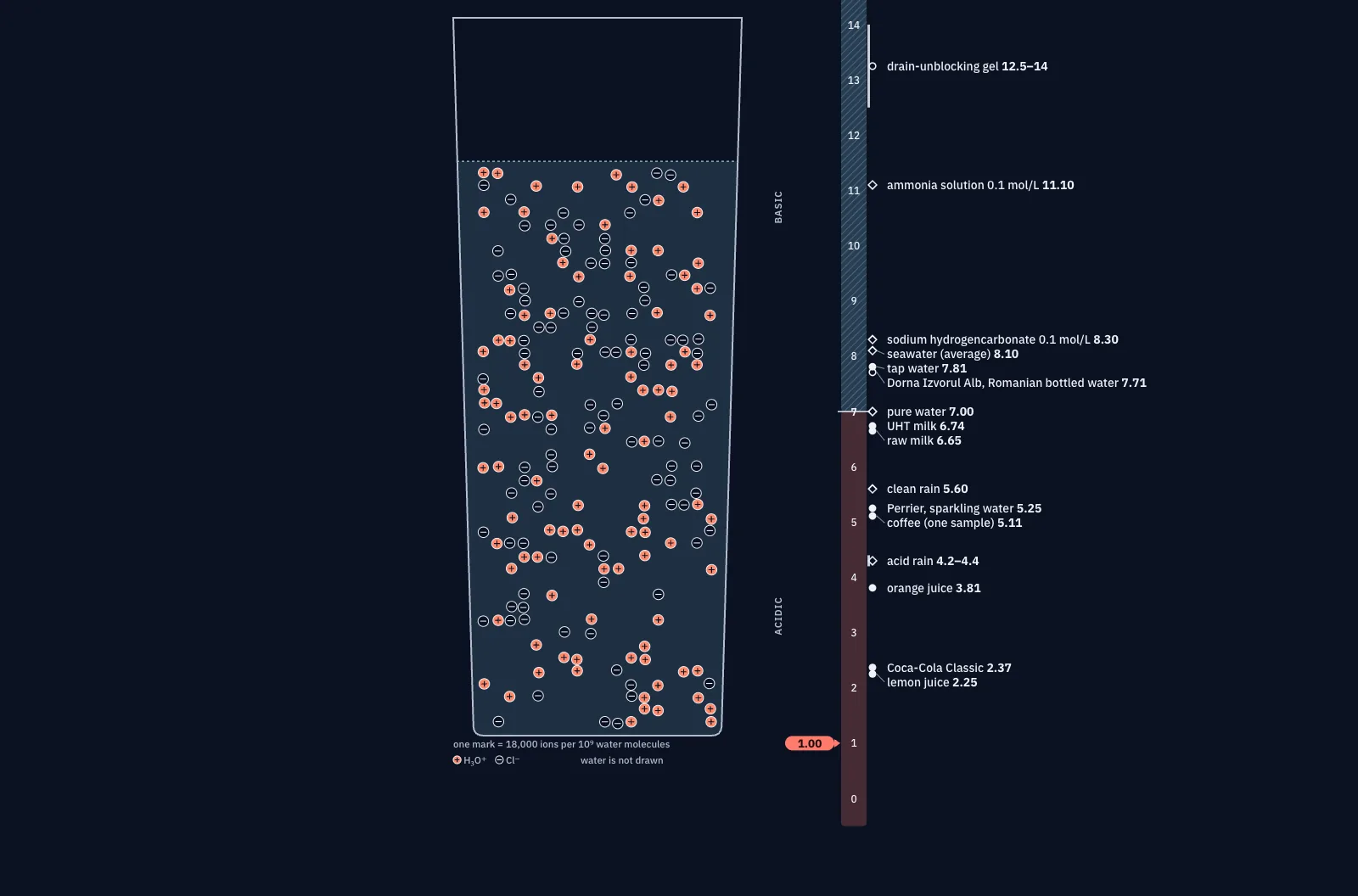
A gel for unblocking pipes and sinks has a safety data sheet in Romanian (MELLERUD, 10 August 2023). The product contains 5 to less than 10% sodium hydroxide, and its pH is between 12.5 and 14 at 20 °C.
The sheet classifies it as corrosive to skin, category Skin Corr. 1A, and sodium hydroxide is the hazardous component that determines its labelling. A pH between 12.5 and 14 is well above 7, the value for pure water at 25 °C.
In short
- A strong monoprotic acid, such as HCl or HNO₃, ionises completely in water: HCl + H₂O → H₃O⁺ + Cl⁻. Examples of strong monoprotic acids: HCl, HBr, HI and HNO₃.
- A strong base with one HO⁻, such as NaOH or KOH, dissociates completely: NaOH(s) → Na⁺(aq) + HO⁻(aq). For a strong acid, [H₃O⁺] = c; for a strong base, [HO⁻] = c.
- Pure water ionises very slightly: 2H₂O ⇌ H₃O⁺ + HO⁻. At 25 °C, [H₃O⁺] = [HO⁻] = 10⁻⁷ mol/L.
- The ionic product of water is Kw = [H₃O⁺]·[HO⁻] = 10⁻¹⁴ at 25 °C.
- The solution is acidic at [H₃O⁺] > 10⁻⁷ mol/L, neutral at [H₃O⁺] = [HO⁻] and basic at [HO⁻] > 10⁻⁷ mol/L.
Common mistakes
WrongAn HCl solution contains HCl molecules as well as ions.
RightHCl is a strong acid: ionisation is complete and the solution contains H₃O⁺ and Cl⁻ ions, with no HCl molecules.
WrongAn acidic solution contains no HO⁻ ions.
RightWater ionises in every solution, so HO⁻ ions are present even in an acid; at [H₃O⁺] = 10⁻² mol/L, [HO⁻] = 10⁻¹² mol/L.
WrongPure water has no ions.
RightPure water contains 10⁻⁷ mol/L each of H₃O⁺ and HO⁻ ions, or about two ionised molecules in every billion.
Test yourself
7 questions. For the first 6 you see the explanation at once, with the paragraph of the lesson that supports it; for the written ones you compare with a good answer.
What particles does a solution of HCl in water contain, apart from water molecules?
Answer
b) H₃O⁺ and Cl⁻ ions, with no HCl molecules. HCl is a strong acid: ionisation is complete, so no HCl molecules remain.
What are the ion concentrations in pure water at 25 °C?
Answer
d) [H₃O⁺] = [HO⁻] = 10⁻⁷ mol/L. The product of the concentrations is 10⁻¹⁴, and in pure water the two are equal: 10⁻⁷ · 10⁻⁷ = 10⁻¹⁴.
Which statement about NaOH dissolved in water is correct?
Answer
a) It dissociates completely into Na⁺ and HO⁻ ions. NaOH is a strong base: the ionic crystal separates completely into ions.
In an HCl solution at 25 °C, [H₃O⁺] = 10⁻² mol/L. The concentration [HO⁻] is 10ⁿ mol/L. What is n?
Answer
-12.0. [HO⁻] = 10⁻¹⁴ ÷ 10⁻² = 10⁻¹² mol/L, so n = −12.
How many moles of H₃O⁺ ions are in 2.0 L of HCl solution with c = 0.050 mol/L? Round to two decimal places.
molAnswer
0.10 mol. For a strong monoprotic acid, [H₃O⁺] = c = 0.050 mol/L, so n = 0.050 · 2.0 = 0.10 mol.
Place each substance in its category.
Answer
Strong monoprotic acid: HCl; HNO₃; HBr; HI.
Strong base with one HO⁻: NaOH; KOH.
HCl, HBr, HI and HNO₃ give up one proton and ionise completely; NaOH and KOH give one HO⁻ ion per formula unit and dissociate completely.
A classmate says: “There are no HO⁻ ions at all in an acidic solution.” Explain why the statement is wrong and give a numerical example.
A good answer
Water ionises in every aqueous solution, and the product [H₃O⁺]·[HO⁻] remains 10⁻¹⁴ at 25 °C. If [H₃O⁺] rises, [HO⁻] falls, but does not become zero. For example, at [H₃O⁺] = 10⁻² mol/L, [HO⁻] = 10⁻¹⁴ ÷ 10⁻² = 10⁻¹² mol/L.
A complete answer mentions the ionisation of water, the constant ionic product and a calculation with values.
Terms
- ionisation
- The formation of ions from a molecule as it dissolves in water, for example HCl + H₂O → H₃O⁺ + Cl⁻.
- dissociation
- The separation of an ionic compound’s ions from the lattice by water.
- strong monoprotic acid
- An acid that gives up one proton per molecule and ionises completely in water.
- strong base with one HO⁻ (monoprotic, monoacid)
- A base that dissociates completely in water and gives one HO⁻ ion per formula unit. The programme calls it a “strong monoprotic base”, and some exercise books call it a “monoacid base”.
- hydronium ion
- The H₃O⁺ ion, formed from a proton bound to a water molecule.
- ionic product of water
- The product Kw = [H₃O⁺]·[HO⁻], equal to 10⁻¹⁴ at 25 °C.
- acidic, neutral, basic solution
- A solution in which [H₃O⁺] is greater than, equal to or less than [HO⁻], respectively.
Sources and link to the programme
- OpenStax – Chemistry 2e, 4.2 Classifying Chemical Reactions – the reaction of HCl with water to produce hydronium and chloride ions, and its virtually complete ionisation; the list of strong acids (HBr, HCl, HI, HNO₃, HClO₄, H₂SO₄); NaOH and KOH dissociate completely into ions
- OpenStax – Chemistry 2e, 14.1 Brønsted-Lowry Acids and Bases – the autoionisation of water, about two molecules per billion at 25 °C; Kw = 1.0·10⁻¹⁴ at 25 °C; 10⁻⁷ mol/L each of H₃O⁺ and HO⁻ in pure water; Kw = 2.4·10⁻¹³ at 80 °C
- OpenStax – Chemistry 2e, 14.3 Relative Strengths of Acids and Bases – strong acids are completely ionised in aqueous solution; strong bases ionise completely to give hydroxide ions
- OpenStax – Chemistry 2e, 14.2 pH and pOH – the gastric juice exercise, an HCl solution with [H₃O⁺] = 1.2·10⁻³ mol/L
- MELLERUD – Fișă cu date de securitate: gel pentru desfundat țevi și chiuvete (10 august 2023) – sodium hydroxide 5–<10%; classification Skin Corr. 1A, H314; pH 12.5–14 at 20 °C; phrase P102 and advice P301+P330+P331
From the programme: “Ionisation of strong monoprotic acids and strong monoprotic bases in aqueous solution; the ionic product of water” (TC: Core curriculum (1 hour a week)). Specific competences followed: 1.5, 6.5.