Chapter 1 · The language of chemistry and the moleLesson 1.2TC Core curriculum (1 hour a week) · beyond your profile
Stoichiometric calculations will be carried out using the chemical formula and the equation of a chemical reaction, with purity, yield, excess of a reactant, percentage concentration by mass and molar concentration of solutions
How do you count particles you cannot see? The mole
One gram of salt contains over 10²² ions. How can you find their number without counting them?
Before you read: what do you think?
You weigh 18 g of water in one glass and 18 g of sugar in another on kitchen scales. Which glass contains more molecules?
See the answer
The water has 19 times as many molecules. A water molecule is much lighter than a sugar molecule: 18 g of water is one mole, or 6.022·10²³ molecules, while 18 g of sugar is about a 19th of a mole.
On kitchen scales, 18 g of water and 342 g of sugar contain the same number of molecules. You cannot see a single molecule, but you can calculate their number from the mass. The quantity that links the two is the amount of substance, and its unit is the mole.
A mole has a fixed number of particles
Atoms and molecules are too small and too numerous to count one by one, so chemistry counts them in packets. One packet is called a mole and contains 6.022·10²³ particles. The particles can be atoms, molecules, ions or formula units; you must say which. The number of particles in a mole is the Avogadro constant: NA = 6.022·10²³ mol⁻¹. The exact value, fixed by the 2019 definition of the mole, is 6.02214076·10²³; the rounded value is used in class.
The amount of substance is written n (or ν in some exercise books) and measured in mol. The number of particles N is found from N = n · NA. For example, 1 mol of O₂ molecules has NA molecules and 2 · NA oxygen atoms, so it contains 2 mol of oxygen atoms.
How much does a mole weigh? Molar mass
Relative atomic mass Ar compares the mass of an atom with one 12th of the mass of a carbon-12 atom; it has no unit. The rounded values used in the book are: H 1, Li 7, B 11, C 12, N 14, O 16, F 19, Na 23, Mg 24, Al 27, S 32, Cl 35.5, K 39, Ca 40, Cr 52, Mn 55, Fe 56, Co 59, Cu 64, Zn 65, Br 80, Ag 108, I 127, Pb 207. Relative molecular mass Mr is the sum of the relative atomic masses in the formula: Mr(H₂O) = 2 · 1 + 16 = 18.
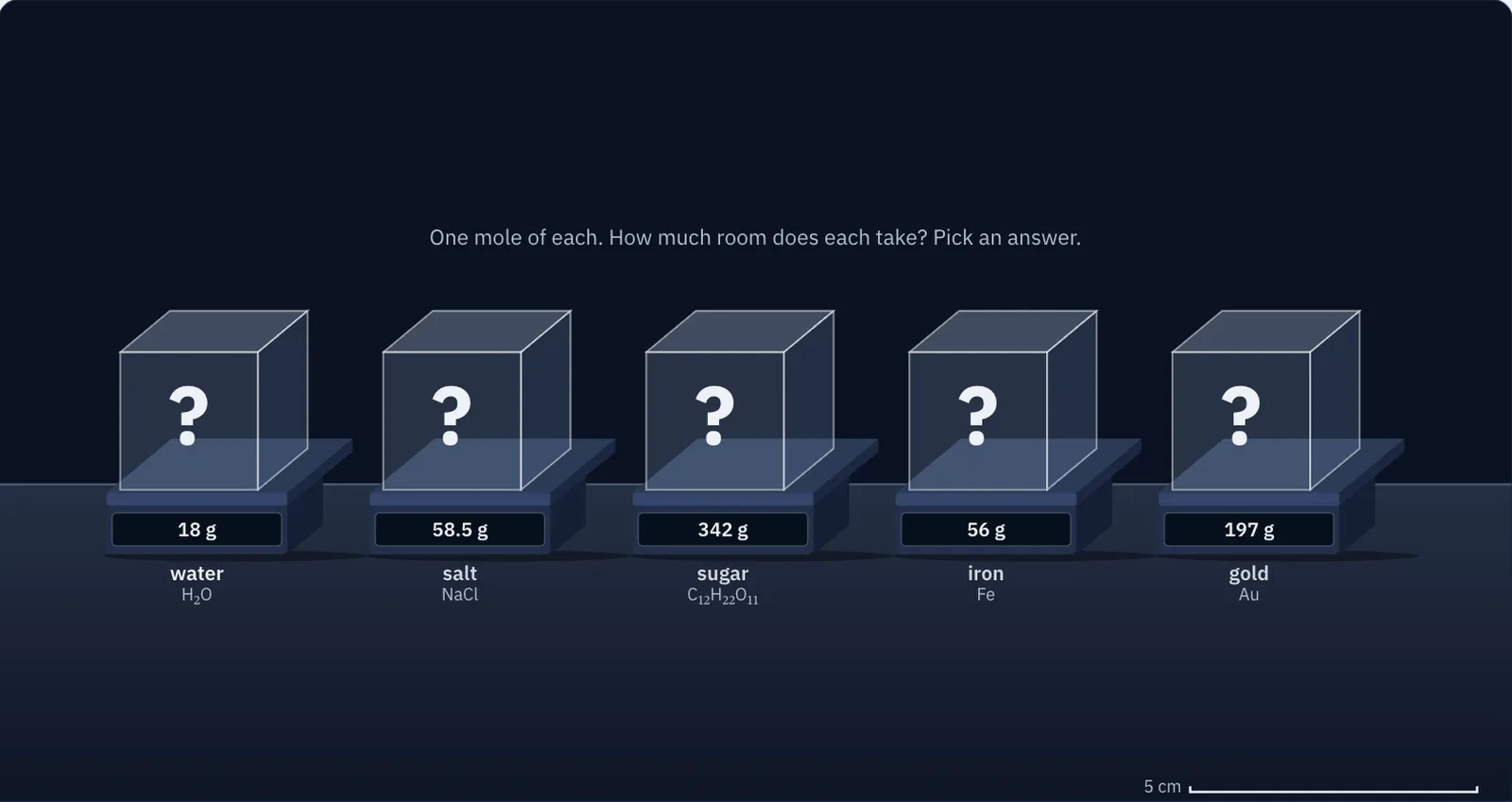
Molar mass M is the mass of one mole of a substance, measured in g/mol. Its numerical value equals the relative atomic or molecular mass: M(H₂O) = 18 g/mol, M(NaCl) = 23 + 35.5 = 58.5 g/mol, M(C₁₂H₂₂O₁₁) = 12 · 12 + 22 · 1 + 11 · 16 = 342 g/mol. This gives two working formulas: n = m ÷ M and m = n · M. On kitchen scales, 18 g of water, 58.5 g of salt and 342 g of sugar are each one mole of the substance.
For ionic substances, moles are counted in formula units: 1 mol of NaCl contains 1 mol of Na⁺ ions and 1 mol of Cl⁻ ions.
| Substance | Mass of one mole | Density | Volume of one mole | Side of the drawn block | Particles in one mole |
|---|---|---|---|---|---|
| Water, H₂O | 18 g | 1 g/cm³ | 18.0 cm³ | 2.62 cm | 6.022·10²³ molecules |
| Salt, NaCl | 58.5 g | 2.17 g/cm³ | 27.0 cm³ | 3 cm | 6.022·10²³ formula units |
| Sugar, C₁₂H₂₂O₁₁ | 342 g | 1.59 g/cm³ | 215 cm³ | 5.99 cm | 6.022·10²³ molecules |
| Iron, Fe | 56 g | 7.87 g/cm³ | 7.1 cm³ | 1.92 cm | 6.022·10²³ atoms |
| Gold, Au | 197 g | 19.3 g/cm³ | 10.2 cm³ | 2.17 cm | 6.022·10²³ atoms |
The volume of one mole is the molar mass divided by the density (calculated). The side of the block is the side of a cube of that volume. One mole of gold weighs 11 times as much as one mole of water and takes up 10.2 cm³, against 18 cm³. For 9 g of water: n = 9 ÷ 18 = 0.5 mol and N = 3.011·10²³ molecules. For 1 kg of sugar: n = 1,000 ÷ 342 ≈ 2.92 mol.
Calculation. Calculated from atomic masses (the book's own) and measured densities: the volume of one mole is the molar mass divided by the density, and the blocks are drawn to one scale as a compact solid, without the air between crystals (kitchen salt and sugar take up more room). The particles are not to scale: the discs in the picture are a drawing in which the area shows the mass of one particle, and the picture holds a few discs against 6.022·10²³ particles in a mole. Atoms, molecules and ions have no colour.
Sources and credits. Densities: PubChem (water, compound 962: 1.00 g/mL at 3.98 °C; sodium chloride, 5234: 2.17 at 25 °C; sucrose, 5988: 1.59 at 20 °C; iron, 23925: 7.87 g/cm³; gold, 23985: 19.3 g/cm³), values taken from HSDB and CAMEO Chemicals. Atomic masses: CIAAW, rounded as in the book. Avogadro constant: NIST (CODATA). Tablespoon: NIST SP 811, appendix B.8 (14.79 mL). Age of the Universe: NASA / WMAP (13.77 billion years).
Molar volume: gases are measured by volume
Gas particles are far apart, and the volume of a gas depends on their number, not their type. So one mole of any gas occupies the same volume at the same temperature and pressure. At normal conditions (c.n.: 0 °C and 1 atm) the molar volume is VM = 22.4 L/mol. From this, n = V ÷ VM. One mole of O₂ (32 g) and one mole of CO₂ (44 g) each occupy 22.4 L, although their masses differ.
The value 22.4 L/mol applies only to gases: one mole of liquid water occupies about 18 mL, not 22.4 L.
Industry works with kilomoles: 1 kmol = 1,000 mol. One kilomole of gas occupies 22.4 m³ at normal conditions, and its mass in kilograms has the same numerical value as M: 1 kmol of CO₂ has a mass of 44 kg and a volume of 22.4 m³.
For the curious
At 273.15 K and 100 kPa, the pressure of nearly 1 atm used in modern tables, the molar volume of an ideal gas is 22.711 L/mol (CODATA); at 273.15 K and 101.325 kPa, exactly 1 atm, it is 22.414 L/mol. Schools use the second value, rounded to 22.4 L/mol. Real gases depart from ideal behaviour, especially at high pressure and low temperature, so 22.4 L/mol is a reference value.
Worked example
What 11 g of carbon dioxide contains
You have 11 g of CO₂. Find the amount of substance, the number of molecules, the volume at normal conditions and the amount of oxygen atoms.
Molar mass: M(CO₂) = 12 + 2 · 16 = 44 g/mol. Amount: n = 11 ÷ 44 = 0.25 mol. Check the order of magnitude: 11 g is a quarter of 44 g, so the amount is a quarter of a mole.
Number of molecules: N = 0.25 · 6.022·10²³ ≈ 1.5·10²³ molecules. Volume: V = 0.25 · 22.4 = 5.6 L.
Each molecule has two oxygen atoms, so n(O) = 2 · 0.25 = 0.5 mol of oxygen atoms.
In Romania
How many moles are in a bag from Azomureș
Azomureș in Târgu Mureș supplies granular ammonium nitrate in 50 kg bags, according to the manufacturer’s technical data sheet, updated in February 2024. Molar mass: M(NH₄NO₃) = 14 + 4 · 1 + 14 + 3 · 16 = 80 g/mol.
A 50 kg bag of pure NH₄NO₃ would have n = 50,000 ÷ 80 = 625 mol of formula units, or 0.625 kmol. Each NH₄NO₃ unit has two nitrogen atoms, so n(N) = 2 · 625 = 1,250 mol of nitrogen atoms. The number of formula units is 625 · 6.022·10²³ ≈ 3.76·10²⁶. In kilomoles, the same calculation is 50 kg ÷ 80 kg/kmol = 0.625 kmol. The product in the bag contains 33.5% nitrogen; pure NH₄NO₃ contains 35% (28 ÷ 80). The values above are for the pure substance and are slightly lower in the actual bag.
In short
- One mole contains 6.022·10²³ particles (NA = 6.022·10²³ mol⁻¹); the number of particles is N = n · NA, and n is also written ν.
- Molar mass M is measured in g/mol and is numerically equal to the relative atomic or molecular mass: M(H₂O) = 18 g/mol.
- From mass, find the amount: n = m ÷ M; from amount, find the mass: m = n · M.
- One mole of any gas occupies 22.4 L at normal conditions (0 °C, 1 atm): VM = 22.4 L/mol and n = V ÷ VM.
- 1 kmol = 1,000 mol; at normal conditions, 1 kmol of gas occupies 22.4 m³.
Common mistakes
WrongA mole of any substance weighs the same.
RightThe number of particles is the same, but the mass depends on the molar mass: 1 mol of water has a mass of 18 g, while 1 mol of sugar has a mass of 342 g.
WrongA mole of any substance occupies 22.4 L.
Right22.4 L/mol applies only to gases at normal conditions. One mole of liquid water occupies about 18 mL.
Wrong1 mol of O₂ means 6.022·10²³ oxygen atoms.
RightIt means 6.022·10²³ molecules, or 2 · 6.022·10²³ oxygen atoms. Always say which particle is being counted.
Test yourself
8 questions. For the first 7 you see the explanation at once, with the paragraph of the lesson that supports it; for the written ones you compare with a good answer.
What is the molar mass of sodium chloride, given Ar(Na) = 23 and Ar(Cl) = 35.5?
Answer
c) 58.5 g/mol. Add the atomic masses of the elements in the formula: 23 + 35.5 = 58.5.
What volume does 1 mol of oxygen gas occupy at normal conditions?
Answer
b) 22.4 L. Any gas occupies 22.4 L/mol at normal conditions. The mass of 32 g does not enter the volume calculation.
How many oxygen atoms are in 1 mol of O₂ molecules?
Answer
c) 1.2044·10²⁴. One mole of molecules has NA molecules, each with two atoms: 2 · 6.022·10²³ = 1.2044·10²⁴ atoms.
Why does 18 g of water contain more molecules than 18 g of sugar?
Answer
c) Water molecules are lighter, so more fit into the same mass. M(H₂O) = 18 g/mol and M(C₁₂H₂₂O₁₁) = 342 g/mol: the same mass means more moles of a substance with a lower molar mass.
How many moles are in 4.4 g of CO₂? Given M(CO₂) = 44 g/mol. Give the answer to two decimal places.
molAnswer
0.10 mol. n = 4.4 ÷ 44 = 0.10 mol.
What volume, in litres, does 0.5 mol of nitrogen, N₂, occupy at normal conditions?
LAnswer
11.2 L. V = n · VM = 0.5 · 22.4 = 11.2 L.
Put the steps in order to find the number of molecules in a weighed sample of water.
Answer
The correct order:
- Calculate the molar mass from the formula H₂O
- Divide the mass of the sample by the molar mass to find n
- Multiply n by NA
- Write the result as a number of molecules
From mass, find moles using n = m ÷ M; from moles, find particles using N = n · NA.
A classmate claims that 22.4 L of liquid water contains one mole of molecules because “one mole occupies 22.4 L”. Explain the mistake and give the actual volume of one mole of liquid water.
A good answer
The molar volume of 22.4 L/mol applies only to gases at normal conditions, because gas particles are far apart. In liquid water the molecules are close together, and one mole, or 18 g, occupies about 18 mL.
A complete answer limits 22.4 L/mol to gases at normal conditions and gives the order of magnitude of one mole of liquid, about 18 mL.
Terms
- mole
- The amount of substance containing 6.022·10²³ particles (atoms, molecules, ions or formula units).
- Avogadro constant
- The number of particles in one mole: NA = 6.022·10²³ mol⁻¹.
- relative atomic mass
- The number that shows how many times the mass of an atom exceeds one 12th of the mass of a carbon-12 atom.
- molar mass
- The mass of one mole of a substance, in g/mol; M = m ÷ n.
- molar volume
- The volume of one mole of gas; at normal conditions, 22.4 L/mol.
- normal conditions
- A temperature of 0 °C and a pressure of 1 atm.
- kilomole
- One thousand moles; 1 kmol = 1,000 mol.
Sources and link to the programme
- BIPM – Mise en pratique for the definition of the mole in the SI – the 2019 definition of the mole: exactly 6.02214076·10²³ elementary entities
- OpenStax – Chemistry 2e, 3.1 Formula Mass and the Mole Concept – the mole, the Avogadro constant, molar mass numerically equal to atomic or molecular mass; the carbon-12 atom as reference
- NIST – CODATA: molar volume of ideal gas (273,15 K, 101,325 kPa) – molar volume of an ideal gas at 1 atm and 273.15 K: 22.414 L/mol
- NIST – CODATA: molar volume of ideal gas (273,15 K, 100 kPa) – molar volume at 273.15 K and 100 kPa: 22.711 L/mol
- CIAAW – Abridged standard atomic weights 2024 – standard atomic weights, the source of the rounded values used in class
- OpenStax – Chemistry 2e, 9.6 Non-Ideal Gas Behavior – real gases depart from the ideal gas law, especially at high pressure and low temperature
- PubChem – Sucrose – the formula of sugar, C₁₂H₂₂O₁₁, and its molecular mass, 342.30
- Azomureș – Azotat de amoniu (fișă tehnică, februarie 2024) – granular ammonium nitrate, packed in 50 kg bags, with total nitrogen of 33.5%
From the programme: “Stoichiometric calculations will be carried out using the chemical formula and the equation of a chemical reaction, with purity, yield, excess of a reactant, percentage concentration by mass and molar concentration of solutions” (TC: Core curriculum (1 hour a week)). Specific competences followed: 5.1, 3.6.