București · 1866 – 1877
The Academy Dictionary, 1871–1877: the war for words
How Laurian and Massim tried to erase every non-Latin word from Romanian — and how the speakers voted otherwise: dragoste lived, cespete died.
Can an Academy clean a language by decree? Between 1871 and 1877 the Romanian Academic Society printed a dictionary that tried exactly that: it exiled non-Latin words to a glossary of shame and proposed new Latinate words in their place. The peasant — the one who spoke the language every day — never signed the decree.
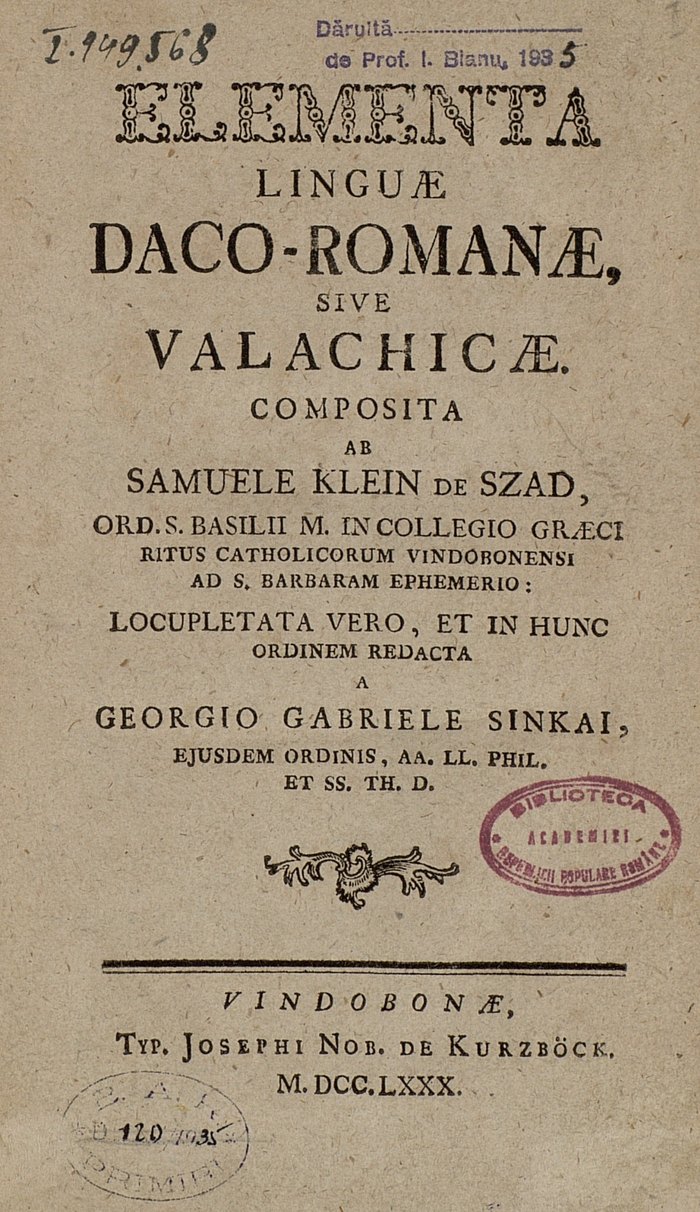
I. Blaj, 1780–1825
The school that dreamed in Latin
- 1780 — Elementa linguae daco-romanae, Vienna
- 1812 — Maior's History of the Romanians' Beginnings, Buda
- 1825 — the Buda Lexicon
At Blaj, Greek-Catholic scholars trained in Vienna and Rome set out to show the world that Romanians are Romans — and that their language could be brought back toward Latin. In 1780 Samuil Micu-Klein wrote, and Gheorghe Șincai revised, at Saint Barbara College in Vienna, the first grammar of Romanian: the Elementa linguae daco-romanae.
Petru Maior carried the dream further: at Buda, in 1812, he printed his History of the Beginnings of the Romanians in Dacia, and in 1825 the same press issued the Buda Lexicon — the first etymological dictionary of Romanian, worked on by several authors for over thirty years.
The excesses were born then too: etymologizing spellings nobody loved — fântână written fontana, țară written tiera — a war on și, wrongly declared Slavic, and words patched from two roots, like răzbel from război and bellum. All of it was the dress rehearsal for what came next in Bucharest.
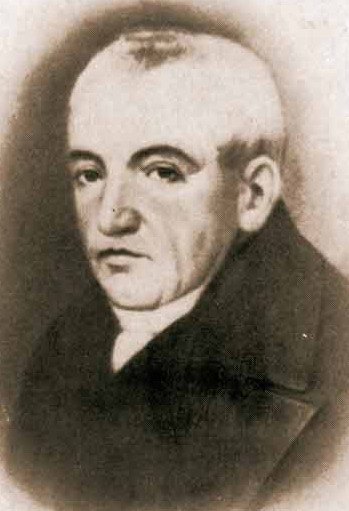
The scene, in the sources' own words
„Lesicon romanescu-latinescu-ungurescu-nemtescu… în cursul a trideci și mai multoru ani”
Title page of the Buda Lexicon, 1825 (via Clim et al., elex2017; in the original spelling)
II. Bucharest, 1866
A new country builds an Academy
- 1 April 1866 — the Romanian Literary Society
- 1867 — the Romanian Academic Society
- 1879 — the Romanian Academy, a national institute
On 1 April 1866 the Princely Lieutenancy approved — decree no. 582, on the initiative of C. A. Rosetti — the founding of the Romanian Literary Society. A year later it is called the Romanian Academic Society, and in 1879 a special law declares it a national institute: the Romanian Academy.
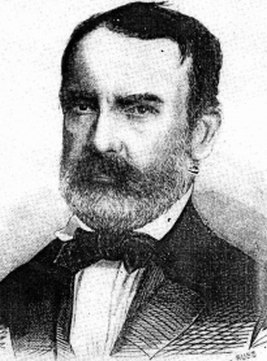
Among the founding members are August Treboniu Laurian — a Transylvanian born at Fofeldea in 1810, a Göttingen doctorate, a veteran of 1848 — and Ion C. Massim. The Society's first mission is clear: a dictionary and a grammar of the Romanian language, an orthography, and a history of the Romanians.
The dictionary commission goes to Laurian and Massim. The two do not set out to photograph the language as spoken, but to steer it toward Latin: non-Latin words are exiled to a separate glossary, and in their place the dictionary proposes new Latinate words — over 20,000 creations of their own.
The scene, in the sources' own words
„…to create a dictionary and a grammar of the Romanian language, to solve the orthographic problem and to write a book of Romanian history”
The Academy's original purpose, summarized by Clim et al., elex2017
III. 1871–1877
Three volumes against the living language
- 1871 — first fascicles; the Glossariu
- 1871–1877 — two volumes and a glossary
- 3,600 pages · 70,000 headwords
The first fascicles appear in 1871; the three volumes — two of dictionary and the Glossariu of “foreign” words — stretch to 1877. The final count: 3,600 pages, 70,000 headwords, an etymological spelling you could not read unless you knew Latin.
The method is merciless: words that entered the language after 1830 are marked with an asterisk, definitions avoid synonyms, and everything that does not sound Latin is dispatched to the Glossariu. That is where război and dragoste end up — words the peasant spoke every day.
The Glossariu is both cemetery and courtroom: it records the condemned words, and it passes the sentence. Of dragoste it writes that it is foreign to the language and fallen into disuse. The verdict turned out to be a wish, not an observation.
The scene, in the sources' own words
„DRAGOSTE, s. f., amor, caritas… este strainu de limba; de acea-aasi cadrutu in desuetudine, si in loculu lui au intratu alte cuvente curatu romanice: amore, caritate, affectione”
Glossariu, 1871, entry DRAGOSTE (OCR transcription from the archive.org scan; period spelling)
IV. 1881
The peasant votes
- 1872 — The New Direction
- 1881 — “Neologisms”
- 1887–1893 — Hasdeu, as far as “bărbat”
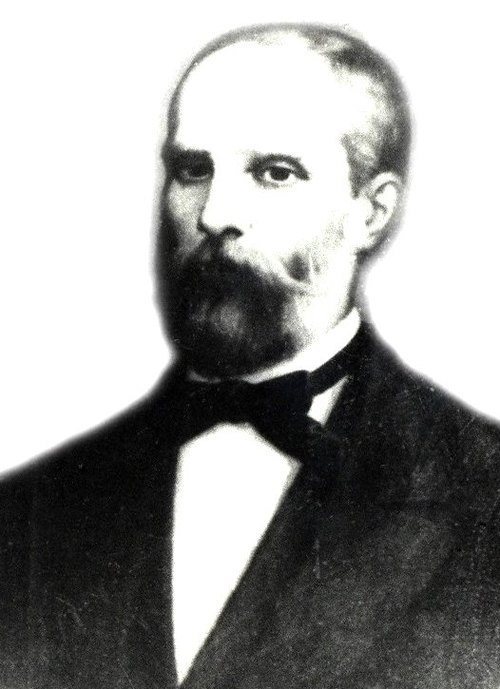
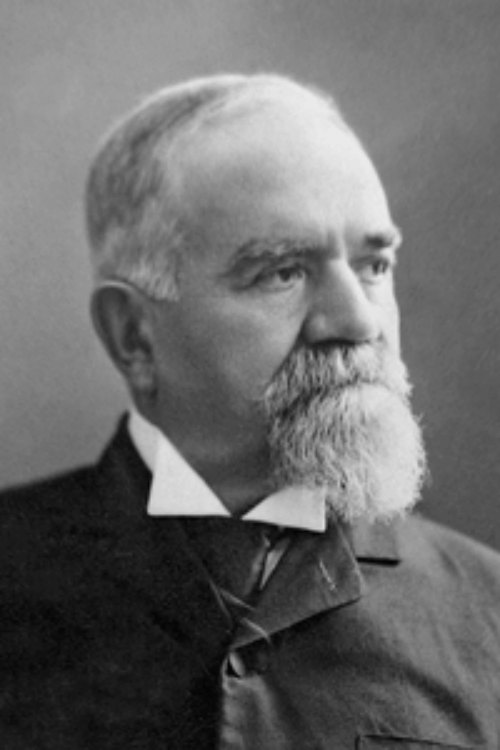
Titu Maiorescu, who joined the Academic Society in 1867, answered in 1881 with his study “Neologisms”. The demonstration is peasant-plain and merciless: for brazdă the Glossariu offers the peasant five or six words — sulc, liră, plancă, rasoriu, cespete — and expects the whole village to say cespete.
The list is an inventory of disaster: bujor becomes rosa de Alpi, castravete becomes cucumă, ciocan becomes toacă or maior, and clește is left with the Latin forceps — “surely we won't call it forcipe?”, Maiorescu asks. The peasant never did.
The law Maiorescu states stayed famous: words are not born from the cold distillation of reflection, but from the warmth of feeling. And literary historians record the end of the Latinist school in one sentence: the purification attempt provoked laughter and discredited it for good.
The scene, in the sources' own words
„Glosarul Laurianu și Massimu ne-ar propune, d. e., pentru brazdă vro cinci-șase cuvinte, care mai de care: sulc, liră, plancă, rasoriu, cespete; dar nu credem că se va găsi vreun om cu mintea sănătoasă care să-și închipuiască pe toți țăranii români zicând cespete sau rasoriu în loc de brazdă.”
Titu Maiorescu, “Neologismele”, 1881 (Wikisource; in the original Romanian)
The same sentence, two languages
Tap a word to see the dictionary's proposed replacement and usage's verdict. Without JavaScript, all verdicts are open below.
Living language → Laurian
Țăranul → tieranulu a murit · died
The Glossariu itself writes tieranulu for țăranul.
brazda → cespete a murit · died
For brazdă the Glossariu offered five or six words: sulc, liră, plancă, rasoriu, cespete.
dragoste → amore a murit · died
The Glossariu declared dragoste foreign and fallen into disuse, replaced by amore. It was wrong.
ciocanul → toacă a murit · died
For ciocan the Glossariu offered toacă or maior.
și → — nedocumentat · undocumented
They tried to drop și, wrongly calling it Slavic. No proposed replacement is documented in our sources.
cleștele → forceps a murit · died
For clește, only the Latin forceps, forficula — Maiorescu: surely we won't call it forcipe?
castravete → cucumă a murit · died
For castravete the Glossariu liked cucumă.
bujor → rosa de Alpi a murit · died
For bujor the academic Glossariu thought of a rosa de Alpi.
război → bellu a murit · died
Resbellu was condemned even by the authors; their correct form was bellu. Război survived.
Score: 0 of 8 Latinate replacements caught on. All 9 living words are still in use today.
Numbers
1780
first grammar of Romanian, Vienna
1812
Maior prints his History, Buda
1825
the Buda Lexicon
1866
the Romanian Literary Society
1868
first issue of Transilvania, Brașov
1871–1877
the dictionary: two volumes and a glossary
3,600
pages
70,000
headwords, over 20,000 created by the authors
1881
Maiorescu publishes “Neologisms”
1893
Hasdeu stops at the word “bărbat”
Did it survive?
Eight words from the war for the language. Guess which ones caught on and which ones faded.
Score: 0 / 8
cespete
brazdă (furrow)
died. It died. One of the five or six replacements proposed for brazdă; nobody ever said cespete.
cucumă
castravete (cucumber)
died. It died. The Glossariu's replacement for castravete; the cucumber won.
resbellu
război (war)
died. It died — condemned by Laurian and Massim themselves as a hybrid, barbarous form. Their correct form was bellu. Război survived.
rosa de Alpi
bujor (peony)
died. It died. The peony never became rosa de Alpi except on Glossariu paper.
forcipe
clește (tongs)
died. It died. Maiorescu asked ironically: surely we won't call it forcipe? We didn't.
factură
the invoice had no Romanian word
survived. It lived. The dictionary's factură entry shows useful neologisms caught on: it exists to this day.
anxietate
a new feeling gets a name
survived. It lived. It is on the list of LM neologisms found in today's Romanian (Clim et al.).
dragoste
banished to the Glossariu — yet it lived
survived. It lived — though the Glossariu had declared it foreign and fallen into disuse. Proof that usage outvotes the Academy.
Myths
The Academy cleaned the language. False
It did not clean it. It tried — and the attempt, literary historians say, provoked laughter and discredited the Latinist school for good. Dragoste, brazdă and război are still spoken today.
The dictionary was good for nothing. False
It was good for much. Of the 20,000+ words the authors created, most stayed in use and enriched Romanian terminology: factură, anxietate, austeritate and thousands more.
The Latinists got nothing right. False
They got plenty right: many of the etymological solutions proposed by Laurian and Massim are still in use, say the lexicographers who digitized their work.
The aftermath
The Society that commissioned the purge then commissioned its opposite: a historical, popular dictionary, begun by Hasdeu in 1887 and left unfinished at “bărbat”. The Academy never again tried to decree words into being.
Sources
The books and essays (public domain)
- Dicționariul limbei române + Glossariu (1871–1877), full OCR text: archive.org/details/glossariucareco00massgoog
- Titu Maiorescu, “Neologismele” (1881): ro.wikisource.org/wiki/Neologismele
Modern scholarship
- Clim, Patrașcu, Tamba — the digital form of the dictionary (elex2017, PDF)
- Re-latinization of Romanian — the Boia/Mallinson synthesis (Wikipedia, EN)
- The Romanian Academy — official history: 1866 founding, 1879 law (acad.ro)
- Transilvania journal — first issue, Brașov 1868 (revistatransilvania.ro)
Every claim with its exact source: SOURCES.md in the repository.
How we worked
Book quotations are short fragments from public-domain works (the 1871 dictionary, Maiorescu 1881). Glossariu fragments come from the scan's OCR layer and use only clear readings, in period spelling. Dates and figures come from verified modern sources; each is cited with its exact source in SOURCES.md, and the check script recomputes them against the built page.