The church
The church above Neumarkt
George Bähr was commissioned to design the new Frauenkirche in Dresden. Its original cornerstone was laid on 26 August 1726; the church was consecrated in 1734 before its dome and interior were complete, and construction finished in 1743.
Stiftung Frauenkirche Dresden, historyDated image: 1749–1751
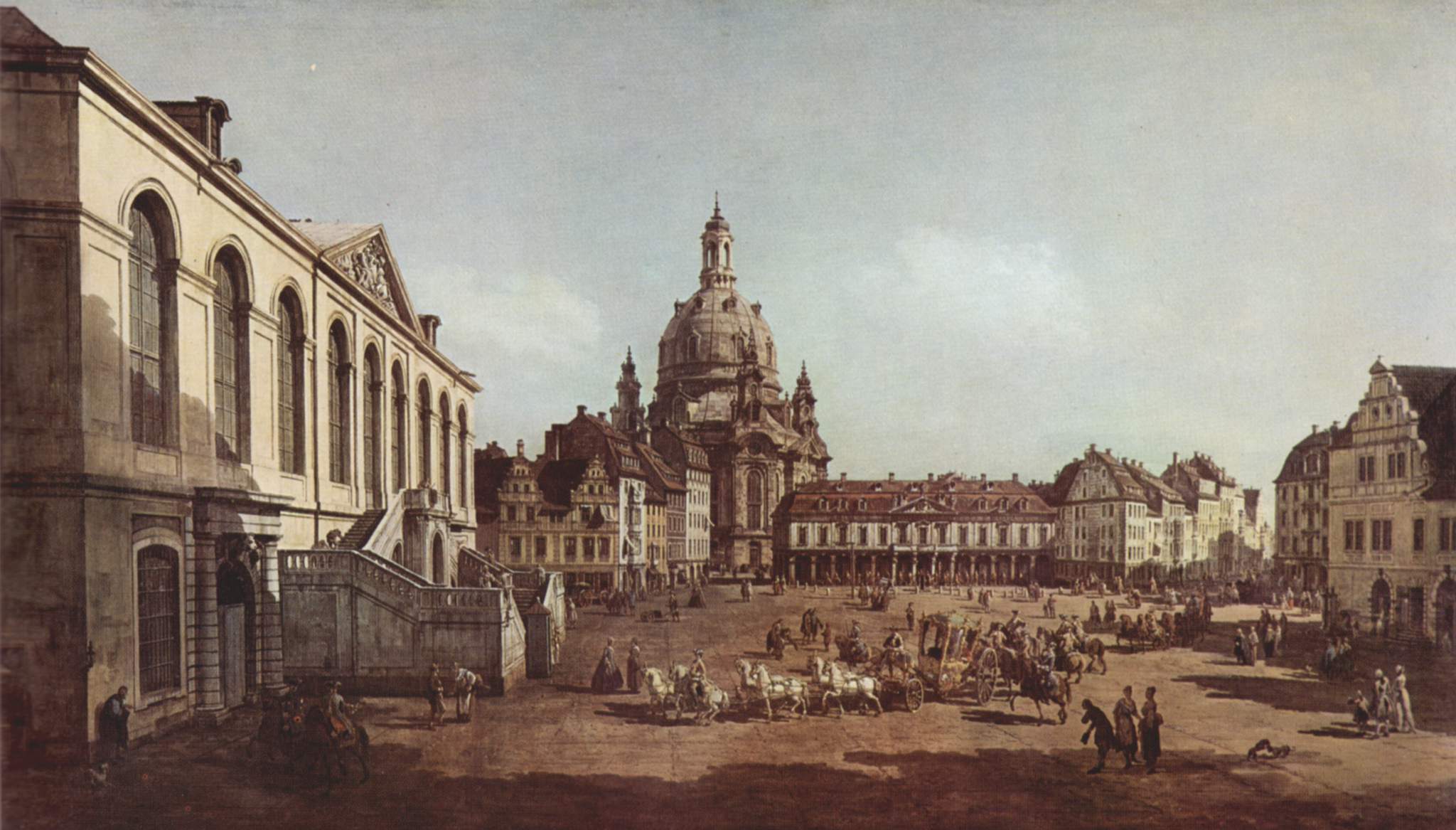
Painting: Bernardo Bellotto, View of the Neumarkt in Dresden from the Jüdenhofe; 1749–1751; Gemäldegalerie Alte Meister, Gal.-Nr. 610. public domain worldwide · PD-old-100 + PD-Art-YorckProject.
_005.jpg)
The collapse
The burned church collapsed on the morning of 15 February 1945
The Frauenkirche survived the raids of 13–14 February 1945. Burned out, it collapsed on the morning of 15 February. The Foundation places the attacks within the war Germany had begun and says that war returned to Dresden.
Stiftung Frauenkirche Dresden, historyClaudia Jerzak, “Der 13. Februar 1945 im kollektiven Gedächtnis Dresdens” (2025)Gorch Pieken, “The benchmark Dresden: 13 February 1945” (2016)Dated image: after 17 September 1945
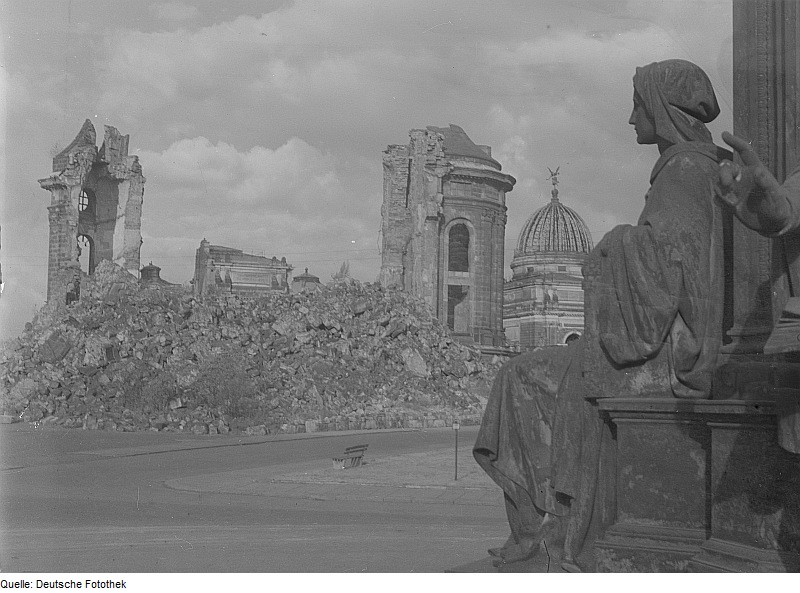
Photograph: Richard Peter sen., Fotothek df ps 0000384 Kriege ^ Kriegsfolgen ^ Zerstörungen - Trümmer - Ruinen; after 17 September 1945; Deutsche Fotothek. CC BY-SA 3.0 Germany.

The memorial
A designation, a plaque, then civic vigils
In the GDR, the City Council designated the ruin a memorial in 1966; a plaque followed in 1967. Historian Stefan Goebel finds that the formal status saw little use in practice. One official commemoration took place around 1980, followed by civic candlelight vigils from 1982 to 1989 that gave the site a more sustained public presence.
Stiftung Frauenkirche Dresden, historyFrauenkirche zu Dresden, history (DE; separate institutional account)Stefan Goebel, “Ruins of War into Memorials of Reconciliation” (2025)Claudia Jerzak, “Der 13. Februar 1945 im kollektiven Gedächtnis Dresdens” (2025)Dated image: 18 October 1967
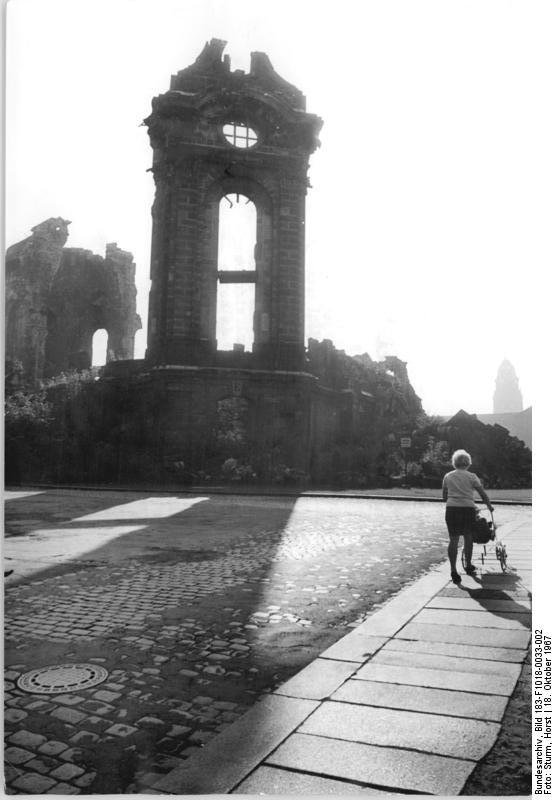
Photograph: Horst Sturm, Bundesarchiv Bild 183-F1018-0033-002, Dresden, Frauenkirche; 18 October 1967; Bundesarchiv, Bild 183-F1018-0033-002. CC BY-SA 3.0 Germany.

Dated image: 1980
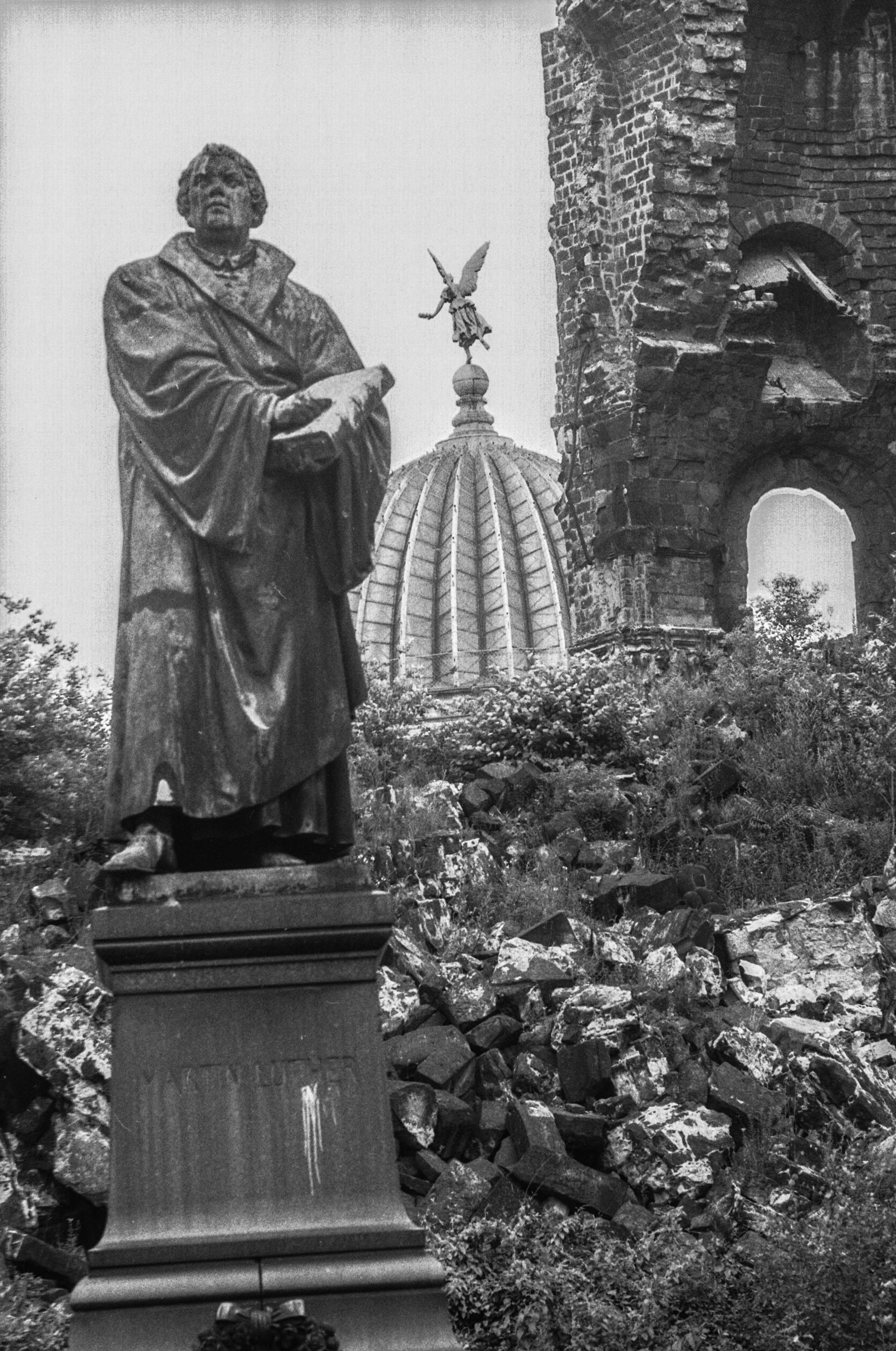
Photograph: Gerd Danigel, Dresden Martin Luther Frauenkirche 1980; 1980. CC BY-SA 4.0.

The rebuilding
A reused stone began the rebuilding
Archaeological clearance of the rubble began on 4 January 1993. On 27 May 1994, the first reused stone from the ruins was placed; the original 1726 cornerstone remained in place.
Stiftung Frauenkirche Dresden, rebuilding chronicleFrauenkirche zu Dresden, history (DE; separate institutional account)Photogrammetry in 1993 recorded the building’s lost three-dimensional geometry. Photographs and plans helped identify recovered stones, some of which were reused. The lower church was inaugurated in 1996, the inner dome was completed on 29 July 2001, and the building’s external form was restored in June 2004.
Stiftung Frauenkirche Dresden, rebuilding chronicleStiftung Frauenkirche Dresden, reconstruction and challengesStiftung Frauenkirche Dresden, challenges of reconstructionThe British replica tower orb and cross was presented in 2000 and raised with the lantern in 2004. It is a separate object from Coventry’s Cross of Nails, made from nails from the cathedral roof destroyed there in 1940.
Stiftung Frauenkirche Dresden, rebuilding chronicleDresden Trust, orb and crossStiftung Frauenkirche Dresden, Cross of NailsThe Frauenkirche was reconsecrated on 30 October 2005.
Stiftung Frauenkirche Dresden, historyStiftung Frauenkirche Dresden, rebuilding chronicleEvangelical Church in Germany, dedication service notice (2005)Dated image: 1994
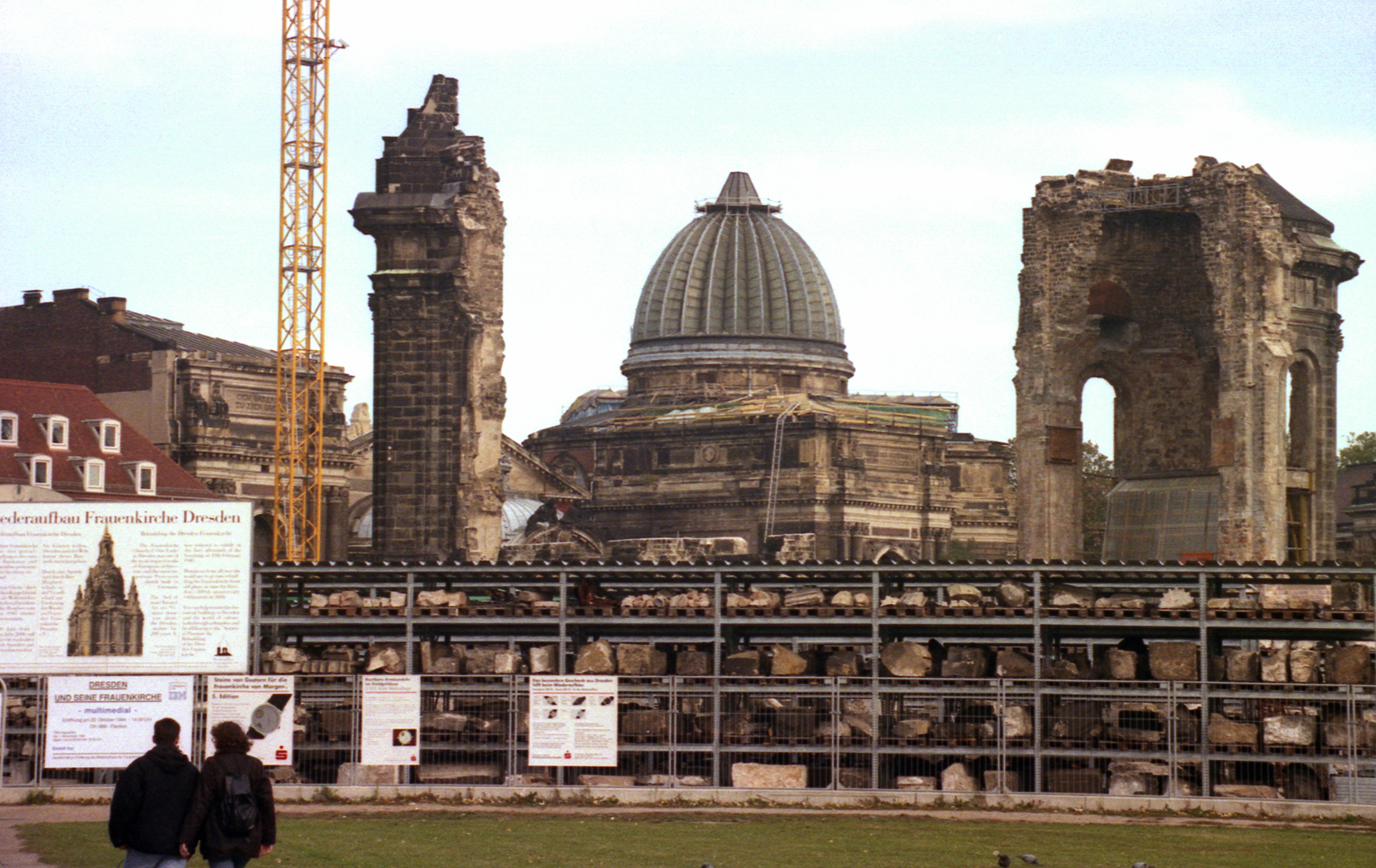
Photograph: Hajotthu, Dresden Frauenkirche Ruine 1994; 1994. CC BY-SA 3.0.

Dated image: 4 December 2023
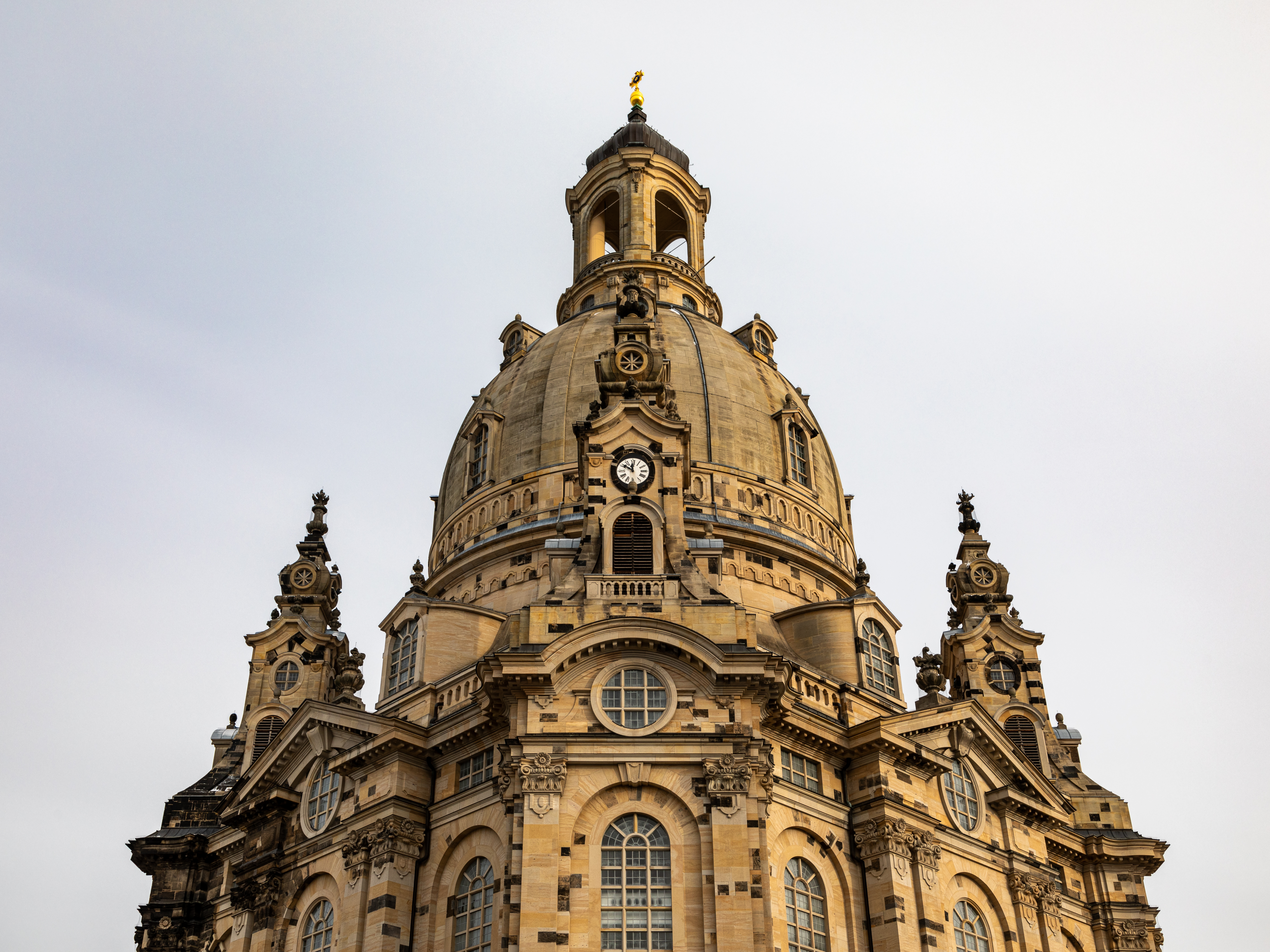
Photograph: Dietmar Rabich, Dresden, Frauenkirche — 2023 — 9387; 4 December 2023. CC BY-SA 4.0.

The site’s meaning
What can the rebuilt church remember?
The Foundation presents the restored church as a symbol of reconciliation. Stefan Goebel interprets the rebuilding as a change in the ruin’s memorial function: Dresden, he argues, gained an uplifting symbol and lost a war memorial. This is the historian’s argument about the ruin’s role, set here beside the Foundation’s account.
Stiftung Frauenkirche Dresden, historyStefan Goebel, “Ruins of War into Memorials of Reconciliation” (2025)The rebuilt church can hold the history of a place of worship, a ruin and changing acts of remembrance. What will Dresden choose to remember here?