Chapter 5 · The atmosphere and climate change
How thin is the layer of air that people live in, and how is the climate changing?
Clock: a day and a centuryScale: the first 100 km above the ground
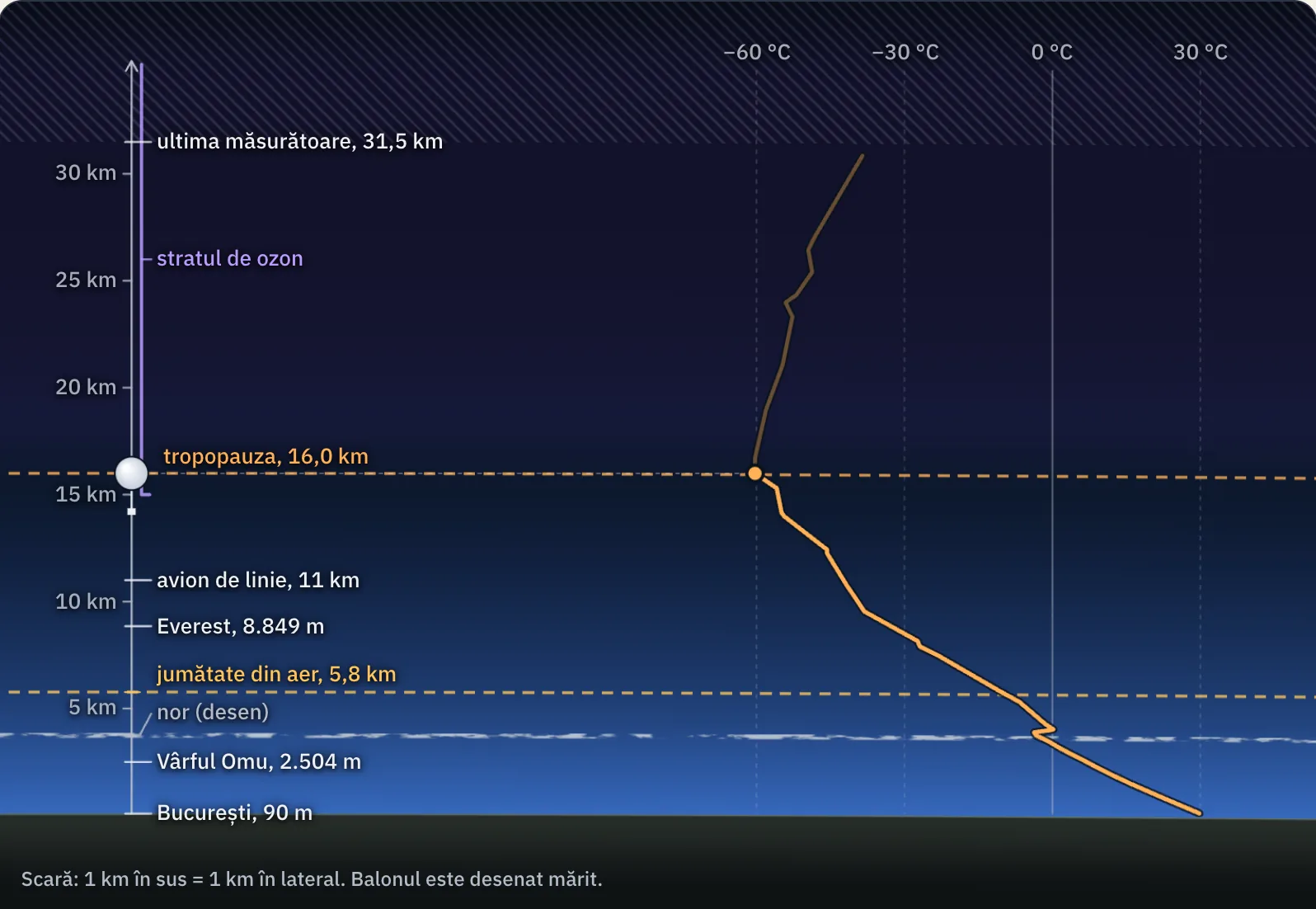
Twice a day, a balloon carrying a radiosonde leaves the Bucharest-Băneasa weather station. The radiosonde measures temperature, pressure, humidity and wind and sends the readings back by radio. Beside you is the air the balloon climbed through on 2 August 2025, drawn to scale, with the values measured that day.
The balloon leaves from the densest air
On 2 August 2025, at 14:05, the balloon was let go at Băneasa, at 90 m altitude. At the ground it was 29.8 °C and the pressure was 1,003 hPa. At launch, a balloon like this is about 1.5 m across.
The brightness of the air in the drawing follows the measurements: the denser the air, the brighter it is.
At what height do you think the balloon will have half of the air below it?
At 5.8 km, half the air lay below
At 5.8 km, the sonde measured 502 hPa, half the pressure at the ground. Pressure is the weight of the air above pressing on each unit of area, so half of all the air was already below the balloon. In winter, when the air is colder and denser, the halfway point is reached lower: at 5.6 km in the flight of 20 January 2025.
At the height of the weather station on Vârful Omu, a summit in the Bucegi Mountains, 2,504 m, the pressure was 756 hPa: 25% of the air was below. At the height of Everest, 8,849 m, 330 hPa remained, so only 33% of the air was left above.
The balloon swells as the surrounding air presses on it less. Here it is 1.8 m across, a value calculated from pressure and temperature.
In the troposphere, every kilometre climbed cooled the air by almost 6 °C
The curve is the temperature measured by the sonde, on the same height axis. From 29.8 °C at the ground, the temperature fell to −42.3 °C at 11 km, the height at which airliners fly.
Between the ground and 16.0 km, the average fall was 5.7 °C for every kilometre. Sunlight passes through the air and warms the ground, and the ground warms the air above it. That is why, in the troposphere, it gets colder the farther you go from the ground.
Between 3.6 and 3.9 km, the measured humidity passed 90%. A cloud is drawn there, with an imagined shape; the sonde measured only the humidity.
At 16.0 km the cooling stops, then the air warms
At 16.0 km, the sonde measured −60.3 °C, and higher up the temperature no longer fell. This level is called the tropopause. Below it lies the troposphere, which held 89% of the air that day and nearly all the clouds. Above it begins the stratosphere.
In the stratosphere, temperature rises with height: −39.3 °C at 31.5 km. The warmth comes from the ozone layer, between 15 and 40 km, which absorbs the Sun’s ultraviolet radiation.
The tropopause was found in the measurements with the rule of the World Meteorological Organization: the lowest level from which the temperature falls by 2 °C per kilometre or less, over a depth of at least 2 km.
The last measurement comes from 31.5 km
The last measurement sent comes from 31.5 km. The pressure there was 10.3 hPa: 99% of the air lay below the balloon.
The surrounding air pressed 97 times more weakly than at the ground, and the balloon had swollen to about 6.3 m across, from 1.5 m (calculated from pressure and temperature). At that size the rubber cannot stretch any more and the balloon bursts: this is how a flight usually ends.
Above, the drawing is hatched: from there the balloon sent no more measurements. The atmosphere goes on, thinner and thinner, for hundreds of kilometres.
In winter, the tropopause was 4.0 km lower
The blue curve is the flight of 20 January 2025, at 13:03: 10.0 °C at the ground and the tropopause at 12.0 km, at −66.1 °C. In August it was at 16.0 km. Warm air takes up more room, so in summer the troposphere is thicker. Up to the tropopause, the average fall was 6.4 °C per kilometre in winter and 5.7 °C in summer.
The night before, at 1:02, the sonde had found something else near the ground: −1.5 °C at Băneasa and 8.8 °C at 590 m altitude. Cold, heavier air sat under warmer air. This is a temperature inversion; fog and smoke gather beneath it.
Against the planet, all this air is a thin film
The drawing has pulled back until the whole Earth fits, with its radius of 6,371 km. At the same scale, the balloon’s 31.5 km climb is shorter than the thickness of a line.
On a school globe 30 cm across, the troposphere measured in August, 16.0 km thick, would be 0.38 mm. The one in January, 12.0 km thick, would be 0.28 mm, about a quarter of a millimetre. This layer holds most of the air, nearly all the clouds and the weather.
The 11 warmest years in the series that began in 1880 are the last 11
The balloon measured a single day. The state of the air on one day is weather. Climate is judged by averages over at least 30 years.
The vertical axis now shows years, from 1880 to 2025. Each bar shows how far the planet’s mean temperature was above or below the mean of the years 1951–1980, the reference period of the NASA series. In 2024, the warmest year in the series, the departure was +1.28 °C; in 2025, +1.19 °C.
The mean of the last 30 years, 1996–2025, is 0.74 °C above that of the reference period. That is how much the climate has changed, beyond the weather of each year.
Now you explain
You are on an airliner at 11 km, above the clouds, in full sunshine. The pilot announces that it is −42 °C outside. A classmate wonders: “How can it be so cold, when the plane is closer to the Sun?” What do you answer?
You have the balloon’s measurements to hand: where the air gets its heat, how much it loses with every kilometre and how much air is left above the plane.
Compare with an answer
The air is not heated from above. Sunlight passes through it and warms the ground, and the ground warms the air above it: that is why, in the troposphere, temperature falls with height. On the August flight it fell by 5.7 °C on average for every kilometre, down to −42 °C at 11 km, where 76% of the air lay below. Set against the distance to the Sun, those 11 km change nothing.
Lesson 5.1, on the composition and layers of the atmosphere
Lesson 5.4, on climate change