Chapter 7 · Life and soilLesson 7.1
The biosphere: where life exists on Earth and why it is unevenly distributed
Why do hundreds of bird species live in the Danube Delta, while only a few low-growing plants survive on a Retezat ridge?
Before you read: what do you think?
How many of the plant, animal and fungal species living on Earth do you think have already been described and entered into catalogues?
See the answer
About 14%. More than 1.2 million species have been catalogued, while a 2011 estimate puts the number living on Earth at about 8.7 million. Most species without names are insects and small marine organisms.
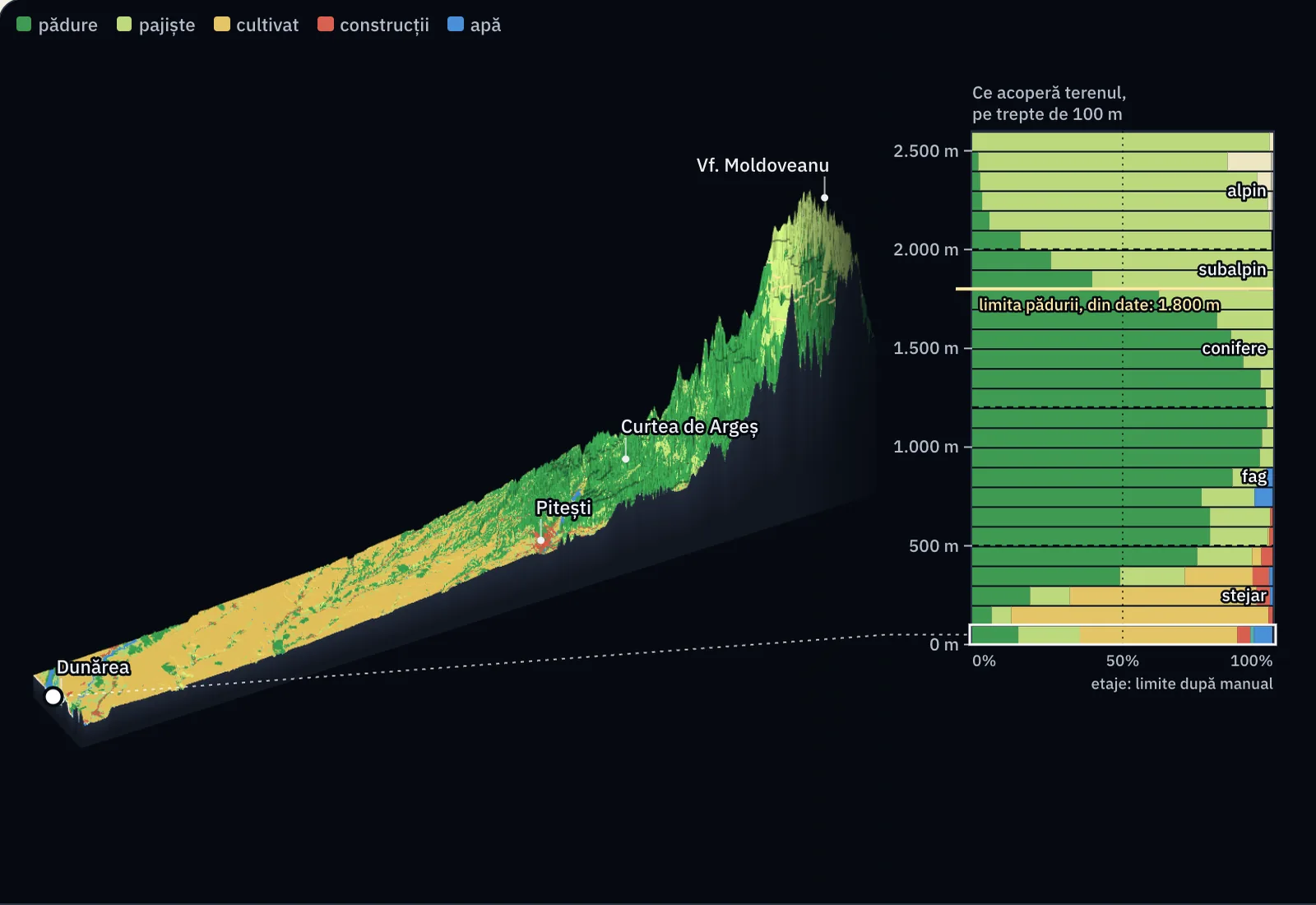
The lakes and marshes of the Danube Delta support 45 freshwater fish species, and more than 300 bird species have been recorded there. On the ridges of Retezat, a mountain range, above 2,200 m, even shrubs no longer grow: only short grassland and rocky ground remain. The two places are in the same country, about 500 km apart.
The biosphere is a thin layer at the planet’s surface
In the Danube Delta, water, light and warmth are found together. On a Retezat ridge, warmth is in short supply because temperature falls from the foot of the mountains towards their summits. Where even one thing living organisms need is missing, life becomes scarcer.
All the places where life exists, from the Delta’s pools to the grasslands on the ridge, make up the biosphere, Earth’s living layer. It includes all living organisms: plants, animals, fungi and microorganisms, together with the environment in which they live. The biosphere overlaps the other layers: it occupies the lower atmosphere, the hydrosphere and the upper lithosphere, including the soil.
From top to bottom, the biosphere measures about 20 km. Almost all life, however, is concentrated in a much thinner layer, from 500 m below the ocean surface to 6 km above sea level. Light is absent in the deep ocean, while warmth and liquid water are missing at great heights.
For the curious
Living organisms are numerous and much remains unknown about them. Scientists have described and catalogued more than 1.2 million species, but an estimate published in 2011 puts the number of plants, animals, fungi and other organisms with a nucleus in their cells (eukaryotes) on Earth at about 8.7 million; bacteria are excluded from this figure.
What determines where a species can live
Life is unevenly distributed because each species needs certain conditions. The factors that provide them fall into three groups.
Abiotic factors belong to the non-living environment. Plants need light for photosynthesis, so algae live only in the sunlit surface layer of the ocean. Temperature falls from the Equator towards the poles and from the foot of mountains towards their summits, and vegetation changes with it. Warm places differ in their water supply: forest grows where rain falls all year, while desert stretches across places where rain is very rare. Soil supplies plants with water and nutrients. Landforms change all these conditions through altitude, slope and the direction a hillside faces: a sunny slope is warmer and drier than a shaded one.
Biotic factors are relationships between living organisms: feeding, competition for light and water, and pollination. The human factor is human activity: people clear forests, farm, build and hunt, but also protect and replant.
An abundant factor cannot replace one that is missing. The Sahara receives as much light and warmth as an equatorial forest, but it lacks water.
An ecosystem: a place and its living organisms
A lake, a beech forest and an alpine meadow are all ecosystems. Each ecosystem has two parts. The biotope is the place, with its non-living conditions: rock, soil, water, air, light and temperature. The biotic community is all the living organisms in that place. The plants of a region make up its flora, and its animals its fauna.
Living organisms in an ecosystem are linked by food. A food chain shows what eats what. At the start are producers, green plants and algae that make their own food through photosynthesis. Next come consumers: herbivores, which eat plants, followed by carnivores, which eat other animals. Decomposers, bacteria and fungi, break down dead remains into simple substances, which plants take up from the soil again.
In a pond, a food chain might look like this: algae → tiny crustaceans → small fish → pike. If one link disappears, the whole chain changes. Without predators, herbivores multiply and consume vegetation faster than it can regrow.
Biodiversity and the two realms of life
Biodiversity is the variety of life in a place. It has three levels: genetic diversity within each species, the number of species and the variety of ecosystems. Equatorial forests and coral reefs are richest in species; deserts and polar regions are poorest.
Life occupies two great realms. The terrestrial realm covers the land, with its forests, grasslands, deserts and tundra. Here conditions change quickly from place to place, and temperature and water determine what vegetation grows. The aquatic realm includes the salt water of seas and oceans and freshwater: rivers, lakes and marshes.
For the curious
In water, life depends on light, temperature, salinity and dissolved oxygen. Most marine species live close to the shore and in the sunlit surface layer.
Worked example
How much of the planet’s life is known
Given: more than 1.2 million species described and catalogued; an estimated 8.7 million eukaryotic species across Earth, in the same 2011 study.
Step 1. Divide the number of known species by the estimated number: 1.2 ÷ 8.7 ≈ 0.14. Known species therefore represent about 14% of the total.
Step 2. Subtract from the whole: 100% − 14% = 86%. According to this estimate, about 86% of eukaryotic species had not yet been described in 2011.
Step 3. Read the result with its limit in mind. 8.7 million is an estimate, with a margin of 1.3 million either way. The percentage may change, but the conclusion remains: most species, especially insects and small marine organisms, still have no names.
In Romania
Five biogeographical regions in one country
Romania is the only country in the European Union with five biogeographical regions within its borders: alpine, in the Carpathians; continental, in the hills, plateaus and much of the plains; Pannonian, in the Western Plain; steppe, in the Bărăgan Plain and Dobrogea; and Black Sea, on the Black Sea coast. The stepped landforms, from 0 m to over 2,500 m, and the country’s position between the oceanic climate to the west and the continental climate to the east explain this variety.
Natural and semi-natural ecosystems cover about 47% of the territory. All of Europe’s large carnivores live in the Carpathian forests: the brown bear, wolf and lynx.
The Danube Delta shows how much life can gather where water, light and warmth are found together: over 300 bird species and 45 freshwater fish species. It is the best preserved of Europe’s deltas.
In brief
- The biosphere is Earth’s living layer; it includes living organisms and their environment and overlaps the atmosphere, hydrosphere and lithosphere.
- The distribution of life depends on abiotic factors (light, temperature, water, soil and landforms), biotic factors (relationships between living organisms) and the human factor.
- An ecosystem consists of a biotope (the place and its non-living conditions) and a biotic community (all the living organisms in that place).
- A food chain links living organisms through food: producers (plants and algae), consumers (herbivores and carnivores) and decomposers (bacteria and fungi).
- Biodiversity is the variety of life: genetic diversity, the number of species and the variety of ecosystems.
- Life occupies two realms: terrestrial (land) and aquatic (salt water and freshwater).
Common mistakes
WrongThe biosphere is a separate layer sitting above the soil, like the atmosphere.
RightThe biosphere has no space of its own. It occupies the lower atmosphere, the hydrosphere and the upper lithosphere: all the places where life exists.
WrongBiotope and biotic community mean the same thing.
RightThe biotope is the place, with its rock, water, light and temperature. The biotic community is all the living organisms in that place. Together they form the ecosystem.
WrongA greener place automatically has more biodiversity.
RightA plantation with a single tree species is very green, but poor in species. Biodiversity is measured by the variety of genes, species and ecosystems, not by the amount of vegetation.
Test yourself
Six questions. For the first five you see the explanation at once, with the paragraph of the lesson that supports it; for the ones with a written answer you compare with a good answer.
What is the biotope of a lake?
Answer
b) The water, lake bed, light and temperature. The biotope is the non-living part of the ecosystem. Living organisms form the biotic community.
Which of these organisms are producers in a food chain?
Answer
a) Algae. Producers make their own food through photosynthesis. Pike and roe deer are consumers, while bacteria are decomposers.
The Sahara receives as much light and warmth as an equatorial forest. Why does forest not grow in the Sahara?
Answer
c) Because water is missing, and light and warmth cannot replace it. Every factor is necessary. Abundant light and warmth cannot make up for a lack of water.
Between which limits is almost all life on Earth concentrated?
Answer
b) Between 500 m below the ocean surface and 6 km above sea level. The biosphere is about 20 km thick in total, but most living organisms occupy a much thinner layer, where light, warmth and liquid water are available.
Of an estimated total of 8.7 million eukaryotic species, 1.2 million have been catalogued. What percentage of the total do the catalogued species represent? Round to the nearest whole number.
%Answer
14 %. 1.2 ÷ 8.7 ≈ 0.138, or about 14%.
On the same mountain, the south-facing slope is covered in dry grassland and the north-facing slope in dense forest. The altitude and rock are the same. Explain the difference using abiotic factors.
A good answer
The south-facing slope receives more light and warmth, so water evaporates faster and the soil stays dry. The north-facing slope is shaded and cooler and retains moisture, allowing trees to grow. The landforms, through the direction the slopes face, have changed the light, temperature and water, even though the altitude is the same.
A complete answer identifies the landforms (the direction the slopes face) as a factor changing light, temperature and water, then links the available water to the type of vegetation.
Terms
- biosphere
- The layer of Earth where life exists, made up of all living organisms and the environment in which they live.
- abiotic factors
- The non-living environmental conditions that influence living organisms: light, temperature, water, soil and landforms.
- ecosystem
- A unit made up of a place (biotope) and the organisms living in it (biotic community), linked by food and energy.
- biotope
- The non-living part of an ecosystem: the place, with its rock, soil, water, air, light and temperature.
- biotic community
- All the living organisms (plants, animals and microorganisms) that live in the same biotope.
- food chain
- A sequence of organisms in which each is food for the next: producers, consumers and decomposers.
- biodiversity
- The variety of life in a place: genetic diversity, the number of species and the variety of ecosystems.
Sources and link to the programme
- National Geographic Education – Biosphere – the thickness of the biosphere (about 20 km) and the layer containing almost all life (from 500 m below the ocean surface to 6 km above sea level)
- Mora et al. (2011), PLOS Biology – How many species are there on Earth and in the ocean? – the estimate of 8.7 million species (±1.3 million), more than 1.2 million catalogued and 86% undescribed
- National Geographic Education – Ecosystem – ecosystems, biotic and abiotic factors
- National Geographic Education – Food chain – producers, consumers and decomposers
- Convenția privind diversitatea biologică – profilul de țară al României – the five biogeographical regions, 47% natural and semi-natural ecosystems, and the presence of bears, wolves and lynx
- Guvernul României – proiectul Strategiei naționale pentru conservarea biodiversității (2026) – Romania as the only EU country with five biogeographical regions
- IUCN World Heritage Outlook – Danube Delta – over 300 bird species and 45 freshwater fish species in the Danube Delta; Europe’s best-preserved delta
- Administrația Parcului Național Retezat – Habitate – dwarf pine reaches 2,000–2,200 m; alpine grasslands and rocky ground remain above it
From the programme: “The biosphere. Regional differences” (common core). Programme competences covered: 1.2, 5.4.