Câmpulung, June 1521
The oldest letter in Romanian opens and closes in Slavonic#
Neacșu of Câmpulung, in Wallachia, writes to the mayor of Brașov in Transylvania, Johannes Benkner (Hanăș Begner in the letter), that the sultan's army is moving up the Danube. It is the oldest dated text in Romanian that survives. It is written in Cyrillic letters, and it opens in Slavonic, the language in which princes' charters and church services were then written: «Mudromu i plemenitomu…», 'to the wise and noble…'. Each piece of news begins «I pak», 'and again'. Câmpulung itself appears under its Slavonic name, Dlugopole, 'the long field'.
Of the letter's 245 words, 36 are Slavonic. Of its 192 Romanian words, seven came from Slavic: corăbii 'ships' (three times), boiari 'boyars', voia 'the will', păziți 'guard', slobozie 'leave, freedom'. Nearly all the rest are inherited from Latin: dau știre 'I give word', am auzit 'I have heard', împăratul 'the emperor', oamini 'men'. The Romanian of 1521 already had its Slavic part, and its writing was still framed by Slavonic.
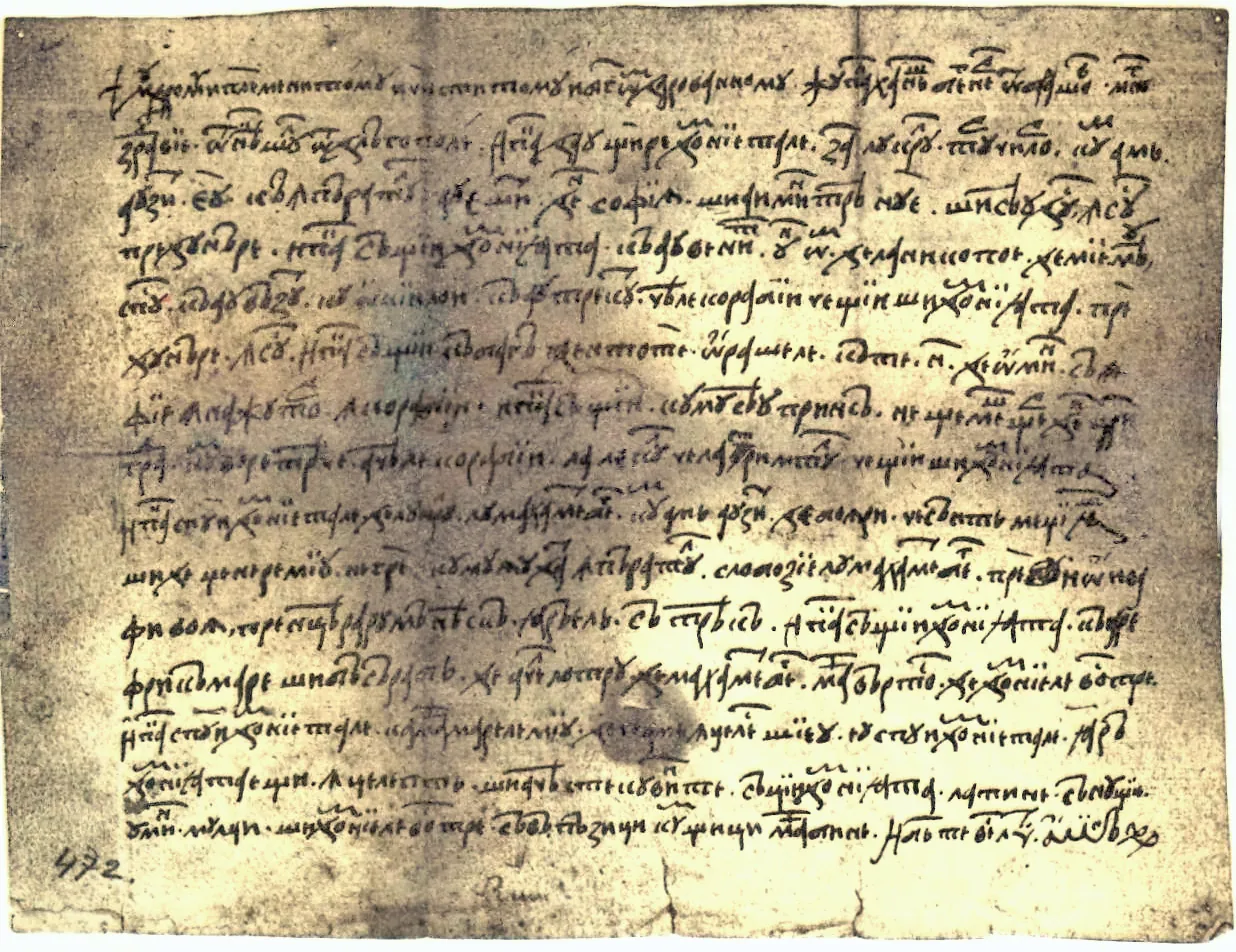
мⷹдромⷹ и племенитомꙋ и чиститомꙋ и бгѡⷨ дарованномꙋ жꙋпаⷩ ханьⷲ беⷢнеⷬ ѿ брашоⷡ мноⷢ(о)зⷣравїь ѿ нѣⷦшꙋⷧ ѿ длъгополе ипаⷦ даꙋ щире доⷨнїе тале за лꙋкрꙋⷧ тꙋⷬчилоⷬ кꙋⷨ амьаꙋзиⷮ еꙋ къ ꙟпъратꙋⷧ аꙋ ешиⷮ деⷩ софїѧ ши аимиⷩтрѣ нꙋ е ши сѣꙋ дꙋⷭ ꙟ сꙋⷭпре дꙋнъре ипаⷦ съ щїи доⷨнїꙗ та къ аꙋ вениⷮ ꙋⷩ ѡⷨ де ла никопое де мїе мѣⷹспꙋⷭ къ аꙋ възꙋⷮ кꙋ ѡ̈кїи лои къ аꙋ трекꙋⷮ чѣле корабїи че щїи ши доⷨнїꙗ та предꙋнъре ꙟ сꙋⷭ ипаⷦ съ щїи къ багъ ден тоте ѡрашеле къте м҃ де ѡмиⷩ съ ?фїе ꙟн ажꙋтоⷬ ꙟ корабїи ипаⷦ съ щїи кꙋмꙋ сѣꙋ принсъ не ще меⷲщеⷬ деⷩ ц(а)риграⷣ кꙋⷨ ворь трѣче ачѣле корабїи ла локꙋⷧ чела (ст)римтꙋⷧ че щїи ши доⷨниꙗ таипаⷦ спꙋн доⷨнїе тале лꙋкрꙋⷧ лꙋ махамеⷮ беⷢ кꙋⷨ амь аꙋзиⷮ де боѧри че сънть меџїꙗⷲши де џенере мїꙋ негре кꙋмꙋ ѧꙋ даⷮ ꙟпъратꙋⷧ слобозїе лꙋ махамеⷮ беⷢ пре (иꙋ) иѡи вафи воѧ прен цѣра рꙋмънѣскъ ꙗръ ель съ трѣкъ ипаⷦ съ щїи доⷨнїꙗ та къ арефрикъ маре ши бъсърабь де ачеⷧ лотрꙋ де махамеⷮ беⷢ маꙵ въртоⷭ де доⷨнїеле воⷭтреипаⷦ спꙋн доⷨнїе тале ка маꙵ мареле мїꙋ де че амь ꙟцелеⷭ шї еꙋ еꙋ спꙋн доⷨнїе тале ѧръдоⷨнїꙗ та ещи ꙟцелепть ши ачѣсте кꙋвиⷩте съ цїи доⷨниа та ла тине съ нꙋ щїеꙋмиⷩ мулци ши доⷨнїеле ноⷭтре съ въ пъзици кꙋⷨ щици маꙵ бине и б(ог)ь те веⷭ(е)лиⷮ амїⷩъ
Mudromu I plemenitomu, I cistitomu I B(o)gom darovannomu zupan Hanăș Begner ot Brașov mnog(o) zdravie ot Nécșul ot Dlugopole. I pak dau știre domnietale za lucrul turcilor, cum am auzit eu că împăratul au ieșit den Sofiia și aimintrea nu e. Și se-au dus în sus pre Dunăre. I pak să știi domniia-ta că au venit un om de la Nicopoe de mie mi-au spus că au văzut cu ochii lui că au trecut ceale corăbii ce știi și domniia-ta pre Dunăre în sus. I pak să știi că bagă den toate orașele câte de oamini să fie în ajutor în corăbii. I pak să știi cumu se-au prins nește meșteri den Țarigrad cum vor treace aceale corabii la locul cela strimtul ce știi și domniia ta. I pak spui domnietale de lucrul lu Mahamet-Beg, cum am auzit de boiari ce sânt megiiaș(i) și de genere-miu Negre, cumu i-au dat împăratul slobozie lui Mahamet-Beg, pre io-i va fi voia pren Țeara Rumânească, iară el să treacă. I pak să știi domniia ta că are frică mare și Băsărab de acel lotru de Mahamet-Beg, mai vârtos de domniele voastre. I pak spui domnietale ca mai-marele miu de ce am înțeles și eu. Eu spui domnietale, iară domniia ta ești înțelept și aceaste cuvinte să ții domniiata la tine, să nu știe oamini mulți și domniele vostre să vă păziți cum știți mai bine. I B(og)i te ves(e)lit, Aminu.
- Slavonic (another language, not Romanian)
- Romanian word of Slavic origin
- inherited from Latin
- from Hungarian, Turkish, Greek
- name
The text in the Cyrillic of the time, after the Wikisource transcription; below, the reading in modern letters. Tap a coloured word to see where it came from.
Three measurements
How much of Romanian is Slavic?#
The answer depends on what is counted, and the differences are large. The three measurements below use open sources and the same rule for every donor language.
12.2%
of basic meanings
Of the 1,454 meanings on the WOLD list (earth, fire, to love, hammer, friend), about one in eight is expressed with a word borrowed from the Slavs, when each meaning counts once and its words share its point. 19.3% of meanings have at least one Slavic word.
2,503
words borrowed directly, in DEX '98
7.5% of the dictionary's loanwords. French gave nearly eight times as many (19,735), nearly all of them book words.
3.5–4.6%
of spoken words
About one word in 20–30, counted in 332 million words of subtitles. Among the most frequent: a trebui ‘must’, nevoie ‘need’, prea ‘too’, prieten ‘friend’, grijă ‘worry, care’, a iubi ‘to love’, drum ‘road’, a primi ‘to receive’, tocmai ‘just’, treabă ‘business, job’, ciudat ‘strange’, a opri ‘to stop’, a plăti ‘to pay’, a omorî ‘to kill’.
The most used words (to be, to have, I, you, and, not, what, which) are Latin, so in speech the Slavic part shrinks. Among the basic things a language names, though, one in eight has a Slavic name. In the dictionary French outnumbers all other donors, through the thousands of school, science and administration terms.
One word cannot be settled by counting: da. As 'yes' it is Slavic; as a form of the verb a da 'to give' it is Latin, and a count of word forms cannot tell them apart. On its own, da is 0.6% of everything said. Without it and without the words DEX '98 only compares with Slavic, the Slavic part is 3.5%; with them and with the forms the dictionary cannot tell apart, 4.6%. Both figures include words made in Romanian with a Slavic suffix, such as fetiță 'little girl'.
What the Slavic words named
To love is Slavic. Brother and sister are Latin.#
Each stitch of the sampler below is one basic meaning from the WOLD list, and each panel is one domain. Red stitches are meanings expressed mostly with Slavic words, black ones with a word inherited from Latin, blue ones with a loan from another language, pale ones with a word made in Romanian.
Red gathers in tools and crafts (a lovi 'to hit', a clădi 'to build', ciocan 'hammer', topor 'axe', nicovală 'anvil'), in the field (grădină 'garden', gard 'fence', lopată 'shovel', coasă 'scythe', a cosi 'to mow'), in people and power (prieten 'friend', stăpân 'master', slugă 'servant', rob 'slave', graniță 'border', obicei 'custom') and in feelings (a iubi 'to love', noroc 'luck', milă 'pity', jale 'grief', grijă 'worry', vină 'guilt'). It is almost absent from close kinship (brother, sister, son and uncle are Latin), from function words and from the words for where things are.
- from Slavic
- inherited from Latin
- from another language
- made in Romanian
A stitch is red when Slavic words carry at least half of how the meaning is said. 15.0% of stitches are red, more than the 12.2% above, where each meaning shares its point among its words. The figure in each panel's corner is its share of red stitches.
When, and from whom
First the early Slavs, then the neighbours#
The first words entered between the 6th and 12th centuries, from the Slavs who settled among the ancestors of the Romanians and in time came to speak Romanian. The linguist Alexandru Rosetti shows that these old words carry the features of north-eastern Bulgarian. Of the 309 Slavic entries on the WOLD list, 179 are dated to the 6th–13th centuries, and for none of them does Kim Schulte name a particular Slavic language: a iubi 'to love', prieten 'friend', nevastă 'wife', noroc 'luck', a citi 'to read', glas 'voice', and also sfânt 'holy', iad 'hell', duh 'spirit', a blagoslovi 'to bless', a posti 'to fast'.
Then, until the 17th century, Slavonic was the written language of the church and of the princes of Wallachia and Moldavia. Neacșu's letter shows how it framed writing in Romanian.
After the 13th century, the words come from particular neighbours (Rosetti, p. 283). Of the 115 Slavic entries WOLD dates to the 11th–18th centuries, 81 have a named donor: 60 Bulgarian (grijă 'worry', obicei 'custom', graniță 'border', sărac 'poor', școală 'school', da 'yes'), 10 Ukrainian (ciubotă 'boot', lan 'field', buhai 'bull'), 9 Serbian (zgomot 'noise', pernă 'pillow', haine 'clothes'). DEX '98 gives 353 words from Russian. For another 191 words such as activ or escadron it lists Russian next to French; these are counted apart here because they came mainly from French.
One would expect each neighbour to have left its words near its own border. The village map below puts that to the test.
Hidden
Latin roots, Slavic pieces#
Slavic also left pieces of words, which Romanian then attached to any root. The prefix ne- makes necunoscut 'unknown' and nesătul 'insatiable', -iță makes fetiță 'little girl' and ploiță 'drizzle', -nic makes puternic 'strong' and dornic 'eager', răs- makes a răsufla 'to breathe', -eală makes fierbințeală 'fever', -ean makes sătean 'villager'. Rosetti and the Romanian Academy's volumes on word formation give them as Slavic; for -eală Rosetti adds a condition, and for răs- Diez and Meyer-Lübke proposed Latin re- instead.
DEX '98 has 1,949 words made in Romanian with such a prefix or suffix, 568 of them only with -eală. At least 407 sit on a root inherited from Latin (341 without the -eală words), such as ne + cunoscut, fet + iță or putere + nic. Another 437 have a Slavic root as well.
And in the grammar
unsprezece
Counting from 11 to 19 as 'one on ten' copies the Slavic pattern jedinŭ na desęte, according to Rosetti. Grigore Brâncuș proposed the pre-Roman substrate instead, citing the Albanian parallel.
Mărioaro!
The vocative in -o of feminine names (soro 'sister!', Ileano) reproduces the Slavic vocative (glavo, ženo), according to Rosetti.
el = 'yel'
Pronouncing initial e as ye (el 'he', este 'is', eu 'I') is attributed by Rosetti to Slavic influence.
lume
Latin lumen 'light' came to mean 'world' on the model of Slavic svĕtŭ, which means both (Rosetti; Schulte, in WOLD).