1910
Drag the street left or right
Timișoara, western Romania · censuses from 1869 to 2021
The languages of Timișoara: what its people told the census, from 1869 to today
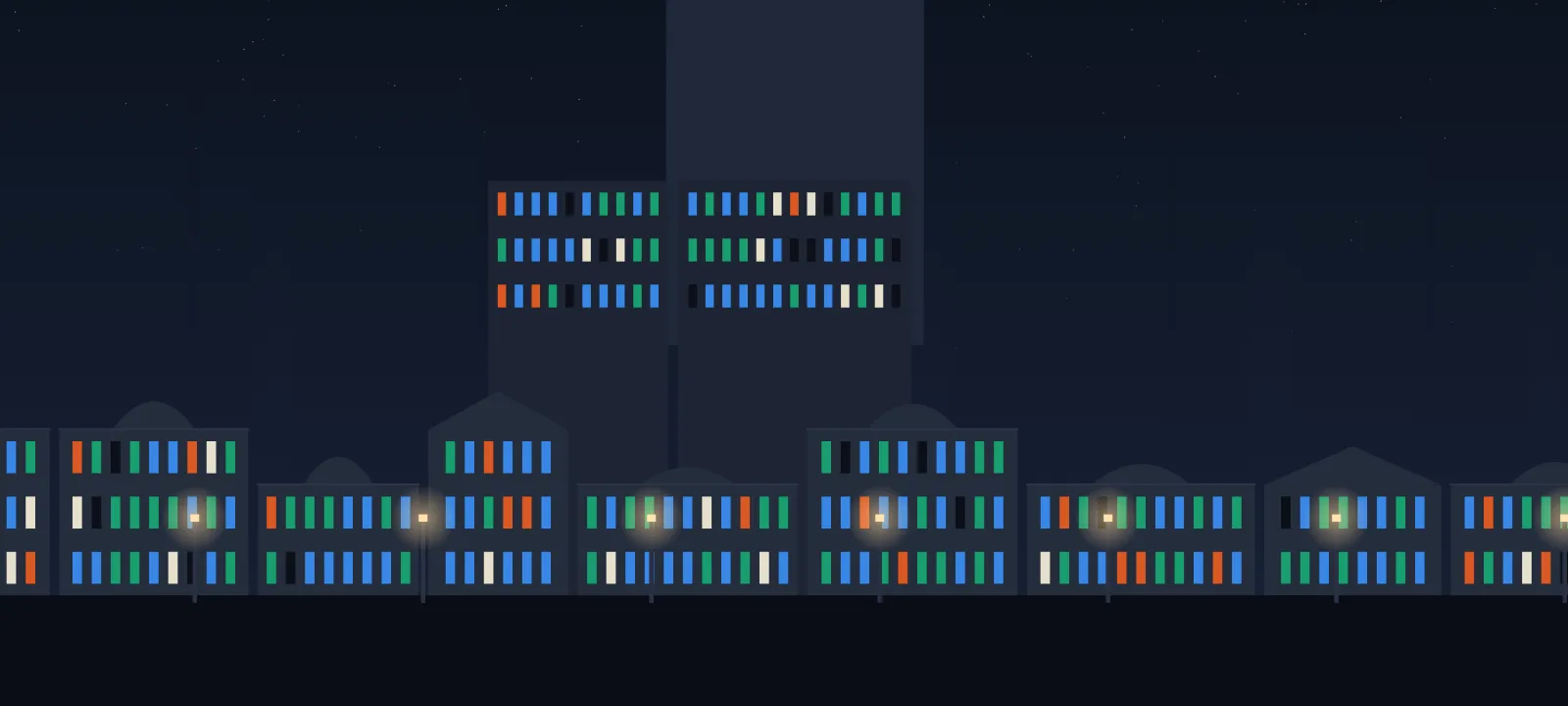
Every lit window is a hundred residents. Ask its people their mother tongue, their nationality and their faith, and the same windows answer differently. In 1910 no language had a majority; in 2021 the census has no answer on ethnicity for nearly one resident in four.
Scroll: the city answers, census by census
1910 · mother tongue
In 1910 no language had a majority#
Timișoara had 72,555 residents: 726 windows. 31,644 gave German as their mother tongue (43.6%), 28,552 Hungarian (39.4%), 7,566 Romanian (10.4%) and 3,482 Serbian.
The colours are scattered along the street at random: the census says how many, not where they lived. The city, the main city of the Banat region in the south-west of today's Romania, was then in the Kingdom of Hungary; it became part of Romania after the First World War. The Hungarian census did not ask about nationality: about origin, it recorded only mother tongue and religion.
1910 · the same people, their faith
The same windows, asked about faith#
For 1910 there is a table that links each person's two answers. The windows take their colours from it; each still stands for the same hundred people.
Two in three residents were Roman Catholic: 28,045 German speakers and 19,399 Hungarian speakers. The Orthodox were mostly Romanian speakers (7,034) and Serbian speakers (3,322).
The violet windows are the 6,728 people of the Jewish faith (the census calls it Mosaic): 4,396 gave Hungarian as their mother tongue, 2,261 German. More than one Hungarian speaker in seven was Jewish (15.4%). A census that asked only about language would not have shown the city's Jews at all.
1930 · three questions
In 1930 the Romanian state asked three questions#
That census asked the 91,580 people of Timișoara their nationality (in the census's sense: the people you belong to, not your passport), their mother tongue and their religion. For the Jews, the three questions give three numbers: 7,171 declared Jewish nationality, 9,368 the Mosaic faith, and only 442 Yiddish as their mother tongue.
The census recorded nationality as each person declared it, with one exception its preface admits. The same preface notes that Jews of the Mosaic faith declared Hungarian nationality “on a wide scale” in Transylvania, the larger region to the east, which its tables keep separate from the Banat, Timișoara's own region. In Timișoara, 9,368 people of the Mosaic faith and 7,171 of Jewish nationality: a gap of 2,197 people, whose declared nationality the volume does not show.
1930 · mother tongue
Three languages, almost equal#
By mother tongue, the city was split almost in three: Hungarian 35.5%, German 33.5%, Romanian 26.3%. Two passers-by picked at random then shared a mother tongue only about one time in three (31%, among those who answered): the rarest of all the censuses.
Set against nationality, the answers show that, among those who answered both questions, at least 7,475 people gave a mother tongue that was not that of their nationality. Of the 7,171 Jews by nationality, at least 6,729 did not give Yiddish. It is a minimum: the volume does not publish each person's two answers together, so the true number may be higher. On the street, the windows that change colour between language and nationality are only this minimum.
1948 · mother tongue
Romanian becomes the majority in 1948#
The 1948 census published only mother tongue. For the first time since 1900 one language passes half, and now it is Romanian: 58,456 speakers (52.2%). German had fallen to 16,139, from 30,670 in 1930.
1977 · nationality
The blocks of flats light up#
Between 1966 and 1977 the city grew from 174,243 to 269,353 residents: by more than half in under eleven years. On the street, the new windows light up in the back row. Romanians reach 71.2%.
1992 · nationality
The Germans become one window in twenty-five#
In 1930, 27,807 people in Timișoara had declared German nationality; in 1977, 28,429; in 1992, 13,206, that is 4.0% of a city of 334,115. Only 549 Jews remained.
1992 · the same people, their language
The second table that links the answers: 1992#
For 1992, the census publishes the nationality and mother tongue of the same people in Timișoara. Of the 13,206 Germans, 1,314 had Romanian as their mother tongue and 452 Hungarian. Of the 31,785 Hungarians, 1,989 had Romanian as their mother tongue.
Of the 549 Jews, 252 had Romanian as their mother tongue, 203 Hungarian, 53 German and 37 Yiddish. Of the 2,668 Roma, 1,590 had Romani as their mother tongue and 992 Romanian.
2021 · ethnicity
In 2021 the second-largest group of windows has no answer#
For 57,602 of the 250,849 residents the census has no answer to the question about ethnicity (23.0%): the grey windows. They outnumber all the Hungarians, Germans, Serbs and Roma together four times over.
Among those who answered, two passers-by picked at random share a mother tongue in 86% of cases. In 1930, in 31%.
Your street: choose the question and the year#
Each census asked different questions: a year in which a question was not asked stays dark. Tap a group in the key to light only its windows, or a window to see what those hundred people answered. The colours are scattered along the street at random: the census says how many answered each way, not where they lived.
Your window
Your answers stay in this browser only: they are not sent anywhere and never go into the link.
What each census asked#
The Hungarian censuses of 1880–1910 asked for mother tongue and religion. The Romanian census of 1930 asked for nationality, mother tongue and religion, and recorded each answer as it was declared. Those of 1956, 1966 and 1977 did not ask about religion; from 1992 all three are asked again. The question about origin changed its name: “neam” (people) in 1930, “nationality” in the communist censuses and in 1992, “ethnicity” from 2002 to 2021. In between, some censuses published only one answer for the city: 1920 only nationality, 1941 only “ethnic origin”, 1948 only mother tongue, 1977 only nationality.
The table shows, for each year, which answers exist for the city.
| Year | Residents | Mother tongue | Nationality | Faith |
|---|---|---|---|---|
| 1869 | 32,223 | — | — | ✓ |
| 1880 | 33,694 | ✓ | — | ✓ |
| 1890 | 39,884 | ✓ | — | ✓ |
| 1900 | 53,033 | ✓ | — | ✓ |
| 1910 | 72,555 | ✓ | — | ✓ |
| 1920 | 82,689 | — | ✓ | — |
| 1930 | 91,580 | ✓ | ✓ | ✓ |
| 1941 | 110,840 | — | ✓ | — |
| 1948 | 111,987 | ✓ | — | — |
| 1956 | 142,257 | ✓ | ✓ | — |
| 1966 | 174,243 | ✓ | ✓ | — |
| 1977 | 269,353 | — | ✓ | — |
| 1992 | 334,115 | ✓ | ✓ | ✓ |
| 2002 | 317,660 | ✓ | ✓ | ✓ |
| 2011 | 319,279 | ✓ | ✓ | ✓ |
| 2021 | 250,849 | ✓ | ✓ | ✓ |
The two tables that link the answers#
Volume five of the 1910 census counts the population present in each town by mother tongue and religion at once. Timișoara's row, from all eight parts of the table:
| Mother tongue \ Faith | Roman Catholic | Orthodox | Jewish (Mosaic) | Reformed (Calvinist) | Lutheran | Greek Catholic (Eastern rite, in union with Rome) | Neo-Protestant (Baptist, Pentecostal, Adventist and others) | other or none | Total |
|---|---|---|---|---|---|---|---|---|---|
| Hungarian | 19,399 | 451 | 4,396 | 3,363 | 665 | 208 | 11 | 59 | 28,552 |
| German | 28,045 | 276 | 2,261 | 133 | 853 | 58 | 9 | 9 | 31,644 |
| Romanian | 139 | 7,034 | 4 | 2 | 2 | 362 | 5 | 18 | 7,566 |
| Serbian | 97 | 3,322 | 1 | 3 | 1 | 53 | 4 | 1 | 3,482 |
| other languages | 918 | 144 | 66 | 31 | 82 | 67 | 1 | 2 | 1,311 |
Volume four of the 1992 census does the same for nationality and mother tongue, by municipality:
| Nationality \ Mother tongue | Romanian | Hungarian | German | Serbian | Romani | Yiddish | other languages | no answer | Total |
|---|---|---|---|---|---|---|---|---|---|
| Romanian | 273,144 | 619 | 457 | 141 | 52 | 5 | 93 | – | 274,511 |
| Hungarian | 1,989 | 29,577 | 153 | 17 | 21 | – | 28 | – | 31,785 |
| German | 1,314 | 452 | 11,404 | 14 | 7 | 1 | 14 | – | 13,206 |
| Serbian | 792 | 57 | 42 | 6,845 | – | – | 12 | – | 7,748 |
| Roma | 992 | 82 | 3 | – | 1,590 | – | 1 | – | 2,668 |
| Jewish | 252 | 203 | 53 | – | – | 37 | 4 | – | 549 |
| other | 763 | 134 | 61 | 61 | 2 | 3 | 2,598 | – | 3,622 |
| no answer | – | – | – | – | – | – | – | 26 | 26 |
Every number, census by census#
Residents and shares for every question that was asked. “Not separated” means the table counts the group under “other”.
Mother tongue
| Year | Romanian | Hungarian | German | Serbian | Yiddish | Romani | other languages | no answer |
|---|---|---|---|---|---|---|---|---|
| 1880 | 3,372 10.0% | 7,497 22.3% | 19,067 56.6% | 1,768 5.2% | not an option | 214 0.6% | 1,776 5.3% | – |
| 1890 | 3,613 9.1% | 10,657 26.7% | 22,301 55.9% | 1,545 3.9% | not an option | not separated in the table | 1,768 4.4% | – |
| 1900 | 4,014 7.6% | 18,624 35.1% | 27,051 51.0% | 1,973 3.7% | not an option | not separated in the table | 1,371 2.6% | – |
| 1910 | 7,566 10.4% | 28,552 39.4% | 31,644 43.6% | 3,482 4.8% | not an option | not separated in the table | 1,311 1.8% | – |
| 1930 | 24,088 26.3% | 32,513 35.5% | 30,670 33.5% | 1,820 2.0% | 442 0.5% | 167 0.2% | 1,611 1.8% | 269 0.3% |
| 1948 | 58,456 52.2% | 30,630 27.4% | 16,139 14.4% | not separated in the table | 2,713 2.4% | not separated in the table | 4,049 3.6% | – |
| 1956 | 76,173 53.5% | 36,459 25.6% | 25,494 17.9% | 2,509 1.8% | 512 0.4% | 128 0.1% | 982 0.7% | – |
| 1966 | 109,806 63.0% | 33,502 19.2% | 25,564 14.7% | 3,784 2.2% | 104 0.1% | 129 0.1% | 1,354 0.8% | – |
| 1992 | 279,246 83.6% | 31,124 9.3% | 12,173 3.6% | 7,078 2.1% | 46 0.0% | 1,672 0.5% | 2,750 0.8% | 26 0.0% |
| 2002 | 277,061 87.2% | 23,036 7.3% | 6,088 1.9% | 5,618 1.8% | 46 0.0% | 1,916 0.6% | 3,895 1.2% | – |
| 2011 | 262,747 82.3% | 15,059 4.7% | 3,776 1.2% | 4,479 1.4% | 43 0.0% | 1,235 0.4% | 3,402 1.1% | 28,538 8.9% |
| 2021 | 178,371 71.1% | 7,788 3.1% | 1,738 0.7% | 2,327 0.9% | 19 0.0% | 444 0.2% | 2,084 0.8% | 58,078 23.2% |
Nationality
| Year | Romanian | Hungarian | German | Serbian | Jewish | Roma | other | no answer |
|---|---|---|---|---|---|---|---|---|
| 1920 | 15,892 19.2% | 26,185 31.7% | 29,188 35.3% | not separated in the table | 8,296 10.0% | not separated in the table | 3,128 3.8% | – |
| 1930 | 24,217 26.4% | 27,652 30.2% | 27,807 30.4% | 2,156 2.4% | 7,171 7.8% | 337 0.4% | 1,991 2.2% | 249 0.3% |
| 1941 | 44,349 40.0% | 20,090 18.1% | 30,940 27.9% | not separated in the table | not separated in the table | not separated in the table | 15,461 13.9% | – |
| 1956 | 75,855 53.3% | 29,968 21.1% | 24,326 17.1% | 3,065 2.2% | 6,700 4.7% | 122 0.1% | 2,221 1.6% | – |
| 1966 | 109,100 62.6% | 31,016 17.8% | 25,058 14.4% | 4,188 2.4% | 2,590 1.5% | 120 0.1% | 2,171 1.2% | – |
| 1977 | 191,742 71.2% | 36,724 13.6% | 28,429 10.6% | 6,776 2.5% | 1,629 0.6% | 1,109 0.4% | 2,944 1.1% | – |
| 1992 | 274,511 82.2% | 31,785 9.5% | 13,206 4.0% | 7,748 2.3% | 549 0.2% | 2,668 0.8% | 3,622 1.1% | 26 0.0% |
| 2002 | 271,677 85.5% | 24,287 7.6% | 7,157 2.3% | 6,311 2.0% | 367 0.1% | 3,062 1.0% | 4,799 1.5% | – |
| 2011 | 259,754 81.4% | 15,564 4.9% | 4,193 1.3% | 4,843 1.5% | 176 0.1% | 2,145 0.7% | 3,925 1.2% | 28,679 9.0% |
| 2021 | 176,615 70.4% | 8,313 3.3% | 2,189 0.9% | 2,776 1.1% | 111 0.0% | 745 0.3% | 2,498 1.0% | 57,602 23.0% |
Faith
| Year | Orthodox | Roman Catholic | Jewish (Mosaic) | Greek Catholic (Eastern rite, in union with Rome) | Reformed (Calvinist) | Lutheran | Neo-Protestant (Baptist, Pentecostal, Adventist and others) | other or none | no answer |
|---|---|---|---|---|---|---|---|---|---|
| 1869 | 5,487 17.0% | 20,631 64.0% | 3,982 12.4% | 302 0.9% | 629 2.0% | 1,120 3.5% | not separated in the table | 72 0.2% | – |
| 1880 | 4,874 14.5% | 22,037 65.4% | 4,019 11.9% | 598 1.8% | 1,021 3.0% | 1,043 3.1% | not separated in the table | 102 0.3% | – |
| 1890 | 4,863 12.2% | 27,187 68.2% | 4,870 12.2% | 612 1.5% | 1,121 2.8% | 1,122 2.8% | not separated in the table | 109 0.3% | – |
| 1900 | 6,129 11.6% | 37,080 69.9% | 5,916 11.2% | 552 1.0% | 2,064 3.9% | 1,186 2.2% | not separated in the table | 106 0.2% | – |
| 1910 | 11,227 15.5% | 48,598 67.0% | 6,728 9.3% | 748 1.0% | 3,532 4.9% | 1,603 2.2% | 30 0.0% | 89 0.1% | – |
| 1930 | 24,307 26.5% | 48,136 52.6% | 9,368 10.2% | 2,056 2.2% | 4,690 5.1% | 2,279 2.5% | 235 0.3% | 239 0.3% | 270 0.3% |
| 1992 | 262,752 78.6% | 42,582 12.7% | 556 0.2% | 4,530 1.4% | 8,274 2.5% | 822 0.2% | 11,038 3.3% | 3,561 1.1% | – |
| 2002 | 256,262 80.7% | 32,274 10.2% | 350 0.1% | 3,876 1.2% | 6,209 2.0% | 455 0.1% | 13,694 4.3% | 4,540 1.4% | – |
| 2011 | 241,992 75.8% | 22,692 7.1% | 180 0.1% | 3,662 1.1% | 4,159 1.3% | 286 0.1% | 11,727 3.7% | 4,547 1.4% | 30,034 9.4% |
| 2021 | 152,234 60.7% | 15,218 6.1% | 114 0.0% | 1,638 0.7% | 2,488 1.0% | 248 0.1% | 8,704 3.5% | 8,098 3.2% | 62,107 24.8% |
What the censuses do not say#
Only for 1910 (language and religion) and 1992 (nationality and language) did I find tables that link two answers of the same people at city level. The 1930 volume sets nationality and mother tongue “face to face, on two pages”, but not together. Varga E. Árpád writes that tables linking nationality and mother tongue are published from 1956 on; for Timișoara I found none before 1992.
The city did not have the same boundaries at every census. Districts and villages joined it over time: Mehala is counted in Timișoara from 1910, Ghiroda Nouă and Plopi from 1948, Fratelia and Freidorf from 1956. For 1880 I use Varga's figures, in which the 1,103 children who could not yet speak are spread across the languages in proportion.
The Hungarian censuses did not offer Yiddish as a mother tongue. The 2011 census counts the usually resident population (populația stabilă), the 2021 census the resident population (populația rezidentă): two different definitions, so the totals of 319,279 and 250,849 residents are not directly comparable. For 2011 and 2021, “no answer” is the “information not available” column in the tables of Romania's National Institute of Statistics.
Sources#
- Varga E. Árpád, Temes megye településeinek etnikai (anyanyelvi/nemzetiségi) adatai 1880–2002 and felekezeti adatai, the electronic edition of volume III of Erdély etnikai és felekezeti statisztikája (Pro-Print, 2000), updated 2008. The original link no longer works; copy in the Internet Archive. web.archive.org
- A Magyar Szent Korona országainak 1910. évi népszámlálása, part 5 (Magyar Statisztikai Közlemények 61, 1916), table 22: mother tongue against religion, row Temesvár (Timișoara's Hungarian name), pages 248–277. library.hungaricana.hu
- Recensământul general al populației României din 29 decemvrie 1930, volume II (Central Institute of Statistics, 1938): the preface and pages 468–469 (nationality, mother tongue) and 755 (religion), Timișoara municipality. archive.org
- Romania's National Institute of Statistics, 2011 Population and Housing Census, tables 8 (ethnicity), 10 (mother tongue) and 13 (religion) by locality. recensamantromania.ro
- Romania's National Institute of Statistics, 2021 Population and Housing Census, tables 2.02.2, 2.03.2 and 2.04.2 by administrative unit. recensamantromania.ro