Neamț Monastery: what did the monks copy — ten dated books in 143 years?
Five centuries of books on a single axis, after the 1905 catalogue: what was copied at Neamț and what only reached the shelves, each book with its year and proof.
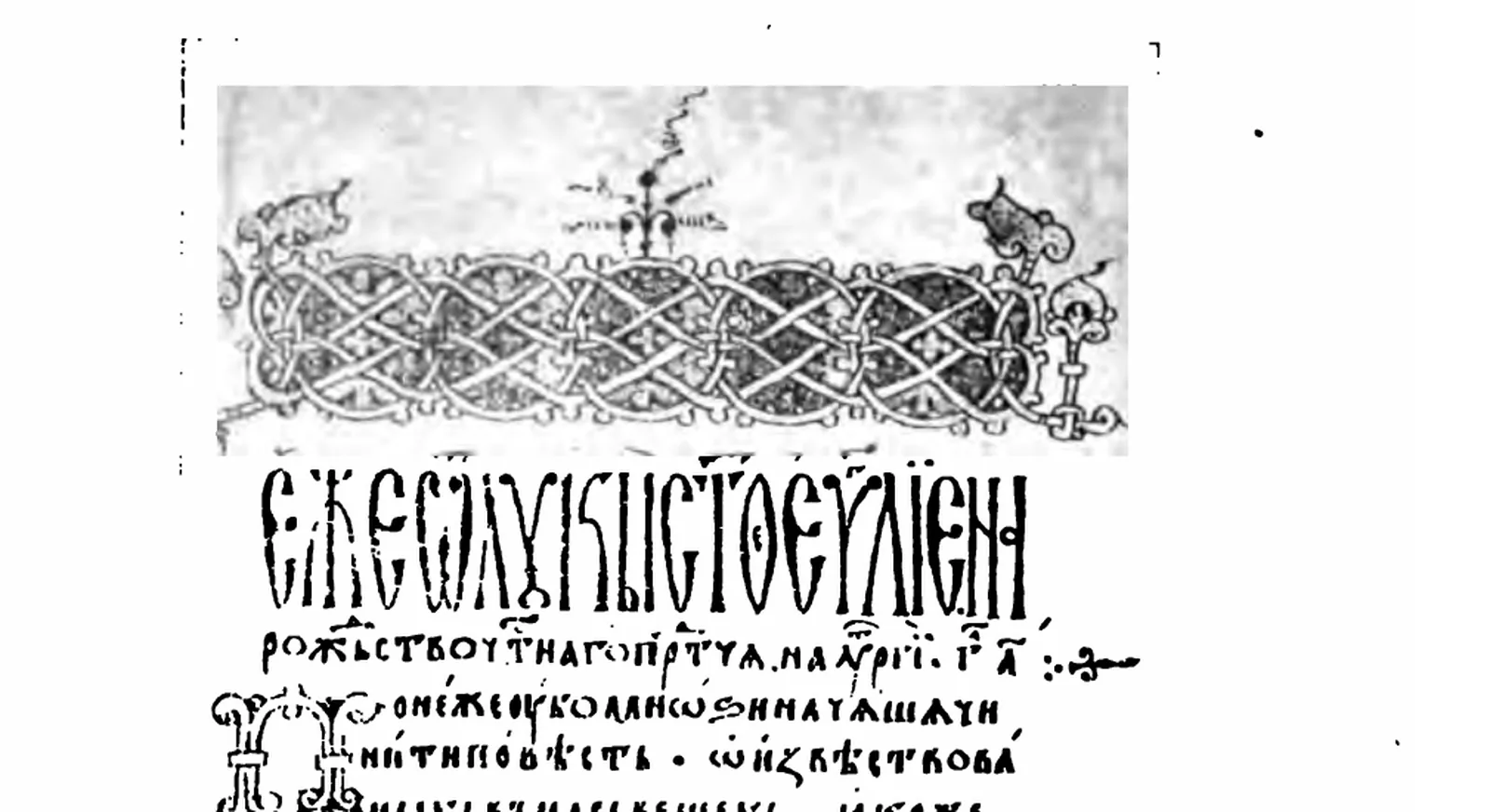
Interlaced headpieces from a Slavonic manuscript: facsimile in Yatsimirsky’s 1905 catalogue, plate XVI (public domain). The plate does not identify the manuscript.
The question
Neamț Monastery is, in the 1905 catalogue's words, one of the oldest monasteries of Moldavia — and its great medieval scriptorium. What did the monks actually copy, and when?
Five centuries of books sit below on one axis, in two rows: COPIED AT NEAMȚ (year, scribe, colophon proof) and ON THE SHELVES (gifts, imports, Paisie's school).
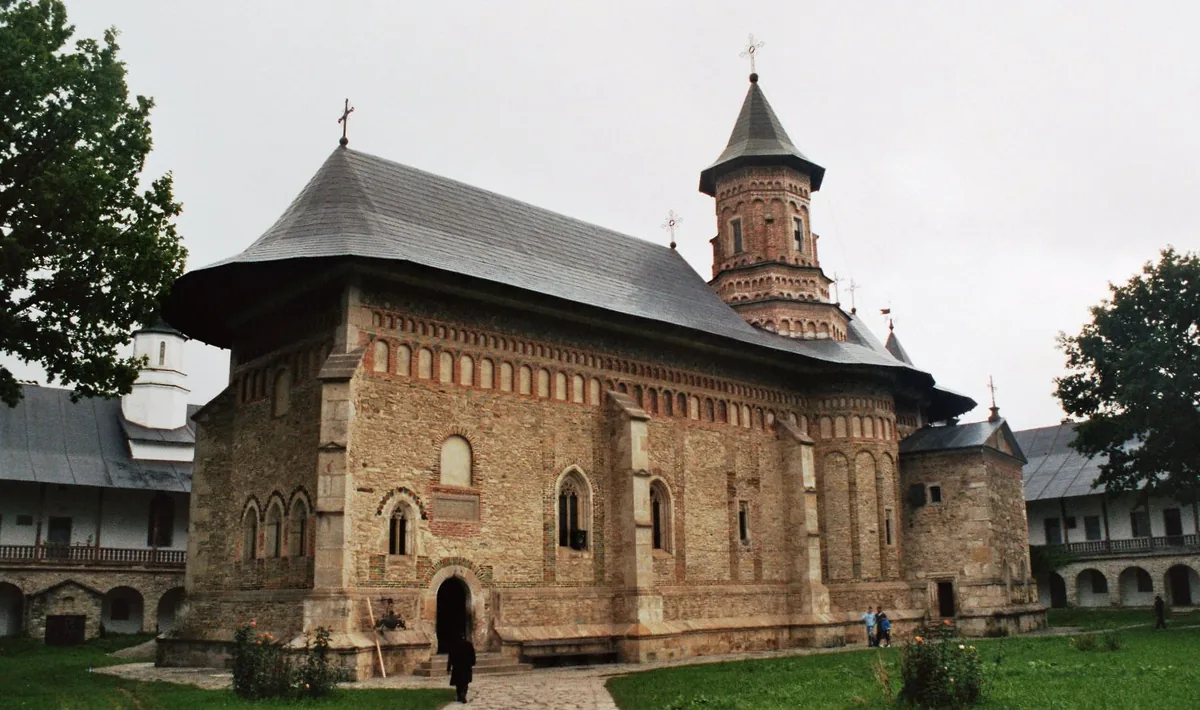
The Neamț monastery ensemble. Photo: Dickelbers, CC BY-SA 3.0, via Wikimedia Commons. Commons
The dossier gathered here — the 1905 catalogue's Neamț section, completed by Turdeanu 1943 — gives ten dated copies in 143 years (1436–1579): five by Gabriel, one menaion from the Putna set, two by Gervasie, two late ones. Then a gap of nearly two centuries with no dated copy identified in this dossier, then 57 dated rows from Paisie's school, between 1768 and 1837. The top row is empty between 1448 and 1467 and between 1480 and 1500; no source in the dossier asks for a copy in those years.
The verdict is yours: three readings of the evidence, and the axis lights up differently under each.
The axis: five centuries, two rows
Every mark is a dated book: copied at Neamț above; gifts and imports (dots) and Paisie's school (rings) below. Bands: 1407, 1497, the empty years, Paisie, 1862, 1861. Hatched: the 13 “Gabriel's hand” books, never signed.
Bring a year of your own
Type a year to see which books already existed.
Copied at Neamț
The 1467 set (attributed)
Gabriel band (unsigned)
On the shelves
Paisie's school
Chapters
1436–1448 · Gabriel
Gabriel, son of Uric — and the thirteen signed books
The most industrious copyist of medieval Neamț: Gabriel, son of the monk Paisie Uric — another Paisie, four centuries before Velichkovsky. The 1905 catalogue had mistaken him for Gregory Tsamblak; Turdeanu 1951 separated the hands.
Twelve dated books, 1424–1448, plus a signed undated ascetic sbornik (about 1430, now BAR 149): Gregory the Theologian (1424, copied at Neamț in Turdeanu 1951's account), Princess Marina's Tetraevangelion (1429), the five at Neamț (1436–1447), two early sborniki at Bucharest (1437/38, 1441), Basil's Discourses (1444), a fragment (1447), the November Menaion (1448). From “about twenty” (1943), by 1951 only a signature enters.
At Neamț, Gabriel signs five books: the 1436 Tetraevangelion (No. 5, begun on April 6, finished on February 3, under abbot Siluan), the 1443 Margarit (No. 67/68: one book in two catalogue numbers), the February Menaion of 1445 (No. 51), the 1446 Ladder (No. 76) and the March Menaion of 1447 (No. 52).
Four of the five left for Bucharest: Turdeanu in 1951 cites the same titles, years and signatures at shelfmarks 136, 122, 143 and 123 — while in 1905 the Academy held none of Gabriel's. The move is recorded nowhere; the inference stands with both shelfmarks on view.
Another 13 books carry the note “Gabriel's hand” — some “hand”, some merely “resembling”. An early-sixteenth-century imitation (No. 13) stands outside the band. Rejected by the 1951 method: they stand as a hatched band, never as signed.
1467 · The Putna menaia
Stephen builds Putna; Neamț writes the menaia
Digging began at Putna on June 4, 1466; Stephen orders a twelve-month set of menaia, divided — says Turdeanu — among Neamț's Slavonic experts, under Ioasaf, Putna's first archimandrite, from Neamț.
Of twelve, seven survive: January (Ioanichie, Moscow), April (deacon Nicodim), November (Casian, at Putna in 1943), December, March, June, August (unsigned, Moscow). Turdeanu reckoned the missing five had existed beyond doubt, since a series is not written with gaps.
“This January menaion was written for the monastery at Putna. And it was written in the monastery of Neamț, by the hand of the much-sinful so-called hieromonk Ioanichie” (spelling normalized) — the only colophon in this dossier to name the house with the word “in”. The six siblings enter only in the catalogue reading, by the set's unity.
The April deacon signs as a hieromonk six years later: the Humor Tetraevangelion (1473), Stephen's gift, finished on June 17, under abbot Gherondie. Turdeanu takes him for the same hand and finds him again “among the scribes of Neamț”; the link between the two signatures is Turdeanu's identification. It is not a Neamț copy: it does not enter the axis; it stands in the story, as diaspora.
1474–1475 · Gervasie
Gervasie: the law and the prophets
“The monk Gervasie of Neamț monastery”: in 1474 he finishes Blastares' Syntagma (in Turdeanu: Vlastaris; No. 60) — canon law with a Latin glossary, which Turdeanu calls Moldavia's first juridical monument — written for Neamț. Its present shelfmark was not opened here.
That October (6983: 1474 by Byzantine reckoning; Turdeanu prints 1475), in the “fruitful quiet of Neamț monastery”, Gervasie writes the prophets and the wisdom books: 297 leaves, 19 ornaments, 24 initials, finished on October 26. A note of 1531 records elder Ioil's death under abbot Teodosie; where the book was then, the note does not say. Turdeanu thought it probably among the manuscripts Yatsimirsky gathered in Romania around 1904 and sold to Shchukin, towards Moscow.
Yatsimirsky believed Gervasie carried on the old Middle-Bulgarian translation Gabriel too had copied from; Turdeanu finds the hypothesis plausible.
1500–1767 · The thin centuries
Two books in two centuries — and shelves full of elsewhere
After 1474 the upper row falls silent: a 1512 Tetraevangelion (Dimitrie, under abbot Partenie, at the order of Teoktist, the former Neamț abbot turned metropolitan — the colophon also dates Cozmin, October 26, 1497, and the church, November 14) and a 1579 Psalter (Misail, at his own cost, under abbot Vissarion — a scraped word before the name).
Below, meanwhile: Stephen's Apostolos of 1500, the Job Commentaries from Zograph (?), the 1523 Typikon from Putna, Lăpușneanu's 1553 Tetraevangelion, a war-colophon menaion (1574), a parchment Euchologion (1634), books from Kiev. In this dossier the house receives; it has no more copies.
The ruptures show as bands: the house empty twelve years (1671–1683) and three (1691–1694); the 1862 fire — most Slavonic books and almost all the Romanian and foreign ones, says the catalogue; Andronic's departure of 1861, across the Prut, towards Noul Neamț.
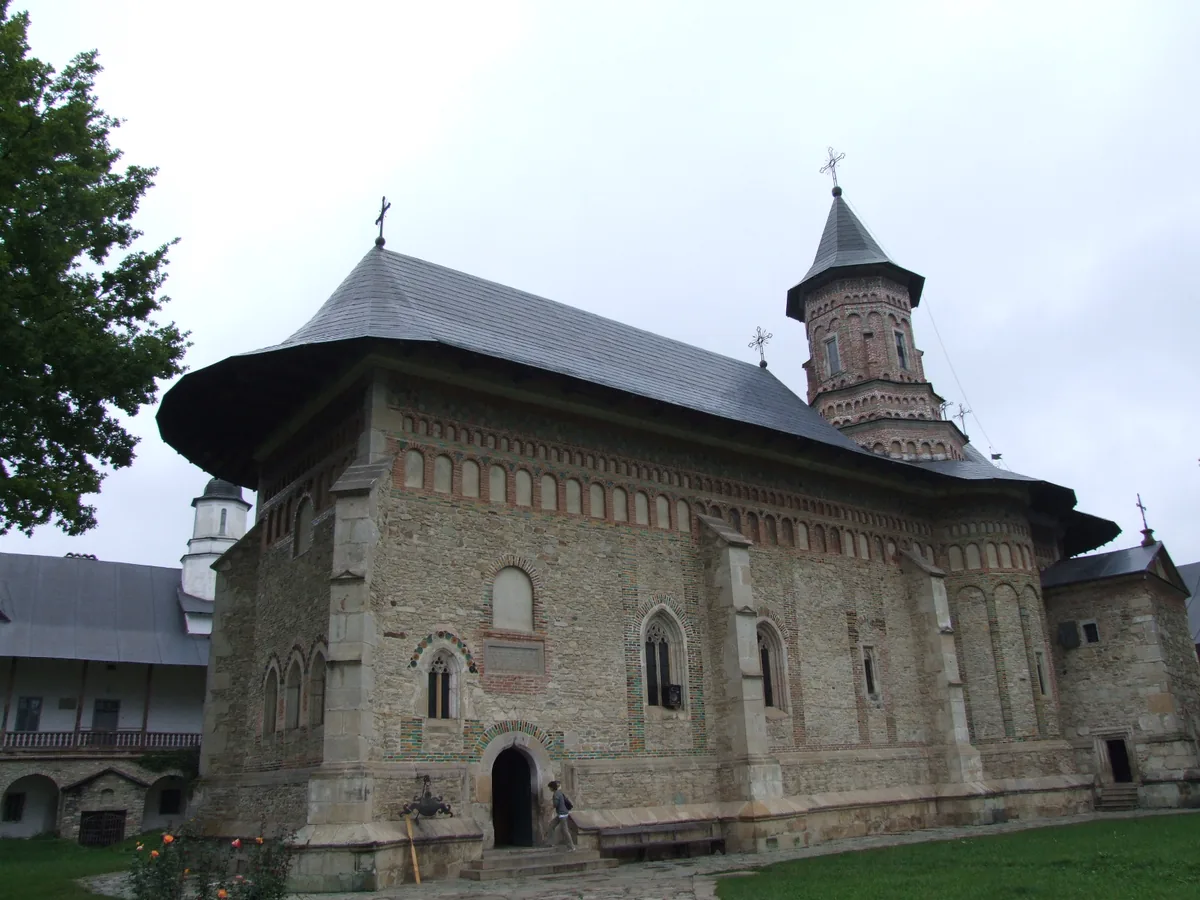
The Ascension church (1497). Photo: Cosmin Cornea, CC BY 2.0, via Wikimedia Commons. Commons
1768–1837 · Paisie
Paisie: 57 rows over 69 years, few located
Paisie Velichkovsky (b. December 21, 1722, Poltava — d. November 15, 1794): Dragomirna, then Secu — October 14, 1775 (the day: Diaconu 2016), with 350 monks in Yatsimirsky's account (Diaconu: a 350-strong Dragomirna community, 200 companions) —, then Neamț, from August 14, 1779, fifteen years, archimandrite from 1790.
His school translates and copies the Fathers: Isaac the Syrian in Paisie's translation (1775, 1777, the fair copy 1787, to 1798), the Ladder (two copies, 1786), the Philokalia (1796, 1800). The count: 57 dated rows, 56 books (P195 has two parts, 1790 and 1791, counted once, at 1791), 1768–1837. A row is one dated part of a book.
For most rows the catalogue gives no copy-place. Of the located ones, six were written at Neamț (among them Dorofei's P160 translation, made inside Neamț); the rest name Dragomirna, the Vorona skete, Iași or Poiana Mărului. That is why they stand below: the school's yield, not the house's.
Print years, composition years, ownership notes and source books did not enter the count; the decisions stand in the ledger, beside each book.
The verdict: which century did the copying?
Three readings of the same evidence; the axis re-lights under each.
Copied at Neamț
The 1467 set (attributed)
Gabriel band (unsigned)
On the shelves
Paisie's school
The ledger: every book, with its proof
Every mark shows its papers: number, year, hand, proof of place (the cited catalogue: 1905, 1943 or 1951; not a present address). The pairs keep both shelfmarks.
Copied at Neamț — the ten
No.51436 Tetraevangelion (Four Gospels) · Gabriel, son of Uric · ab. Siluan · signed; begun Apr 6, finished Feb 3 · inv. 92
No.67/681443 Margarit (Pearls of John Chrysostom) · Gabriel · signed on the fragment; one book in two numbers · inv. 89, 63
No.511445 February Menaion · Gabriel · signed; headpiece painted by Gabriel · inv. 87
No.761446 Ladder of John of Sinai · Gabriel · signed · inv. 94
No.521447 March Menaion · Gabriel · signed · inv. 77
No.1467-Jan1467 January Menaion (for Putna) · Ioanichie · “in the monastery of Neamț” · Moscow, Undolsky 78
No.601474 Syntagma of Matthew Blastares · Gervasie of Neamț · a Neamț scribe; for Neamț · inv. 54
No.1475-OT1474 Prophets and wisdom books · Gervasie · “the fruitful quiet of Neamț monastery”; Oct 26, 6983 · Moscow, Rumyantsov ex-Șciukin
No.101512 Tetraevangelion (Four Gospels) · Dimitrie · ab. Partenie · Teoktist's order; under ab. Partenie · inv. 91
No.311579 Psalter · Misail · ab. Vissarion · at his own cost; ab. Vissarion (a scraped word before it) · inv. 28
The Gabriel band — 13 notes, unsigned
No.2руки писца Гавріила
No.6рука писца Гавріила (resembling No. 76)
No.7руки писца Гавріила; dated by resemblance to the 1448 Sbornik
No.17middle quires from a Gabriel MS (composite with 17th c.)
No.33руки писца Гавріила
No.34рука писца Гавріила
No.35руки писца Гавріила
No.41очень близкій к почерку писца Гавріила
No.49похожій на письмо Гавріила + Gabriel's corrections and quire signatures
No.50похожій на письмо Гавріила + quire signatures in Gabriel's hand
Every date names its suppliers: Yatsimirsky 1905 (autobiography, Grigorie's Life, hegumen list) and Diaconu 2016.
Born: December 21, 1722, Poltava — the autobiography + Grigorie's Life (Y1905) · D2016.
Secu: October 14, 1775 — the day is D2016's; the year, Y1905's.
350 monks at the move towards Secu — Yatsimirsky (narrative and hegumen list); D2016 counts the 350 in the Dragomirna community and 200 companions.
Neamț: August 14, 1779 — Y1905; the Dormition 1779 — D2016.
Archimandrite: 1790 — Y1905 · D2016.
Died: November 15, 1794 — Grigorie's Life (Y1905) · D2016.
The Ascension church: the year 1497 in both witnesses — the day (November 14) only in the No. 10 colophon.
Method: what enters, what does not
A Neamț copy means a Neamț scribe, work under its named abbot, or an explicit “at/in Neamț” formula, quoted beside each book. The rest stand below: the house's wealth, not its hand.
The method's edge: three books. The 1463 Praxapostolos (Mircea; 18 ducats), place unfound. The January 1466 Menaion, Moldovița's. The 1475 Abba Dorotheus, for Zograph — house unstated; Turdeanu inferred it stayed in the country, reaching Bisericani at an unknown date.
Not printed: any fourteenth-century foundation year (the 1390s charters are 1490s charters — 1397→1497, 1398→1498, 1399→1499 — by the catalogue's three tests; the first mention remains 1407); where the 1473 book sleeps today (no opened source); Paisie's canonization dates; Fecioru 1952, unreachable and uncited.
Opened sources: Yatsimirsky 1905 (105 + 275 catalogue entries, used colophons checked on the scans); Turdeanu 1943 (the 1467 set, Gervasie, Humor 1473); Turdeanu 1951 (the 13); Bogdan 1907 (the Humor colophon); Diaconu 2016 (Paisie's dates).