In May 1600 a prince of Wallachia ruled, for the first time, all three Romanian lands. Four months later he held not one. This is the story of the three campaigns — and of the treasury that paid for them.
By Marius Comper · 18 September 2026 · English edition
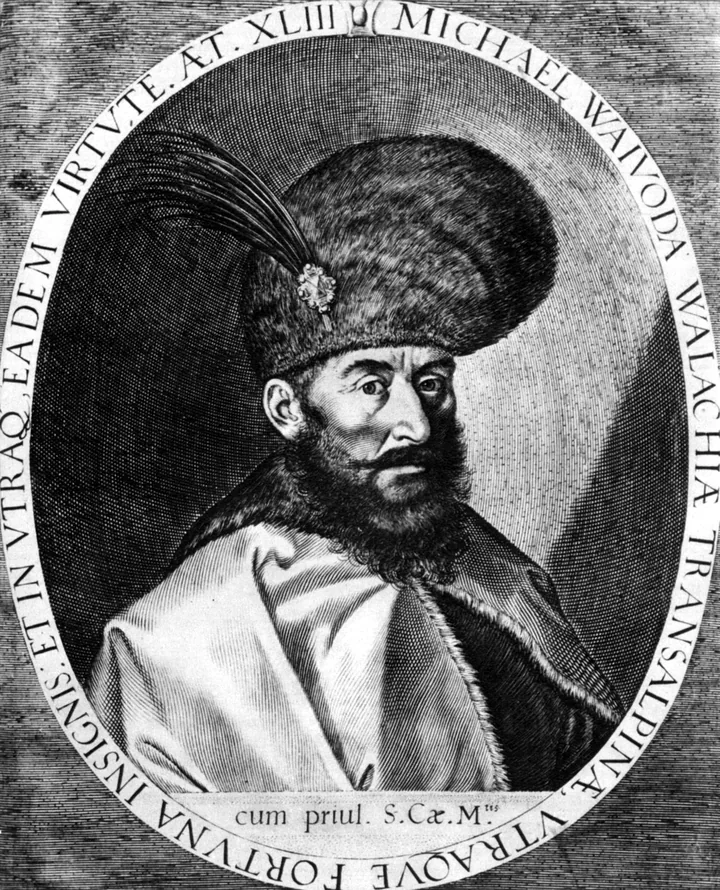
Michael the Brave — a contemporary portrait, engraved by Aegidius Sadeler II, 1601. A contemporary portrait: engraved by Aegidius Sadeler II, 1601 · Public domain · Wikimedia Commons
The short answer
Michael the Brave (1558–1601) took Wallachia in October 1593, defeated the Ottoman Empire at Călugăreni (13/23 August 1595), conquered Transylvania at Șelimbăr (18/28 October 1599), entered Alba Iulia on 1 November 1599 and seized Moldavia by surprise (6 May 1600). For four months — May–September 1600 — he held all three crowns in a personal union, not a national one. Defeated at Mirăslău (18 September 1600) and driven from Moldavia at Bucov, he returned with 100,000 florins from Prague, won at Guruslău (3 August 1601) and was assassinated at Câmpia Turzii (9/19 August 1601).
The map of the three campaigns
Three campaigns on a single map, from October 1593 to August 1601. Press play and watch the empire grow while the treasury drains.
A schematic map, drawn from scratch; positions are representative, not measurements.
October 1593 – 9/19 August 1601Three campaigns on a single map, from October 1593 to August 1601. Press play and watch the empire grow while the treasury drains.
The treasuryIllustrative200,000 → 0 florinsAn illustrative counter: it joins two documented sums — 200,000 florins (1593) and 100,000 florins (1601) — with a linear drain. The real monthly wages are undocumented.
All 13 moments
October 1593An enthronement on credit: 200,000 florins, the treasury full.
20 May 1595The treaty of Alba Iulia: alliance with Sigismund Báthory.
13/23 August 1595Călugăreni: victory over Sinan Pasha, then retreat.
October 1595Târgoviște and Giurgiu retaken beside the allies.
26 June 1599Peace with the Turks: without money or allies, the war stops.
18/28 October 1599Șelimbăr: Transylvania conquered by the sword.
1 November 1599The triumphal entry into Alba Iulia: the second crown.
6 May 1600The crossing into Moldavia: the third crown.
18 September 1600Mirăslău: Transylvania lost.
October 1600Bucov, on the Teleajen: Moldavia lost too.
February–March 1601Prague: an audience and 100,000 florins for a new host.
3 August 1601Guruslău: the last victory, between 9 and 19 o'clock.
9/19 August 1601Câmpia Turzii: assassinated on Rudolf II's order. The treasury: empty.
The three campaigns and the fall
Four chapters, one anatomy: the dates, a scene in Bălcescu's words, a period image and what was happening meanwhile.
I
The inheritance
1593–1595
A throne bought with 200,000 borrowed florins — and defended with the first Christian victory against Sinan Pasha.
Mihai Pătrașcu — Ban of Mehedinți in 1588, stolnic, then Ban of Craiova in 1593 — quarrelled with Alexandru cel Rău in May 1593 and fled to Transylvania, then to Constantinople. With the support of his cousin Andronikos Kantakouzenos and of the English ambassador Edward Barton, plus a loan of 200,000 florins, he was invested prince by Sultan Murad III in September 1593; his effective rule begins on 11 October.
He joined Pope Clement VIII's Holy League and signed the treaty of Alba Iulia on 20 May 1595 — a regime of the 12 great boyars. Sinan Pasha crossed the Danube on 4 August with a host nearly three times larger; on 13/23 August 1595, on the marshy field of Călugăreni, Michael defeated him — but then had to retreat to Stoienești, while Sinan occupied Bucharest and Târgoviște and declared the country a pashalik.
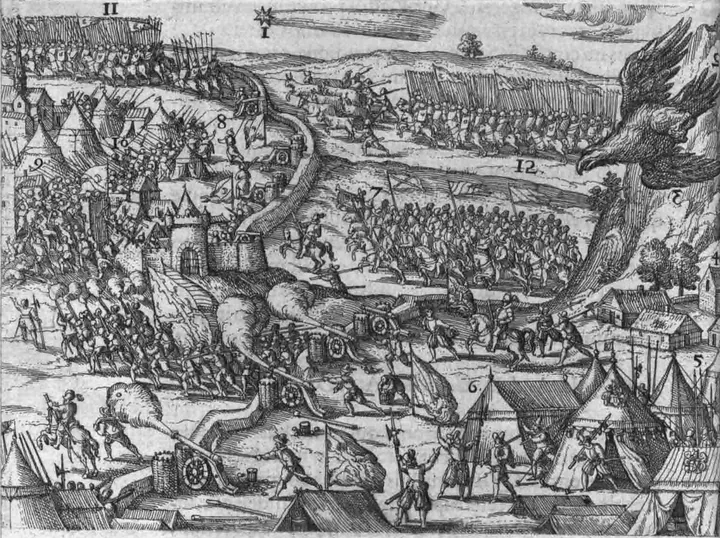
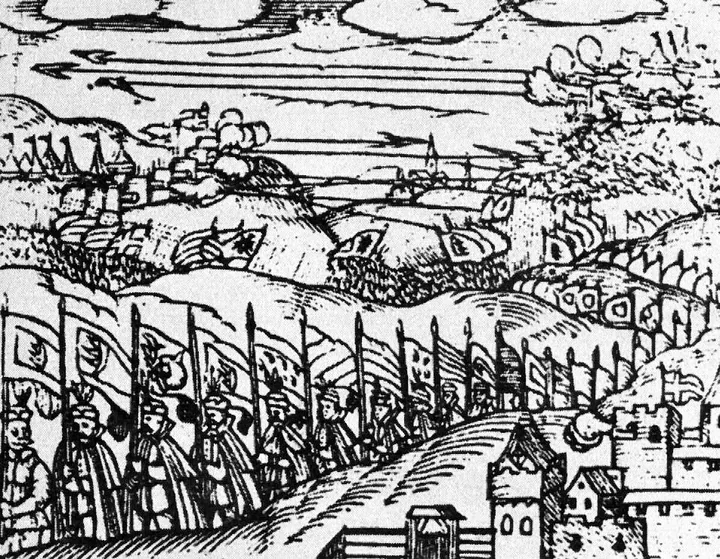
Liberation came only in October 1595, beside Sigismund Báthory's 40,000 men under Bocskai: Târgoviște and Giurgiu were retaken. The Turkish war dragged on, with pauses on 7 January 1597 and 9 June 1598, until the peace of 26 June 1599 — signed because Michael had run out of money and allies.
Michael beats the Turks at Târgoviște, October 1595 — a contemporary illustration. A contemporary illustration, 1595 · Public domain · Wikimedia Commons
II
Transylvania, by the sword
1599
Peace with the Turks in June, war on the cardinal in October: crossing the Carpathians at Buzău and the hour of Șelimbăr.
The Ottoman peace, signed on 26 June 1599, freed his hands against Cardinal Andrew Báthory, who treated by turns with Basta, with Poland and with the Turks. Michael crossed the Carpathians at Buzău unopposed, won the Székelys with freedom from serfdom and advanced through Prejmer and Șercaia toward Sibiu.
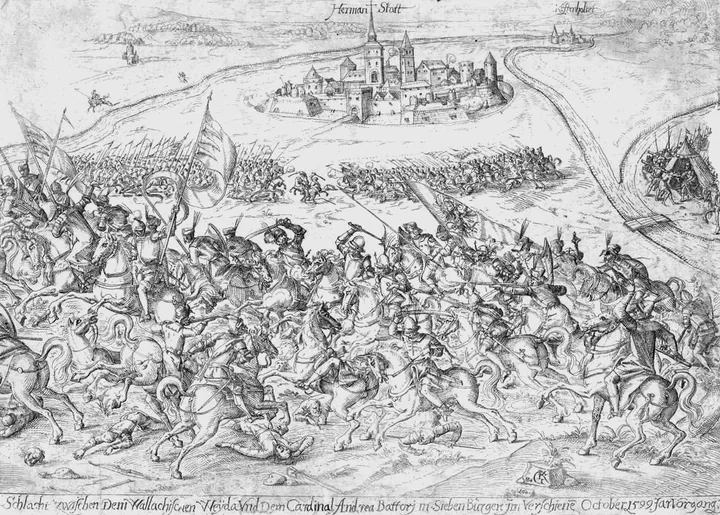
On 18/28 October 1599 the Wallachian–Székely host destroyed the cardinal's army at Șelimbăr. Andrew Báthory fled toward Poland, was caught and killed by the Székelys, and his head was brought to Michael — who gave him a pompous funeral at Alba Iulia.
On 1 November 1599 he entered Alba Iulia in triumph as master of Transylvania. The diet, however, recognised him only as imperial governor subject to Rudolf II; he demanded the title of Prince of Transylvania and the Partium. Between 20 and 28 November 1599 he held his first diet.
The battle of Șelimbăr — a contemporary engraving by Georg Keller. Georg Keller, contemporary · Public domain · Wikimedia Commons
III
Moldavia, by surprise
1600
1 May: the camp at Prejmer. 6 May: the mountains crossed where no one waited. June: three crowns on a single head.
In the spring of 1600 Michael struck Moldavia on the declared pretext of avenging Ștefan Răzvan. Bălcescu writes that the host passed 50,000 men — 38,000 musketeers, 3,000 Cossacks, 4,000 Serb horsemen, 4,000 Székelys and 4,000 volunteers under Baba Novac — in two columns, via Trotuș and via Focșani. On 1 May he camped at Prejmer; on 6 May 1600 he crossed the mountains by an untrodden road, where the enemy least expected him.
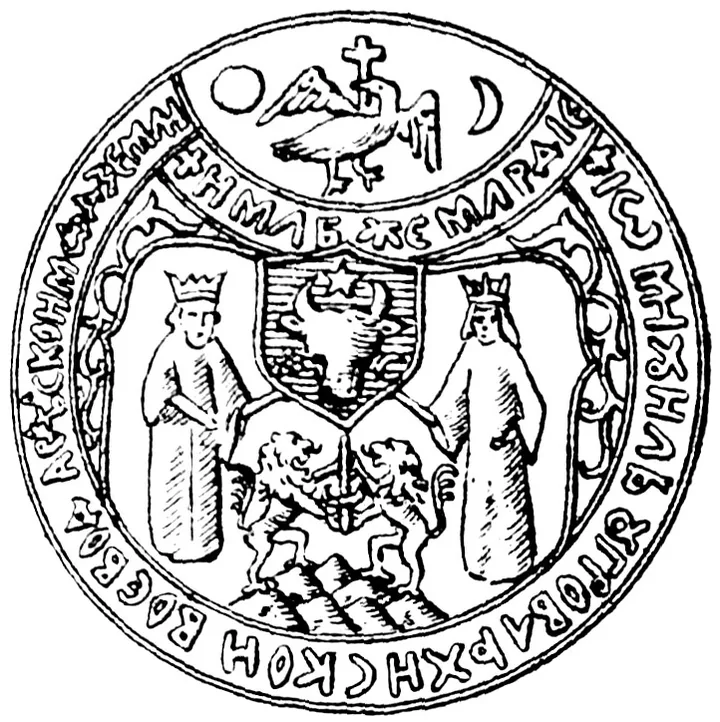
Ieremia Movilă and Sigismund Báthory — caught at a wedding at Trotuș — fled all the way to Hotin. All Moldavia was occupied, and its government left to Marcu, son of Petru Cercel, beside Preda Buzescu. Michael changed his seal to show the personal union of the three lands: the same person, three crowns, three administrations.
For four months — May–September 1600 — he held everything. The emperor asked him to give up Transylvania and be content with Wallachia and Moldavia; Michael refused: Transylvania he had won “with the sword”. On 20 July 1600 he opened the diet at Alba Iulia and made it swear loyalty to him anew.
The arms of the three lands united under Michael — the seal of the personal union. After the princely seal · Public domain · Wikimedia Commons
IV
The fall
1600–1601
Mirăslău, Bucov, Prague, Guruslău, Câmpia Turzii: eleven months from summit to grave.
On 18 September 1600 the revolted nobility and Basta's army crushed him at Mirăslău. The Wallachian artillery, fallen into enemy hands, fired on its own ranks; Michael swam the Mureș on horseback and fled through Alba Iulia to Făgăraș. Meanwhile Jan Zamoyski's Poles entered Moldavia: defeats at Năieni, Ceptura and Bucov on the Teleajen — the third crown lost too.
At Prague, Rudolf II first refused him, then — after Basta lost Transylvania to Sigismund Báthory — granted him audience between 23 February and 5 March 1601, with 100,000 florins for a new army. In Wallachia, his son Nicolae Pătrașcu was driving Simion Movilă out of Moldavia.
On 3 August 1601, between 9 and 19 o'clock, Michael with 20,000 men and Basta with 14,000 defeated Sigismund's 18,000 horsemen and 12,000 foot with 45 guns at Guruslău. Days later, near Câmpia Turzii, Basta's men assassinated him on Emperor Rudolf II's order: 9/19 August 1601.
Guruslău, 3 August 1601 — a contemporary engraving: the last victory. A contemporary engraving, 1601 · Public domain · Wikimedia Commons
The figures
Nine figures that carry the whole story. Each is verified in the sources.
1558–1601
the life of Mihai Pătrașcu
200,000
florins, the loan for the throne (1593)
13/23 August 1595
Călugăreni: victory, then retreat
18/28 October 1599
Șelimbăr: Transylvania conquered by the sword
1 November 1599
the triumphal entry into Alba Iulia
May–September 1600
three simultaneous crowns: about four months
100,000
florins, the Prague subsidy (1601)
3 August 1601
Guruslău: the last victory, 9–19 o'clock
9/19 August 1601
assassinated at Câmpia Turzii
Hold three thrones
November 1599 – October 1600: twelve months with three crowns on your head and money for not two. Every month four hands stretch out — the host, the boyars, the emperor, the sultan — and the treasury cannot cover them all. Choose whom to pay. The sums are game rules, not historical facts.
The rules
Every month you receive 9 thalers (an illustrative sum).
The four creditors ask 16 thalers together — you cannot pay them all.
Whom you do not pay loses 1 loyalty. Whom you pay keeps its loyalty.
The host at zero loyalty scatters: you lose everything. Each of the other three guards a throne: you lose the throne when its loyalty reaches zero.
Lose two thrones or the host = defeat. Survive 12 months = live in history.
Playing needs JavaScript; the rules above are the complete game on paper: 9 thalers a month, four creditors asking 16, loyalty falling by 1 for each non-payment.
Thrones
Myths to explode
Three things everybody knows — that do not survive the sources.
“The first union of the Romanians”
A nineteenth-century label
Michael held the three lands in a personal union — the same person, three crowns, three administrations — and the Transylvanian diet recognised him only as imperial governor. No national programme is documented; Bălcescu himself reproaches him that he “does nothing for the Romanians”. The idea of a “first union” belongs to Romantic historiography, 250 years after the events.
“He ruled all three for a year”
About four months
Simultaneous rule begins with the occupation of Moldavia (May 1600) and ends at Mirăslău (18 September 1600). May–September 1600: about four months, not a year.
“Călugăreni crushed the Empire”
A tactical victory; the war went on
On 13/23 August 1595 Michael defeated a far larger host, but then withdrew to Stoienești, while Sinan occupied Bucharest and Târgoviște and declared the country a pashalik. Liberation came only in October 1595, with the help of Sigismund Báthory's host.
Sources
Every fact on the page points to one entry here. The full ledger: SOURCES.md in the repository.
Double dates (13/23 August) are Old Style/New Style: the 10-day gap of the age; the narrative gives both.
The Bălcescu quotations keep the spelling of the Wikisource edition, of 1849–1860.
The treasury counter joins two documented sums — 200,000 florins (1593) and 100,000 florins (1601) — with an illustrative linear drain; the real monthly wages are undocumented.
The map is schematic, drawn from scratch; positions are representative.
The sums in the game are game rules, not historical facts.
The birthplace is disputed (Târgul de Floci or Drăgoești); the year, 1558, is secure.