Marius Comper RO
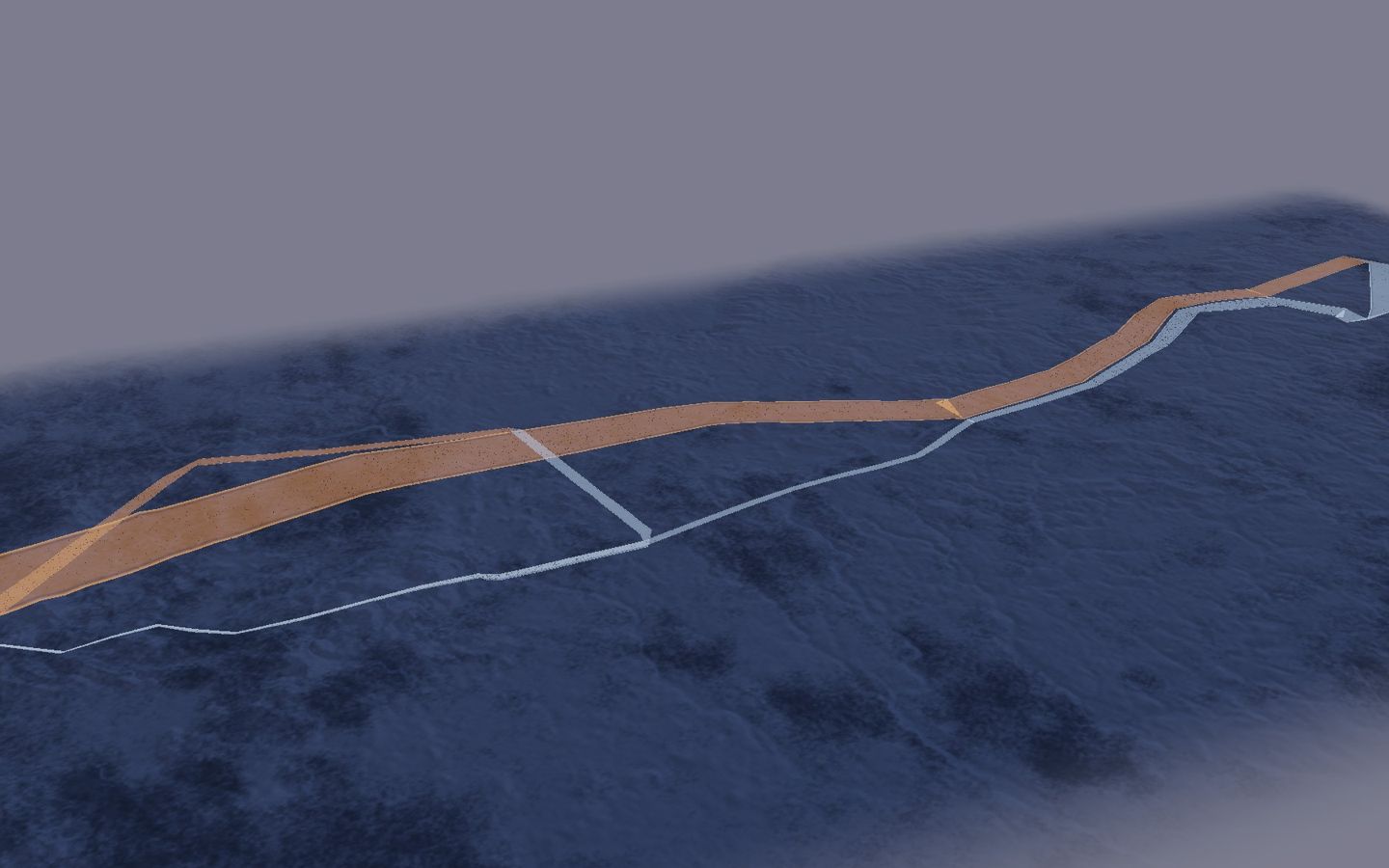
Minard’s band on the relief of Russia

Russia, 1812

The march on MoscowNapoleon’s army in Russia, 1812, day by day

In June 1812, by the count of the French engineer Charles Joseph Minard, 422,000 men marched into Russia; 10,000 came back. Here every dot is 100 of them, on the real relief from Kaunas to Moscow and back. Where a dot drops out, dead, sick, captured or deserted, a mark stays on the road.

A peace made in Bucharest

Four weeks before the invasion, Russia ended its six-year war with the Ottoman Empire. Peace was concluded in Bucharest on 28 May 1812 (16 May in the old calendar Russia still used), after talks held at Manuc's Inn, where, by tradition, the treaty was also signed.

The Ottoman Empire ceded to Russia the eastern half of Moldavia, between the Prut and the Dniester, together with the Ottoman districts to the south. The annexed land, about 45,000 km², became known as Bessarabia: most of today’s Republic of Moldova and part of Ukraine.

With peace made, Russia's Army of the Danube could march north. It set off at the end of July under Admiral Pavel Chichagov. Six months after the peace it would be at the Berezina.
An army from half of Europe

By the historian Richard Riehn’s count, about 300,000 men of the Grande Armée came from the French Empire, which then stretched from Hamburg to Rome; 108,000 were Poles and Lithuanians, 111,500 came from the German states of the Confederation of the Rhine and 27,000 from the Kingdom of Italy. There were Austrians, Prussians, Swiss, Neapolitans, Spaniards, Croats and Portuguese.

By the historian Georges Lefebvre’s estimate, only about half of the soldiers came from France.

422,000 men cross the Niemen

On the night of 23–24 June 1812 advance troops crossed the Niemen by boat; on 24 June the columns followed over pontoon bridges near Kowno, today’s Kaunas in Lithuania. The Russian armies fell back without fighting at the river.

Minard writes 422,000 at the crossing. Marie-Pierre Rey counts nearly 440,000 men on the banks of the Niemen; counting every unit that crossed the river during the campaign, Adam Zamoyski arrives at 550,000–600,000.

Every dot on the map stands for 100 men in Minard’s count. He draws two branches to the north: one of 22,000 men, and one of 60,000 that heads for Polotsk.

Storm, heat and the first gaps

On 28 June Barclay de Tolly evacuated Vilnius; the French advance guard arrived about an hour later, and Napoleon entered the same day. Around 29 June a violent storm broke over the columns; memoirists describe horses dying in the mud.

Then came the heat: 28–30 °C by day on the road to Vitebsk. The supplies fell behind. Men went hungry, fell ill with dysentery and typhus, or deserted.

Watch the marks on the road: each is 100 men who left the column there.

A third gone before the first great battle

Napoleon reached Vitebsk on 28 July and stayed until about 12 August. Before Vilnius, Minard’s band stands for 400,000 men, counting the column that turns off for Polotsk; at Vitebsk it stands for 175,000.

By Adam Zamoyski’s reckoning, about a third of the army was already missing from the ranks by Vitebsk, mostly to hunger, illness and desertion. Some 30,000 lay sick in makeshift hospitals in Vilnius alone.

Not everyone missing was dead: garrisons stayed behind in the towns, and Minard’s band follows only the strength of the columns.

Smolensk, August

On 16 and 17 August Napoleon’s troops attacked Smolensk, the old fortress city on the Dnieper. The Russians withdrew overnight, and the French entered the city on 18 August.

Estimates vary by author: 6,000 to 14,000 men lost on the Russian side and 9,000 to 10,000 on the French and allied side. Minard notes 145,000 before Smolensk.

Napoleon had hoped for a decisive battle near the frontier. The Russian armies kept falling back, and every week of marching lengthened the road back to the supplies.

Borodino, 7 September

On 7 September Kutuzov gave battle at Borodino, some 110 to 125 kilometres west of Moscow. It was the bloodiest day of the campaign.

Estimates run from 28,000 to 42,000 killed, wounded and missing on the French side and from 40,000 to 53,000 on the Russian side. The surgeon Dominique-Jean Larrey performed about 200 amputations in 24 hours.

Minard marks 127,100 on the approach, at Gzhatsk, and 100,000 beyond the battlefield.

Moscow, almost empty

On 14 September Murat’s vanguard entered Moscow; Napoleon spent the night on the outskirts and entered the Kremlin the next morning. Of about 262,000 inhabitants, by one Fondation Napoléon estimate, some 10,000 had stayed.

Take away Minard’s two northern branches and his main column starts with 340,000 men. At Moscow he notes 100,000: a drop of 71 per cent before the retreat.

The fire

As the French occupied the city on 14–15 September, fires broke out across it, a city built largely of wood. They burned for several days, until rain helped put them out around the 20th.

Napoleon wrote that “three quarters of the houses are burned”. One Fondation Napoléon account counts a third of the houses destroyed outright. How much of the city burned is still disputed.

Five weeks of waiting

Napoleon stayed in Moscow for five weeks, waiting in vain for Tsar Alexander I to make peace. At Tarutino, south-west of Moscow, Kutuzov’s army rested, took on supplies and received reinforcements.

Minard’s temperature line only begins at the departure: “zero” on 18 October, the day before the army left.

Turned back at Maloyaroslavets

On 19 October the army left Moscow on the roads to Kaluga, to the south-west. On 24 October Italian troops fought the Russians at Maloyaroslavets; each side lost around 6,000 to 7,000 men, by the estimates.

After Maloyaroslavets Napoleon turned back towards Mozhaysk and the old Smolensk road, the road he had come by, where food and shelter were scarce. Minard drew the retreat in black; here it is the colour of frost.

The same road, back

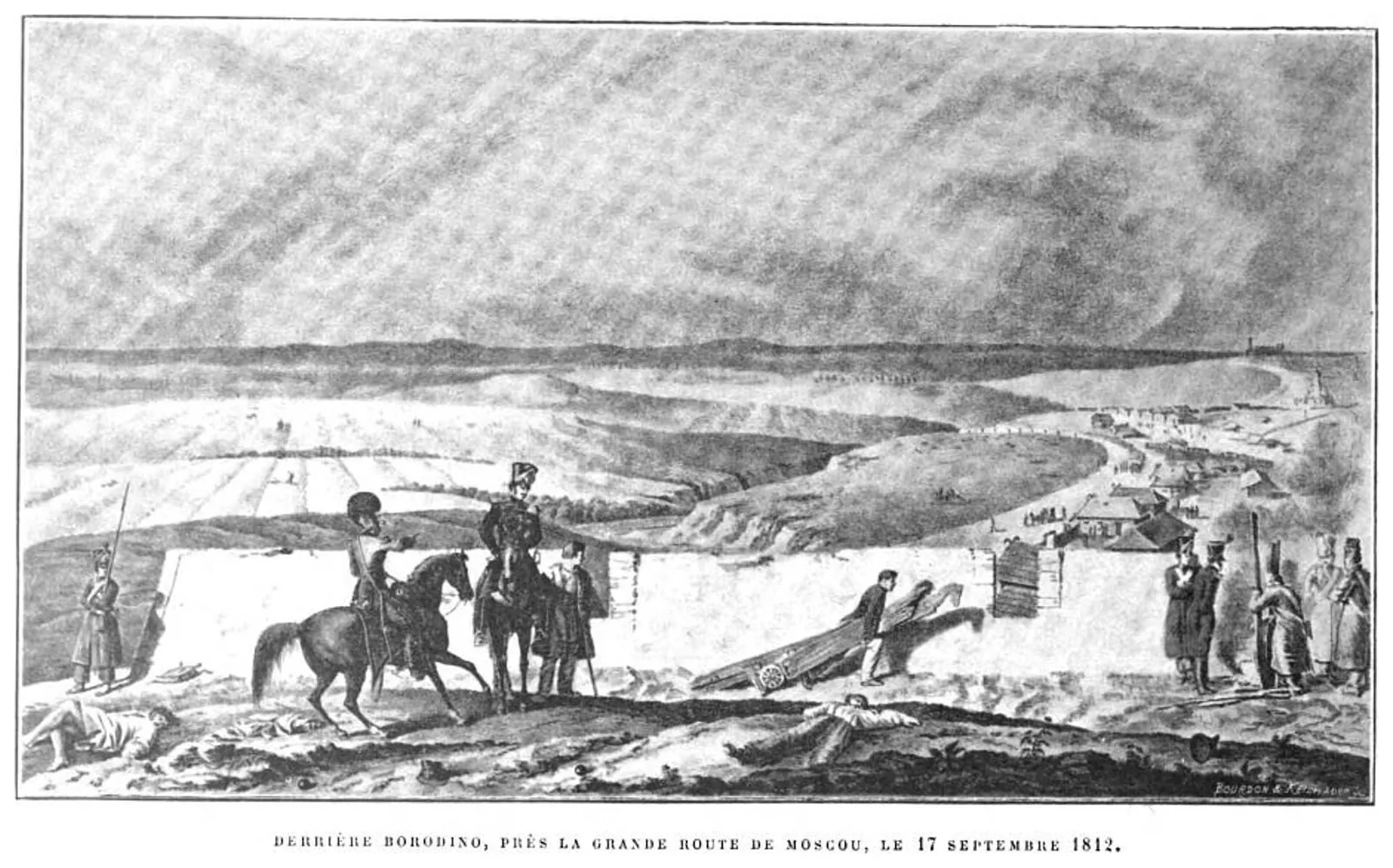
At the end of October the columns passed the battlefield of Borodino again. On 3 November, at Vyazma, the Russians struck the rearguard.

It was not winter yet: as far as Vyazma the cold stayed around −3 to −5 °C, according to a reconstruction of the weather published in 2022. Even so, the army nearly halved: Minard notes 100,000 leaving Moscow, 87,000 before Vyazma and 55,000 after it.

The marks from the summer are still on the road. The new ones fall beside them.

Then the snow

On the road of the retreat the first snow fell on 4 November, and by the 6th it lay on the ground (a light snow had fallen in Moscow on 13 October). On 9 November it was −12 °C at Dorogobuzh. Minard records −21° Réaumur, −26 °C, on 14 November, as the army left Smolensk.

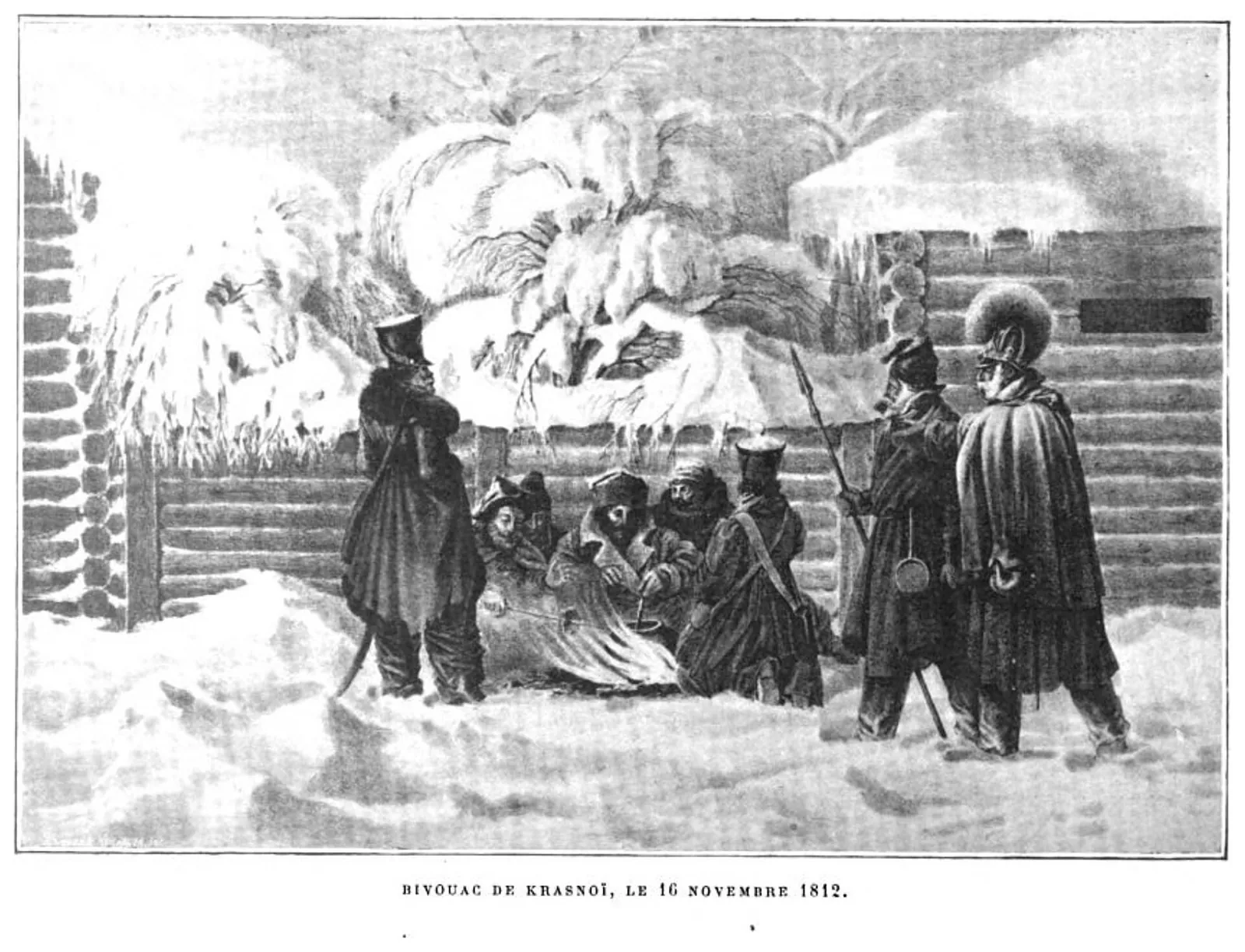
Horses died by the thousand. On 18 November Napoleon wrote that the cold had killed “almost all our horses, that is, 30,000”. Without horses the guns and wagons were left behind. On 15–18 November, at Krasny, the Russians struck the column again.

The Berezina

After a thaw around 22 November the river was no longer frozen hard. Chichagov’s troops, the army the peace of Bucharest had let march north, had taken Borisov; when the French drove them back, the Russians burned the bridge.

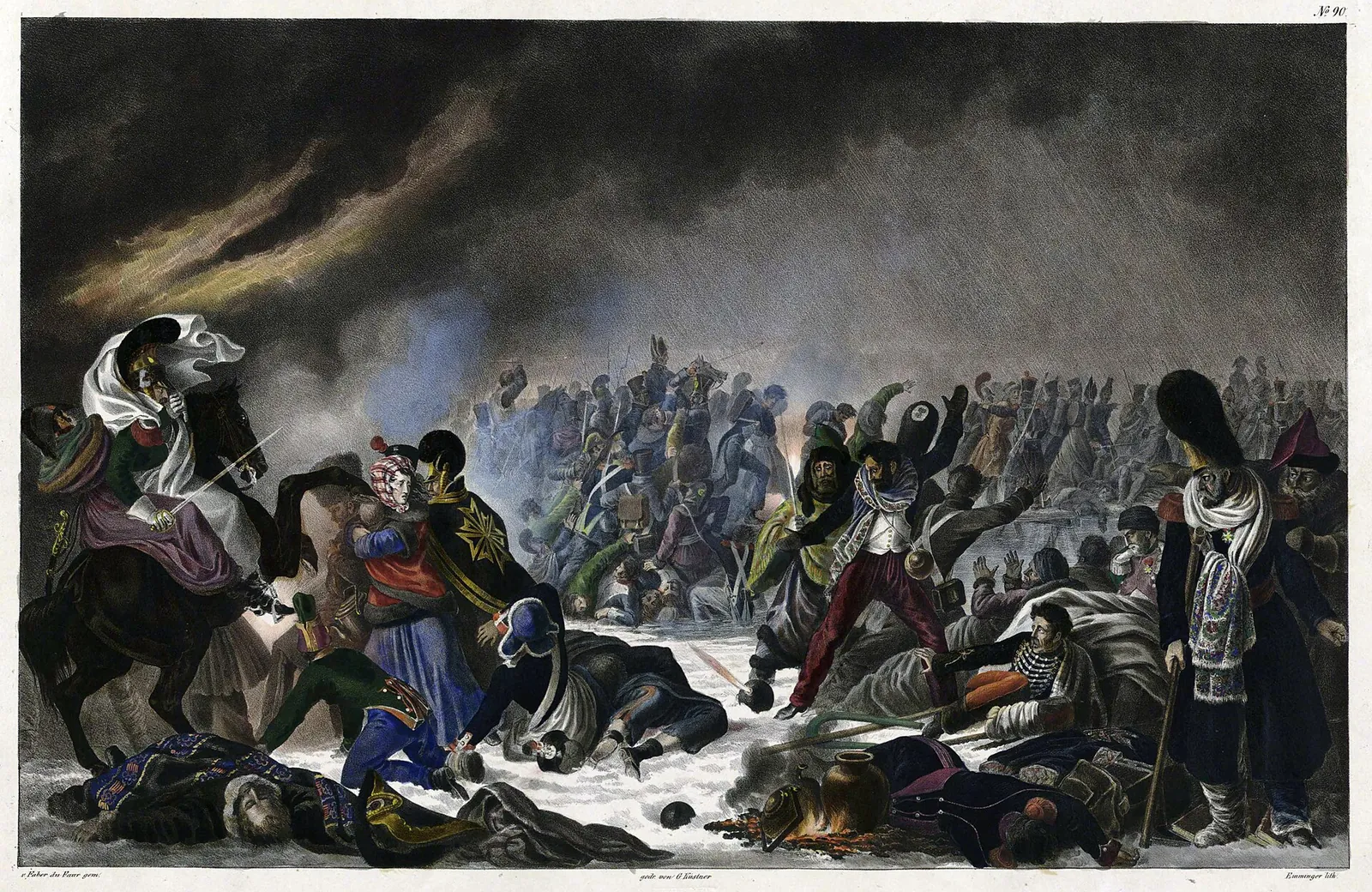
Further north, at Studianka, General Éblé’s 400 or so pontonniers helped build two bridges, opened on 26 November, many of them working in ice-cold water. The first was built by two companies, about 200 men under Captain Benthien, roughly half of them Dutch; after the crossing he could rally about 40 of them.

Swiss regiments defended the west bank. The crossing lasted until the morning of 29 November; when the bridges were set on fire, thousands were still on the far side. Minard: 50,000 before the river, 28,000 after it. In French, “c’est la Bérézina” still means a total disaster.

−37.5 °C

On the night of 5 December, at Smorgon, Napoleon left the army for Paris: some 2,500 kilometres in about 13 days.

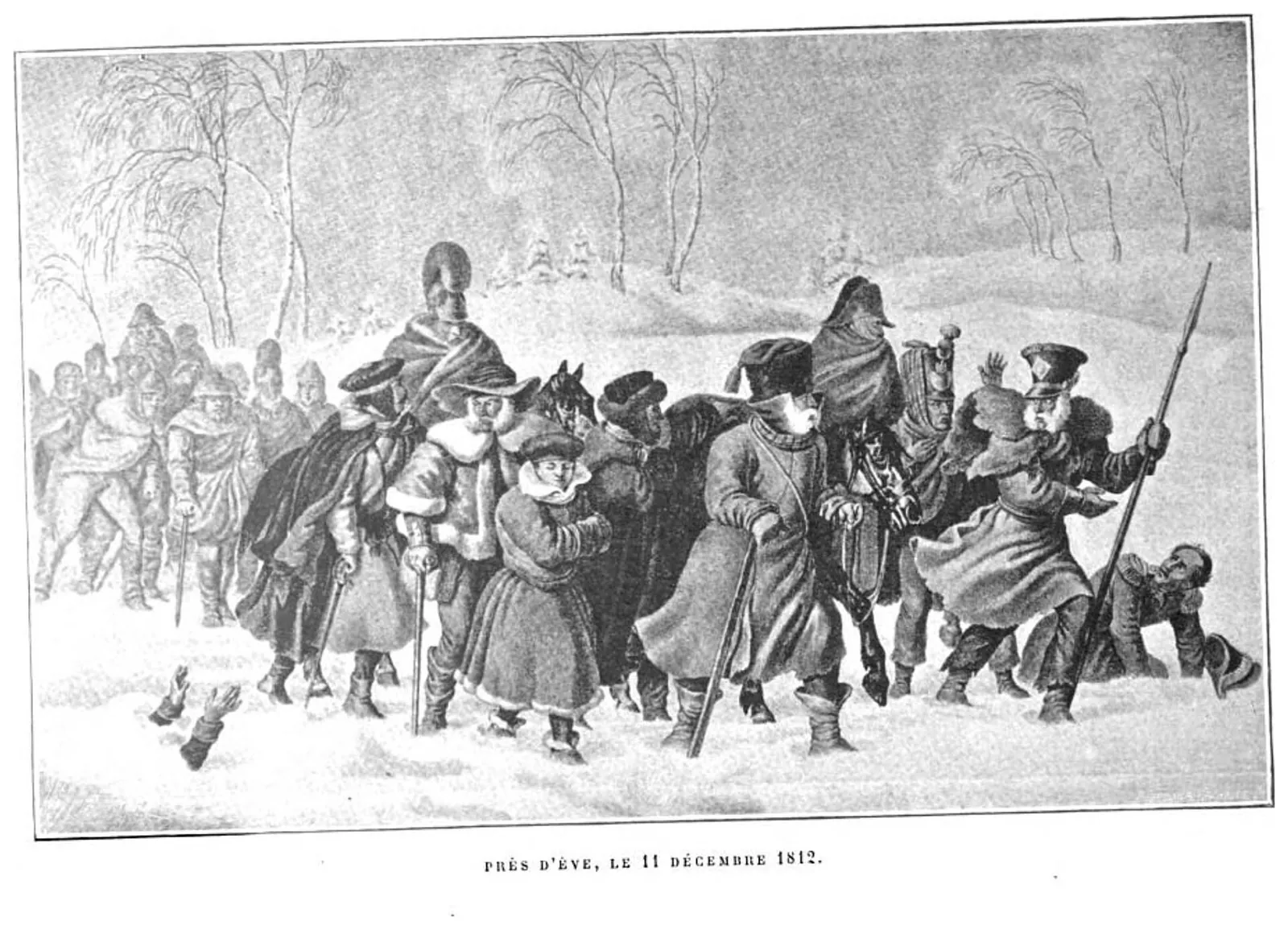
On 6 December Minard records −30° Réaumur: −37.5 °C. (The 2022 reconstruction puts that day nearer −30 °C.) Between the Berezina and Molodechno the band falls from 28,000 to 12,000 men.

The grave in Vilnius

Napoleon changed horses outside Vilnius on 6 December and was at Kowno the next morning. Historical accounts cited by the archaeologists speak of some 37,000 soldiers buried in and around Vilnius.

In 2001 builders at a former Soviet barracks found a mass grave: at least 3,269 people, counted by their left thigh bones. Those whose sex could be told were nearly all men, most of them young; the uniform remains came from about 40 regiments. The archaeologists concluded that cold, exhaustion and hunger were the main causes of death.

In 2006 researchers reported DNA of the trench-fever bacterium in lice and teeth, and of epidemic typhus in teeth; in 2025 a study of 13 soldiers’ teeth found paratyphoid in four and relapsing fever in one, possibly two. Both teams stress that so few samples cannot say what killed the army.

Back at the Niemen

On 13 and 14 December the remnants of the army crossed back over the Niemen at Kowno, where they had come in in June. Minard writes 4,000 for the main column and 6,000 for the northern branch coming back: 10,000 in all.

That is his count of the men still marching in the columns. Historians count differently: fewer than 40,000 crossed back “in formation”, by Markham’s estimate; about 120,000 came out of Russia in December, every kind included, by Zamoyski’s. Between 300,000 and 400,000 died.

The chart of 1869

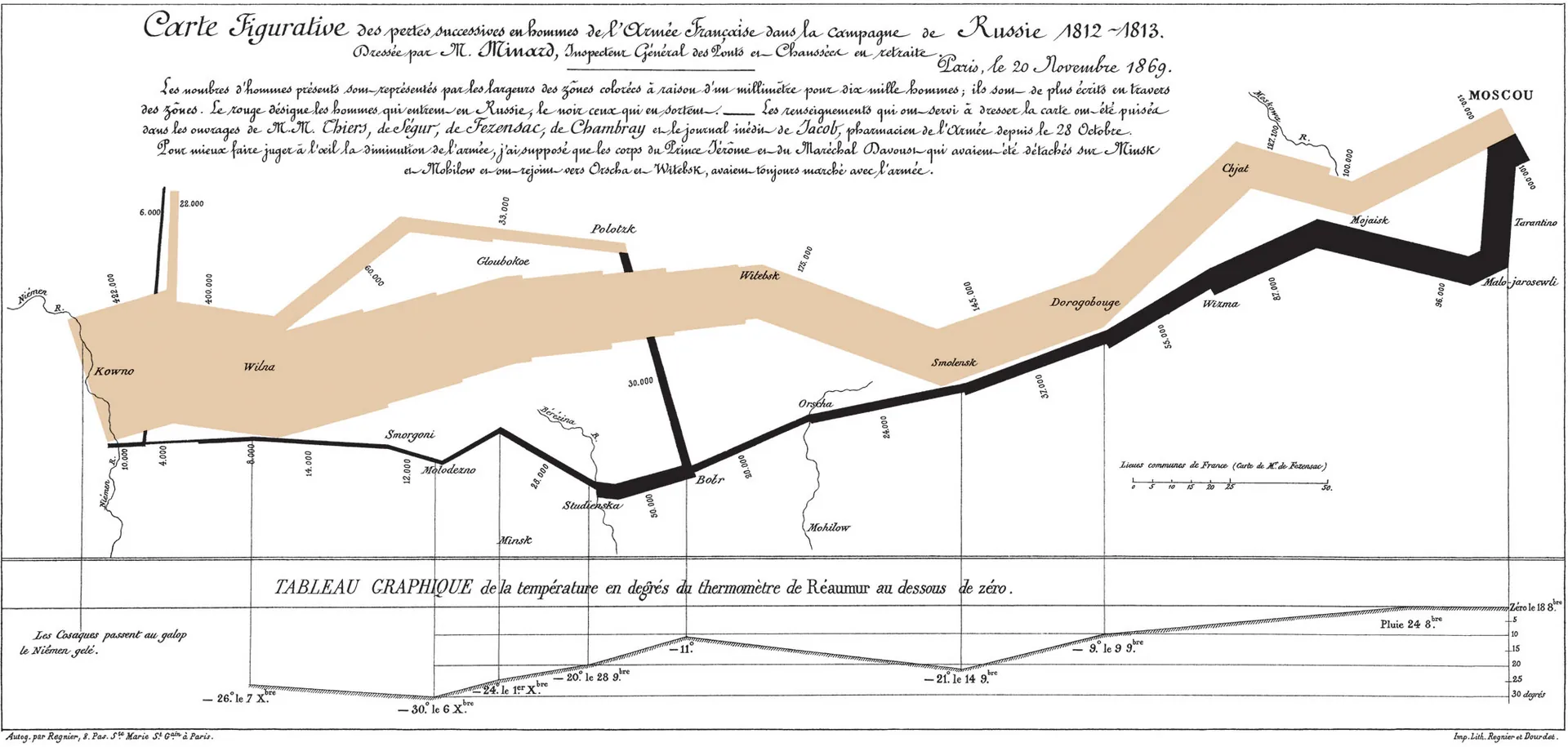
Charles Joseph Minard, a retired inspector general of bridges and roads, drew it in Paris on 20 November 1869, aged 88. “The numbers of men present are shown by the widths of the coloured zones, one millimetre for ten thousand men,” his legend says. He calls the advance band red; on surviving copies it has faded to beige. The retreat is black.

He took his numbers from the histories of Thiers, Ségur, Fezensac and Chambray and the diary of the army pharmacist Jacob. To make the decline easier to see, he counted Jérôme’s and Davout’s corps, sent towards Minsk and Mogilev and back with the army near Orsha and Vitebsk, as if they had marched with it all along. On the same sheet he drew Hannibal’s march.

This page is his chart, laid on the ground it describes.

Most of the losses, before the winter

“General Winter” is the usual explanation. By Minard’s own numbers, the column that reached Moscow had lost 71 per cent of its starting strength in summer and early autumn, before the retreat began.

The historian Marie-Pierre Rey rejects “General Winter”: the army had lost “more than a third, if not half” of its strength before the great cold, to hunger, typhus, dysentery and desertion. The frost then struck an army already weakened by hunger, disease and fighting.

The march, starting from your town

Choose a town you know. The route starts there, with the same shape and at the same scale.

Share this page

Minard’s chart, as he drew it

Minard printed only 26 strength labels on his chart, some of them repeated; the rest is the width of the band. Here they are in chart order, with the place names spelled as he spelled them.

On the chartWayMen
Kownoadvance422,000
→ north advance22,000
Wilnaadvance400,000
→ Polotzkadvance60,000
Gloubokoe → Polotzkadvance33,000
Witebskadvance175,000
Smolenskadvance145,000
Chjatadvance127,100
Mojaiskadvance100,000
Moscouadvance100,000
Moscou → Tarantinoretreat100,000
Malo-jarosewli → Mojaiskretreat96,000
Wizmaretreat87,000
Wizma → Dorogobougeretreat55,000
Dorogobouge → Smolenskretreat37,000
Smolensk → Orscharetreat24,000
Orscha → Bobrretreat20,000
Polotzk → Bobrretreat30,000
Bobr → Studienskaretreat50,000
Studienskaretreat28,000
Molodeznoretreat12,000
Smorgoni → Wilnaretreat14,000
Wilnaretreat8,000
Kownoretreat4,000
→ Niémen (north)retreat6,000
Niémenretreat10,000
Minard’s figurative map: a thick beige band from Kowno to Moscow and a thinning black one back
Minard’s chart, 1869. The beige band is the army going in, the black one coming out; below, the temperatures.Charles Joseph Minard, 1869 · Wikimedia Commons · public domain

Drawn on the march

Christian Wilhelm von Faber du Faur was an artillery officer in the Württemberg contingent. He sketched during the campaign and later worked the sketches into watercolours, published as lithographs between 1831 and 1843. The paintings by Peter von Hess and Vasily Vereshchagin came much later.

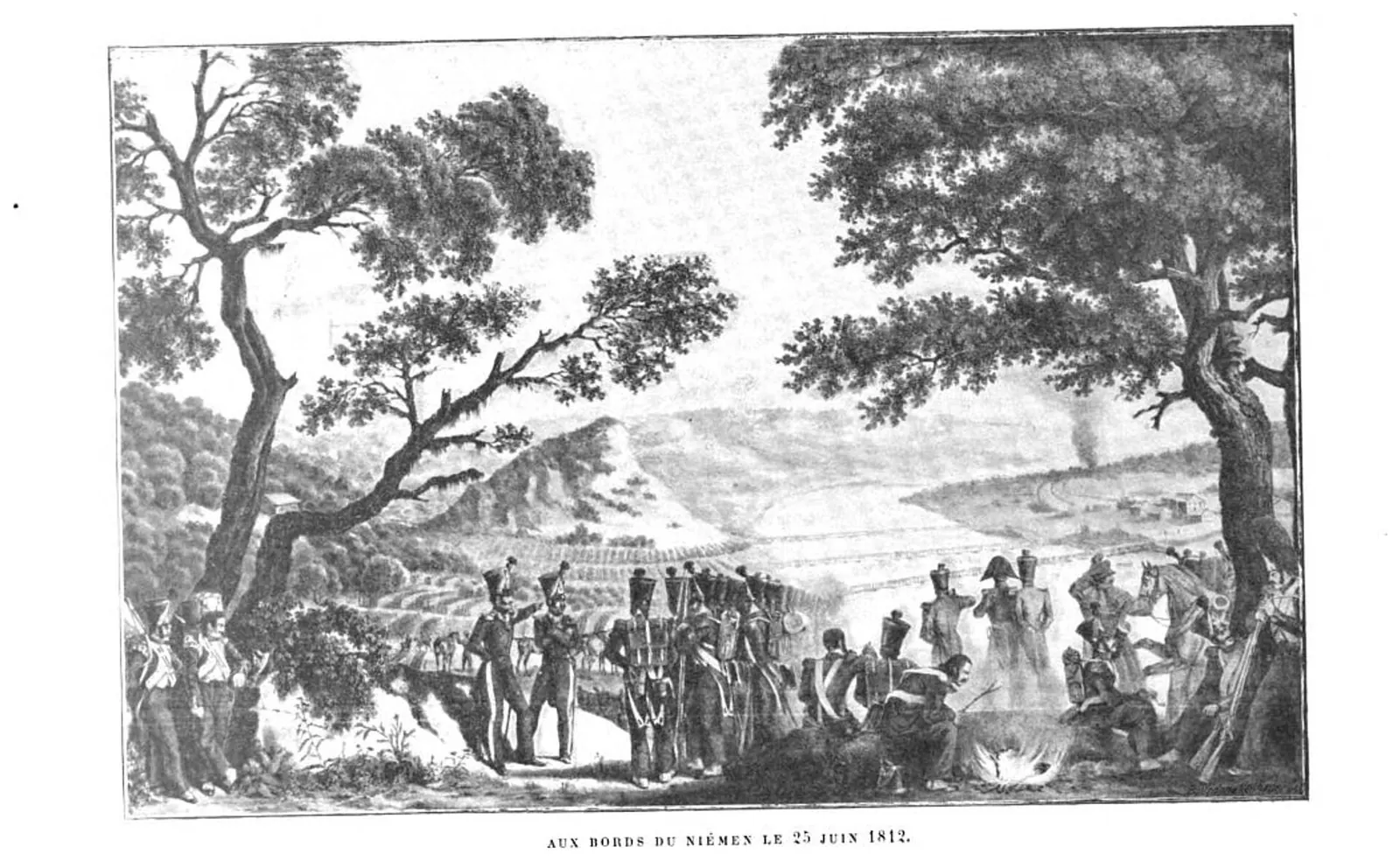
Soldiers under trees on the bank of the Niemen, the river and hills behind
“On the banks of the Niemen, 25 June 1812.”Christian Wilhelm von Faber du Faur · plate from the 1895 Paris edition · Wikimedia Commons · public domain
An open field with riders and wounded men beside a road
“Behind Borodino, near the great road to Moscow, 17 September 1812.”Christian Wilhelm von Faber du Faur · plate from the 1895 Paris edition · Wikimedia Commons · public domain
Muffled soldiers by a fire in front of a snow-covered log house
“Bivouac at Krasnoi, 16 November 1812.”Christian Wilhelm von Faber du Faur · plate from the 1895 Paris edition · Wikimedia Commons · public domain
People and horses crowded in the snow under smoke at the river crossing
Crossing the Berezina, 28 November 1812.Christian Wilhelm von Faber du Faur · Wikimedia Commons · public domain
A group of exhausted soldiers wrapped in greatcoats walking through snow
“Near Evje, 11 December 1812.”Christian Wilhelm von Faber du Faur · plate from the 1895 Paris edition · Wikimedia Commons · public domain
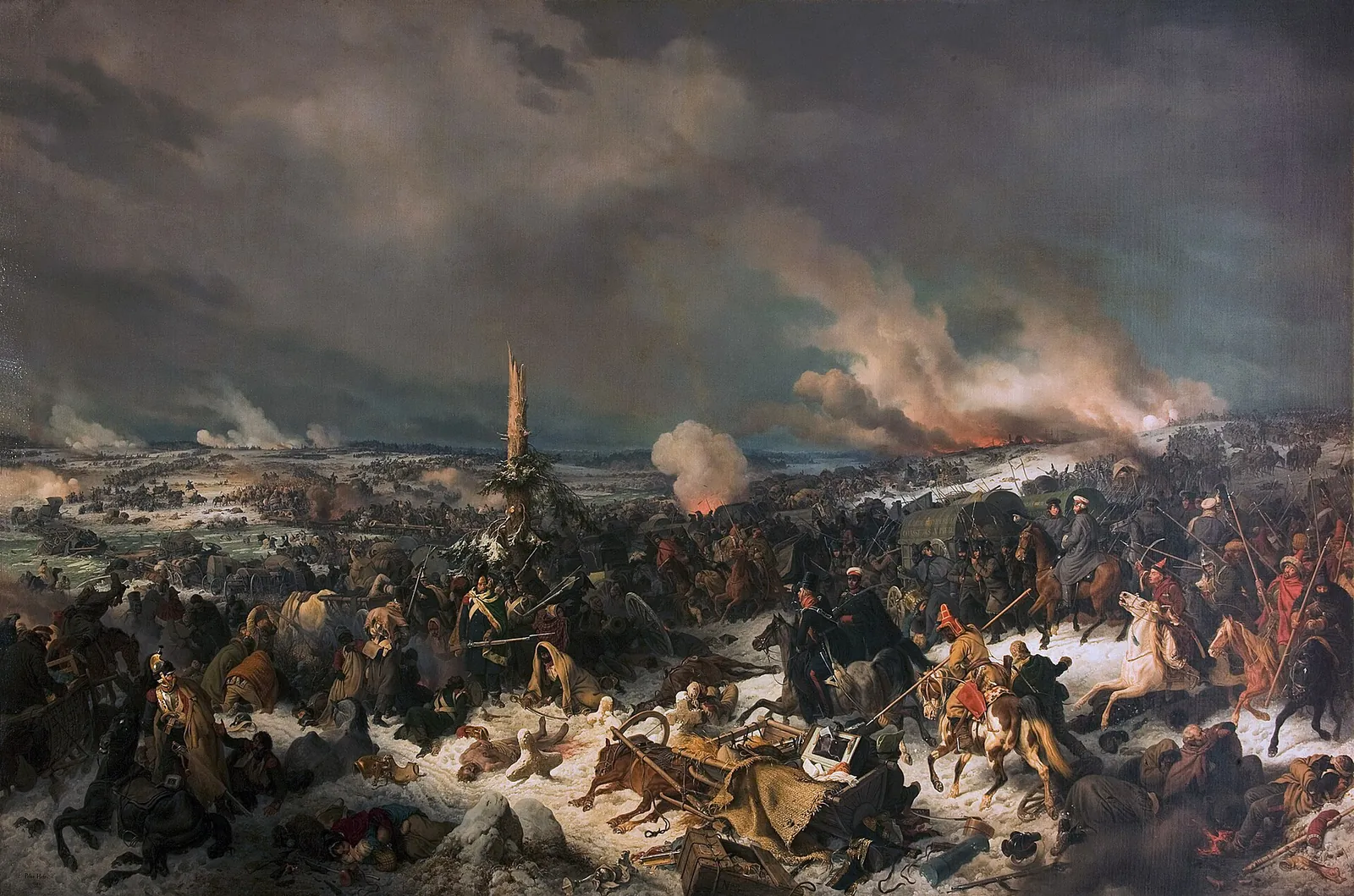
Painting: a crowd of soldiers and carts on a snowy river bank, with smoke and fire
Peter von Hess, Crossing the Berezina, painted in 1844, 32 years later.Peter von Hess, 1844 · Wikimedia Commons · public domain
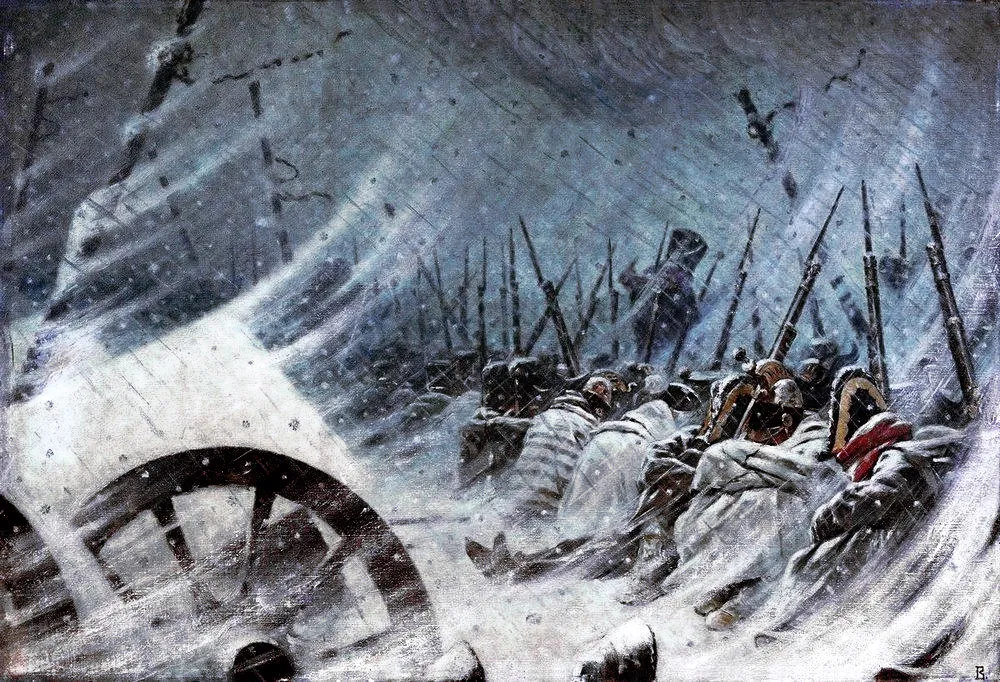
Painting: soldiers huddled in a blizzard beside a gun wheel
Vasily Vereshchagin, Night bivouac of the Grande Armée, painted in 1896–1897.Vasily Vereshchagin · State Historical Museum, Moscow · Wikimedia Commons · public domain

How this page is drawn

The numbers are Minard’s. Between the ones he wrote, the column’s strength is estimated from the width of his band, from Leland Wilkinson’s transcription in the HistData package. Where that transcription departs from the chart (at the Berezina, for instance, where the Polotsk column rejoins the army), the page follows the chart.

One dot = 100 men. Each dot gets a threshold; on the first day the column’s strength falls below it, the dot leaves the column and a mark stays there. Each mark is an estimated drop of about 100 men: dead, sick, captured, deserted or left in a garrison. Where the dots sit in the column is approximate.

The route runs through the towns Minard names, in straight lines from town to town: about 920 km out and 1,010 km back, less than by the real roads. The flank columns follow Minard’s schematic drawing. The dates come from the campaign’s chronology; between them the march is taken as even.

The relief is ETOPO 2022, exaggerated in height so the plain shows; rivers and lakes are from Natural Earth. The seasons, fire, smoke and snow are drawn approximately to the dates: first snow on 4 November, Moscow burning from 14 to 20 September.

What is not known for sure

  • How many went in. Minard writes 422,000; Marie-Pierre Rey counts nearly 440,000 on the banks of the Niemen, and Adam Zamoyski 550,000–600,000 counting every unit that crossed during the campaign.
  • How many came back. 10,000 for Minard (the columns only); for historians, from fewer than 40,000 “in formation” (Markham) to about 120,000 who came out of Russia in December, every kind included (Zamoyski).
  • How many died. Between 300,000 and 400,000, depending on the author.
  • How much of Moscow burned. Napoleon wrote that three quarters of the houses had burned; one Fondation Napoléon account counts a third destroyed outright. The two are different measures.
  • The cold. Minard gives degrees Réaumur gathered from memoirs; the 2022 reconstruction gives somewhat milder values for December.
  • Manuc’s Inn. The talks held there are documented; the signing in the inn is a tradition supported by historians, with no document found.

Share

The page opens on the whole map; the chapter with your town has its own link.

Further reading on this site

Sources

The data, chronology and quotations come from the sources below; where they disagree, the page gives the range.

  1. Charles Joseph Minard, Carte figurative des pertes successives en hommes de l’Armée française dans la campagne de Russie 1812–1813, Paris, 20 Nov 1869 (BnF copy). commons.wikimedia.org
  2. M. Friendly et al., HistData: Minard.troops, Minard.cities, Minard.temp (after L. Wilkinson). friendly.github.io
  3. Marie-Pierre Rey, preface to Correspondance générale de Napoléon, vol. 12, Fondation Napoléon. napoleon.org
  4. Marie-Pierre Rey, interview, Fondation Napoléon. napoleon.org
  5. Orlando Figes on Adam Zamoyski’s 1812, New York Review of Books, 2 Dec 2004. nybooks.com
  6. Paul Ganière, “La marche vers Moscou”, Revue du Souvenir Napoléonien 353 (1987). napoleon.org
  7. Fondation Napoléon, timelines of the Russian campaign (advance and retreat). napoleon.org
  8. Fondation Napoléon, timeline of the retreat. napoleon.org
  9. Fondation Napoléon, “1812, la campagne de Russie (2): de Borodino à Moscou”. napoleon.org
  10. Order of battle of the invasion, with Richard Riehn’s contingent table (1812: Napoleon’s Russian Campaign, 1990, p. 81). en.wikipedia.org
  11. A. J. Joes, “Continuity and Change in Guerrilla War”, Journal of Conflict Studies 16(2), 1996 (quoting Lefebvre, Markham, Riehn). journals.lib.unb.ca
  12. N. Lobanov-Rostovsky on Zamoyski’s 1812, The Moscow Times, 23 Apr 2004. themoscowtimes.com
  13. Vlad Mischevca, “Pacea de la București din 1812: însumarea unor concluzii”, Limba Română. IBN, Chișinău
  14. Vlad Mischevca, “Din culisele diplomatice ale semnării Tratatului de pace de la București… rolul lui Manuc Bey”. IBN, Chișinău
  15. Hanul lui Manuc, history. hanulluimanuc.ro
  16. Army of the Danube, strength and march (after Podmazo and Lieven). en.wikipedia.org
  17. Battle of the Berezina, history of war. historyofwar.org
  18. G. Bakker, “De Nederlandse pontonniers aan de Berezina”, Bruggen 18 (2010) 3. bruggenstichting.nl
  19. “Remembering Berezina”, swissinfo, 13 Feb 2003. swissinfo.ch
  20. M. Signoli et al., “Discovery of a mass grave of Napoleonic period in Lithuania (1812, Vilnius)”, C. R. Palevol 3 (2004). sciencepress.mnhn.fr
  21. D. Raoult et al., “Evidence for louse-transmitted diseases in soldiers of Napoleon’s Grand Army in Vilnius”, J Infect Dis 193 (2006). DOI
  22. R. Barbieri et al., “Paratyphoid fever and relapsing fever in 1812 Napoleon’s devastated army”, Current Biology (2025), accepted text via Institut Pasteur. research.pasteur.fr
  23. A. I. Ugryumov, E. V. Sokolikhina, N. N. Sokolikhina, “Napoleon and ‘General Frost’ in the war of 1812”, Gidrometeorologiya i ekologiya 66 (2022). notes.rshu.ru
  24. Christian Wilhelm von Faber du Faur, campaign sketches (plates), Wikimedia Commons. commons.wikimedia.org
  25. NOAA, ETOPO 2022 global relief model (60 arc-seconds). ncei.noaa.gov
  26. Natural Earth, rivers and lakes at 1:10,000,000. naturalearthdata.com
  27. GeoNames, towns of 15,000 and more (CC BY 4.0). geonames.org