BUCHAREST · FROM INN TO HOTEL
The inns of Bucharest
You drink a beer in Manuc's courtyard never knowing the city held 145 inns: in 1838 Bucharest teemed with church inns, great inns and small inns — named things like Bear-Yoker, Shout-Upwards or the Devil's. Then came the great fire of 1847, demolitions for “insalubrity” and the hotels — and three were left. The map below pins 8 inns on today's streets.
In short: the first great inns are princely (Șerban Vodă 1686, St. George 1698); the peak comes in 1838, with 145 inns; the great fire of 1847, the demolitions and the hotels (Brenner, 1828) erase them one by one — Stavropoleos falls in 1871 as “insalubrious”, Golescu is evicted in 1893. Three stand today: Manuc, Gabroveni and cu Tei. Search your street below and see which inn stood on it.
See the inn map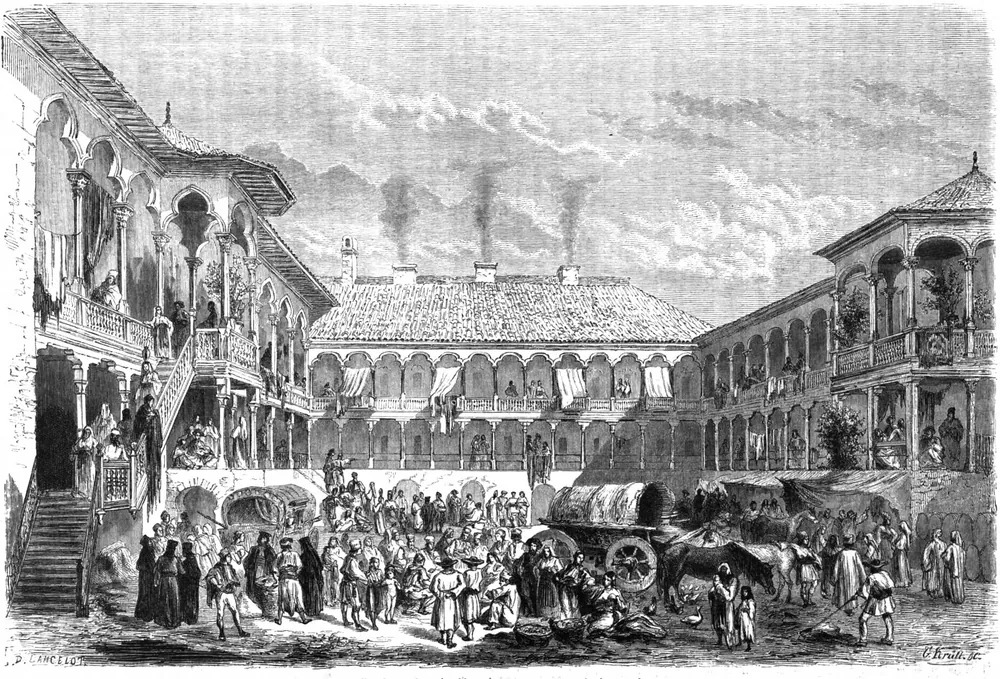
The inn map: three standing, five ghosts
Green are the 3 inns still standing: Manuc, Gabroveni, cu Tei. Amber are 5 ghosts: Șerban Vodă, St. George, Stavropoleos, Colțea, Golescu — pinned on today's streets as points, not surveys. Drag the slider or press play and see what was open in the chosen year — in 1838, at the peak, all 8 were open.
The list beside the map tells the same story, with the same data.
- Inns today
- Lost inns
Map background: © OpenStreetMap contributors (ODbL).
145 inns in 1838
The count sounds like a race: 34 places in Ionnescu-Gion (8 with churches, 7 great without, 28 small), 43 between 1780 and 1800, 77 in the 1819 census, 145 in 1838. Ten of the 94 neighbourhoods bore inn names — all in the market centre.
1847–1893: the erasure
The Great Fire of 23 March 1847 razes St. George; Colțea falls to the pickaxe in 1848; Stavropoleos is declared decrepit and insalubrious and demolished in 1871; Șerban Vodă vanishes after the War of Independence, to make room for the National Bank; Golescu is evicted and demolished from 1893. On the map, the ghosts fade one by one.
Today: 3 inns
Manuc (an inn since 1804, with the 1812 peace talks inside), Gabroveni (a commercial passage since 1871, a hotel after 1900) and cu Tei (1833, a faithful copy of Gabroveni). The rest is hotels: the first, Brenner's, from 1828 — though the source also mentions a Hôtel de l'Europe “before him”.
Points are anchors on the nearest today's street (display only, not surveys or footprints). The start year is the first certain attestation: Manuc 1804 (the fire chronicle — the building is disputed, 1804–1808), Gabroveni 1804 (built 1804–1818, unknown builder), Golescu ~1800 (early 19th century). Small inns, with no address in the sources, are counted in the text, not pinned on the map.
From Șerban Vodă to Brenner
Two centuries of inns: who built them, who tore them down, and who inherited them.
The beginnings are princely. In 1686–1687 Șerban Cantacuzino buys the inn grounds on Lipscani, Smârdan and Doamnei — some 80 rooms with hiding places, where Grigore Ghica and his son hide in 1769 (found, taken to St. George, held three days, sent to St. Petersburg). St. George the New starts in 1671–1672, with the dragoman Mamona's money, stalls at his death, and Brâncoveanu finishes it in 1694–1698: over 200 rooms, the city's second great inn. Stavropoleos is the work of a Greek monk, Ioanichie, who buys the plot on 6 April 1722 and finishes the inn in 1724; Colțea is built by the sword-bearer Mihai Cantacuzino in 1746, for the monastery and hospital revenues — and lasts a century, until the 1848 pickaxe.
The peak is a race of figures: 34, 43, 77, 145. In 1838 the census counts 145 inns — 8 with churches, 7 great without (Manuc, Constantin Vodă, Papazoglu, Golescu, Gabroveni, Zamfir, Filipescu, after Fotino), 28 small. Each nation had its inn: Bulgarians and Serbs at Gabroveni, Austrians at Filaret, Brașov folk at the Red Inn (across from the Bărăția), Westerners at Filipescu, Orientals at Simion Arnăutu's, Jews at Niculescu's and Nenciulescu's. And the names sounded like neighbourhood nicknames: Bear-Yoker, Shout-Upwards, the Devil's — or like colours: Red, Green.
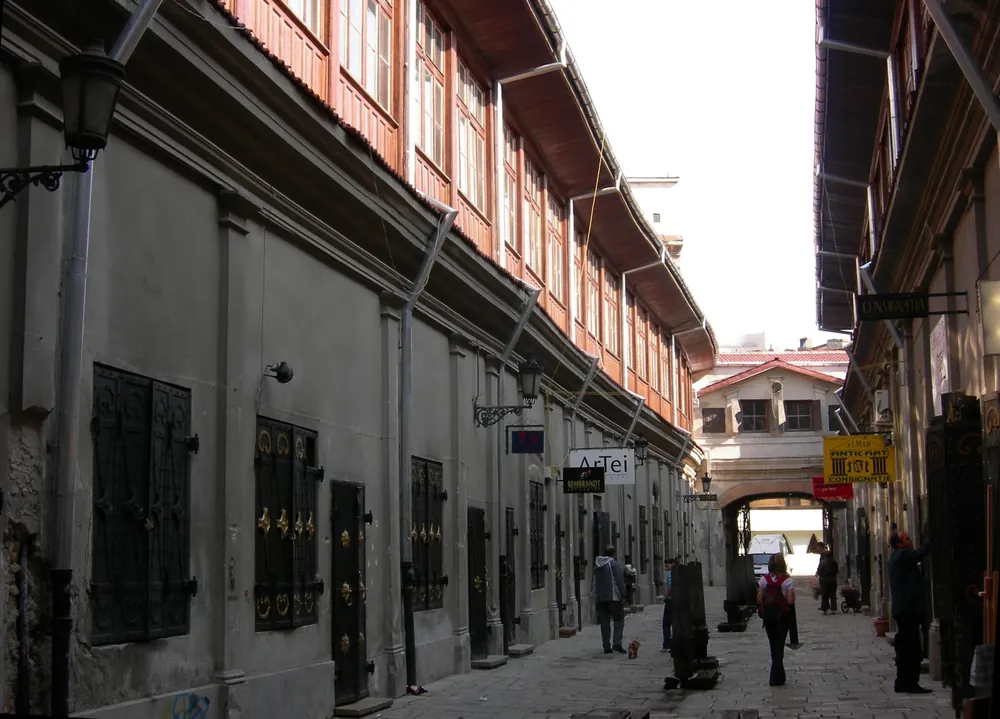
Three inns deserve a separate file. Manuc: Emanuel Mîrzaian Bey builds (or fits out) between 1804 and 1808 — the 23 August 1804 fire chronicle already mentions “Manuc's inn” burning, Ionnescu-Gion gives 1808, one deed gives 1806; in 1812 the inn hosts the Russo-Ottoman peace talks, and Manuc flees to Vienna and Hâncești. Gabroveni: NOT Mavrocordat's 1739 bedesten — the 1790–1791 plans show nothing on the site, and the current one rose between 1804 and 1818, unknown builder, on houses burned in 1804; the first certain attestation is Fotino, 1818. Hanul cu Tei: 1833, Anastase Polizu with Ștefan Popovici, contract on 6 August 1835 — a faithful copy of Gabroveni, with Transylvanian manufactures.
The end comes in waves. The 28 August 1804 fire breaks out inside St. George itself; the Great Fire of 23 March 1847 razes it utterly — the church garden and streets take its courtyard. Colțea falls in 1848, Stavropoleos in 1871 (“decrepit and insalubrious”), Șerban Vodă after 1878, Golescu from 1893 (eviction with scandal — Janetta Nirescher resists to the end; the Nirescher Passage replaces it, demolished only in 1984). And the hotel-keepers bite into the earnings: Brenner opens the first hotel in 1828 — though the same source mentions a Hôtel de l'Europe “before him”. The contradiction stays on the page, as such.
The people: the Armenian, the monk and the innkeeper
A merchant who makes peace between empires, a monk raising monastery money, and a guild with the Watch on its back.
Manuc Bey: the Armenian with an inn and a peace
Emanuel Mîrzaian Bey: an inn between 1804 and 1808, the 1812 peace talks, the flight to Hâncești.
An Armenian with high-placed friends — the Rusciuk pasha, Mustafa Bairactar — Manuc turns the Romanian Principalities into a “field of activity of the first order”: houses, shops, estates, mountains, bought with the pasha's money. When his protector loses his head, Manuc settles in Bucharest (1808) and fits out his refuge inn — on the Princely Court's enclosure walls and market-town houses, not on empty ground.
In 1812 the inn hosts the Russo-Ottoman peace talks; suspected of a double game, Manuc flees to Vienna, then to the Hâncești estate in Bessarabia, where he dreams of an entire town (the plan survives among the archive's 400 deeds). The inn's courtyard stays legendary: carriages, coachmen, ducks, sows and piglets under the wagons — and the amazement of travellers who came to see it without sleeping there.
Ioanichie: the monk who built himself an inn
Ioanichie Stratonikeas, a Greek: plot bought on 6 April 1722, inn finished in 1724, a church in the courtyard.
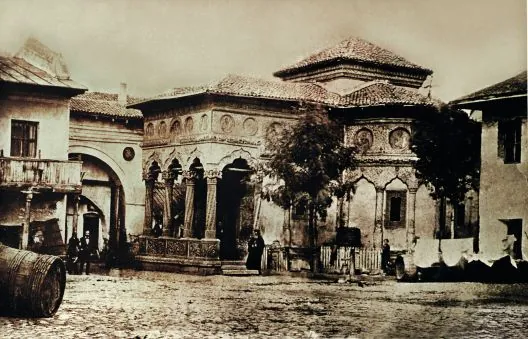
Ioanichie's mission was to raise money for the Pogoniani monastery — and he reckoned an inn brings steady income. He buys a plot by the Greeks' Monastery, builds the inn by 1724, then the church in the courtyard; the Phanariot princes' charters (Mavrocordat, Ypsilanti, Caragea, Soutzos, Moruzi) confirm his purchases and gifts.
The inn lives a century and a half — until 1871, when city hall deems its buildings “decrepit and insalubrious” and orders immediate demolition. The church stayed and is a monastery today; the 1724 inn is a ghost on the map, on the street that bears its name.
The innkeeper: a trade with the Watch on its back
Innkeepers keep the tenant rolls, report foreigners and answer for spies — from 1783, with written permits.
The great inn is hotel, customs and police station at once: the abbot (at monastery inns) keeps the tenant and rent rolls, and the authorities ask innkeepers to report every guest's name to the Watch — the penalty is the inn's closure. On 9 August 1783 Mihai Soutzos orders that nobody be lodged without a written permit from the Constabulary and the Watch; Prince Caragea drafts a bill of innkeepers' duties, because secret missions also passed through the inns.
The trade dies of hotels: innkeepers punch doors and windows through walls to make street-facing shops (endangering the walls), but earnings fall when Brenner appears with the first hotel, in 1828. The small inns — the Devil's, Vasilache's and those “utterly forgotten” — do not reach the 20th century even as names.
Which inn stood on your street?
Type your street: the page knows, for 4,878 streets, which of the 8 mapped inns stood on it around 1838. Only 10 streets hold mapped inns; the rest — small inns with no address in the sources — are counted in the text, not pinned on the map.
On Strada Lipscani cu Tei (since 1833)
Inns: cu Tei (since 1833). Lost: Șerban Vodă (1686–1878).
Streets are OpenStreetMap (October 2026); inn points are anchors on the nearest street (display only). If your street held a small inn with no address in the sources, it is not on the map — but it is in the count of 145.
Eight streets, eight inns
- Strada Lipscani — Șerban Vodă (1686–1878) and cu Tei (since 1833) — the street with two inns, one a ghost.
- Strada Franceză — Manuc (since 1804) — the inn of the 1812 peace talks.
- Strada Gabroveni — Gabroveni (since 1804) — NOT Mavrocordat's bedesten, unknown builder.
- Calea Rahovei — Golescu (1800–1893) — second after Manuc, evicted with scandal.
- Strada Stavropoleos — Stavropoleos (1724–1871) — demolished as insalubrious, the church stayed.
- Strada Colței — Colțea (1746–1848) — a century of inn, three eras, then the pickaxe.
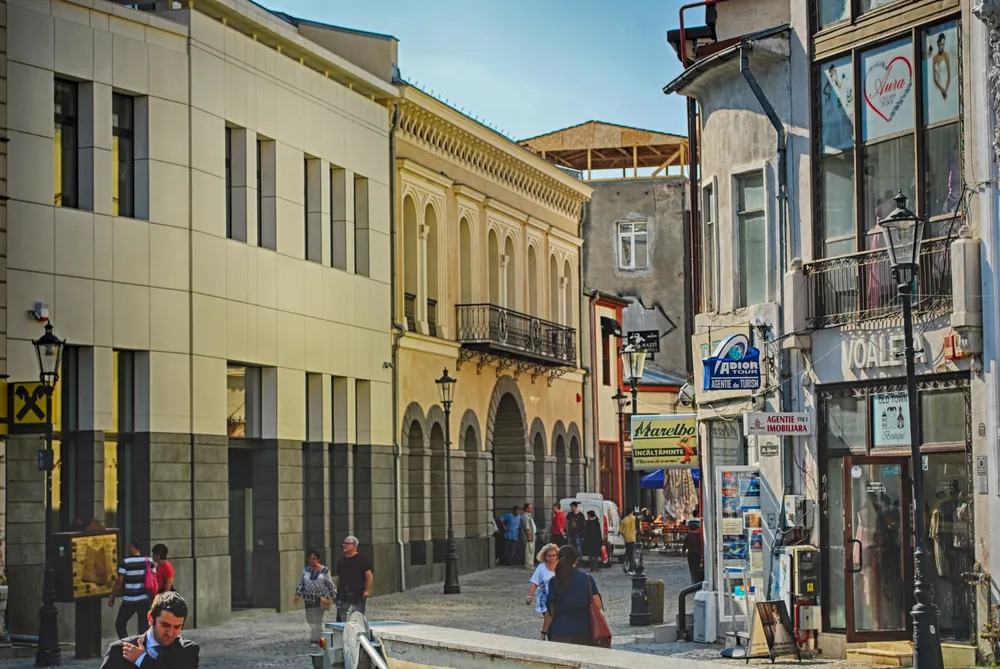
- Strada Blănari — cu Tei (since 1833) — the faithful copy of Gabroveni.
- Bulevardul Ion Constantin Brătianu — St. George (1698–1847) — 200 rooms, razed by the Great Fire.
Method: how we know
Every year on the page has a source; every point is marked as an anchor, not a survey.
The backbone is the Bucharest Museum Bulletin: BMIM XXI (2007) for the 7 great inns (dates, statistics, disputes — 34/8+7+28, 43, 77, 145, the 10 neighbourhoods), with archive references; BMIM XXVI (2012) for Golescu (Radu Golescu, Rahovei 3–5, the 1893 eviction, the Nirescher Passage until 1984). Controversial exact dates (Manuc 1804–1808, Gabroveni 1804–1818 without Mavrocordat) are rendered as disputes, not certainties.
The geometry is anchoring, not survey: each inn is a point on the centroid of the nearest today's street (OpenStreetMap, October 2026, 4,878 streets), with small offsets so they do not overlap. The start year is the first certain attestation: Manuc 1804 (the fire chronicle — the building is disputed), Gabroveni 1804 (built 1804–1818), Golescu ~1800 (early 19th century). The lookup only matches street names; it measures no distances.
What we do not know we do not invent: inns with no address in the sources (Filaret, the Red Inn, Filipescu, Zlătari, Constantin Vodă, Papazoglu, Zamfir, Chiriță and the 28 small ones) are counted, not mapped; the exact year Șerban Vodă vanished (“after the War of Independence” → 1878 as a bound); the Brenner/Hôtel de l'Europe contradiction stays as such; Gabroveni's builder stays unknown.
Quiz: six questions from the page
All answers are above, source included. Three of six is human; six of six is from the inn days.
Old questions, short answers
How many inns did Bucharest have?
145 in the 1838 census — 8 with churches, 7 great without, 28 small. There were 77 in 1819, about 43 between 1780 and 1800, and Ionnescu-Gion counted 34 places. Ten of the 94 neighbourhoods bore inn names.
When was Manuc's Inn built?
Disputed: Ionnescu-Gion gives 1808, one deed gives 1806, while BMIM shows the inn already burning in the 23 August 1804 fire — the building stands between 1804 and 1808. The page takes 1804 as the first certain attestation.
Whose is Gabroveni Inn?
Not Constantin Mavrocordat's — though one tradition starting with Flachat (1739) says so: the 1790–1791 plans show nothing on the site, and the current one rose between 1804 and 1818, unknown builder, on houses burned in 1804. The first certain attestation is Fotino, 1818.
Why was Stavropoleos demolished?
In 1871 city hall declared its buildings “decrepit and insalubrious” and ordered immediate demolition. The courtyard church stayed — it is a monastery today; the 1724 inn is a ghost on the map.
What stood where the National Bank is?
Șerban Vodă Inn: bought in 1686–1687, some 80 rooms with hiding places, vanished after the War of Independence to make room, on part of its courtyard and shops, for the National Bank of Romania.
What was the first hotel?
Brenner's, in 1828 — but the same source mentions a Hôtel de l'Europe “before him”. The contradiction stays on the page as such; what is certain is that hotels bit into the innkeepers' earnings.
Which inns are still standing?
Three: Manuc (an inn since 1804), Gabroveni (a commercial passage since 1871, a hotel after 1900) and cu Tei (1833). The rest — Șerban Vodă, St. George, Stavropoleos, Colțea, Golescu — are ghosts on the map.
Sources
- BMIM XXI (2007) — cele 7 hanuri mari, statistici, dispute: 34/8+7+28, 43, 77, 145, cele 10 mahalale / the 7 great inns, statistics, disputes
- BMIM XXVI (2012) — Golescu: Rahovei 3–5, evacuarea 1893, Pasajul Nirescher până în 1984 / the 1893 eviction, Nirescher Passage until 1984
- Wikipedia — Lista hanurilor din București: 11 nume / list of 11 inn names
- OpenStreetMap (ODbL), octombrie 2026 — 4.878 de străzi, geometria de fond / 4,878 streets, background geometry