
The 1231 poemROEN

Dan Ungureanu’s argument, checked word by word: what holds and what does not

A 13th-century Sicilian poem that sounds like Romanian, and what it says about the age of the Romanian language

The line below was written in Sicilian between 1231 and 1250, and a Romanian speaker understands it almost without translation. The likeness is real, but it does not show when Romanian was born. The linguist Dan Ungureanu infers from it that Romanian could not have split from Latin before about 500–600; traced word by word, the six forms he relies on do not support that date.

tràgemitrage-măd’estedin astefocora,focuri,sedacăt’esteîți estea bolontatevoia

“draw me out of these fires, if it is your will”

Cielo d’Alcamo, “Rosa fresca aulentissima”, line 3

Tap an underlined word to trace it back to its oldest written trace.

From other lines of the same poem

  • l. 42e solo purpenzànnomeși numai gândindu-măla diaziuaquanno vo forecând ies afară“and thinking of it only by day, when I go out”
  • l. 54Contecocu tinestaostaula sera e lo maitinoseara și dimineața“with you I stay evening and morning”
  • l. 79Se tu no levi edacă nu te ridici șiva’tine di quacipleci de aici“if you do not get up and go away from here”

The six words ↓

What Dan Ungureanu argues#

“Around 1231, Cielo d’Alcamo writes the Contrasto, one of the liveliest poems of Italian literature. […] All these forms, trage, focora, este, stao, quaci, are Romance, not Latin; we cannot date them before 500, perhaps even later; Romanian has both vocabulary and morphological features that do not exist before the 6th–7th century. In conclusion, Romanian could not have come from a Latin separated before 500–600.”

Dan Ungureanu, message to Marius Comper, 8 November 2026 (translated from Romanian)

Romanian is the Romance language of Romania and Moldova. Where and when its Latin parted from the rest is disputed, and this argument is about when.

It has three steps. First: Cielo’s poem has forms that Romanian also has. Second: these forms cannot be dated before 500. Third: so the ancestors of Romanian spoke the same Latin as the rest of the Empire at least until then. This page checks each step against the oldest texts that can be read today.

Ungureanu reached a nearby period, 540–600, by another route, using the Reichenau glosses; that test is on the page Dan Ungureanu and the origin of Romanian. His target is a real convention: the Romance Etymological Dictionary (DÉRom), the project that reconstructs spoken Latin from all the Romance languages, treats the split of Proto-Romanian as complete by the end of the 3rd century, with the year 271 as its reference point.

Almost nothing is known about Cielo d’Alcamo. His poem, a lovers’ quarrel between a man and a woman, is quoted by Dante as an example of spoken Sicilian. Its date comes from the text: the fine called defensa, which most editors tie to the laws Frederick II issued at Melfi in 1231, and the emperor, still alive, so before his death in 1250. The lower limit is disputed.

What the only manuscript actually says#

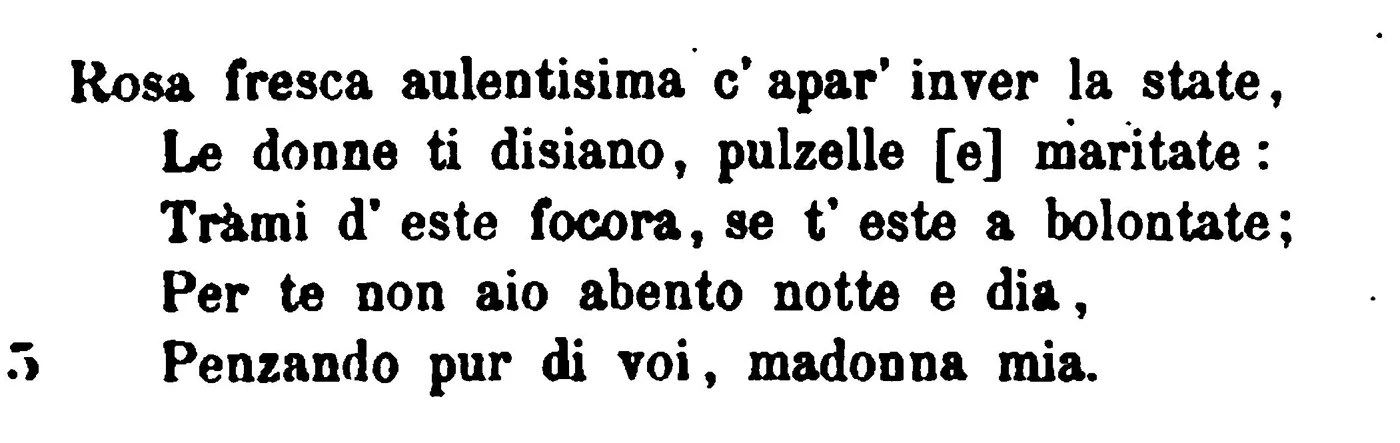
The poem survives in a single medieval manuscript, Vatican Latin codex 3793, copied in Florence at the end of the 13th century or early in the next. There the line begins Tràmi, with no g. Alessandro D’Ancona, who printed the codex in 1875 reproducing it “even where it is plainly wrong”, notes that the manuscript “Florentinizes” the word and so spoils the metre of the line.

The form with g comes from Dante. In De vulgari eloquentia, written between 1303 and 1305, he quotes the line as a sample of Sicilian: Tragemi d’este focora se t’este a boluntate. The g also appears in the poem’s first printing, by Leone Allacci at Naples in 1661 (traggeme), from a manuscript D’Ancona believes was a different one and which is now missing; Allacci’s second printing has Traheme. Modern editions combine these sources and print tràgemi. Ungureanu’s first example therefore rests on Dante and on a lost source, not on the surviving manuscript.

The g is still real: Italian and Portuguese have it, and a Frankish chronicler writes it around 660. But the gap shows why, for each word below, three things are kept apart: what the manuscript says, what others quote, and what editors reconstruct.

A page printed in 1875 with the first five lines of the poem; the third line begins with the word Tràmi.
The first stanza, printed from Vatican codex 3793 in “Le antiche rime volgari”, vol. I, Bologna, 1875, p. 169. Line 3 begins “Tràmi”. Public domain; Internet Archive scan.
Two printed lines listing the variants of the word that begins line 3: Traheme, Traemi, Tragemi, Tragimi, Trájimi.
The editor’s note on line 3, p. 170: “Traheme” in Allacci’s second printing (1661), “Traemi” in other editors, “Tragemi” in the late copy of the codex (Vatican 4823) and in Vigo.

Six words, traced back to their first written trace#

Each row starts from the poem and runs back to the oldest text that has the form or its pieces. The red line is Ungureanu’s threshold, the year 500; the dotted blue line is DÉRom’s reference year, 271.

the form, writtenits pieces or mechanism, writteninferred form, never writtenthe poem

Word 1 of 6 · l. 3

tràgemi trage-mă

“Tràgemi”, draw me: the g in “trage”

What Ungureanu says

“In Latin traho ‘to draw’ has -H-, not -G-. *trago is late, after AD 500.”

What the manuscript has

The only surviving manuscript reads Tràmi, with no g. The g form appears in Dante (Tragemi) and in Allacci’s first printing (traggeme), probably made from a manuscript now lost; modern editions adopt it.

Oldest written trace

  1. about 660The Chronicle of Fredegar, Gaul, about 660tragereApart from a single adtrai, the chronicler writes tragere and vegere (Haag, 1898). source
  2. 1303–1305Dante, “De vulgari eloquentia” I.xii.6, 1303–1305Tragemi d’este focora se t’este a boluntateDante quotes the line as a sample of Sicilian as ordinary people spoke it. source

How it formed

The g does not come from the h. Speakers rebuilt the verb from the perfect traxi and the participle tractus, on the model of rego, rexi, rectus or lego, lexi, lectus (Grandgent, § 417). An analogy this simple can happen in several places at once.

Who else says it

  • Romaniantrag
  • Cielo’s Siciliantràgemi
  • Italian (Tuscan)traggo
  • Frenchtrais
  • Spanishtraigo
  • Portuguesetrago

What it shows

The first written trace is after 500, as Ungureanu says. But Portuguese and Italian have the g form too, and no text shows when it was born.

Word 2 of 6 · l. 3

focora focuri

“Focora”, fires: the plural in -ora

What Ungureanu says

“‘focora’ = focuri is late, after 500.”

What the manuscript has

The manuscript reads focora, line 3, as Dante does.

Oldest written trace

  1. ClassicalClassical Latintempus, tempora · corpus, corporaThe plural in -ora exists, but only for neuter nouns. source
  2. 54–68Petronius, “Satyricon” 45, in Nero’s reign (54–68)nervia praecisaA masculine noun, nervus, takes the neuter plural: nervia instead of nervi. source
  3. 753Latin charter from Lombardy, 753subvalle CamporaA place name, from the masculine campus: the oldest example found by Paul Aebischer (1933, p. 16). He concludes that campora “certainly belonged to everyday speech before 753”. source

How it formed

Latin had the plural in -ora only for neuters, as in tempora. Grandgent (§ 369) shows that in Italy and Romania -ora became a plural ending, extended in Old Italian to the second declension and in Romanian to the second and the first. Several words match: foc, focuri and fuoco, fuocora (fire); câmp, câmpuri and campo, campora (field); loc, locuri and luogo, luogora (place); fund, funduri and fondo, fondora (bottom). In Latin these were masculine (focus, campus, locus, fundus); in Romanian they became neuter.

Who else says it

  • Romanianfocuri
  • Cielo’s Sicilianfocora
  • Italian (Tuscan)fuocora*
  • Frenchfeux
  • Spanishfuegos
  • Portuguesefogos

What it shows

This is the strongest match: Grandgent finds the extended -ora plural only in Italy and in Romanian, and several words match. The first written trace is from 753, but Aebischer himself concludes the form was in use before, and the mechanism already shows in Petronius, in the 1st century. No text shows when it was born.

Word 3 of 6 · l. 3

t’este îți este

“T’este”, is to you: the final vowel

What Ungureanu says

“este = este, as in Romanian, is late as well.”

What the manuscript has

The manuscript: se t’este a bolontate, line 3, and ch’este granne assai, line 59. In the same line, d’este focora means “out of these fires” and comes from Latin iste, “this”; t’este means “is to you” and comes from est.

Oldest written trace

  1. ClassicalClassical LatinestThe word itself is the most ordinary form of the verb “to be”. source

How it formed

The final vowel is an addition. The standard Romanian dictionary (DEX) gives simply “Lat. est”, and the old Romanian form was iaste. None of the sources consulted says when the vowel appeared, in Romanian or in Sicilian.

Who else says it

  • Romanianeste
  • Cielo’s Sicilianeste
  • Italian (Tuscan)è
  • Frenchest
  • Spanishes
  • Portugueseé

What it shows

The word is Classical Latin. The added vowel has no date: nothing places it after 500, and nothing before.

Word 4 of 6 · l. 42

la dia ziua

“La dia”, the day: a feminine

What Ungureanu says

“Cielo also says ‘la dia’ = ziua, the day, feminine.”

What the manuscript has

The manuscript: la dia quanno vò foro, line 42. The same form appears in other poets of the same codex: La notte co’ la dia.

Oldest written trace

  1. 50s BCCaesar, “Gallic War” I.4, the 50s BCDie constituta“On the appointed day”: dies with a feminine adjective. source

How it formed

Latin used dies as a feminine for an appointed day and for time in general (Allen and Greenough, § 97a). The form dia, with -a, is a remake on the first declension; nouns in -ies had begun moving to -ia in Classical Latin, and dies lived on beside dia (Grandgent, § 355).
A trap. The match “la dia = ziua” is half an illusion. Romanian zi comes from dies, and the -a of ziua is the definite article. In Cielo the -a belongs to the word, as in Spanish día. Only the feminine gender is shared.

Who else says it

  • Romanianziua
  • Cielo’s Sicilianla dia
  • Italian (Tuscan)il dì
  • Frenchle jour
  • Spanishel día
  • Portugueseo dia

What it shows

The feminine of dies already exists in Classical Latin, in a restricted use: Caesar uses it more than five centuries before Ungureanu’s threshold. Its spread to every “day” has no date.

Word 5 of 6 · l. 54

stao stau

“Stao”, I stay: the diphthong

What Ungureanu says

“and stao = eu stau, I stay, with a diphthong (in Latin, sto).”

What the manuscript has

The manuscript: Con teco stao la sera e lo maitino, line 54.

Oldest written trace

  1. ClassicalClassical LatinstoThe Classical form, without the diphthong. *Stao appears in no Latin text. source
  2. —*staonever written in Latin

How it formed

Grandgent (§ 397): beside do and sto there arose *dao and *stao, which gave Romanian dau, stau, Old Italian dao, Provençal dau, estau and Portuguese dou, estou. He takes them as late formations, made to keep the root vowel apart from the ending. The asterisk marks a form inferred from the languages that have it, not read in a text.

Who else says it

  • Romanianstau
  • Cielo’s Sicilianstao
  • Italian (Tuscan)sto
  • French—
  • Spanishestoy
  • Portugueseestou

What it shows

The form appears in no Latin text; it is reconstructed. Grandgent takes it as late, which fits Ungureanu’s timing. But Provençal and Portuguese have it too: either it spread through a Latin common to the whole Empire, or it formed more than once, so on its own it cannot date a split.

Word 6 of 6 · l. 79

quaci încoace

“Quaci”, hither: one word out of two

What Ungureanu says

“vatine di quaci = go away from here, where quaci = Romanian încoaci, hither.”

What the manuscript has

The manuscript: vàtine di quaci, line 79, and Di quaci non mi mosera, line 83. The meanings differ slightly: quaci means “here”, Romanian încoace “hither”.

Oldest written trace

  1. before 184 BCPlautus, “Curculio” 615, before 184 BCCerte eccistam video“I can see her right here”: ecce, “look”, fused with istam. Plautus uses eccum dozens of times. source

How it formed

Quaci is built from eccu(m), “look”, and hac, “this way”; Romanian încoace comes, according to DEX, from in-eccu(m)-hocce. Plautus was already fusing ecce with other words. Grandgent (§ 65) thinks the final fusion into one word happened only towards the end of spoken Latin.

Who else says it

  • Romanianîncoace
  • Cielo’s Sicilianquaci
  • Italian (Tuscan)qua
  • Frenchçà
  • Spanishacá
  • Portuguesecá

What it shows

The pieces are in Plautus, before 184 BC. Their fusion is later, towards the end of spoken Latin according to Grandgent, which fits Ungureanu’s timing. But every Romance language has it, from Lisbon to Bucharest: it is a change of spoken Latin as a whole, and it does not say when one branch left.

First written is not first spoken#

Ungureanu is right on one point: none of the six forms appears as such in any text before 500; for only two of them are the gender or the pieces attested earlier. The next step does not hold. In the first millennium, people who wrote wrote the Latin they had learned at school, and spoken forms got into writing only when someone slipped. The first appearance of a form shows it already existed, not that it was born then.

If the date of first writing were the date of birth, some things would come out plainly impossible:

  • Romanian would have been born in 1521, the year of Neacșu’s letter from Câmpulung, the oldest surviving Romanian text.
  • Yet in 587, in the Haemus mountains of the Balkans, soldiers of the Byzantine army shouted “torna, torna” “in the local tongue”, writes the chronicler Theophylact Simocatta; Theophanes the Confessor gives the shout as “torna, torna, fratre”. Most scholars read the shout as spoken Romance; others see an army command in Latin. Either way, a spoken Latin lived there more than nine hundred years before the first Romanian text.
  • Applied to the six forms, the rule would move Romanian’s split to after 753, the year of the oldest masculine plural in -ora that Ungureanu cites. That is later than the 540–600 he himself reaches with the Reichenau glosses.
587 · A Romance language spoken in the Balkans1521 · The first surviving Romanian text

On the timeline above, the button “The rule ‘first written = born’” shows where these dates would fall.

Who else says it#

When Portuguese or Spanish shares one of Cielo’s forms, its match with Romanian says nothing about Italy: the form was either old and common, or it arose more than once. The table shows what six languages have for each form.

RomanianCielo’s SicilianItalian (Tuscan)FrenchSpanishPortuguese
“I draw”, with gtragtràgemitraggotraistraigotrago
“fires”, plural in -orafocurifocorafuocora*feuxfuegosfogos
“is”, with a final vowelesteesteèestesé
“the day”, feminineziuala diail dìle jourel díao dia
“I stay”, with a diphthongstaustaosto—estoyestou
“here”, from ecce/eccu + adverbîncoacequaciquaçàacácá

* Old form: today’s Italian says fuochi. French has no diphthong “I stay”, but Old Provençal has estau. Spanish estoy comes from estó, with no diphthong; the g of traigo has other explanations too, and French trais shows no g. Shaded cells are of the same type as the Romanian.

Three forms cross the borders of Italy: trag, stau and încoace. Among the languages in the table, the other three appear only in Italy and in Romanian: the plural in -ora, este with a final vowel, and a feminine “day”. None of these three has a date of birth, and the feminine of dies has roots in Classical Latin.

What remains of the conclusion#

Ungureanu’s conclusion has a real target. DÉRom treats the split of Proto-Romanian as complete by the end of the 3rd century and takes as its reference the year 271, when the Roman army left Dacia (Florescu, 2014). If Romanian shared with Italy an innovation that was surely born after 271 and could hardly arise twice, that reference point would fall.

Cielo’s line offers no such innovation. And the 271 reference is not the only alternative. Eutropius writes that the emperor Aurelian, giving up Dacia, “took the Romans out of the towns and fields of Dacia and settled them in the middle of Moesia”, that is, south of the Danube, inside the Empire. In 587 a spoken Latin was still heard in the Empire’s army in the Balkans. A Latin tied to the rest of the Empire until about 600 would have received late innovations without anyone coming from Italy.

  1. A

    Split off in 271, with no later ties

    DÉRom’s reference point, taken literally.

    not contradicted Requires every form shared with Italy to be older than 271, or to have arisen twice. Grandgent dates *stao and the fusion in quaci late; if he is right and the forms did not arise twice, this option is under pressure. No secure date in the line contradicts it.

  2. B

    Danubian Latin, tied to the Empire until about 600

    Eutropius; “torna, torna” in 587.

    consistent Fits all six forms.

  3. C

    An Italian-type Latin reaching the Balkans after 500

    The thesis of Ungureanu’s 2024 book, summarised on the page about him.

    consistent Fits all six forms.

The line can at most tell option A from the other two, and only if the -ora plural ever gets a date. Between B and C it cannot choose.

What could decide it

  • Shared innovations that come with an independent date: a loan from a language that reached the region at a known time, or a change of meaning dated in texts. This is what Ungureanu looks for in the Reichenau glosses; the result and its limits are on the page about him.
  • A comparison of complete lists for the -ora plural: every noun that takes -ora in Italian charters and every noun that takes -uri in Romanian, against a chance baseline. An overlap far above chance would show a shared innovation; a secure date for it would be a reference point.

How this was done#

  • The text of the poem and the line numbers: the Einaudi edition on Wikisource, checked against the 1875 edition, which reproduces Vatican codex 3793.
  • Every date comes from the oldest text that can be read today, opened in its own edition: Plautus, Caesar, Petronius, Eutropius, Theophylact, Theophanes, Fredegar (through Haag’s 1898 study) and Dante.
  • Inferred forms, which appear in no text, carry an asterisk and are drawn apart from written ones.
  • The 753 example comes from Paul Aebischer’s 1933 article, read page by page on Persée; Ungureanu cites the same example.
  • Forms in the other languages: DEX for Romanian, Wiktionary for the rest, Grandgent for old forms.
  • Still open: the date of the final vowel in este and the origin of the -ci in quaci.

Sources#