The whole walk, in words
The 14 stops, in the order of the path. For each animal: what was found, what is inferred and what is assumed.
Three ways of knowing
- Foundbones, eggs and the rock they lie in; with site, year and collection number
- Inferredthe whole skeleton; what is missing is completed in plaster, after named relatives
- Assumedskin, colour, feathers, gait, sound
Sânpetru: the valley where the first bones were found
The Sibișel valley, south of the town of Hațeg. Here Ilona Nopcsa found the first bones, in 1895. The rocks were laid down by wide, shallow rivers.
1 Sânpetru
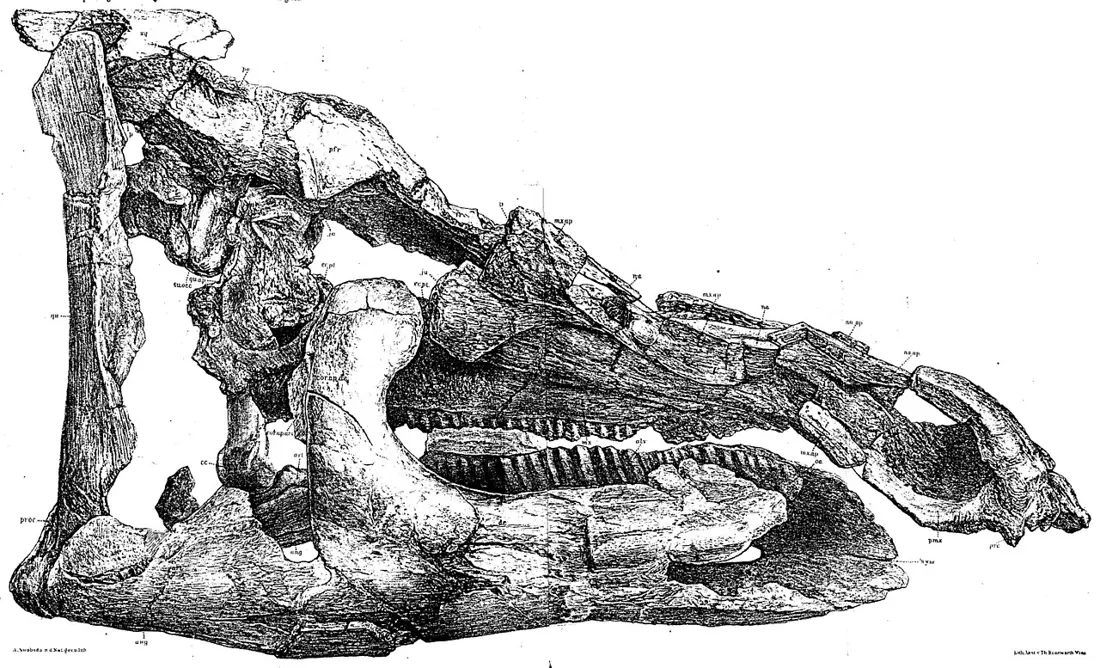
Telmatosaurus transsylvanicus, the first skull

Found
A crushed skull with its lower jaw, 44 centimetres long. In 1895 Ilona Nopcsa found the first bones on her family's estate at Sânpetru, a village in the Hațeg Basin. Her brother Franz described the skull in 1900. It is in the Natural History Museum in London (NHMUK R.3386). Some of the bones around the eye and almost all of the palate are missing.
Inferred
The body is put together from bones of other animals of the same species: vertebrae, a shoulder blade, an upper arm bone, a thigh bone. The largest thigh bone is about 46 centimetres long. Hence a length of 5 metres at most and a weight of over 500 kilograms, a tenth of that of the duck-billed dinosaurs of the continents. The tail (probably more than 50 vertebrae), the hands, the feet and the hips are completed after relatives. It has no crest.
Assumed
The scales are assumed after skin impressions of relatives from other parts of the world; there is no skin impression of an adult from the Hațeg Basin. Colour, walking mostly on two legs and living in groups are assumptions. A jaw of a young animal, found in the same valley, bears the mark of an ameloblastoma, a benign jaw tumour, the first ever found in a fossil.
Sources
- Weishampel, Norman, Grigorescu (1993), „Telmatosaurus transsylvanicus from the Late Cretaceous of Romania: the most basal hadrosaurid dinosaur”, Palaeontology 36(2): 361–385
- Grigorescu (2010), „The Latest Cretaceous fauna with dinosaurs and mammals from the Haţeg Basin — A historical overview”, Palaeogeography, Palaeoclimatology, Palaeoecology 293: 271–282
- Benton, Csiki, Grigorescu, Redelstorff, Sander, Stein, Weishampel (2010), „Dinosaurs and the island rule: The dwarfed dinosaurs from Haţeg Island”, Palaeogeography, Palaeoclimatology, Palaeoecology 293: 438–454
- Dumbravă, Rothschild, Weishampel, Csiki-Sava et al. (2016), “A dinosaurian facial deformity and the first occurrence of ameloblastoma in the fossil record”, Scientific Reports 6: 29271
- Grellet-Tinner, Codrea, Folie, Higa, Smith (2012), „First evidence of reproductive adaptation to “island effect” of a dwarf Cretaceous Romanian titanosaur, with embryonic integument in ovo”, PLoS ONE 7(3): e32051
- Natural History Museum, London, collections catalogue (records R 3386, R 3392, R 4900, R 4966)
2 Sânpetru
Zalmoxes robustus, known from pieces

Found
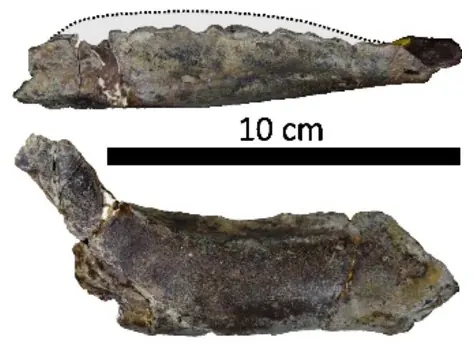
A right lower jaw from Sânpetru (NHMUK R.3392) carries the name of the species. Nopcsa had called it Mochlodon robustus; the genus name Zalmoxes, after Zalmoxis, god of the ancient Dacians, was given in 2003. Six more skull pieces in the same collection are thought to come from the same animal. A whole skull has never been found. At Sânpetru, bones of Zalmoxes and of Telmatosaurus came out of the same pocket of rock.
Inferred
The thigh bones measured are 25–32 centimetres long and belong to nearly grown animals about 2.4 metres long; older estimates go up to 3 metres. Whether it is an island dwarf is disputed: a 2012 study shows that the family's ancestors were about the same size, and that the exception is the French relative, Rhabdodon, which grew larger. In January 2026 the other species from Sânpetru, Zalmoxes shqiperorum, was moved among the horned dinosaurs under the name Ferenceratops. Zalmoxes robustus kept its name.
Assumed
Skin and colour are assumed. Walking habitually on two legs is thought probable by specialists, not proven.
Sources
- Augustin, Ősi, Csiki-Sava (2023), „The Rhabdodontidae (Dinosauria, Ornithischia), an enigmatic dinosaur group endemic to the Late Cretaceous European Archipelago”, Fossil Record 26(2): 171–189
- Brusatte, Dumbravă, Vremir, Csiki-Sava, Totoianu, Norell (2017), „A catalog of Zalmoxes specimens from the Upper Cretaceous Nălaţ-Vad locality”, American Museum Novitates 3884
- Augustin, Dumbravă, Bastiaans, Csiki-Sava (2023), „Reappraisal of the braincase anatomy of the ornithopod dinosaurs Telmatosaurus and Zalmoxes”, PalZ 97: 129–145
- Ősi, Prondvai, Butler, Weishampel (2012), „Phylogeny, histology and inferred body size evolution in a new rhabdodontid dinosaur from the Late Cretaceous of Hungary”, PLoS ONE 7(9): e44318
- Benton, Csiki, Grigorescu, Redelstorff, Sander, Stein, Weishampel (2010), „Dinosaurs and the island rule: The dwarfed dinosaurs from Haţeg Island”, Palaeogeography, Palaeoclimatology, Palaeoecology 293: 438–454
- Maidment, Butler, Brusatte, Meade, Augustin, Csiki-Sava, Ősi (2026), „A hidden diversity of ceratopsian dinosaurs in Late Cretaceous Europe”, Nature
3 Sânpetru
Struthiosaurus transylvanicus, the armoured dinosaur

Found
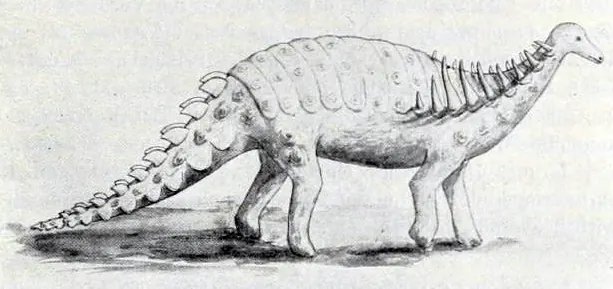
The back of a skull, some vertebrae, ribs, a shoulder blade and bony plates from the skin, found in 1912 near Sânpetru; the exact spot is no longer known. They are in London (NHMUK R 4966). Later, near Vurpăr, in Alba county, came bones of at least three related animals, with 15 bony plates.
Inferred
No length has been published for the Romanian animal. The whole genus is put at “up to three metres”; the skeleton here is 2.5. The plates found are low, oval or rectangular, with a keel. How they sat on the body cannot be told from the Romanian bones: the rows on the back and the shoulder spikes are taken from relatives in Austria, France and Hungary. Whether it is a dwarf has not been tested: the bone of the London animal has never been thin-sectioned.
Assumed
The horn sheaths over the plates, the skin between them and the colour are assumed.
Sources
- Ősi, Codrea, Prondvai, Csiki-Sava (2014), „New ankylosaurian material from the Upper Cretaceous of Transylvania”, Annales de Paléontologie 100: 257–271
- Schade, Stumpf, Kriwet, Kettler, Pfaff (2022), „Neuroanatomy of the nodosaurid Struthiosaurus austriacus”, Scientific Reports 12: 144
- Csiki-Sava, Buffetaut, Ősi, Pereda-Suberbiola, Brusatte (2015), „Island life in the Cretaceous”, ZooKeys 469: 1–161
- Natural History Museum, London, collections catalogue (records R 3386, R 3392, R 4900, R 4966)
4 Sânpetru
Nopcsa's idea: dwarfs, because they lived on an island
On 27 November 1912, in Vienna, the Transylvanian palaeontologist Franz Nopcsa told the Zoological and Botanical Society that Transylvania had been an island in the Late Cretaceous and that its dinosaurs were small because of island life, like the dwarf elephants of the Mediterranean. The report was printed in 1914. In the room, the palaeontologist Othenio Abel asked at once where the line between an island and a continent lies.
The reasoning was circular: the animals are small, so it was an island. Geology confirmed the island much later. The dwarfs were confirmed only in part. In Magyarosaurus dacus, bone tissue shows small adults. In Telmatosaurus, the evidence points the same way. On Zalmoxes and Struthiosaurus, published opinion is divided. The meat-eaters are not dwarfs. And in 2025 a titanosaur from the same rocks was named, Uriash kadici, of 5–8 tonnes and 9–12 metres: large sauropods lived on the island too.
Nopcsa also thought his dinosaurs lived in swamps. The fossil soils show mostly well-drained river plains with seasonal rain.
Sources
- Nopcsa (1914), „Über das Vorkommen der Dinosaurier in Siebenbürgen”, Verhandlungen der k.k. zoologisch-botanischen Gesellschaft in Wien 64: (12)–(14)
- Benton, Csiki, Grigorescu, Redelstorff, Sander, Stein, Weishampel (2010), „Dinosaurs and the island rule: The dwarfed dinosaurs from Haţeg Island”, Palaeogeography, Palaeoclimatology, Palaeoecology 293: 438–454
- Stein, Csiki, Curry Rogers, Weishampel, Redelstorff, Carballido, Sander (2010), „Small body size and extreme cortical bone remodeling indicate phyletic dwarfism in Magyarosaurus dacus”, PNAS 107(20): 9258–9263
- Ősi, Prondvai, Butler, Weishampel (2012), „Phylogeny, histology and inferred body size evolution in a new rhabdodontid dinosaur from the Late Cretaceous of Hungary”, PLoS ONE 7(9): e44318
- Díez Díaz, Mannion, Csiki-Sava, Upchurch (2025), „Revision of Romanian sauropod dinosaurs”, Journal of Systematic Palaeontology 23(1): 2441516
- Therrien (2005), „Palaeoenvironments of the latest Cretaceous (Maastrichtian) dinosaurs of Romania: insights from fluvial deposits and paleosols”, Palaeogeography, Palaeoclimatology, Palaeoecology 218: 15–56
Tuștea: the nests
Oltoane hill, in the north-west of the basin. In 1988 a landslide brought to light the first dinosaur eggs found in Romania.
5 Tuștea
The nests at Tuștea

Found
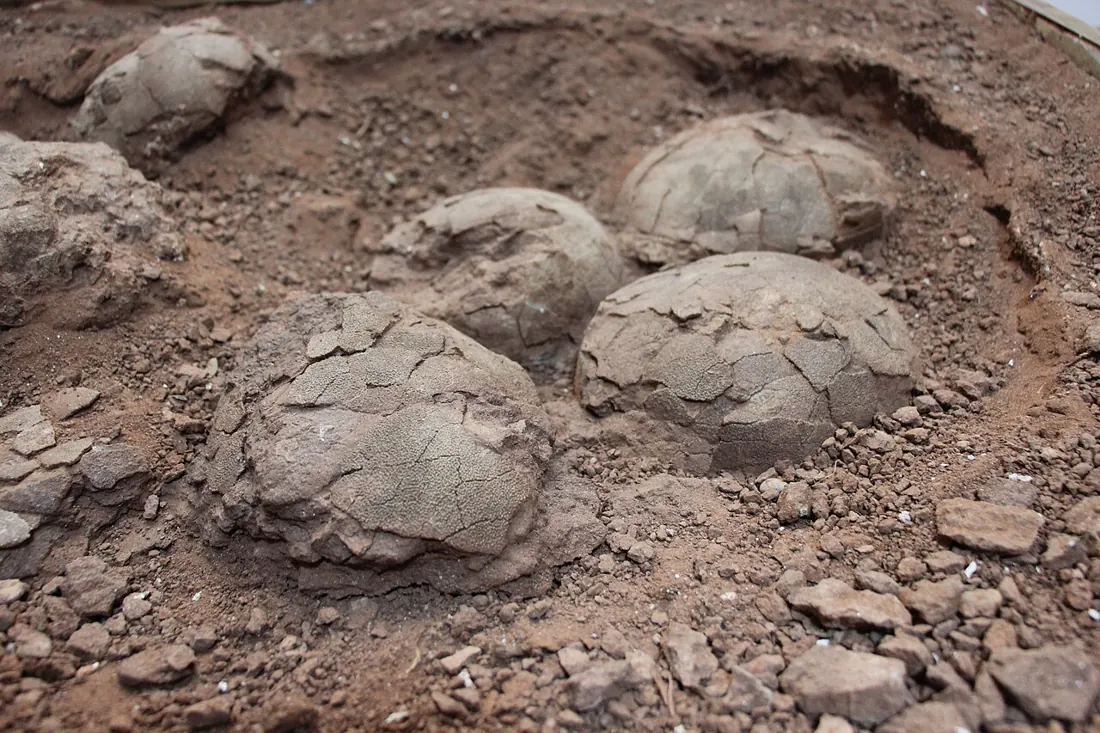
In 1988, after a landslide on Oltoane hill at Tuștea, a village in the north-west of the Hațeg Basin, nearly round eggs came to light, 14–16 centimetres across, with a shell over 2 millimetres thick. So far 18 nests have been counted, on two levels, with over a hundred eggs. A nest usually holds 3–7 eggs, at most 14, sometimes in rows. Most have hatched: only the lower half is left.
Inferred
The whole eggs in plaster show what they were like before they broke. The fossil soil says that the place was a well-drained part of the plain, near a branch of a river, and that floods buried the nests.
Assumed
Who made the nests is the question at Tuștea. By shape and shell, the eggs resemble those laid by titanosaurs in other parts of the world. Yet beside them, and even inside them, were bones of duck-billed dinosaur hatchlings, assigned to Telmatosaurus, and in one egg a tooth of such a hatchling. The researcher who described the site now assigns them to Telmatosaurus. A whole embryo in an unbroken egg, which would settle it, has not been found. That is why no adult stands by the nests.
Overhead flies a pterosaur with a wingspan of 5–6 metres. A thigh bone about 40 centimetres long, assigned to Hatzegopteryx, also comes from Tuștea; at “found” the bone lies on the rock, to the left of the nests.
Sources
- Botfalvai, Csiki-Sava, Grigorescu, Vasile (2017), „Taphonomical and palaeoecological investigation of the Late Cretaceous (Maastrichtian) Tuştea vertebrate assemblage”, Palaeogeography, Palaeoclimatology, Palaeoecology 468: 228–262
- Grigorescu (2010), „The “Tuştea Puzzle”: hadrosaurid (Dinosauria, Ornithopoda) hatchlings associated with Megaloolithidae eggs in the Maastrichtian of the Haţeg Basin”, Ameghiniana 47(1): 89–97
- Grigorescu (2017), „The ‘Tuştea puzzle’ revisited: Late Cretaceous (Maastrichtian) Megaloolithus eggs associated with Telmatosaurus hatchlings in the Haţeg Basin”, Historical Biology 29(5): 627–640
- Therrien (2005), „Palaeoenvironments of the latest Cretaceous (Maastrichtian) dinosaurs of Romania: insights from fluvial deposits and paleosols”, Palaeogeography, Palaeoclimatology, Palaeoecology 218: 15–56
- Buffetaut, Grigorescu, Csiki (2002), „A new giant pterosaur with a robust skull from the latest Cretaceous of Romania”, Naturwissenschaften 89: 180–184
- Vremir, Kellner, Naish, Dyke (2013), „A new azhdarchid pterosaur from the Late Cretaceous of the Transylvanian Basin, Romania”, PLoS ONE 8(1): e54268
6 Tuștea
The hatchlings beside the eggs
Found
83 hatchling bones, from at least five animals, most of them less than half a metre from the nests or inside them. Among the first described are the ends of two thigh bones and the end of a shin bone (FGGUB 248–250); one thigh-bone fragment is 26.5 millimetres long. One nest also held the vertebrae of a small snake, Nidophis insularis.
Inferred
The skeleton is that of the adult Telmatosaurus, ten times smaller: too little of the hatchlings exists to know how their proportions changed with age. The size, under half a metre, was chosen after the size of the egg.
Assumed
That the hatchlings stayed near the nest for a while is an assumption supported only by where their bones were found. Their colour and the way they moved are assumptions.
Sources
- Botfalvai, Csiki-Sava, Grigorescu, Vasile (2017), „Taphonomical and palaeoecological investigation of the Late Cretaceous (Maastrichtian) Tuştea vertebrate assemblage”, Palaeogeography, Palaeoclimatology, Palaeoecology 468: 228–262
- Weishampel, Norman, Grigorescu (1993), „Telmatosaurus transsylvanicus from the Late Cretaceous of Romania: the most basal hadrosaurid dinosaur”, Palaeontology 36(2): 361–385
- Grigorescu (2010), „The “Tuştea Puzzle”: hadrosaurid (Dinosauria, Ornithopoda) hatchlings associated with Megaloolithidae eggs in the Maastrichtian of the Haţeg Basin”, Ameghiniana 47(1): 89–97
- Csiki-Sava, Buffetaut, Ősi, Pereda-Suberbiola, Brusatte (2015), „Island life in the Cretaceous”, ZooKeys 469: 1–161
7 Tuștea
A larger Balaur, at Tuștea
Found
The bones of a single left arm: upper arm, a forearm bone, a bone of the hand and finger bones (LPB (FGGUB) R.1580–1585), found in the nesting site. Of the upper arm bone, 157 millimetres survive, out of about 170.
Inferred
It is one and a half times the size of the Balaur from Sebeș and also adult, by its bone tissue. The authors call it Balaur sp.: it may be a second species. The rest of the skeleton here is the one from Sebeș, enlarged.
Assumed
What it was doing by the nests is not known. The feathers are assumed, as for the animal from Sebeș.
Sources
- Brusatte, Vremir, Csiki-Sava, Turner, Watanabe, Erickson, Norell (2013), „The osteology of Balaur bondoc”, Bulletin of the American Museum of Natural History 374: 1–100
- Csiki, Vremir, Brusatte, Norell (2010), „An aberrant island-dwelling theropod dinosaur from the Late Cretaceous of Romania”, PNAS 107(35): 15357–15361
- Csiki-Sava, Andrășanu (2021), „Meeting Island Dwarfs and Giants of the Cretaceous – The Hațeg Country UNESCO Global Geopark”, Geoconservation Research 4(2): 471–491
Vălioara: a sauropod the weight of a horse and a pterosaur the span of a small plane
The north-west of the Hațeg Basin. The bones on which Magyarosaurus dacus and Hatzegopteryx thambema were named come from here.
8 Vălioara
An island where Transylvania is now
You are near Vălioara, a village in the north-west of the Hațeg Basin in Transylvania, Romania, some 70 million years before the village. The land under you is an island in the archipelago that stands where Europe will be. The estimate used most often gives it 80,000 square kilometres, the size of Hispaniola; others go up to 200,000. Other land was, by estimate, at least 200–300 kilometres away, and the latitude is that of today's Canary Islands.
The bone-bearing rocks of the Hațeg Basin were laid down between about 72 and 68 million years ago. “70 million years ago” is the middle of that span.
The walk has four places, each named after its fossil site: Vălioara, Sânpetru, Tuștea and Sebeș. No animal appears in a place where its bones were not found. Animals from different places did not necessarily meet: the sites lie tens of kilometres apart and, in some cases, hundreds of thousands of years.
The handle at the bottom changes how you know what you see. At “found” there is today's rock, with the bones that exist. At “inferred” the skeleton stands up: real bone stays dark, and what is missing is completed in white plaster, after close relatives. At “assumed” come the skin, the colour and the walk, which nobody has seen; the “Colour” button goes through three guesses, none better founded than the others. The red-and-white pole beside each animal is two metres tall, in bands of 20 centimetres.
Sources
- Benton, Csiki, Grigorescu, Redelstorff, Sander, Stein, Weishampel (2010), „Dinosaurs and the island rule: The dwarfed dinosaurs from Haţeg Island”, Palaeogeography, Palaeoclimatology, Palaeoecology 293: 438–454
- Csiki-Sava, Buffetaut, Ősi, Pereda-Suberbiola, Brusatte (2015), „Island life in the Cretaceous”, ZooKeys 469: 1–161
- Bojar, Halas, Bojar, Grigorescu, Vasile (2011), „Upper Cretaceous volcanoclastic deposits from the Haţeg Basin”, Geochronometria 38(2): 182–188
- Panaiotu, Panaiotu (2010), „Palaeomagnetism of the Upper Cretaceous Sânpetru Formation”, Palaeogeography, Palaeoclimatology, Palaeoecology 293: 343–352
- Paleobiology Database, coordinates of the Vălioara, Tuștea-Oltoane, Sânpetru and Sebeș-Glod sites; the distances are computed from them
9 Vălioara
Magyarosaurus dacus, a sauropod with its hip one metre up

Found
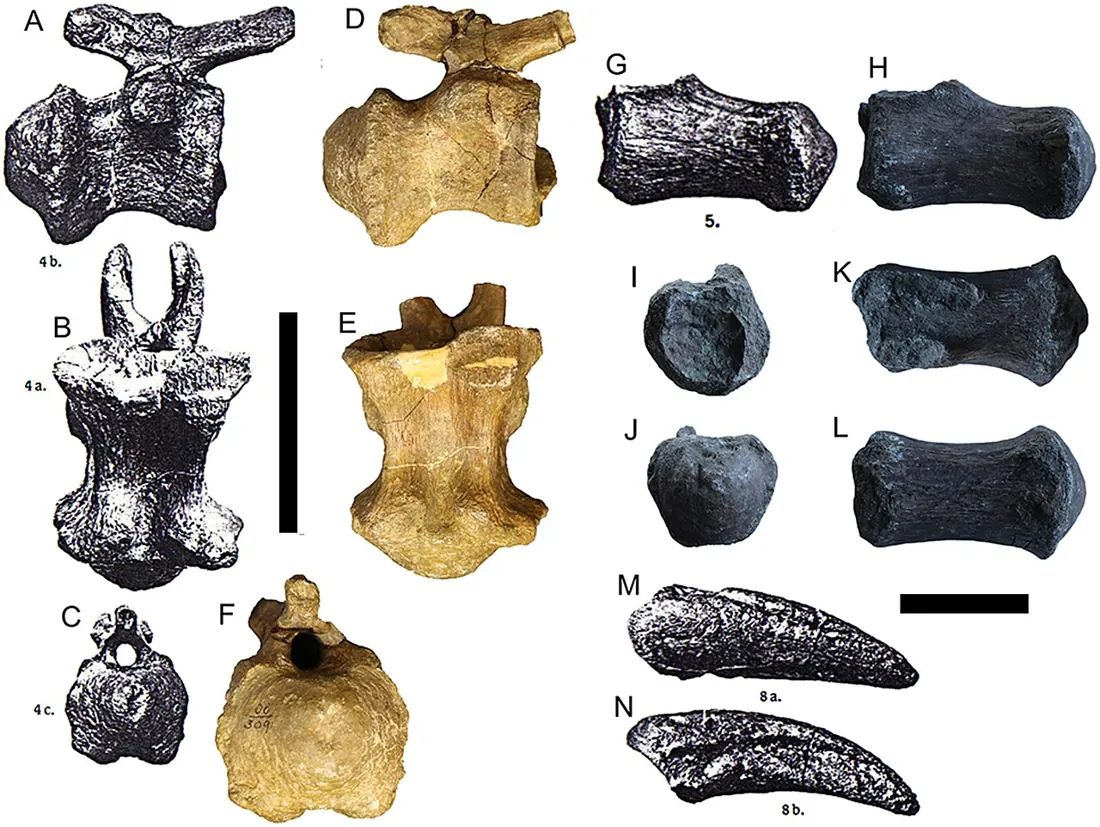
Ten bones collected by the geologist Ottokár Kadić between 1909 and 1915 in a ravine between the villages of Vălioara and Ciula Mică, now in Budapest: two tail vertebrae, an upper arm bone, the two forearm bones, a bone of the hand, a broken thigh bone and three left fibulae. Three left fibulae mean at least three animals. The species name rests on one tail vertebra 9 centimetres long (SZTFH Ob.3091). One bone of each kind lies on the rock.
Inferred
The limbs stand on measurements: in the largest known animal the upper arm bone is 40 centimetres long and the thigh bone 50–54, so the hip was about one metre off the ground. The skull, the neck (of which a single fragment exists), the hips, the shoulder and the feet were not found. In plaster they are those of a generic titanosaur; no paper names the relative they should be completed after.
Length is the least certain part. The 2025 revision gives 2.2–2.8 metres and 660–972 kilograms: the weight is computed from the thickness of the limb bones, and the length from the weight, and notes that such proportions might be unrealistic for a sauropod. Older estimates went to 5–6 metres. The skeleton here is nearly 5 metres long, because vertebrae of the size of those found (9–12 centimetres) are laid end to end in a number that was chosen, not found: 13 in the neck, 10 in the back, 35 in the tail.
That the small bones are adult shows in their tissue, almost wholly rebuilt, as in animals that have finished growing.
Assumed
Skin, colour, the way it held its neck and walking in a group are assumptions. A single titanosaur armour plate is known from the Hațeg Basin, 8 by 7 centimetres, found in 1995 near Sânpetru; nobody knows which of the four species here it belonged to, so this animal has no armour. By weight it is a large horse, with its back at an adult's waist.
Sources
- Díez Díaz, Mannion, Csiki-Sava, Upchurch (2025), „Revision of Romanian sauropod dinosaurs”, Journal of Systematic Palaeontology 23(1): 2441516
- Stein, Csiki, Curry Rogers, Weishampel, Redelstorff, Carballido, Sander (2010), „Small body size and extreme cortical bone remodeling indicate phyletic dwarfism in Magyarosaurus dacus”, PNAS 107(20): 9258–9263
- Benton, Csiki, Grigorescu, Redelstorff, Sander, Stein, Weishampel (2010), „Dinosaurs and the island rule: The dwarfed dinosaurs from Haţeg Island”, Palaeogeography, Palaeoclimatology, Palaeoecology 293: 438–454
- Csiki (1999), „New evidence of armoured titanosaurids in the Late Cretaceous – Magyarosaurus dacus from the Haţeg Basin (Romania)”, Oryctos 2: 93–99
10 Vălioara
Hatzegopteryx thambema, a giant of which three pieces of bone remain

Found
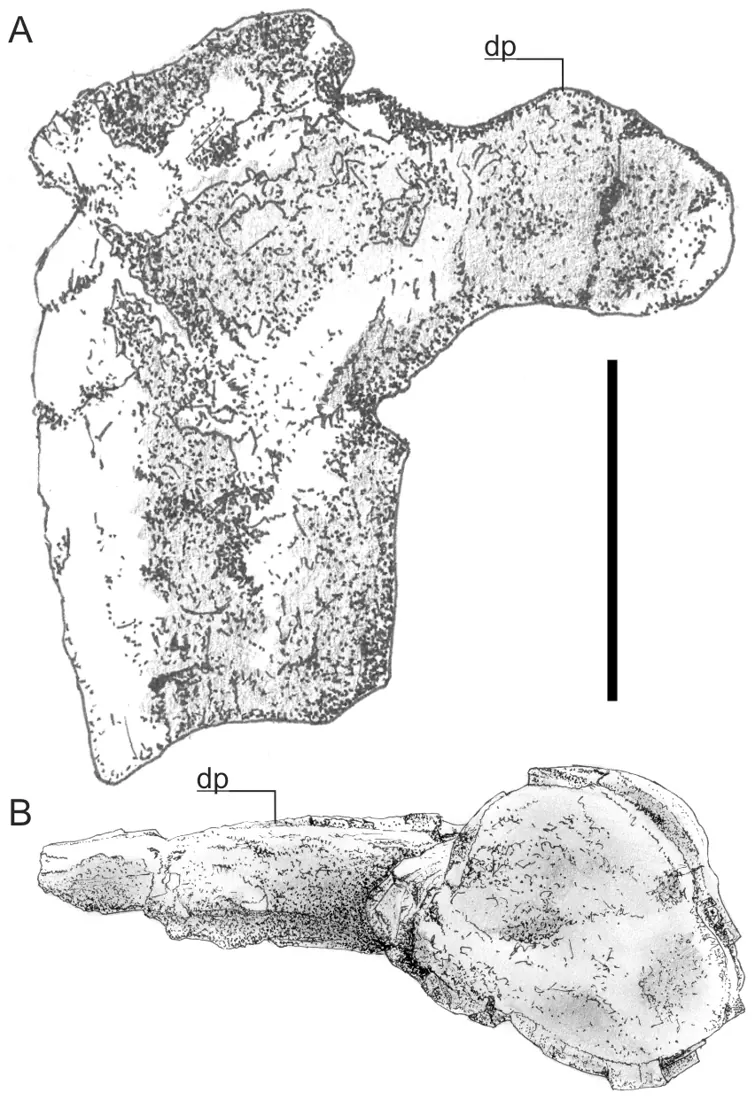
The back of a skull, a piece of the jaw joint and the upper end of an upper arm bone, found at Vălioara and kept at the University of Bucharest (FGGUB R 1083). The skull was first taken for that of a meat-eating dinosaur. It is half a metre wide at the jaw joints. The arm bone is 8 centimetres thick, as thick as that of the largest pterosaur known, Quetzalcoatlus northropi. The skull piece and the arm bone lie on the rock.
Inferred
Everything else comes from relatives. The beak, the wing, the trunk and the legs are those of Quetzalcoatlus and Zhejiangopterus, enlarged to a wingspan of 10–12 metres, which is what the thickness of the arm bone calls for. The relative is not much better known: of Quetzalcoatlus northropi there is a single wing.
The skull was estimated at nearly 3 metres long in 2002, then at much less; here it is 1.8 metres. The short, thick neck comes from one vertebra found near Sebeș, the last part of this walk. How high it held its head has not been published; for a pterosaur of the same size, known from footprints in Korea, almost 3 metres at the shoulder was estimated.
Assumed
The dense fuzz is assumed after small pterosaurs from China in which fine fibres are preserved; nobody knows whether a ten-metre animal was covered the same way. The colour is invented. Walking on all fours with the wings folded is what is accepted today for its relatives, from footprints. That it hunted animals the size of a dwarf dinosaur on foot is a hypothesis published in 2017. The weight of a pterosaur this size is estimated at 200–250 kilograms.
Sources
- Buffetaut, Grigorescu, Csiki (2002), „A new giant pterosaur with a robust skull from the latest Cretaceous of Romania”, Naturwissenschaften 89: 180–184
- Vremir, Kellner, Naish, Dyke (2013), „A new azhdarchid pterosaur from the Late Cretaceous of the Transylvanian Basin, Romania”, PLoS ONE 8(1): e54268
- Witton, Habib (2010), „On the size and flight diversity of giant pterosaurs”, PLoS ONE 5(11): e13982
- Naish, Witton (2017), „Neck biomechanics indicate that giant Transylvanian azhdarchid pterosaurs were short-necked arch predators”, PeerJ 5: e2908
- Witton, Naish (2008), „A reappraisal of azhdarchid pterosaur functional morphology and paleoecology”, PLoS ONE 3(5): e2271
- Kellner et al. (2010), “The soft tissue of Jeholopterus and the structure of the pterosaur wing membrane”, Proceedings of the Royal Society B 277: 321–329
11 Vălioara
What grew on the island
Found
Of the plants, mostly leaves, pollen and spores remain, almost never trunks. Leaves of fan palms (Sabalites) and of screw-pines (Pandanites) were found in the Hațeg and neighbouring Rusca Montană basins, together with broad leaves of flowering trees. At Budurone, near Vălioara, the mud of a pond kept many fern spores, fruits and seeds of some fifteen kinds, a little conifer pollen and pieces of charcoal up to 7 millimetres long.
Inferred
The soil was red and well drained, with white nodules of lime. The rivers were wide and shallow and kept shifting their beds; here and there were ponds and marshes. It rained a lot for part of the year and little for the rest, under 1,000 millimetres a year, at an average of 20–25 °C. The pine pollen is thought to have blown in from the island's mountains. A 2008 study sees Budurone as a pond ringed by dense woodland.
Assumed
The shape and height of every plant here are assumed, the palms included: only their leaves exist. There is no grass here: it does not appear in the plant lists published for Budurone and Vălioara. No fossil flower appears in the published Hațeg records. Nor is there a volcano on the horizon. Two ash layers in the north-west of the basin are 70–71 million years old, but the thick volcanic deposits at Densuș, long believed to be of that age, were dated in 2023 to 80–82 million.
Sources
- Popa, Kvaček, Vasile, Csiki-Sava (2014), „Maastrichtian monocotyledons of the Rusca Montană and Haţeg basins”, Review of Palaeobotany and Palynology 210: 89–101
- Popa, Kvaček, Vasile, Csiki-Sava (2016), „Maastrichtian dicotyledons of the Rusca Montană and Haţeg basins”, Cretaceous Research 57: 699–712
- Csiki, Ionescu, Grigorescu (2008), „The Budurone microvertebrate fossil site from the Maastrichtian of the Haţeg Basin”, Acta Palaeontologica Romaniae 6: 49–66
- Therrien (2005), „Palaeoenvironments of the latest Cretaceous (Maastrichtian) dinosaurs of Romania: insights from fluvial deposits and paleosols”, Palaeogeography, Palaeoclimatology, Palaeoecology 218: 15–56
- Bojar, Grigorescu, Ottner, Csiki (2005), „Palaeoenvironmental interpretation of dinosaur- and mammal-bearing continental Maastrichtian deposits, Haţeg basin, Romania”, Geological Quarterly 49(2): 205–222
- Bojar, Halas, Bojar, Grigorescu, Vasile (2011), „Upper Cretaceous volcanoclastic deposits from the Haţeg Basin”, Geochronometria 38(2): 182–188
- Vornicu, Seghedi, Csiki-Sava, Ducea (2023), Geologica Carpathica 74(5): 407–422
- Botfalvai, Csiki-Sava, Magyar et al. (2025), “Paleontological and paleoecological significance of the oldest highly productive Upper Cretaceous vertebrate site” (Vălioara), PLoS ONE 20: e0335893
Sebeș: Balaur and a giant's vertebra
The Transylvanian Basin, about 70 kilometres north-east of Sânpetru: the red banks at Sebeș-Glod and Râpa Roșie.
12 Sebeș
Balaur bondoc, a skeleton without a head

Found
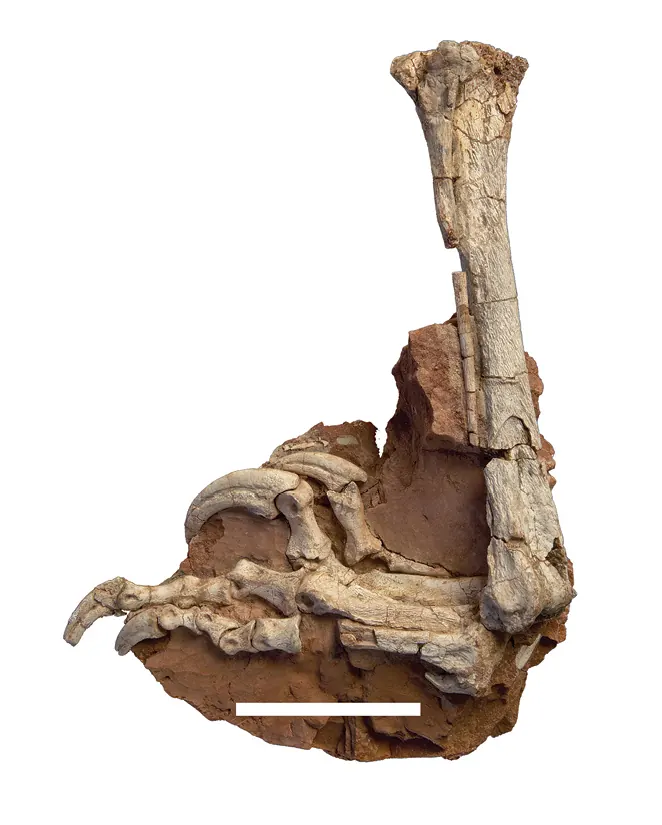
In September 2009 the geologist Mátyás Vremir found a partial skeleton in red floodplain mud at Sebeș-Glod, in central Romania: eight back vertebrae, the sacrum, four tail vertebrae, the shoulders, both arms, one hand, the hips, the left leg nearly whole and part of the right. No skull and no thigh bones. It is in Cluj-Napoca, at the Transylvanian Museum Society (EME PV.313). Sebeș lies in another basin, about 70 kilometres north-east of Sânpetru. The name is Romanian: a stocky dragon.
Inferred
The upper arm bone is 117 millimetres long, the shin 153, the long bones of the foot (the metatarsus) 62: short, broad feet, the metatarsus less than twice as long as it is wide. No body length has been published. The skeleton here, with neck, tail and thigh bone after Velociraptor, is 1.4 metres long. The head is a block of plaster without eye sockets, because no bone of it is known. On each foot, two toes carry large claws.
What Balaur was is disputed: a close relative of Velociraptor, according to the first authors, or an early flightless bird, according to a 2015 analysis. The bones are the same; the head and the diet would differ.
Assumed
There is no direct evidence for the feathers: the surface of the arm bones is too worn to show whether they bore the marks of feather attachment. They are assumed because its close relatives had them. Colour, diet and the purpose of the double claws are assumptions.
Sources
- Brusatte, Vremir, Csiki-Sava, Turner, Watanabe, Erickson, Norell (2013), „The osteology of Balaur bondoc”, Bulletin of the American Museum of Natural History 374: 1–100
- Csiki, Vremir, Brusatte, Norell (2010), „An aberrant island-dwelling theropod dinosaur from the Late Cretaceous of Romania”, PNAS 107(35): 15357–15361
- Cau, Brougham, Naish (2015), „The phylogenetic affinities of the bizarre Late Cretaceous Romanian theropod Balaur bondoc: dromaeosaurid or flightless bird?”, PeerJ 3: e1032
- Paleobiology Database, coordinates of the Vălioara, Tuștea-Oltoane, Sânpetru and Sebeș-Glod sites; the distances are computed from them
13 Sebeș
One vertebra from Râpa Roșie

Found
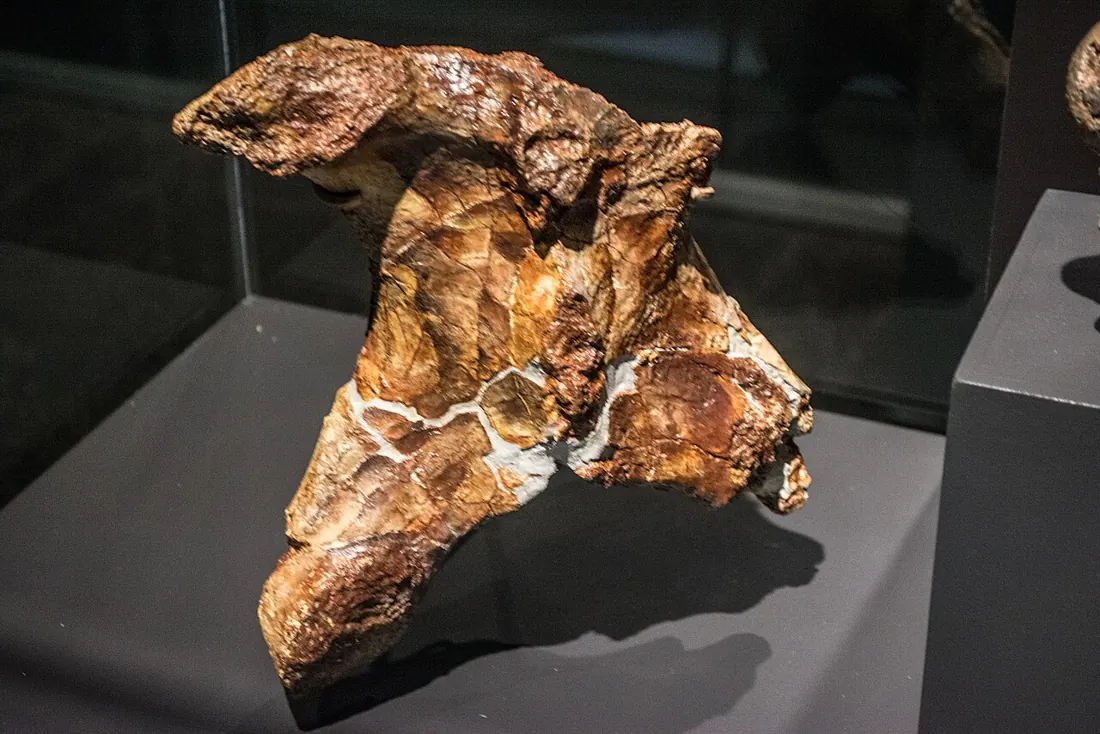
A single neck vertebra (EME 315) from Râpa Roșie, the “Red Cliff” near Sebeș. It is 24 centimetres long as preserved and would have been 30 when whole; it is 15 centimetres wide at the end, with a bone wall 4–6 millimetres thick, a lot for a pterosaur.
Inferred
Going by it, the long part of the neck was about a metre and a half, roughly half of what would be expected in a pterosaur this large: a short and very strong neck. The vertebra is assigned to a Hatzegopteryx, without belonging to the animal from Vălioara. The skeleton that rises from it is the one from there, with its wings open.
Assumed
Soaring is assumed from the shape of the wing in better-known relatives. At Sebeș-Glod, in the Balaur site, a smaller pterosaur was also found, Eurazhdarcho langendorfensis, with a wingspan of about 3 metres and crocodile tooth marks on two bones.
Sources
- Naish, Witton (2017), „Neck biomechanics indicate that giant Transylvanian azhdarchid pterosaurs were short-necked arch predators”, PeerJ 5: e2908
- Vremir, Kellner, Naish, Dyke (2013), „A new azhdarchid pterosaur from the Late Cretaceous of the Transylvanian Basin, Romania”, PLoS ONE 8(1): e54268
- Witton, Habib (2010), „On the size and flight diversity of giant pterosaurs”, PLoS ONE 5(11): e13982
14 Sebeș
What is not known
The youngest dated rock in the Sibișel valley, at Sânpetru, is about 67.8 million years old. In Transylvania, dinosaur bones reach to at least about a million years before the end of the Cretaceous, 66 million years ago. How it all ended on the island is not written in any rock found so far.
Of the sauropods here, the only piece of a skull is a braincase from Pui that nobody can tie to any of the four species. The only skin preserved is that of embryos in the eggs from Totești, with bumps 8–12 thousandths of a millimetre across. There is no feather and no egg with a whole embryo. The length of Balaur, the height of Hatzegopteryx and the size of the Romanian Struthiosaurus have never been published.
Bones from the Hațeg Basin can be seen at the Natural History Museum in London, at the University of Bucharest, in Cluj-Napoca, in Deva and, in the basin itself, in the houses of the UNESCO Geopark, among them the House of the Dwarf Dinosaurs at Sânpetru.
Sources
- Csiki-Sava, Vremir, Vasile, Brusatte, Dyke, Naish, Norell, Totoianu (2016), „The East Side Story – The Transylvanian latest Cretaceous continental vertebrate record and its implications for understanding Cretaceous–Paleogene boundary events”, Cretaceous Research 57: 662–698
- Bojar, Halas, Bojar, Grigorescu, Vasile (2011), „Upper Cretaceous volcanoclastic deposits from the Haţeg Basin”, Geochronometria 38(2): 182–188
- Díez Díaz, Mannion, Csiki-Sava, Upchurch (2025), „Revision of Romanian sauropod dinosaurs”, Journal of Systematic Palaeontology 23(1): 2441516
- Grellet-Tinner, Codrea, Folie, Higa, Smith (2012), „First evidence of reproductive adaptation to “island effect” of a dwarf Cretaceous Romanian titanosaur, with embryonic integument in ovo”, PLoS ONE 7(3): e32051
- Csiki-Sava, Andrășanu (2021), „Meeting Island Dwarfs and Giants of the Cretaceous – The Hațeg Country UNESCO Global Geopark”, Geoconservation Research 4(2): 471–491
- Where Romania is now, there was once an island of dwarf dinosaurs: the same animals to scale, beside the reader's own height
What is disputed
- How big the island was. About 80,000 km² on the estimate used most often; up to 200,000 on other reconstructions of the surrounding seas. An older figure of 7,500 km² was in fact the area of today's Hațeg Basin.
- Who was a dwarf. Magyarosaurus dacus, certainly. Telmatosaurus, very probably. Zalmoxes and Struthiosaurus, perhaps only small by family. The meat-eaters, no. Uriash kadici, not at all: 5–8 tonnes.
- How long Magyarosaurus was. Under 3 metres on the 2025 calculation; 5–6 metres on older estimates. A hip one metre up and a weight under a tonne appear in both.
- What Balaur was. A relative of Velociraptor, or an early flightless bird.
- Hatzegopteryx. The length of the skull (from “nearly 3 metres” to “very short”), the wingspan (10–12 metres) and the role of the island's top predator are inferred from a few bones and from relatives.
- The eggs at Tuștea. A shell like that of titanosaurs, duck-billed dinosaur hatchlings beside them, assigned to Telmatosaurus.
- Ferenceratops. In 2026 Zalmoxes shqiperorum was read as an early horned dinosaur. No new bones turned up; it is a new reading of the old ones.
- The volcanoes. Active in the dinosaurs' time, on older dates; ten million years older, on a date published in 2023.
How exact the reconstruction is
Each animal is built from published measurements: bone lengths, skull widths, collection numbers. Where no measurement exists, the text of the stop says which relative the part was completed after, or that the number was chosen.
At “found”, the bones are those that exist, at their size, but their layout on the rock does not reproduce the dig: for most of them no plan was ever published. The skeleton of Balaur is the only one found with its bones still joined, and it is shown that way, lying on its side.
The rock at “found” is schematic: red mudstone in beds and grey-green sandstone, as in the valleys at Sânpetru and Vălioara, without today's pastures and orchards.
The relief of each place is invented. The rocks say what kind of ground it was, a pond, a river with several branches or a dry plain, but not where each bank lay. The width and depth of the rivers have not been published.
The gait of each animal is assumed: on four legs for the sauropod, the armoured dinosaur and the pterosaur, on two for the others. A foot on the ground does not slide; that much can be asked of a walk nobody has seen.
The dark colour of real bone is a convention of this page, to set it apart from plaster. The bones from Vălioara and Sânpetru are black or yellowish; those of Balaur are pale.
The light is that of a morning with the sun low and was chosen, not computed. The sound is made of noise and tones; nothing is recorded, and the animals' voices are assumed.
The same animals, to scale, beside the reader's own height, are in Where Romania is now, there was once an island of dwarf dinosaurs. There you compare them; here you walk among them and see how much of each is bone.
Sources
The measurements come from the research papers below; most are free to read.
- Benton, Csiki, Grigorescu, Redelstorff, Sander, Stein, Weishampel (2010), „Dinosaurs and the island rule: The dwarfed dinosaurs from Haţeg Island”, Palaeogeography, Palaeoclimatology, Palaeoecology 293: 438–454
- Csiki-Sava, Buffetaut, Ősi, Pereda-Suberbiola, Brusatte (2015), „Island life in the Cretaceous”, ZooKeys 469: 1–161
- Bojar, Halas, Bojar, Grigorescu, Vasile (2011), „Upper Cretaceous volcanoclastic deposits from the Haţeg Basin”, Geochronometria 38(2): 182–188
- Panaiotu, Panaiotu (2010), „Palaeomagnetism of the Upper Cretaceous Sânpetru Formation”, Palaeogeography, Palaeoclimatology, Palaeoecology 293: 343–352
- Paleobiology Database, coordinates of the Vălioara, Tuștea-Oltoane, Sânpetru and Sebeș-Glod sites; the distances are computed from them
- Díez Díaz, Mannion, Csiki-Sava, Upchurch (2025), „Revision of Romanian sauropod dinosaurs”, Journal of Systematic Palaeontology 23(1): 2441516
- Stein, Csiki, Curry Rogers, Weishampel, Redelstorff, Carballido, Sander (2010), „Small body size and extreme cortical bone remodeling indicate phyletic dwarfism in Magyarosaurus dacus”, PNAS 107(20): 9258–9263
- Csiki (1999), „New evidence of armoured titanosaurids in the Late Cretaceous – Magyarosaurus dacus from the Haţeg Basin (Romania)”, Oryctos 2: 93–99
- Buffetaut, Grigorescu, Csiki (2002), „A new giant pterosaur with a robust skull from the latest Cretaceous of Romania”, Naturwissenschaften 89: 180–184
- Vremir, Kellner, Naish, Dyke (2013), „A new azhdarchid pterosaur from the Late Cretaceous of the Transylvanian Basin, Romania”, PLoS ONE 8(1): e54268
- Witton, Habib (2010), „On the size and flight diversity of giant pterosaurs”, PLoS ONE 5(11): e13982
- Naish, Witton (2017), „Neck biomechanics indicate that giant Transylvanian azhdarchid pterosaurs were short-necked arch predators”, PeerJ 5: e2908
- Witton, Naish (2008), „A reappraisal of azhdarchid pterosaur functional morphology and paleoecology”, PLoS ONE 3(5): e2271
- Kellner et al. (2010), “The soft tissue of Jeholopterus and the structure of the pterosaur wing membrane”, Proceedings of the Royal Society B 277: 321–329
- Popa, Kvaček, Vasile, Csiki-Sava (2014), „Maastrichtian monocotyledons of the Rusca Montană and Haţeg basins”, Review of Palaeobotany and Palynology 210: 89–101
- Popa, Kvaček, Vasile, Csiki-Sava (2016), „Maastrichtian dicotyledons of the Rusca Montană and Haţeg basins”, Cretaceous Research 57: 699–712
- Csiki, Ionescu, Grigorescu (2008), „The Budurone microvertebrate fossil site from the Maastrichtian of the Haţeg Basin”, Acta Palaeontologica Romaniae 6: 49–66
- Therrien (2005), „Palaeoenvironments of the latest Cretaceous (Maastrichtian) dinosaurs of Romania: insights from fluvial deposits and paleosols”, Palaeogeography, Palaeoclimatology, Palaeoecology 218: 15–56
- Bojar, Grigorescu, Ottner, Csiki (2005), „Palaeoenvironmental interpretation of dinosaur- and mammal-bearing continental Maastrichtian deposits, Haţeg basin, Romania”, Geological Quarterly 49(2): 205–222
- Vornicu, Seghedi, Csiki-Sava, Ducea (2023), Geologica Carpathica 74(5): 407–422
- Botfalvai, Csiki-Sava, Magyar et al. (2025), “Paleontological and paleoecological significance of the oldest highly productive Upper Cretaceous vertebrate site” (Vălioara), PLoS ONE 20: e0335893
- Weishampel, Norman, Grigorescu (1993), „Telmatosaurus transsylvanicus from the Late Cretaceous of Romania: the most basal hadrosaurid dinosaur”, Palaeontology 36(2): 361–385
- Grigorescu (2010), „The Latest Cretaceous fauna with dinosaurs and mammals from the Haţeg Basin — A historical overview”, Palaeogeography, Palaeoclimatology, Palaeoecology 293: 271–282
- Dumbravă, Rothschild, Weishampel, Csiki-Sava et al. (2016), “A dinosaurian facial deformity and the first occurrence of ameloblastoma in the fossil record”, Scientific Reports 6: 29271
- Grellet-Tinner, Codrea, Folie, Higa, Smith (2012), „First evidence of reproductive adaptation to “island effect” of a dwarf Cretaceous Romanian titanosaur, with embryonic integument in ovo”, PLoS ONE 7(3): e32051
- Natural History Museum, London, collections catalogue (records R 3386, R 3392, R 4900, R 4966)
- Augustin, Ősi, Csiki-Sava (2023), „The Rhabdodontidae (Dinosauria, Ornithischia), an enigmatic dinosaur group endemic to the Late Cretaceous European Archipelago”, Fossil Record 26(2): 171–189
- Brusatte, Dumbravă, Vremir, Csiki-Sava, Totoianu, Norell (2017), „A catalog of Zalmoxes specimens from the Upper Cretaceous Nălaţ-Vad locality”, American Museum Novitates 3884
- Augustin, Dumbravă, Bastiaans, Csiki-Sava (2023), „Reappraisal of the braincase anatomy of the ornithopod dinosaurs Telmatosaurus and Zalmoxes”, PalZ 97: 129–145
- Ősi, Prondvai, Butler, Weishampel (2012), „Phylogeny, histology and inferred body size evolution in a new rhabdodontid dinosaur from the Late Cretaceous of Hungary”, PLoS ONE 7(9): e44318
- Maidment, Butler, Brusatte, Meade, Augustin, Csiki-Sava, Ősi (2026), „A hidden diversity of ceratopsian dinosaurs in Late Cretaceous Europe”, Nature
- Ősi, Codrea, Prondvai, Csiki-Sava (2014), „New ankylosaurian material from the Upper Cretaceous of Transylvania”, Annales de Paléontologie 100: 257–271
- Schade, Stumpf, Kriwet, Kettler, Pfaff (2022), „Neuroanatomy of the nodosaurid Struthiosaurus austriacus”, Scientific Reports 12: 144
- Nopcsa (1914), „Über das Vorkommen der Dinosaurier in Siebenbürgen”, Verhandlungen der k.k. zoologisch-botanischen Gesellschaft in Wien 64: (12)–(14)
- Botfalvai, Csiki-Sava, Grigorescu, Vasile (2017), „Taphonomical and palaeoecological investigation of the Late Cretaceous (Maastrichtian) Tuştea vertebrate assemblage”, Palaeogeography, Palaeoclimatology, Palaeoecology 468: 228–262
- Grigorescu (2010), „The “Tuştea Puzzle”: hadrosaurid (Dinosauria, Ornithopoda) hatchlings associated with Megaloolithidae eggs in the Maastrichtian of the Haţeg Basin”, Ameghiniana 47(1): 89–97
- Grigorescu (2017), „The ‘Tuştea puzzle’ revisited: Late Cretaceous (Maastrichtian) Megaloolithus eggs associated with Telmatosaurus hatchlings in the Haţeg Basin”, Historical Biology 29(5): 627–640
- Brusatte, Vremir, Csiki-Sava, Turner, Watanabe, Erickson, Norell (2013), „The osteology of Balaur bondoc”, Bulletin of the American Museum of Natural History 374: 1–100
- Csiki, Vremir, Brusatte, Norell (2010), „An aberrant island-dwelling theropod dinosaur from the Late Cretaceous of Romania”, PNAS 107(35): 15357–15361
- Csiki-Sava, Andrășanu (2021), „Meeting Island Dwarfs and Giants of the Cretaceous – The Hațeg Country UNESCO Global Geopark”, Geoconservation Research 4(2): 471–491
- Cau, Brougham, Naish (2015), „The phylogenetic affinities of the bizarre Late Cretaceous Romanian theropod Balaur bondoc: dromaeosaurid or flightless bird?”, PeerJ 3: e1032
- Csiki-Sava, Vremir, Vasile, Brusatte, Dyke, Naish, Norell, Totoianu (2016), „The East Side Story – The Transylvanian latest Cretaceous continental vertebrate record and its implications for understanding Cretaceous–Paleogene boundary events”, Cretaceous Research 57: 662–698
- Where Romania is now, there was once an island of dwarf dinosaurs: the same animals to scale, beside the reader's own height