mariuscomper.uk RO
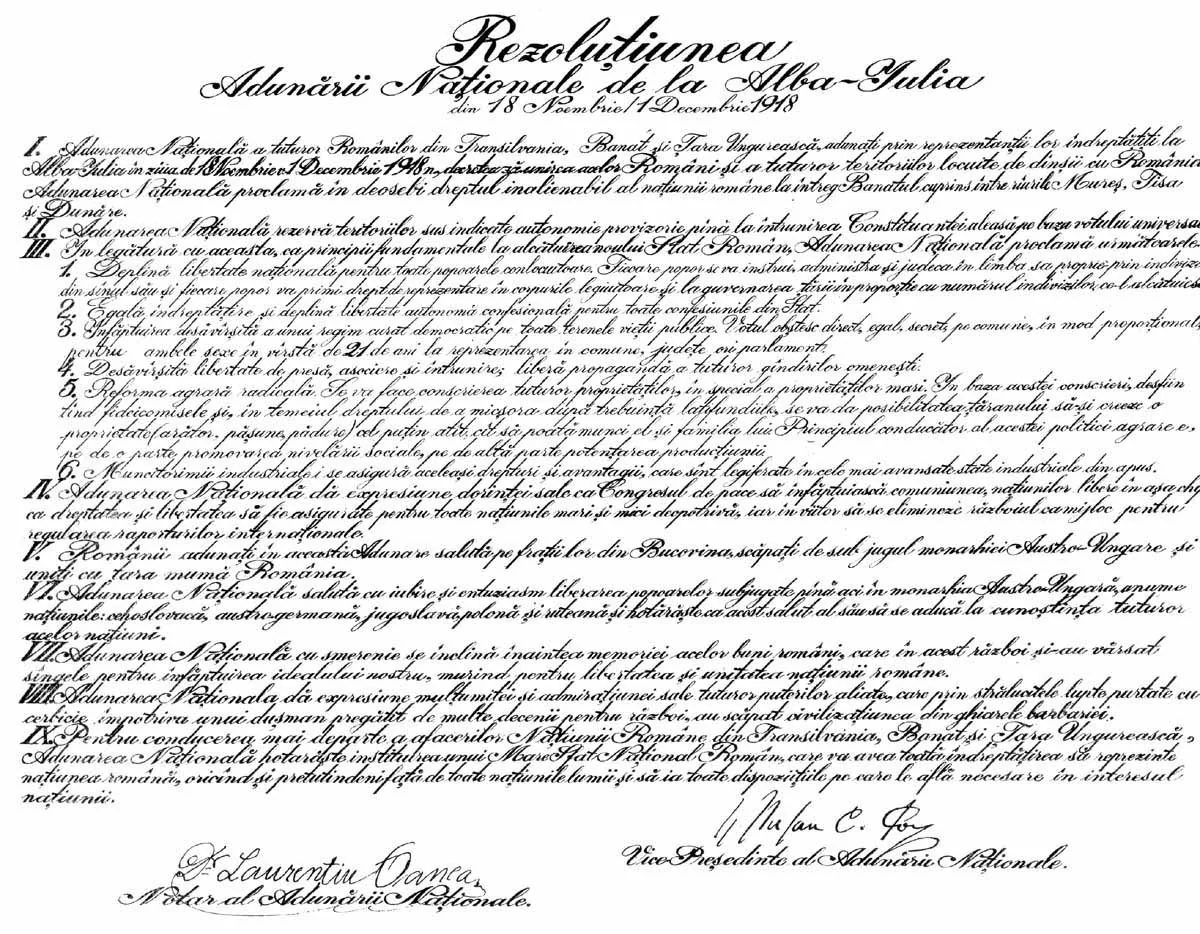
The Resolution of the National Assembly of Alba Iulia, handwritten in nine articles, signed by Ștefan C. Pop and Laurențiu Oanea

The Resolution of the National Assembly of Alba Iulia, the copy signed by vice-president Ștefan C. Pop and notary Laurențiu Oanea. CIMEC copy, Wikimedia Commons, public domain.

1 December 1918 – 31 December 1923

What became of the Alba Iulia promises

2 kept 8 partly kept 1 postponed

The Resolution voted on 1 December 1918, Romania's national day, proclaimed union and laid down principles for the new state: autonomy, freedom for the peoples living alongside the Romanians, votes for women, land for peasants. Here is each promise, checked against the laws of the next five years. Two were kept, eight only partly, and one was postponed.

One square per promise, in the order of the text. Full: kept. Half: partly kept. Ticked: postponed. Struck: not kept.

The Resolution of the National Assembly of Alba Iulia, handwritten in nine articles, signed by Ștefan C. Pop and Laurențiu Oanea

Nine articles, eleven promises

The Resolution has nine articles. Five of them (IV–VIII) are wishes, greetings and thanks, with nothing to check. That leaves articles I, II, III and IX. Article I asks for two things, union and the whole Banat, and point III.3 promises the vote to men and women alike, so the page judges them separately: 11 promises.

Each is judged as things stood on 31 December 1923, nine months after the new Constitution, on a four-step scale explained at the end of the page. The day itself and its 1,228 delegates are on the page about Alba Iulia, 1918.

Article I

Union with Romania

Kept

The National Assembly of all the Romanians of Transylvania, the Banat and the Hungarian Land, gathered through their rightful representatives at Alba Iulia on 18 November old style, 1 December new style 1918, decrees the union of those Romanians and of all the territories they inhabit with Romania.
The 1918 Romanian text

Adunarea Națională a tuturor Românilor din Transilvania, Banat și Țara Ungurească, adunați prin reprezentanții lor îndreptățiți la Alba-Iulia în ziua de 18 Noembrie v. 1 Decembrie 1918 n., decretează unirea acelor Români și a tuturor teritoriilor locuite de dînșii cu România.

The Assembly's central demand became law in just over three weeks. The decree does not repeat the principles of articles II and III, and the government report that accompanied it spoke of “their unconditional and everlasting union”. A delegation took the Resolution to Bucharest on 14 December, and the decree-law appeared in the official gazette on 26 December. International recognition came at Trianon, after the year and a half of negotiation told on the page about the treaty.

What followed

  • King Ferdinand's Decree-Law no. 3631 has a single article: the lands named in the Alba Iulia decision “are and remain for ever united with the Kingdom of Romania”.
  • The parliament elected in November 1919 ratifies the union by law.
  • In the Treaty of Trianon Hungary renounces the territories assigned to Romania (art. 45).

After 1923: 30 August 1940: The Second Vienna Award gives northern Transylvania to Hungary. The peace treaty signed in Paris on 10 February 1947 confirms its return to Romania.

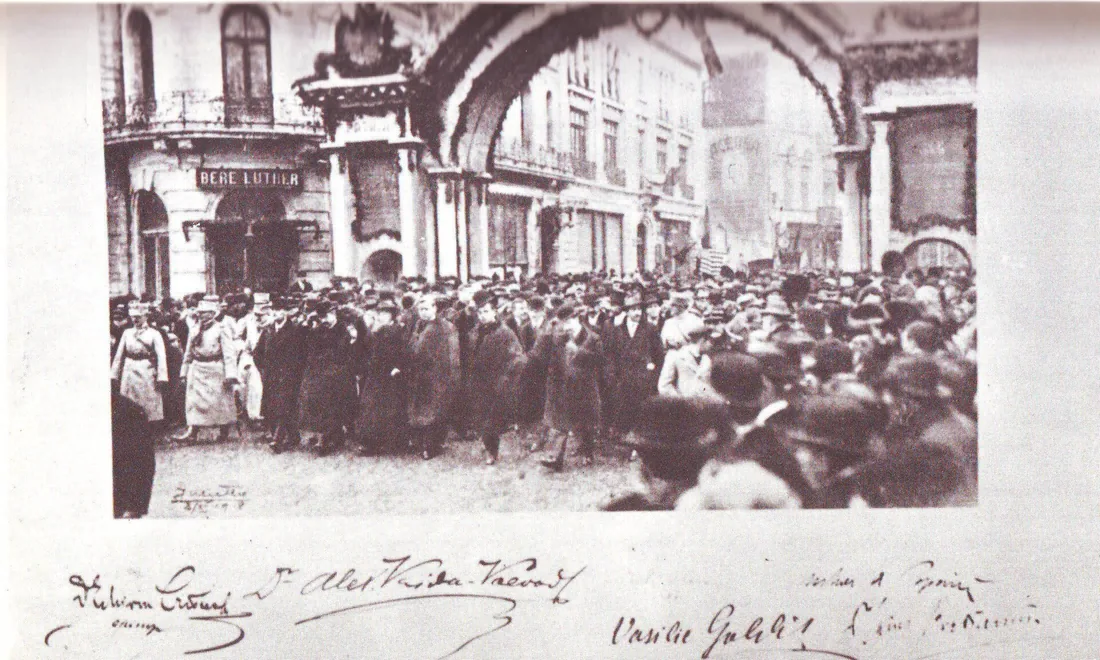
The Transylvanian delegation arriving in Bucharest on 14 December 1918 with the Resolution
The Transylvanian delegation in Bucharest, 14 December 1918. Author not stated, Wikimedia Commons, public domain.
Sources

Article I

The whole Banat, between Mureș, Tisa and Danube

Partly kept

The National Assembly proclaims in particular the inalienable right of the Romanian nation to the whole of the Banat between the rivers Mureș, Tisa and Danube.
The 1918 Romanian text

Adunarea Națională proclamă în deosebi dreptul inalienabil al națiunii române la întreg Banatul cuprins între rîurile Mureș, Tisa și Dunăre.

The second sentence of article I asked for more than union: the whole Banat, as far as the Tisa. But the Banat also had large Serbian and German populations, and the Serbian army had occupied it in November 1918. The peace conference divided it, and Romania received about two thirds. It is the one promise that depended entirely on the peace conference.

What followed

  • The Paris Peace Conference approves dividing the Banat between Romania and the Kingdom of Serbs, Croats and Slovenes.
  • In the Treaty of Trianon Hungary renounces the Banat in favour of Romania and the Kingdom of Serbs, Croats and Slovenes (arts 27, 42, 45). About two thirds of the historical Banat go to Romania, nearly a third to the southern neighbour and about 1% stays with Hungary.
  • The Treaty of Sèvres on frontiers recognises the line between Romania and the Kingdom of Serbs, Croats and Slovenes.
  • The Belgrade Protocol swaps a few villages either way: Jimbolia goes to Romania, Modoș to the neighbour.

After 1923: 10 April 1924: Jimbolia passes to Romanian administration, after the exchange of villages agreed at Belgrade.

Sources

Article II

Autonomy until the Constituent Assembly

Kept

The National Assembly reserves provisional autonomy for the territories named above until the meeting of the Constituent Assembly elected by universal suffrage.
The 1918 Romanian text

Adunarea Națională rezervă teritoriilor sus indicate autonomie provizorie pînă la întrunirea Constituantei aleasă pe baza votului universal.

The verdict reads the text literally. The term it set was the meeting of the Constituent Assembly, and autonomy lasted beyond 20 November 1919, when that assembly met. What the text did not foresee came after. The 1919 Constituent Assembly was dissolved without passing a constitution. The Directing Council was abolished by decree. The 1923 Constitution was voted by a second Constituent Assembly, elected in 1922; the Romanian National Party of Transylvania boycotted the vote on the Constitution. The Directing Council handed over power, but its manifesto of 10 April 1920, signed by Iuliu Maniu and Alexandru Vaida-Voevod, said the Constituent Assembly had been dissolved before it could fulfil its task of carrying out that organisation.

What followed

  • Decree-Law no. 3632 leaves the province's public services to the Directing Council in Sibiu. Bucharest keeps foreign affairs, the army, railways, post, currency and customs.
  • The “new constituent legislative assemblies”, as convocation decree no. 4230 calls them, meet: the first parliament elected by universal male suffrage across the country.
  • After the king dissolves that parliament, a decree-law of 2 April 1920, published on 4 April, abolishes the Directing Council and hands its powers to the central government.

After 1923: 14 June 1925: The administrative unification law puts every province under one organisation.

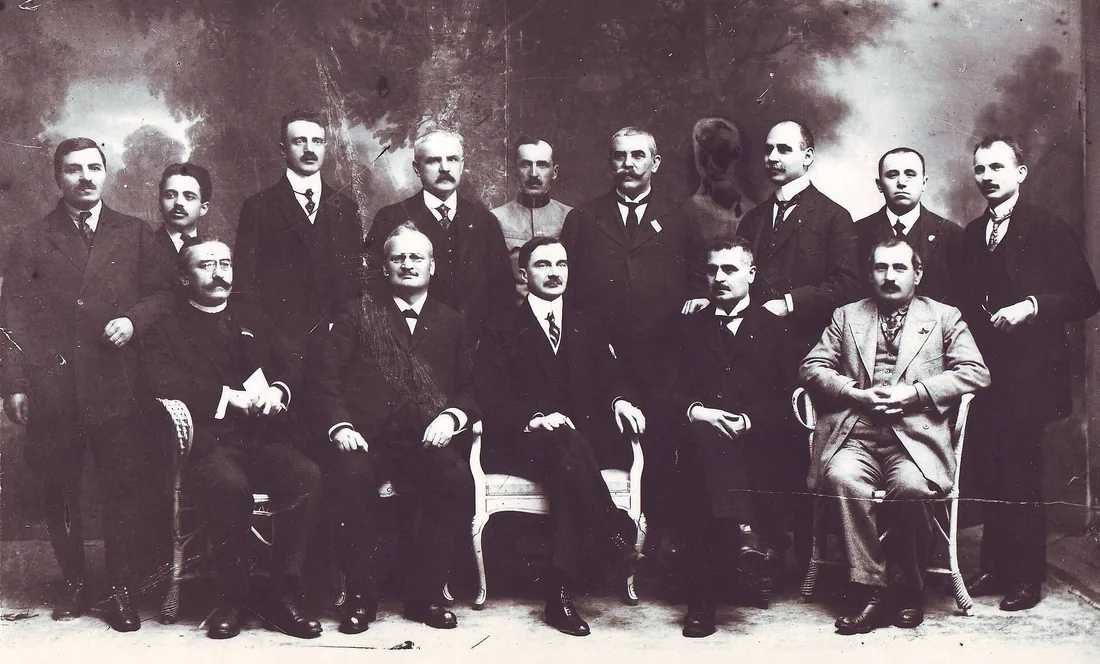
Members of the Directing Council, Transylvania's provisional government, in December 1918
The Directing Council, December 1918; Iuliu Maniu at the centre of the bottom row. Wikimedia Commons, public domain.
Sources

Article III.1

National freedom for the co-inhabiting peoples

Partly kept

Full national freedom for all the co-inhabiting peoples. Each people shall be taught, administered and judged in its own language by individuals from its own midst, and each people shall receive the right of representation in the legislative bodies and in the government of the country in proportion to the number of individuals who make it up.
The 1918 Romanian text

Deplină libertate națională pentru toate popoarele conlocuitoare. Fiecare popor se va instrui, administra și judeca în limba sa proprie prin indivizi din sînul său și fiecare popor va primi drept de reprezentare în corpurile legiuitoare și la guvernarea țării în proporție cu numărul indivizilor ce-l alcătuiesc.

The promise had three parts: school, administration and courts in one's own language, then representation in parliament and government in proportion to numbers. The January 1919 decree took it over for administration and courts, but only in counties where a people passed one fifth of the population, and without proportional representation. The 1923 Constitution guaranteed each citizen's equality before the law, and the Minorities Treaty guaranteed primary schools in the mother tongue where there were enough pupils. Administration and courts in each people's own language did not enter the Constitution. No law provided seats in parliament or government in proportion to each people's numbers.

What followed

  • Directing Council Decree no. I makes Romanian the official language but keeps the Hungarian nationalities law of 1868. In counties where a co-inhabiting people is a fifth of the population, each is to be “administered and judged in its own language”. Church and private schools choose their language.
  • The Minorities Treaty, signed in Paris, guarantees equality, free use of language, primary schools in the mother tongue where numbers warrant, and local autonomy in religion and schooling for the Saxons and Szeklers, under state control.
  • The Constitution guarantees each person's equality “without distinction of ethnic origin, language or religion” (arts 5, 7, 8) and makes Romanian the official language of the state (art. 126). It says nothing about administration and courts in each people's language or about proportional representation.

After 1923: 22 December 1925: The private-education law tightens state control over minority church schools.

Sources

Article III.2

Equality for every confession

Partly kept

Equal rights and full autonomous confessional freedom for all the confessions in the State.
The 1918 Romanian text

Egală îndreptățire și deplină libertate autonomă confesională pentru toate confesiunile din Stat.

Freedom was guaranteed, equality was not. The Resolution had been voted by Orthodox and Greek-Catholic delegates alike, and the Constitution gave those two Romanian churches a special status: the Orthodox dominant, the Greek-Catholic with precedence over the other cults. The Roman Catholic, Reformed, Lutheran and Unitarian churches of the Hungarians, Saxons and Swabians did not have that status. The law on cults announced by the same article came only in 1928.

What followed

  • The Minorities Treaty guarantees free exercise of religion and minority religious institutions.
  • The Constitution (art. 22) guarantees “equal freedom and protection to all cults”, but declares the Orthodox Church the “dominant church” and gives the Greek-Catholic Church “precedence over the other cults”.

After 1923: 22 April 1928: The law on the general regime of cults.

Sources

Article III.3

Universal, direct, equal, secret vote from age 21

Partly kept

The complete achievement of a purely democratic regime in every field of public life. Universal, direct, equal, secret suffrage, by communes, proportional, for both sexes from the age of 21, for representation in communes, counties or parliament.
The 1918 Romanian text

Înfăptuirea desăvîrșită a unui regim curat democratic pe toate terenele vieții publice. Votul obștesc direct, egal, secret, pe comune, în mod proporțional, pentru ambele sexe în vîrstă de 21 de ani la reprezentarea în comune, județe ori parlament.

For men, the vote for the Chamber became universal, direct, equal and secret. The departures: the election was proportional only in four cities, and the Senate required age 40 and had members who were not directly elected. For women, see the next row.

What followed

  • Decree-Law no. 3621 gives Transylvania a direct, equal and secret vote for men: from 21 for the Chamber, from 40 for the Senate. Most districts elect one deputy; only Arad, Cluj, Oradea and Timișoara elect two proportionally.
  • The Chamber is elected on 2–4 November and the Senate on 7–8 November: the province's first elections by universal male suffrage.
  • The Constitution (art. 64) has deputies elected “by universal, equal, direct, compulsory and secret vote on the basis of minority representation”. The Senate also has members by right and indirectly elected members.

After 1923: 1926: The first single electoral law for the whole country replaces the provincial systems.

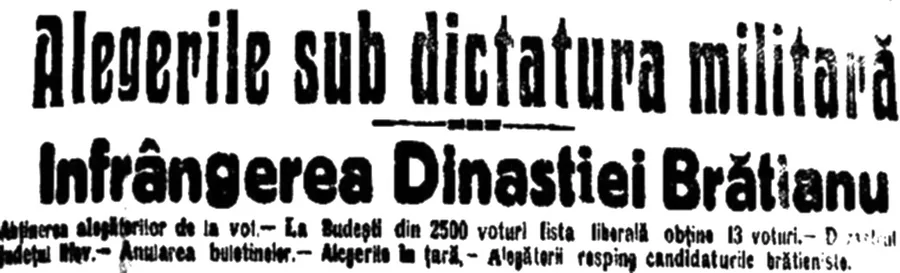
Headline of the newspaper Îndreptarea on the elections, 15 November 1919
Îndreptarea, the People's League newspaper, 15 November 1919. Wikimedia Commons, public domain.
Sources

Article III.3

Equal voting rights for women

Postponed

… for both sexes from the age of 21 …
The 1918 Romanian text

… pentru ambele sexe în vîrstă de 21 de ani …

The 1923 Constitution left women's political rights to future laws. Women voted on the same terms as men only on 19 November 1946. The road is told on the page about the women's vote.

What followed

  • The Constitution (art. 6) sends women's political rights to “special laws, voted by a two-thirds majority”.

After 1923: 3 August 1929: The local-government law lets some women vote in local elections. 19 November 1946: Women vote on the same terms as men.

Sources

Article III.4

Freedom of the press, association and assembly

Partly kept

Complete freedom of the press, of association and of assembly; free propagation of all human thought.
The 1918 Romanian text

Desăvîrșită libertate de presă, asociere și întrunire; liberă propagandă a tuturor gîndurilor omenești.

On paper, the 1923 Constitution gave almost everything the Resolution asked. In practice, much of Transylvania lived through the whole period under a state of siege. At the end of 1923, Alba Iulia itself lay on the line to which the siege zone had been widened.

What followed

  • The wartime state of siege remains. A joint order of the Directing Council and the military command requires police approval for open-air meetings and bars newspapers from discussing military matters.
  • During the general strike, decree no. 4209 brings back censorship across the country.
  • Decree no. 502 lifts preventive censorship and restores freedom of assembly, except in military frontier zones.
  • Decree no. 131 widens the western siege zone up to a line through Sighet, Dej, Apahida, Aiud, Alba Iulia and Petroșani. In July the VII Army Corps in Sibiu again requires permission for meetings and sets censorship rules.
  • The Constitution bans censorship (art. 25) and guarantees assembly (art. 28) and association (art. 29). Article 128 allows a state of siege by law.

After 1923: 20 November 1928: Decrees of 16 and 20 November 1928 lift the siege and censorship, except in a frontier strip.

Sources

Article III.5

Radical land reform

Partly kept

Radical land reform. All properties, in particular the large ones, shall be registered. On the basis of this register, abolishing entails and by virtue of the right to reduce the latifundia as needed, the peasant shall be enabled to create a property (arable land, pasture, forest) at least as large as he and his family can work. The guiding principle of this agrarian policy is, on the one hand, to promote social levelling and, on the other, to raise production.
The 1918 Romanian text

Reforma agrară radicală. Se va face conscrierea tuturor proprietăților, în special a proprietăților mari. În baza acestei conscrieri, desființînd fideicomisele și, în temeiul dreptului de a micșora după trebuință latifundiile, se va da posibilitatea țăranului să-și creeze o proprietate (arător, pășune, pădure) cel puțin atît cît să poată munci el și familia lui. Principiul conducător al acestei politici agrare e, pe de o parte, promovarea nivelării sociale, pe de altă parte potențarea producțiunii.

The law was passed and applied, but the text promised every peasant as much land as he and his family could work. By 1 January 1934, 801,997 people had registered and 388,117 had definitively received land: 369,262 hectares, under one hectare each. Much of the 1,831,421 hectares expropriated went to communal pastures and forests. The large landowners were mostly Hungarian, so the reform hit their community harder, though Hungarian and German peasants also received land: by 1927, 82,640 of the 310,583 new owners were of other nationalities. The expropriations also cut the income from which Hungarian churches and the Saxon University funded their schools, the very own-language schools that point III.1 promised.

What followed

  • Decree-Law no. 3911, prepared by the Directing Council and approved by the Great National Council, published on 12 September, allows expropriation to enlarge peasant holdings.
  • The land-reform law for Transylvania, Banat, Crișana and Maramureș, promulgated by decree no. 3610 of 23 July, cites point III.5 by name. It also subjects church, school, foundation and community land to expropriation, within limits.
  • The Constitution (art. 131) gives the core articles of the land law constitutional rank.
  • The League of Nations Council adopts a resolution in the dispute of the “optants”, landowners who had chosen Hungarian citizenship and claimed compensation. The dispute continues.

After 1923: 1 January 1934: The ministry's tally: 1,831,421 hectares expropriated, 801,997 registered, 388,117 definitive new owners.

Sources

Article III.6

Western rights for industrial workers

Partly kept

The industrial working class is assured the same rights and advantages as are legislated in the most advanced industrial states of the West.
The 1918 Romanian text

Muncitorimii industriale i se asigură aceleași drepturi și avantagii, care sînt legiferate în cele mai avansate state industriale din apus.

Transylvania kept the social insurance inherited from the Hungarian law of 1907, and the eight-hour day came here before the rest of the country. The 1920 labour-disputes law, however, restricted the right to strike. The 1923 Constitution promised a social-insurance law (art. 21).

What followed

  • Directing Council Decree no. XII of 21 May brings in, from 1 June, the eight-hour day and the 48-hour week in Transylvania, with no cut in pay.
  • The Trancu-Iași law puts labour disputes under state arbitration and restricts strikes.
  • The general strike begins; the government breaks it with arrests, troops and censorship.
  • The trade-union law gives unions legal personality. In June Romania ratifies the international eight-hour convention.

After 1923: 13 April 1928: The eight-hour law for all of the country's industry. 1933: The provinces' social insurance schemes are unified.

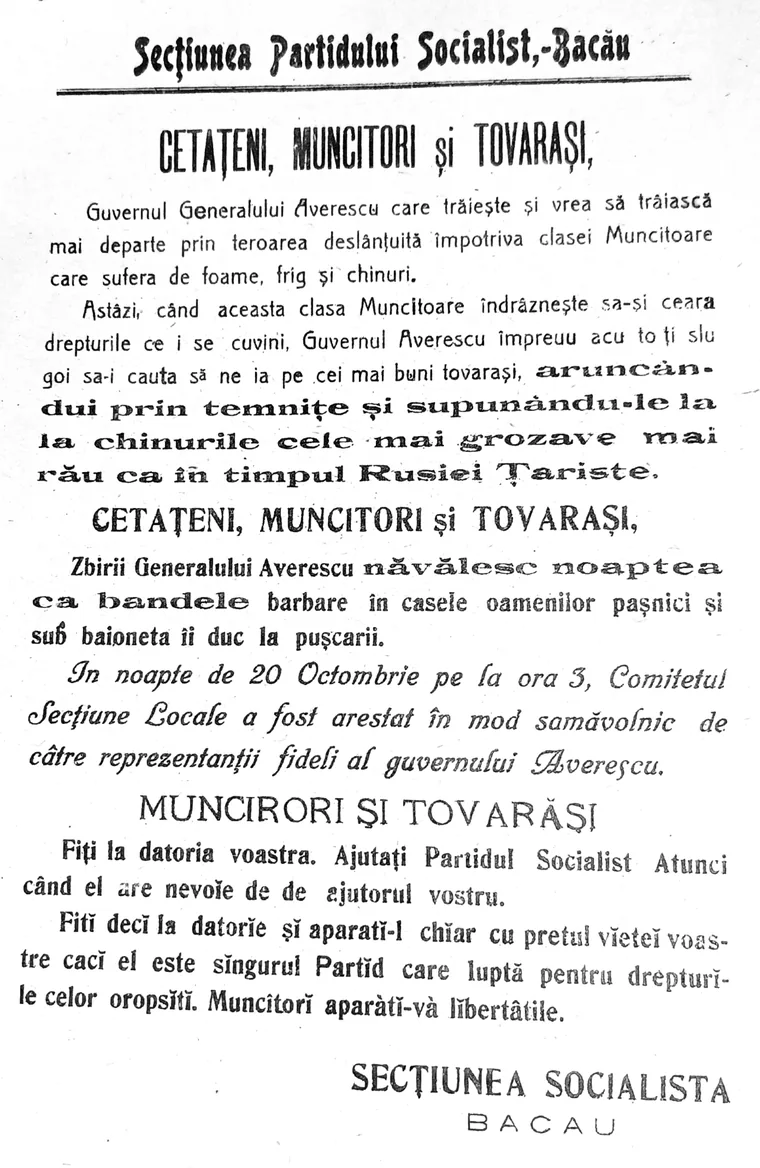
Socialist Party manifesto, Bacău section, 21 October 1920, against the repression of the general strike
Manifesto of the Bacău section of the Socialist Party, 21 October 1920, the day the general strike began. Wikimedia Commons, public domain.
Sources

Article IX

The Great National Council

Partly kept

For the further conduct of the affairs of the Romanian nation of Transylvania, the Banat and the Hungarian Land, the National Assembly decides to set up a Great Romanian National Council, which shall have full right to represent the Romanian nation at any time and anywhere before all the nations of the world and to take every measure it finds necessary in the interest of the nation.
The 1918 Romanian text

Pentru conducerea mai departe a afacerilor Națiunii Române din Transilvania, Banat și Țara Ungurească, Adunarea Națională hotărăște instituirea unui Mare Sfat Național Român, care va avea toată îndreptățirea să reprezinte națiunea română oricînd și pretutindeni față de toate națiunile lumii și să ia toate dispozițiile pe care le află necesare în interesul națiunii.

The Great Council was set up and worked: it elected the provincial government and approved the land and electoral bills. But the text gave it the right to represent the nation “at any time and anywhere”, with no term, and its role ended in November 1919, when its powers passed to parliament. Under the page's rule, a promise with no term that stopped before the end of 1923 is partly kept. The list of its members is shown by the Virtual Museum of the Union.

What followed

  • The Great Council meets at the Alba Iulia courthouse under Gheorghe Pop de Băsești and elects the Directing Council.
  • The last of 21 sittings in Sibiu, mostly on the land and electoral bills.
  • Its role ends when the parliament elected across the country meets.
Sources

The ledger: five years, eleven promises

Every line starts on 1 December 1918. A dotted line shows the wait for the first act, a solid one the time an act in force kept it, and a line that stops shows an institution abolished. The vertical rule marks the Constitution of March 1923. Past the break in the axis, thin lines show what happened later.

The ledger: five years, eleven promises19191920192119221923Constitution, 29 Mar 192319301940I · Union with Romania · KeptIUnion with RomaniaI · The whole Banat, between Mureș, Tisa and Danube · Partly keptIThe whole Banat, between Mureș,Tisa and DanubeII · Autonomy until the Constituent Assembly · KeptIIAutonomy until the ConstituentAssemblyIII.1 · National freedom for the co-inhabiting peoples · Partly keptIII.1National freedom for theco-inhabiting peoplesIII.2 · Equality for every confession · Partly keptIII.2Equality for every confessionIII.3 · Universal, direct, equal, secret vote from age 21 · Partly keptIII.3Universal, direct, equal, secretvote from age 21III.3 · Equal voting rights for women · PostponedIII.3Equal voting rights for womenIII.4 · Freedom of the press, association and assembly · Partly keptIII.4Freedom of the press, associationand assemblyIII.5 · Radical land reform · Partly keptIII.5Radical land reformIII.6 · Western rights for industrial workers · Partly keptIII.6Western rights for industrialworkersIX · The Great National Council · Partly keptIXThe Great National CouncilThe ledger: five years, eleven promises19191920192119221923Constitution, 29 Mar 1923I · Union with Romania · KeptI · Union with RomaniaI · The whole Banat, between Mureș, Tisa and Danube · Partly keptI · The whole Banat, between Mureș, Tisa and Dan…II · Autonomy until the Constituent Assembly · KeptII · Autonomy until the Constituent AssemblyIII.1 · National freedom for the co-inhabiting peoples · Partly keptIII.1 · National freedom for the co-inhabiting peopl…III.2 · Equality for every confession · Partly keptIII.2 · Equality for every confessionIII.3 · Universal, direct, equal, secret vote from age 21 · Partly keptIII.3 · Universal, direct, equal, secret vote from a…III.3 · Equal voting rights for women · PostponedIII.3 · Equal voting rights for womenIII.4 · Freedom of the press, association and assembly · Partly keptIII.4 · Freedom of the press, association and assemb…III.5 · Radical land reform · Partly keptIII.5 · Radical land reformIII.6 · Western rights for industrial workers · Partly keptIII.6 · Western rights for industrial workersIX · The Great National Council · Partly keptIX · The Great National Council
Art.Promise · VerdictDeciding actAfter 1923
IUnion with Romania
Kept
24 December 1918. King Ferdinand's Decree-Law no. 3631 has a single article: the lands named in the Alba Iulia decision “are and remain for ever united with the Kingdom of Romania”.30 August 1940: The Second Vienna Award gives northern Transylvania to Hungary. The peace treaty signed in Paris on 10 February 1947 confirms its return to Romania.
IThe whole Banat, between Mureș, Tisa and Danube
Partly kept
4 June 1920. In the Treaty of Trianon Hungary renounces the Banat in favour of Romania and the Kingdom of Serbs, Croats and Slovenes (arts 27, 42, 45). About two thirds of the historical Banat go to Romania, nearly a third to the southern neighbour and about 1% stays with Hungary.10 April 1924: Jimbolia passes to Romanian administration, after the exchange of villages agreed at Belgrade.
IIAutonomy until the Constituent Assembly
Kept
20 November 1919. The “new constituent legislative assemblies”, as convocation decree no. 4230 calls them, meet: the first parliament elected by universal male suffrage across the country.14 June 1925: The administrative unification law puts every province under one organisation.
III.1National freedom for the co-inhabiting peoples
Partly kept
29 March 1923. The Constitution guarantees each person's equality “without distinction of ethnic origin, language or religion” (arts 5, 7, 8) and makes Romanian the official language of the state (art. 126). It says nothing about administration and courts in each people's language or about proportional representation.22 December 1925: The private-education law tightens state control over minority church schools.
III.2Equality for every confession
Partly kept
29 March 1923. The Constitution (art. 22) guarantees “equal freedom and protection to all cults”, but declares the Orthodox Church the “dominant church” and gives the Greek-Catholic Church “precedence over the other cults”.22 April 1928: The law on the general regime of cults.
III.3Universal, direct, equal, secret vote from age 21
Partly kept
24 August 1919. Decree-Law no. 3621 gives Transylvania a direct, equal and secret vote for men: from 21 for the Chamber, from 40 for the Senate. Most districts elect one deputy; only Arad, Cluj, Oradea and Timișoara elect two proportionally.1926: The first single electoral law for the whole country replaces the provincial systems.
III.3Equal voting rights for women
Postponed
29 March 1923. The Constitution (art. 6) sends women's political rights to “special laws, voted by a two-thirds majority”.3 August 1929: The local-government law lets some women vote in local elections. 19 November 1946: Women vote on the same terms as men.
III.4Freedom of the press, association and assembly
Partly kept
16 January 1923. Decree no. 131 widens the western siege zone up to a line through Sighet, Dej, Apahida, Aiud, Alba Iulia and Petroșani. In July the VII Army Corps in Sibiu again requires permission for meetings and sets censorship rules.20 November 1928: Decrees of 16 and 20 November 1928 lift the siege and censorship, except in a frontier strip.
III.5Radical land reform
Partly kept
30 July 1921. The land-reform law for Transylvania, Banat, Crișana and Maramureș, promulgated by decree no. 3610 of 23 July, cites point III.5 by name. It also subjects church, school, foundation and community land to expropriation, within limits.1 January 1934: The ministry's tally: 1,831,421 hectares expropriated, 801,997 registered, 388,117 definitive new owners.
III.6Western rights for industrial workers
Partly kept
5 September 1920. The Trancu-Iași law puts labour disputes under state arbitration and restricts strikes.13 April 1928: The eight-hour law for all of the country's industry. 1933: The provinces' social insurance schemes are unified.
IXThe Great National Council
Partly kept
20 November 1919. Its role ends when the parliament elected across the country meets.–
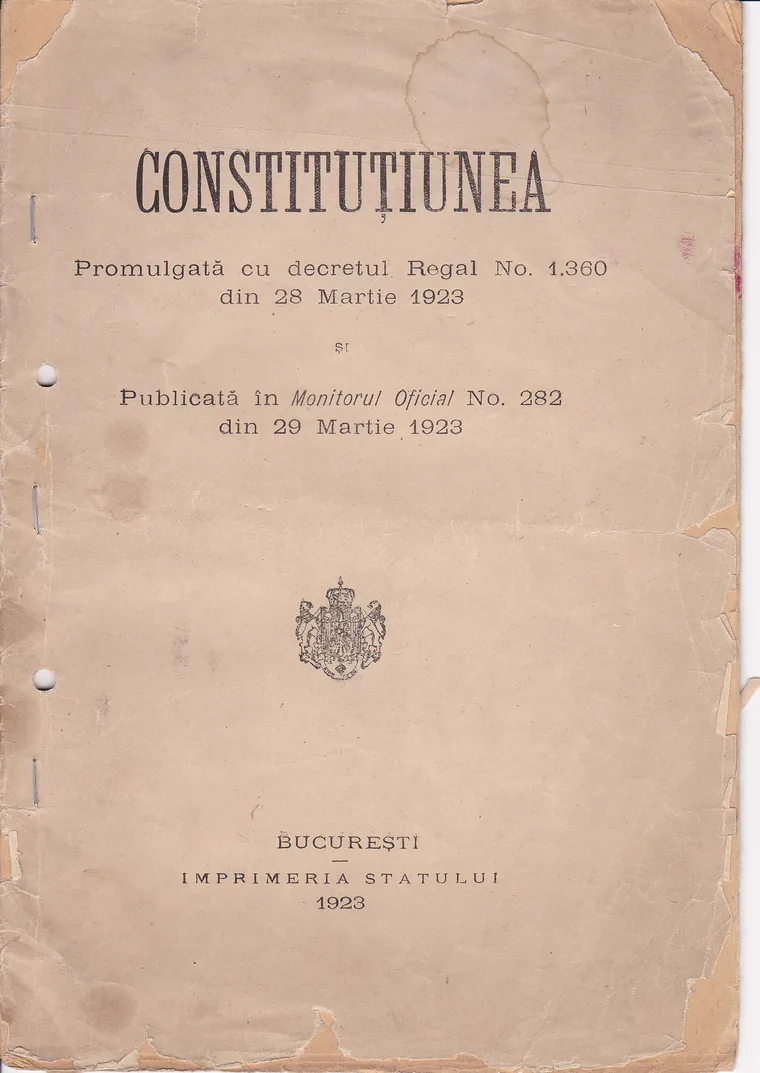
First page of Romania's 1923 Constitution, State Printing House edition
The 1923 Constitution, first page of the official edition. Wikimedia Commons, public domain.

Who article III.1 was written for

Article III.1 addressed the “co-inhabiting” peoples: those who had not voted at Alba Iulia. In 1910, today's 16 counties of Transylvania, the Banat, Crișana and Maramureș had 5,228,865 people. 53.8% had Romanian as their mother tongue, 31.6% Hungarian, 10.7% German and 3.8% another language. The map shows every settlement: dot size is population, colour the majority language, and a ring marks a second language above one fifth.

RomanianHungarianGermanSerbianothersecond language above one fifth

Or tap the map. Names work in Romanian and Hungarian.

The 1910 Hungarian census asked for mother tongue, not nationality, so Jews appear mostly under Hungarian or German. Village figures come from Árpád E. Varga's tables; the dots sit on the OpenStreetMap settlements.

The counties in 1910
CountyPopulationRomanianHungarianGermanOther
Alsó-Fehér216,36177.1%18.1%3.1%1.7%
Arad *396,24459.9%29.8%8.0%2.2%
Bihar *484,88852.2%44.7%0.7%2.4%
Beszterce-Naszód126,31168.5%8.4%19.9%3.1%
Brassó102,49835.5%34.5%28.8%1.2%
Krassó-Szörény450,03573.1%6.9%11.8%8.2%
Csanád *21,28844.5%14.1%0.7%40.7%
Csík132,2897.4%91.5%0.7%0.5%
Kolozs289,90756.6%38.5%2.9%2.0%
Fogaras93,87588.6%6.9%3.4%1.1%
Hunyad340,23179.9%15.5%2.4%2.2%
Máramaros *145,48150.5%19.4%18.3%11.8%
Maros-Torda219,91932.8%61.1%3.8%2.4%
Udvarhely124,5092.3%95.4%1.8%0.5%
Szatmár *285,57842.0%55.1%2.3%0.6%
Szeben178,81164.6%5.7%27.8%1.9%
Szolnok-Doboka251,93675.2%20.7%2.7%1.4%
Szilágy229,58259.1%38.0%0.4%2.6%
Temes *370,54638.3%18.2%35.9%7.7%
Torontál *156,79724.1%12.8%46.2%17.0%
Háromszék146,37114.8%84.1%0.4%0.7%
Torda-Aranyos177,36571.8%25.9%0.3%2.0%
Nagy-Küküllő151,03441.0%12.6%41.3%5.1%
Kis-Küküllő113,59448.4%28.6%18.3%4.6%
Ugocsa *23,41541.4%52.7%3.4%2.5%

* county cut by the 1920 border: only the part in today's Romania.

The other peoples

The Resolution was voted by Romanians. The other peoples held their own assemblies and wrote their own demands, and some of them invoked the Alba Iulia text itself.

The Saxons

Mediaș, 8 January 1919

On 29 October 1918 the Saxon leaders had still declared their loyalty to Hungary. On 8 January 1919 their assembly in Mediaș voted to join Romania and expressly grounded the vote in the Alba Iulia Resolution. The historian Harald Roth shows that the Saxons asked for broad national autonomy, with a self-governing territory, church autonomy and a German university, and that disappointment followed when many expectations stayed on paper. The land reform took part of their communal forests and pastures.

The Hungarians

Cluj, 22 December 1918

The Hungarian assembly in Cluj, led by István Apáthy, asked for Transylvania to remain in Hungary; the Szekler assembly in Târgu-Mureș had voted the same way on 28 November. After 1920 the complaints went to the League of Nations: a Hungarian delegation in July 1922, petitions from 1923 onwards and the optants dispute over the land reform. On 23 October 1923 the Hungarian Party and Averescu's People's Party, then in opposition, signed the agreement known as the Ciucea pact, for concessions on language, schools and representation.

The Swabians

Timișoara, 10 August 1919

Representatives of 33 communities, gathered in the German-Swabian People's Party, backed union and an undivided Banat. They invoked the Alba Iulia guarantees for minorities as the basis for keeping their identity. Other Swabian leaders took other paths, autonomy among them. The division of the Banat left Swabians on both sides of the new border.

The Jews

Citizenship, 1918–1923

In Transylvania and the Banat, Jews had held equal rights since 1867 as citizens of Hungary, and became Romanian citizens like every habitual resident, under article 3 of the Minorities Treaty. For the Jews of the Old Kingdom, citizenship came through decree-laws of December 1918, May and August 1919, ratified by article 133 of the 1923 Constitution. Article 7 removed religion and ethnic origin as barriers to civil and political rights. The Minorities Treaty gave citizenship without formalities to Jews who could claim no other.

What five years could not hold

Women voted on the same terms as men only in 1946. The state of siege and censorship were lifted in November 1928, under Iuliu Maniu's government. Social insurance was unified in 1933. The 1923 Constitution was replaced in 1938 by Carol II's; its course can be followed on the page about Romania's constitutions.

The scale and the method

Each promise is judged by the acts in force on 31 December 1923 (and, for liberties, by the acts that suspended them). The verdict is one of four:

  • Kept: an act in force at the end of 1923 does what the text says for everyone it names, or did so until the term the text itself set.
  • Partly kept: an act does only part of it, or only for some of those named, or was withdrawn before the term the text set or, where the text set no term, before the end of 1923.
  • Postponed: an act in force expressly sends the promise to a future law.
  • Not kept: no act in force does it, or an act does the opposite.

“Partly kept” is not a middle grade. It only says that the law covered part of what the text said. The paragraph beside each square says which part. Dates are new style; acts before April 1919 also carried an old-style date at the time. The Resolution is quoted in its 1918 spelling, from the CIMEC transcription of the signed copy; the date in article I follows the copy.

The map uses Árpád E. Varga's settlement tables for 1910, 1930 and 2002, all three by mother tongue, so they can be compared. They cover 4,118 settlements in today's 16 counties; county totals match Varga's within 2% per county and 0.2% overall; the gaps come from villages that changed county. For 225 settlements with no OpenStreetMap point, the dot sits in their commune. County shares add up the settlements in today's Romania. For the eight counties cut by the 1920 border that have settlements in today's Romania (Arad, Bihar, Szatmár, Máramaros, Ugocsa, Temes, Torontál, Csanád), the share covers only the Romanian part, so it cannot say whether the whole county passed Decree no. I's one-fifth threshold.

On the same years

Sources

Images and data