When «rost» meant mouth — 19 words from the Scheian Psalter
«Codru» meant mountain. «Cumplit» meant fulfilled. «Meser» meant poor — and rang out 96 times. The Scheian Psalter — one of the oldest translations of the Psalms into Romanian — caught 19 words in the moment before they shifted. We follow each one: what it meant then, what it means now, and the page where the evidence sits.
Manuscript 449 of the Romanian Academy Library holds the Scheian Psalter, one of the oldest copies of the Psalms in Romanian: a translation from Slavonic, three scribal hands, edited by Bianu in 1889 and comparatively by Candrea in 1916. Its vocabulary shows three fates: shifted senses («codru» meant mountain, «rost» meant mouth), senses lost through competition («ciudesă» lost to «minune»), and searches with no result, recorded as findings («chiar», «cîștiga», «răposa»). Each card shows the form, the then-meaning, the now-meaning, the etymon and the Candrea page where the evidence sits.
I
Why the Scheian
Manuscript 449, three hands, two editions
Manuscript
ms. 449 Romanian Academy Library
Scripts
3 hands of copyists, not translators
Editions
1889 · 1916 Bianu · Candrea
The Scheian Psalter is one of the oldest witnesses that the Psalter was read in Romanian. Manuscript 449 of the Romanian Academy Library holds a translation from Slavonic, copied by three scribal hands — three distinct scripts laid over the same text.
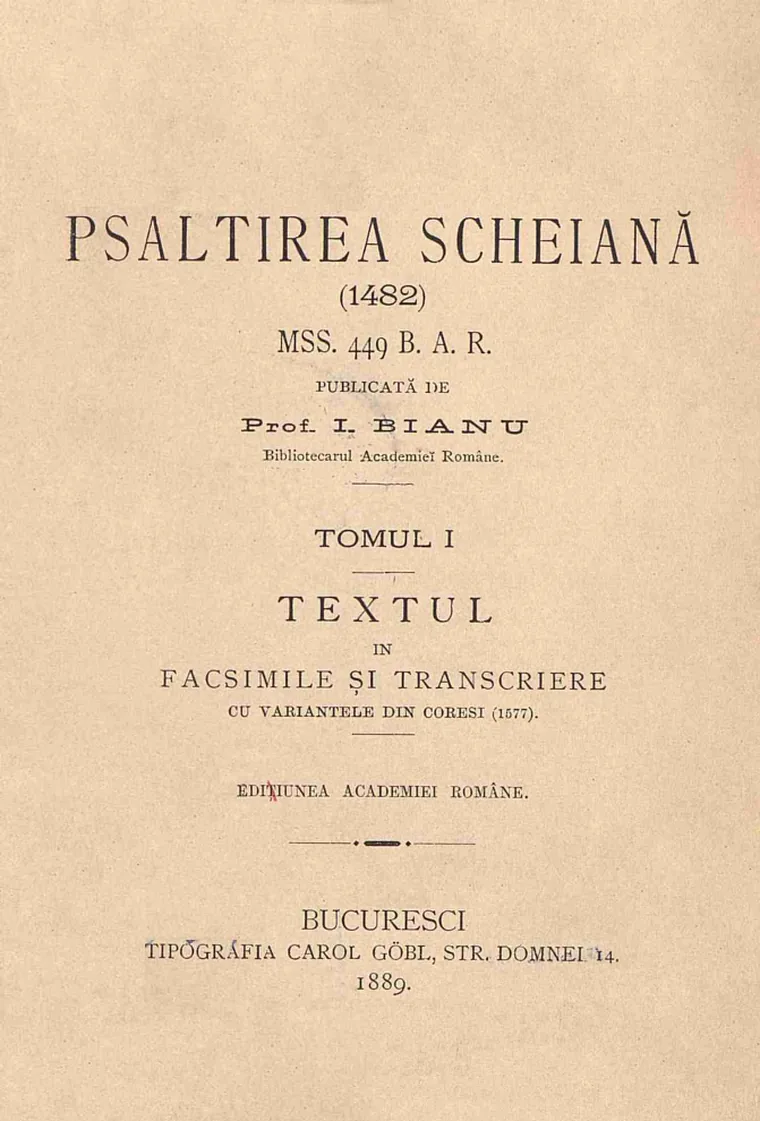
Bianu edited it in 1889: volume I, the text, facsimile and transcription, with the variants from Coresi (1577) gathered in the apparatus. The title page, reproduced below, states the programme on its own: first the manuscript as it looks, then its lettering as it reads.
Bianu, 1889. «Psaltirea Scheiană (1482), mss. 449 B.A.R.»: facsimile and transcription, with the variants from Coresi (1577).
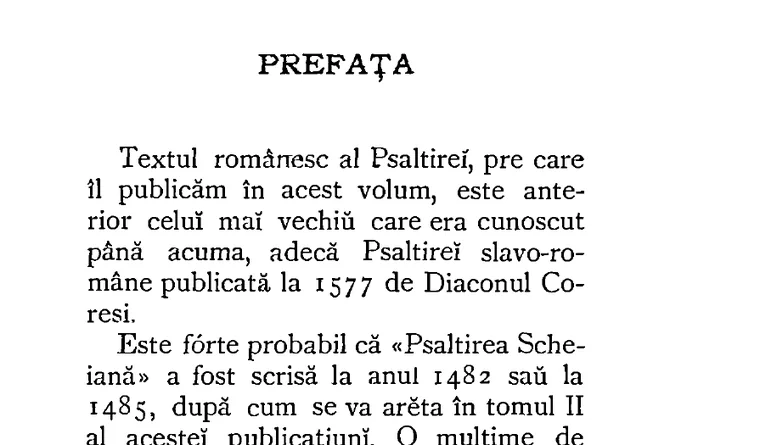
In the preface, Bianu shows his reckoning. The Romanian text predates everything known until then — the Slavo-Romanian Psalter printed by Deacon Coresi in 1577 —, and he dates the copying «la anul 1482 saŭ la 1485» (in the year 1482 or 1485):
The preface, 1889. Older than Coresi (1577); dated by the editor «la anul 1482 saŭ la 1485». The exact dating stays debated (the dating note).
Candrea re-edited it comparatively in 1916, alongside the other old psalters. His pagination is the ruler for every card here: each «p.» points at the 1916 edition.
The question is plain: what did the words mean then, and what do they mean now? 19 cards answer — 12 words followed from end to end, plus 7 short cards —, each with its attestation badge. Where the search returned nothing, the zero stands on the page as a finding, not a gap.
II
How to read a shift in meaning
The same order on every card: form, senses, etymon, evidence
Each card answers in the same order: the manuscript form, the then-meaning, the now-meaning, the etymon and the evidence — the Candrea page where the form occurs. The badge says at a glance how solid the attestation is:
AttestedForm and sense attested in the Scheian; the Candrea page sits at the card.
Inflected formsOnly inflected forms attested, not the headword form.
FamilyDerivatives or kin of the word attested, not the word itself.
Not foundThe search returned nothing in the Scheian; the absence is recorded as such.
«With no modern heir», under the now-meaning, means the old word has nothing to show today: it left use, or its sense was lost. Each card links to DEX, so you can check for yourself.
Some forms need a reading key: rhotacismintervocalic n > r, e.g. inremă = inimă (heart). We meet it at inremă, the yardstick of the phenomenon in the manuscript: 42 occurrences of the same phonetic signature. Once learnt, it unlocks a host of forms that otherwise look foreign.
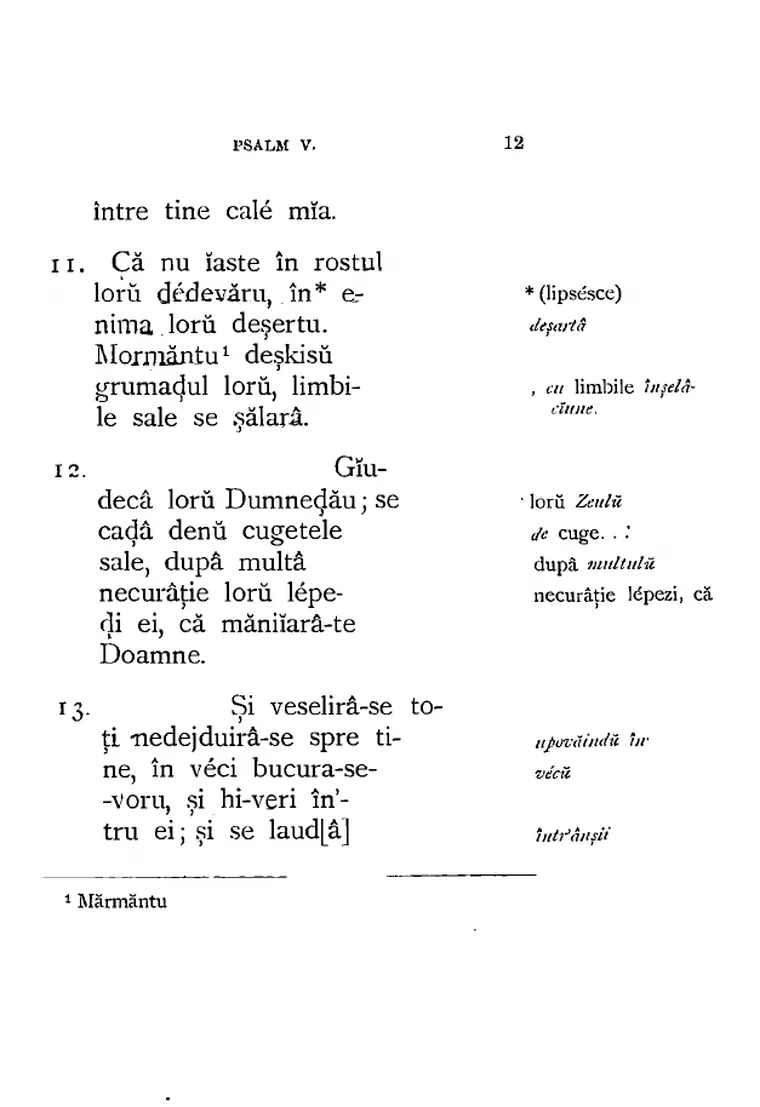
Bianu's transcription. The numbered text, with the apparatus of variants in the margin — the readings from Coresi (1577) set against the Scheian.
One primitive, three copyists
Today's scholars (Camară, Felea, Munteanu) trace the Romanian Psalter to a single primitive, passed down through successive revisions: one spring the text keeps returning to, each generation of copyists drawing from it again. The three hands distinguished in manuscript 449 are copyists' hands — people who transcribed, not people who each translated in their own way. So we treat the manuscript as a single witness in three scripts.
III
Lost Latin, remaining Slavonic
Three words show how the Latin inheritance thinned where Slavonic stayed the translation's base language
Chiar comes from CLARUS and meant «clear». The loveliest evidence sits with Coresi, not in the psalms: eggs «mai chiar» — clearer and brighter, in Densușianu's gloss. In the Scheian, the psalm search returned zero; the word occurs only in the preface, so the card wears the «Not found» badge, and the road from «clear» to today's precision adverb stays undocumented here. The old adjective still shows in two places: «din chiar senin» — out of the clear blue sky — and «apă chioară», where the form decayed after the sense was lost. Meanwhile the adjective yielded the ground to «limpede» and survived only as an adverb.
With răposa, the replacement was caught in the act. In the 16th century, «a răposa» meant «to rest», and Coresi writes in his Homiliary: «dă lor răpaos și odihnă» — the old word beside its new gloss, as if the printer doubted the reader would still understand it. He was right to worry: Slavonic «a se odihni» won, and today's «răposa», meaning «to die», is a neologism dressed in the old word's formal clothes. In the psalms the form was never found: formal continuity, with no continuity of sense.
And lume is the mixed case: MUNDUS, attested on pp. 60, 328 and 500, beside a rare use as LUMEN — «light» —, calqued on Slavonic světъ, which meant both. The Scheian itself preserves the scene:
«Ferește-mă, Doamne, ca lumea ochiului»
«Light» never caught on; mankind remained.
No consensus: Latin or Slavonic?
How much of the old psalters' vocabulary is Latin inheritance and how much is Slavonic or calqued on Slavonic stays a question with no consensus. We do not decide: each card shows the etymon and the evidence, and you can see for yourself where Latin stands and where Slavonic stands.
IV
Strayed metaphors
Four words shifted their sense along paths that look impossible today
Cumplit is attested meaning «fulfilled» (pp. 276, 124, 64), and Densușianu reconstructs its road step by step: «Zilele se cumplu» — the days are fulfilled; «a cumplit drumul» — to carry a road through to its end. Today's dread would have passed through «om cumplit de rău» — a man perfected in evil, to the last margin of wickedness —, where «cumplit» intensified, like an intensifier. At some point the companion vanished, and the intensifier stood alone with the nuance they had carried together. A hypothesis, marked as such at the card.
Greață — «weight, heaviness» become «disgust» — was never found in the Scheian; the only old witness is Voroneț:
«Urma frîngea-se de greața valurilor»
The sense then narrowed to «something that presses, something that sickens». The shift looks natural, yet here it cannot be proven.
Rost meant «mouth» — ROSTRUM, which in Latin first meant «beak», from RODERE, «to gnaw», and was said of animals. Coresi uses it as an everyday word:
«Deschide-voi rostul meu și se va auzi»
In the Scheian stand the inflected forms (pp. 40, 53, 93). Then «gură» — from GULA, «gullet» — won the race, and «rost» withdrew into the phrase «pe de rost» (by heart): a contamination of «de rost» (from the mouth) with «pre rost» (through the mouth). And the road does not end there: at the weaving loom, «rost» is the empty gap between heddles — «a pune rostul pînzei» —, whence «nu e cu rost», properly made, and today's purpose. From beak to purpose in four stops: the chart at the top of the page shows them all.
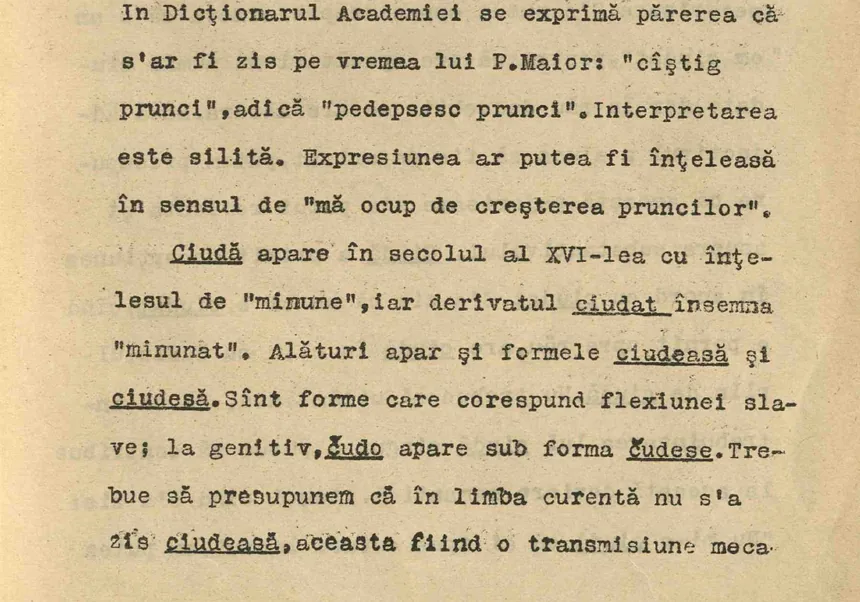
Cîștiga is the slipperiest case: from «to care for» (CASTIGARE) to «to obtain», with no attestation in the psalms to show the crossing. Densușianu proposes the bridge: «cîștig pruncii» — not «I punish the children», as the Academy Dictionary would have it («a forced reading»), but «I see to the raising of the children». From tending to gaining, the step was taken outside the manuscript. The facsimile of the paragraph sits in the duels chapter, beside «ciudesă».
V
Mountain, hamlet, sheepfold
Three cards belong to the world of the mountain and the settlement
Codru meant «mountain» (QUADRUM), on pp. 88, 574, 866, 473 and 983. Densușianu climbs higher still: vulgar QUODRUM could at first only have meant «lowland forest» — only a forest standing on flat ground could look like something square. Later «un codru» was also said of high-altitude forest, and by the 16th century the sense had become identical with «mountain». Today's forest is, most likely, the forest on the ridge: the sense slid off the peak onto what covers it.
Mutare meant «settlement, village, dwelling» (pp. 124, 883), with the pastoral sense of «sheepfold». The verse shows it in festive dress:
«În soare puse mutarea sa»
And in the dialects the old sense still sounds: around Rodna a «mutare» is a small sheepfold that can be moved with ease, while Maramureș and the Apuseni Mountains have «mutătoare» and «mutătură». The village-sheepfold of transhumance stayed behind; the word keeps only the movement today.
Fără-fund — hell, the abyss — is attested (pp. 497, 734); beznă, darkness, never occurs in the manuscript. Slavonic bezdeno, «without bottom», circulates in Coresi in a form deemed artificial: hell is in the manuscript, darkness is not. Densușianu traces «beznă» through the century's religious texts, where it occurs often — but the Scheian would not take it.
VI
Duels
The words that fought each other — and what stayed behind
Not every disappearance is an accident. Some words lost because someone else won: the same idea, two coats, only one survives. Two duels and a few survivors tell the story of competition in the vocabulary — plus one precious Latinism that never fitted among the cards.
Slavonic čudo, «miracle» — and it did not stand alone: «ciudă» itself had meant «miracle», and «ciudat», «wondrous». Densușianu shows the mechanism of the fall: the man unlike others comes to be deemed «not quite in his right mind», and the noun inherits the suspicion — «with his soul full of ciudă». The form «ciudeasă», he says, may never have been spoken in the living language at all: a mechanical transmission from Slavonic.
About 30 times (p. 715), minune took everything: the sense, the place, the future. Today «ciudat» means strange, and «minune» stands alone as the name of the miracle.
Densușianu, the lithographed course, p. 23. Two scenes on one page: «cîștig pruncii» (= I see to the raising of the children) and «ciudă = miracle, ciudat = wondrous», with the forms «ciudeasă» and «ciudesă». The mechanism of pejoration is described on the next page.
The same Slavonic, translated piece by piece (pp. 157, 256, 104, 232) — «a morphological and semantic calque on Slavonic», as Densușianu calls it. For a while they circulated side by side with the same meaning; then the borrowing withdrew, and the compound stayed.
Yet «bezaconie» never quite died: the downtrodden Romanian saying «a venit și bezaconia aceasta, împilarea aceasta» (here comes this bezaconie too, this oppression) gave it the sense of «an unexpected, startling thing» — today's bazaconie.
Meser lost to no single rival: it lost an entire world. «Poor» (MISER — the same root as Western misericordia), with «meserătate» = poverty, «a meseri» = to grow poor, and «mesereze» = mercy — the last a crystallized Latin verb (MISERERE, «have mercy»), turned noun like «durere». At 96 occurrences it is the most frequent lost word on the list — and it looks strikingly like «meșter» (master craftsman), which has nothing to do with it. And the trace of «meser» may well have survived inside «meserie» (profession): Scriban and DLRM see it derived from «meser» (poor), while Tiktin builds it on «meserere» — mercy, but also «office», since offices were given by the prince, who showed mercy to the dignitary. The sense would have come from It. mestiere and Fr. métier, in an explanation adopted by CADE and DLR; the DER's author leans toward the first explanation, «but it needs some clarification», while DU drily writes «origin unknown».
Cerca, by contrast, shows what it means to hold out five centuries: «to seek» it was, and «to seek» it stayed — from CIRCARE, «to walk around a plot to measure it», the surveyors' phrase that, with time, crossed over into «passing through in order to seek, to pursue something». Inremă (42 tokens) is the rhotacism yardstick; arina (p. 512) was abandoned by the literary language but lives on regionally; celariu (p. 527), the monastic cellarer, never crossed the walls.
The twentieth word: «mărit»
Densușianu quotes from the Scheian «el ca măritu eși din celariul său» — MARITUS, bridegroom — and calls it «a precious Latinism», preserved in Aromanian too. With a single citation it never fitted among the cards; it stands here as a bonus, with its page: 107.
The word explorer
All 19 cards in one place: the words from chapters III–V, the duels and survivors from chapter VI. Each card also carries its «scene» — the quotation or episode that fixes it in memory. The filters narrow the list by badge and by mechanism of change; without them, the page shows everything.
No card combines these filters. Widen the selection or press «Show all».
greață
Not found
Then → now
weight, heaviness → disgust
Etymon
GREVITIA
Evidence
No result in the Scheian search; old witness only Voroneț.
In Densușianu
p. 38.
The scene
«Urma frîngea-se de greața valurilor» — the hull broke under the weight of the waves. The Voroneț Codex, the only old witness.
The shift
A modern slide toward disgust, unproven here.
From the chapter «Strayed metaphors» · Mechanism: pejoration · DEX: greață
Candrea, pp. 497, 734; in Coresi the form bezdeno is deemed artificial.
In Densușianu
pp. 13–15.
The scene
«Bezna» is frequent in the century's religious texts — but the Scheian would not take it.
The shift
Hell is in the manuscript; darkness is not.
From the chapter «Mountain, hamlet, sheepfold» · Mechanism: shifted sense · DEX: beznă
cumplit
Attested
Then → now
fulfilled → dreadful
Etymon
COMPLIRE
Evidence
Candrea, pp. 276, 124, 64.
In Densușianu
p. 30.
The scene
«Zilele se cumplu» — the days are fulfilled. The dread may come from «om cumplit de rău».
The shift
Via «fulfilled in evil» (hypothesis).
From the chapter «Strayed metaphors» · Mechanism: pejoration · DEX: cumplit
rost
Inflected forms
Then → now
mouth → purpose; pe-de-rost
Etymon
ROSTRUM
Evidence
Candrea, pp. 40, 53, 93 — inflected forms.
In Densușianu
pp. 53–55.
The scene
«Deschide-voi rostul meu» (Coresi) — and, at the weaving loom, «the empty gap between heddles».
The shift
The mouth survives in the phrase.
From the chapter «Strayed metaphors» · Mechanisms: phrase, shifted sense · DEX: rost
chiar
Not found
Then → now
clear → adverb of precision
Etymon
CLARUS
Evidence
Zero in the psalms; preface only.
In Densușianu
p. 21.
The scene
Eggs «mai chiar» — clearer, brighter (Coresi). Today only «din chiar senin».
The shift
Road undocumented here.
From the chapter «Lost Latin, remaining Slavonic» · Mechanism: shifted sense · DEX: chiar
cîștiga
Not found
Then → now
to care for → to obtain
Etymon
CASTIGARE
Evidence
No result in the psalm search.
In Densușianu
p. 22.
The scene
«Cîștig pruncii» = «I see to the raising of the children» — not «I punish».
The shift
The slipperiest shift.
From the chapter «Strayed metaphors» · Mechanism: shifted sense · DEX: cîștiga
răposa
Not found
Then → now
to rest → (neologism) to die
Etymon
Latin.
Evidence
No result in the psalm search.
In Densușianu
p. 51.
The scene
«Dă lor răpaos și odihnă» — the old word and its new gloss, side by side (Coresi).
The shift
Formal continuity, not semantic.
From the chapter «Lost Latin, remaining Slavonic» · Mechanism: shifted sense · DEX: răposa
lume
Attested
Then → now
MUNDUS + rare LUMEN (calque on světъ) → mankind
Etymon
MUNDUS / LUMEN
Evidence
Candrea, pp. 60, 328, 500 (MUNDUS).
In Densușianu
p. 42.
The scene
«Ferește-mă, Doamne, ca lumea ochiului» — as the light of the eye.
The shift
«Light» never caught on.
From the chapter «Lost Latin, remaining Slavonic» · Mechanisms: calque, shifted sense · DEX: lume
mutare
Attested
Then → now
settlement, village, sheepfold → change of place
Etymon
Latin.
Evidence
Candrea, pp. 124, 883.
In Densușianu
p. 46.
The scene
«În soare puse mutarea sa» — and at Rodna a «mutare» is a portable sheepfold.
The shift
Village-sheepfold → only the movement.
From the chapter «Mountain, hamlet, sheepfold» · Mechanism: shifted sense · DEX: mutare
cerca
Family
Then → now
to seek → to seek (literary)
Etymon
CIRCARE
Evidence
Candrea, pp. 56, 539, 172 — the family of forms, including Carcetu.
In Densușianu
pp. 19–20.
The scene
«To walk around a plot to measure it» — the surveyors' phrase.
The shift
The sense holds five centuries.
From the chapter «Duels» · Mechanism: kept sense · DEX: cerca
codru
Attested
Then → now
mountain → forest
Etymon
QUADRUM
Evidence
Candrea, pp. 88, 574, 866, 473, 983.
In Densușianu
pp. 26–27.
The scene
QUODRUM: first «lowland forest» — only flat ground looks square —, then «mountain».
The shift
Ridge → the forest on it.
From the chapter «Mountain, hamlet, sheepfold» · Mechanism: shifted sense · DEX: codru
meser
Attested
Then → now
poor; meserere = mercy → with no modern heir (≠ meșter)
Etymon
MISER
Evidence
Candrea, pp. 65, 69, 64; 96 times, in our count.
In Densușianu
pp. 62, 109.
The scene
«Mesererea mea» = my mercy: MISERERE, «have mercy», turned noun like «durere». The family's trace in «meserie» is disputed among dictionaries — see chapter VI.
The shift
The most frequent lost word.
From the chapter «Duels» · Mechanism: lexical competition · DEX: meser
bezaconie
Attested
Then → now
iniquity, sin → with no modern heir
Etymon
Slavonic.
Evidence
Candrea, pp. 731, 879.
In Densușianu
pp. 12–13.
The scene
«A venit și bezaconia aceasta, împilarea aceasta» — hence today's bazaconie.
The shift
Beaten by fărădelege.
From the chapter «Duels» · Mechanism: lexical competition · DEX: bezaconie
fărădelege
Attested
Then → now
iniquity → crime (literary)
Etymon
fără + de + lege
Evidence
Candrea, pp. 157, 256, 104, 232.
In Densușianu
p. 12 (the calquing of bezaconie).
The scene
Translated piece by piece from Slavonic: «a morphological and semantic calque».
The shift
The compound beat the borrowing.
From the chapter «Duels» · Mechanism: lexical competition · DEX: fărădelege
celariu
Attested
Then → now
monastic cellarer → with no modern heir
Etymon
cellarium
Evidence
Candrea, p. 527.
In Densușianu
p. 107.
The scene
The monastery's cellarer, keeper of the cellar keys: a word that never crossed the walls.
The shift
Never left the walls.
From the chapter «Duels» · Mechanism: lexical competition · DEX: celariu
inremă
Attested
Then → now
heart (with rhotacism) → heart
Etymon
anima
Evidence
Candrea, pp. 57, 141; 42 times, in our count.
The scene
42 occurrences of the same signature: intervocalic n > r, no exceptions.
The shift
The rhotacism yardstick.
From the chapter «Duels» · Mechanisms: rhotacism, kept sense · DEX: inimă
minune
Attested
Then → now
miracle → miracle (kept)
Etymon
— (not noted on file)
Evidence
Candrea, p. 715; about 30 times, in our count.
In Densușianu
p. 23 (in the discussion of ciudă).
The scene
It took everything: the sense, the place, the future. «Ciudesă» withdrew.
The shift
Replaced ciudesă.
From the chapter «Duels» · Mechanisms: lexical competition, kept sense · DEX: minune
arină
Attested
Then → now
sand → sand (regional arină)
Etymon
arena
Evidence
Candrea, p. 512.
The scene
The literary language chose «nisip»; the dialects kept «arina».
The shift
The literary form abandoned it.
From the chapter «Duels» · Mechanisms: lexical competition, kept sense · DEX: arină
ciudesă
Attested
Then → now
miracle (čudo) → with no modern heir
Etymon
Slavonic čudo
Evidence
Candrea, pp. 57, 461, 639; 20 times, in our count.
In Densușianu
pp. 23–24.
The scene
«Ciudă = miracle, ciudat = wondrous» — until the unusual man became «not quite in his right mind».
The shift
Lost to minune — after ciudă itself had meant “miracle” and ciudat “wondrous”.
From the chapter «Duels» · Mechanism: lexical competition · DEX: ciudesă
Heard most often
Four cards come with a frequency noted — the rest give pages, not counts. The bars measure against each other: «meser», the lost word, sounds more often than all the others put together.
All frequencies come from our count on Candrea's pagination; «~» marks a rounding in the count itself.
What did it mean then?
Six of the 19 words. Pick the old sense — the answer also shows the page where the evidence sits.
rost
What did «rost» mean in the Scheian?
The answer
«Rost» meant «mouth» (ROSTRUM). The inflected forms stand at Candrea, pp. 40, 53, 93 — and the mouth survives in «pe de rost». See the card.
codru
What did «codru» mean in the Scheian?
The answer
«Codru» meant «mountain» (QUADRUM): Candrea, pp. 88, 574, 866, 473, 983. See the card.
cumplit
What did «cumplit» mean in the Scheian?
The answer
«Cumplit» meant «fulfilled»: «Zilele se cumplu». Candrea, pp. 276, 124, 64. See the card.
meser
What did «meser» mean in the Scheian?
The answer
«Meser» meant «poor» (MISER), 96 times: Candrea, pp. 65, 69, 64. It has nothing to do with «meșter». See the card.
mutare
What did «mutare» mean in the Scheian?
The answer
«Mutare» meant «settlement, village, dwelling»: Candrea, pp. 124, 883. «În soare puse mutarea sa». See the card.
ciudesă
What did «ciudesă» mean in the Scheian?
The answer
«Ciudesă» meant «miracle» (čudo), 20 times: Candrea, pp. 57, 461, 639. It lost to «minune». See the card.
Score: 0 / 6
What is missing
Five searches returned nothing in the psalms. We record them as findings, not gaps: absence proves nothing about what speakers knew — only that the translator never used the words here.
greață — old witness only Voroneț; in the Scheian, nothing.
cîștiga — zero; the slipperiest shift stays bridgeless.
răposa — zero; the old rest and the new death never meet in the manuscript.
The dating note
Bianu edited the Scheian Psalter in 1889, with 1482 in the title, and showed his reckoning in the preface: «la anul 1482 saŭ la 1485». Candrea re-edited it comparatively in 1916. Beyond these two editorial landmarks, the exact dating of the translation stays debated, and we propose no definitive year. Every «p.» reference at the cards follows Candrea's pagination.
How we worked
The «p.» pages point at the 1916 Candrea edition; the frequencies («96 times») are our count on the same pagination. The badges say at each card whether the form is attested, inflected, related or not found. The modern senses are the editors' own; each card links to DEX for checking. The old quotations (Coresi, Voroneț, the Scheian verses) follow the glosses of Densușianu's lithographed course (1932–1933), with the pagination at each card. The facsimiles were extracted locally, at reading resolution, from scans of the two editions. Coresi is cited for the form bezdeno, deemed artificial; Camară, Felea and Munteanu for the single primitive and its revisions. The English edition translates the Romanian one; badges, pages and etyma are identical.
Sources on show
Bianu, I. C. — Psaltirea Scheiană, the 1889 edition (with 1482 in the title); manuscript 449 of the Romanian Academy Library.
Candrea, I.-A. — the 1916 comparative re-edition of the Scheian Psalter, alongside the other old psalters; the pagination followed on every card.
Densușianu, Ovid — Filologia romanică, the lithographed course of the University of Bucharest (summarized by Alexandru Vasiliu), 1932–1933; the discussion of each word, with the pagination cited at every card.
Camară, Felea, Munteanu — the single primitive of the Romanian Psalter, passed down through revisions; the three hands in manuscript 449 are copyists' hands .
Coresi — the form bezdeno, deemed artificial ; the old Voroneț witness, for greață.
dexonline.ro — checks of 18 September 2026: meser (3 definitions, «lat. miser, sărac»), bazaconie («lucru bizar, ciudățenie», from bezaconie), carcet (no definitions). The DEX links at each card point at the headword form.
The page facsimiles — Bianu 1889 (title page, preface, a transcription page, ms. p. 393) and Densușianu 1933 (p. 23), extracted locally from the Dacoromanica scans of the two editions; each stands beside the passage it proves.