mariuscomper.ukRO

An atlas of the year

The seasons: why the year turns, how many seasons the world counts and what 351 languages call them

The sky gives the year four corners: two solstices and two equinoxes. Everything else was decided by people. Some counted two seasons, some three, six or seven, and Japan’s old almanac counts seventy-two. Scroll through one year cut 21 ways, the season words of 351 languages, and the stories told about the turning year.

sumarveturקיץ (qayits)חרף (ḥoref)KauHoʻoiloWangtankaYurluurrpAkhetPeretShemuฤดูร้อน (ruedu ron)ฤดูฝน (ruedu fon)ฤดูหนาว (ruedu nao)BelgKiremtBegaJamutakariKumunupunariTiyariSpringSummerAutumnWinterSpringSummerAutumnWintererrachsamradfogamargemred春 (chūn)夏 (xià)秋 (qiū)冬 (dōng)WinterPre-monsoonSouth-west monsoonPost-monsoonWunthurruLhabayiRra-marduNgardaruNa-yinarrambaवसन्त (vasanta)ग्रीष्म (grīṣma)वर्षा (varṣā)शरद् (śarad)हेमन्त (hemanta)शिशिर (śiśira)BirakBunuruDjeranMakuruDjilbaKambarangKudjewkBangkerrengYekkeWurrkengKurrungKunumelengMan-galaMarrulWirralburuBarrganaWirlburuLajagiđđadálvigiđđagiđđageassigeassičakčageassičakčačakčadálvidálvi立春 (lìchūn)雨水 (yǔshuǐ)惊蛰 (jīngzhé)春分 (chūnfēn)清明 (qīngmíng)谷雨 (gǔyǔ)立夏 (lìxià)小满 (xiǎomǎn)芒种 (mángzhòng)夏至 (xiàzhì)小暑 (xiǎoshǔ)大暑 (dàshǔ)立秋 (lìqiū)处暑 (chǔshǔ)白露 (báilù)秋分 (qiūfēn)寒露 (hánlù)霜降 (shuāngjiàng)立冬 (lìdōng)小雪 (xiǎoxuě)大雪 (dàxuě)冬至 (dōngzhì)小寒 (xiǎohán)大寒 (dàhán)東風解凍 (Harukaze kōri o toku)黄鶯睍睆 (Kōō kenkan su)魚上氷 (Uo kōri o izuru)土脉潤起 (Tsuchi no shō uruoi okoru)霞始靆 (Kasumi hajimete tanabiku)草木萌動 (Sōmoku mebae izuru)蟄虫啓戸 (Sugomori mushito o hiraku)桃始笑 (Momo hajimete saku)菜虫化蝶 (Namushi chō to naru)雀始巣 (Suzume hajimete sukū)桜始開 (Sakura hajimete saku)雷乃発声 (Kaminari sunawachi koe o hassu)玄鳥至 (Tsubame kitaru)鴻雁北 (Kōgan kaeru)虹始見 (Niji hajimete arawaru)葭始生 (Ashi hajimete shōzu)霜止出苗 (Shimo yamite nae izuru)牡丹華 (Botan hana saku)蛙始鳴 (Kawazu hajimete naku)蚯蚓出 (Mimizu izuru)竹笋生 (Takenoko shōzu)蚕起食桑 (Kaiko okite kuwa o hamu)紅花栄 (Benibana sakau)麦秋至 (Mugi no toki itaru)蟷螂生 (Kamakiri shōzu)腐草為蛍 (Kusaretaru kusa hotaru to naru)梅子黄 (Ume no mi kibamu)乃東枯 (Natsukarekusa karuru)菖蒲華 (Ayame hana saku)半夏生 (Hange shōzu)温風至 (Atsukaze itaru)蓮始開 (Hasu hajimete hiraku)鷹乃学習 (Taka sunawachi waza o narau)桐始結花 (Kiri hajimete hana o musubu)土潤溽暑 (Tsuchi uruōte mushi atsushi)大雨時行 (Taiu tokidoki furu)涼風至 (Suzukaze itaru)寒蝉鳴 (Higurashi naku)蒙霧升降 (Fukaki kiri matō)綿柎開 (Wata no hana shibe hiraku)天地始粛 (Tenchi hajimete samushi)禾乃登 (Kokumono sunawachi minoru)草露白 (Kusa no tsuyu shiroshi)鶺鴒鳴 (Sekirei naku)玄鳥去 (Tsubame saru)雷乃収声 (Kaminari sunawachi koe o osamu)蟄虫坏戸 (Mushi kakurete to o fusagu)水始涸 (Mizu hajimete karuru)鴻雁来 (Kōgan kitaru)菊花開 (Kiku no hana hiraku)蟋蟀在戸 (Kirigirisu to ni ari)霜始降 (Shimo hajimete furu)霎時施 (Kosame tokidoki furu)楓蔦黄 (Momiji tsuta kibamu)山茶始開 (Tsubaki hajimete hiraku)地始凍 (Chi hajimete kōru)金盞香 (Kinsenka saku)虹蔵不見 (Niji kakurete miezu)朔風払葉 (Kitakaze konoha o harau)橘始黄 (Tachibana hajimete kibamu)閉塞成冬 (Sora samuku fuyu to naru)熊蟄穴 (Kuma ana ni komoru)鱖魚群 (Sake no uo muragaru)乃東生 (Natsukarekusa shōzu)麋角解 (Sawashika no tsuno otsuru)雪下出麦 (Yuki watarite mugi nobiru)芹乃栄 (Seri sunawachi sakau)水泉動 (Shimizu atataka o fukumu)雉始雊 (Kiji hajimete naku)款冬華 (Fuki no hana saku)水沢腹堅 (Sawamizu kōri tsumeru)鶏始乳 (Niwatori hajimete toya ni tsuku)March equinox, 20 MarchJune solstice, 21 JuneSeptember equinox, 23 SeptemberDecember solstice, 21 December

12 October was, when this page was last built:

  • By the Sun, north of the equatorAutumn equinox to solstice
  • China’s 24 solar terms寒露 hánlù Cold dew
  • Japan’s 72 seasons鴻雁来 Kōgan kitaru Wild geese arrive
  • India’s six seasons (ṛtu)शरद् śarad autumn, the ripening
  • Noongar country, south-west AustraliaKambarang season of birth; second spring
  • Ancient Egypt, by the NileAkhet Inundation

Read your birthday in every calendarSee the year cut 21 ways

One · The cause

Why the year turns

The Earth is closest to the Sun in the first week of January. Whatever makes July hot in London and Bucharest, it is not distance. Follow one orbit and watch your own latitude.

3 January · closest to the Sun

In January the Earth is nearest the Sun

On 3 January 2026 the Earth passes its closest point to the Sun: 147.1 million km. The north of the planet is in midwinter.

So the common explanation, that summer comes when the Earth is close to the Sun, is wrong everywhere, and in the north it is the wrong way round. The orbit on the left is drawn to scale. It is an ellipse so close to a circle that the eye cannot tell.

All year · 23.44°

The axis leans, and keeps pointing the same way

The Earth spins on an axis tilted 23.44° from upright, and as the planet goes round the Sun the axis keeps pointing at the same distant stars. For half the year the northern end leans towards the Sun, for the other half it leans away.

On the right is the Earth seen from the side, with sunlight coming from the left. The bright line is your latitude: the lit part is your day, the dark part your night. Move the latitude under the picture to yours.

20 March · March equinox

Day and night are nearly equal everywhere

At 14:46 UTC on 20 March the Sun stands exactly over the equator. The line between day and night runs through both poles, and every latitude gets about twelve hours of each.

About, because the air bends the Sun’s light over the horizon and the Sun is a disc, not a point: on the equinox the day is already a few minutes longer than the night. At London’s latitude it lasts 12 h 11 min.

21 June · June solstice

The longest day in the north, the shortest in the south

The northern end of the axis now leans straight at the Sun. At London’s latitude the day lasts 16 h 38 min and the noon Sun climbs to 62° above the horizon. North of the Arctic Circle it does not set.

Height matters as much as hours. A high Sun spreads its light over less ground, so each square metre receives more of it.

6 July · farthest from the Sun

Two weeks into northern summer, the Sun is at its farthest

On 6 July the Earth is 152.1 million km from the Sun, 5.0 million km farther than in January. In January the planet receives about 6.9% more sunlight than it does now.

The south therefore gets its summer Sun slightly stronger and its winter Sun slightly weaker than the north does. The tilt decides which season it is; distance only adjusts it a little.

Late July · the lag

The hottest weeks come after the longest day

The solstice is the day of most sunlight in the north, yet the warmest weeks arrive a month or so later, and the coldest come in January and February, well after the darkest day. Land, and above all sea, take time to warm up and to cool down.

Measured against the curve of incoming sunlight, surface temperature outside the tropics runs about 29 days behind over land and about 56 days behind over the oceans.

23 September · September equinox

The four seasons of the sky are not equal

Count the days between the four corners of 2026: 92.7 from the March equinox to the June solstice, 93.7 to the September equinox, 89.9 to the December solstice, 89.0 back to March.

The Earth moves fastest when it is nearest the Sun, in January, so it hurries through the northern winter. The north’s spring and summer together last 7.5 days longer than its autumn and winter. The reason follows from the laws Johannes Kepler published in 1609; astronomers in Athens had noticed the inequality about two thousand years before him.

21 December · December solstice

The shortest day in the north

At London’s latitude the Sun now stays up for 7 h 50 min and reaches only 15° at noon. The June day there is 2.1 times as long. In Sydney and Buenos Aires this is the start of summer.

Solstice means “the Sun stands still”: for a few days its noon height hardly changes before it starts back.

All year · the equator

Where the tilt changes almost nothing

Set the latitude to Singapore, one degree north of the equator. Its longest and shortest days differ by 9 minutes. There is no winter to speak of.

What changes there is rain. Much of the world counts its year in wet and dry, and that is where the count of seasons begins.

How long is the longest day where you live?

Sunrise to sunset, with the usual allowance for the bending of light at the horizon.
CityLatitudeDaylight on the June solsticeDaylight on the December solstice
Tromsø70° N24 h, the Sun does not setnone, the Sun does not rise
Reykjavík64° N21 h 09 min4 h 07 min
Stockholm59° N18 h 37 min6 h 05 min
London52° N16 h 38 min7 h 50 min
Bucharest44° N15 h 32 min8 h 50 min
New York41° N15 h 06 min9 h 15 min
Tokyo36° N14 h 35 min9 h 44 min
Cairo30° N14 h 05 min10 h 12 min
Delhi29° N13 h 58 min10 h 19 min
Mexico City19° N13 h 18 min10 h 58 min
Singapore1° N12 h 12 min12 h 03 min
Nairobi1° S12 h 03 min12 h 12 min
Lima12° S11 h 25 min12 h 50 min
Johannesburg26° S10 h 30 min13 h 47 min
Sydney34° S9 h 54 min14 h 24 min
Buenos Aires35° S9 h 50 min14 h 28 min
Wellington41° S9 h 11 min15 h 10 min
Ushuaia55° S7 h 12 min17 h 20 min

The curve of daylight for a single city, day by day, has its own page: the light of your days.

Two · The count

How many seasons are there?

The same 365 days, cut by different peoples. Each ring is one calendar; they stay on the page as you go, from two seasons to seventy-two.

sumarveturקיץ (qayits)חרף (ḥoref)KauHoʻoiloWangtankaYurluurrpAkhetPeretShemuฤดูร้อน (ruedu ron)ฤดูฝน (ruedu fon)ฤดูหนาว (ruedu nao)BelgKiremtBegaJamutakariKumunupunariTiyariSpringSummerAutumnWinterSpringSummerAutumnWintererrachsamradfogamargemred春 (chūn)夏 (xià)秋 (qiū)冬 (dōng)WinterPre-monsoonSouth-west monsoonPost-monsoonWunthurruLhabayiRra-marduNgardaruNa-yinarrambaवसन्त (vasanta)ग्रीष्म (grīṣma)वर्षा (varṣā)शरद् (śarad)हेमन्त (hemanta)शिशिर (śiśira)BirakBunuruDjeranMakuruDjilbaKambarangKudjewkBangkerrengYekkeWurrkengKurrungKunumelengMan-galaMarrulWirralburuBarrganaWirlburuLajagiđđadálvigiđđagiđđageassigeassičakčageassičakčačakčadálvidálvi立春 (lìchūn)雨水 (yǔshuǐ)惊蛰 (jīngzhé)春分 (chūnfēn)清明 (qīngmíng)谷雨 (gǔyǔ)立夏 (lìxià)小满 (xiǎomǎn)芒种 (mángzhòng)夏至 (xiàzhì)小暑 (xiǎoshǔ)大暑 (dàshǔ)立秋 (lìqiū)处暑 (chǔshǔ)白露 (báilù)秋分 (qiūfēn)寒露 (hánlù)霜降 (shuāngjiàng)立冬 (lìdōng)小雪 (xiǎoxuě)大雪 (dàxuě)冬至 (dōngzhì)小寒 (xiǎohán)大寒 (dàhán)東風解凍 (Harukaze kōri o toku)黄鶯睍睆 (Kōō kenkan su)魚上氷 (Uo kōri o izuru)土脉潤起 (Tsuchi no shō uruoi okoru)霞始靆 (Kasumi hajimete tanabiku)草木萌動 (Sōmoku mebae izuru)蟄虫啓戸 (Sugomori mushito o hiraku)桃始笑 (Momo hajimete saku)菜虫化蝶 (Namushi chō to naru)雀始巣 (Suzume hajimete sukū)桜始開 (Sakura hajimete saku)雷乃発声 (Kaminari sunawachi koe o hassu)玄鳥至 (Tsubame kitaru)鴻雁北 (Kōgan kaeru)虹始見 (Niji hajimete arawaru)葭始生 (Ashi hajimete shōzu)霜止出苗 (Shimo yamite nae izuru)牡丹華 (Botan hana saku)蛙始鳴 (Kawazu hajimete naku)蚯蚓出 (Mimizu izuru)竹笋生 (Takenoko shōzu)蚕起食桑 (Kaiko okite kuwa o hamu)紅花栄 (Benibana sakau)麦秋至 (Mugi no toki itaru)蟷螂生 (Kamakiri shōzu)腐草為蛍 (Kusaretaru kusa hotaru to naru)梅子黄 (Ume no mi kibamu)乃東枯 (Natsukarekusa karuru)菖蒲華 (Ayame hana saku)半夏生 (Hange shōzu)温風至 (Atsukaze itaru)蓮始開 (Hasu hajimete hiraku)鷹乃学習 (Taka sunawachi waza o narau)桐始結花 (Kiri hajimete hana o musubu)土潤溽暑 (Tsuchi uruōte mushi atsushi)大雨時行 (Taiu tokidoki furu)涼風至 (Suzukaze itaru)寒蝉鳴 (Higurashi naku)蒙霧升降 (Fukaki kiri matō)綿柎開 (Wata no hana shibe hiraku)天地始粛 (Tenchi hajimete samushi)禾乃登 (Kokumono sunawachi minoru)草露白 (Kusa no tsuyu shiroshi)鶺鴒鳴 (Sekirei naku)玄鳥去 (Tsubame saru)雷乃収声 (Kaminari sunawachi koe o osamu)蟄虫坏戸 (Mushi kakurete to o fusagu)水始涸 (Mizu hajimete karuru)鴻雁来 (Kōgan kitaru)菊花開 (Kiku no hana hiraku)蟋蟀在戸 (Kirigirisu to ni ari)霜始降 (Shimo hajimete furu)霎時施 (Kosame tokidoki furu)楓蔦黄 (Momiji tsuta kibamu)山茶始開 (Tsubaki hajimete hiraku)地始凍 (Chi hajimete kōru)金盞香 (Kinsenka saku)虹蔵不見 (Niji kakurete miezu)朔風払葉 (Kitakaze konoha o harau)橘始黄 (Tachibana hajimete kibamu)閉塞成冬 (Sora samuku fuyu to naru)熊蟄穴 (Kuma ana ni komoru)鱖魚群 (Sake no uo muragaru)乃東生 (Natsukarekusa shōzu)麋角解 (Sawashika no tsuno otsuru)雪下出麦 (Yuki watarite mugi nobiru)芹乃栄 (Seri sunawachi sakau)水泉動 (Shimizu atataka o fukumu)雉始雊 (Kiji hajimete naku)款冬華 (Fuki no hana saku)水沢腹堅 (Sawamizu kōri tsumeru)鶏始乳 (Niwatori hajimete toya ni tsuku)sumarsumarveturveturקיץ (qayits)qayitsחרף (ḥoref)ḥorefKauKauHoʻoiloHoʻoiloWangtankaWangtankaYurluurrpYurluurrpAkhetAkhetPeretPeretShemuShemuฤดูร้อน (ruedu ron)ruedu ronฤดูฝน (ruedu fon)ruedu fonฤดูหนาว (ruedu nao)ruedu naoBelgBelgKiremtKiremtBegaBegaJamutakariJamutakariKumunupunariKumunupunariTiyariTiyariSpringSpringSummerSummerAutumnAutumnWinterWinterSpringSpringSummerSummerAutumnAutumnWinterWintererracherrachsamradsamradfogamarfogamargemredgemred春 (chūn)春夏 (xià)夏秋 (qiū)秋冬 (dōng)冬WinterWinterPre-monsoonPre-monsoonSouth-west monsoonSouth-west monsoonPost-monsoonPost-monsoonWunthurruWunthurruLhabayiLhabayiRra-marduRra-marduNgardaruNgardaruNa-yinarrambaNa-yinarrambaवसन्त (vasanta)vasantaग्रीष्म (grīṣma)grīṣmaवर्षा (varṣā)varṣāशरद् (śarad)śaradहेमन्त (hemanta)hemantaशिशिर (śiśira)śiśiraBirakBirakBunuruBunuruDjeranDjeranMakuruMakuruDjilbaDjilbaKambarangKambarangKudjewkKudjewkBangkerrengBangkerrengYekkeYekkeWurrkengWurrkengKurrungKurrungKunumelengKunumelengMan-galaMan-galaMarrulMarrulWirralburuWirralburuBarrganaBarrganaWirlburuWirlburuLajaLajagiđđadálvigiđđadálvigiđđagiđđagiđđageassigeassigeassičakčageassičakčageassičakčačakčačakčadálvičakčadálvidálvidálvi立春 (lìchūn)立春雨水 (yǔshuǐ)雨水惊蛰 (jīngzhé)惊蛰春分 (chūnfēn)春分清明 (qīngmíng)清明谷雨 (gǔyǔ)谷雨立夏 (lìxià)立夏小满 (xiǎomǎn)小满芒种 (mángzhòng)芒种夏至 (xiàzhì)夏至小暑 (xiǎoshǔ)小暑大暑 (dàshǔ)大暑立秋 (lìqiū)立秋处暑 (chǔshǔ)处暑白露 (báilù)白露秋分 (qiūfēn)秋分寒露 (hánlù)寒露霜降 (shuāngjiàng)霜降立冬 (lìdōng)立冬小雪 (xiǎoxuě)小雪大雪 (dàxuě)大雪冬至 (dōngzhì)冬至小寒 (xiǎohán)小寒大寒 (dàhán)大寒東風解凍 (Harukaze kōri o toku)黄鶯睍睆 (Kōō kenkan su)魚上氷 (Uo kōri o izuru)土脉潤起 (Tsuchi no shō uruoi okoru)霞始靆 (Kasumi hajimete tanabiku)草木萌動 (Sōmoku mebae izuru)蟄虫啓戸 (Sugomori mushito o hiraku)桃始笑 (Momo hajimete saku)菜虫化蝶 (Namushi chō to naru)雀始巣 (Suzume hajimete sukū)桜始開 (Sakura hajimete saku)雷乃発声 (Kaminari sunawachi koe o hassu)玄鳥至 (Tsubame kitaru)鴻雁北 (Kōgan kaeru)虹始見 (Niji hajimete arawaru)葭始生 (Ashi hajimete shōzu)霜止出苗 (Shimo yamite nae izuru)牡丹華 (Botan hana saku)蛙始鳴 (Kawazu hajimete naku)蚯蚓出 (Mimizu izuru)竹笋生 (Takenoko shōzu)蚕起食桑 (Kaiko okite kuwa o hamu)紅花栄 (Benibana sakau)麦秋至 (Mugi no toki itaru)蟷螂生 (Kamakiri shōzu)腐草為蛍 (Kusaretaru kusa hotaru to naru)梅子黄 (Ume no mi kibamu)乃東枯 (Natsukarekusa karuru)菖蒲華 (Ayame hana saku)半夏生 (Hange shōzu)温風至 (Atsukaze itaru)蓮始開 (Hasu hajimete hiraku)鷹乃学習 (Taka sunawachi waza o narau)桐始結花 (Kiri hajimete hana o musubu)土潤溽暑 (Tsuchi uruōte mushi atsushi)大雨時行 (Taiu tokidoki furu)涼風至 (Suzukaze itaru)寒蝉鳴 (Higurashi naku)蒙霧升降 (Fukaki kiri matō)綿柎開 (Wata no hana shibe hiraku)天地始粛 (Tenchi hajimete samushi)禾乃登 (Kokumono sunawachi minoru)草露白 (Kusa no tsuyu shiroshi)鶺鴒鳴 (Sekirei naku)玄鳥去 (Tsubame saru)雷乃収声 (Kaminari sunawachi koe o osamu)蟄虫坏戸 (Mushi kakurete to o fusagu)水始涸 (Mizu hajimete karuru)鴻雁来 (Kōgan kitaru)菊花開 (Kiku no hana hiraku)蟋蟀在戸 (Kirigirisu to ni ari)霜始降 (Shimo hajimete furu)霎時施 (Kosame tokidoki furu)楓蔦黄 (Momiji tsuta kibamu)山茶始開 (Tsubaki hajimete hiraku)地始凍 (Chi hajimete kōru)金盞香 (Kinsenka saku)虹蔵不見 (Niji kakurete miezu)朔風払葉 (Kitakaze konoha o harau)橘始黄 (Tachibana hajimete kibamu)閉塞成冬 (Sora samuku fuyu to naru)熊蟄穴 (Kuma ana ni komoru)鱖魚群 (Sake no uo muragaru)乃東生 (Natsukarekusa shōzu)麋角解 (Sawashika no tsuno otsuru)雪下出麦 (Yuki watarite mugi nobiru)芹乃栄 (Seri sunawachi sakau)水泉動 (Shimizu atataka o fukumu)雉始雊 (Kiji hajimete naku)款冬華 (Fuki no hana saku)水沢腹堅 (Sawamizu kōri tsumeru)鶏始乳 (Niwatori hajimete toya ni tsuku)March equinox, 20 MarchJune solstice, 21 JuneSeptember equinox, 23 SeptemberDecember solstice, 21 December

Two seasons · Iceland

In use today

Iceland: the year in two halves

The old Icelandic calendar has two seasons, summer and winter. They are called misseri, half-years. Summer begins on the first Thursday after 18 April and winter on a Saturday between 21 and 27 October; in 2026 that is 23 April and 24 October. The University of Iceland’s almanac calls the rules old, probably of the twelfth century.

Bede, writing around 725, says the early English divided the year chiefly into two seasons, winter and summer, of six months each.

  • sumarsummer · 23 Apr – 23 Oct
  • veturwinter · 24 Oct – 22 Apr

Source: Almanak Háskóla Íslands (University of Iceland almanac), glossary

Two seasons · Ancient Israel

Ancient text

The Hebrew Bible: dry and rain

The Hebrew Bible speaks mostly of two seasons: qayits, warm and dry, and ḥoref, cold and wet. On the eastern shore of the Mediterranean it is rain, far more than temperature, that divides the year.

The text gives no dates. The months drawn here are the region’s climate today, and the two colours stand for water: ochre for the dry months, blue-green for the rain.

  • קיץ qayitsthe warm, dry season · about April to September
  • חרף ḥorefthe cold season of rain · about October to March

Source: Tel Aviv University, Dictionary of Nature Imagery of the Bible, “Season”

Two seasons · Hawaiʻi

In use today

Hawaiʻi: Kau and Hoʻoilo

Hawaiian tradition names a hotter, drier season, Kau, and a cooler, wetter one, Hoʻoilo. Hoʻoilo begins in the month when Makaliʻi, the Pleiades, appears in the east after sunset; it is the season of rain and of humpback whales offshore. In Kau the green turtles come ashore to lay their eggs.

The seasons follow lunar months, so the dates on the ring are approximate.

  • Kauthe hotter, drier season · about April to October
  • Hoʻoilothe cooler, wetter season · about October to April

Source: Kapiʻolani Community College Library, University of Hawaiʻi, Hawaiian months

Two seasons · Central Australia

In use today

Central Australia: hot and cold

“There are two distinctive seasons that we talk about – the hot and cold weather,” say the Walabunnba families whose calendar Australia’s weather bureau publishes. Wangtanka, the hot time, brings bushfires and heavy rain; the rain bird calls before a big storm. In Yurluurrp, the cold time, kangaroo and goanna grow fat.

This is the first ring from south of the equator. Its hot season falls from October to March, so its gold sits opposite the gold of the northern rings.

  • Wangtankahot weather · about October to March
  • Yurluurrpcold weather · about April to September

Source: Walabunnba calendar, told by Lana, Rachel, Pansy, Trisha and Lindy of the Rankine family; Bureau of Meteorology, Indigenous Weather Knowledge

Three seasons · Ancient Egypt

Ancient text

Ancient Egypt: flood, growth, harvest

The Egyptian year had three seasons of four months each, named for what the Nile did: Akhet, the inundation; Peret, when the land emerged and was sown; Shemu, the harvest. New Year was probably first tied to the day Sirius returned to the dawn sky, at about the time the river began to rise.

The calendar had 365 days and no leap day, so over the centuries its seasons slid away from the river they were named for. The ring shows them where the names fit, with the flood starting near the June solstice. Around 3000 BC, calculations put the dawn return of Sirius within days of the June solstice.

  • AkhetInundation · about June to October
  • PeretEmergence · about October to February
  • ShemuHarvest · about February to June

Source: The Metropolitan Museum of Art, “Telling Time in Ancient Egypt”

Three seasons · Thailand

In use today

Thailand: three seasons set by the wind

Thailand’s weather service divides the year into a hot season from about mid-February, a rainy season from about mid-May and a cool season from about mid-October. The south-west monsoon brings the rain and the north-east monsoon ends it.

Rain takes five of the twelve months.

  • ฤดูร้อน ruedu ronhot season · about February to May
  • ฤดูฝน ruedu fonrainy season · about May to October
  • ฤดูหนาว ruedu naocool season · about October to February

Source: Thai Meteorological Department, ฤดูกาลของประเทศไทย

Three seasons · Ethiopia

In use today

Ethiopia: Belg, Kiremt, Bega

Ethiopia’s meteorological institute reports on three seasons: Belg, the short rains from February to May; Kiremt, the main rains from June to September; and Bega, the dry months from October to January, when the harvest comes in and highland nights are cold.

Each lasts four months, as in ancient Egypt. The Nile’s flood was Ethiopia’s Kiremt arriving downstream: most of the flood water came from the Ethiopian highlands.

  • Belgthe short rains · about February to May
  • Kiremtthe main rains · about June to September
  • Begathe dry season, harvest · about October to January

Source: Ethiopian Meteorological Institute, Annual Climate Bulletin for 2022

Three seasons · Tiwi Islands, northern Australia

In use today

The Tiwi Islands: three seasons and thirteen more

North of Darwin, the Tiwi count three major seasons. In Jamutakari it rains every day and the north-west wind brings lightning and thunder. Kumunupunari is “the dry season of fire and smoke”. Tiyari is hot and humid.

They are not equal: three months, six and three. Inside them the Tiwi calendar names thirteen minor seasons, which overlap.

  • Jamutakarithe wet season · about December to February
  • Kumunupunarithe dry season of fire and smoke · about March to August
  • Tiyarithe hot, humid season · about September to November

Source: Tiwi calendar, Bureau of Meteorology, Indigenous Weather Knowledge

Four seasons · Northern hemisphere

In use today

Four, by the sky

Astronomers cut the year at the four moments described in the first chapter: the two equinoxes and the two solstices. In 2026 spring lasts 92.7 days, summer 93.7, autumn 89.9 and winter 89.0.

South of the equator the same four quarters carry the opposite names. The dotted spokes on the ring mark the four moments; every other ring can be read against them.

  • Springequinox to solstice · 20 Mar – 20 Jun
  • Summersolstice to equinox · 21 Jun – 22 Sep
  • Autumnequinox to solstice · 23 Sep – 20 Dec
  • Wintersolstice to equinox · 21 Dec – 19 Mar

Source: US Naval Observatory, Earth’s Seasons

Four seasons · Weather services, northern hemisphere

Modern

Four, by the month

Weather services need seasons that begin and end with whole months, so that one year’s figures can be compared with another’s. Their spring is March, April and May; summer is the three warmest months, winter the three coldest.

It starts about three weeks before the astronomers’ spring. Australia’s weather bureau uses the same four dates with the names reversed: spring there begins on 1 September.

  • SpringMarch, April, May · 1 Mar – 31 May
  • SummerJune, July, August · 1 Jun – 31 Aug
  • AutumnSeptember, October, November · 1 Sep – 30 Nov
  • WinterDecember, January, February · 1 Dec – 28 Feb

Source: NOAA, “Meteorological versus astronomical seasons”

Four seasons · Ireland

Medieval or early modern text

Ireland: seasons that begin at the festivals

In the old Irish calendar the seasons begin at four festivals: spring at Imbolc on 1 February, summer at Beltaine on 1 May, autumn at Lugnasad on 1 August and winter at Samain on 1 November. The solstices and equinoxes fall in the middle of each season, as in the English word midsummer for 24 June.

The same medieval texts also remember a count of two: a tale in the Ulster cycle says the year once had only two divisions, summer from Beltaine to Samain, and winter. In Ireland 1 February is still marked as the first day of spring.

  • errachspring, from Imbolc · 1 Feb – 30 Apr
  • samradsummer, from Beltaine · 1 May – 31 Jul
  • fogamarautumn, from Lugnasad · 1 Aug – 31 Oct
  • gemredwinter, from Samain · 1 Nov – 31 Jan

Source: eDIL, Electronic Dictionary of the Irish Language: imbolc, Beltaine, Lugnasad, samain

Four seasons · China, Japan, Korea, Vietnam

Ancient text

East Asia: spring starts in early February

The traditional calendar of China, followed in Japan, Korea and Vietnam, also puts the solstices and equinoxes at mid-season. Spring begins at lìchūn, around 4 February, when the Sun is halfway between the winter solstice and the spring equinox.

So four calendars that all count four seasons disagree about when spring starts: 1 February in Ireland, 4 February in China, 1 March for the weather services and 20 March for astronomers. That is 47 days between the first and the last.

  • 春 chūnspring · 4 Feb – 4 May
  • 夏 xiàsummer · 5 May – 6 Aug
  • 秋 qiūautumn · 7 Aug – 6 Nov
  • 冬 dōngwinter · 7 Nov – 3 Feb

Source: National Astronomical Observatory of Japan, 二十四節気とは?

Four seasons · India

Modern

India’s forecasters: the monsoon is a season

The India Meteorological Department reports its statistics by four seasons of unequal length: winter is January and February, the pre-monsoon hot weather runs from March to May, the south-west monsoon from June to September, and the post-monsoon from October to December.

None of the four is called spring or autumn. The older Indian count, six seasons, comes a few rings further out.

  • WinterJanuary and February · 1 Jan – 28 Feb
  • Pre-monsoonthe hot weather, March to May · 1 Mar – 31 May
  • South-west monsoonJune to September · 1 Jun – 30 Sep
  • Post-monsoonOctober to December · 1 Oct – 31 Dec

Source: India Meteorological Department, Statement on the Climate of India during 2025

Five seasons · classical China

A fifth season to match five elements

Chinese medicine paired the seasons with the five phases: wood, fire, earth, metal and water. The Huangdi Neijing, the founding classic of Chinese medicine, names a fifth, 長夏 chángxià, “long summer”, between summer and autumn, and assigns it to the spleen.

The passage gives the fifth season no dates, so it has no ring here. The usual explanation is that five phases needed five seasons.

Source: Huangdi Neijing, Suwen, chapter 22 (Chinese Wikisource)

Five seasons · Gulf of Carpentaria, northern Australia

In use today

The Gulf of Carpentaria: five

The Yanyuwa of northern Australia count five. In Rra-mardu, the dry season, heavy fogs and dews come and the oystercatcher lays its eggs on the beach. In Ngardaru the north wind turns hot and raises dust storms. Na-yinarramba brings electrical storms without rain, when it is too hot for anything but fishing.

Then Wunthurru, the early storms, when flying foxes leave and long rolling clouds arrive over the coast, and Lhabayi, the last of the wet.

  • Wunthurruearly storm season · about January to February
  • Lhabayiend of the wet · about March to May
  • Rra-mardudry season of fogs and dew · about June to July
  • Ngardaruhot season · about August to September
  • Na-yinarrambahumid season · about October to December

Source: Yanyuwa calendar, Bureau of Meteorology, Indigenous Weather Knowledge

Six seasons · India

Ancient text

India: six seasons of two months

Sanskrit literature counts six seasons, the ṛtu, of two months each: spring, the hot season, the rains, autumn, the cold season and the cool season of dew. The dictionary of Monier-Williams notes that in ancient times the year was also divided into three, five, six, seven, twelve, thirteen and twenty-four; “in later time six seasons are enumerated”.

The rains, varṣā, are a season in their own right. They arrive in different months in different parts of India, so the dates on the ring are approximate.

  • वसन्त vasantaspring · about March to May
  • ग्रीष्म grīṣmathe hot season · about May to July
  • वर्षा varṣāthe rains · about July to September
  • शरद् śaradautumn, the ripening · about September to November
  • हेमन्त hemantathe cold season · about November to January
  • शिशिर śiśirathe cool, dewy season · about January to March

Source: Monier-Williams, A Sanskrit–English Dictionary (1899), “ṛtu”

Six seasons · South-west Australia

In use today

Noongar country: six seasons told by flowers

In the south-west corner of Australia the Noongar year has six seasons, named for stages of life from birth to adulthood. They are read from what is in flower. Bunuru, the second summer, is the time of white flowers on the jarrah and marri trees; Djeran turns to red; Makuru, cold and wet, to blue and purple, while black swans prepare to nest.

Djilba opens with yellow acacias. In Kambarang the orange-yellow flowers of the Christmas tree warn that heat is on its way. The seasons have no fixed dates and, in the words of the calendar’s keepers, can be long or short.

  • Birakseason of the young; first summer · about December to January
  • Bunuruseason of adolescence; second summer · about February to March
  • Djeranseason of adulthood; autumn · about April to May
  • Makuruseason of fertility; winter · about June to July
  • Djilbaseason of conception; first spring · about August to September
  • Kambarangseason of birth; second spring · about October to November

Source: Nyoongar calendar, Bureau of Meteorology, Indigenous Weather Knowledge

Six seasons · Kakadu, northern Australia

In use today

Kakadu: a season named for flattened grass

The Bininj/Mungguy people of Kakadu, in Australia’s tropical north, recognise six seasons. In Kudjewk, the monsoon, speargrass grows more than two metres tall. Bangkerreng is the month of the “knock ’em down” storms, violent winds that flatten it.

In Wurrkeng, the cold season, most creeks stop flowing and the country is burnt in patches. Kurrung is hot and dry, “goose time”. Kunumeleng, the build-up to the rains, “can last from a few weeks to several months”.

  • Kudjewkmonsoon · about December to March
  • Bangkerreng“knock ’em down” storms · about April
  • Yekkecooler but still humid · about May to June
  • Wurrkengcold weather · about June to August
  • Kurrunghot dry weather · about August to October
  • Kunumelengpre-monsoon storms · about October to December

Source: Kakadu National Park, “Seasons”

Six seasons · Broome, north-west Australia

In use today

Broome: a season one month long

On the north-west coast of Australia the Yawuru count six seasons of very different lengths. Man-gala, the wet, lasts four months. Marrul lasts one: it begins when the inland bloodwood tree comes into bud and ends when the south-east wind starts to blow.

Three of the six seasons are a single month. A season here is an event, and takes as long as the event takes.

  • Man-galathe wet · about December to March
  • Marrulhot, still air and very high tides · about April
  • Wirralburucooling · about May
  • Barrganacold season · about June to August
  • Wirlburuwarming · about September
  • Lajathe hot build-up · about October to November

Source: Yawuru calendar, Bureau of Meteorology, Indigenous Weather Knowledge

Six seasons · northern Canada

Seasons named for a sound and for beads

Some calendars cannot be drawn against dates at all. The Asiniskaw Īthiniwak, the Rocky Cree of northern Manitoba, tie six seasons to thirteen moons. Sikwan, the break-up, is named for rattling: candling ice, running streams and the wings of arriving geese. Mikiskaw, the freeze-up, means “plenty of beads”, for the frost.

Their summer, nīpin, is also the new year, the time to count how many winters old you are. The Inuit of Nunavut describe their own six seasons in one line: “Our 6 seasons follow the migration of birds.”

Source: Six Seasons of the Asiniskaw Īthiniwak project

Seven seasons · Darwin

Heavy dew time, and the season of big wind

The Gulumoerrgin (Larrakia) people of the Darwin region divide the year into seven main seasons. Among them are the rainy season, the monsoon, a “speargrass, magpie goose egg and knock ’em down season”, “barramundi and bush fruit time”, “heavy dew time”, the season of “big wind” and the build-up.

The calendar was set down in 2012 by Larrakia knowledge-holders with Australia’s national science agency. Only two of its seven seasons have printed months, so it is described here and not drawn.

Source: Lorraine Williams, Judith Williams, Maureen Ogden, Keith Risk, Anne Risk and Emma Woodward, Gulumoerrgin Seasons calendar, CSIRO, 2012 (© Indigenous knowledge holders)

Eight seasons · Sápmi, northern Scandinavia

Modern

Sápmi: eight seasons, and a book title

Sámi reindeer herders in the far north of Scandinavia work through a year of eight parts, with four in-between seasons added to the usual four. Giđđadálvi, spring-winter, is the time in March and April when the light is back but the snow still holds and the herds are moved to higher ground.

The herding year is real and in use. The phrase “people of the eight seasons” is younger: it is the title of a 1963 book by the Swedish ethnographer Ernst Manker, and the linguist Michael Rießler thinks Manker may have coined it. No older text with the eight-part scheme was found for this page.

  • giđđadálvispring-winter · about March to April
  • giđđaspring · about April to May
  • giđđageassispring-summer · about June
  • geassisummer · about June to July
  • čakčageassiautumn-summer · about August
  • čakčaautumn · about September to October
  • čakčadálviautumn-winter · about November to December
  • dálviwinter · about December to March

Source: Laptander and others, “Critical seasonal conditions in the reindeer herding year”, Polar Science, 2024

24 seasons · China

In use today

China: twenty-four steps of the Sun

The Chinese calendar divides the Sun’s yearly path into 24 equal steps of 15 degrees. Eight of them are the solstices, the equinoxes and the starts of the four seasons. The other sixteen describe the weather and the farm work of the plain of the Yellow River, where the list was made: Insects awaken, Grain rain, White dew, Frost descends.

The Hong Kong Observatory notes that the list “reflects to some extent the climate over central China in ancient time”. They are still printed in calendars across East Asia, and UNESCO added them to its list of intangible heritage in 2016. All 24 are listed after this chapter.

Source: Hong Kong Observatory, The 24 Solar Terms

72 seasons · Japan

In use today

Japan: seventy-two seasons of five days

Each of the 24 terms is split in three, which gives 72 seasons of about five days. Each has a sentence for a name. In mid-October it is “Chrysanthemums open”; in early March, “Hibernating creatures open their doors”; in June, “Rotted grass turns into fireflies”.

The list came from China. The astronomer Shibukawa Shunkai rewrote it for Japan’s own birds, flowers and weather in 1685, and it was revised again for the calendar of 1755. About fifty of the 72 were changed: only 20 keep exactly the name the old Chinese list had in that place. Otters laying out their fish, hawks turning into doves and sparrows becoming clams were replaced.

Source: National Astronomical Observatory of Japan, 七十二候

21 calendars · one year

One year, 21 ways of cutting it

Every ring is the same 365 days. Between the innermost and the outermost, the count goes from two seasons to seventy-two, and no boundary runs clean through all of them. The four spokes are the only cuts the sky makes.

Australia alone appears with two, three, four, five and six seasons, each count belonging to a different country within it. The hand marks today. In the next section the ring turns to any date you give it.
The 24 solar terms and Japan’s 72 seasons, in full

Both lists divide the Sun’s yearly path into equal steps: 15 degrees for each of the 24 terms, 5 degrees for each of the 72. The dates are those of 2026; they move by a day from year to year.

The 24 solar terms

BeginsNameMeaning
4 February立春 lìchūnStart of spring
18 February雨水 yǔshuǐRain water
5 March惊蛰 jīngzhéInsects awaken
20 March春分 chūnfēnSpring equinox
5 April清明 qīngmíngClear and bright
20 April谷雨 gǔyǔGrain rain
5 May立夏 lìxiàStart of summer
21 May小满 xiǎomǎnGrain fills
5 June芒种 mángzhòngGrain in ear
21 June夏至 xiàzhìSummer solstice
7 July小暑 xiǎoshǔLesser heat
23 July大暑 dàshǔGreater heat

The 72 seasons of the Japanese almanac

The list is the one printed in Japanese almanacs since the calendar reform of 1755, a rewriting for Japan’s birds, flowers and weather of a list that came from China.

BeginsNameMeaning
4 February東風解凍 Harukaze kōri o tokuEast wind melts the ice
9 February黄鶯睍睆 Kōō kenkan suBush warblers sing
14 February魚上氷 Uo kōri o izuruFish rise through the ice
19 February土脉潤起 Tsuchi no shō uruoi okoruThe veins of the soil grow moist
23 February霞始靆 Kasumi hajimete tanabikuHaze first trails
28 February草木萌動 Sōmoku mebae izuruGrasses and trees begin to bud
5 March蟄虫啓戸 Sugomori mushito o hirakuHibernating creatures open their doors
10 March桃始笑 Momo hajimete sakuPeach blossoms first open
15 March菜虫化蝶 Namushi chō to naruCabbage caterpillars become butterflies
20 March雀始巣 Suzume hajimete sukūSparrows begin to nest
26 March桜始開 Sakura hajimete sakuCherry blossoms first open
31 March雷乃発声 Kaminari sunawachi koe o hassuThunder gives voice

Your day in every calendar

Choose a date: a birthday, a wedding day, today. The ring turns to it and each calendar says what season it is, in its own country and its own words. The page opens on today.

The day this page was last updated

12 October

sumarveturקיץ (qayits)חרף (ḥoref)KauHoʻoiloWangtankaYurluurrpAkhetPeretShemuฤดูร้อน (ruedu ron)ฤดูฝน (ruedu fon)ฤดูหนาว (ruedu nao)BelgKiremtBegaJamutakariKumunupunariTiyariSpringSummerAutumnWinterSpringSummerAutumnWintererrachsamradfogamargemred春 (chūn)夏 (xià)秋 (qiū)冬 (dōng)WinterPre-monsoonSouth-west monsoonPost-monsoonWunthurruLhabayiRra-marduNgardaruNa-yinarrambaवसन्त (vasanta)ग्रीष्म (grīṣma)वर्षा (varṣā)शरद् (śarad)हेमन्त (hemanta)शिशिर (śiśira)BirakBunuruDjeranMakuruDjilbaKambarangKudjewkBangkerrengYekkeWurrkengKurrungKunumelengMan-galaMarrulWirralburuBarrganaWirlburuLajagiđđadálvigiđđagiđđageassigeassičakčageassičakčačakčadálvidálvi立春 (lìchūn)雨水 (yǔshuǐ)惊蛰 (jīngzhé)春分 (chūnfēn)清明 (qīngmíng)谷雨 (gǔyǔ)立夏 (lìxià)小满 (xiǎomǎn)芒种 (mángzhòng)夏至 (xiàzhì)小暑 (xiǎoshǔ)大暑 (dàshǔ)立秋 (lìqiū)处暑 (chǔshǔ)白露 (báilù)秋分 (qiūfēn)寒露 (hánlù)霜降 (shuāngjiàng)立冬 (lìdōng)小雪 (xiǎoxuě)大雪 (dàxuě)冬至 (dōngzhì)小寒 (xiǎohán)大寒 (dàhán)東風解凍 (Harukaze kōri o toku)黄鶯睍睆 (Kōō kenkan su)魚上氷 (Uo kōri o izuru)土脉潤起 (Tsuchi no shō uruoi okoru)霞始靆 (Kasumi hajimete tanabiku)草木萌動 (Sōmoku mebae izuru)蟄虫啓戸 (Sugomori mushito o hiraku)桃始笑 (Momo hajimete saku)菜虫化蝶 (Namushi chō to naru)雀始巣 (Suzume hajimete sukū)桜始開 (Sakura hajimete saku)雷乃発声 (Kaminari sunawachi koe o hassu)玄鳥至 (Tsubame kitaru)鴻雁北 (Kōgan kaeru)虹始見 (Niji hajimete arawaru)葭始生 (Ashi hajimete shōzu)霜止出苗 (Shimo yamite nae izuru)牡丹華 (Botan hana saku)蛙始鳴 (Kawazu hajimete naku)蚯蚓出 (Mimizu izuru)竹笋生 (Takenoko shōzu)蚕起食桑 (Kaiko okite kuwa o hamu)紅花栄 (Benibana sakau)麦秋至 (Mugi no toki itaru)蟷螂生 (Kamakiri shōzu)腐草為蛍 (Kusaretaru kusa hotaru to naru)梅子黄 (Ume no mi kibamu)乃東枯 (Natsukarekusa karuru)菖蒲華 (Ayame hana saku)半夏生 (Hange shōzu)温風至 (Atsukaze itaru)蓮始開 (Hasu hajimete hiraku)鷹乃学習 (Taka sunawachi waza o narau)桐始結花 (Kiri hajimete hana o musubu)土潤溽暑 (Tsuchi uruōte mushi atsushi)大雨時行 (Taiu tokidoki furu)涼風至 (Suzukaze itaru)寒蝉鳴 (Higurashi naku)蒙霧升降 (Fukaki kiri matō)綿柎開 (Wata no hana shibe hiraku)天地始粛 (Tenchi hajimete samushi)禾乃登 (Kokumono sunawachi minoru)草露白 (Kusa no tsuyu shiroshi)鶺鴒鳴 (Sekirei naku)玄鳥去 (Tsubame saru)雷乃収声 (Kaminari sunawachi koe o osamu)蟄虫坏戸 (Mushi kakurete to o fusagu)水始涸 (Mizu hajimete karuru)鴻雁来 (Kōgan kitaru)菊花開 (Kiku no hana hiraku)蟋蟀在戸 (Kirigirisu to ni ari)霜始降 (Shimo hajimete furu)霎時施 (Kosame tokidoki furu)楓蔦黄 (Momiji tsuta kibamu)山茶始開 (Tsubaki hajimete hiraku)地始凍 (Chi hajimete kōru)金盞香 (Kinsenka saku)虹蔵不見 (Niji kakurete miezu)朔風払葉 (Kitakaze konoha o harau)橘始黄 (Tachibana hajimete kibamu)閉塞成冬 (Sora samuku fuyu to naru)熊蟄穴 (Kuma ana ni komoru)鱖魚群 (Sake no uo muragaru)乃東生 (Natsukarekusa shōzu)麋角解 (Sawashika no tsuno otsuru)雪下出麦 (Yuki watarite mugi nobiru)芹乃栄 (Seri sunawachi sakau)水泉動 (Shimizu atataka o fukumu)雉始雊 (Kiji hajimete naku)款冬華 (Fuki no hana saku)水沢腹堅 (Sawamizu kōri tsumeru)鶏始乳 (Niwatori hajimete toya ni tsuku)March equinox, 20 MarchJune solstice, 21 JuneSeptember equinox, 23 SeptemberDecember solstice, 21 December
  • Iceland’s old calendarsumar summer
  • The Hebrew Bibleחרף ḥoref the cold season of rain
  • HawaiʻiKau the hotter, drier season
  • Walabunnba country, central AustraliaWangtanka hot weather
  • Ancient Egypt, by the NileAkhet Inundation
  • Thailand’s weather serviceฤดูฝน ruedu fon rainy season
  • EthiopiaBega the dry season, harvest
  • The Tiwi IslandsTiyari the hot, humid season
  • By the Sun, north of the equatorAutumn equinox to solstice
  • By whole months, north of the equatorAutumn September, October, November
  • Ireland’s old calendarfogamar autumn, from Lugnasad
  • East Asia’s traditional calendar秋 qiū autumn
  • India’s weather servicePost-monsoon October to December
  • Yanyuwa country, Gulf of CarpentariaNa-yinarramba humid season
  • India’s six seasons (ṛtu)शरद् śarad autumn, the ripening
  • Noongar country, south-west AustraliaKambarang season of birth; second spring
  • Bininj/Mungguy country, KakaduKurrung hot dry weather
  • Yawuru country, BroomeLaja the hot build-up
  • The Sámi reindeer yearčakča autumn
  • China’s 24 solar terms寒露 hánlù Cold dew
  • Japan’s 72 seasons鴻雁来 Kōgan kitaru Wild geese arrive

Seasons that follow the Sun (the equinox seasons, the 24 terms, the 72) are worked out for 2026; in other years a boundary can fall a day earlier or later. Seasons read from plants, winds and animals have no fixed dates: the page uses the months their own keepers print.

Three · The words

Where the four words come from

Each dot is a language. Dots of one colour share a word or an idea; the key under the map says which. Winter is the word most widely shared, and autumn the one the languages agree on least.

AfarAbkhazAbazaHijazi ArabicWest CircassianAvestanEastern ArrernteAfrikaansAssyrian Neo-AramaicAinuAleutAlutorSouthern AltaiAmharicAragoneseAramaicMoroccan ArabicEgyptian ArabicAssameseAsturianAvarAlviri-VidariAzerbaijaniBashkirBaluchiBalineseBatsCentral BikolBelarusianBella CoolaTibetanEastern MinChechenCebuanoCheyenneShorJinCentral KurdishChukchiLutuvMandarin ChineseCorsicanCopticCrimean TatarKashubianSouthern OhloneChuvashWoods CreeDargwaDolganDalmatianDunganLower SorbianDaurDhivehiDzongkhaEgyptianForest EnetsMiddle EnglishEsperantoYup'ikEtruscanEvenEvenkiExtremaduranFaroeseOld FrenchFranco-ProvençalNorth FrisianFriulianWest FrisianGanGalicianNanaiOld High GermanAlemannic GermanGujaratiParaguayan GuaraniManxGwich'inHausaGuraniHakkaHawaiianHiligaynonHittiteHunsrikUpper SorbianXiangHarsusiInterlinguaIlocanoIngushIshkashimiInuktitutIngrianJapaneseJejuJavaneseKabyleEast CircassianKhiamniungan NagaKhakasGreenlandicKlamath-ModocGamilaraayKhmerKannadaKoreanKomi-PermyakKomi-ZyrianKimaragangKarachay-BalkarKarelianKashmiriKumykBrunei MalayKyrgyzLadinoLuxembourgishLakLezgiLigurianLivonianLakiBadiotLombardLake MiwokLaoLouisiana CreoleLishana DeniLushootseedLazHigaononMokshaCentral MelanauMauritian CreoleMalagasyMòchenoEastern MariMāoriMacedonianMalayalamManchuNorthern MinMontagnaisMarathiWestern MariMalteseMatorMuongMiyakoMirandeseWhite HmongBurmeseErzyaClassical MandaicNeapolitanNepaliNganasanNivkhNorwegian NynorskNogaiNormanNavajoOccitanOjibweLivviOromoOdiaOld East SlavicOssetianOsageGurmukhiPangasinanKapampanganPennsylvania GermanPlautdietschPiedmontesePolabianDariQuechuaRapa NuiRéunion Creole FrenchRomagnolRohingyaTarifitRomanshCarpathian RusynAromanianMegleno-RomanianOkinawanYakutSardinianSicilianScotsSindhiSassareseGallureseOld IrishSanglechiSinhaleseKildin SamiTer SamiSlovakSloveneSouthern SamiInari SamiSkolt SamiSomaliSranan TongoSothoSaterland FrisianSvanSwahiliSwabianClassical SyriacTamilTabasaranAtayalTeluguTetumTajikTigrinyaTurkmenTokelauanTlingitTalyshTatarTatTaosTuvanTàyCentral Atlas TamazightUdiUdmurtUyghurUgariticUlchUnamiUrduVenetanVepsVietnameseVoticVõroWalloonWarlpiriWinnebagoWolofWuWoiwurrungVilamovianKalmykKamassianOld ArmenianXhosaMingrelianKanakanabuYazghulamiYaghnobiYiddishYorubaCantoneseKhitanZandeOld EnglishArabicBulgarianBengaliBretonCatalanCherokeeCzechOld Church SlavonicWelshDanishGermanGreekEnglishSpanishEstonianBasquePersianFinnishFrenchIrishScottish GaelicAncient GreekHebrewHindiHungarianArmenianIndonesianIcelandicItalianGeorgianKazakhKurdish (Kurmanji)CornishLatinLithuanianLatvianMalayNorwegianDutchOld NorsePolishOld PrussianPortugueseRomanianRussianSanskritNorthern SámiSerbo-CroatianSwedishThaiTagalogTurkishUkrainianZulu

    Winter

    One word from Ireland to India

    Latin hiems, Greek kheimṓn, Russian zima, Lithuanian žiema, Irish geimhreadh, Persian zemestān, Sanskrit hemantá: these are one word, worn differently by several thousand years. Romanian iarnă and French hiver come from the Latin adjective, “wintry times”.

    Of the 64 languages whose season words were traced for this map, 27 keep it. No other season word is shared so widely. Among Europe’s Indo-European languages only the Germanic ones lack it: nobody knows for certain where winter comes from.

    Winter

    Years counted in winters

    In the fourth century the Gothic Bible translated “twelve years” with the word for winter. Old English and Old Norse counted years the same way, and in Icelandic a person is still so many winters old.

    The habit is not only Germanic. Navajo hai, winter, belongs to a root meaning “a winter or a year passes”, and Greenlandic ukioq means both winter and year.

    Summer

    Summer, Sommer, samhradh, haf

    Summer has an old shared word too. English summer, German Sommer, Irish samhradh, Welsh haf and Armenian amaṙ all continue it: 17 of the 64 languages, two of them inside a compound. In Armenian the same root also gave am, “year”.

    The Slavic languages chose another word, leto, and it too means both summer and year. Russians give their age in it. English has counted ages in summers since about 1300.

    Summer

    Where summer is the Latin word for spring

    Latin for spring was ver. In Romanian that word, vară, means summer, and spring became primăvară, “first spring”. Spanish verano, Portuguese verão and Albanian verë made the same move. Lithuanian and Latvian did it on their own, with their inherited word: vasara is summer and spring is pavasaris, “toward summer”.

    Spanish shows the word in mid-journey. In Don Quixote (1615) Cervantes names five seasons in a row: primavera, verano, estío, otoño, invierno. A dictionary printed four years earlier counts four and calls the first of them verano.

    Spring

    The old word, and what replaced it

    The inherited spring word survives in Latin ver, Greek éar, Russian vesna, Swedish vår, Persian bahār and Sanskrit vasantá: 17 languages on this map. Elsewhere spring was renamed, most often as a beginning. French printemps is “first season” and German Frühling “the early one”; 10 languages name it that way.

    Another eight build it on their word for summer: Basque udaberri is “new summer”, Bulgarian prolet “before summer”. Old English said lencten, “long days”. Spring, first “springing time” in the early 1300s, replaced it, and Lent is what is left.

    Autumn

    The season with no shared name

    Around AD 98 the Roman historian Tacitus wrote of the Germanic peoples that winter, spring and summer had a meaning and a name among them, but “the name and the goods of autumn are alike unknown”. It is one Roman’s report, and the Germanic languages do have an old word for harvest time. But the map agrees with him in one respect: autumn is the season the languages agree on least.

    Sixteen languages name it for the harvest, with at least four unrelated words: German Herbst, Russian osen’, Albanian vjeshtë, Arabic kharīf. Four call it an ending, like Catalan tardor, “lateness”. Five call it the approach of winter, from Irish fómhar to Persian pāyiz. Six name the falling leaves. Lithuanian ruduo is the red-brown season, and Welsh hydref is the call of the stag.

    Whether the first speakers of the Indo-European languages had an autumn word at all is disputed. One standard dictionary says none can be reconstructed; another handbook reconstructs a word for harvest time.

    Autumn

    Harvest, autumn, fall

    English has gone through three. Old English called the season hærfest. Autumn arrived from French in the late fourteenth century and pushed harvest back into the fields. “Fall of the leaf” is recorded from the 1540s and plain fall from the 1660s.

    Latin autumnus itself has no known origin. French and Italian took their words from it by way of books; Romanian toamnă, Spanish otoño and Portuguese outono inherited theirs by word of mouth.

    Beyond the four

    Words made for other people’s seasons

    Hebrew stav, autumn, occurs once in the Bible, in the Song of Songs, where it means the rainy winter; its use for autumn is modern. Hebrew ḥoref, winter, is the same root as Arabic kharīf, autumn. In India and Pakistan kharif and rabi, the Arabic words for autumn and spring, now name the two crop seasons.

    Where the year has no autumn, a word was built when one was needed. Thai says “season of falling leaves”, Tagalog taglagas, “season of falling”; Yoruba borrowed the English words. Malay musim, Swahili msimu and English monsoon are all one Arabic word, mawsim, which simply means season.

    For Chinese, Japanese and Korean the map stays grey. The dictionary used here gives no accepted origin for Japanese haru, natsu and fuyu, and the familiar stories about the characters, such as grain and fire for 秋, are later readings.

    The four seasons in 351 languages

    Counting English itself, English Wiktionary’s translation tables give a word for at least one of the four seasons in 351 languages, and for all four in 181. Type a language to see its words, or tap a dot on the map above.

    Winter 257 languages

    аʒынwinterマタ matadimërqanaqлыӄлаӈ ləqlaŋክረምትχειμών kheimṓnشِتَاء shitāʾhibiernoձմեռ jmeṙearnãশীতকালiviernuqmisanхасел𐬰𐬌𐬌𐬃qışزمستانҡышneguჺაзіма́sutkশীত śitgoañvmusim sajukзима zimaဆောင်းүбэл冬天 dung1 tin1зима́hiverntingtugnawⵜⴰⴳⵔⵙⵜtaglipotزستانӏаᎪᎳ golaáa'eԓьэԓеӈ ḷʹėḷeṇхӗлgwavqışzimainviarnovinterزِمِسْتَانފިނި މޫސުންдунтянwinterтелеشتا šitawitterwinterтелеvintrotalvтугэнитугэниveturtalvihiverunviêrinvernodhandarraa冬天ზამთარი zamtariWinterWinterχειμώνας cheimónasukioqશિશિરzimsanਸਰਦੀ寒天 hòn-thiênśetewhunturuחֹרֶף ḥoreftingtinoसर्दी sardī𒄀𒈠𒀭 giman冬天 tang-thiⁿtélWinterveturvintromusim dingintalviӏаhibernogeimhreadhinverno冬 fuyumangsa adhem冬天үвлka'amisanಚಳಿಗಾಲamyamкъышtalviوَنٛدٕzëmaқыс qysхысхыā-ūh𘲚𘲀សិសិរៈта̄лльвtiya tosogitloldamтӧв겨울 gyeoulzivistanкышʔúmcuລະດູໜາວzīmahiemsziemaкьуьдinvernožiemalivèzymapədt'əsthlasiyWanterзимаririninamusim sejukശീതകാലംxitwaᡨᡠᠸᡝᡵᡳ冬 dōnggeureyशिशिरliverwinteryvergemredზოთონჯიambiernoフユ fuyuтялаөвөл övölpipunbintertakuruaтуэhaiशिशिरт’улфwunterdálvivintervinterivèrnଶୀତձմեռնзима zimaзимаwinteryvergaimredvetrsemogannaзымӕгقیش kışжимаژمۍ žaməyWinderزمستان zemestānWintazaimăzimainvernocítkalinvéranivendiarnăenviernзима zimalivèrहेमन्त hemantáibérruWintergeamhradhzimanvèrnuسِيارو siyārōශිශිර ඍතුවtäʹlvvzimazímajiilaalmarihaشتا šitaкышtiurisguaiinviernowenterლინთვWãẽderkipupwevintertaglamigзимистонзымсон zımsonகுளிர் காலம்tajarstкышచలికాలంฤดูหนาวདགུན་ཀክረምቲtáakwtau mālūlūkışgyşкыштолзима zymaтуэzymaسَرْدیقىشqishinvernođôngwynternifüpiviergaeafкӏымафwintercaij ntuj nomąąnįberrentakcóoróonᐱᐳᐣᡉᡋᡉᠯ冬天ubusika冬天зимистонкыһынзинווינטערìgbà òtútùuksuqkitazımıstanseizdoengubusika

    Spring 227 languages

    ааԥынlentepranverëFrüeligምንጭἔαρ éarرَبِيع rabīʿգարուն garunprimuvearãবসন্তܒܹܝܬ݇ܢܝܼ̈ܣܵܢܹܐ bīnīsaneprimaverattungan abawихyazaisciödaяҙudaberriвясна́বসন্তnevezamzermusim bungaпролет proletနွေဦးပေါက်хабар春天ярьprimaveraⵜⴰⴼⵙⵓⵜtagburakanبەھارбӏаьсте̄ᎪᎨᏱ gogeyiҫуркуннеࡁࡄࡀࡓ bharܬܸܕ݂ܐܵܐ teḏʾāʾⲉⲁⲣgwentonbaarjaroforårبَهَارчунтянlenteшошо春天ربيع rabīʕspringтундоprintempokevadнэгинненңениvárkevätprintempsprimevereprimavera春天გაზაფხული gazapxuliFrühlingFröhjohrάνοιξη ánoixiupernaaqબસંતweharਬਸੰਤ春天 chhûn-thiênkau kupulauאָבִיב avivرَبيع rabīʕवसंत vasant春 chhuntavaszFrihlingvorprintempomusim semikevätбӏаьстиprimaveraearrachprimavera春 haru봄春天tafsutхаврವಸಂತджазkevätسونٛتھкөктем köktemчасхыmīulèihឧតុរាជsqoтулыстулыс봄 bombiharжазວະສັນvērpavasarisгатфарprimmavejapavasariskievādprintemnalěśeFréijoerпролетlohataonamusim bungaവസന്തംrebbiegħaᠨᡳᠶᡝᠩᠨᡳᠶᡝᡵᡳ春 chūnYn Arraghबसन्तlenten봄〮 pwómაფუნიprimaberaтундахавар khavarshikuanmùa xânlangeskōangaненгнеdaanӿонфязлыкr'nouvé春天giđđavårvårprimaବସନ୍ତвесна vesnaвеснаlenctenprintansvárarfaasaaуалдзӕгبهار baharярپسرلۍ psarləyبهار bahārFarjoapüzaimăwiosnaprimaveraprimavaraprimăvarăprimavairaвесна vesnaवसन्त vasantábanauFoarjiervoarearrachproljećeчасқы çasqıprimaveraبَہارَ bahāraවසන්ත ඍතුවjarpomládgu’јасtiusa piregïjreprimaveramasikavårtagsibolбаҳорəvəsorஇளவேனில்vasalязవసంత ఋతువుฤดูใบไม้ผลิ ruedu bai mai phliདཔྱིད་ཀkhukalt'éex' kátau totogoilkbaharýazxuânжӏогъултулысвесна vesnaнеӈнеsikònnalěćoبَہارباھارbahorvertakeväzʹxuânfiywytflorüpčevädkevväibontinsgwanwynгъатхэmaaitiidweenąnoor春天intwasahlobo春天буҳорсаасפֿרילינגsípíríǹgìup'nerkaqwesarseizcinintwasahlobo

    Summer 257 languages

    аԥхынcagaysomerverëалаал alaalتوستان tovestānበጋθέρος thérosصَيْف ṣayfestiuקיטאամառ amaṙvearãগ্ৰীষ্মকালܩܲܝܛܵܐ qayṭaveranu'baganрииyaymusim kebusйәйudaле́таগ্রীষ্মhañvmusim panasлято ljatoနွေရာသီзун夏天 haa6 tin1лї́тоestiuting-initⴰⵏⴱⴷⵓtag-initھاوینаьхкеᎪᎩ gogiэленҫуллаܩܝܛܐhavestateyazlétoinstuatsommerتَابِسْتَانހޫނު މޫސުންщятянzomerབྱཱгъэмахуэuterneкеҥеж熱天šmwصيف ṣefsummerкизэsomerosuviдьуганидюганиsummarkesäétéistâtveránზაფხული zapxuliSommerSommerκαλοκαίρι kalokaíriaasaqઉનાળોhamînਗਰਮੀshin熱天 ngie̍t-thiên / ngia̍t-thiênagazariקַיִץ qayitzصيف ṣēftingadlawगर्मी garmī熱天 joa̍h-thiⁿnyárSommersumarsomerokalgawmusim panaskesäахкаestateᐊᐅᔭsamhradhestate夏 natsumangsa panasᄋᆢ름зунಬೇಸಗೆkaleldoджайkezäرؠتہٕ کولlãtɵжаз jazāshēuគិម្ហន្តmonongaddaupadaaгожӧмгожӧм여름 yeoreumhavînжайenveranowíilawtawsanຣະດູຮ້ອນvosoraaestāsvasaramonç̆inoraгадstævasarasõvestaaètélěśepədhədəbSummerлетоfahavaratramusim panasവേനല്‍ക്കാലംsajfᠵᡠᠸᠠᡵᡳ夏 xiàउन्हाळाletevearăsomerზარხულიberanoкизазун zunnipinsummerraumatiдёаshį́'a staggioneगमीरт’олфêtégeassisommersumarsommarestiuଖରାଦିନniibinամառնлѣто lětoлѣтоsumorestésumarsumardagisbonaсӕрдیاز yaztiagewлєтоاوړۍ ōṛəyتابستان tābestānistàSommalatoverãoruphay killanilajvarăstadлето letoग्रीष्म grīṣmáiltiusimmersamhradhljetoчайғы çayğıastatiاونهارو ūnhāroගිම්හාන ඍතුවǩieʹssletopolétjexaggaaјайtsalaguiveranodagaskiangazisommartag-initтобистонتاوستون tâvəstunகோடை காலம்pȉlénaanebduҗәйవేసవిbailoroฤดูร้อนདབྱར་ཀሓጋይtaakw.eetítau māfanafanayaztomusчайгужем𐎖𐎑літо litoдюаnipënlěćoگَرْمیيازyozistàkezahạzumerhitüpestéwantahafгъэмафэsimmertookngumi-e-ak-korreennawet夏天ihlobo夏天сайынזומערìgbà é̩rùnìgbà orukiakamnancawzhahihlobo

    Autumn 249 languages

    дзныҭагаланherfsvjeshtëመፀውὀπώρα opṓraخَرِيف kharīfagüerroաշուն ašuntoamnãশৰৎকালܬܸܫܪ̈ܝܹܐ tishriyeserondahawqan abawхасалихълъиpayızкөҙudazkenво́сеньশরৎdiskar-amzermusim luruhесен esenဆောင်းဦးнамар秋天 cau1 tin1о́синьtardorⴰⵎⵡⴰⵏtagtarataanپاییزmusim laraihгуьйреᎤᎶᎪᎰᏍᏗ ulagohosdiкӗркуннеkynnyavküzpodzimautunefterårгӏебшниnamurкүһүн kühünчютянherfstбжьыхьэшыжеخريف ḵarīfostautumnсёксьaŭtunosügis𐌀𐌕𐌖𐌍𐌄боланиболониotoñuheystsyksyотуз otuz, ɔtuzмыԓичуôtonautomneautunoutonoattugnuშემოდგომა šemodgomaHerbstHarvstφθινόπωρο fthinóporoukiaqપાનખરਪਤਝੜ秋季 chhiû-kuiסְתָיו stavخريف ḵarīfपतझड़ patjhaṛ秋天 chhiu-thiⁿőszHerrebsthaustautonoduppočohčâmusim gugursyksyгуйраautumnofómharтирамоautunno秋 akiᄀᆞ슬намререಶರತ್ಕಾಲkalugusкъачsygyzyہَرُدjeséńкүз küzкӱскӱôchàmjūសរទៈче̄ххчsʔaLamире ireар가을 gaeulгюзpayizкүзссутລະດູໃບໄມ້ຫຼົ່ນrudiņsautumnusrudensзулaotùnnoגׄירי čeriruduosygyzyotònnnazymaHierschtесенfararanomusim luruhശരത്കാലംħarifaᠪᠣᠯᠣᡵᡳ秋 qiūशरदӧрӧх öröhtoamnăhervestᄀᆞᅀᆞᆶ kòzòlhდამორჩილიсёксенамар namartakuatshinخريف ḵrīfherbestngahuruболоaakʼeedशरदӈитүтилфerchéyantHārefst秋天араčakčahøsthaustauton秋 achiѥсень jesenĭосеньhærfest秋察 *KOsol, *KOcolhaustassanisbirraa𐓱𐓘͘ htąфӕззӕгگوز güzєшеньمنى mᶕnayپاییز pāyizHoafstjisinjesieńoutonotoŋa 'itiautôntoamnăatunосень osen'تیرماशरद् śarádatonzuattugnuHäärstback-endfogharjesenкӱскӱ küsküautunnuسرءසරත් ඍතුවčõhččjeseňjeséndayrара́тotoñoasenisმუჟღვერvulihöstчвулtaglagasтирамоҳpozஇலையுதிர்காலம்поризэкөзశరత్కాలంчаккч čakkčฤดูใบไม้ร่วง ruedu bai mai ruangསྟོན་ཀ ston kaቀውዒyeistau kua kāmata mālūlūӈэ̇рёgüzgüýzкүссӥзьылосінь osin'боло bolonazymaخَزاںكۈزkuzutunothuhiewystfluküpsüčüzühydrefбжыхьэhjerstшӹжӹcaij mplooj zeegcąąnįlolli秋天күһүнтирмоהאַרבסטìgbà ìwọ́wéuksuaqpayızcouikwindla

    Words as listed by English Wiktionary on 11 October 2026 (text under CC BY-SA 4.0). A language missing a word here may simply not have been entered yet; where the language itself has no such season, the map chapter says so.

    Four · The stories

    Who takes the summer away

    Before the tilt of the Earth was understood, the turning year was told as a story: a daughter kept underground, a sun goddess who hides in a cave, an old woman with her sheepskin coats. Each story is set here at its day or its season, with the oldest text found for it. Where the text names no season, the card says so.

    sumarveturקיץ (qayits)חרף (ḥoref)KauHoʻoiloWangtankaYurluurrpAkhetPeretShemuฤดูร้อน (ruedu ron)ฤดูฝน (ruedu fon)ฤดูหนาว (ruedu nao)BelgKiremtBegaJamutakariKumunupunariTiyariSpringSummerAutumnWinterSpringSummerAutumnWintererrachsamradfogamargemred春 (chūn)夏 (xià)秋 (qiū)冬 (dōng)WinterPre-monsoonSouth-west monsoonPost-monsoonWunthurruLhabayiRra-marduNgardaruNa-yinarrambaवसन्त (vasanta)ग्रीष्म (grīṣma)वर्षा (varṣā)शरद् (śarad)हेमन्त (hemanta)शिशिर (śiśira)BirakBunuruDjeranMakuruDjilbaKambarangKudjewkBangkerrengYekkeWurrkengKurrungKunumelengMan-galaMarrulWirralburuBarrganaWirlburuLajagiđđadálvigiđđagiđđageassigeassičakčageassičakčačakčadálvidálvi立春 (lìchūn)雨水 (yǔshuǐ)惊蛰 (jīngzhé)春分 (chūnfēn)清明 (qīngmíng)谷雨 (gǔyǔ)立夏 (lìxià)小满 (xiǎomǎn)芒种 (mángzhòng)夏至 (xiàzhì)小暑 (xiǎoshǔ)大暑 (dàshǔ)立秋 (lìqiū)处暑 (chǔshǔ)白露 (báilù)秋分 (qiūfēn)寒露 (hánlù)霜降 (shuāngjiàng)立冬 (lìdōng)小雪 (xiǎoxuě)大雪 (dàxuě)冬至 (dōngzhì)小寒 (xiǎohán)大寒 (dàhán)東風解凍 (Harukaze kōri o toku)黄鶯睍睆 (Kōō kenkan su)魚上氷 (Uo kōri o izuru)土脉潤起 (Tsuchi no shō uruoi okoru)霞始靆 (Kasumi hajimete tanabiku)草木萌動 (Sōmoku mebae izuru)蟄虫啓戸 (Sugomori mushito o hiraku)桃始笑 (Momo hajimete saku)菜虫化蝶 (Namushi chō to naru)雀始巣 (Suzume hajimete sukū)桜始開 (Sakura hajimete saku)雷乃発声 (Kaminari sunawachi koe o hassu)玄鳥至 (Tsubame kitaru)鴻雁北 (Kōgan kaeru)虹始見 (Niji hajimete arawaru)葭始生 (Ashi hajimete shōzu)霜止出苗 (Shimo yamite nae izuru)牡丹華 (Botan hana saku)蛙始鳴 (Kawazu hajimete naku)蚯蚓出 (Mimizu izuru)竹笋生 (Takenoko shōzu)蚕起食桑 (Kaiko okite kuwa o hamu)紅花栄 (Benibana sakau)麦秋至 (Mugi no toki itaru)蟷螂生 (Kamakiri shōzu)腐草為蛍 (Kusaretaru kusa hotaru to naru)梅子黄 (Ume no mi kibamu)乃東枯 (Natsukarekusa karuru)菖蒲華 (Ayame hana saku)半夏生 (Hange shōzu)温風至 (Atsukaze itaru)蓮始開 (Hasu hajimete hiraku)鷹乃学習 (Taka sunawachi waza o narau)桐始結花 (Kiri hajimete hana o musubu)土潤溽暑 (Tsuchi uruōte mushi atsushi)大雨時行 (Taiu tokidoki furu)涼風至 (Suzukaze itaru)寒蝉鳴 (Higurashi naku)蒙霧升降 (Fukaki kiri matō)綿柎開 (Wata no hana shibe hiraku)天地始粛 (Tenchi hajimete samushi)禾乃登 (Kokumono sunawachi minoru)草露白 (Kusa no tsuyu shiroshi)鶺鴒鳴 (Sekirei naku)玄鳥去 (Tsubame saru)雷乃収声 (Kaminari sunawachi koe o osamu)蟄虫坏戸 (Mushi kakurete to o fusagu)水始涸 (Mizu hajimete karuru)鴻雁来 (Kōgan kitaru)菊花開 (Kiku no hana hiraku)蟋蟀在戸 (Kirigirisu to ni ari)霜始降 (Shimo hajimete furu)霎時施 (Kosame tokidoki furu)楓蔦黄 (Momiji tsuta kibamu)山茶始開 (Tsubaki hajimete hiraku)地始凍 (Chi hajimete kōru)金盞香 (Kinsenka saku)虹蔵不見 (Niji kakurete miezu)朔風払葉 (Kitakaze konoha o harau)橘始黄 (Tachibana hajimete kibamu)閉塞成冬 (Sora samuku fuyu to naru)熊蟄穴 (Kuma ana ni komoru)鱖魚群 (Sake no uo muragaru)乃東生 (Natsukarekusa shōzu)麋角解 (Sawashika no tsuno otsuru)雪下出麦 (Yuki watarite mugi nobiru)芹乃栄 (Seri sunawachi sakau)水泉動 (Shimizu atataka o fukumu)雉始雊 (Kiji hajimete naku)款冬華 (Fuki no hana saku)水沢腹堅 (Sawamizu kōri tsumeru)鶏始乳 (Niwatori hajimete toya ni tsuku)March equinox, 20 MarchJune solstice, 21 JuneSeptember equinox, 23 SeptemberDecember solstice, 21 December

    Midwinter · Ojibwe, Lake Superior

    Folklore, written down later

    The Fisher who let the summer out

    On the southern shore of Lake Superior, in an Ojibwe tale printed in 1839, a hunter called Ojeeg, the Fisher, climbs to the sky with the otter, the beaver, the lynx, the badger and the wolverine. They break through. In the lodges of the sky people they find cages full of birds, and Ojeeg cuts them open. The birds pour down through the hole, and warm weather with them.

    The sky people shoot him in the tail and he stays in the heavens, as the stars the Ojibwe call the Fisher.

    “They will now have from eight to ten moons without snow.”Henry R. Schoolcraft, Algic Researches, 1839

    The tale as printed names no narrator. Schoolcraft’s wife, the Ojibwe writer Jane Johnston Schoolcraft, and her family helped gather his material.

    Oldest text: H. R. Schoolcraft, Algic Researches (1839), “Ojeeg Annung; or, The Summer-Maker”

    1 February · Scotland

    Modern

    The hag of winter and her prisoner

    All winter Beira, queen of winter, keeps the young Bride captive, until Angus comes to free her on the first day of spring, which is Bride’s Day. This is the form in which the story of the Cailleach and Brigid is usually told.

    It was printed in 1917, in a book of tales for the general reader, and its author names no source.

    “All the long winter Beira kept captive a beautiful young princess named Bride”Donald A. Mackenzie, Wonder Tales from Scottish Myth and Legend, 1917

    Often presented as an ancient Celtic myth. The old hag of winter and the weather lore of St Bride’s Day are recorded folklore. No text earlier than 1917 that joins them into this plot was found.

    Oldest text: D. A. Mackenzie, Wonder Tales from Scottish Myth and Legend (1917)

    4 February · China

    Ancient text

    An ox of clay to send away the cold

    China’s Book of Rites gives each month its orders. For the last month of winter officials are told to send out a clay ox, to see the cold off. The first month of spring belongs to the spirit Gou Mang.

    The oldest description opened for this page, of the Song capital in the early twelfth century, has the ox on the eve of lìchūn, the start of spring. It says the prefecture brought a spring ox into the palace “to whip the spring”, and small oxen were sold in the street.

    “send out the clay ox, to see off the cold air”Book of Rites, “Monthly Ordinances”; translated for this page

    The beating of the ox is not in the Book of Rites. The ancient text has only the clay ox, sent out at the end of winter.

    Oldest text: Liji (Book of Rites), “Yue ling”

    22 February · Mexica (Aztec), central Mexico

    Medieval or early modern text

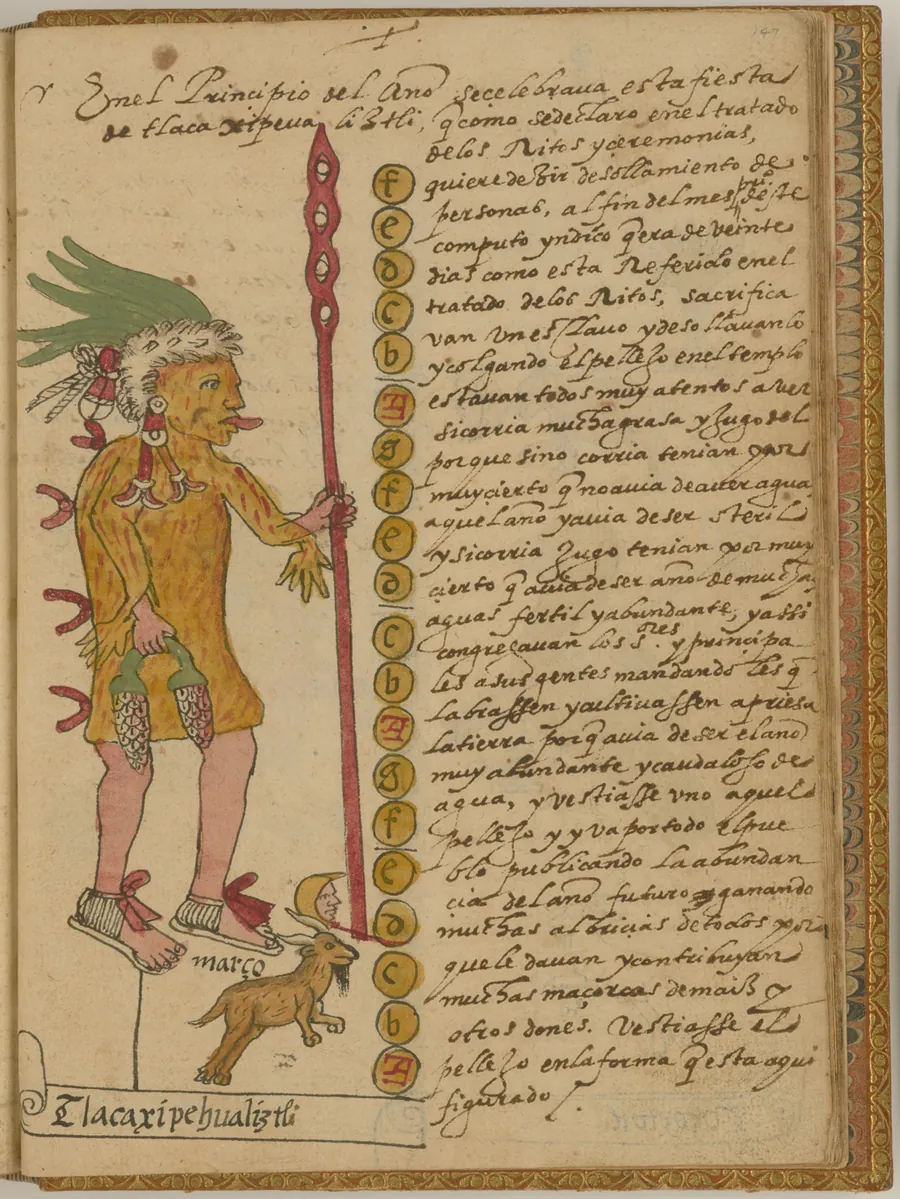
    The feast of the flaying of men

    A page of a sixteenth-century manuscript: a painted figure in costume holding a staff, beside handwritten text.
    Tlacaxipehualiztli, the second month, in the Tovar Codex. Juan de Tovar, about 1585, John Carter Brown Library. Public domain, via Wikimedia Commons.

    The second month of the Mexica year was Tlacaxipehualiztli. The Franciscan Bernardino de Sahagún, who questioned Nahua elders in the sixteenth century, records that on its first day slaves and captives were killed and flayed in honour of the god Xipe Totec, and that people suffering from diseases of the skin and eyes vowed to wear the skins.

    By the reckoning of Sahagún’s editor of 1829 the month ran from about 22 February to 13 March, in the dry season; other reckonings put it in March.

    “they killed and flayed many slaves and captives”Bernardino de Sahagún, Historia general, book 2; translated for this page

    Often explained as the earth putting on a new skin in spring. That reading is modern. Sahagún describes the rite and the vows of the sick, and gives no such meaning.

    Oldest text: B. de Sahagún, Historia general de las cosas de Nueva España (compiled c. 1545–1577), book 2

    1 March · Romania

    Folklore, written down later

    Baba Dochia and her coats

    Romanians call the first nine days of March the days of the Babe, the old women. The story behind them, as folklorists printed it around 1900, has old Dochia climbing the mountain with her sheep in March, wearing all her sheepskin coats. The sun comes out and she takes off one coat a day. Then the cold returns and she freezes on the mountain.

    In some versions she has nine coats, in others twelve. Around 1716 the Moldavian prince and scholar Dimitrie Cantemir described the rock itself, on Mount Ceahlău: an old woman with about twenty sheep. He gave her no name and no story.

    “showing an old woman surrounded by, if I am not mistaken, twenty sheep”Dimitrie Cantemir, Descriptio Moldaviae, 1714–1716; translated for this page

    The tale that Dochia was the daughter of the Dacian king Decebalus, fleeing the emperor Trajan, is a ballad of 1839 by the writer Gheorghe Asachi, his own composition.

    Oldest text: D. Cantemir, Descriptio Moldaviae (1714–1716); S. F. Marian, Sărbătorile la români (1898–1901)

    Spring · India

    Ancient text

    Love burned to ash, with Spring beside him

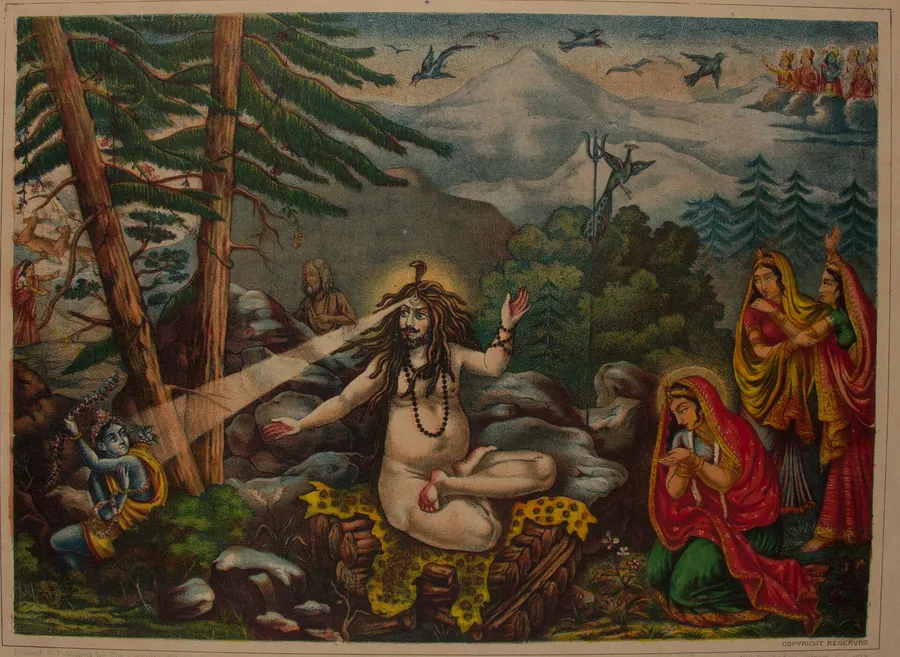
    An Indian print: the god Śiva seated in meditation as flames from his brow strike the god of love, who holds a bow.
    Śiva turns Kāma to ashes. Lithograph, about 1890. Public domain, via Wikimedia Commons.

    The Rāmāyaṇa tells that Kāma, the god of love, dared to disturb Śiva at his meditation. The god’s eye fell on him and he was burned; since then he is called the bodiless one.

    The poet Kālidāsa, some centuries later, set the scene in a sudden spring. In his telling Kāma arrives with his constant companion, Spring in person, who carries the mango twig that is Kāma’s weapon.

    “Dissolved the shape that was so fair / And burnt up every limb.”Rāmāyaṇa, trans. Ralph T. H. Griffith, 1870–74

    The oldest text does not mention spring; the season enters with Kālidāsa. A link to the festival of Holi was not found in the ancient texts opened for this page.

    Oldest text: Vālmīki, Rāmāyaṇa, Bāla Kāṇḍa; Kālidāsa, Kumārasambhava, canto 3

    21 March · Poland

    Medieval or early modern text

    Death is carried out of the village

    Two effigies dressed in bright cloth and flowers float on a lake.
    The drowning of Marzanna at Konopiska, Poland, in 2023. Photo: Robert Garstka / Regionalny Instytut Kultury w Katowicach, CC BY 4.0, via Wikimedia Commons.

    In Poland, on or near the first day of spring, an effigy called Marzanna is carried out and drowned or burned. The custom is at least six centuries old. In 1420 a church synod at Poznań ordered priests to stop people carrying out a figure “which they call Death” and throwing it into water.

    The name Marzanna comes a little later, from the chronicler Jan Długosz, who listed her among the Polish gods and compared her to the Roman Ceres.

    Długosz modelled his list of Polish gods on the Roman ones, and historians treat it with caution. The oldest record speaks of Death, with no goddess of winter.

    Oldest text: Statutes of the Synod of Poznań, 1420, as quoted in the Polish Wikipedia article “Marzanna”

    Spring · Greece

    Ancient text

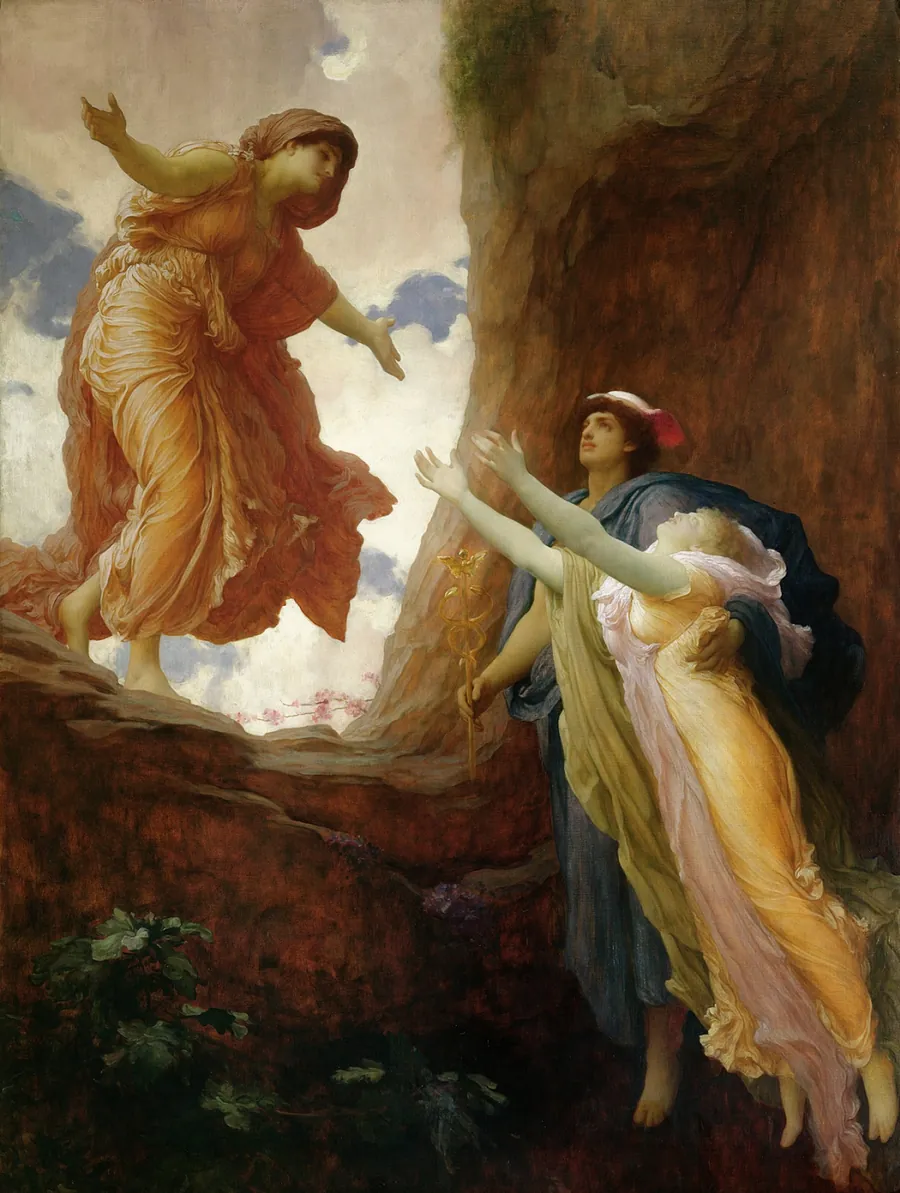
    A third of the year underground

    Persephone, led by Hermes out of a dark cave, reaches toward her mother Demeter, who stands in sunlight with open arms.
    The Return of Persephone. Frederic Leighton, 1891, Leeds Art Gallery. Public domain, via Wikimedia Commons.

    Hades carried off Persephone. Her mother Demeter, goddess of grain, hid the seed in the ground: oxen ploughed in vain and barley was sown for nothing. Because Persephone had eaten in the underworld she must return there for part of every year, and she comes up, the hymn says, when the earth blooms with the flowers of spring.

    The oldest full telling, the Homeric Hymn to Demeter, says three times how long she stays below: a third of the year.

    “there to dwell a third part of the seasons every year”Homeric Hymn to Demeter, trans. H. G. Evelyn-White, 1914

    Six months, in most retellings. That figure is Roman, from Ovid. And her absence may not be winter at all: in Greece grain is sown in autumn and reaped in May, and one scholar argued that the barren months of the myth are the dry summer, when the seed lies stored underground.

    Oldest text: Homeric Hymn to Demeter, 7th–6th century BC

    Southern winter · ǀXam, South Africa

    Folklore, written down later

    A burning stick held up to a star

    In South Africa, in notebooks kept in the 1870s, speakers of the ǀXam language described what was done when Canopus and then Sirius first came out in the winter sky. A child is told to put the end of a stick in the fire and point it, burning, at the star, and the people ask that the star may not come out coldly, and that the sun may warm them.

    Afterwards the women go out early to gather food, sunning their shoulders.

    “that the sun may shining come out for us”Specimens of Bushman Folklore, trans. Lucy C. Lloyd and W. H. I. Bleek, 1911

    Oldest text: W. H. I. Bleek and L. C. Lloyd, Specimens of Bushman Folklore (1911)

    17 June · Egypt

    Folklore, written down later

    The Night of the Drop

    In Cairo in the 1830s the night of 17 June was the Night of the Drop: a miraculous drop was believed to fall into the Nile and make it rise. Families spent the night on the river bank.

    Nearly seventeen centuries earlier the Greek traveller Pausanias was told that the Egyptians said the river rose with the tears of Isis, mourning Osiris.

    “what makes the river rise and water their fields is the tears of Isis”Pausanias, Description of Greece 10.32.18, trans. W. H. S. Jones, 1935

    The tears of Isis are known through a Greek writer repeating a Phoenician; no ancient Egyptian text was found for them. The Englishman who recorded the Night of the Drop does not mention Isis; joining the two is later learning.

    Oldest text: Pausanias 10.32.18 (c. AD 170); E. W. Lane, Manners and Customs of the Modern Egyptians (1836)

    21 June · Inca, Peru

    Medieval or early modern text

    The Inca feast of the Sun

    Of the four festivals the Inca kings kept at Cusco, the greatest was Inti Raymi, held at the June solstice to honour the Sun as the father of the first Inca. In Cusco that is midwinter: the shortest day of the year.

    The description comes from Garcilaso de la Vega, born in Cusco in 1539 and writing in Spain decades after the conquest.

    “this was the Raymi, and took place in the June solstice”Garcilaso de la Vega, Royal Commentaries, trans. Clements R. Markham, 1871

    The Inti Raymi performed at Cusco today was first staged in 1944, as a reconstruction based largely on Garcilaso.

    Oldest text: Garcilaso de la Vega, Comentarios Reales de los Incas (1609), book 6, ch. 20

    24 June · Moldavia, Romania

    Medieval or early modern text

    The day the sun trembles

    On 24 June, St John’s day, Romanians keep Sânziene. Cantemir, writing around 1716, records what Moldavian villagers believed about that morning: that the sun does not rise steadily but with a trembling step. Everyone got up before dawn to watch. Cantemir adds that the trembling was in their dazzled eyes.

    He describes a second custom of the same season, the Drăgaica. When the grain begins to ripen the girls of several villages choose the most beautiful among them, crown her with ears of wheat and lead her through the fields.

    “the sun completes its course not steadily but with a trembling step”Dimitrie Cantemir, Descriptio Moldaviae, 1714–1716; translated for this page

    Oldest text: D. Cantemir, Descriptio Moldaviae (1714–1716), part 3

    No season named · Sumer, Mesopotamia

    Ancient text

    Half the year below, half above

    In a Sumerian poem written on tablets more than 3,600 years old, the goddess Inana goes down to the underworld and can leave only by sending someone in her place. She gives her husband, Dumuzid. In the broken last lines a voice divides the sentence: Dumuzid for half the year, his sister for the other half.

    The tablets are about a thousand years older than the hymn to Demeter.

    “You for half the year and your sister for half the year”Inana’s Descent to the Nether World, Electronic Text Corpus of Sumerian Literature, Oxford

    The poem names no season and says nothing of plants dying. That the story explains the dead season, which in Iraq is the summer heat, is a modern reading.

    Oldest text: “Inana’s descent to the nether world”, tablets of c. 1900–1600 BC (ETCSL 1.4.1)

    1 November · Ireland

    Medieval or early modern text

    Summer’s end

    In the Irish tale of the wooing of Emer, the hero Cú Chulainn explains old words to his charioteer. Samain, he says, is the end of summer, for the year once had two divisions: summer from Beltaine and winter from Samain. Imbolc is the beginning of spring, when the ewes are milked.

    This is the count of two seasons from the first rings of this page, in a tale about a thousand years old.

    “summer from Beltaine (the first of May), and winter from Samuin to Beltaine”Tochmarc Emire, trans. Kuno Meyer, 1888

    Samain as the “Celtic New Year” is an inference first made by the scholar John Rhys in lectures of 1886; it is disputed. The early texts opened for this page give a division of the year and a night on which tales are set.

    Oldest text: Tochmarc Emire (The Wooing of Emer), a tale of the 10th–11th century

    Late autumn · Inuit, Baffin Island

    Folklore, written down later

    Summer and winter pull on a rope

    The anthropologist Franz Boas described the feast held on Baffin Island in November 1883, when the autumn storms begin. The people divide into two parties: the ptarmigans, who were born in winter, and the ducks, the children of summer. A rope of sealskin is stretched between them and each side pulls.

    If the ducks win, summer has won, and fine weather can be expected through the winter.

    “If the ptarmigans give way the summer has won the game”Franz Boas, The Central Eskimo, 1888

    It is one rite, in one region, seen by one visitor. It foretells the weather; it does not explain why there are seasons.

    Oldest text: F. Boas, The Central Eskimo (1888)

    Winter · Iceland

    Medieval or early modern text

    Why winter is cold: he takes after his father

    In the Prose Edda, written in Iceland around 1220, a traveller asks why summer should be hot and winter cold. The answer is a family tree. Summer’s father is Svásuðr, a man of pleasant nature. Winter’s father is Vindsvalr, and his kin were grim and cold-hearted; Winter has their temper.

    The same book describes the Fimbulvetr, three winters in a row with no summer between them.

    “Those winters shall proceed three in succession, and no summer between”Snorri Sturluson, Prose Edda, trans. A. G. Brodeur, 1916

    The Fimbulvetr is the first sign of the end of the world, a single catastrophe. It is not a story about winter returning each year.

    Oldest text: Snorri Sturluson, Prose Edda, Gylfaginning 19 and 51 (c. 1220)

    No season named · Japan

    Ancient text

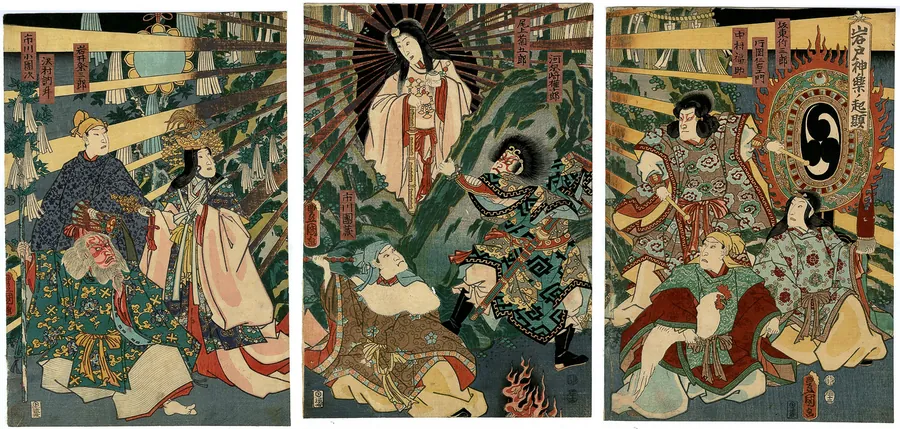
    The sun shuts herself in a cave

    A Japanese woodblock print: the sun goddess emerges in rays of light from a cave while gods and a dancer celebrate outside.
    The sun goddess comes out of the cave. Utagawa Kunisada, 1856. Public domain, via Wikimedia Commons.

    In the Kojiki, Japan’s oldest chronicle, the sun goddess Amaterasu, frightened by her brother’s violence, shuts herself in the Heavenly Rock-Dwelling, and heaven and earth go dark. The eight hundred myriad gods gather. They make the long-singing birds sing and hang up a mirror; one goddess dances, and a strong god waits hidden beside the door.

    The story is placed here at the December solstice because some scholars read it as the sun’s weakening at midwinter. Others read it as the memory of an eclipse.

    “all the Central Land of Reed-Plains darkened”Kojiki, trans. Basil Hall Chamberlain, 1882

    The chronicle names no season and does not say that the darkness returns. Both readings are modern.

    Oldest text: Kojiki (AD 712), book 1, section 16

    The solstices · Māori, Aotearoa New Zealand

    Folklore, written down later

    The sun has two wives

    In Māori tradition the sun has two wives: Hine-raumati, the summer maiden, and Hine-takurua, the winter maiden. He spends half the year with each. One teller explains that the story is the sun’s own path, between its rising place in the north-east in winter and in the south-east in summer.

    Hine-takurua lives on the ocean and Hine-raumati on the land. Takurua is also the Māori name of Sirius.

    Oldest text: Te Ara, the Encyclopedia of New Zealand, “Ancestors from the natural world”; E. Best, The Maori As He Was (1924)

    How the idea of a season was built

    Nobody discovered the seasons. They were assembled: from stars that farmers watched, from a medical theory, from church arithmetic, from a law of planetary motion and from two centuries of thermometers.

    1. About 3200 BC · Ireland

      A tomb built for the shortest day

      At Newgrange, on the River Boyne, an opening above the entrance lets the rising sun shine down a passage 19 metres long into the burial chamber on the mornings around the winter solstice. A survey published in 1974 concluded that the builders intended it. Long before anyone wrote about seasons, people were building for the day the sun turns back.

    2. About 700 BC · Greece

      A calendar of stars and birds

      The poet Hesiod tells a farmer when to work by stars and birds, hardly ever by a date. Reap when the Pleiades rise and plough when they set. The cry of the crane means rain and ploughing. Sixty days after the winter solstice the star Arcturus rises at dusk, then the swallow comes, and it is spring.

    3. About 620 BC · Sparta

      Three seasons, and a fourth

      A fragment of the poet Alcman says that three seasons were made, summer and winter and autumn the third, and a fourth, spring, when things grow but there is not enough to eat. The four seasons had to be assembled, and this line shows one being added.

    4. About 430 BC · Athens

      The seasons are measured, and are not equal

      The Athenian astronomers Meton and Euctemon are the first people recorded as finding that the four seasons differ in length. Around 130 BC Hipparchus measured spring at 94½ days and summer at 92½, and explained it by moving the Earth off the centre of the Sun’s circle. In his time autumn was the shortest season; today it is winter, because the point where the Earth is nearest the Sun has drifted.

    5. About 400 BC · Kos

      Four seasons, four humours

      A medical treatise from the school of Hippocrates ties each season to a fluid of the body: phlegm increases in winter, blood in spring, yellow bile in summer, black bile in autumn. For some two thousand years afterwards the four seasons were part of a system of fours, with the elements and the temperaments.

    6. 139 BC · China

      The 24 terms, complete

      The Huainanzi, compiled at the court of the prince Liu An, contains the first complete list of the 24 solar terms: every fifteen days the handle of the Dipper shifts, “producing the changes of the twenty-four seasons”. Older texts have fewer: the Book of Documents marks four, and the monthly ordinances of the Book of Rites eight.

    7. 37 BC · Rome

      A farmer’s year in eight parts

      Varro’s handbook of farming gives the four seasons with their lengths, then divides the working year into eight, by winds and stars: from the west wind to the spring equinox 45 days, to the rising of the Pleiades 44, to the solstice 48, to the Dog Star 27, and so on round to the west wind again.

    8. About 613 and 725 · Seville and Jarrow

      The wheel of the year

      Isidore of Seville explained the seasons with circular diagrams, and his book became known as the book of wheels. One wheel carries the words world, year, man, and joins seasons, elements and humours. The English monk Bede repeated the scheme in 725: winter is cold and wet, spring wet and hot, summer hot and dry, autumn dry and cold. The ring on this page has ancestors.

    9. 905 · Kyoto

      Poetry is filed by season

      Japan’s first imperial anthology of poems, the Kokinshū, opens with the four seasons, before love. Later came books of season words for the poets of linked verse and haiku: the first separate one was printed in 1648, and one of 1803 lists some 2,600 words.

    10. About 1412–1416 · France

      Twelve pictures of work and weather

      Medieval calendars showed the year as a round of work, one task to a month. The Limbourg brothers began the grandest set for the Duke of Berry’s book of hours. In February the sheep are penned, snow lies on the beehives and the household warms itself at the fire.

      A snow-covered farm in February: sheep in a pen, beehives, people warming themselves by a fire, a man driving a donkey toward a village.
      February, from the Très Riches Heures of the Duke of Berry. Limbourg brothers, 1412–1416, Musée Condé, Chantilly. Public domain, via Wikimedia Commons.
    11. 1563–1573 · Vienna

      A face made of autumn

      Giuseppe Arcimboldo, painter to the Habsburg court, composed each of the four seasons as a head built from its own produce. Autumn is a man of grapes, pears and a pumpkin, with a split barrel for a coat. The emperor sent a set as a gift to the Elector of Saxony in 1573.

      A man’s head in profile made of grapes, pears, a pumpkin and other fruit, on a body made of a broken barrel.
      Autumn, from Arcimboldo’s Four Seasons. Giuseppe Arcimboldo, 1573, Musée du Louvre. Public domain, via Wikimedia Commons.
    12. 1609 · Prague

      Why the seasons are unequal

      Johannes Kepler showed that a planet moves on an ellipse and sweeps equal areas in equal times, so it travels fastest when nearest the Sun. For the Earth that is early January, which is why the northern winter is the shortest season.

    13. 1725 · Amsterdam

      Four concertos with a script

      Antonio Vivaldi’s Four Seasons were printed with a sonnet for each concerto, and letters in the score mark which line is being played.

    14. 1736 · Norfolk

      Writing down the first swallow

      Robert Marsham began to note, each year on his estate, the first dates of the signs of spring: flowers, leaves, the arrival of birds and their song. His family kept the record until 1958. It is the kind of record, like Kyoto’s cherry blossoms, that now shows spring moving.

    15. 1793 · Paris

      Months renamed for the weather

      The French Republic replaced the months with twelve new ones named by Fabre d’Églantine for the weather and the farm, with one ending for each season: Vendémiaire, Brumaire, Frimaire for autumn; Nivôse, Pluviôse, Ventôse for winter; Germinal, Floréal, Prairial for spring; Messidor, Thermidor, Fructidor for summer. The year began in autumn.

    16. 1958 · Hawaiʻi

      The planet breathes once a year

      Charles David Keeling began measuring carbon dioxide on Mauna Loa in March 1958. Besides the rise from year to year, his curve shows a yearly wave: the gas falls from about May to September as the plants of the north grow, and climbs through autumn and winter as they decay. With the long-term rise removed, the swing is now close to 7 parts per million.

    17. 1987 · Massachusetts

      The wrong answer, in cap and gown

      A film that opens at a Harvard graduation asks new graduates and teachers why summer is warmer than winter. Again and again the answer is that the Earth is then closer to the Sun.

    Are the seasons changing?

    In Kyoto, the day the mountain cherries reach full flower has been written down since the year 812, in court diaries and temple records. Dates survive for 838 of the springs since. From 1801 to 1850 the average date was 17 April. Over the thirty years to 2026 it was 4 April, 13 days earlier.

    The two earliest flowerings in the whole record are 25 March 2023 and 26 March 2021. Before this century the earliest was 27 March 1409.

    1 Apr11 Apr21 Apr1 May81210001200140016001800200025 March 2023: the earliest
    Day of full flowering of mountain cherry (Prunus jamasakura) in Kyoto, one dot a year, and the average of the preceding 30 years. The last 30 years are in colour. Data: Aono and Kazui (2008), Aono and Saito (2010), continued by Katata; compiled by Our World in Data.

    A season can also be defined by temperature instead of by dates. A 2021 study took the land of the northern mid-latitudes, from 30° to 60° north, and let summer begin, at each place, when the smoothed temperature rises above the level that three quarters of the days of 1952–2011 stayed below, and end when it falls back under it; winter is the same with the coldest quarter. By that measure summer grew from 78 days in 1952 to 95 in 2011. Spring shrank from 124 days to 115, autumn from 87 to 82 and winter from 76 to 73.

    1952Spring 124 daysSummer 78 daysAutumn 87 daysWinter 76 days2011Spring 115 daysSummer 95 daysAutumn 82 daysWinter 73 days

    Wang and others, “Changing lengths of the four seasons by global warming”, Geophysical Research Letters, 2021. Land between 30° and 60° N; the seasons are set by temperature thresholds, so the four do not start equal.

    Do other planets have seasons?

    Any planet with a tilted axis has seasons, and each has its own count of days. Mars leans a little more than the Earth, 25.2° against 23.4°, and its orbit is far more stretched, so its seasons are very unequal.

    SpringSummerAutumnWinterEarth365 days
    Earth, tilt 23.4°. The four seasons differ by less than five days: the orbit is nearly a circle.
    SpringSummerAutumnWinterMars669 sols
    Mars, tilt 25.2°. Northern spring lasts 193 Martian days and northern autumn 143, because the orbit is strongly stretched.
    SpringSummerAutumnWinterUranus84 years
    Uranus, tilt 97.8°. Each season lasts about 21 Earth years.

    Uranus lies on its side, tilted 98°, and takes 84 Earth years to go round the Sun, so each season lasts about 21 years, and each pole has about 42 years of daylight followed by 42 of night. On Titan, Saturn’s largest moon, a season lasts more than seven Earth years. Mercury stands almost upright, with a tilt of 0.03°, and has no seasons of this kind.

    The Earth’s own tilt is not fixed. Over the last million years it has swung between 22.1° and 24.5° in a cycle of about 41,000 years, and it is slowly decreasing now. The date of closest approach to the Sun also drifts, by about one day every 58 years, so in some ten thousand years the Earth will be nearest the Sun in the northern summer.

    Questions people ask about the seasons

    Why do we have seasons?

    Because the Earth’s axis is tilted 23.4° and keeps pointing the same way as the planet goes round the Sun. For half the year the northern half leans towards the Sun and gets longer days and a higher Sun; for the other half the southern half does. Distance is not the cause: the Earth is closest to the Sun in early January.

    How many seasons are there?

    It depends on who is counting. Astronomers and weather services count four. Iceland’s old calendar counts two, ancient Egypt and Thailand three, India’s classical calendar and the Noongar people of Australia six, the traditional Chinese calendar 24 solar terms and Japan’s old almanac 72. This page draws 21 such calendars as rings of one year.

    When does spring start?

    On 1 March for weather services in the northern hemisphere, and at the March equinox (20 March in 2026) for astronomers. The traditional calendars of Ireland and of China start it earlier, on 1 February and around 4 February. South of the equator the same rules give 1 September and the September equinox.

    Why are the seasons reversed in the southern hemisphere?

    When the northern end of the Earth’s axis leans towards the Sun, the southern end leans away. June brings the longest days of the year to London and the shortest to Sydney.

    Are the four seasons the same length?

    No. In 2026 the northern spring lasts 92.7 days, summer 93.7, autumn 89.9 and winter 89.0. The Earth moves fastest when it is nearest the Sun, in January, and so spends less time on that part of its orbit.

    Why is autumn called fall?

    It is short for “fall of the leaf”, a phrase recorded in English from the 1540s; plain “fall” for the season is recorded from the 1660s. Before either, the English name of the season was harvest. Autumn came from French in the late fourteenth century.

    What is the longest day of the year?

    The June solstice in the northern hemisphere (21 June in 2026) and the December solstice in the southern (21 December by universal time; in Sydney it is already the 22nd). At London’s latitude the June day lasts 16 h 38 min and the December day 7 h 50 min.

    How this page was made

    The dates and times of the equinoxes and solstices, the lengths of the seasons, the Sun’s distance and the hours of daylight are computed for 2026 with the formulas of Jean Meeus’s Astronomical Algorithms. The equinox and solstice times were compared with the table published by the US Naval Observatory for 2024 to 2030 and agree to within a minute. Daylight is counted from sunrise to sunset with the standard allowance of 0.833° for the bending of light and the size of the Sun’s disc.

    Each calendar on the rings comes from a source named on its card: where possible the community’s or the institution’s own publication. The Aboriginal seasonal calendars belong to the communities who shared them; they are summarised here from the pages published with their permission by the Bureau of Meteorology, Kakadu National Park and CSIRO, and each card links to the original. Seasons that follow the Sun are drawn from its computed position, in the time zone of the country concerned. Seasons that their keepers read from plants, animals and winds are drawn at the months those keepers print, and the cards say that such dates are approximate. Egypt’s three seasons are drawn where their names fit the river, beginning at the June solstice, because the Egyptian civil calendar later drifted through the year. On the rings a colour means a time of the local year, from midwinter blue to midsummer gold; seasons defined by water have colours of their own.

    The words come from the translation tables of English Wiktionary for spring, summer, autumn and winter, as they stood on 11 October 2026. For 64 languages each word was traced further in etymological dictionaries, and only those languages are coloured on the map. A dot stays grey where no origin is agreed. The counts printed in the chapter are counts of those 64 languages, which are mostly languages of Europe and western Asia, so they describe that sample and not all the world’s languages.

    Each story is given with the oldest text found for it and a note on its kind: an ancient text, a medieval or early modern one, folklore written down by a named collector, or a modern composition. Where a familiar version turned out to be later than usually said, the card says so. Quotations from published translations name the translator; the line from Tacitus is translated here from his Latin. Some points were read only through Wikipedia’s account of the source: the Poznań statute of 1420 and Jan Długosz on Marzanna, the Blue Nile’s share of the flood, the first staging of Inti Raymi in 1944, the lectures of 1886 behind the “Celtic New Year”, the part played by Jane Johnston Schoolcraft, and the crop seasons kharif and rabi.

    Sources

    Related pages: where the names of the months come from, Romania’s folk calendar and 1816, the year without a summer.