The Passion of Saint Sabbas · the Greek text, a new translation
Saint Sabbas the Goth in four old texts: where they agree and where they differ
The death of Sabbas, drowned in April 372 north of the Danube, is told at length in a Greek letter of the Church of Gothia, preserved in two medieval copies, the older made in 916. Three Byzantine calendar notices tell the same story in brief: in place of Atharid, who orders the killing in the letter, they name Athanaric, and one of them does not name the river and gives Sabbas 31 years instead of 38.
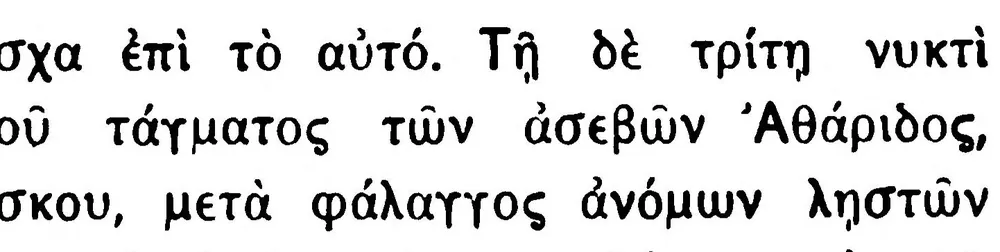
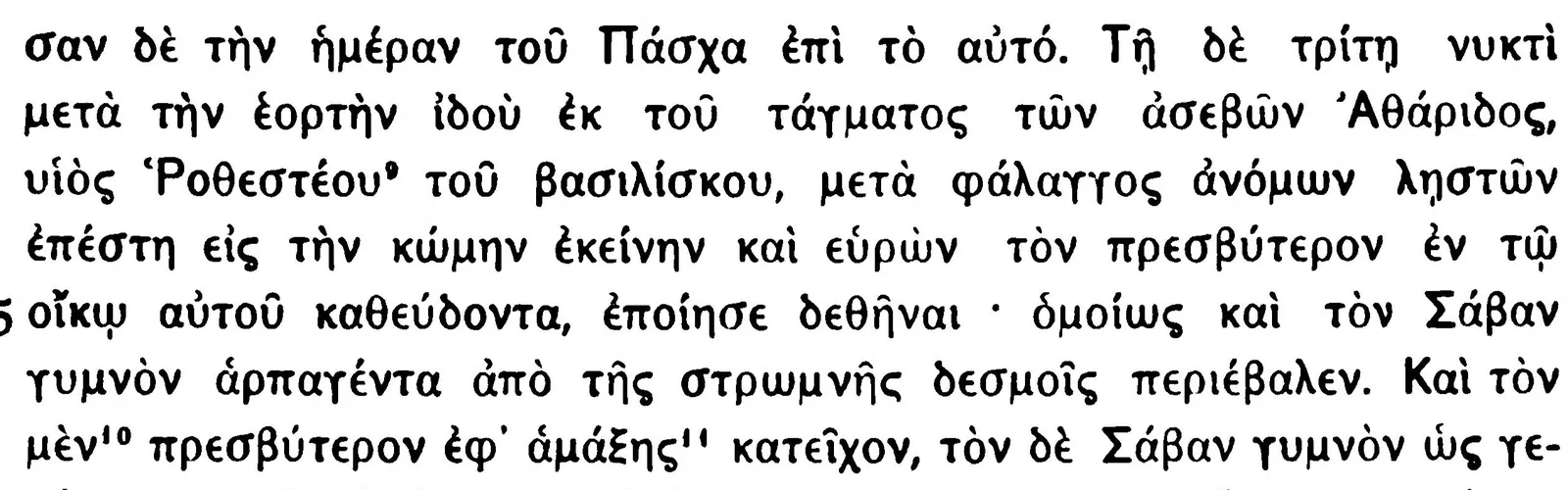
§4 But on the third night after the feast, Atharid, son of Rhothesteos the kinglet, one of the company of the impious, came upon that village with a band of lawless brigands; he found the presbyter asleep in his house and had him bound.
The same story in four texts#
The story of Sabbas survives in four Greek texts. The long one is the letter of the Church of Gothia: 1,674 words. The other three are Byzantine calendar notices of 124–146 words each, which tell the same story in brief.
All four tell the essentials alike: Sabbas was from the land of the Goths and a Christian from childhood; he refused meat sacrificed to idols; he was driven out, then seized, tortured on an axle and hung from the beam of the house; he was drowned in a river with a piece of wood at his neck. In three places they part.
Who comes for Sabbas
- P The letterἈθάριδος, υἱὸς Ῥοθεστέου τοῦ βασιλίσκου Atharid, son of Rhothesteos the kinglet
- D Notice D ≠differsἈθαναρίχου παραγενομένου when Athanaric arrived
- S Notice S ≠differsἈθαναρίχου τοῦ ἄρχοντος τῶν Γότθων Athanaric, the ruler of the Goths
- 1727 The 1727 notice ≠differsἈθαναρίχου τοῦ Ἄρχοντος τῶν Γότθων Athanaric, the ruler of the Goths
The letter names Atharid 12 times and Athanaric never. The notices name only Athanaric. In notice D his name stands where the letter says Atharid “came upon the village”. In S and in the 1727 notice it stands where the letter says, with no name at all, that “the sinners in Gothia set a great persecution in motion” (§4). That Athanaric persecuted the Gothic Christians is also said by the ancient historians, who do not mention Sabbas. The difference of name does not, on its own, show that Atharid and Athanaric were the same man. None of the notices says who ordered the killing. Notice D can also be read in a manuscript of the 10th–11th century, at Sinai: the name Athanaric has stood in the story of Sabbas at least since then.
Did Sabbas baptise?
- P The letterψάλλων ἐν ἐκκλησίᾳ he sang the psalms in church; nothing about baptising
- D Notice Dπολλοῖς πρόξενος σωτηρίας ἐγένετο he became for many a cause of salvation; nothing about baptising
- S Notice S ≠differsπολλοὺς ἐπιστρέφων ἐβάπτιζεν converting many, he baptised them
- 1727 The 1727 notice ≠differsπολλοὺς ἐπιστρέφων ἐβάπτιζεν converting many, he baptised them
The letter calls Sansalas and Gouththikas presbyters; of Sabbas it says he sang the psalms. Baptising appears in only two of the three notices. This cannot tell when it entered the tradition: the date of a manuscript or of a print is not the date at which a sentence was first written.
The river and the age
- P The letterτὸν ποταμὸν τὸν καλούμενον Μουσαῖον the river called Mousaios
- D Notice Dτὸν ποταμὸν Μουσαῖον the river Mousaios
- S Notice Sτὸν ποταμὸν Μουσαῖον the river Mousaios
- 1727 The 1727 notice ≠differsἐπὶ τὸν ποταμόν “to the river”, with no name
The notice printed in 1727 does not name the river; its Greek gives Sabbas 31 years, and the Latin beside it says “in his 31st year”. The other three texts name the river Mousaios; the letter says he was 38 years old, D and S that he was in his 38th year. The 1727 print is the only place where this text has been read here; the manuscript it was made from has not been seen. So it is not known where the change happened.
Every difference, row by row
| What is compared | P The letter | D Notice D | S Notice S | 1727 The 1727 notice |
|---|---|---|---|---|
| The persecutor named | Ἀθάριδος, υἱὸς Ῥοθεστέου τοῦ βασιλίσκου Atharid, son of Rhothesteos the kinglet | ≠differsἈθαναρίχου παραγενομένου when Athanaric arrived | ≠differsἈθαναρίχου τοῦ ἄρχοντος τῶν Γότθων Athanaric, the ruler of the Goths | ≠differsἈθαναρίχου τοῦ Ἄρχοντος τῶν Γότθων Athanaric, the ruler of the Goths |
| The persecutor’s father | Ῥοθεστέου τοῦ βασιλίσκου Rhothesteos “the kinglet”: the title is the father’s | ≠differsdoes not say | ≠differsdoes not say | ≠differsdoes not say |
| The emperors | ἐπὶ Οὐαλεντινιανοῦ καὶ Οὐάλεντος αὐγούστων under the Augusti Valentinian and Valens | Οὐαλεντινιανοῦ τοῦ μεγάλου καὶ Οὐάλεντος Valentinian the Great and Valens | ≠differsἐπὶ τῆς βασιλείας Οὐαλεντινιανοῦ in the reign of Valentinian | ≠differsἐπὶ τῆς βασιλείας Οὐαλεντινιανοῦ in the reign of Valentinian |
| Valens is missing from S and from the 1727 notice. The texts do not say why. | ||||
| Where he was from | Γότθος ὢν τῷ γένει a Goth by birth | ἐν Γοτθίᾳ, ἔνθα γεγέννηται in Gothia, where he had been born | ἐκ τῆς χώρας δὲ τῶν Γότθων from the land of the Goths | ἐκ τῆς χώρας δὲ τῶν Γότθων from the land of the Goths |
| A Christian from childhood | ἐξέτι νηπίου from infancy | Ἔτι δὲ νήπιος ὢν while still a small child | Ἐκ παιδόθεν χριστιανὸς ὤν a Christian from childhood | ἐκ παιδόθεν δὲ Χριστιανὸς ὢν a Christian from childhood |
| He baptised others | ψάλλων ἐν ἐκκλησίᾳ he sang the psalms in church; nothing about baptising | πολλοῖς πρόξενος σωτηρίας ἐγένετο he became for many a cause of salvation; nothing about baptising | ≠differsπολλοὺς ἐπιστρέφων ἐβάπτιζεν converting many, he baptised them | ≠differsπολλοὺς ἐπιστρέφων ἐβάπτιζεν converting many, he baptised them |
| Where he is driven from | ἐξέβαλον αὐτὸν τῆς κώμης from the village (κώμη) | ≠differsτῆς πόλεως ἀπελαύνουσιν from the “polis”: town | ≠differsβίᾳ τῆς πόλεως ἀπήλασαν from the “polis”, by force | ≠differsβίᾳ τῆς πόλεως ἀπήλασαν from the “polis”, by force |
| None of the four texts gives the name of the place. In the letter, πόλις occurs once, for “another town”, that of the presbyter Gouththikas (§4). | ||||
| The axle and the beam | ἄραντες ἄξονα ἁμάξης the axle of a wagon, then the beam of the house (§5) | τῷ ἄξωνι ἐκταθεὶς καὶ ἐπὶ τῶν δοκῶν τῆς οἰκίας μετεωρισθεὶς stretched on the axle and hoisted on the beams of the house | ἐν τῷ τῆς ἁμάξης ἄξωνι προσδεθεὶς ἐπὶ τῶν δοκῶν τῆς οἰκίας ἐκρεμάσθη bound to the wagon axle, hung on the beams of the house | ἐν τῷ τῆς ἁμάξης ἄξονι προσδεθεὶς, ἐπὶ τὴν δοκὸν τῆς οἰκίας ἐκρεμάσθη bound to the wagon axle, hung on the beam of the house |
| All four keep the axle and the beam. None speaks of fire or of a roof. | ||||
| The river | τὸν ποταμὸν τὸν καλούμενον Μουσαῖον the river called Mousaios | τὸν ποταμὸν Μουσαῖον the river Mousaios | τὸν ποταμὸν Μουσαῖον the river Mousaios | ≠differsἐπὶ τὸν ποταμόν “to the river”, with no name |
| The age | ὢν ἐτῶν τριάκοντα ὀκτώ 38 years old | ≠differsἔτος ἄγων τῆς ἡλικίας λη′ in his 38th year | ≠differsἔτος ἄγων τῆς ἡλικίας τριακοστὸν ὄγδοον in his 38th year | ≠differsχρόνων ὑπάρχων τριάκοντα καὶ ἑνός 31 years old |
| The wood at his neck | ἐπιθέντες αὐτῷ ξύλον κατὰ τοῦ τραχήλου they laid a piece of wood across his neck | ἐπιτεθέντος αὐτῷ ξύλου κατὰ τοῦ τραχήλου with a piece of wood laid on his neck | προσδεθέντος αὐτῷ ξύλου μεγίστου κατὰ τοῦ τραχήλου with a very large piece of wood tied at his neck | προσδεθεὶς ξύλῳ μεγάλῳ ἀπὸ τοῦ τραχήλου tied by the neck to a large piece of wood |
| The body | εἰς τὴν Καππαδοκίαν Soranus brings it into the Empire and sends it to Cappadocia (§8) | ≠differsdoes not say | ≠differsdoes not say | ≠differsdoes not say |
How much of the letter is left in a calendar notice
Each row is one part of the story; the number shows how many Greek words each text gives it. The notices keep the thread: the faith, the refusal, the arrest, the tortures, the river. They leave out Easter with the priest Sansalas, the men who wanted to let him go, and the body’s journey to Cappadocia.
| words | P The letter | D Notice D | S Notice S | 1727 The 1727 notice |
|---|---|---|---|---|
| The frame: who writes, and to whom | 154 | – | – | – |
| Who Sabbas was | 34 | 22 | 22 | 24 |
| A Christian from childhood | 219 | 15 | 4 | 5 |
| The sacrificed meat and the other villagers | 103 | 24 | 24 | 24 |
| Driven out | 20 | 11 | 10 | 9 |
| The second search: “I am a Christian” | 121 | 27 | – | – |
| Easter with the priest Sansalas | 197 | – | – | – |
| Who comes and seizes him | 49 | 5 | 24 | 16 |
| The wagon axle and the beam of the house | 213 | 15 | 13 | 13 |
| He refuses the sacrificed meat | 205 | 6 | 6 | 6 |
| The order to kill and the river | 139 | 5 | 5 | 4 |
| The men leading him want to let him go | 55 | – | – | – |
| The wood and the water | 32 | 11 | 12 | 18 |
| His age | 17 | 5 | 6 | 5 |
| The day and the year of the death | 28 | – | – | – |
| The body: Soranus and Cappadocia | 88 | – | – | – |
| In all | 1,674 | 146 | 126 | 124 |
The story, part by part, in each text
Choose the texts you want to see. For the letter, the matching sentence is given; the rest of the chapter can be read below, in the whole letter.
The frame: who writes, and to whom
Ἡ ἐκκλησία τοῦ Θεοῦ ἡ παροικοῦσα Γοτθίᾳ τῇ ἐκκλησίᾳ τοῦ Θεοῦ τῇ παροικούσῃ Καππαδοκίᾳ
The Church of God that sojourns in Gothia, to the Church of God that sojourns in Cappadocia §1
A calendar notice, under 15 April; no sender and no addressee.
A calendar notice, under 17 April; no sender and no addressee.
A calendar notice, under 15 April; no sender and no addressee.
Who Sabbas was
Γότθος ὢν τῷ γένει καὶ διατελῶν ἐν τῇ Γοτθίᾳ
a Goth by birth and living in Gothia §1
τὴν διατριβὴν ἔχων ἐν Γοτθίᾳ, ἔνθα γεγέννηται
spent his life in Gothia, where he had been born
ἐκ τῆς χώρας δὲ τῶν Γότθων
was from the land of the Goths
ἐκ τῆς χώρας δὲ τῶν Γότθων
was from the land of the Goths
A Christian from childhood
ἐξέτι νηπίου ζηλωτὴς
zealous from infancy §1
Ἔτι δὲ νήπιος ὢν τὴν εἰς Χριστὸν πίστιν εἵλετο
while still a small child he chose the faith in Christ
Ἐκ παιδόθεν χριστιανὸς ὤν
a Christian from childhood
ἐκ παιδόθεν δὲ Χριστιανὸς ὢν
a Christian from childhood
The sacrificed meat and the other villagers
παρελθὼν εἰς τὸ μέσον διεμαρτύρατο τοῖς πᾶσι λέγων· « Ἐάν τις φάγῃ ἐκ τῶν κρεῶν ἐκείνων, χριστιανὸς οὗτος εἶναι οὐ δύναται· »
he came forward into the middle and declared to everyone: “If anyone eats of that meat, he cannot be a Christian.” §3
τοὺς βουλομένους ἀπογεύσασθαι διεκώλυεν, τὴν εἰς Χριστὸν πίστιν τούτοις ὑποτιθέμενος, καὶ πολλοῖς πρόξενος σωτηρίας ἐγένετο
he stopped those who wanted to taste it, setting the faith in Christ before them, and became for many a cause of salvation
τὴν εἰς Χριστὸν πίστιν παρατιθέμενος, πολλοὺς ἐπιστρέφων ἐβάπτιζεν
he set the faith in Christ before them and, converting many, baptised them
τὴν εἰς Χριστὸν πίστιν παρατιθέμενος, πολλοὺς ἐπιστρέφων ἐβάπτιζεν
he set the faith in Christ before them and, converting many, baptised them
Driven out
ἐξέβαλον αὐτὸν τῆς κώμης· εἶτα δὲ μετὰ χρόνον τινὰ ἐπέτρεψαν αὐτὸν ἐπανελθεῖν
drove him out of the village; then, after some time, they let him come back §3
τῆς πόλεως ἀπελαύνουσιν
drove him out of the town
βίᾳ τῆς πόλεως ἀπήλασαν
drove him out of the town by force
βίᾳ τῆς πόλεως ἀπήλασαν
drove him out of the town by force
The second search: “I am a Christian”
Ὁ δὲ Σάβας παρρησιασάμενος πάλιν καὶ παρελθὼν ἐν μέσῳ τῷ συνεδρίῳ ἔλεγεν· « Ὑπὲρ ἐμοῦ μηδεὶς ὀμόσῃ· ἐγὼ γὰρ χριστιανός εἰμι. »
But Sabbas again spoke out; he came into the middle of the council and said: "Let no one swear on my behalf, for I am a Christian." §3
προσελθόντα τὸν ἅγιον Σάβαν καὶ ἑαυτὸν προσαγγείλαντα αὖθις μυκτηρίσαντες ἀπεπέμψαντο
the holy Sabbas came forward and denounced himself; they mocked him again and sent him away
does not say
does not say
Easter with the priest Sansalas
Καὶ θεασάμενος τὸν Σανσαλᾶν ἐχάρη καὶ ἀπήγγειλεν αὐτῷ καὶ ἄλλοις πλείοσι τὴν ὀπτασίαν ἣν ἴδε κατὰ τὴν ὁδόν. Ἐτέλεσαν δὲ τὴν ἡμέραν τοῦ Πάσχα ἐπὶ τὸ αὐτό.
When he saw Sansalas he was glad, and he told him and a number of others of the vision he had seen on the road. And they kept the day of Easter together. §4
does not say
does not say
does not say
Who comes and seizes him
Ἀθάριδος, υἱὸς Ῥοθεστέου τοῦ βασιλίσκου, μετὰ φάλαγγος ἀνόμων λῃστῶν ἐπέστη εἰς τὴν κώμην ἐκείνην
Atharid, son of Rhothesteos the kinglet, came upon that village with a band of lawless brigands §4
Ὕστερον δὲ Ἀθαναρίχου παραγενομένου συνελήφθη
Later, when Athanaric arrived, he was seized
Ἀθαναρίχου τοῦ ἄρχοντος τῶν Γότθων διωγμὸν κινήσαντος κατὰ χριστιανῶν
when Athanaric, the ruler of the Goths, set a persecution in motion against Christians
Ἀθαναρίχου τοῦ Ἄρχοντος τῶν Γότθων διωγμὸν κινήσαντος κατὰ τῶν Χριστιανῶν, κρατηθεὶς ἐτύφθη
when Athanaric, the ruler of the Goths, set a persecution in motion against the Christians, he was seized and beaten
The wagon axle and the beam of the house
ἐκέλευσε δεθῆναι αὐτοῦ τὰς χεῖρας καὶ προσκρεμασθῆναι αὐτὸν τῇ δοκῷ τῆς οἰκίας
he ordered that his hands be tied and that he be hung from the beam of the house §5
φραγγελλωθεὶς καὶ τυφθεὶς καὶ τῷ ἄξωνι ἐκταθεὶς καὶ ἐπὶ τῶν δοκῶν τῆς οἰκίας μετεωρισθεὶς
scourged, beaten, stretched on the axle and hoisted on the beams of the house
ἐν τῷ τῆς ἁμάξης ἄξωνι προσδεθεὶς ἐπὶ τῶν δοκῶν τῆς οἰκίας ἐκρεμάσθη
bound to the axle of the wagon, he was hung on the beams of the house
ἐν τῷ τῆς ἁμάξης ἄξονι προσδεθεὶς, ἐπὶ τὴν δοκὸν τῆς οἰκίας ἐκρεμάσθη
bound to the axle of the wagon, he was hung on the beam of the house
He refuses the sacrificed meat
Ὁ δὲ Σάβας εἶπεν· « Εἷς δεσπότης Θεὸς ἐν οὐρανοῖς ἐστιν· Ἀθάριδος δὲ ἄνθρωπος ἀσεβὴς καὶ ἐπικατάρατος· καὶ ταῦτα ἀκάθαρτά ἐστι καὶ βέβηλα τῆς ἀπωλείας τὰ βρώματα, ὡς καὶ ὁ ἀποστείλας αὐτὰ Ἀθάριδος. »
Sabbas said: "There is one Lord, God in heaven. Atharid is an impious and accursed man, and this food of perdition is unclean and profane, like Atharid who sent it." §6
ἀπογεύσασθαι τῶν εἰδωλοθύτων μὴ πεισθείς
not persuaded to taste what had been sacrificed to idols
ἀπογεύσασθαι τῶν εἰδωλοθύτων μὴ πεισθείς
not persuaded to taste what had been sacrificed to idols
ἀπογεύσασθαι τῶν εἰδωλοθύτων μὴ πεισθεὶς
not persuaded to taste what had been sacrificed to idols
The order to kill and the river
ἀπήγαγον πνῖξαι παρὰ τὸν ποταμὸν τὸν καλούμενον Μουσαῖον
led him away to drown him at the river called Mousaios §7
ἤχθη ἐπὶ τὸν ποταμὸν Μουσαῖον
he was led to the river Mousaios
ἤχθη ἐπὶ τὸν ποταμὸν Μουσαῖον
he was led to the river Mousaios
ἤχθη ἐπὶ τὸν ποταμόν
he was led to the river
The men leading him want to let him go
Ἡνίκα δὲ ἤχθη ἐπὶ τὴν ὄχθαν τοῦ ποταμοῦ, οἱ κατέχοντες αὐτὸν ἔλεγον πρὸς ἀλλήλους· « Δεῦτε τὸν ἀθῷον τοῦτον ἀπολύσωμεν· πόθεν γὰρ γνώσεται τοῦτο Ἀθάριδος; »
When he had been brought to the bank of the river, those who held him said to one another: "Come, let us set this innocent man free. How would Atharid ever find out?" §7
does not say
does not say
does not say
The wood and the water
ῥίψαντες αὐτὸν καὶ ἐπιθέντες αὐτῷ ξύλον κατὰ τοῦ τραχήλου, ἐπίεζον εἰς τὸ βάθος
they threw him in, laid a beam of wood across his neck and pressed him down into the deep §7
⟨καὶ ἐν αὐτῷ ῥιφείς⟩ ἐπιτεθέντος αὐτῷ ξύλου κατὰ τοῦ τραχήλου, ἀπεπνίγη
⟨and, thrown into it,⟩ with a piece of wood laid on his neck, he was drowned
προσδεθέντος αὐτῷ ξύλου μεγίστου κατὰ τοῦ τραχήλου· καὶ ἐν αὐτῷ ῥιφεὶς ἀπεπνίγη
with a very large piece of wood tied at his neck; thrown into it, he was drowned
προσδεθεὶς ξύλῳ μεγάλῳ ἀπὸ τοῦ τραχήλου, καὶ ῥιφεὶς, ἐν αὐτῷ ἀπεπνίγη
tied by the neck to a large piece of wood and thrown in, he was drowned in it
His age
ὢν ἐτῶν τριάκοντα ὀκτώ
being thirty-eight years old §7
ἔτος ἄγων τῆς ἡλικίας λη′
being in the 38th year of his age
ἔτος ἄγων τῆς ἡλικίας τριακοστὸν ὄγδοον
being in the thirty-eighth year of his age
χρόνων ὑπάρχων τριάκοντα καὶ ἑνός
being thirty-one years old
The day and the year of the death
πέμπτῃ τοῦ σαββάτου τῇ μετὰ τὸ Πάσχα, ἥτις ἐστὶ πρὸ μιᾶς ἰδῶν ἀπριλλίων
on the fifth day of the week, the one after Easter, which is the day before the Ides of April §7
The notice gives no day of death. It stands in the calendar under 15 April.
The notice gives no day of death. It stands in the calendar under 17 April.
The notice gives no day of death. It stands in the calendar under 15 April.
The body: Soranus and Cappadocia
ὅπερ Οὔνιος Σωρανός, ὁ λαμπρότατος δοὺξ τῆς Σκυθίας, τιμῶν τὸν Κύριον, ἀποστείλας ἀξιοπίστους ἀνθρώπους, ἐκ τοῦ βαρβαρικοῦ εἰς τὴν Ῥωμανίαν μετήνεγκεν·
Junius Soranus, the most illustrious dux of Scythia, honouring the Lord, sent trustworthy men and brought it over from the barbarian land into Romania. §8
does not say
does not say
Nothing about the body. The notice ends: “and so he ran up eagerly to Christ”.
Four texts compared does not mean four independent accounts: the notices are summaries, and S and the 1727 notice share almost the same words. Notices D and S are read in Delehaye’s edition, which corrects the manuscript in places; where it does, this is shown below, beside the text.
The three notices, whole, in Greek and in translation
D Notice D
Manuscript Paris, BnF, gr. 1587, under 15 April. Printed by H. Delehaye in Synaxarium Ecclesiae Constantinopolitanae (Brussels, 1902), cols. 603–604, in the lower register of the page, lines 40–50. The same notice, almost word for word, can be read in an older manuscript: Sinai gr. 548, ff. 164v–165r. The page of the edition
Σάβα τοῦ Γότθου. Οὗτος ἦν κατὰ τοὺς χρόνους τῆς βασιλείας Οὐαλεντινιανοῦ τοῦ μεγάλου καὶ Οὐάλεντος, τὴν διατριβὴν ἔχων ἐν Γοτθίᾳ, ἔνθα γεγέννηται.
Sabbas the Goth. He lived in the time of the reign of Valentinian the Great and of Valens, and spent his life in Gothia, where he had been born.
Ἔτι δὲ νήπιος ὢν τὴν εἰς Χριστὸν πίστιν εἵλετο καὶ τοὺς τῶν εἰδώλων λατρευτὰς ἐμυκτήριζεν, καὶ τῶν εἰδωλοθύτων οὐ μόνον οὐ προσίετο ἀλλὰ καὶ τοὺς βουλομένους ἀπογεύσασθαι διεκώλυεν, τὴν εἰς Χριστὸν πίστιν τούτοις ὑποτιθέμενος, καὶ πολλοῖς πρόξενος σωτηρίας ἐγένετο.
While still a small child he chose the faith in Christ and mocked the worshippers of idols. He not only would not touch what had been sacrificed to idols but also stopped those who wanted to taste it, setting the faith in Christ before them, and he became for many a cause of salvation.
- ὑποτιθέμενος So it is printed. On the photograph of the manuscript (f. 38v) the word reads παρατιθέμενος, the verb that notice S and the 1727 notice also have; the Sinai manuscript reads the same. The sense is unchanged.
Ὅθεν συστάντες ἐπ' αὐτὸν οἱ τοῖς εἰδώλοις προσκείμενοι τῆς πόλεως ἀπελαύνουσιν.
So those devoted to the idols rose against him and drove him out of the town.
- προσκείμενοι The note at the foot of the printed page says the manuscript has προκείμενοι, without the σ. On the photograph of f. 38v the word reads προσκείμενοι, with the σ, as in the printed text.
Μετὰ δὲ χρόνον τινὰ ἔρευναν περὶ τῶν χριστιανῶν ποιούμενοι καί τινας ὡς κατέχοντας αὐτοὺς καὶ φυλάττοντας αἰτιώμενοι, προσελθόντα τὸν ἅγιον Σάβαν καὶ ἑαυτὸν προσαγγείλαντα αὖθις μυκτηρίσαντες ἀπεπέμψαντο.
After some time, when they were making a search for the Christians and accusing some people of keeping and guarding them, the holy Sabbas came forward and denounced himself; they mocked him again and sent him away.
Ὕστερον δὲ Ἀθαναρίχου παραγενομένου συνελήφθη· καὶ φραγγελλωθεὶς καὶ τυφθεὶς καὶ τῷ ἄξωνι ἐκταθεὶς καὶ ἐπὶ τῶν δοκῶν τῆς οἰκίας μετεωρισθεὶς καὶ ἀπογεύσασθαι τῶν εἰδωλοθύτων μὴ πεισθείς, ἤχθη ἐπὶ τὸν ποταμὸν Μουσαῖον,
Later, when Athanaric arrived, he was seized; scourged, beaten, stretched on the axle and hoisted on the beams of the house, and not persuaded to taste what had been sacrificed to idols, he was led to the river Mousaios
- τῷ ἄξωνι On the photograph of the manuscript the words read ἐν τῷ ἄξωνι, with the preposition ἐν, as in S.
⟨καὶ ἐν αὐτῷ ῥιφείς⟩ ἐπιτεθέντος αὐτῷ ξύλου κατὰ τοῦ τραχήλου, ἀπεπνίγη, ἔτος ἄγων τῆς ἡλικίας λη′.
⟨and, thrown into it,⟩ with a piece of wood laid on his neck, he was drowned, being in the 38th year of his age.
- ⟨καὶ ἐν αὐτῷ ῥιφείς⟩ The words in angle brackets are not in manuscript D, nor in the Sinai manuscript. The editor supplied them from another manuscript, Mc, under 18 April (“supplevi ex Mc ad d. Aprilis 18”).
- λη′ The age is written as a Greek numeral: λη′ is 38.
S Notice S
The Sirmondianus manuscript (Berlin, Staatsbibliothek, Phillipps 1622), under 17 April, §4. It is the base text of Delehaye’s edition of 1902: col. 608, line 32 – col. 609, line 5. The page of the edition
Τῇ αὐτῇ ἡμέρᾳ ἄθλησις τοῦ ἁγίου μάρτυρος Σάβα τοῦ Γότθου. Οὗτος ἦν ἐπὶ τῆς βασιλείας Οὐαλεντινιανοῦ, ἐκ τῆς χώρας δὲ τῶν Γότθων.
On the same day, the contest of the holy martyr Sabbas the Goth. He lived in the reign of Valentinian and was from the land of the Goths.
Ἐκ παιδόθεν χριστιανὸς ὤν, οὐ μόνον ἀπεστρέφετο τὰ εἰδωλόθυτα βρώματα, ἀλλὰ καὶ τοὺς βουλομένους αὐτῶν ἀπογεύεσθαι διεκώλυεν· ἀντὶ δὲ αὐτῶν τὴν εἰς Χριστὸν πίστιν παρατιθέμενος, πολλοὺς ἐπιστρέφων ἐβάπτιζεν.
A Christian from childhood, he not only turned away from food sacrificed to idols but also stopped those who wanted to taste it; in its place he set the faith in Christ before them and, converting many, baptised them.
Ἐπισυστάντες οὖν ἐπ' αὐτὸν οἱ εἰδωλολάτραι βίᾳ τῆς πόλεως ἀπήλασαν.
So the idolaters rose together against him and drove him out of the town by force.
Μετὰ δὲ χρόνον τινὰ Ἀθαναρίχου τοῦ ἄρχοντος τῶν Γότθων διωγμὸν κινήσαντος κατὰ χριστιανῶν καὶ πάντας τοὺς τὸν Χριστὸν Θεὸν κηρύττοντας λυμαινομένου, ἐκρατήθη καὶ αὐτὸς καὶ ἐν τῷ τῆς ἁμάξης ἄξωνι προσδεθεὶς ἐπὶ τῶν δοκῶν τῆς οἰκίας ἐκρεμάσθη.
After some time, when Athanaric, the ruler of the Goths, set a persecution in motion against Christians and was maltreating all who proclaimed Christ as God, he too was seized; bound to the axle of the wagon, he was hung on the beams of the house.
Καὶ ἀπογεύσασθαι τῶν εἰδωλοθύτων μὴ πεισθείς, ἤχθη ἐπὶ τὸν ποταμὸν Μουσαῖον, προσδεθέντος αὐτῷ ξύλου μεγίστου κατὰ τοῦ τραχήλου·
And, not persuaded to taste what had been sacrificed to idols, he was led to the river Mousaios, with a very large piece of wood tied at his neck;
- ξύλου μεγίστου This is what the editor prints. Manuscript S has the dative, ξύλῳ μεγίστῳ, according to the note at the foot of the page.
καὶ ἐν αὐτῷ ῥιφεὶς ἀπεπνίγη, ἔτος ἄγων τῆς ἡλικίας τριακοστὸν ὄγδοον.
thrown into it, he was drowned, being in the thirty-eighth year of his age.
1727 The 1727 notice
Menologium Graecorum, part III (Urbino, 1727), p. 56, under 15 April: Greek text, with the Latin translation in the adjacent column. The page of the edition
Ἄθλησις τοῦ ἁγίου Μάρτυρος Σάβα τοῦ Γότθου. Σάβας ὁ τοῦ Χριστοῦ Μάρτυς, ἦν μὲν ἐπὶ τῆς βασιλείας Οὐαλεντινιανοῦ, ἐκ τῆς χώρας δὲ τῶν Γότθων·
The contest of the holy martyr Sabbas the Goth. Sabbas, the martyr of Christ, lived in the reign of Valentinian and was from the land of the Goths;
ἐκ παιδόθεν δὲ Χριστιανὸς ὢν, οὐ μόνον ἀπεστρέφετο τὰ εἰδωλόθυτα βρώματα, ἀλλὰ καὶ τοὺς βουλομένους αὐτῶν ἀπογεύεσθαι διεκώλυεν. Ἀντὶ δὲ αὐτῶν τὴν εἰς Χριστὸν πίστιν παρατιθέμενος, πολλοὺς ἐπιστρέφων ἐβάπτιζεν.
a Christian from childhood, he not only turned away from food sacrificed to idols but also stopped those who wanted to taste it. In its place he set the faith in Christ before them and, converting many, baptised them.
Ἐπισυστάντες οὖν αὐτῷ οἱ εἰδωλολάτραι, βίᾳ τῆς πόλεως ἀπήλασαν.
So the idolaters rose together against him and drove him out of the town by force.
Μετὰ δὲ χρόνον τινὰ, Ἀθαναρίχου τοῦ Ἄρχοντος τῶν Γότθων διωγμὸν κινήσαντος κατὰ τῶν Χριστιανῶν, κρατηθεὶς ἐτύφθη. Εἶτα ἐν τῷ τῆς ἁμάξης ἄξονι προσδεθεὶς, ἐπὶ τὴν δοκὸν τῆς οἰκίας ἐκρεμάσθη.
After some time, when Athanaric, the ruler of the Goths, set a persecution in motion against the Christians, he was seized and beaten. Then, bound to the axle of the wagon, he was hung on the beam of the house.
Καὶ ἀπογεύσασθαι τῶν εἰδωλοθύτων μὴ πεισθεὶς, ἤχθη ἐπὶ τὸν ποταμόν.
And, not persuaded to taste what had been sacrificed to idols, he was led to the river.
Καὶ προσδεθεὶς ξύλῳ μεγάλῳ ἀπὸ τοῦ τραχήλου, καὶ ῥιφεὶς, ἐν αὐτῷ ἀπεπνίγη, χρόνων ὑπάρχων τριάκοντα καὶ ἑνός· καὶ οὕτω προθύμως ἀνέδραμε πρὸς Χριστόν.
Tied by the neck to a large piece of wood and thrown in, he was drowned in it, being thirty-one years old; and so he ran up eagerly to Christ.
- τριάκοντα καὶ ἑνός Thirty-one years. The Latin beside it says “annum ageret trigesimum primum”: “he was in his thirty-first year”.
- Ἐπισυστάντες In the third segment of the notice: the fifth letter of this word is weakly printed and could also be read as ι.
Sabas Christi martyr fuit ex regione Gotthorum, Valentiniano Imperatore. Cùm autem ab adolescentia Christianus esset, non modo cibos idolis immolatos aversatus est; sed & alios, qui illos gustare volebant, ab iis avertit. Pro illis verò eam, quæ in Christum est, fidem proponens, multos à se conversos baptizavit. Insurgentes proinde in eum idololatræ, vi ipsum ex civitate expulerunt. Post aliquod tempus cùm Athanaricus Gotthorum princeps persecutionem adversus Christianos excitasset, comprehensus fuit ipse Sabas, ac virgis cæsus. Deinde currus axi alligatus, ad domus trabem suspensus fuit. Cùmque cibos idolis immolatos gustare recusasset, ad flumen adductus, grandi ligno ad collum alligato, in illud projectus demersusque fuit; cùm suæ ætatis annum ageret trigesimum primum: atque ita alacriter ad Christum migravit.
What have you heard about Sabbas?#
Tick what you have heard or read about him. For each statement you see what the letter says, what the Byzantine notices say, what other ancient sources say and what scholars have proposed.
Tick what you have heard. If you have heard nothing, the whole letter has 1,674 Greek words and takes about 10 minutes to read in translation.
King Athanaric ordered his killing.
The letter says otherwise
In the letter the order is Atharid’s. The Byzantine notices name Athanaric, but none says that he ordered the killing.
- The letter≠ says otherwiseAtharid “ordered him to be put to death” (§7). Ἀθάριδος κελεύει ἀναιρεθῆναι αὐτόν
- The Byzantine notices◐ says part of itD: seized “when Athanaric arrived”. S and 1727: seized in the persecution Athanaric started. No order to kill appears.
- Other ancient sources○ does not say itJerome, Socrates and Sozomen speak of Athanaric’s persecution, without Sabbas.
- Modern research? disputedNăsturel (1969): it is inexact to lay Sabbas’s death directly at Athanaric’s door.
He died in the persecution started by King Athanaric.
Other ancient sources say so
The letter does not name Athanaric, and does not contradict this either: it says “the sinners in Gothia” set a great persecution in motion. Notices S and 1727 and the ancient historians name Athanaric.
- The letter○ does not say itA “great persecution”, set in motion by “the sinners in Gothia” (§4); no name. διωγμοῦ μεγάλου κινηθέντος ὑπὸ τῶν ἁμαρτανόντων ἐν τῇ Γοτθίᾳ
- The Byzantine notices● says itS and 1727: Athanaric, ruler of the Goths, set the persecution in motion. Ἀθαναρίχου τοῦ ἄρχοντος τῶν Γότθων διωγμὸν κινήσαντος
- Other ancient sources● says itJerome, Socrates and Sozomen: Athanaric persecuted the Gothic Christians. They do not mention Sabbas.
The river Mousaios is the Buzău.
An identification made by scholars
This is the usual identification, made by scholars; the old texts give only the name Mousaios and do not say where the river flows.
- The letter◐ says part of it“The river called Mousaios” (§7); no location. τὸν ποταμὸν τὸν καλούμενον Μουσαῖον
- The Byzantine notices◐ says part of itD and S: Mousaios. The 1727 notice does not name the river.
- Modern research◇ a proposalTomaschek (1872), Xenopol (1885), Pârvan (1911): the Buzău. Papenbroeck (1675) looked for it near Târgoviște. Duridanov (1969) rejects the link between the two names and holds the river “not yet located with certainty”.
He was born at Buzău or in the Buzău area.
No old text says so
No old text says where he was born. The letter does not name the village; notice D says only “in Gothia”.
- The letter○ does not say itThe village has no name; six times “the village”.
- The Byzantine notices◐ says part of itD: he lived “in Gothia, where he had been born”. ἐν Γοτθίᾳ, ἔνθα γεγέννηται
- Modern research◇ a proposalIt follows from identifying the river with the Buzău and from assuming the village lay near the river.
He was born of Christian parents.
The texts say only part of it
All four texts say he was a Christian from childhood. None speaks of his parents.
- The letter◐ says part of itZealous for piety “from infancy” (§1); nothing about parents. ἐξέτι νηπίου
- The Byzantine notices◐ says part of itD: “while still a small child he chose the faith”. S and 1727: “a Christian from childhood”.
Sabbas was a Daco-Roman, not a Goth.
The letter says otherwise
The letter says he was “a Goth by birth”, and the notices that he was from the land of the Goths. No old text calls him a Roman or a Dacian.
- The letter≠ says otherwise“A Goth by birth and living in Gothia” (§1). Γότθος ὢν τῷ γένει
- The Byzantine notices≠ says otherwiseThe heading: “Sabas the Goth”. S and 1727: “from the land of the Goths”.
- Modern research◇ a proposalArgued in Romanian writing of the 20th century. The letter’s words say what Sabbas was by birth; they say nothing of the other people in the village.
Sabbas spoke Latin.
No old text says so
No old text says what language he spoke. That he was a Goth shows neither that he knew Latin nor that he did not.
- The letter○ does not say itNo language is named. The letter is in Greek, the language the account was written in.
- The Byzantine notices○ does not say itNothing.
The letter is addressed to Basil the Great.
The texts say only part of it
The letter is addressed to the Church of Cappadocia, not to a person. Basil was then bishop of Caesarea in Cappadocia and, by his own letters, received a martyr and a letter from beyond the Danube.
- The letter≠ says otherwise“The Church of God in Gothia, to the Church of God in Cappadocia” (§1). τῇ ἐκκλησίᾳ τοῦ Θεοῦ τῇ παροικούσῃ Καππαδοκίᾳ
- Other ancient sources◐ says part of itBasil, Letter 164: “a letter came from the far-off land … and a martyr came to us from the barbarians beyond the Ister”. No names.
Basil the Great asked for the relics.
The texts say only part of it
In a surviving letter Basil asks for “relics of martyrs” from the land of the persecution. He does not name Sabbas. The link with him is a connection made by scholars, on good grounds.
- The letter○ does not say itSoranus sends the body to Cappadocia, “bestowing a gift on his own homeland” (§8). No request is mentioned.
- Other ancient sources◐ says part of itBasil, Letter 155: “you will do well if you also send relics of martyrs to the homeland”. Plural, no names. λείψανα μαρτύρων τῇ πατρίδι
- Modern research◇ a proposalThe editors of the letters see Soranus in the addressee and Sabbas in the martyr.
He is the first martyr on Romanian soil.
No old text says so
No old text says this, and the statement depends on which territory and which martyrs are counted. His Passion is one of the few full accounts of a martyr north of the Danube.
- The letter○ does not say itThe letter speaks of Gothia and of “Romania”, that is, the Roman Empire.
- Modern research◇ a proposalA phrase of present-day accounts.
Sabbas held the Nicene faith and rejected Arianism.
Scholars disagree
The letter says he was “upright in the faith”, without naming Nicaea or Arius. Basil praises “the exactness of the faith” of the martyr from beyond the Danube. Scholars disagree.
- The letter◐ says part of it“Upright in the faith” (§2). ὀρθὸς τῇ πίστει
- Other ancient sources◐ says part of itBasil, Letter 164: “the exactness of the faith that is lived there”. Socrates calls the Goths martyred under Athanaric Arians.
- Modern research? disputedPaul Parvis (2014) argued that Sabbas was an Arian; in the same volume Herwig Wolfram argues against him.
He converted and baptised many.
The texts say only part of it
Two of the three Byzantine notices say so. The letter and notice D do not speak of baptising.
- The letter○ does not say itHe confesses the faith before the village; nothing about baptising.
- The Byzantine notices◐ says part of itS and 1727: “converting many, he baptised them”. D: “he became for many a cause of salvation”. πολλοὺς ἐπιστρέφων ἐβάπτιζεν
He was a priest.
No old text says so
The letter does not say that Sabbas was a priest. It calls Sansalas and Gouththikas presbyters; of Sabbas it says he sang the psalms in church.
- The letter○ does not say it“He sang the psalms in church” (§2); the presbyter named is Sansalas. ψάλλων ἐν ἐκκλησίᾳ
- The Byzantine notices○ does not say itNo title; S and 1727 say that he baptised.
He was a monk.
The texts say only part of it
The letter describes him as an ascetic: without property, unmarried, fasting. The word “monk” appears in none of the texts.
- The letter◐ says part of it“He had not known a woman, he was abstinent, he fasted” (§2).
- The Byzantine notices○ does not say itNothing.
His day is 12 April.
The letter says so
The letter places the death on the day before the Ides of April, that is 12 April, and asks that he be commemorated on that day. The Byzantine calendars also commemorate him on 15, 17 or 18 April.
- The letter● says it“The day before the Ides of April” (§7). πρὸ μιᾶς ἰδῶν ἀπριλλίων
- The Byzantine notices○ does not say itThe notices do not give the day of death. They commemorate him on other days: D and 1727 on 15 April, S on 17 April.
He died at 38.
The letter says so
So the letter says. Notices D and S say “in his 38th year”, and the one printed in 1727 says 31 years.
- The letter● says it“Being thirty-eight years old” (§7). ὢν ἐτῶν τριάκοντα ὀκτώ
- The Byzantine notices≠ says otherwiseD and S: “in his 38th year”, that is, aged 37. 1727: thirty-one years. τριάκοντα καὶ ἑνός
What remains open
- Why the Byzantine notices write Athanaric where the letter writes Atharid, and whether the two names belong to the same man.
- Where the river Mousaios flowed. The Buzău is the usual identification; the letter neither confirms nor contradicts it.
- Where the age of 31 and the unnamed river in the notice printed in 1727 come from: the Grottaferrata manuscript, or its copying for the press.
- When the sentence about baptising entered the notices. It stands in S and in the 1727 print; it is absent from the letter and from D.
- Who drafted the letter.
- What language Sabbas and his fellow villagers spoke, and whether Latin speakers also lived in Gothia. The letter does not say.
- Whether Sabbas and his community held the Nicene faith. The letter says only that he was “upright in the faith”.
What survives: handwritten copies and printed books#
The fourth-century letter does not survive in the original. What survives is two handwritten copies, made more than five hundred years after the death of Sabbas, and the editions printed from them. The same holds for the notices: each is read today in a medieval manuscript or in a printed book.
What happened
- 12 April 372 Sabbas is drowned in the river Mousaios. The day is given by the letter; the year follows from the consuls’ names.
When the texts were written
- after April 372 The letter of the Church of Gothia; usually dated 373–374. Basil the Great’s letters 155, 164 and 165 belong to the same years.
- 10th century The Synaxarion of Constantinople, the collection of short lives the notices belong to, was compiled then, according to Hippolyte Delehaye. When each notice about Sabbas was written is not known.
The surviving handwritten copies
- 916 V: the letter, in the Vatican manuscript.
- 10th–11th century Notice D, in the Sinai manuscript.
- early 11th century U: the letter, in the Venice manuscript.
- 1100–1125 The Grottaferrata synaxarion, from which, according to Luzzi, the text printed in 1727 derives.
- 12th century Notice D, in the Paris manuscript.
- 12th–13th century Notice S, in the Berlin manuscript.
The printed editions
- 1559 The letter, in the Latin translation of Pier Francesco Zino.
- 1675 The letter, in Greek, in the Acta Sanctorum (Daniel Papenbroeck).
- 1727 The notice in the Menologium Graecorum.
- 1902 Notices D and S, in Delehaye’s edition of the Synaxarion.
- 1912 The letter, in Delehaye’s edition, from V and U: the text read here.
The manuscripts and editions, one by one
V Vatican Library, Vat. gr. 1660
Manuscript: the oldest copy of the letter
- Date
- March 916. The scribe, John, of the Stoudios monastery in Constantinople, dated his work at the end of the book (f. 408r). The 1912 edition gave the year as 912.
- What it holds
- Saints’ lives for April. The letter about Sabbas stands under 12 April, ff. 205v–211v.
- How it was read here
- On the library’s photographs: f. 208v (Atharid and his father) and f. 211r (the sentence with the date of death).
U Venice, Biblioteca Marciana, gr. Z. 359
Manuscript: the second copy of the letter
- Date
- Early 11th century, according to the Pinakes catalogue; 10th–11th century in older descriptions.
- What it holds
- The letter about Sabbas stands under 15 April, ff. 190–193v.
- How it was read here
- On photographs: f. 193r (the sentence with the date of death and the closing greeting).
W, K Two letters in the notes of the 1912 edition that are not manuscripts
Editors’ corrections
- What it holds
- W stands for the corrections of the first editor of the Greek (Acta Sanctorum, 1675); K for the corrections proposed by Eduard Kurtz. The letter survives in two copies, V and U.
Sinai Mount Sinai, St Catherine’s Monastery, gr. 548
Manuscript: a synaxarion
- Date
- 10th–11th century; the catalogues do not agree on the century.
- What it holds
- Under 15 April, ff. 164v–165r, it has the same notice as manuscript D, almost word for word: both emperors, Athanaric, the river Mousaios, the age written λη′ (38); nothing about baptising. It is the oldest copy of a notice about Sabbas read for this page.
- How it was read here
- On the Library of Congress photographs; the middle of f. 165r is faded and hard to read.
D Paris, Bibliothèque nationale de France, grec 1587
Manuscript: a synaxarion (a calendar with short lives) for March–August
- Date
- 12th century, according to the library’s catalogue; copied by a priest John.
- What it holds
- The notice about Sabbas stands under 15 April, f. 38v.
- How it was read here
- In Delehaye’s edition of 1902, cols. 603–604, and on the photograph of f. 38v. The photograph differs from the printed text in three small places, shown beside the notice.
S Berlin, Staatsbibliothek, Phillipps 1622 (the “Sirmondianus”)
Manuscript: the Synaxarion of Constantinople, for the whole year
- Date
- 12th–13th century.
- What it holds
- The notice about Sabbas stands under 17 April. Hippolyte Delehaye printed this manuscript as the base text of his edition of 1902.
- How it was read here
- In the 1902 edition, cols. 608–609.
1727 Menologium Graecorum, part III, Urbino, 1727
A printed book: Greek text with a Latin translation
- Date
- Printed in 1727, under the name of Cardinal Annibale Albani. The text is older than the book: according to Andrea Luzzi, the part for March–August was printed from a transcription of a synaxarion at Grottaferrata (B.γ.III), copied in the first quarter of the 12th century.
- What it holds
- The notice about Sabbas stands under 15 April, p. 56. The book goes by the name “Menologion of Basil II”, but the emperor’s manuscript (Vat. gr. 1613) covers only September–February and has nothing on Sabbas.
- How it was read here
- On the printed page, in Greek and in Latin.
The letter, whole#
The Church of Gothia writes to the Church of Cappadocia after Sabbas’s body had been sent there. The letter was written after April 372, within a few years; most scholars put it in 373–374, the Buzău County Museum in 375/376.
The letter has 1,674 Greek words. Delehaye's edition divides the letter into eight chapters. Each row gives the Greek as Hippolyte Delehaye printed it in 1912, with the translation beneath. Names of people, places and days can be tapped.
The land where the priest Sansalas had fled the letter calls “Romania”: the Roman Empire. Auxentius, the pupil of Ulfila, also writes "in solo Romaniae" twice.
New translation from the Greek of Delehaye's edition, not reviewed by a Hellenist. The Greek was keyed twice, independently, from the page images and compared. Three misprints of the edition are corrected here (τοιαύτην, εἰρημένων, ἀθῷον); the line-by-line transcription keeps them.
§1
216.21καὶ πάσαις ταῖς κατὰ τόπον τῆς ἁγίας καθολικῆς ἐκκλησίας παροικίαις, ἔλεος, εἰρήνη, ἀγάπη Θεοῦ πατρὸς καὶ τοῦ κυρίου ἡμῶν Ἰησοῦ Χριστοῦ πληθυνθείη.
, to and to all the communities of the holy catholic Church in every place: may the mercy, peace and love of God the Father and of our Lord Jesus Christ be multiplied.
note
The address follows that of the Martyrdom of Polycarp. The addressee is a church, not a person. The same word, παροικοῦσα, is used of both churches: to live somewhere as a stranger, for a time.
216.25Τὸ εἰρημένον τῷ μακαρίῳ Πέτρῳ καὶ νῦν κραταιῶς ἀποδέδεικται, ὅτι ἐν παντὶ ἔθνει ὁ φοβούμενος τὸν Θεὸν καὶ ἐργαζόμενος δικαιοσύνην δεκτὸς αὐτῷ ἐστιν· ἐπιστώθη γὰρ τοῦτο καὶ ἐν τοῖς κατὰ τὸν μακάριον , ὅς ἐστι μάρτυς Θεοῦ καὶ σωτῆρος ἡμῶν Ἰησοῦ Χριστοῦ.
What the blessed Peter said has now been proved with force: that in every nation whoever fears God and does what is right is acceptable to him. This has been confirmed in the case of the blessed , who is a martyr of God and of our Saviour Jesus Christ.
216.29Οὗτος γὰρ καὶ διατελῶν , ἐν μέσῳ γενεᾶς σκολιᾶς καὶ διεστραμμένης ἐφάνη ὡς φωστὴρ ἐν κόσμῳ, μιμούμενος τοὺς ἁγίους καὶ μετ' αὐτῶν ἐν τοῖς κατὰ Χριστὸν κατορθώμασι διαπρέπων.
For he, and living , shone like a light in the world in the midst of a crooked and perverse generation, imitating the saints and excelling with them in the deeds done according to Christ.
217.1Οὐ γάρ τινος ἑτέρου γέγονεν ζηλωτὴς ἀλλ' ἢ τῆς εἰς τὸν σωτῆρα καὶ κύριον ἡμῶν Ἰησοῦν Χριστὸν εὐσεβείας, ταύτην ἡγησάμενος ἀρετὴν τελείαν, φθάσαι εἰς ἄνδρα τέλειον πρὸς ἐπίγνωσιν τοῦ υἱοῦ τοῦ Θεοῦ.
he was zealous for nothing other than devotion to our Saviour and Lord Jesus Christ, holding this to be perfect virtue: to attain mature manhood in the knowledge of the Son of God.
note
The letter does not mention Sabbas's parents.
217.5Ἐπεὶ δὲ τοῖς ἀγαπῶσι τὸν Θεὸν πάντα συνεργεῖ εἰς ἀγαθόν, ἔφθασεν εἰς τὸ βραβεῖον τῆς ἄνω κλήσεως, ὅπερ ἐκ νεότητος ἐπόθει· εἶτα ἀγωνισάμενος ἄντικρυς κατὰ τοῦ ἀντικειμένου καὶ περιγενόμενος τῶν κατὰ τὸν βίον κακῶν πρός τε πάντας εἰρηνικὸς γενόμενος, μνήμης καὶ οἰκοδομῆς τῶν θεοσεβῶν χάριν μετὰ τὴν ἐν κυρίῳ ἀνάλυσιν αὐτοῦ οὐκ ἠρεμεῖν ἡμῖν ἐπέτρεψεν ἀλλὰ γράψαι τὰς ἀριστείας αὐτοῦ.
And since for those who love God all things work together for good, he reached the prize of the upward call, which he had desired from his youth. Then, having fought openly against the adversary, having overcome the evils of this life and lived at peace with everyone, he did not allow us, after his departure in the Lord, to stay silent: for the sake of his memory and for the building up of the devout, we were to write down his brave deeds.
Want to check? The names in §1
- The Church of God that sojourns in Gothia (group)
- the Church of God that sojourns in Cappadocia (group)
- Sabbas (person)
- a Goth by birth (person)
- Gothia (place)
- From infancy (time)
§2
217.12Γεγένηται γὰρ , εὐλαβής, πρὸς πᾶσαν ὑπακοὴν τὴν ἐν δικαιοσύνῃ ἕτοιμος, ἐπιεικής, ἰδιώτης τῷ λόγῳ ἀλλ' οὐ τῇ γνώσει, πρὸς πάντας εἰρηνικῶς ὑπὲρ ἀληθείας φθεγγόμενος, ἐπιστομίζων τοὺς εἰδωλολάτρας καὶ οὐχ ὑπεραιρόμενος ἀλλ' ὡς πρέπον τοῖς ταπεινοῖς συναπαγόμενος,
He was , devout, ready for every obedience that is just, gentle, unskilled in speech but not in knowledge, speaking peaceably to all for the truth, silencing the idolaters, and not proud but, as is fitting, keeping company with the lowly;
note
The last words echo Romans 12:16.
217.16ἡσύχιος καὶ οὐ προπετὴς λόγῳ, πρὸς πᾶν ἔργον ἀγαθὸν σπουδαιότατος, καὶ τοῦτο πάνυ ἐπιμελόμενος,
quiet and not hasty in speech, most eager for every good work; and took great care over it;
note
The text names no church office (cantor, reader) and no language. The verb ψάλλειν can mean sacred singing in general, and ἐκκλησία can be the assembly of the faithful, not necessarily a building.
217.18οὐ χρημάτων, οὐ κτημάτων πλὴν τῶν πρὸς τὴν χρείαν φροντίζων, νηφάλιος, ἐγκρατὴς ἐν πᾶσι, γυναικὸς ἀμύητος, ἀπεχόμενος, νηστεύων παρ' ἕκαστα, δεήσεσιν ἀκενοδόξως παραμένων καὶ τῇ ἀγαθῇ προθέσει πάντας ὑποτάσσων,
he gave no thought to money or possessions beyond what he needed; he was sober, self-controlled in everything, had known no woman, was abstinent, fasted regularly, persevered in prayer without vainglory, and won everyone over by his good intent;
note
παρ’ ἕκαστα ("on each occasion", "constantly") does not securely show how often he fasted. The last words, literally: "subjecting all by his good purpose".
217.22ἐργαζόμενος τὰ καθήκοντα καὶ μὴ περιεργαζόμενος τὰ μὴ συμφέροντα καὶ τὸ ὅλον ἄμεμπτον πίστιν ἔχων δι' ἀγάπης ἐνεργουμένην, ὡς μηδὲν διστάζοντα αὐτὸν παρρησιάζεσθαι πάντοτε ἐν κυρίῳ.
he did what was fitting and did not meddle in what was of no use; in all, he kept a blameless faith working through love, so that he never hesitated to speak out boldly in the Lord.
Want to check? The names in §2
- right in faith (thing)
- he sang the psalms in church (thing)
§3
217.25Οὐχ ἅπαξ γὰρ ἀλλὰ πλεονάκις πρὸ τοῦ τελειωθῆναι αὐτὸν ἐν πίστει ἔργον ἐπεδείξατο εὐσεβές·
Not once but many times before he was made perfect he showed, in faith, a work of piety.
note
The verb τελειόω, "to make perfect", is the letter's word for a martyr's death; it returns in chapter 7.
217.26πρῶτον μὲν γὰρ ὡς ἤρξαντο κινεῖσθαι κατὰ τῶν χριστιανῶν, ἀναγκάζοντες αὐτοὺς ἐσθίειν εἰδωλόθυτα, ἔδοξέ τισιν ἐθνικοῖς τῶν κατὰ τὴν , ἐν ᾗ διῆγεν ὁ , ἵνα κρέα μὴ εἰδωλόθυτα ἀντὶ εἰδωλοθύτων ποιήσωσι φαγεῖν ἐπὶ τῶν διωκτῶν δημοσίᾳ, ἐπὶ τὸ τοὺς μὲν ἰδίους ἀμώμους φυλάξαι τοὺς δὲ διώκτας ἀπατῆσαι.
The first time, when began to move against the Christians and force them to eat meat sacrificed to idols, some of the pagans in where lived decided to have eat, in public and before the persecutors, meat that had not been sacrificed in place of meat that had, so as to keep their own people blameless and deceive the persecutors.
note
The village has no name in the letter. The persecutors are "the chief men in Gothia"; King Athanaric is not named here or anywhere else in the letter. The Greek word for "their own" (προσήκοντας) often means "relatives" but can also mean people connected with or belonging to them; the tie is not specified.
217.32Ὅπερ γνοὺς ὁ μακάριος οὐ μόνον αὐτὸς οὐκ ἔφαγεν τῶν ἀπειρημένων βρωμάτων ἀλλὰ καὶ παρελθὼν εἰς τὸ μέσον διεμαρτύρατο τοῖς πᾶσι λέγων· « Ἐάν τις φάγῃ ἐκ τῶν κρεῶν ἐκείνων, χριστιανὸς οὗτος εἶναι οὐ δύναται· » καὶ διεκώλυσε τοὺς πάντας μὴ ἐμπεσεῖν εἰς τὴν παγίδα τοῦ διαβόλου.
When the blessed learned of this, he not only did not eat the forbidden food himself but came forward into the middle and declared to everyone: "If anyone eats of that meat, he cannot be a Christian." And he kept them all from falling into the devil's trap.
217.36Τούτου γοῦν ἕνεκεν οἱ τὴν τοιαύτην ἀπάτην μηχανώμενοι ἐξέβαλον αὐτὸν · εἶτα δὲ μετὰ χρόνον τινὰ ἐπέτρεψαν αὐτὸν ἐπανελθεῖν.
For this the men who had devised the trick drove him ; then, after some time, they let him come back.
218.3Πάλιν δὲ κινηθέντος πειρασμοῦ κατὰ τὸ εἰωθὸς , τινὲς τῶν ἐκ τῆς προειρημένης κώμης ἐθνικῶν θυσίας τοῖς δαιμονίοις προσάγοντες ἔμελλον ὀμνύειν μὴ εἶναί τινα χριστιανὸν ἐν τῇ κώμῃ αὐτῶν.
When a time of trial was again set in motion , as was their custom, some of the pagans of that same village, while offering sacrifices to the demons, were about to swear to that there was no Christian in their village.
218.6Ὁ δὲ παρρησιασάμενος πάλιν καὶ παρελθὼν ἐν μέσῳ ἔλεγεν· « Ὑπὲρ ἐμοῦ μηδεὶς ὀμόσῃ· ἐγὼ γὰρ χριστιανός εἰμι. »
But again spoke out; he came into the middle of and said: "Let no one swear on my behalf, for I am a Christian."
218.8Τότε ἐπιστάντος , ὤμοσαν τοὺς ἰδίους ἀποκρύπτοντες, μὴ εἶναι ἐν τῇ κώμῃ αὐτῶν χριστιανὸν πλὴν ἑνός.
Then, when arrived, hid their own people and swore that there was no Christian in their village except one.
note
The printed word is κόμητες, the Greek form of Latin comites ("companions", later a title). The Venice manuscript has κόμιτες. Daniel Papenbroeck, the first editor (1675), corrected to κομῆται, "villagers", the sense the context needs and the one followed here.
218.10Ἀκούσας δὲ ἐκέλευσε παραστῆναι τὸν . Ὡς δὲ παρέστη, ἐπηρώτα τοὺς παραστήσαντας, εἰ ἔχοι τι ἐν τοῖς ὑπάρχουσιν αὐτῷ. Τῶν δὲ « μηδὲν ὧν περιβέβληται πλεῖον » εἰπόντων, ἐξουδενώσας αὐτὸν ὁ ἄνομος εἶπεν· « Οὔτε ὠφελῆσαι οὔτε βλάψαι δύναται ὁ τοιοῦτος. » Καὶ τοῦτο εἰπὼν ἐκέλευσεν αὐτὸν ῥιφῆναι ἔξω.
On hearing this, ordered to be brought before him. When he stood there, he asked those who had brought him whether he owned anything. They said, "Nothing more than what he is wearing." The lawless man made nothing of him and said: "Such a man can neither help nor harm." And with that he ordered him to be thrown out.
note
Apparently the persecutor just mentioned. He has no name in the letter.
Want to check? The names in §3
- the chief men in Gothia (group)
- the village (place)
- Sabbas (person)
- the Christians among their own people (person)
- by the Goths (group)
- the persecutor (person)
- the council (group)
- the villagers (person)
- the ruler of lawlessness (person)
§4
218.16Μετέπειτα δὲ διωγμοῦ μεγάλου κινηθέντος ὑπὸ τῶν ἁμαρτανόντων κατὰ τῆς τοῦ Θεοῦ ἐκκλησίας, ὡς ἤγγικεν, ἐβουλήθη ἀπελθεῖν πρὸς τὸν πρεσβύτερον μετ' αὐτοῦ ἐπιτελέσαι τὴν ἑορτήν.
Later, when a great persecution was set in motion by the sinners against the Church of God, as drew near he wanted to go , to the presbyter , to keep the feast with him.
note
The town has no name either. The persecutors are "the sinners in Gothia". The presbyter's name occurs only in the accusative, Γουθθικᾶν; "Gouththikas" is the restored nominative.
218.20Πορευομένῳ δὲ αὐτῷ κατὰ τὴν ὁδόν, ὤφθη ἀνήρ τις ὑπερμεγέθης καὶ λαμπρὸς τῇ εἰδέᾳ, εἶπεν δὲ αὐτῷ· « Ὑπόστρεψον καὶ ἄπελθε πρὸς τὸν πρεσβύτερον. » Ὁ δὲ ἀπεκρίθη λέγων αὐτῷ· « Σανσαλᾶς ἀποδημεῖ. »
As he was on the road, a man appeared to him, very tall and radiant in appearance, who said: "Turn back and go to the presbyter ." answered him: "Sansalas is away."
218.23Ἦν δὲ ὁ διὰ τὸν διωγμὸν φυγὼν καὶ χρονίσας · τότε οὖν διὰ ἐληλύθει προσφάτως εἰς τὰ ἴδια·
had in fact fled because of the persecution and had spent some time ; but at that time, for , he had recently come back home.
note
"Romania" (Ῥωμανία) here means the Roman Empire. That it lay across the Danube is an inference; the text does not name the river.
218.26διὸ μὴ εἰδὼς ὁ περὶ τῆς ἐπανόδου αὐτοῦ ταῦτα ἀπεκρίθη τῷ ὀφθέντι αὐτῷ καὶ ἐπολέμει πορευθῆναι πρὸς τὸν πρεσβύτερον.
, who did not know of his return, gave that answer to the one who had appeared to him, and strove to go on to the presbyter .
218.28Μὴ βουλομένου δὲ αὐτοῦ πεισθῆναι τῷ προστάγματι, ἄφνω εὐδίας οὔσης κατὰ τὴν ὥραν ἐκείνην, ὤφθη ἐπὶ τὸ πρόσωπον τῆς γῆς ὡς ἐμφραγῆναι τὴν ὁδὸν καὶ μὴ δύνασθαι αὐτὸν διελθεῖν.
As he would not obey the command, suddenly, though the weather at that hour was fair, appeared on the face of the earth, so that the road was blocked and he could not get through.
218.31Τότε συνῆκε θέλημα Θεοῦ εἶναι τὸ κωλύον αὐτὸν περαιτέρω διαβῆναι, κελεῦον ἀλλὰ ἀναλῦσαι πρὸς τὸν πρεσβύτερον · καὶ εὐλογήσας τὸν κύριον ὑπέστρεψεν.
Then he understood that it was God's will that stopped him from going further and told him to return to the presbyter ; and blessing the Lord, he turned back.
218.34Καὶ θεασάμενος τὸν ἐχάρη καὶ ἀπήγγειλεν αὐτῷ καὶ ἄλλοις πλείοσι τὴν ὀπτασίαν ἣν ἴδε κατὰ τὴν ὁδόν. Ἐτέλεσαν δὲ ἐπὶ τὸ αὐτό.
When he saw he was glad, and he told him and a number of others of the vision he had seen on the road. And they kept together.
219.1ἰδοὺ ἐκ τοῦ τάγματος τῶν ἀσεβῶν , υἱὸς , μετὰ φάλαγγος ἀνόμων λῃστῶν ἐπέστη εἰς καὶ εὑρὼν καθεύδοντα, ἐποίησε δεθῆναι·
But , , son of , one of the company of the impious, came upon with a band of lawless brigands; he found asleep and had him bound.
note
The only persecutor named in the letter. His father is Rhothesteos "the kinglet" (βασιλίσκος, a petty king or minor ruler; the word does not fix his rank); Athanaric appears nowhere in the text. The father's name occurs only in the genitive, Ῥοθεστέου (Ῥωθεσθέου in the Vatican manuscript); the nominative is restored.
219.5ὁμοίως καὶ τὸν γυμνὸν ἁρπαγέντα ἀπὸ τῆς στρωμνῆς δεσμοῖς περιέβαλεν.
In the same way he had seized naked from his bed and put in bonds.
219.6Καὶ τὸν μὲν κατεῖχον, τὸν δὲ γυμνὸν ὡς γεγέννητο· καὶ ἀπήγαγον αὐτὸν διὰ τῶν ναπῶν ἃς προσφάτως ἦσαν φλογίσαντες, διώκοντες καὶ τύπτοντες ξύλοις καὶ ὠμῶς καὶ ἀνηλεῶς φερόμενοι κατὰ τῶν δούλων τοῦ Θεοῦ.
they held ; they kept naked as he was born, and they drove him through the wooded glens they had lately set on fire, chasing him and beating him with sticks and , bearing down savagely and without mercy on the servants of God.
note
The beating is told in the singular, of Sabbas; only the last words ("the servants of God") are plural. φραγέλλαις is a Latin word (flagellum) in the Greek text.
Want to check? The names in §4
- Gothia (place)
- Easter (time)
- to another town (place)
- Gouththikas (person)
- Sansalas (person)
- Sabbas (person)
- Romania (place)
- a vast amount of snow (thing)
- the day of Easter (time)
- the third night (time)
- Atharid (person)
- Rhothesteos (person)
- that village (place)
- in his house (thing)
- on a wagon (thing)
- whips (thing)
§5
219.11Ἀλλὰ τὸ ἀπηνὲς τῶν ἐχθρῶν τὴν ὑπομονὴν καὶ πίστιν συνέστησε τοῦ δικαίου·
But the harshness of his enemies proved the endurance and faith of the just man.
219.12ἔλεγεν ἐν κυρίῳ καυχώμενος τοῖς διώξασιν αὐτὸν· « Οὐχὶ διὰ χέρσων κεκαυμένων ἐπὶ τὰ ὀξέα τῶν σκολόπων τύπτοντες ἠλάσατέ με γυμνὸν καὶ ἀνυπόδετον; ἴδετε, εἰ ἐβλάβησαν οἱ πόδες μου καὶ εἰ ἐν τῷ σώματί μου ἔχω μώλωπας καὶ ἀπὸ τῶν πληγῶν ὧν ἐπηνέγκατέ μοι. »
, glorying in the Lord, he said to those who had persecuted him: "Did you not drive me, with blows, naked and barefoot across burnt ground and onto the points of the stakes? Look whether my feet are hurt and whether I have weals on my body, even from the blows you gave me."
219.17Ἰδόντες οὖν ὡς οὐδὲν ἐφαίνετο εἰς τὴν σάρκα αὐτοῦ ἐξ ὧν ἀνηλεῶς πεποιήκεισαν, ἄραντες καὶ ἐπιθέντες τοῖς ὤμοις αὐτοῦ, διέτειναν τὰς χεῖρας αὐτοῦ ἀποτείναντες εἰς τὰ ἄκρα τοῦ ἄξονος, ὁμοίως καὶ τοὺς πόδας διατείναντες ἑτέρῳ ἄξονι προσέδησαν·
When they saw that nothing showed on his flesh of what they had so mercilessly done, they lifted and laid it on his shoulders, stretched his hands out to the ends of the axle; in the same way they stretched his feet and bound them to another axle.
219.21καὶ τέλος ἐπὶ τοὺς ἄξονας ῥίψαντες αὐτὸν εἴων κεῖσθαι ὕπτιον ἐν τῷ ἐδάφει καὶ οὐκ ἐφείσαντο βασανίζοντες αὐτόν.
Finally they threw him down on the axles and left him lying on his back on the ground, and they continued to torment him .
note
Literally: "until a great part of the night".
219.23Ἀποκαθευδησάντων δὲ τῶν δημίων, προσελθοῦσα ἔλυσεν αὐτόν, ἥτις ἦν ἐγερθεῖσα νυκτὸς ἵνα ἑτοιμάσῃ βρώματα τοῖς ἐν τῷ οἴκῳ. Ὁ δὲ λυθεὶς διέμεινεν ἐν τῷ τόπῳ ἄφοβος, μετὰ τῆς γυναικὸς ἐργαζόμενος τὸ ἔργον αὐτῆς.
When the executioners had fallen asleep, came and untied him; she had got up in the night to prepare food for those in the house. Once freed, he stayed where he was, without fear, and helped the woman with her work.
219.27, γνοὺς τοῦτο ὁ ἀσεβὴς ἐκέλευσε δεθῆναι αὐτοῦ τὰς χεῖρας καὶ προσκρεμασθῆναι αὐτὸν τῇ δοκῷ τῆς οἰκίας.
and the impious learned of this, he ordered that his hands be tied and that he be hung from the beam of the house.
Want to check? The names in §5
- When day came (time)
- the axle of a wagon (thing)
- until late in the night (time)
- a woman (person)
- When day came (time)
- Atharid (person)
§6
219.30Καὶ μετ' οὐ πολὺ ἦλθον οἱ ἀποσταλέντες παρὰ τοῦ , φέροντες βρώματα εἰδωλόθυτα· εἶπον δὲ πρὸς καὶ τὸν · « Ταῦτα Ἀθάριδος ἐκέλευσεν ὑμῖν κομισθῆναι, ἵνα φάγητε καὶ ῥύσησθε ἐκ θανάτου τὰς ψυχὰς ὑμῶν. »
Not long after, the men sent came, bringing food sacrificed to idols, and said to and to : "Atharid has ordered these to be brought to you, so that you may eat and save your lives from death."
219.34Ἀποκριθέντος δὲ καὶ εἰπόντος· « Ταῦτα ἡμεῖς οὐκ ἐσθίομεν· οὐ γὰρ ἔξεστιν ἡμῖν· ἀλλὰ παρακαλέσατε ἵνα κελεύσῃ ἡμᾶς σταυρωθῆναι ἢ ἄλλως ὅπως βούλοιτο ἀναιρεθῆναι. »
answered: "We do not eat these things; it is not permitted to us. Ask rather to order us to be crucified, or put to death in whatever other way he wishes."
220.1Λέγει ὁ · « Τίς ὁ ἀποστείλας ταῦτα; » Οἱ δὲ εἶπον· « . »
said: "Who sent these?" They said: "."
note
δεσπότης, "master" or "lord": the same word Sabbas uses at once of God. It does not show what office Atharid held.
220.2Ὁ δὲ εἶπεν· « Εἷς δεσπότης Θεὸς ἐν οὐρανοῖς ἐστιν· ἀσεβὴς καὶ ἐπικατάρατος· καὶ ταῦτα ἀκάθαρτά ἐστι καὶ βέβηλα τῆς ἀπωλείας τὰ βρώματα, ὡς καὶ ὁ ἀποστείλας αὐτὰ Ἀθάριδος. »
said: "There is one Lord, God in heaven. and accursed man, and this food of perdition is unclean and profane, like Atharid who sent it."
220.6Λέγοντος δὲ ταῦτα τοῦ , ἐκκαυθεὶς εἷς τῶν παίδων ἐν ὀργῇ καὶ λαβὼν ἔρριψεν εἰς τὸ στῆθος τοῦ ἁγίου ἀκοντίσας εἰς ὀξύ, ὡς τοὺς παρόντας νομίσαι ὅτι τῷ ῥοιζήματι τῆς πληγῆς συντριβεὶς τεθνήξεται παραχρῆμα.
As said this, one of servants, burning with anger, took and hurled it like a javelin, point first, at the saint's chest, so that those present thought he would be crushed by the rush of the blow and die on the spot.
note
ῥοιζήματι (the "whirr" or "rush" of the blow) is a rare word; the Vatican manuscript has ῥυζήματι and the first editor corrected to ῥύματι. ἀκοντίσας εἰς ὀξύ, literally "hurling it like a javelin, to the sharp": Papenbroeck (1675) understood a club thick at one end and pointed at the other, fit for throwing.
220.9Ὁ δὲ τῷ τῆς εὐσεβείας πόθῳ νικήσας τὸν τῶν ἐπιφερομένων πόνον, εἶπεν τῷ δημίῳ· « Νῦν σὺ νομίζεις ὅτι ἔπληξάς με τῷ ὑπέρῳ· τοῦτο δὲ γίνωσκε, ὅτι εἰς τοσοῦτον οὐκ ἤλγησα, ὡς νομίζειν με ὅτι μήρυμα ἐρίου ἠκόντισας κατ' ἐμοῦ. »
But he, overcoming the pain of what was done to him by his longing for piety, said to the executioner: "You think you have struck me with the pestle. Know this: I felt so little pain that I thought you had thrown a skein of wool at me."
220.13Καὶ φανερὸν τεκμήριον τῶν εἰρημένων ἔργῳ παρέστησεν· οὔτε γὰρ ἀνέκραξεν οὔτε ἐστέναξεν ὡς ἐν πόνῳ οὔτε πληγῆς ὅλως ἴχνος ἐν τῷ σώματι αὐτοῦ ἐφάνη.
And he gave clear proof of his words in fact: he neither cried out nor groaned as one in pain, and no trace at all of a blow appeared on his body.
Want to check? The names in §6
- Atharid (person)
- Sansalas (person)
- Sabbas (person)
- a pestle (thing)
§7
220.16Τότε γνοὺς πάντα ταῦτα .
Then .
note
The order to kill comes from Atharid.
220.17Οἱ γοῦν ὑπηρέται τῆς ἀνομίας ἐάσαντες τὸν πρεσβύτερον , παρέλαβον τὸν καὶ ἀπήγαγον πνῖξαι παρὰ .
So the servants of lawlessness left , took and led him away to drown him at .
note
The letter does not say where the river is, nor what became of Sansalas. The Vatican manuscript has the form Μουσαίων.
220.19Ὁ δὲ μακάριος μεμνημένος τῆς ἐντολῆς τοῦ κυρίου καὶ ἀγαπῶν τὸν πλησίον ὡς ἑαυτόν, εἶπεν· « Τί ἥμαρτεν , ὅτι σὺν ἐμοὶ οὐκ ἀποθνῄσκει; » Ἀπεκρίθησαν δὲ αὐτῷ· « Οὐ σόν ἐστι περὶ τούτου διατάσσεσθαι. »
The blessed man, remembering the Lord's commandment and loving his neighbour as himself, said: "What has done wrong, that he does not die with me?" They answered him: "It is not for you to give orders about this."
220.23Τοῦτο εἰπόντων αὐτῶν, ἀνέκραξεν ἐν ἀγαλλιάσει πνεύματος ἁγίου καὶ εἶπεν· « Εὐλογητὸς εἶ, κύριε, καὶ δεδοξασμένον τὸ ὄνομά σου, Ἰησοῦ, εἰς τοὺς αἰῶνας, ἀμήν, ὅτι μὲν ἑαυτὸν θανάτῳ αἰωνίῳ καὶ ἀπωλείᾳ περιέπειρεν, ἐμὲ δὲ εἰς ζωὴν τὴν ἀεὶ μένουσαν παραπέμπει, ὅτι οὕτως εὐδόκησας ἐν τοῖς δούλοις σου, κύριε ὁ Θεὸς ἡμῶν. »
When they had said this, he cried out in the joy of the Holy Spirit: "Blessed are you, Lord, and glorified is your name, Jesus, for ever, amen; for has pierced himself through with eternal death and destruction, and sends me on to the life that lasts for ever; for so you have been pleased with your servants, Lord our God."
220.28Καὶ δι' ὅλης τῆς ὁδοῦ ἀπαγόμενος ηὐχαρίστει τῷ Θεῷ, οὐκ ἄξια ἡγούμενος τὰ παθήματα τοῦ νῦν καιροῦ πρὸς τὴν μέλλουσαν εἰς τοὺς ἁγίους ἀποκαλύπτεσθαι δόξαν.
And all along the road, as he was led away, he gave thanks to God, counting the sufferings of the present time not worth comparing with the glory that is to be revealed to the saints.
note
The words echo Romans 8:18.
220.31Ἡνίκα δὲ ἤχθη ἐπὶ , ἔλεγον πρὸς ἀλλήλους· « Δεῦτε τὸν ἀθῷον τοῦτον ἀπολύσωμεν· πόθεν γὰρ γνώσεται τοῦτο ; »
When he had been brought to , said to one another: "Come, let us set this innocent man free. How would ever find out?"
220.33Ὁ δὲ μακάριος εἶπεν πρὸς αὐτούς· « Τί ματαιολογεῖτε καὶ οὐ ποιεῖτε τὸ προστεταγμένον ὑμῖν; ἐγὼ ὁρῶ ὅπερ ὑμεῖς οὐ δύνασθε ἰδεῖν· ἰδοὺ ἄντικρυς ἑστᾶσιν ἐν δόξῃ οἱ ἐλθόντες ὑποδέξασθαί με. »
But the blessed said to them: "Why do you talk nonsense and not do what you were ordered? I see what you cannot see: there, facing me, standing in glory, are those who have come to receive me."
note
ἄντικρυς means "straight opposite", "facing"; on a river bank it may also be understood as "on the far bank".
221.1Τότε κατάγουσιν αὐτὸν εἰς τὸ ὕδωρ εὐχαριστοῦντα καὶ δοξάζοντα τὸν Θεόν – μέχρι τέλους γὰρ ἐλειτούργησεν αὐτῷ τὸ πνεῦμα – καὶ ῥίψαντες αὐτὸν καὶ ἐπιθέντες αὐτῷ κατὰ τοῦ τραχήλου, ἐπίεζον εἰς τὸ βάθος·
Then they took him down to the water as he gave thanks and glorified God (for to the end the spirit served him); they threw him in, laid across his neck and pressed him down into the deep.
note
"The spirit" may be Sabbas's own spirit or the Holy Spirit; the Greek does not decide.
221.4καὶ οὕτω τελειωθεὶς ἄχραντον ἐφύλαξε, τῆς σωτηρίας τὸ σύμβολον, .
And so, made perfect , he kept the sign of salvation undefiled, .
note
Basil of Caesarea repeats the same two words, "the wood and the water", in his Letter 164.
221.6Ἐτελειώθη δὲ , ἥτις ἐστὶ , ὑπατείας Φλαυΐου ἐπὶ . Εὑρίσκονται οὗτοι .
He was made perfect on , which is , in the consulship of Flavius, under . These are found .
note
The fifth day of the week is Thursday; the day before the Ides of April is 12 April. The sentence with the consuls is translated word for word. This is how it stands in both manuscripts, read on the images (Vatican, f. 211r; Venice, f. 193r), and in Delehaye's edition. Two phrases have troubled editors: ὑπατείας Φλαυΐου ("in the consulship of Flavius") and εὑρίσκονται οὗτοι ("these are found"). Daniel Papenbroeck left them out of the 1675 edition and said why: they give no suitable sense, and the Latin translator of 1559, Pier Francesco Zino, had passed over them too. Without them the sentence reads: "under the emperors Valentinian and Valens, when Modestus and Arintheus were consuls"; modern translations usually give it so. Delehaye restored them in 1912, noted that the passage is corrupt and proposed, with a "perhaps", the reading "when Flavius Modestus and Flavius Arintheus were consuls". The year does not depend on the two phrases: the consuls of 372 were Domitius Modestus and Flavius Arinthaeus. Of the two, only Arinthaeus bore the name Flavius.
Want to check? The names in §7
- Atharid (person)
- Sansalas (person)
- Sabbas (person)
- Mousaios (place)
- the bank of the river (place)
- those who held him (person)
- a beam of wood (thing)
- through wood and water (thing)
- being thirty-eight years old (time)
- the fifth day of the week, the one after Easter (time)
- the day before the Ides of April (time)
- the Augusti Valentinian and Valens (person)
- when Modestus and Arintheus were consuls (time)
§8
221.10Εἶτα ἐξελκύσαντες αὐτὸν ἐκ τοῦ ὕδατος οἱ φονεῖς ἀφῆκαν ἄταφον καὶ ἀνεχώρησαν·
Then the killers dragged him out of the water, left him unburied and went away.
221.11ἀλλ' οὔτε κύων οὔτε τι θηρίον τὸ σύνολον ἥψατο αὐτοῦ, ἀλλὰ διὰ χειρὸς συνεστάλη καὶ ἀπετέθη τὸ λείψανον,
But no dog, nor any wild animal at all, touched him; the body was wrapped and laid away by the hand of .
note
συνεστάλη is the verb of Acts 5:6: to wrap a dead body for burial. The letter does not say where the body was laid.
221.13ὅπερ , τιμῶν τὸν Κύριον, ἀποστείλας ἀξιοπίστους ἀνθρώπους, μετήνεγκεν·
, honouring the Lord, sent trustworthy men and brought it over .
note
The edition prints Οὔνιος Σωρανός; "Junius Soranus" is the form used today. Scythia is the Roman province (today's Dobruja). "Romania" is the Roman Empire.
221.15καὶ χαριζόμενος δῶρον τίμιον καὶ καρπὸν πίστεως ἔνδοξον, πρὸς τὴν ὑμετέραν ἀπέστειλε θεοσέβειαν, διὰ θελήματος , οἰκονομοῦντος τοῦ κυρίου τὰ πρὸς χάριν τοῖς ὑπομένουσιν αὐτὸν καὶ φοβουμένοις ἀδελφοῖς.
And bestowing on a precious gift and a glorious fruit of faith, he sent it , to Your Piety, by the will of , the Lord arranging what is gracious for the brothers who wait for him and fear him.
note
"His own homeland" is Soranus's: the reflexive ἑαυτοῦ refers to the subject of the sentence, the one who sends the gift. "Your Piety" (θεοσέβεια) is a form of address.
221.20Ἐπιτελοῦντες οὖν, σύναξιν πνευματικὴν καὶ τοῖς ἐπέκεινα ἀδελφοῖς σημάνατε, ἵνα ἐν πάσῃ καθολικῇ καὶ ἀποστολικῇ ἐκκλησίᾳ ἀγαλλιάσεις ἐπιτελῶσι, δοξάζοντες τὸν κύριον τὸν ἐκλογὰς ποιούμενον τῶν ἰδίων δούλων αὐτοῦ.
So, as you hold a spiritual gathering , inform the brothers further on as well, so that in every catholic and apostolic church they may celebrate with joy, glorifying the Lord who makes his choice from among his own servants.
note
In the Greek, "holding a gathering" is a participle and the command is "inform". The participle can also be read as an exhortation: "hold a gathering and inform". The close follows the Martyrdom of Polycarp, 20.
221.24Προσαγορεύετε πάντας τοὺς ἁγίους· ὑμᾶς προσαγορεύουσιν.
Greet all the saints. greet you.
note
The edition prints ὑμῖν ("with you"). The Venice manuscript (f. 193r, read on the image) has ἡμῖν, "with us", as the sense requires and as the Martyrdom of Polycarp has it; the edition's apparatus does not record the difference. The Latin translation of 1675 has "nobiscum", "with us".
221.25Τῷ δὲ δυναμένῳ πάντας ἡμᾶς εἰσαγαγεῖν τῇ ἑαυτοῦ χάριτι καὶ δωρεᾷ εἰς τὴν ἐπουράνιον βασιλείαν, δόξα, τιμή, κράτος, μεγαλωσύνη, σὺν παιδὶ μονογενεῖ καὶ ἁγίῳ πνεύματι εἰς τοὺς αἰῶνας τῶν αἰώνων, ἀμήν.
To him who is able to bring us all, by his grace and gift, into the heavenly kingdom, be glory, honour, power and majesty, with his only-begotten Son and the Holy Spirit, for ever and ever, amen.
Want to check? The names in §8
- the brothers (group)
- Soranus (person)
- from the barbarian land (place)
- Romania (place)
- his own homeland (place)
- Cappadocia (place)
- the presbytery (group)
- on the day on which he fought and received the crown (time)
- Those who are persecuted with you (group)
The six printed pages
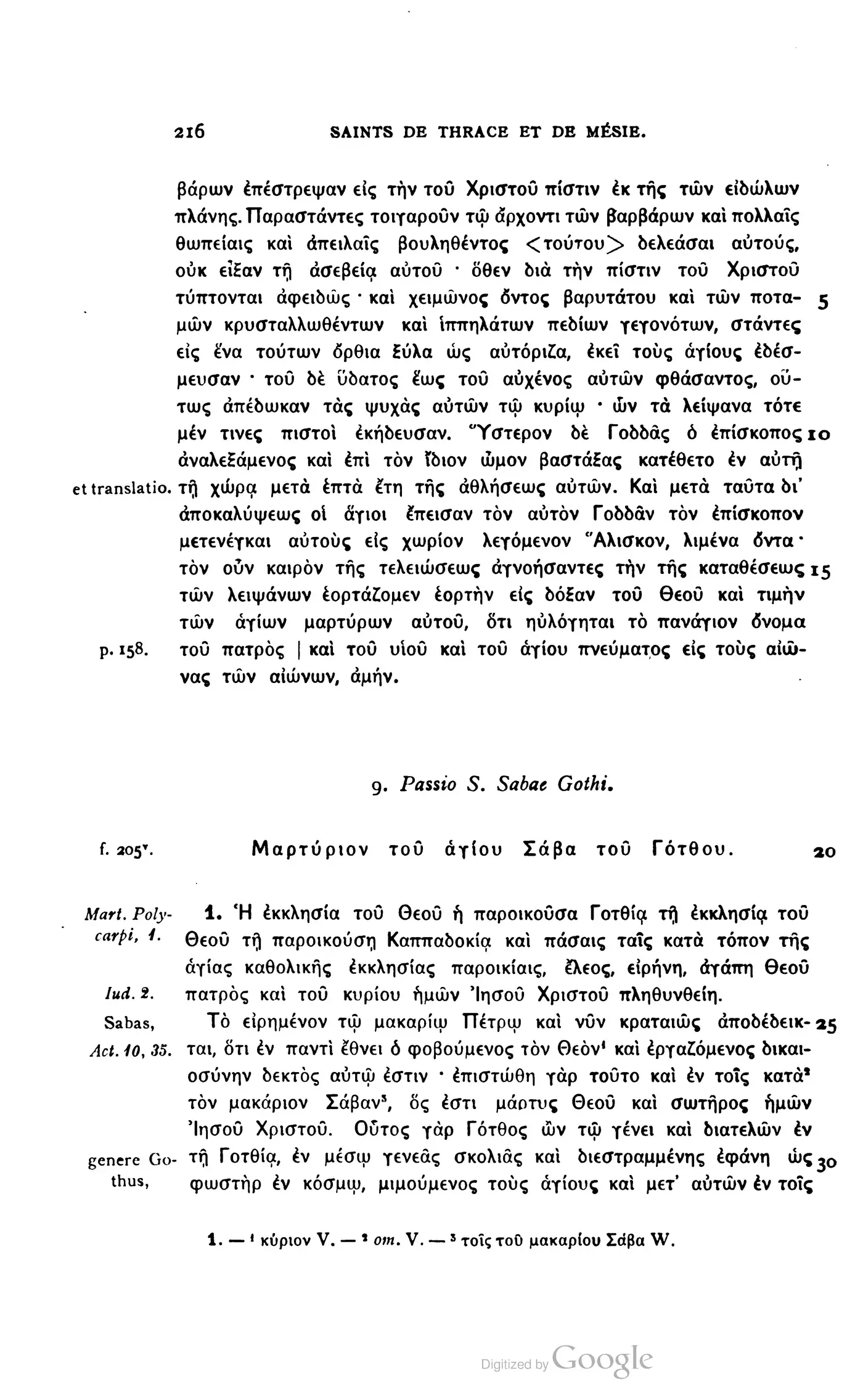
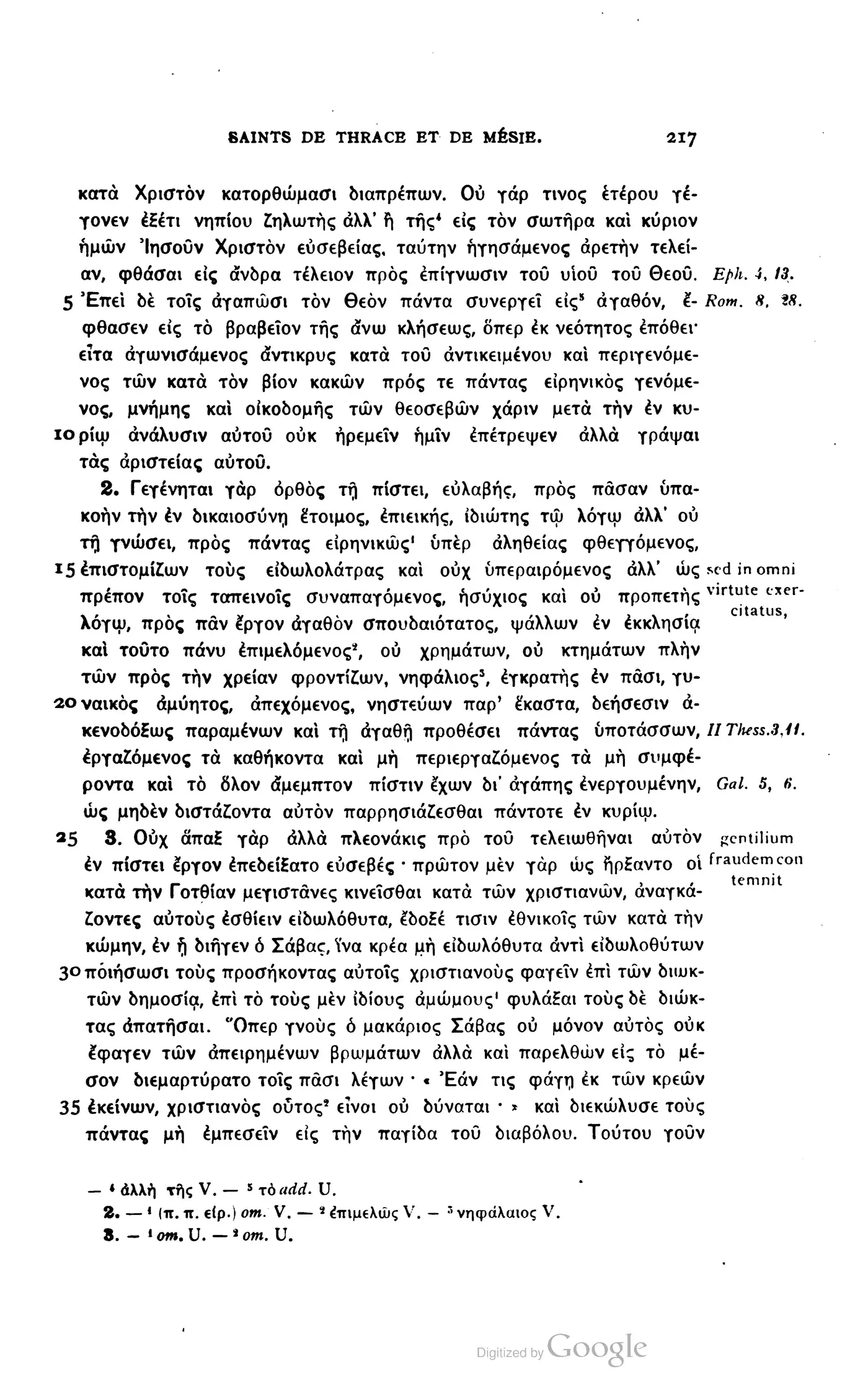
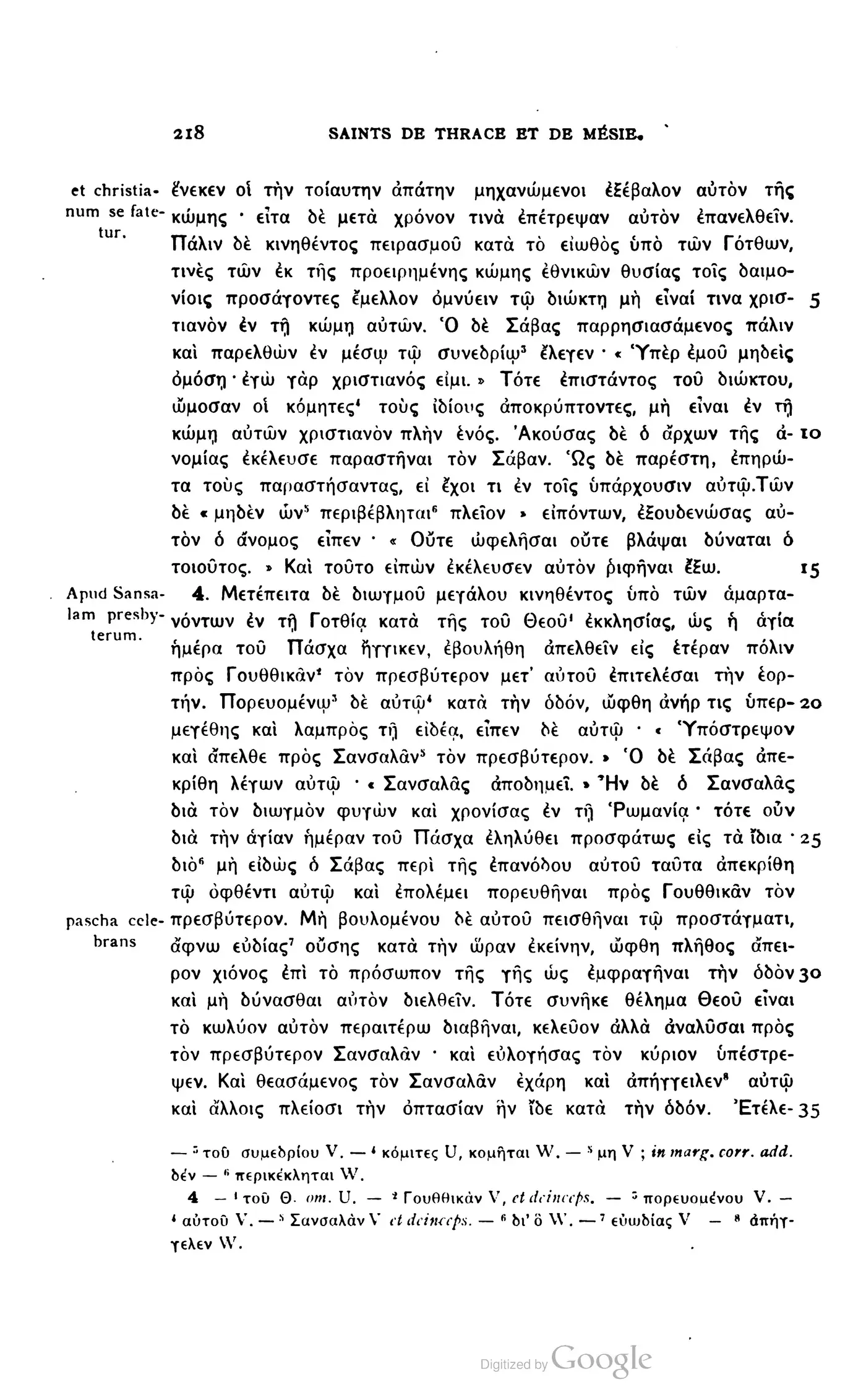
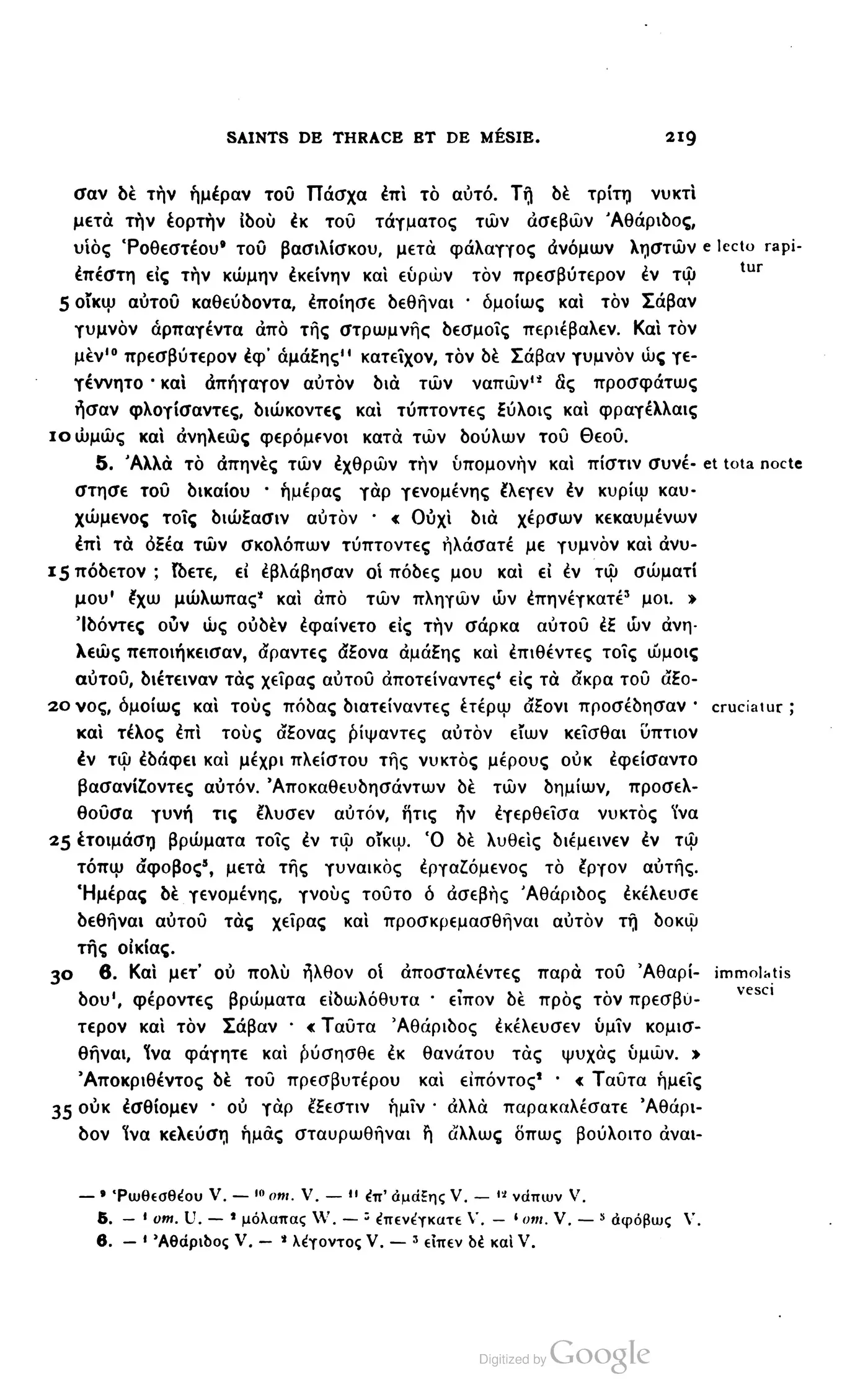
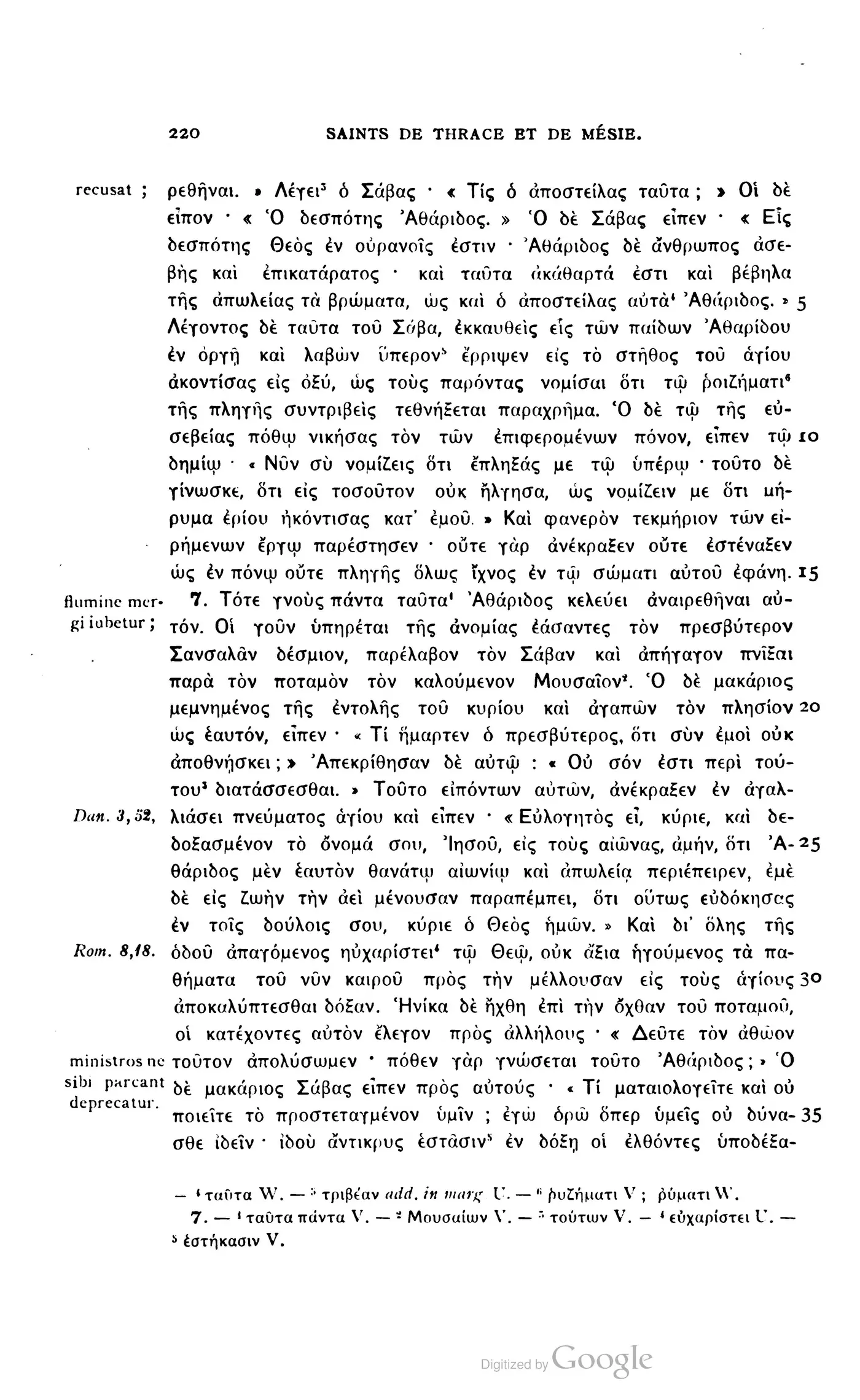
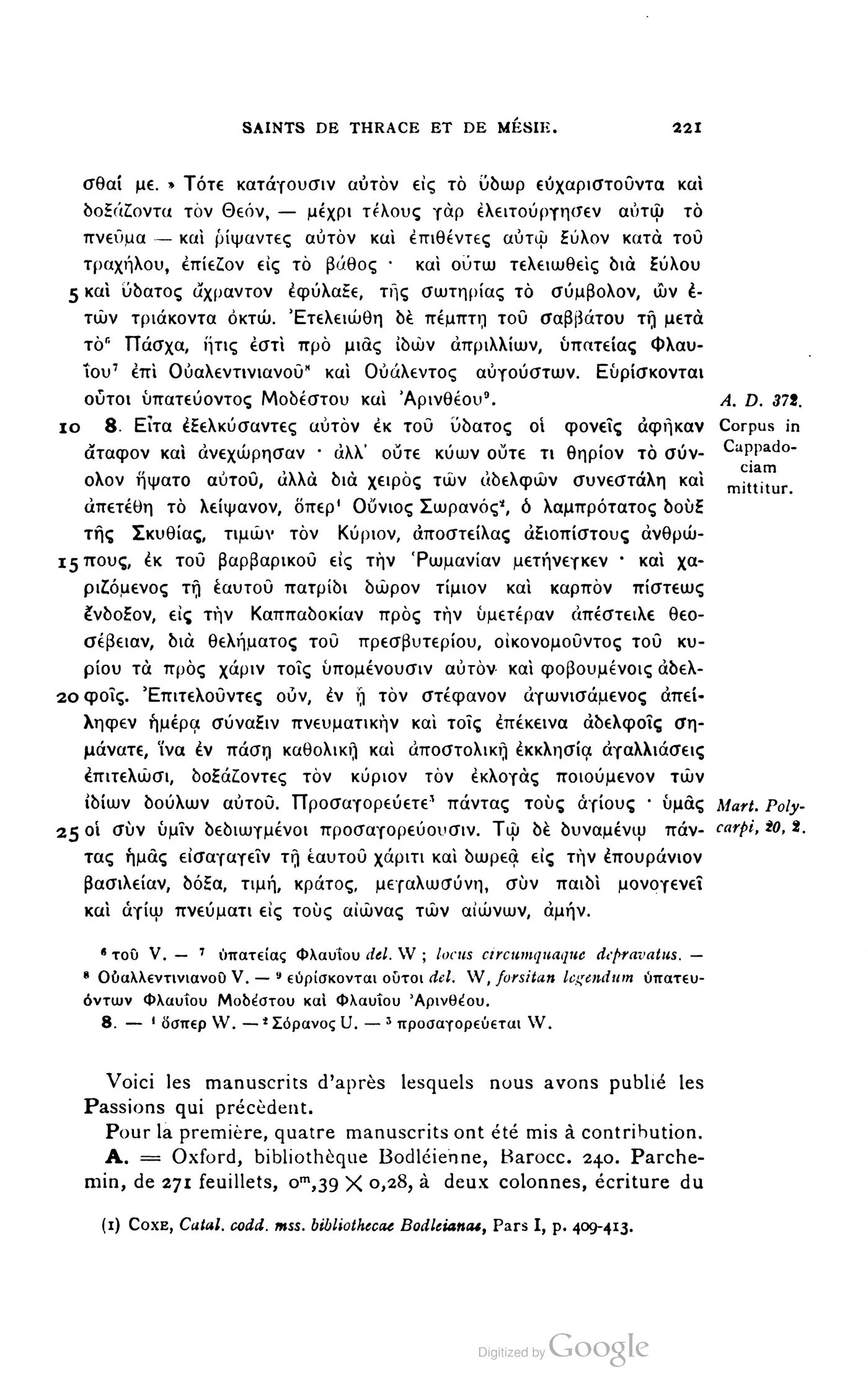
Five days in April 372#
The letter says: “He was made perfect on the fifth day of the week, the one after Easter, which is the day before the Ides of April”, and names the consuls Modestus and Arintheus, that is, the year 372. The days are reckoned in the Julian calendar, the one then in use. Between 330 and 419 Easter fell on 8 April only in 350, 361 and 372.
The three nights and two dawns in the letter fit the week from 8 to 12 April if the nights are counted from Easter Sunday. Counted from the vigil night, the death would fall on Wednesday. Hippolyte Delehaye made the same check in 1912 (p. 291). The table below repeats it so anyone can verify it.
The letter says he was 38 years old. If the age and the year are those of the letter, he was born about 334; the letter gives no year of birth.
| Year | Easter | 12 April falls on |
|---|---|---|
| 368 | 20 April | Saturday |
| 369 | 12 April | Sunday |
| 370 | 28 March | Monday |
| 371 | 17 April | Tuesday |
| 372 | 8 April | Thursday |
| 373 | 31 March | Friday |
| 374 | 13 April | Saturday |
| 375 | 5 April | Sunday |
How it is computed
a = year mod 4, b = year mod 7, c = year mod 19
d = (19c + 15) mod 30
e = (2a + 4b − d + 34) mod 7
month = (d + e + 114) div 31
day = (d + e + 114) mod 31 + 1
The villagers who tried to protect the Christians#
The letter tells of two tests the Christians of the village went through before Easter 372. In both, the pagans of the village try to save the Christians among their own people: once by swapping the meat, once by swearing there is no Christian in the village. This is a reading of the text, not a statistic about the people of Gothia.
Later a woman of the house where he is held unties him in the night, and the men leading him to the river say to one another: “Come, let us set this innocent man free.” Each time Sabbas refuses to escape. Like any saint’s life, the letter keeps details of the village and at the same time arranges them to show the martyr’s constancy.
The priest Sansalas was bound and held on a wagon. He too was brought the sacrificial meat and refused it. When Sabbas was taken to the river, Sansalas was left bound; the letter does not say what became of him.
The letter says of Sabbas only that he was "right in faith"; it names neither Nicaea nor Arius. The second chapter opens with these words. The letter also says he “sang psalms in church”, without naming an office or a language.
Atharid and Athanaric#
The letter names a single persecutor: Atharid, son of Rhothesteos. “The kinglet” (βασιλίσκος) is the father; of Atharid the letter does not say what rank he held. He comes to the village by night, he orders the tortures and he orders the killing; others take Sabbas to the river and drown him.
The name Athanaric never occurs in the letter. The name Atharid occurs 12 times, all in chapters 4–7. The letter also mentions, without names, “the chief men in Gothia”, a “persecutor” who comes to the village and “the sinners in Gothia” who set the great persecution in motion before Easter.
The three Byzantine notices do not name Atharid. They name Athanaric: D, when someone arrives and Sabbas is seized; S and the 1727 notice, as the one who set the persecution in motion. Athanaric is known from other sources too: Jerome, Socrates and Sozomen, writing in the fourth and fifth centuries, say he persecuted the Gothic Christians. None of them mentions Sabbas.
Two things can be said with confidence, and one cannot. Certain: according to the letter, the order to kill was Atharid’s. Certain: the ancient historians attribute a persecution of the Gothic Christians to Athanaric, without mentioning Sabbas, and notices S and 1727 connect him with the persecution in which Sabbas was seized; the letter does not say otherwise. Uncertain: why the notices write Athanaric where the letter writes Atharid. Petre Ș. Năsturel (1969) saw in it a correction made by a scribe who knew of Athanaric’s persecutions from his reading, and thought it inexact to lay the death of Sabbas directly at Athanaric’s door. Thomas Hodgkin, in the 19th century, wrote in one note that they were probably the same person and, in another, that this was extremely doubtful. The texts do not decide.
Daniel Papenbroeck had observed as early as 1675 that the letter names only Atharid. Who the Goths were and where they came from: what Jordanes says and what ancient DNA shows.
The letter names five people who live in Gothia: Sabbas, Sansalas, Gouththikas, Atharid and Rhothesteos. None of the five has a Latin name. The only Latin name in the story is that of the Roman commander Junius Soranus. The letter names no spoken language. That does not show there were no Latin speakers in Gothia: the letter simply does not say. The Latin Christian inscriptions of the Danube and the question of how old Romanian Christianity is are on the page How old is Romanian Christianity?.
Basil the Great: an ancient source for the same events#
The letter about Sabbas and three letters of Basil the Great throw light on each other. The letter says that Junius Soranus, the Roman commander of Scythia, sent the body to Cappadocia, “his own homeland”. Basil, a bishop in Cappadocia, asks in one letter for relics of martyrs and in others gives thanks for a martyr who came from beyond the Danube, mentioning “the wood” and “the water”. The name of Sabbas does not appear in Basil’s letters; the fit of the details leads almost all scholars to connect them with him.
Basil’s letters are thus an ancient source for the same events, written by someone else and preserved by another route than the letter.
ὅπερ Οὔνιος Σωρανός, ὁ λαμπρότατος δοὺξ τῆς Σκυθίας, τιμῶν τὸν Κύριον, ἀποστείλας ἀξιοπίστους ἀνθρώπους, ἐκ τοῦ βαρβαρικοῦ εἰς τὴν Ῥωμανίαν μετήνεγκεν·
Junius Soranus, the most illustrious dux of Scythia, honouring the Lord, sent trustworthy men and brought it over from the barbarian land into Romania.
Letter 155: Basil asks for relics of martyrs
καλῶς δὲ ποιήσεις, ἐὰν καὶ λείψανα μαρτύρων τῇ πατρίδι ἐκπέμψῃς, εἴπερ, ὡς ἐπέστειλας ἡμῖν, ὁ ἐκεῖ διωγμὸς ποιεῖ καὶ νῦν μάρτυρας τῷ Κυρίῳ.
“And you will do well if you also send relics of martyrs to the homeland, if indeed, as you wrote to us, the persecution there is even now making martyrs for the Lord.”
- What it shows
- Basil asks for relics from the land where persecution “is even now making martyrs”. The letter mentions Scythia.
- What it does not show
- The martyrs are in the plural and none is named. In the manuscripts the letter has no addressee; that he is Soranus is the editors’ proposal.
Letter 164: a martyr from beyond the Danube
μάρτυς δὲ ἡμῖν ἐπεδήμησεν ἐκ τῶν ἐπέκεινα Ἴστρου βαρβάρων, δι’ ἑαυτοῦ κηρύσσων τῆς ἐκεῖ πολιτευομένης πίστεως τὴν ἀκρίβειαν.
“… and a martyr came to stay among us from the barbarians beyond the Ister, proclaiming through himself the exactness of the faith that is lived there.”
- What it shows
- A letter “from the far-off land” and a martyr from north of the Danube (the Ister) reached Basil.
- What it does not show
- The martyr is not named.
Letter 164: “the wood, the water”
αἱ ποικίλαι βάσανοι τῶν διωκόντων, αἱ διὰ πάντων ἐνστάσεις τῶν ἀγωνιζομένων, τὸ ξύλον, τὸ ὕδωρ, τὰ τελειωτικὰ τῶν μαρτύρων.
“… the manifold tortures of the persecutors, the resistance through everything of those who were contending, the wood, the water, the things that bring martyrs to their perfection.”
- What it shows
- Basil lists “the wood” and “the water” among the things that bring to perfection the martyrs he has been told about. The letter says of Sabbas that he was made perfect “through wood and water” (§7).
- What it does not show
- The sentence speaks of martyrs, in the plural. The fit with the letter about Sabbas is close, but his name does not appear.
Letter 165: “you have honoured the land that bore you”
μάρτυρι, νέον ἀθλήσαντι ἐπὶ τῆς γείτονος ὑμῖν βαρβάρου, τὴν ἐνεγκοῦσαν ἐτίμησας, οἷόν τις εὐγνώμων γεωργὸς τοῖς παρασχομένοις τὰ σπέρματα τὰς ἀπαρχὰς τῶν καρπῶν ἀποπέμπων.
“With a martyr, who lately contended in the barbarian land neighbouring you, you have honoured the land that bore you, like a grateful farmer sending back the first-fruits of the harvest to those who supplied the seeds.”
- What it shows
- Basil says that the man he writes to has honoured his homeland by sending it a martyr; earlier in the same letter he calls it “our homeland”. The letter about Sabbas says of Soranus that he made “a gift to his own homeland” (§8).
- What it does not show
- The homeland is the sender’s, not the martyr’s: it does not follow that Sabbas or his ancestors were from Cappadocia. The martyr is not named. In the manuscripts the letter is addressed to Ascholius; that the addressee is Soranus is the editors’ proposal.
Who wrote the letter
The letter is sent in the name of a Church; who held the pen is not known. In the manuscripts, Basil’s letters 164 and 165 are addressed to Ascholius, bishop of Thessalonica, and so some have taken him for the author. Others have thought of Bretanion, bishop of Tomis. Constantin Zuckerman (1991), as Mario Girardi summarises him, proposed a priest and monk in Scythia; Girardi notes that other scholars rejected the proposal. Mario Girardi (2013) reads Basil’s word for the man who prepared the martyr, “the trainer”, as pointing first to the priest Sansalas, then to Bretanion. These are scholars’ proposals, and the letter confirms none of them.
- move stated in the letter (no route)
- modern identification
- area with no known edges
The Mousaios and the Buzău#
The link between Sabbas and Buzău passes through a single word of the letter: the name of the river. Four questions are often run together here, and they have different answers.
Οἱ γοῦν ὑπηρέται τῆς ἀνομίας ἐάσαντες τὸν πρεσβύτερον Σανσαλᾶν δέσμιον, παρέλαβον τὸν Σάβαν καὶ ἀπήγαγον πνῖξαι παρὰ τὸν ποταμὸν τὸν καλούμενον Μουσαῖον.
So the servants of lawlessness left the presbyter Sansalas bound, took Sabbas and led him away to drown him at the river called Mousaios.
- What do the texts call the river?
- Mousaios, in the letter and in notices D and S. The 1727 notice says only “the river”.
- Which river of today has it been identified with?
- Usually with the Buzău. It is the identification most scholars accept, and it has grounds: the likeness of the names and the fact that the body was taken by the commander of the neighbouring Roman province, Scythia (today’s Dobruja). The letter neither contradicts nor confirms it: it does not say where the river flows.
- Does the name Buzău come from Mousaios?
- That is a different question, for linguists. Xenopol (1885) explained the shift from “b” to “m”. Ivan Duridanov (1969) rejects the link between the two names and proposes a Slavic origin for Buzău; he adds that the Mousaios could still have been the Buzău under another name. A river can be the same even if its present name has another origin.
- Does the letter mention a town called Mousaios?
- No. In all the texts Mousaios is the river. Sabbas’s village has no name, and the only “town” in the letter is the unnamed one of the presbyter Gouththikas. The letter is sent by one Church to another, not by a governor to Basil the Great, as is sometimes written.
Where writers have put the river
The list below covers the books and articles searched for this page. It shows how the identification with the Buzău spread in the prints of the 19th century; it does not show who said it first.
- the letter (after April 372)"The river called Mousaios". No location. παρὰ τὸν ποταμὸν τὸν καλούμενον Μουσαῖον
- 1578, quoted in 1675The Sava. in Sabam fluvium projectus
- 1675A river "Missovo" in Wallachia, not far from Târgoviște, flowing past "Rebnick". apud Walachos autem etiam hodie fluvius Missovo nominatur, haud longe a Terisco seu Targovisco
- 18th–19th century"Mussovo in Wallachia", repeated: Butler (1812 edition), Stolberg (1816/17), Migne (1844), Vogel (1863), Pusey (1880). A river in Walachia, now called Mussovo
- before 1811A river "Museu" that "washes Râmnic". rîul Museu, care rîu spală Rîmnicul
- 1850A garbled account: Sabbas thrown into the "Buseo river", rescued, dead long afterwards. The name Mousaios does not appear. ließ im Jahr 372 den heil. Sava in den Buseo-Fluß werfen, er ward aber von den christlichen Daciern gerettet
- 1872The earliest print found that equates the two names: the Buzău "was called Mouseos". der Buzeo in der gr. Walachei hiess Μουσέος (Acta S. Sabae Gothi a. 363)
- 1874Repeats Tomaschek. Buzeo …, welcher im Alterthum Museos hieß
- 1878The earliest found that says the saint was drowned "in the Bozau (Museus)". welcher am 12. April 372 in der Bozau (Museus) ertränkt wurde
- 1883"The Buzeo (Museus)", in a list of rivers. der Buzeo (Museus)
- 1885The earliest found with an argument: b turned into m; cites Tomaschek 1872. le Bouzéou … sous la forme Museus, où nous rencontrons le changement du b en m
- 1904A Romanian encyclopedia: "all authors" identify the river with the Buzău. rîul Museu, pe care toți autorii îl identifică cu rîul Buzău
- 1911Pârvan adds an argument from Basil's letters: the martyr died next to Soranus's province, so the river "can only be today's Buzău". nu poate fi decât Buzeul de azi
- 1991A standard English translation keeps it conditional: "if this river … is correctly identified as the Buzău". If this river … is correctly identified as the Buzău
Filled dot: the source says Buzău. Hollow dot: the source puts the river elsewhere or nowhere. Papenbroeck’s river is not drawn on the map below: his description does not lead to a single river.
The days of commemoration#
The day of death and the day of commemoration are different things. The letter gives a single day, 12 April. The Byzantine calendars also placed Sabbas on other days in April.
| Day | What is commemorated | Where it is written |
|---|---|---|
| 12 April | The day of the death, according to the letter, which also asks for the commemoration “on the day he received the crown”. | The letter, §7–8. Manuscript V places it under 12 April. The calendar of the Romanian Orthodox Church: 12 April. |
| 15 April | The commemoration of Sabbas the Goth. | Manuscript U of the letter; notice D (Sinai and Paris); the 1727 notice; many of the Synaxarion manuscripts Delehaye used. |
| 16 April | The commemoration of Sabbas. | One Synaxarion manuscript (Bb), according to Delehaye. |
| 17 April | “The contest of the holy martyr Sabas the Goth”. | Notice S (the Berlin manuscript). |
| 18 April | The commemoration of Sabbas the Goth. | Two Synaxarion manuscripts (Mc, Mv), according to Delehaye. He is also painted under 18 April in the calendar on the walls of Voroneț monastery (1547), according to Elisabeta Negrău (2023). |
| 24 or 25 April | Another saint of the same name: Sabbas Stratelates (“the commander”), whom tradition places at Rome under the emperor Aurelian. He is not Sabbas the Goth. | His day is 24 or 25 April, according to Elisabeta Negrău (2023). The relation between the two saints was studied by Enrica Follieri (1962). |
The Romanian calendar
By its Synodal Act of 21 June 1992 the Romanian Orthodox Church entered in its calendar, “with generalised veneration”, a number of saints who preached or were martyred in the territory inhabited by Romanians. In the summary of the act published by the Basilica news agency, “the Holy Martyr Sava of Buzău” is among them, on 12 April. His veneration is far older: the copies of the letter made in 916 and in the 11th century, the Byzantine calendars and the painting at Voroneț of 1547 are traces of it.
Who said what about Sabbas, from 372 to today#
The table follows 29 statements about Sabbas through 33 books, articles and pages, from the letter to the present. Each row is a statement, each column a source. The columns are ordered by the year in which the source was written or printed; for the Byzantine notices, the year is that of the manuscript or of the print, not of the text.
Open the table
● says it◐ says it in part or with reservations○ does not say it≠ says otherwise— the source was not read for this row
The table is wide: swipe left for newer sources. Tap a claim for details.
| Claim | The letterafter 372 | Basil370s | Historians4th–5th c. | Notice S12th–13th c. ms. | Notice D10th–12th c. mss | Martyrologies– | Acta Sanctorum1675 | The 1727 noticeprinted 1727 | Butler– | Șincaibefore 1811 | Neigebaur1850 | Tomaschek1872 | Gooss1874 | Korrespondenzblatt1878 | Hunfalvy1883 | Xenopol1885 | Iorgulescu1892 | Tomaschek1894 | Encyclopedia1904 | Pârvan1911 | Delehaye1912 | Densușianu1913 | Pârvan1923 | Năsturel1969 | Fontes1970 | Mousaios III1981 | Rămureanu1982 | Heather–Matthews1991 | Păcurariu1991/92 | Romanian Synod1992 | Girardi2013 | Drugaș2018 | Web pagestoday |
|---|---|---|---|---|---|---|---|---|---|---|---|---|---|---|---|---|---|---|---|---|---|---|---|---|---|---|---|---|---|---|---|---|---|
He died in the persecution started by Athanaric.The letter does not name Athanaric, and does not contradict this either: it says “the sinners in Gothia” set a great persecution in motion. Notices S and 1727 and the ancient historians name Athanaric. „Μετὰ δὲ χρόνον τινὰ Ἀθαναρίχου τοῦ ἄρχοντος τῶν Γότθων διωγμὸν κινήσαντος κατὰ χριστιανῶν … ἐκρατήθη καὶ αὐτός” (col. 608, ll. 41–45) Synaxarium of Constantinople, 17 April §4 (ed. Delehaye 1902, cols. 608–609) | does not say it | does not say it | does not say it | says it | says it (partial) | says it | says it | says it | says it | says it | — | — | — | — | — | — | — | — | — | says it | — | — | — | says it | says it | — | does not say it | — | — | — | — | — | says it |
He was killed on the order of Athanaric.In the letter the order is Atharid’s. The Byzantine notices name Athanaric, but none says that he ordered the killing. „Ὕστερον δὲ Ἀθαναρίχου παραγενομένου συνελήφθη· καὶ φραγγελλωθεὶς καὶ τυφθεὶς … ἤχθη ἐπὶ τὸν ποταμὸν Μουσαῖον … ἀπεπνίγη” (machine-recognised text) Synaxarium, manuscript D (Paris gr. 1587), notice printed in Delehaye 1902 among the "Synaxaria selecta" before col. 608 | does not say it | does not say it | does not say it | does not say it | does not say it | says it (partial) | says otherwise | does not say it | does not say it | does not say it | — | — | — | — | — | — | — | — | — | does not say it | — | — | — | says otherwise | does not say it | — | says otherwise | — | — | — | — | — | does not say it |
The order to kill came from Atharid.Τότε γνοὺς πάντα ταῦτα Ἀθάριδος κελεύει ἀναιρεθῆναι αὐτόν (220.16). The name occurs 12 times, all in §§4–7. Letter of the Church of Gothia (Passio S. Sabae), Greek, ed. Delehaye 1912, pp. 216–221 | says it | does not say it | — | does not say it | does not say it | — | says it | does not say it | says it | — | — | — | — | — | — | — | — | — | — | does not say it | — | — | — | says it | — | says it (partial) | says it | — | — | — | — | — | says it |
Atharid was Athanaric's son or his subordinate.Index: "Atharidus Princeps sub Athanarico R." Acta Sanctorum, Aprilis II (Antwerp 1675), "De S. Saba Gotho", commentary by D. Papenbroeck, §§4–11 | does not say it | does not say it | — | does not say it | does not say it | — | says it | does not say it | — | — | — | — | — | — | — | — | — | — | — | — | — | — | — | does not say it | — | — | — | does not say it | — | — | — | — | says it (partial) |
The river Mousaios is the Buzău.This is the usual identification, made by scholars; the old texts give only the name Mousaios and do not say where the river flows. „der Buzeo in der gr. Walachei hiess Μουσέος (Acta S. Sabae Gothi a. 363)” (p. 150): a flat equation, in a list of rivers said to have kept their ancient names, with the Passion of Sabbas as the source. No argument. W. Tomaschek, review of R. Roesler, Romänische Studien, in Zeitschrift für die österreichischen Gymnasien 23 (1872), pp. 141–157, at p. 150 | does not say it | does not say it | — | does not say it | does not say it | says otherwise | does not say it | does not say it | does not say it | does not say it | says it (partial) | says it | says it | says it | says it | says it | says it | says it | says it | says it | — | — | says it | — | says it | says it | — | says it (hedged) | — | does not say it | — | — | says it |
He was born at or near Buzău.No old text says where he was born. The letter does not name the village; notice D says only “in Gothia”. ro.wikipedia: „S-a născut în anul 334 (aproximativ), în regiunea Buzăului”; en.wikipedia: "born … in a village in the Buzău river valley"; OrthodoxWiki EN and RO; adevarul.ro Present-day web pages (dates of writing unchecked): ro.wikipedia, en.wikipedia, OrthodoxWiki (EN, RO), oca.org, doxologia.ro, adevarul.ro, muzeubuzau.ro | does not say it | does not say it | — | does not say it | does not say it | — | — | does not say it | — | — | — | — | — | — | — | — | — | — | — | does not say it | — | — | — | does not say it | — | does not say it | does not say it | — | — | does not say it | — | — | says it |
He was born of Christian parents.All four texts say he was a Christian from childhood. None speaks of his parents. «il giovane Saba di famiglia già cristiana» (p. 118) M. Girardi, in Classica et Christiana 8/1 (2013), pp. 109–119 | does not say it | does not say it | — | does not say it | does not say it | — | does not say it | does not say it | does not say it | — | — | — | — | — | — | — | — | — | — | — | — | — | — | says it (hedged) | — | — | does not say it | — | — | — | says it | — | says it |
"The Goth" is only a label of place; Sabbas was not a Goth.„Și Saba, ca și Audius, e dară grec din Asia.” (p. 157); „martyri «goți»” in quotation marks V. Pârvan, Contribuții epigrafice la istoria creștinismului daco-roman (1911), pp. 137, 156–158 | says otherwise | does not say it | — | says otherwise | says otherwise | — | says otherwise | says otherwise | says otherwise | — | — | — | — | — | — | — | — | — | says otherwise | says it | — | does not say it | — | — | says otherwise | says it | says otherwise | — | says it | — | — | — | says it |
Sabbas was Daco-Roman, a Latin speaker or a native.The letter says he was “a Goth by birth”, and the notices that he was from the land of the Goths. No old text calls him a Roman or a Dacian. „își însușise creștinismul în limba latină … într-un mediu cu care, credem, avea afinități și etnice” (p. 31) M. Constantinescu, in Mousaios III (Buzău 1981), pp. 31–34 | says otherwise | does not say it | — | does not say it | does not say it | — | — | does not say it | — | — | — | — | — | — | — | — | — | — | — | says otherwise | — | says it (partial) | — | — | — | says it | does not say it | — | does not say it | — | — | says it (hedged) | says it (hedged) |
Sabbas's ancestors were captives from Cappadocia.„ne fac să credem că Sfîntul Sava este originar tot de aici [din Capadocia], deci un descendent al captivilor greci aduși de goți în Dacia” M. Păcurariu, Istoria Bisericii Ortodoxe Române I (2nd ed., 1991/92) | does not say it | does not say it | — | does not say it | does not say it | — | — | does not say it | — | does not say it | — | — | — | — | — | — | — | — | — | says it (partial) | — | — | — | — | — | — | says it (partial) | — | says it | — | — | says it (hedged) | says it |
The letter is addressed to Basil the Great or sent through him.The letter is addressed to the Church of Cappadocia, not to a person. Basil was then bishop of Caesarea in Cappadocia and, by his own letters, received a martyr and a letter from beyond the Danube. „scrisoarea lui Iunnius Soranus către Vasile cel Mare, arhiepiscop în Cezareea Capadochiei” (p. 31): the addressee is Basil; the sender is made Soranus, not the Church of Gothia. M. Constantinescu, in Mousaios III (Buzău 1981), pp. 31–34 | does not say it | does not say it | — | does not say it | does not say it | — | does not say it | does not say it | does not say it | — | — | — | — | — | — | — | — | — | — | does not say it | — | — | — | — | — | says it | does not say it | — | — | — | — | — | says it |
Basil the Great asked for the relics.In a surviving letter Basil asks for “relics of martyrs” from the land of the persecution. He does not name Sabbas. The link with him is a connection made by scholars, on good grounds. „la rugămintea și intervenția Sfîntului Vasile cel Mare († 379) către Iunius Soranus … spre a-i trimite moaștele Sfîntului” (p. 311) I. Rămureanu, Actele martirice (1982), pp. 311–324 | does not say it | says it (partial) | — | does not say it | does not say it | — | — | does not say it | — | — | — | — | — | — | — | — | — | — | — | does not say it | — | — | — | — | — | — | says it | — | — | — | not opened | — | says it |
The letter was written by Bretanion, bishop of Tomis.„Se crede că alcătuitorul acestei Scrisori era episcopul Vetranion de la Tomis”; „adevăratul lor destinatar era episcopul tomitan, deci o do[vadă în] plus că el era și autorul actului martiric” M. Păcurariu, Istoria Bisericii Ortodoxe Române I (2nd ed., 1991/92) | does not say it | does not say it | — | does not say it | does not say it | — | — | does not say it | — | — | — | — | — | — | — | — | — | — | — | — | does not say it | — | — | — | — | — | says otherwise | — | says it | — | says it (hedged) | — | says it (hedged) |
The letter was written by Ascholius of Thessalonica."penned, in all appearance, by St. Ascholius, bishop of Thessalonica" Alban Butler, Lives of the Saints, 12 April (1756–59; web copy) | does not say it | does not say it | — | does not say it | does not say it | — | — | does not say it | says it | — | — | — | — | — | — | — | — | — | — | does not say it | — | — | — | — | — | — | — | — | — | — | — | — | — |
He is the first martyr on Romanian soil.No old text says this, and the statement depends on which territory and which martyrs are counted. His Passion is one of the few full accounts of a martyr north of the Danube. OrthodoxWiki EN: "the earliest known native-born martyr on Romanian soil" Present-day web pages (dates of writing unchecked): ro.wikipedia, en.wikipedia, OrthodoxWiki (EN, RO), oca.org, doxologia.ro, adevarul.ro, muzeubuzau.ro | does not say it | does not say it | — | does not say it | does not say it | — | — | does not say it | — | — | — | — | — | — | — | — | — | — | — | does not say it | — | — | — | — | — | — | — | — | — | — | — | — | says it (partial) |
Sabbas (or his community) held the Nicene faith and was not Arian.The letter says he was “upright in the faith”, without naming Nicaea or Arius. Basil praises “the exactness of the faith” of the martyr from beyond the Danube. Scholars disagree. §4: the part of Gothia under Athanaric "integerrima adhuc esset fidei nullaque Arianismi labe contacta" (after Baronius) Acta Sanctorum, Aprilis II (Antwerp 1675), "De S. Saba Gotho", commentary by D. Papenbroeck, §§4–11 | says it (partial) | says it (partial) | does not say it | does not say it | does not say it | — | says it | does not say it | — | — | — | — | — | — | — | — | — | — | — | says it | does not say it | — | — | — | — | — | — | — | — | — | — | — | — |
His day is 12 April.The letter places the death on the day before the Ides of April, that is 12 April, and asks that he be commemorated on that day. The Byzantine calendars also commemorate him on 15, 17 or 18 April. πρὸ μιᾶς ἰδῶν ἀπριλλίων (221.07): the day before the Ides of April, as the day of death. Vat. gr. 1660 files the text at 12 April. Letter of the Church of Gothia (Passio S. Sabae), Greek, ed. Delehaye 1912, pp. 216–221 | says it | does not say it | — | does not say it | does not say it | says it | says it | does not say it | — | — | — | — | — | — | — | — | — | — | — | — | — | — | — | — | — | — | says it | — | — | says it | — | — | — |
His day is 15 April (or 16, 17, 18, 24).17 April in the base manuscript; Delehaye (1912, p. 291): 15, 16, 17, 18 "et parfois le 12" in the various copies. Synaxarium of Constantinople, 17 April §4 (ed. Delehaye 1902, cols. 608–609) | does not say it | does not say it | — | says it | says it | — | says it | says it | — | says it | — | — | — | — | — | — | — | — | — | — | — | — | — | — | — | — | says it | — | — | — | — | — | says it |
The body was moved by a Roman commander, Soranus.Οὔνιος Σωρανός, ὁ λαμπρότατος δοὺξ τῆς Σκυθίας … ἐκ τοῦ βαρβαρικοῦ εἰς τὴν Ῥωμανίαν μετήνεγκεν (221.13–15) Letter of the Church of Gothia (Passio S. Sabae), Greek, ed. Delehaye 1912, pp. 216–221 | says it | says it (partial) | — | does not say it | does not say it | — | — | does not say it | says it | says it | — | — | — | — | — | — | — | — | — | says it | — | — | — | — | — | — | says it | — | — | — | — | — | says it (partial) |
The relics went to Cappadocia (to Caesarea).εἰς τὴν Καππαδοκίαν πρὸς τὴν ὑμετέραν ἀπέστειλε θεοσέβειαν (221.17). Caesarea is not named. Letter of the Church of Gothia (Passio S. Sabae), Greek, ed. Delehaye 1912, pp. 216–221 | says it | says it | — | does not say it | does not say it | does not say it | — | does not say it | says it | — | — | — | — | — | — | — | — | — | — | — | — | — | — | — | — | — | says it | — | — | — | — | — | — |
He was a church cantor or reader.n. 21: "Saba was lector, or possibly …" P. Heather, J. Matthews, The Goths in the Fourth Century (1991), pp. 102–109 | does not say it | does not say it | — | does not say it | does not say it | — | — | does not say it | does not say it | — | — | — | — | — | — | — | — | — | — | — | — | — | — | — | — | — | does not say it | says it | — | — | — | — | says it (hedged) |
He converted and baptised many.Two of the three Byzantine notices say so. The letter and notice D do not speak of baptising. „πολλοὺς ἐπιστρέφων ἐβάπτιζεν” (col. 608, l. 39): he converted and baptised many. Synaxarium of Constantinople, 17 April §4 (ed. Delehaye 1902, cols. 608–609) | does not say it | does not say it | — | says it | does not say it | — | does not say it | says it | — | — | — | — | — | — | — | — | — | — | — | does not say it | — | — | — | — | — | does not say it | — | — | — | — | — | — | says it (partial) |
He was a priest, monk or missionary.„Dintre numeroșii missionari ai secolului al IV-lea în Nordul Dunării, mai cunoscuți sânt cinci: Ulfila, Audius (ereticul), Saba, Nicetas martyrul și Nicetas episcopul.” (p. 154, machine-recognised text) V. Pârvan, Contribuții epigrafice la istoria creștinismului daco-roman (1911), pp. 137, 156–158 | does not say it | does not say it | — | does not say it | does not say it | — | does not say it | does not say it | — | — | — | — | — | — | — | — | — | — | — | says it | — | — | — | — | — | says it | — | — | — | — | — | — | says it |
He was an army officer (stratelates).§11: the printed Menaia wrongly add the title Στρατηλάτης, "qui alterius … Gotthi est, sub Aureliano Romae passi"; relics sent to Ascoli in 1612 were celebrated on the wrong day. Acta Sanctorum, Aprilis II (Antwerp 1675), "De S. Saba Gotho", commentary by D. Papenbroeck, §§4–11 | does not say it | does not say it | — | does not say it | does not say it | — | says otherwise | does not say it | — | — | — | — | — | — | — | — | — | — | — | — | does not say it | — | — | — | — | — | — | — | — | — | — | — | does not say it |
The presbyter Sansalas was released (or martyred)."having dismissed the priest Sansala, his companion" Alban Butler, Lives of the Saints, 12 April (1756–59; web copy) | does not say it | does not say it | — | does not say it | does not say it | — | — | does not say it | says it | — | — | — | — | — | — | — | — | — | — | — | does not say it | — | — | — | — | — | does not say it | — | — | — | says it | — | says it |
An idol on a wagon was brought to Sabbas's village.doxologia.ro: „regele Atanaric a poruncit ca un idol să fie purtat într-un car prin cetăţi şi sate şi să i se aducă jertfe. Sfântul Sava îndemna pe creştini să nu jertfească idolilor şi să nu mănânce din cărnurile jertfite” Present-day web pages (dates of writing unchecked): ro.wikipedia, en.wikipedia, OrthodoxWiki (EN, RO), oca.org, doxologia.ro, adevarul.ro, muzeubuzau.ro | does not say it | does not say it | does not say it | does not say it | does not say it | — | does not say it | does not say it | — | — | — | — | — | — | — | — | — | — | — | — | — | — | — | — | — | — | — | — | — | — | — | — | says it (partial) |
He died aged 38.So the letter says. Notices D and S say “in his 38th year”, and the one printed in 1727 says 31 years. ὢν ἐτῶν τριάκοντα ὀκτώ (221.05–06): thirty-eight years old. Letter of the Church of Gothia (Passio S. Sabae), Greek, ed. Delehaye 1912, pp. 216–221 | says it | does not say it | — | says it | says it | — | — | says otherwise | — | — | — | — | — | — | — | — | — | — | — | — | — | — | — | says it | says it | — | — | — | — | — | — | — | — |
He died in 372.ὑπατεύοντος Μοδέστου καὶ Ἀρινθέου (221.09), in a damaged clause; the weekday and Easter agree with 372. Letter of the Church of Gothia (Passio S. Sabae), Greek, ed. Delehaye 1912, pp. 216–221 | says it | does not say it | — | does not say it | does not say it | — | says it | does not say it | says it | — | — | — | — | — | — | — | — | — | — | — | says it | — | — | — | — | — | — | — | — | — | — | — | — |
| Sabbas's village has a known name. | does not say it | does not say it | — | does not say it | does not say it | — | — | does not say it | — | — | — | — | — | — | — | — | — | — | — | — | — | — | — | — | — | does not say it | — | — | — | — | — | — | does not say it |
Sources and method#
- H. Delehaye, "Saints de Thrace et de Mésie", Analecta Bollandiana 31 (1912), pp. 161–300: Passio S. Sabae pp. 216–221, commentary pp. 274–291 · Public domain (author died 1941; published 1912). archive.org marks the scan Public Domain Mark 1.0
- Page images of the Passio (leaves n259–n264) · as above; scan "Digitized by Google"
- Vat. gr. 1660, ff. 205v–211v (the Vatican manuscript of the letter) · © Biblioteca Apostolica Vaticana, all rights reserved: link only, never embed
- Venice, Biblioteca Nazionale Marciana, Gr. Z. 359 (=816), ff. 190r–193v (the Venice manuscript) · images © Biblioteca Nazionale Marciana, on Internet Culturale: link only, never embed
- Basil of Caesarea, Letters 155, 164, 165: Greek text, ed. R. J. Deferrari, Saint Basil: The Letters, vol. II (Loeb Classical Library, 1928), pp. 380–384, 420–430 · public domain
- Ammianus Marcellinus 27.5 (Latin) · Latin public domain
- Socrates, Church History 4.33; Sozomen 6.21, 6.37; Theodoret 4.31 (NPNF translations) · translations public domain
- Philostorgius 2.5 (tr. E. Walford, 1855) · public domain
- Jerome, Chronicle (online translation) · site translation; terms not checked
- Auxentius of Durostorum, Letter on Ulfila: Latin transcription; English by J. Marchand · Latin public domain; Marchand translation in copyright: do not reproduce
- Synaxarium ecclesiae Constantinopolitanae, ed. H. Delehaye (Brussels 1902): notice D, cols. 603–604; notice S, cols. 608–609 · public domain (1902; editor died 1941); archive.org item carries no licence statement
- Menologium Graecorum, part III, March–August (Urbino 1727), p. 56 · public domain
- Acta Sanctorum, Aprilis II (Antwerp 1675), "De S. Saba Gotho martyre", commentary by D. Papenbroeck · public domain
- A. Butler, Lives of the Saints, 12 April · text public domain (18th century); web copy of a later edition
- Romanian and other 19th–21st-century sources: Șincai, Neigebaur 1850, Hunfalvy 1883, Xenopol 1885, Iorgulescu 1892, Tomaschek 1894, Diaconovich 1904, Pârvan 1911 and 1923, Densușianu 1913, Năsturel 1969, Fontes II 1970, Mousaios III 1981, Rămureanu 1982, Păcurariu, Popescu 2001, Girardi 2006–2013, Drugaș 2018, the 1992 synodal act (each with its own link in the ledger of claims) · mixed: pre-1930 works public domain; later works in copyright, quoted briefly for criticism
- W. Tomaschek, review of R. Roesler, Romänische Studien, Zeitschrift für die österreichischen Gymnasien 23 (1872), p. 150; C. Gooss, Studien zur Geografie und Geschichte des Trajanischen Daciens (1874), p. 31; Korrespondenzblatt des Vereins für siebenbürgische Landeskunde 1 (1878), p. 20; Paul Hunfalvy, Die Rumänen und ihre Ansprüche (1883), pp. 39, 43; A. D. Xenopol, Une énigme historique (1885), p. 146; J. F. Neigebaur, Zeitschrift für Philosophie und katholische Theologie N. F. 11, Heft 2 (1850), p. 3 · public domain (19th-century prints)
- V. Pârvan, Contribuții epigrafice la istoria creștinismului daco-roman (București 1911) · public domain (author died 1927)
- Mousaios III (Muzeul Județean Buzău, 1981), pp. 31–34 · in copyright; quoted briefly
- Muzeul Județean Buzău, "Mileniul I d. Hr." · in copyright; one sentence quoted
- P. Heather, J. Matthews, The Goths in the Fourth Century (Liverpool 1991), ch. 4 · in copyright: cite only
- Current retellings (ro.wikipedia, en.wikipedia, OrthodoxWiki EN and RO, oca.org, doxologia.ro, adevarul.ro) · Wikipedia CC BY-SA 4.0; others in copyright; cited as evidence of what is said today
- Easter and weekday computation · computed for this page (Alexandrian computus, Julian day number)
- Acta Sanctorum Aprilis II (Antwerp 1675), p. 90, note g on the date sentence · public domain
- M. Girardi, "La passio Sabae Gothi (BHG 1607): il contributo di ricercatori romeni", Classica et Christiana 6/1 (2011), pp. 81–95 · open access; cited, not reproduced
- Prosopography of the Later Roman Empire I, "Fl. Arinthaeus" (consul 372 with Domitius Modestus), digital edition · cited, not reproduced
- Paris, BnF, grec 1587, f. 38v (notice D) · Bibliothèque nationale de France, Gallica; linked, not reproduced
- Sinai, St Catherine’s Monastery, gr. 548, ff. 164v–165r (notice D) · Library of Congress microfilm; linked, not reproduced
- Database of Byzantine Book Epigrams: Vat. gr. 1660 (colophon, March 916) · catalogue record
- A. Luzzi, “Edizione di alcuni sinassari B* assenti nel Menologium Graecorum”, Nea Rhome 3 (2006), pp. 207–222 · cited
- P. Ș. Năsturel, “Les Actes de saint Sabas le Goth (BHG³ 1607). Histoire et archéologie”, Revue des études sud-est européennes 7 (1969), pp. 175–185 · cited
- I. Duridanov, “Thrakisch-dakische Studien”, Linguistique balkanique 13/2 (1969), pp. 47–48 · cited
- M. Girardi, “Chi «ha unto e preparato» al martirio Saba il Goto?”, Classica et Christiana 8/1 (2013), pp. 109–128 · cited
- E. Negrău, “Hagiography and Identity: Saints from the Dioceses of Dacia and Thrace in Balkan Medieval Menologia”, Revue Roumaine d’Histoire de l’Art, Beaux-Arts 60 (2023), pp. 3–32 · cited
- T. Hodgkin, Italy and Her Invaders, 2nd ed., vol. I, book I, ch. 2, notes 71 and 102 · public domain
- Romanian Orthodox Church, Synodal Act of 21 June 1992, as summarised by Basilica news agency (2022) · cited

The text of the letter
The letter of the Church of Gothia survives in two Greek manuscripts: Vat. gr. 1660, in the Vatican Library, copied in March 916, where the text stands under 12 April, and Marcianus gr. Z. 359, in Venice, of the early 11th century, where it stands under 15 April. The text on this page follows the edition of Hippolyte Delehaye, “Saints de Thrace et de Mésie”, Analecta Bollandiana 31 (1912), pages 216–221, which is in the public domain. In the manuscripts, the opening, the names of Atharid and his father, the sentence with the date of death and the closing greeting were read on photographs.
The Greek follows the pages of the edition. Three misprints of the edition are corrected in the reading text: τοιαύτην, εἰρημένων, ἀθῷον.
The letter has 1,674 Greek words, in eight chapters. The count is of the words separated by spaces in the text given here, without punctuation marks. For the notices (146, 126 and 124 words) the heading is counted too and, in D, the words the editor added in brackets. The division into parts of the story was made for this page. The division into 57 segments is not the edition’s; it was made for this page.
The three Byzantine notices
Notices D and S are printed by Hippolyte Delehaye in Synaxarium Ecclesiae Constantinopolitanae (Brussels, 1902): S, the base text of the edition, at columns 608–609 (17 April); D, in the lower register of columns 603–604 (15 April). The 1727 notice is in Menologium Graecorum, part III (Urbino, 1727), page 56, in Greek and in Latin. The texts follow the pages of these editions; the editors’ signs and the variants are explained beside the text.
Notice D was also read on photographs of two manuscripts: Paris, BnF, grec 1587, f. 38v, and Sinai gr. 548, ff. 164v–165r. The Paris manuscript differs from the printed text in three small places, shown beside the notice; in one of them, the edition’s note credits the manuscript with a reading (προκείμενοι) that the photograph does not bear out.
Notice S and the 1727 notice were not read in manuscript. For the 1727 notice, the Grottaferrata manuscript from which the text derives, according to Andrea Luzzi, has not been seen; this is why the age of 31 and the unnamed river are given here as readings of the print.
The four texts are not four independent witnesses. The notices summarise the same story, and S and the 1727 notice share almost the same words.
Earlier editions and translations
The Greek text of the letter was first printed by Daniel Papenbroeck in the Acta Sanctorum, April, volume II (1675), from the Vatican manuscript. A Latin translation made by Pier Francesco Zino from the Venice manuscript had appeared in 1559. Delehaye re-edited the text in 1912 from both manuscripts. Mario Girardi reprinted it in 2009, revised, with an Italian translation and commentary (Iași, Bibliotheca Patristica Iassiensis).
Romanian translations of the letter were made by Gheorghe Zotu (1883), Gherasim Timuș (1891) and Constantin Erbiceanu (1898), from the 1675 text, then by Ștefan Alexe and Vasile Sibiescu (1972), in Fontes Historiae Daco-Romanae II (1970, extracts), by Ioan Rămureanu (1982) and by Nicolae Dănilă (1995). The list is Girardi’s (Classica et Christiana 6/1, 2011, pp. 84–85). The standard English translation is by Peter Heather and John Matthews (1991).
The translation
The Romanian and English translations of the letter, of the notices and of the passages from Basil the Great are new, made from the Greek. They have not been checked by a Hellenist. Uncertain places are flagged in the notes under the text.
Some choices:
- “Romania” renders the Greek Ῥωμανία, which in the letter means the Roman Empire. It has no connection with the name of the modern country.
- “The kinglet” renders βασιλίσκος, the title of Rhothesteos, Atharid’s father; the word does not fix his rank.
- “A Goth by birth” renders Γότθος ὢν τῷ γένει: it says of what people Sabbas was, not where he lived.
- “The Christians among their own people” renders τοὺς προσήκοντας αὐτοῖς χριστιανούς. The word often means “relatives”, but the tie is not specified.
- “The villagers” renders an uncertain word: the edition prints κόμητες, the Venice manuscript has κόμιτες, and Papenbroeck corrected to κομῆται.
- In the notices, πόλις is translated “town”; the letter speaks at the same point of a village (κώμη).
- The Roman commander is printed Οὔνιος Σωρανός; the form used here is the usual one, Junius Soranus.
- At the end, the edition has “those who are persecuted with you”. The Venice manuscript has “with us”, and the notes of the edition do not record the difference. The translation keeps what is printed and says so in a note.
- The sentence with the consuls’ names is translated word for word, as it stands in both manuscripts and in the edition. In 1675 Papenbroeck removed two phrases he could not make sense of; Delehaye restored them and judged the passage corrupt. The note under the sentence says what each did. The year 372 rests on the names of the consuls Modestus and Arintheus and on the fit between the weekday and the date of Easter.
The calendar
The letter says Sabbas died “on the fifth day of the week, the one after Easter, the day before the Ides of April”, that is, on a Thursday, 12 April. All dates are in the Julian calendar. Computing Easter by the Alexandrian rule shows that, between 330 and 419, Easter fell on 8 April only in 350, 361 and 372. In 372, 12 April was a Thursday. Delehaye made this check in 1912 (page 291); it is only repeated here.
The three nights and two mornings of the story fit the week of 8–12 April if “the third night after the feast” is counted from Easter Sunday, as the text suggests. Counted from the vigil night, the death would fall on Wednesday. The fit shows that the letter’s dates do not contradict each other; it proves no more, and today’s rule of computation does not show how the community of Sabbas reckoned Easter in 372.
Basil the Great
The passages from letters 155, 164 and 165 are read in the Greek text of Roy J. Deferrari’s edition (Saint Basil: The Letters, vol. II, 1928, pages 380–384 and 420–430). None of the three letters contains the name of Sabbas. The connection with him, like the name of Soranus for the addressee of letter 155, comes from the editors of the letters.
The table of sources
The table follows 29 statements commonly made about Sabbas through 33 sources, from the letter to present-day web pages. The columns for the letter, for Basil’s letters and for the three notices are filled in from the Greek texts on this page. The other columns show what the books and articles searched say; they are not a complete history of each statement. The list of statements was fixed before the sources later than the fifth century were read.
For the identification of the river Mousaios with the Buzău, the oldest print among those searched that makes it is a review by Wilhelm Tomaschek of 1872; Gooss (1874) and Hunfalvy (1883) repeat it, and Xenopol (1885) brings an argument. Earlier writings, among them Hasdeu, Cantemir and the German geographies, were not searched.
The names
The letter names five people who live in Gothia. None bears a Latin name. It does not follow that no Latin speakers lived in Gothia: the letter is silent, and a name shows neither a person’s language nor their people.
The wider count, of 33 named Christians in all the sources about Gothia, with a single Latin name, is provisional: only three names come from a contemporary text, and the lists differ from one manuscript to another.