The chain on a map centred on its middle. Dots are the nests; the larger dot is the first one, in Italy.
Argentine ant · Italy to the Atlantic coasts of Spain and Portugal
Argentine ants accept strangers from thousands of kilometres away and fight rivals whose nests are 27 metres apart
In spring 2000, researchers collected Argentine ants from 33 nests along the Mediterranean and Atlantic coasts of southern Europe and put two strangers at a time into a small vial for ten minutes. Ants from nests thousands of kilometres apart showed no aggression. Ants from three nests in eastern Spain did: they fought, and usually killed. Pick two places on the map and see what happened.
Tap two dots on the map.
What happens when two Argentine ants from different nests meet?
Each trial put one worker from each of two nests together in a round vial 5.5 cm wide for ten minutes. The researchers scored the worst behaviour they saw on a scale from 0 to 5. The paper ran at least one trial for each pair of the 32 populations it analysed, and three replicates for 20 selected populations: 1,151 trials in all. The paper does not print every pair’s outcome, so the dish below replays its group result for pairs like the one you choose.
The score the researchers used
- 0Ignore: they touch and neither shows any interest
- 1Antennation: tapping with the antennae
- 2Avoidance: one or both walk away after contact
- 3Dorsal flexion: abdomen raised, the first step towards chemical defence
- 4Aggression: biting, pulling a leg or the head, venom
- 5Fight: prolonged, often with jaws locked on the other ant, or carrying it
The drawing shows behaviour from the paper’s scale, with ants roughly six times larger than life. The result comes from the paper.
No fight
The paper reports that aggression never occurred between populations of the same supercolony. Their workers tapped each other about 9.14 times in ten minutes, as often as two ants of the same nest (9.38).
A fight, usually to the death
One nest belongs to the main supercolony, the other to the Catalonian one. Between the two supercolonies the paper reports severe aggression every time, and a worker died in 235 of 241 trials.
Where does the peace stop? Two nations of ants side by side
The two supercolonies are not two halves of the coast. The three Catalonian nests (red rings) are separated by main-supercolony nests: two close together near the north-east coast of Spain, one further south with four main nests between. Positions are read from the paper's map and are approximate.
Where do they touch? In 2003 researchers went looking for a place where the two supercolonies meet and found one along the 6.2 km road between the villages of Pals and Palafrugell, near Girona. They sampled 46 nests. The closest pair of nests from the two supercolonies was 27 metres apart. In aggression tests, workers there were “always very aggressive towards workers of one of the supercolonies but not to workers of the other”. They read the DNA of 332 ants from 22 of the nests, and none was a mix: the two supercolonies “have completely separate gene pools”.
Europe has at least three supercolonies: the main one, the Catalonian one and a Corsican one, which shows moderate to high aggression towards the main one, depending on the nesting site, and invariably high aggression towards the Catalonian one.
Every pair of nests in the paper, by distance
How big is a supercolony nobody can see all at once?
The 2002 paper says the main supercolony “extends at least 6,000 km and consists of millions of nests comprising billions of workers”. That is the authors’ estimate: the paper shows no census behind it, and we found none elsewhere.
The authors measured 6,004 km along the coast between the farthest nests. Tracing the Natural Earth coastline (1:10 million scale) between the first and last marker of their map gives 4,245 to 4,696 km, and a later paper cites “more than 4000 km”. The more detail you count, the longer a coast gets. On any reading it is thousands of kilometres.
Time a worker would need to walk the authors’ 6,004 km without stopping, at the 1.85–2.46 cm per second measured for foragers on oak-tree trails in California in winter. On our own coast trace it would be 5.5–8.0 years. Workers live 4.8 months on average and 11.2 at most, the authors report.
Stretch a 2.2–2.6 mm worker to the height of a 1.7 m person and the authors’ 6,004 km become 3.9–4.6 million km: 10 to 12 times the distance to the Moon (384,400 km). On our own coast trace, 7 to 9 times.
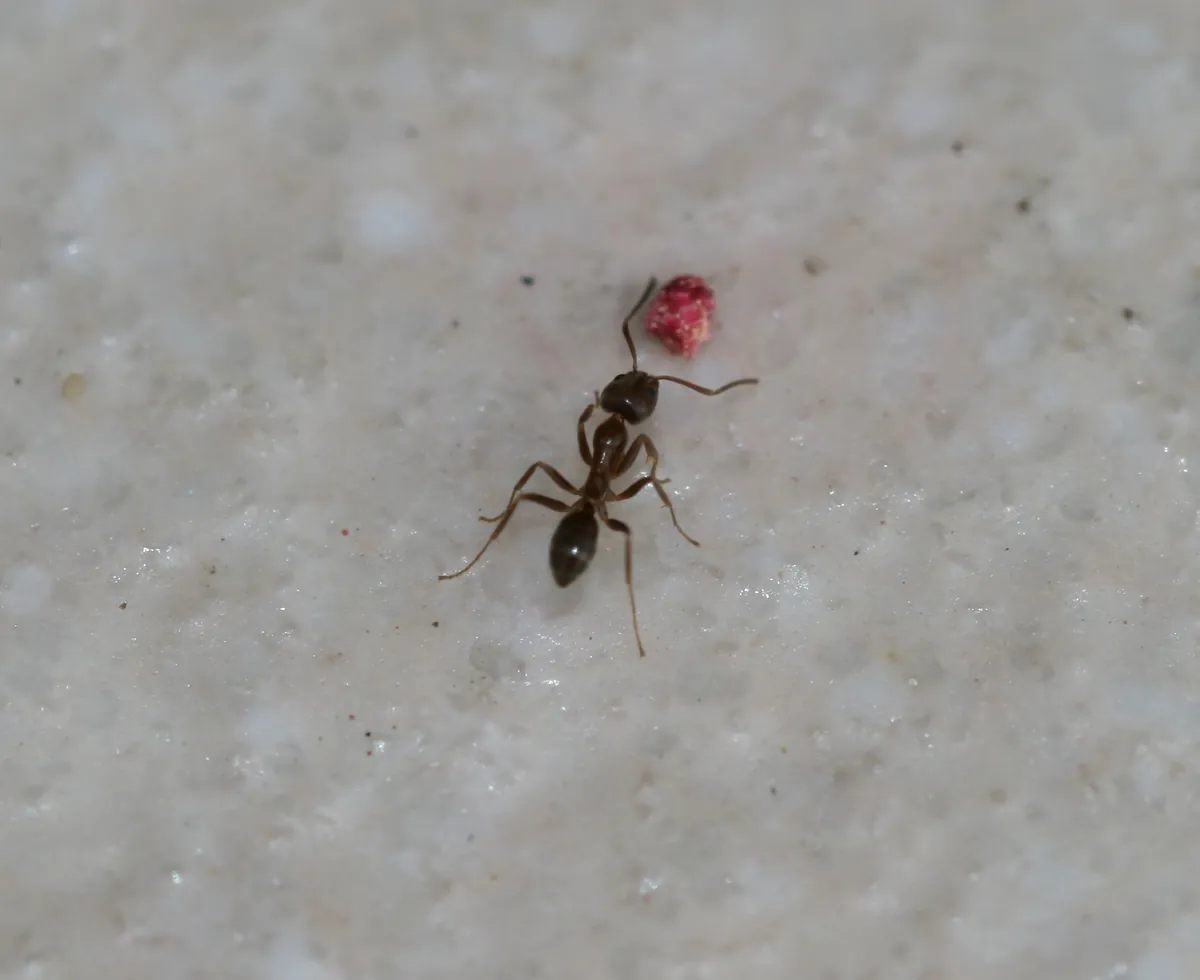
Lay the chain of nests over your own city
The 31 coastal nests, joined in order, with the same distances and compass bearings leg by leg, start in the city you choose. Straight lines through the nests add up to 2,811 km, shorter than the coast because they cut across bays.
Are the ants of California and Japan the same supercolony?
For the biggest supercolonies, tests between continents found little or no aggression. Van Wilgenburg, Torres and Tsutsui (2010) put pairs of workers in dishes for three minutes and counted a trial as aggressive if a worker flared its mandibles, recoiled, bit or grabbed. Ants from the large Californian supercolony showed no aggression towards ants from Japan (0 of 50 trials), Europe (0 of 50) or New Zealand (0 of 50), and little towards those from Australia (4 of 50).
Pick two sites on the world map: the study’s own pairings.
The drawing shows behaviour from the paper’s scale, with ants roughly six times larger than life. The result comes from the paper.
There are limits. “Europe” in those tests is one nest, from Marseille. And not every supercolony joins: a smaller second supercolony in California was aggressive towards ants from Europe (in 47 of 50 trials), Japan (45 of 50) and Australia (38 of 45). One from South Africa was aggressive towards the big Californian one (20 of 50). The authors write that “it is likely we have only revealed the tip of the iceberg”.
In Japan one supercolony is spread widely, while three others live only around the port of Kobe, Sunamura and colleagues found in 2009.
Ants spread on foot by budding, up to about 150 m a year (the average of the maximum yearly distances); human transport jumps three orders of magnitude farther (Suarez, Holway and Case 2001). The earliest known records: the island of Madeira between 1847 and 1858; continental Europe 1890–1896, all in Portugal; Italy by 1902, France about 1906, Spain by 1916 (Wetterer and colleagues 2009).
Are they related? Apparently not: what they share is a recognition code
Ants tell nestmates from strangers by smell: a blend of chemicals on the body surface, the cuticular hydrocarbons. In Argentine ants the more alike two nests’ blends are, the fewer workers fight: aggression rose with the chemical distance between the colonies’ hydrocarbon profiles.
Nestmates are not relatives: the 2002 paper calls relatedness between nestmates “effectively zero”. Nests far apart also differ in their DNA (an index of genetic difference, FST, of 0.12), yet that difference did not predict who fought. “The level of aggression between workers strongly depends on whether they are from the same supercolony, but not on their overall genetic dissimilarity.”
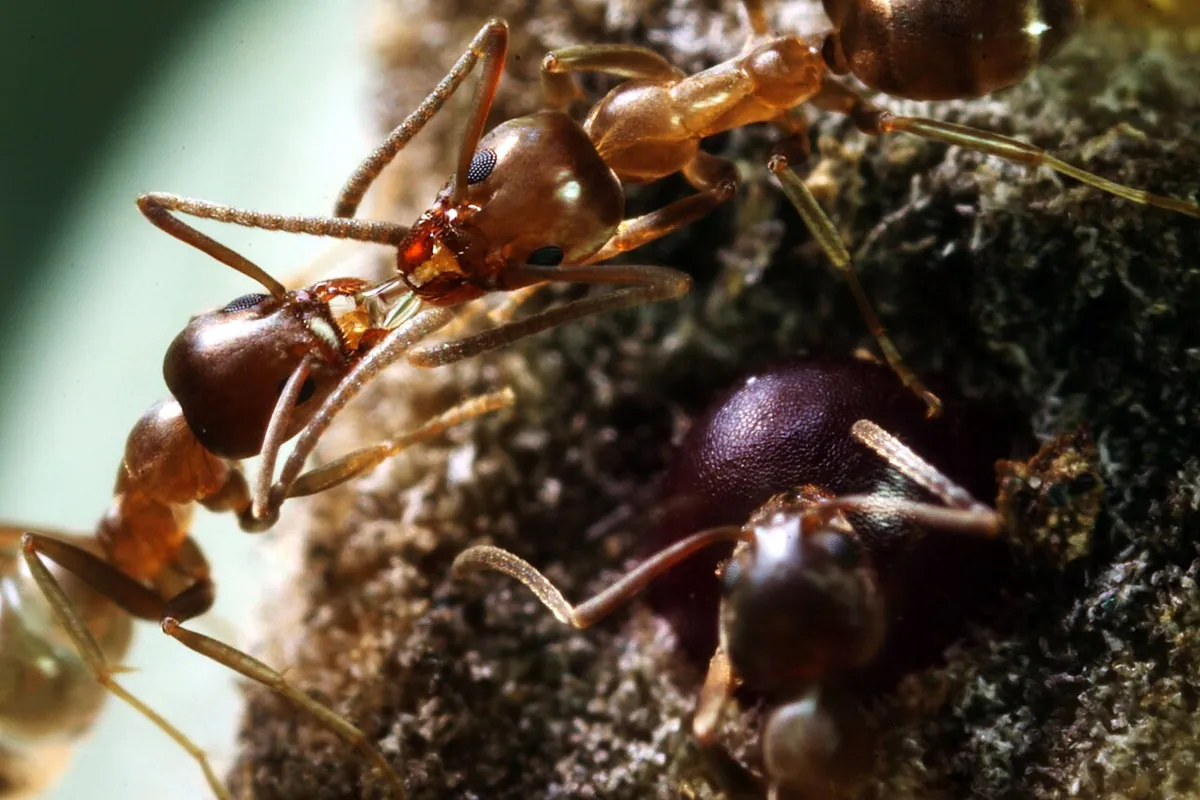
It is not diet or place either. Workers born in the laboratory still killed each other later: most workers in the 6-month test and all in the 18-month test had hatched there, and all 30 trials between the two supercolonies scored 5.
How could one code spread across so many nests? The authors suggest “genetic cleansing”: where nests are crowded, ants with the commonest code fight less and do better, so rare codes disappear. It is their proposal, not a demonstrated mechanism. Their simulation suggests that at least 6–13 unrelated mated queens must have been introduced into Europe.
In Argentina, the ants’ home, the picture is subtler. The 2002 paper described “systematic aggression between workers from different nests”, but Pedersen and colleagues (2006) found that native ants also form supercolonies of unrelated nestmates, only far smaller: 25–500 m across.
What was not tested?
- Each of the 33 populations is one nest, and each trial paired one worker from each side for ten minutes in a laboratory, in 2000. Nobody tested every nest in between.
- The 6,004 km is a distance along the coast between the farthest nests, not a chain of nests that was followed.
- “Millions of nests” and “billions of workers” are an estimate. We found no published count.
- The paper counts 33 populations; its printed map shows 32 markers, so two probably overlap. The 32 are drawn here at positions read from that map, approximate to within several tens of kilometres.
- The idea of one supercolony spanning continents rests on a few sites. The European one in those tests is one nest in Marseille.
- A 2024 preprint found the main and Catalonian supercolonies of Europe and a supercolony in Chile “genetically highly differentiated” from one another. Supercolonies are separate units, even where each is huge.
Are there Argentine ants in Romania?
No record has been found. The species is not in the 2006 checklist of Romanian ants (103 species), and GBIF holds no Romanian record. The same checklist says a considerable number of species “remains to be detected”, and records of absence are not proof of absence. The nearest published records we found are in Bulgaria: Sofia, Varna and Burgas, from a 1992 source, and later described as known “only indoors and from greenhouses”.
Will it last?
The 2002 authors expected such a system to be unstable, because workers raise unrelated young, and suggested it might be “a transient social system doomed to failure”. That is an expectation. A 2021 study of the Balearic Islands and Corsica found that the three European supercolonies kept their positions and expanded to new places.
Sources
- Giraud, Pedersen and Keller (2002). Evolution of supercolonies: the Argentine ants of southern Europe. PNAS 99:6075–6079.
- Jaquiéry, Vogel and Keller (2005). Multilevel genetic analyses of two European supercolonies of the Argentine ant. Molecular Ecology 14:589–598.
- Van Wilgenburg, Torres and Tsutsui (2010). The global expansion of a single ant supercolony. Evolutionary Applications 3:136–143.
- Sunamura and colleagues (2009). Four mutually incompatible Argentine ant supercolonies in Japan. Biological Invasions 11:2329–2339.
- Brandt, Van Wilgenburg, Sulc, Shea and Tsutsui (2009). The scent of supercolonies: the discovery, synthesis and behavioural verification of ant colony recognition cues. BMC Biology 7:71.
- Blight and colleagues (2012). Variation in the level of aggression, chemical and genetic distance among three supercolonies of the Argentine ant in Europe. Molecular Ecology 21:4106–4121.
- Castro-Cobo, Blight, Espadaler and Angulo (2021). Long-term spread of Argentine ant European supercolonies on three Mediterranean islands. Myrmecological News 31:185.
- Pedersen, Krieger, Vogel, Giraud and Keller (2006). Native supercolonies of unrelated individuals in the invasive Argentine ant. Evolution 60:782–791.
- Wetterer, Wild, Suarez, Roura-Pascual and Espadaler (2009). Worldwide spread of the Argentine ant. Myrmecological News 12:187–194.
- Suarez, Holway and Case (2001). Patterns of spread in biological invasions dominated by long-distance jump dispersal: insights from Argentine ants. PNAS 98:1095–1100.
- Burford and colleagues (2018). Foraging behavior and locomotion of the invasive Argentine ant from winter aggregations. PLoS ONE 13.
- Markó and colleagues (2006). A comprehensive list of the ants of Romania. Myrmecologische Nachrichten 9:65–76.
- Argentine ant in Bulgaria: Atanassov and Dlusskij (1992), via the ZooKeys 62 checklist (2010); Biodiversity Data Journal 10:e95599 (2022).
- GBIF.org: occurrence records of Linepithema humile, queried 2 October 2026.
- NASA Moon fact sheet: distance to the Moon.
- University of Florida IFAS, Argentine ant fact sheet: worker length.
Nest positions come from the paper’s Figure 1, read at a few tens of kilometres’ precision. Observations come from GBIF (CC BY and CC0 records only). The coast and land outlines come from Natural Earth (public domain).
Records from GBIF (CC BY or CC0), 895 of them in this view. They show where people take photos, not where the ants stop.