The Danube, AD 100
Six words carved into a cliff above the Danube that a Romanian can half-read
On a limestone cliff at the narrowest point of the Iron Gates gorge, where the Danube squeezes to 150 metres across and flows above 50 metres of water, someone carved an inscription 1,926 years ago. The last sentence says, in brief, what the emperor did: montibus excisis anconibus sublatis viam refecit. Two of the six words survived into Romanian nearly unchanged. Then the dam came.
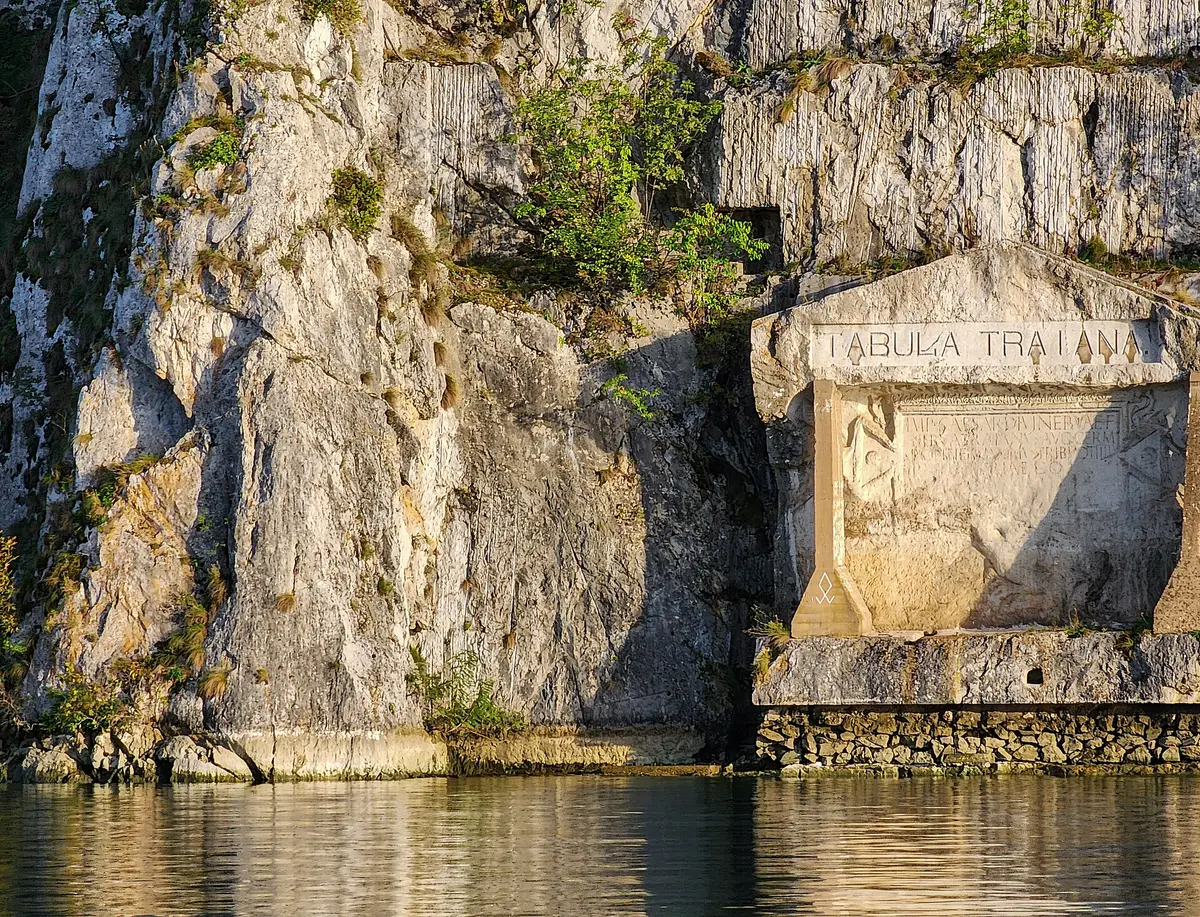
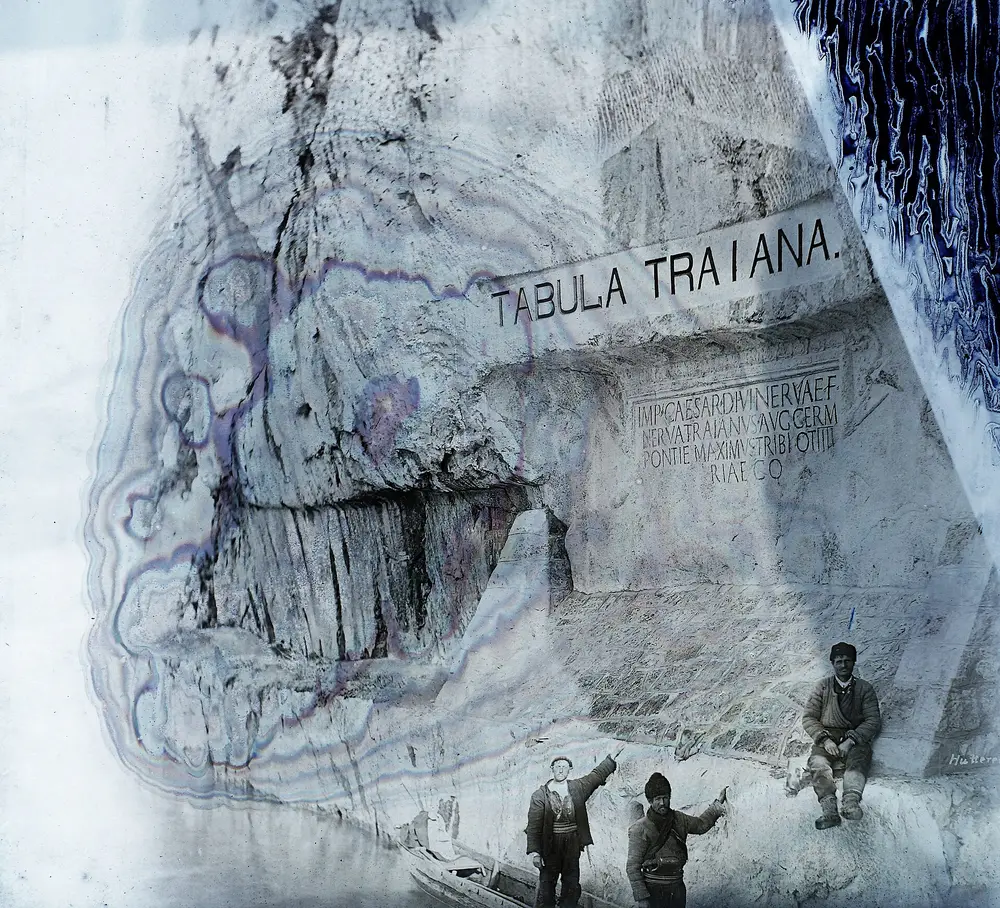
Imp · Caesar · divi · Nervae · f
Nerva · Traianvs · Avg · Germ
Pontif · maximvs · trib · pot · IIII
Pater · patriae · cos · III
montibvs · excisis · anconibvs · svblatis · viam · refecit
Where the Danube fits through a crack
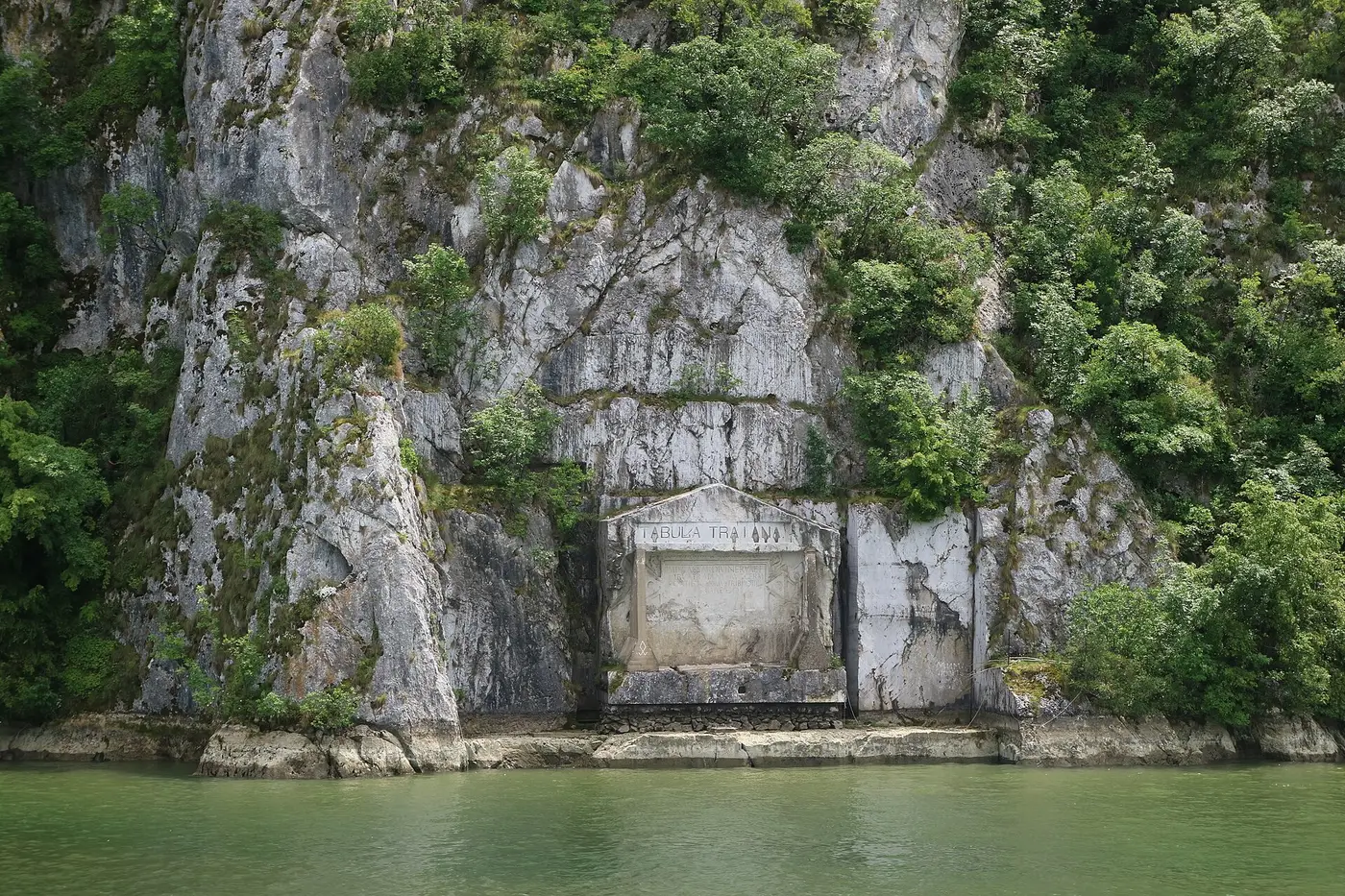
The Tabula Traiana stands on the Serbian bank of the Danube, at the exit of the Little Cauldrons (Mali Kazan), where the Miroč mountains drop vertically into the water. The limestone cliff falls straight, with no bank, into depths exceeding 50 metres. Between the two shores, about 150 metres of current remain.
The inscription was carved into the rock in AD 100, on the orders of Emperor Trajan. The date is precise: the text says Trajan held the tribunician power for the fourth time (trib. pot. IIII) and was consul for the third time (cos. III). The fourth tribunician power ran from 10 December 99 to 9 December 100, and the third consulship started on 1 January 100. The titles therefore date the plaque to AD 100; the absence of the title Dacicus is consistent with that date, before the First Dacian War of 101–102.
The inscription is not a plain plaque: it is a sacellum, a miniature temple façade carved into the rock. Above the text, a coffered vault with rosettes. In the pediment, an eagle with outstretched wings — symbol of the legions and imperial power. Two dolphins flank the pediment. Two winged genii hold the edges of the tablet. Below, a kneeling bearded figure: probably the river Danube personified, looking up at the inscription.
- Where
- Little Cauldrons (Mali Kazan), right bank of the Danube, Đerdap National Park, Serbia; 44°39′N, 22°18′E
- When
- AD 100, between 1 January and 9 December
- Number
- CIL III 1699 = CIL III 8267 = ILS 5863
- Dimensions
- Plaque: about 4 × 1.75 m
- How to reach it
- Only by boat, from Orșova, Dubova, or Tekija; no road access exists
The first four lines are the emperor's titles: name, divine filiation, offices. The last line says what he did: he cut through the mountain and remade the road. In Latin, that takes only six words.
.jpg)
Six words: two survived, two shifted, two vanished
Pick a word from the last line. The colour tells you what happened to it between Rome and Craiova.
- survived into Romanian
- meaning survived, word didn't
- lost
2 survived · 2 shifted · 2 lost

-
montibvs
munte
survived into Romanian
Latin mons, montem passed directly into Romanian as munte (plural munți). The sound change is regular: the accusative montem gave munte, just as fontāna gave fântână (fountain) and pontem gave punte (footbridge). In the inscription, the ablative plural montibus appears, "from the mountains." The word passed identically into all Romanian dialects: Daco-Romanian, Aromanian, Megleno-Romanian, Istro-Romanian.
-
excisis
—
lost
Latin excidere, "to cut out, to carve," did not pass into Romanian. The Romanian word a tăia (to cut) comes from Late Latin taliare. The root caedere ("to cut") lives on only in learned compounds, like Italian decidere and French décider.
-
anconibvs
—
lost
A Greek word borrowed into Latin: ancon (from ἀγκών, "elbow") meant a corbel, a cantilever bracket — exactly the wooden arm that supported the road above the Danube. It left no descendant in Romanian, though related words exist in Spanish and Portuguese. The construction itself is described in the next section.
-
svblatis
a ridica
meaning survived, word didn't
Latin sublatus, the participle of tollere ("to raise"), did not pass as such into Romanian. The verb tollere itself survived in Italian togliere, but vanished from Romanian; its meaning is expressed today by a ridica, of Latin origin, though the exact form is disputed.
-
viam
cale, drum
meaning survived, word didn't
Latin via ("road") vanished entirely from popular Romanian — it is the only Romance language where this happened (Italian has via, French voie, Spanish vía). Its place was taken by cale, from Latin callis, which meant "rough mountain path, stony defile, track trodden by herds." If the language preferred "mountain path" over "paved road," perhaps that says something about the world its speakers lived in: a world of mountains with flocks, where the Empire's paved roads were far away. Later, drum arrived from Greek δρόμος, directly or via South Slavic — the route is disputed.
-
refecit
a (re)face, făcut
survived into Romanian
Facere gave Romanian a face — one of the most used verbs in the language. The participle factum gave făcut. The perfect fecit ("he made") continues in the simple past făcu, the form you hear today in Oltenia — the exact region north of the Danube, directly across from where the inscription is carved. The prefix re- ("again") also survived: a reface means exactly what Trajan says he did. The text reads refecit, not fecit: Trajan remade a road first cut under Tiberius and repaired under Domitian.
The lost words — excisis and anconibus — are the most technical: cutting stone and the cantilever bracket. The survivors — munte and a face — are the most common. The most revealing is via: it vanished from Romanian, yet survived in every other Romance language. Its replacement, cale — "mountain path" — seems to carry within it the history of the shepherds who spoke an early Romanian in the Balkan mountains, far from the paved roads of the Empire.
What a road cut through the mountain looks like
The inscription says three things: the mountains were cut (montibus excisis), the brackets were raised (anconibus sublatis), the road was remade (viam refecit). The three actions fit the method of the Roman road through the gorge, as archaeologists reconstruct it from the cuttings preserved in the rock — though the inscription alone does not spell out every construction detail.
Where the limestone bank allowed, a ledge about one and a half metres wide was carved into the rock. Exactly how the legionaries cut it is uncertain: chisel, pickaxe, and — where the rock was too hard — fire followed by vinegar are plausible hypotheses, not site evidence. Where the cliff dropped straight into the water with no bank at all, the road was suspended.
From the rectangular cavities cut into the vertical wall, timber beams projected in cantilever — the ancones — carrying the deck. What the struts looked like, how wide the road was, and which timber it used can no longer be established precisely; reconstructions speak of a narrow wooden road above the water.
The road probably doubled as a towpath: barges were hauled upstream past the gorge's swift currents.
The inscription names these beams ancones, from the Greek ἀγκών — "elbow." The beams behaved like an elbow: one arm fixed in rock, the other reaching out horizontally. Their square sockets are still visible in the gorge cliffs when the reservoir level drops.
When the water came
In 1964, Romania and Yugoslavia began building the Iron Gate I Dam, the largest on the Danube. The dam, completed in 1972, raised the upstream water level by up to 35 metres — the maximum at the dam; further up the gorge, the rise was smaller. The Roman road, the islands (including Ada Kaleh), the villages, and the old town of Orșova vanished beneath the lake, while the prehistoric site of Lepenski Vir was moved to higher ground, nearly 30 metres above its old hearth.
The Tabula Traiana stood low, beside the Roman road. The new reservoir level would have buried its original site about 20 metres below the planned waterline.
The decision was to move it in one piece. Between 1967 and 1969, the craftsmen of the firm Venčac of Aranđelovac — some of whom had moved pharaonic tombs in Egypt in the years of the Aswan Dam — cut a block of 260–270 tonnes (about 300 with its associated structure) from the mountain and raised it, centimetre by centimetre, with cables, timber beams, and small hydraulic jacks built by the specialists of Mostogradnja.
The block was lifted 21.5 metres and set into a prepared seat higher up the cliff. The lift and placement were completed, according to the conservation report, in autumn 1969, before the reservoir flooded the old river bed.
Today, at ordinary reservoir level — which fluctuates — the water strikes the rock just a few metres below the base of the relocated block. The Roman road is entirely submerged. Visitors reach the inscription only by boat, from Orșova or Dubova on the Romanian bank, or from Tekija on the Serbian bank.

- c. AD 33Tiberius cuts the first military paths through the gorge.
- 93–94Domitian orders the deteriorated road repaired.
- 100Trajan remakes the road with cantilevered beams. The Tabula Traiana is carved.
- 103–105Apollodorus of Damascus builds the bridge at Drobeta: 1,135 metres, 20 masonry piers, wooden arches. It remains the longest arch bridge in the world for over a thousand years.
- 117–138Hadrian removes the bridge's wooden superstructure.
- 1964Construction of the Iron Gate I Dam begins.
- 1967–1969The Tabula Traiana is cut from the mountain and raised 21.5 m.
- 1972The dam is operational. The reservoir floods the gorge.
Sources
Etymologies are from the dictionaries on dexonline (DEX, DER). The translation of the last line is literal.
- Corpus Inscriptionum Latinarum III, 1699 = III, 8267 (Hirschfeld). cil.bbaw.de
- Inscriptiones Latinae Selectae 5863 (Dessau).
- Cassius Dio, Roman History 68.13 (description of Trajan's bridge). penelope.uchicago.edu
- dexonline: DEX, DER (Ciorănescu) for munte, a face, cale, and drum. dexonline.ro/definitie/munte
- Večernje novosti: "Trajanova tabla: Rimljani je postavili, Aranđelovčani premestili" (30 April 2016, eyewitness account of the 1967–1969 move). novosti.rs
- Institute for the Protection of Cultural Monuments: the 1969 conservation report on the move (Serbian/French). heritage.gov.rs (PDF)
- Politika: interview with the move's chief engineer (2016). politika.rs
- Wikipedia: "Tabula Traiana" (en, ro, sr, de). en.wikipedia.org/wiki/Tabula_Traiana
- Atlas Obscura: "Tabula Traiana." atlasobscura.com