Azizyie mosque, Tulcea: two years on one wall, 1863 and 1865
The plaque by the door says 1865. The heritage list says 1863. The scholar gives a whole reign, 1861 to 1876, and no year. Three lines about one building: lay them on the wall, piece by piece, and measure what can be measured.
In 2026: 163 years by the list, 161 by the plaque.
The year calculation runs locally in your browser.
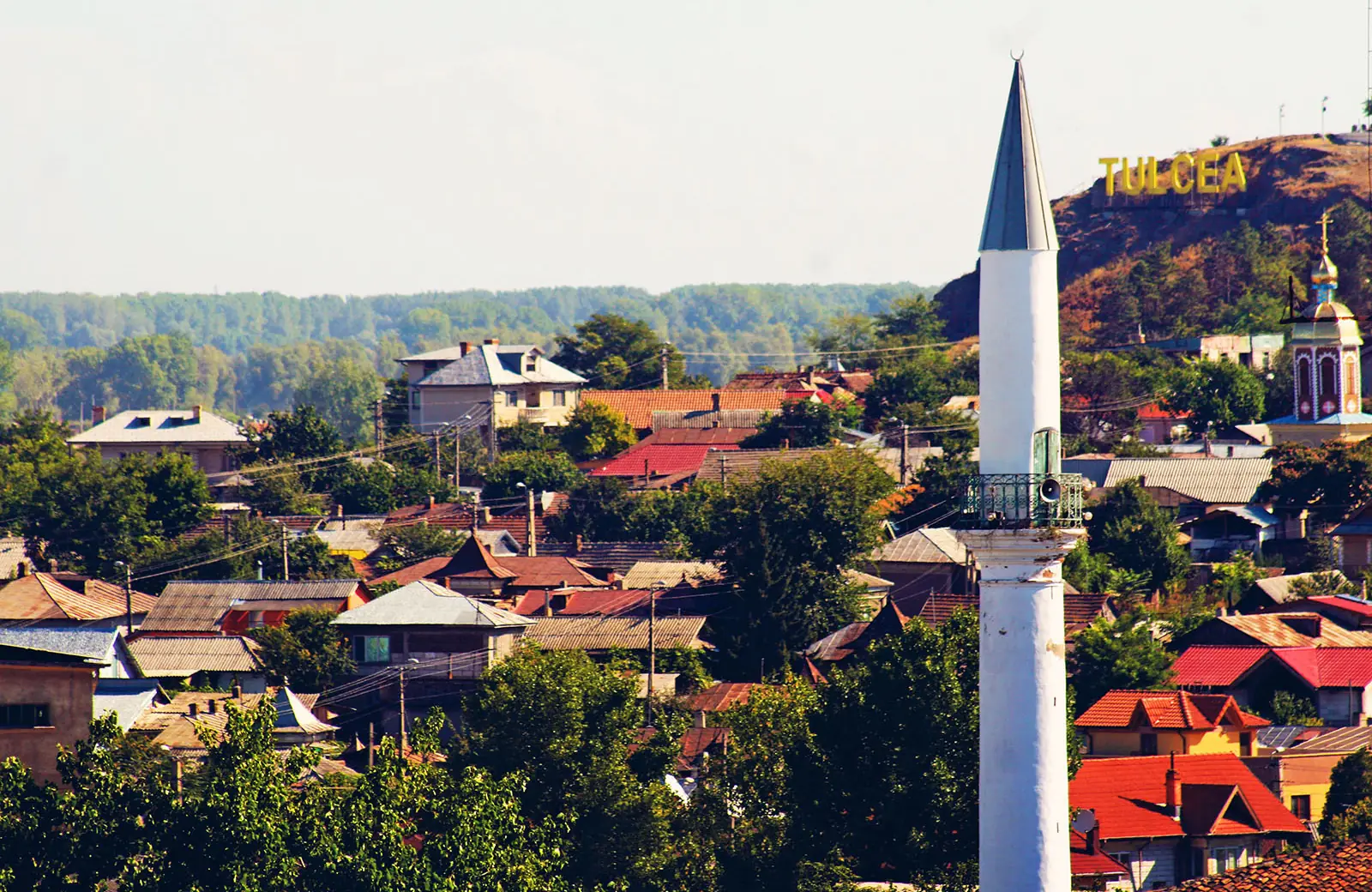
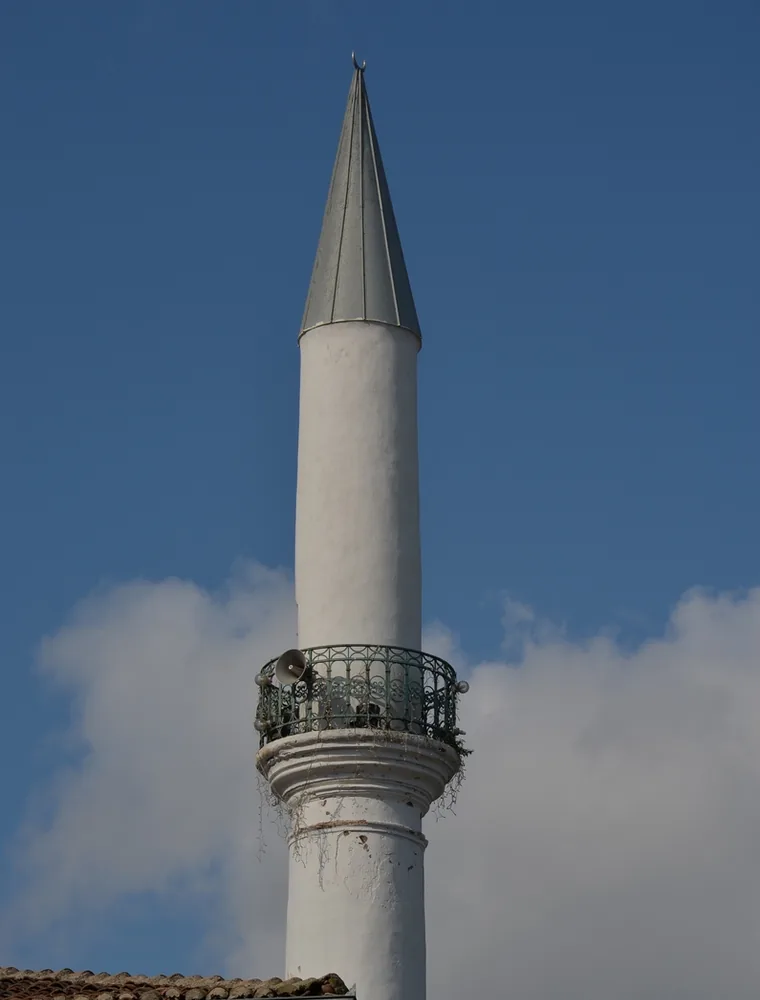
The minaret of the Azizyie mosque above Tulcea, with the hill that spells TULCEA. Photo: Colicaranica, Wikimedia Commons, CC BY-SA 4.0.
Share
When was the Azizyie mosque built, in 1863 or in 1865?
At 2 Independenței Street, in the centre of Tulcea — a Romanian port town on the Danube — stands a white, square building with two rows of arched windows and a thin minaret attached to its wall. It is the Azizyie mosque, named after Sultan Abdülaziz, in whose reign it was raised. By the door, a white plaque says, in Turkish and Romanian, that the mosque was built in the time of Sultan Abdülaziz: 1865.
Romania’s listed-buildings register says another year: 1863. Row 493 records “Moscheea Azizyie”, Tulcea, 2 Independenței Street, dated 1863, code TL-II-m-A-05984, category A. And Semavi Eyice, the historian who described the mosque in the Islamic encyclopedia in Istanbul, gives no year: from its name and its architecture, he writes, the building belongs to the reign of Sultan Abdülaziz, 1861–1876.
Three lines, three datings, one wall. The sources opened here give no documentary basis for the year: no firman opened, no deed of endowment opened. Eyice notes that, architecturally, the building carries no ornament at all. So no year is picked: the three datings are laid on the wall, one after another, and what can be measured is measured.
The records give different years, and the cause of the discrepancy is not established. The plaque is a white, modern tablet with Romanian text lacking diacritics — and 1865 is also the year on the Muftiate’s page, archived in 2013 and 2017. The list is an administrative act of 2010, which records the year without showing its source. The scholar writes in 1991 and dates by style, not by paper. Three ways of knowing, three answers.
1863 and 1865 disagree with each other; the reign-based dating, 1861–1876, accommodates both. And the scholar’s word meets a measure on the wall: “about 20 metres”, he wrote; 19.1 metres is what the building’s open outline gives, with the difference printed beside it.
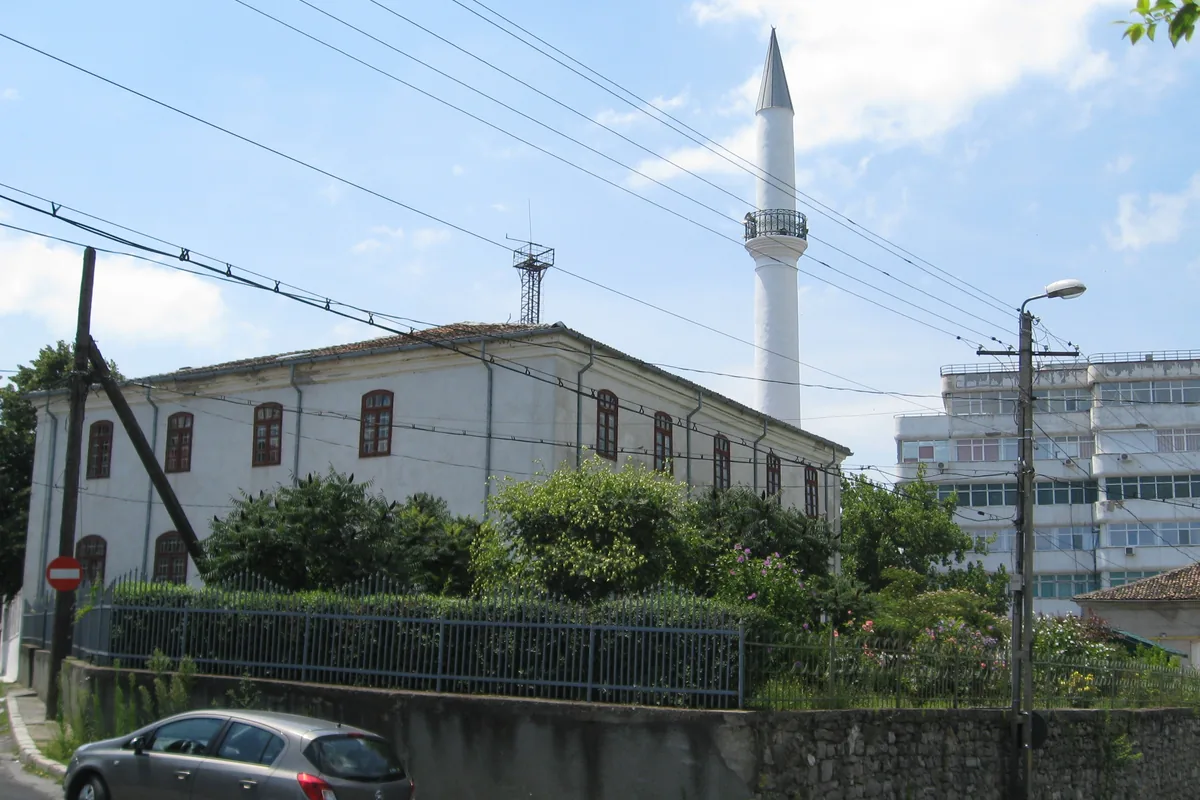
The mosque from the street: white wall, two window rows, minaret behind. Photo: Biruitorul, Wikimedia Commons, CC0.
What did Tulcea look like when the mosque was raised?
Tulcea was then Tulça, a Danube landing and market town on the Danube’s right bank, at the entrance to the delta. Dobruja — the region between the Danube and the Black Sea — had come under Ottoman rule in 1419; around 1530, the Tolçı landing and village counted 167 households, 59 bachelors, 13 widows and 55 households from elsewhere temporarily staying there, plus two Roma households — about 1,500 people, with a landing revenue of 56,000 akçe.
In 1621, Sultan Osman II, passing through Tulça on the Polish campaign, had a fort, a mosque and a bath raised here. In the seventeenth century Tulça became the centre of a kaza — an Ottoman district — and in 1657 Evliya Çelebi saw the town and described the fort on the Danube bank. In the nineteenth century the town entered, with all of Dobruja, the Danube vilayet (province) of Midhat Pasha.
When the mosque was raised, Tulça was an Ottoman landing and market town on the Danube road, and the mosque rose in the middle of town. Ottoman rule over Dobruja lasted 459 years, from 1419 to 1878 — and the mosque was raised 13 or 15 years before that line, depending on which year you count.
By the decisions of the Congress of Berlin in 1878, Northern Dobruja passed to Romania, and Tulça left Ottoman administration. Part of the town’s Muslim population left then for Ottoman lands. The mosque stayed: in 1878 it was 13 years old by the plaque or 15 by the list. In 1966 Eyice found the interior clean, with the carpets laid, but the windows broken; in 1976, Eyice writes, Ekrem Hakkı Ayverdi found the building in very good condition. Between the two viewings, ten years apart, the Muftiate places a restoration: 1970.
Today Tulcea is a county capital. The town also has an Orthodox cathedral and Armenian, Russian and Catholic churches — the listing is the TULÇA article’s. Of the landing of around 1530, a port town remains where the river splits toward the delta; of the Ottoman market town, among other things, the white wall at 2 Independenței Street.
The mosque and minaret from the Danube, among Tulcea’s houses. Photo: Jmabel (Joe Mabel), Wikimedia Commons, CC BY-SA 4.0.
Year on stage: —
Touch a piece of the drawing or a name below: each tells its date.
The line from the records
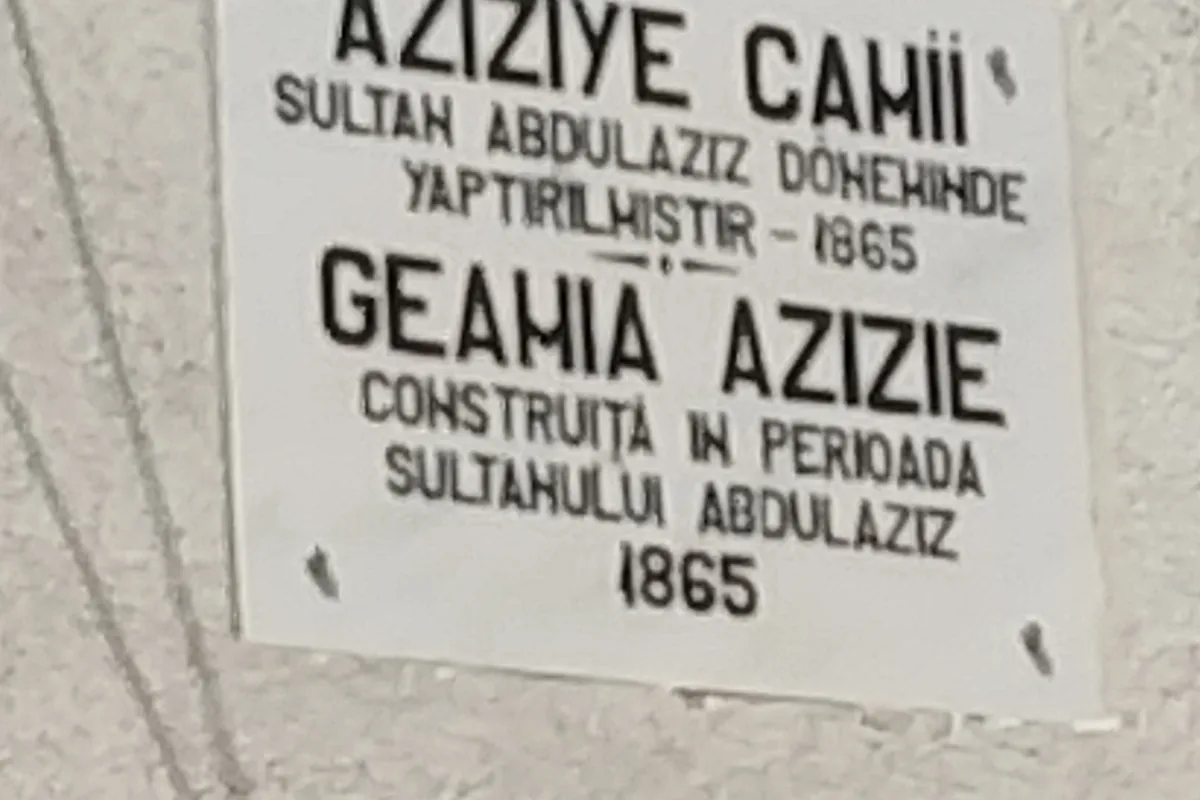
“AZİZİYE CAMİİ / SULTAN ABDULAZIZ DÖNEMINDE / YAPTIRILMISTIR – 1865” — “GEAMIA AZIZIE / CONSTRUITA IN PERIOADA / SULTANULUI ABDULAZIZ / 1865”
The plaque on the wall, transcribed from Balkanique’s photograph, 2018 (CC BY-SA 4.0).
The line from the records
“493 TL-II-m-A-05984 Moscheea Azizyie municipiul TULCEA Str. Independenţei 2 1863” — “494 TL-II-m-B-05985 Fosta şcoala turcească municipiul TULCEA Str. Independenţei 4 1865”
The 2010 heritage list, Tulcea county, Official Gazette 670 bis/2010.
The line from the records
“Adından ve mimarisinden de anlaşıldığı gibi Sultan Abdülaziz’in saltanat yıllarında (1861-1876) yaptırılmıştır.”
Semavi Eyice, “AZİZİYE CAMİİ”, the TDV Islamic encyclopedia, vol. 4, 1991, pp. 347–348.
The line from the records
“Her bir kenarı dıştan 20 m. kadar uzunlukta bir kare biçiminde” — “a square with each side, outside, about 20 m long”.
Eyice, 1991; the outline: OpenStreetMap, way 854940904.
On the map the side is 19.13 m; the scholar wrote “about 20 metres”. The difference is under one metre.
The line from the records
“Sağ duvarına bitişik ince, uzun bir minaresi vardır.”
Eyice: a thin, tall minaret, attached to the right-hand wall; Ülgen (2013): with a single balcony.
“In anul 1897 … este refacut minaretul daramat al moscheii.”
Valentina Postelnicu, Tulcea de altădată, quoted by the county library — with a 1,000 lei grant from the ministry; a later history, not the act of the time: “… the collapsed minaret of the mosque was rebuilt.”
The line from the records
“1966’da gördüğümüzde Aziziye Camii’nin içi temiz ve halıları döşeli olmakla beraber camları kırıktı.”
Eyice on the 1966 viewing and on Ayverdi’s reported 1976 viewing; the Muftiate attests the 1970 restoration.
The line from the records
“1878 Berlin Kongresi kararları uyarınca Kuzey Dobruca kesiminin Romanya’ya verilmesi üzerine Tulça Osmanlı idaresinden çıktı.”
The TULÇA article, the TDV Islamic encyclopedia: in 1878, Tulça leaves Ottoman administration.
The line from the records
“Pe langa geamie a mai functionat si o scoala turca.”
Postelnicu, quoted by the county library: beside the mosque a Turkish school functioned.
What the figure shows
The drawing shows the mosque as a schematic elevation: wall with two window rows, door with plaque, adjoining school, minaret and wooden gallery inside. Heights are schematic; only the 19.1 m footprint is measured.
Plaque — The white tablet by the door: 1865, in Turkish and Romanian.
Wall — The prayer-hall wall: 1863 in the list, 1865 on the plaque.
School — The school house at number 4: 1865, in the list.
Minaret — Thin, against the wall, one balcony; rebuilt in 1897, says the town history.
Gallery — The U-shaped wooden gallery on pillars — so Eyice describes it.
Roof — Tiled roofing on timber, in the Tanzimat style (Eyice, 1991).
Plan — The footprint: 19.1 m a side, from the open outline.
Schematic drawing after photographs, Eyice’s article and the OpenStreetMap outline; heights are not to scale, the school’s seat is schematic.
Three datings on one wall
Each stop lays one record line on the piece of wall it names.
The plaque
1865, by the door
On the wall, a white tablet gives the year in two languages: Turkish above, Romanian below, the Romanian text without diacritics. The tablet is modern, with painted letters, and the year it carries, 1865, is also the year on the Muftiate’s page.
The plaque, tightly framed: 1865, in Turkish and Romanian. Photo: Balkanique, Wikimedia Commons, CC BY-SA 4.0.
Scroll on: the list.
The list
1863, in the official gazette
The heritage list records the mosque at row 493: “Moscheea Azizyie”, 2 Independenței Street, dated 1863, category A. The next row, 494, records the former Turkish school, at number 4, dated 1865. Two neighbouring buildings, two neighbouring years, one act.
Scroll on: the scholar.
The scholar
A reign, no year
Semavi Eyice describes the mosque without giving it a year: by name and architecture, it belongs to the reign of Sultan Abdülaziz, 1861–1876, and to the Tanzimat style of the reform age. Unadorned; a square of about 20 metres a side; tiled timber roofing; two rows of windows, and no entrance porch.
Scroll on: the measure.
The measure
19.1 metres on the map
The scholar wrote “about 20 metres”. The building’s outline in OpenStreetMap measures 19.12 / 19.15 / 19.12 / 19.13 — 19.13 a side on average, an area of 366.4 m² against the round 400 m². The difference, 0.87 m, is under one metre: word and measure meet here.
Scroll on: the minaret.
The minaret
Thin, against the wall
The minaret is thin and tall, attached to the right-hand wall — Eyice's description; one balcony, after Ülgen; the photographs show railing, cap and crescent. The town’s later history says the collapsed minaret was rebuilt in 1897, with 1,000 lei from the ministry; the Muftiate says it was raised with Turkey’s support, undated.
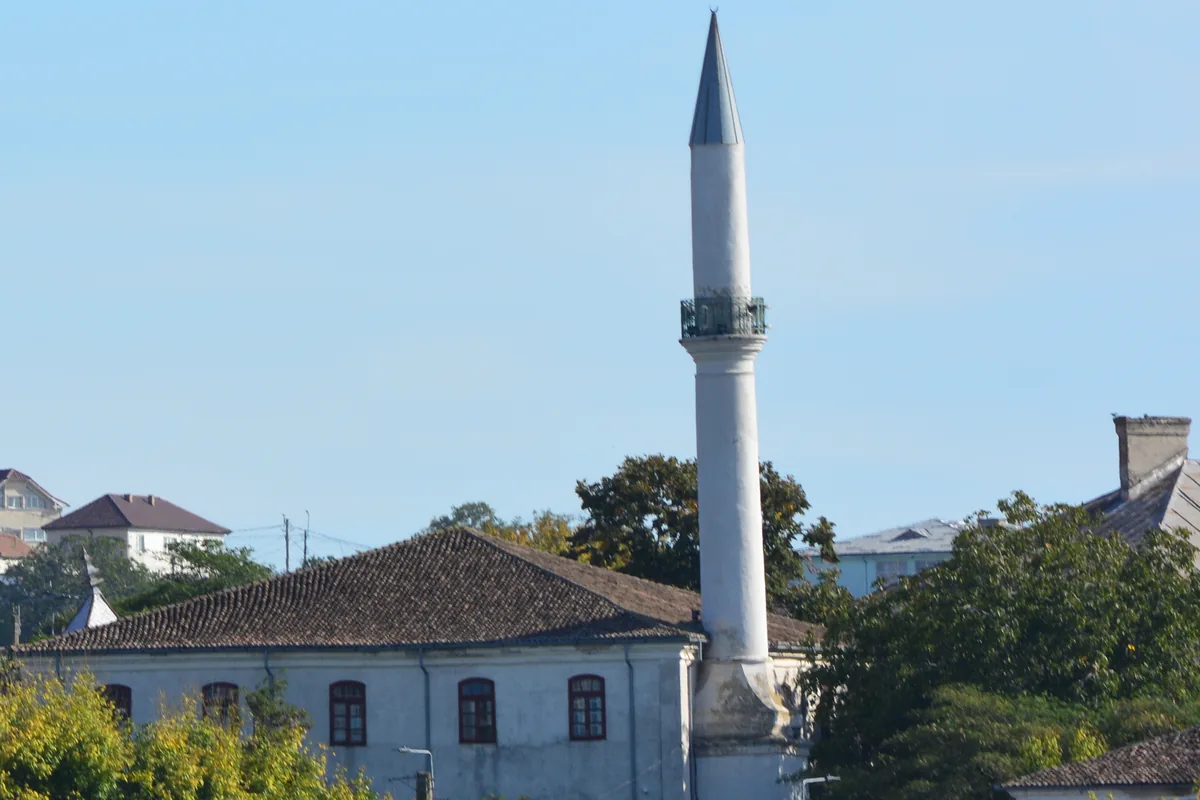
The minaret up close: a single balcony, cap, crescent. Photo: Dora Domsa, Wikimedia Commons, CC BY-SA 3.0 ro.
Scroll on: the windows.
The windows
Broken panes in 1966, sound building in 1976
In 1966 Eyice finds the interior clean and the carpets laid, but the windows broken. In 1970 the Muftiate records a restoration. In 1976, Eyice writes, Ayverdi found the mosque in very good condition. Ten years between the two viewings; one restoration between them.
Scroll on: the line.
The line
13 or 15 years before 1878
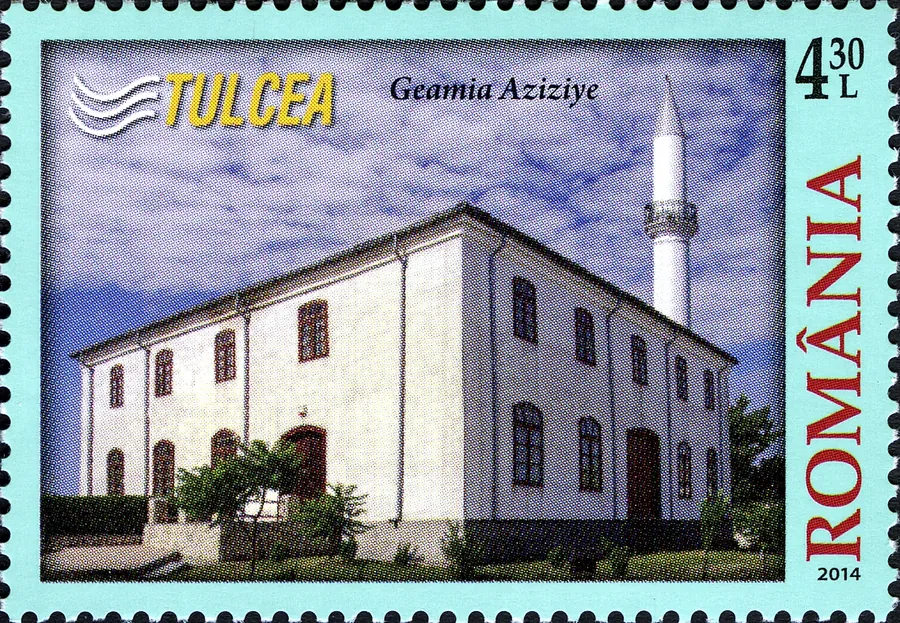
The mosque was raised 13 years before 1878, by the plaque, or 15, by the list. Then: Northern Dobruja passed to Romania, and part of the town’s Muslims left for Ottoman lands. The mosque stayed standing — and in 2014 it appeared on a Romanian stamp: “TULCEA — Geamia Aziziye”.
A Romanian stamp of 2014, 4.30 lei: “TULCEA — Geamia Aziziye”. Author: Post of Romania; uploaded by Cekli829; public domain.
Scroll on: today.
Today
Three things from the street
The plaque, by the door: two languages, one year, 1865. The school, at number 4: 1865 in the list, the plaque's year, in another act. The minaret: the thin shaft, the single balcony, the cap — its year is not established; 1897 is the year of a rebuilding from a book.
Scroll on: what to look at.
What to look at when you reach the mosque
The mosque stands at 2 Independenței Street, in the centre of Tulcea. Three things can be seen from the street, without going in — in the walk’s order.
The plaque, by the door
The white tablet gives the year in two languages: “AZİZİYE CAMİİ … 1865” above, “GEAMIA AZIZIE … 1865” below. The Romanian text has no diacritics and spells AZIZIE, with no Y. It is the dating you see first — and the Muftiate’s dating.
The school, at number 4
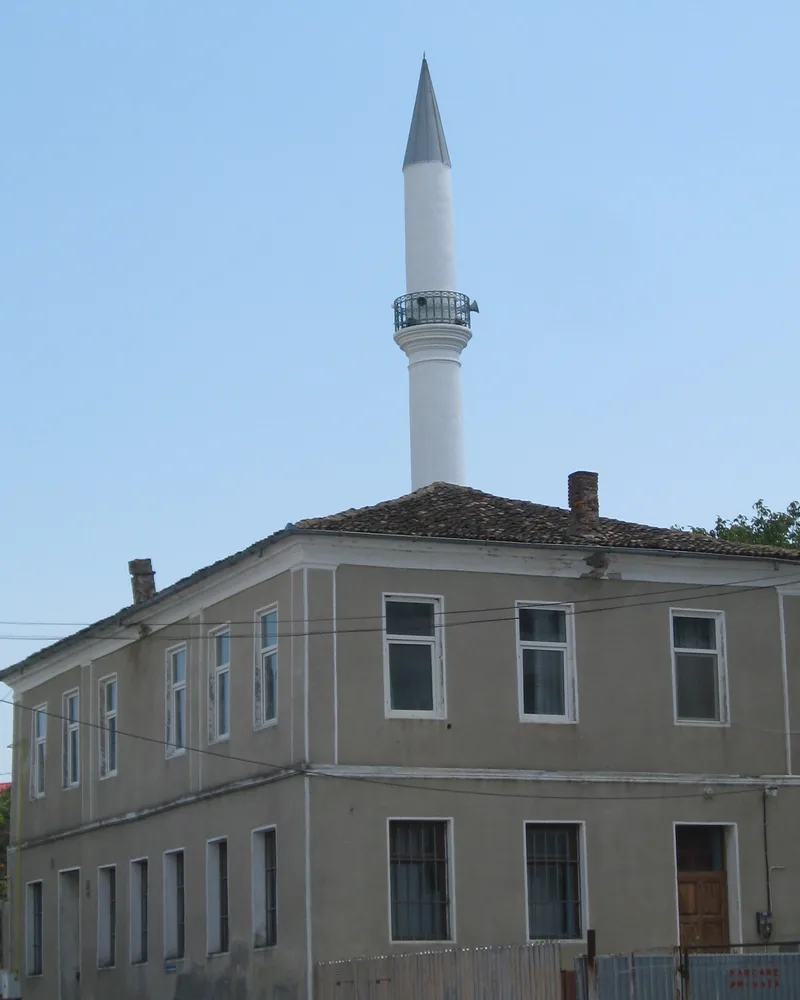
The house next door is the former Turkish school of the list: row 494, dated 1865, category B. In the photograph, the mosque’s minaret rises right behind it. Beside the mosque a Turkish school functioned — the sentence is the town history’s.
The minaret, from the ground up
The thin white shaft, as Eyice describes it; the single balcony, as Ülgen gives it; the iron parapet, conical cap and crescent, as the close-up shows them. The present wall’s year is not established: 1897 is the book’s year for the collapsed minaret rebuilt then.
The former Turkish school, with the mosque’s minaret behind. Photo: Biruitorul, Wikimedia Commons, CC0.
And if you remember a year — a birth, a grandmother — put it in the box at the top: the illustration shows what the records establish for that year, not what the wall looked like.
The wall, read on the spot
When you reach 2 Independenței Street, stand before the wall and read it in its order: the plaque by the door first, then the school door at number 4, then the foot of the minaret. Three datings in a single courtyard wall — 1865, 1865, and an 1897 rebuilding that stands in a book. And if you lost or won Tulcea in the game, go back to your year at the top: that year has its own line in the records too, with its date a year or two less settled.
Sources and the way of working
How the work was done
Every date on the wall comes from an opened record: the heritage list (rows 493–494), the Muftiate’s page (the 2013 and 2017 archives), Eyice’s article (1991) and the photograph of the plaque (2018).
Unsourced figures — the wall’s thickness, the windows’ number — stayed working notes, asserted nowhere. The year 1897 dates a rebuilding told by the town’s later history, quoted as such — not the present wall, and not from the archive act of the time.
No foundation inscription is transcribed in the sources opened here: a 2013 study states the mosque has no construction inscription, and the plaque on the wall is a modern, bilingual tablet.
The side measurement comes from the building’s open polygon in OpenStreetMap, with the difference printed beside it; anyone can redo the sum from the same data.
The house of worship is historic; Eyice wrote in 1991 that it was open for worship, Ülgen wrote the same in 2013. Nobody is described and nothing is imagined about those who pray here.
Where the records contradict each other, the contradiction stays in the open: 1863 and 1865 stand side by side to the end.
Records
The 2010 heritage list, Tulcea county: row 493 (the mosque, 1863) and row 494 (the former Turkish school, 1865).
The Muftiate of the Muslim Community of Romania, “Geamia Sultanului Abdulaziz – Tulcea (1865)” — founded by Sultan Abdülaziz, restored in 1970, minaret with Turkey’s support (2013–2017 archive).
Semavi Eyice, “AZİZİYE CAMİİ”, TDV İslâm Ansiklopedisi, vol. 4, 1991, pp. 347–348 — the 1861–1876 reign, the Tanzimat style, the side of about 20 m, the 1966 viewing and the reported 1976 Ayverdi viewing.
The TULÇA article, the same encyclopedia — Ottoman Tulcea, 1419–1878, the year 1863 for the mosque.
Images
The plaque on the wall: Balkanique, 2018, CC BY-SA 4.0 (the transcription is the author’s, from the photograph).
The minaret above the town: Colicaranica, CC BY-SA 4.0; the mosque from the Danube: Jmabel, CC BY-SA 4.0; the facade: Biruitorul, CC0.
The minaret above the town (Colicaranica), the mosque from the Danube (Jmabel), the plaque (Balkanique): CC BY-SA 4.0; cropped to the subject and converted to WebP.
The street facade and the school (Biruitorul, Biruitorul): CC0, public domain; cropped to the subject — passer-by and cars removed — and converted to WebP.