Barcelona, at La Mercè
The hand at the top
A human tower stands in the square. You will climb it by scrolling, crown it by raising your hand, then come down and lend your shoulders to the base. Put on headphones.
Sound starts as you scroll, at its honest level — the square below, the gralla above — and you can boost it at any time. Phone speakers lose most of it.
Scroll
The square
It is festival time in Barcelona: at La Mercè, the square in front of the town hall — Plaça de Sant Jaume — holds a diada castellera on the nearest Sunday, and on 24 September, the Virgin's own feast day, the local colles perform.
I won't tell you which year you're in. It doesn't matter: this is the Sunday the tower goes up.
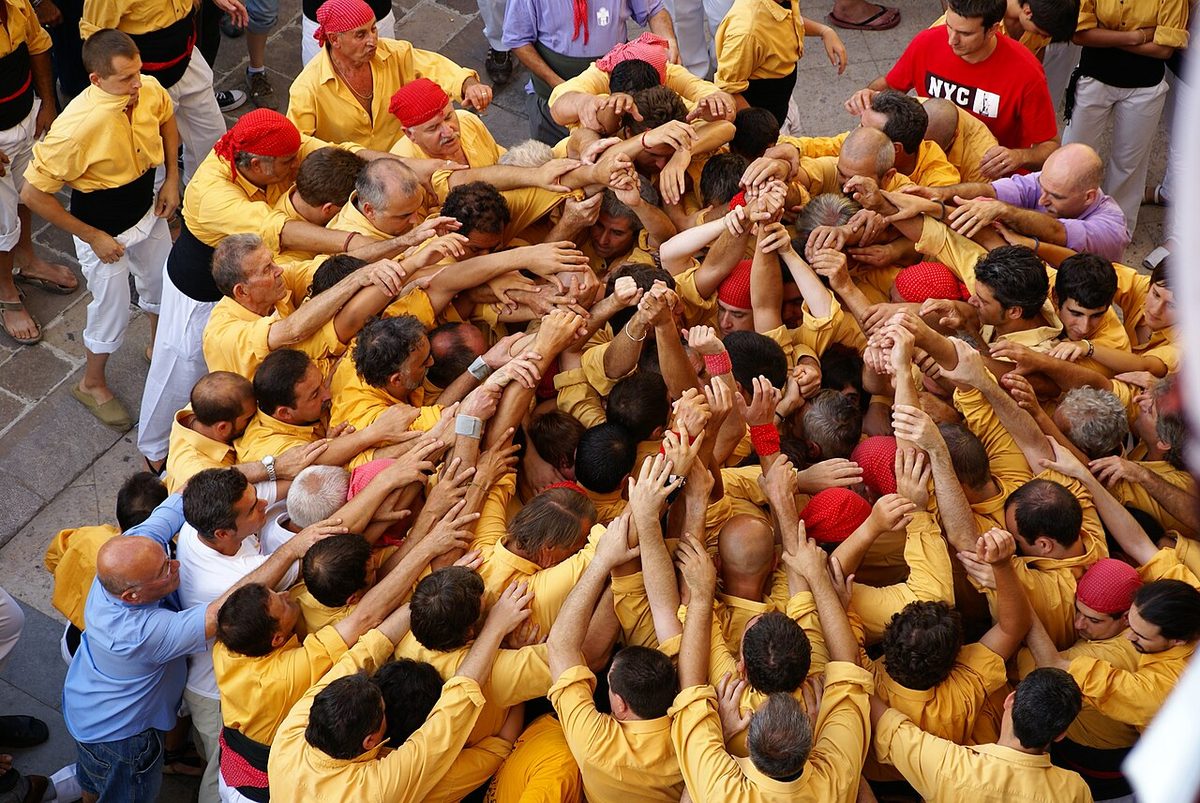
You look up and see the tower. You're wrong: the story starts down here, in the pinya — the throng that holds the base, which UNESCO says anyone is welcome to join.
The climb
Level 1
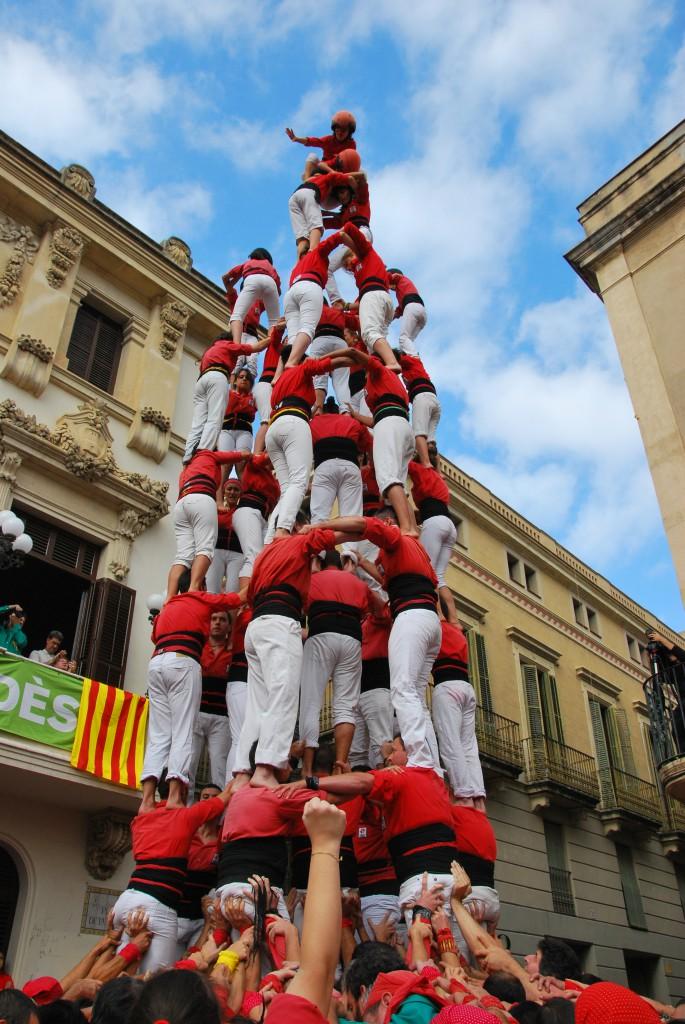
The tower runs six to ten storeys high. From the second level up — the tronc — each storey carries two to five people, standing on the shoulders below. The heaviest stand low; the lightest, high.
You hear it before you see it: the gralla, the shrill pipe from the oboe family, setting the rhythm the tower is built to. The toc de castells is played by at least one gralla and one timbal.
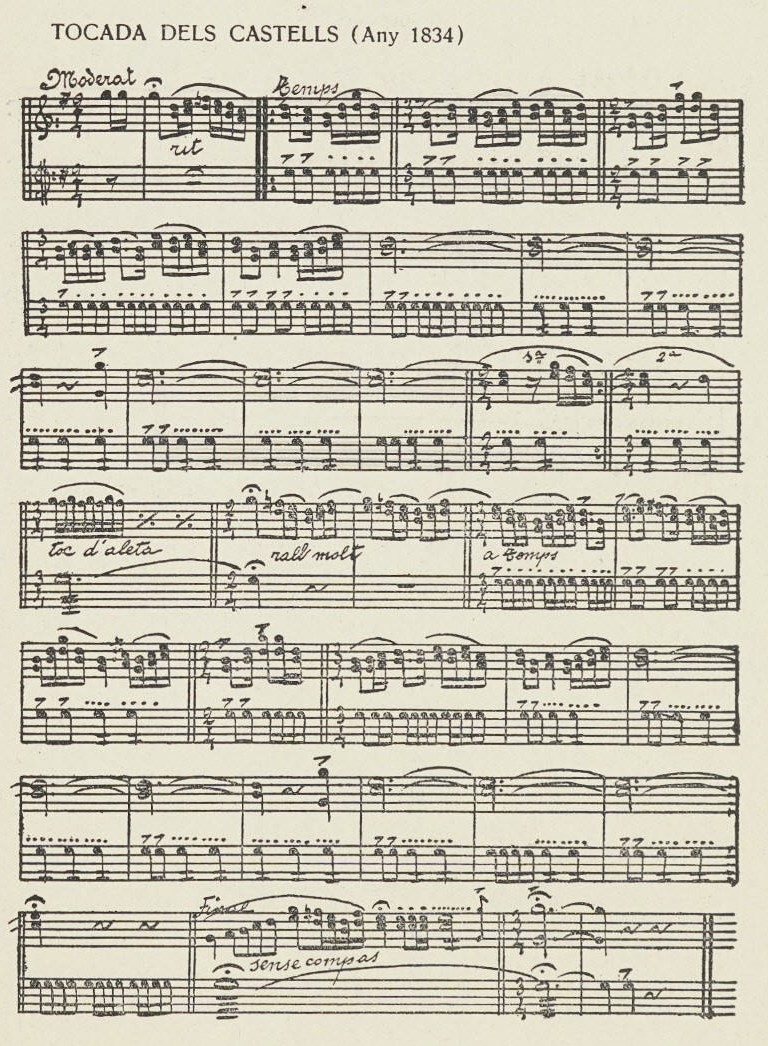
Climb on: the shoulders beneath you thin out with every storey, and the square sounds further below. (The gralla you hear is a simplified electronic rendering from a public-domain score; the timbal beat and the crowd are illustrative — read the method at the end.)
The sway
Halfway up the tronc, the tower starts to sway. You feel it in your ankles before you see it: a slow motion, like a boat.
The sway drawn here is a stylisation — the levels are documented, the motion is for feeling.
And then the strange thing happens: you stop holding on. Hands you have never seen hold you — and you start to trust them.
The crown
The top three storeys — the pom de dalt — are climbed by the smallest and lightest: children and youths, girls and boys.
Everyone up there wears a helmet. Since 24 March 2012, when the federation assembly at Molins de Rei made it mandatory for the enxaneta, the acotxador and the dosos, at any age, in rehearsal and in the square, in all castells except the pilar — and the rule stands today.
The crowning
Right at the top climbs the enxaneta — usually a light, agile young girl. Reaching the summit, she raises one hand: l'aleta.
At exactly that moment the gralla breaks into the fragment called the toc d'aleta: the sign that the tower has been carregat — crowned. No raised hand, no aleta.
Crown it yourself
Press and hold for one second, like the enxaneta.
The descent
But wait: if you climbed all this way for the view, you climbed in vain. The point was never what you can see from the top.
You climb down through shoulders and only now do you count them: the dozens of people in the pinya you never saw — they held you the whole time.
Your shoulders
Down below there is room for you. “Making the pinya” — fer pinya — has become the Catalan synonym for working together. A colla has between 75 and 500 members, and the tower season runs from April to November.
Shout with them
Record up to 5 seconds: a shout, a name, a cheer. Then hear yourself from inside the crowd.
The recording stays on your device and disappears when you close the page.
Shouting needs a microphone, and this device does not offer one here. The gralla and the square still play.
The numbers
Since 2010, human towers have been on UNESCO's Representative List of intangible heritage — decision 5.COM 6.40, taken in Nairobi: Catalans recognise them as “an integral part of their cultural identity”. They have gone up without a break for over 200 years, and the colles grew from 6 in 1970 to 56 in 2009.
At the opening of the 1992 Olympic Games, 12 towers went up at once: 2,174 people from 16 colles. In 2008, 37,418 people voted them among the treasures of the heritage.
Who holds you here
Choose a level and read who holds you and how many hands there are. The levels and roles are documented; the drawing is schematic.
The surprise
The crowning is only half of it: a tower fully counts — descarregat — only if it comes down in order, the way it went up. Crowned but fallen on the way down — carregat — ranks below.
And the second surprise: the crowd below makes the top, and anyone may join it — even senior citizens. The earliest records of the practice come from near Tarragona, in the early 18th century.
Ending
Somewhere there is a square where people need shoulders. You don't have to be strong, you don't have to be light. You just have to show up and lend a shoulder.
If you can, go to the square one Sunday and join the base. If you can't, call someone who once carried you on their shoulders — and thank them.
Sources and method
Every historical and participation figure on the page comes from the sources below: 6–10 levels, 2–5 people per level (pilars one), the pom de dalt as the top three storeys, colles of 75 to 500 members, an April-to-November season, 6 colles in 1970 and 56 in 2009 (UNESCO, file 00364 and decision 5.COM 6.40, Nairobi, 2010). The tower you see is a stylisation: the level names and who stands where are documented, while the ring counts, heights and sway are drawn to be felt, not measured.
The gralla you hear is synthesised (a double-reed, oboe-like timbre) from the melody line of the Bové score, public domain: arpeggios from the “Penes” section while you climb, the rising run of the “toc d'aleta” at the crowning. It is not a recording and not a performance — an illustration, and the page says so. The timbal beat is an editorial pattern, not from the score; the crowd is an editorial bed, kept clearly below the gralla. No injury figures appear on the page beyond the 2002–2004 comparison (19.2 versus 52.8 per 100 child-years, 146 children in 21 colles, before the helmet), with its conditions attached.
16 November 2010 as the inscription day is the Barcelona city council's dating, not UNESCO's (which gives only the 15–19 November session, Nairobi). The year, colla and child name of the depicted diada are left deliberately generic: “at La Mercè, in Plaça de Sant Jaume” — as far as the sources go.
- UNESCO, Decision 5.COM 6.40 — human towers on the Representative List of the Intangible Cultural Heritage, 2010 ich.unesco.org
- UNESCO, Nomination file 00364 (PDF, 12 pp.) — the full description of castells ich.unesco.org
- CCCC, Manual de Bones Pràctiques en Prevenció i Seguretat Castellera v1.2 (2014) — the helmet rule, voted at Molins de Rei, 24 March 2012 (PDF, mirror) potesroges.cat
- CCCC, Manual de Bones Pràctiques, Àrea mèdica i de salut (May 2025) — the current helmet rule castellscat.cat
- CCCC, Manual de bones pràctiques dels grups de gralles i timbals (June 2023) — the toc de castells and the toc d'aleta castellscat.cat
- RevistaCastells, “Més segur del que sembla” (21 May 2015) — the two paediatric studies, 1998 and 2002–2004 (PDF, reprint) xiquelosixiquelesdeldelta.cat
- Lauren Frayer for NPR, “With Human Pyramids, Catalans Reach For Independence” (2 Nov 2014) — the enxaneta, the helmets, Tarragona (WUOT mirror) wuot.org
- Ajuntament de Barcelona, Cultura Popular — “Castells”: the La Mercè diades and 16 November 2010 (the city's dating, not UNESCO's) barcelona.cat
- Francesc de Paula Bové, Partitura del Toc de castell (1926) — public domain, via Wikimedia Commons commons.wikimedia.org
- The gralla voice: synthesised from the Bové score (above), not a recording — see the method commons.wikimedia.org
- Photos: Castellers de Barcelona (CC BY 3.0), Núria i JC (CC BY 2.0) — via Wikimedia Commons, credited on each picture commons.wikimedia.org
