mariuscomper.uk RO
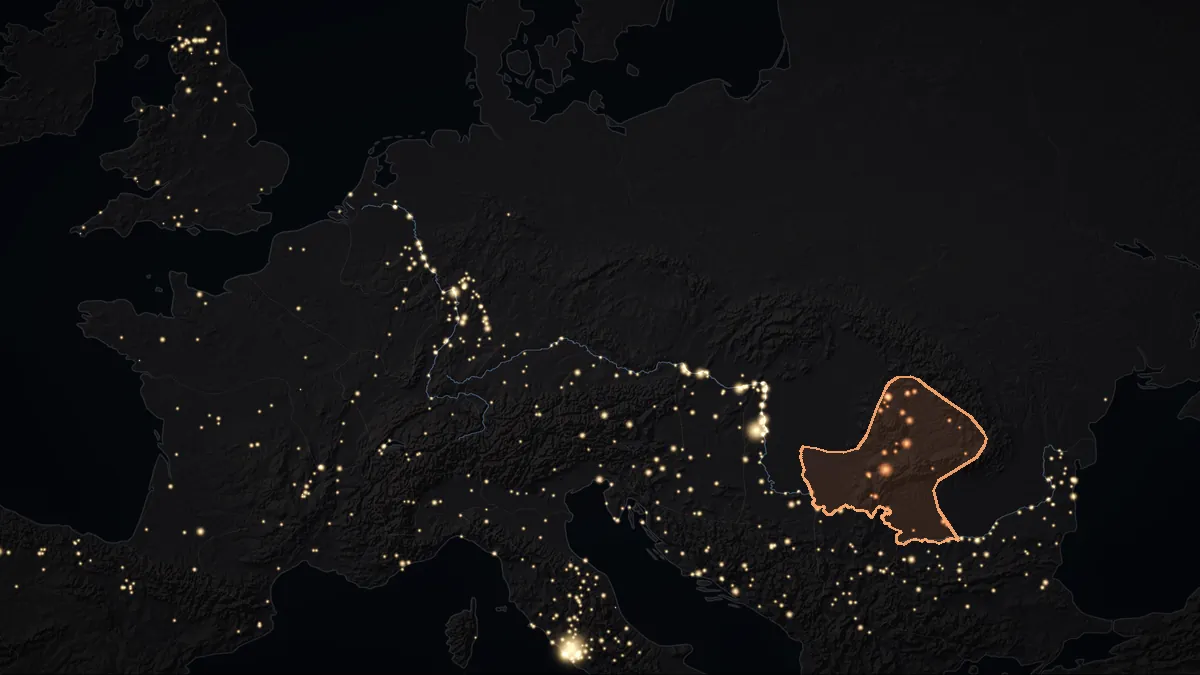
Night map of the Roman frontier, from Hadrian’s Wall to the Black Sea. Each site lights up in the years a stone from it is dated to.
Year230

Roman Dacia · dated Latin inscriptions, AD 150–320

The last dated inscriptions of the province of Dacia: dated stones thinned along the whole frontier in the 250s, and in Dacia they end with Gallienus

Aurelian’s withdrawal from Dacia is usually put in 271–275. The province’s dated stones end earlier. In the 250s, dated stones thinned out along the whole Roman frontier, from the Rhine to the Black Sea. In Dacia the last ones honour Gallienus, 268 at the latest, and no inscription of the province names Claudius II or Aurelian. Britain, at the other end of the same frontier, kept carving dated stones until about 297.

#How a Roman stone gets a date

Roman Dacia has 3,552 Latin inscriptions in LIST, the dataset that merges the two big catalogues, EDCS (Clauss–Slaby) and EDH (Heidelberg). Few carry the year. Usually the date comes from an emperor, a consul or a unit named on the stone: a dedication to Valerian and Gallienus together can only be dated 253–260, the years they ruled side by side.

On the map each site lights up in the years a stone from it can be dated to, brighter for more stones and for tighter dates. Only the 9,601 inscriptions dated to within 15 years show, from Britain to the Black Sea. In the 230s the frontier is full of lights.

#What happened to inscriptions in the 250s

Between 251 and 275, each frontier province had between 7% and 25% of the yearly mass of dated stones it had in 201–250: from 7% in Raetia to 25% in Upper Moesia. Dacia fell to 9%. The measure is the same everywhere: stones dated to within 50 years, each spread in equal parts over the years of its range, so an estimate rather than a year-by-year count. In five-year steps (chart below), the fall begins after 250 in every frontier province; Dalmatia and Britain fall less.

The frontier thinned; it did not fall silent. In the same years Rome kept 28% of its pace and Britain 35%. Why the stones thinned, they do not say.

#Why the catalogue shows a collapse in 271

44% of Dacia’s dated inscriptions (1,550 of 3,524) have a date range ending at exactly 270 or 275. In the neighbouring provinces the share is 0.3% to 1.5%. Stones with no other clue were given the life of the province as their date: “107–275”, “151–270”. EDH does the same: 45.7%.

Spread over the years, these ranges make a cliff: the date mass drops from 14.1 in 270 to 5.2 in 271 and 1.0 in 276. The cliff comes from the way the stones were catalogued. With “As the catalogue dates them”, the map shows it as a haze over Dacia that thins abruptly in 271 and is gone by 276; the charts and the town answers leave these ranges out.

As the catalogue dates them (every dated inscription); Dated to within 15 years150200250300As the catalogue dates them (every dated inscription)270: 14.1 → 271: 5.2Dated to within 15 yearsGallienus

#Which are the last dated inscriptions of Dacia

Setting aside the objects from after the withdrawal (Constantine’s milestone, the inscription of 373, the bars of 379), Dacia’s stones dated to within 15 years that end after 255 are five, all from the reign of Gallienus (253–268). The latest range belongs to an altar at Băile Herculane to Aesculapius and Hygia, set up by the prefect of the Thirteenth Legion Gemina, which carries the title “Gallieniana”: dated 260–268. The second, from Tibiscum (Jupa, near Caransebeș), honours Salonina, Gallienus’s wife: 254–268. The last stone dated to within ten years is from 268; in the neighbours, the last is from 290–300.

260–268

Băile Herculane · Ad Mediam

Diis magnis et bonis Aesculapio et Hygiae Marcus Aurelius Veteranus praefectus legionis XIII geminae Gallienianae votum libens merito posuit

To the great and good gods Aesculapius and Hygia, Marcus Aurelius Veteranus, prefect of the Thirteenth Legion Gemina Gallieniana, willingly and deservedly fulfilled his vow.

Ruling then: Gallienus · HD044777 · date from the raw dating text; the cleaned dates give 253–268

254–268

Jupa · Tibiscum

Corneliae Saloninae Augustae coniugi Gallieni Augusti nostri ordo municipii Tibiscensium devotus numini maiestati que eius

To Cornelia Salonina Augusta, wife of our Augustus Gallienus: the council of the municipium of Tibiscum, devoted to her divinity and majesty.

Ruling then: Valerian · Gallienus · HD046504 · the stone is known only from old copies

253–260

Mehadia · Ad Mediam

Imperatori Caesari Publio Licinio Gallieno Pio Felici Augusto pontifici maximo tribunicia potestate consuli III proconsuli cohors III Delmatarum Valeriana Galliena miliaria eqquitata civium Romanorum pia fidelis devota numini maiestati que eorum

To the Emperor Caesar Publius Licinius Gallienus Pius Felix Augustus, chief priest, holder of the tribunician power, consul for the third time, proconsul: the Third Cohort of Dalmatians, Valeriana Galliena, a thousand strong with cavalry, of Roman citizens, dutiful and faithful, devoted to their divinity and majesty.

Ruling then: Valerian · Gallienus · HD044786 · complete when found, now three fragments

256–258

Turda · Potaissa

Deo Azizo Bono Puero Conservatori pro salutem ddominorum nnostrorum Valeriani et Gallieni Auggustorum et Valeriani nobilissimi Caesaris et Corneliae Saloninae Augustae et legionis V Macedonicae III piae fidelis Donatus praefectus legionis eiusdem templum inceptum perfecit V

To the god Azizus, the Good Boy, the Protector, for the health of our lords Valerian and Gallienus, Augusti, of Valerian, most noble Caesar, of Cornelia Salonina Augusta and of the Fifth Legion Macedonica, three times dutiful and faithful: Donatus, prefect of the legion, finished the temple that had been begun.

Ruling then: Valerian · Gallienus · HD048963 · the emperors’ names are partly restored by editors

255–258

Sarmizegetusa · Ulpia Traiana

Publio Licinio Cornelio Valeriano nobilissimo Caesari filio Imperatoris Caesaris Publi Licini Egnati Gallieni Pii Felicis invicti Augusti colonia Ulpia Traiana Augusta Dacica Sarmizegetusa metropolis publice

To Publius Licinius Cornelius Valerianus, most noble Caesar, son of the Emperor Gallienus: the colony Ulpia Traiana Augusta Dacica Sarmizegetusa, the metropolis, at public expense.

Ruling then: Valerian · Gallienus · HD046338

No inscription from the years of the province names an emperor after Gallienus; later emperors appear only on objects from after the withdrawal: Constantine on the Sucidava milestone, Valens and Valentinian at Romula. A search for the titulature of Claudius II, Quintillus, Aurelian, Tacitus, Probus, Carus and the Gallic emperors finds dozens in the neighbours (38 in Lower Moesia, 25 in Lower Pannonia, 20 in Upper Germany) and in Dacia only three matches, all ordinary people: a councillor called Diocletianus, a little girl, Quintilla, and a soldier, Aurelius Victorinus. A text search cannot prove an absence on broken stones; it can only find nothing.

#How long the neighbours kept carving after 260

A count made after seeing the result, so read it with care: Dacia has 233 stones dated wholly inside 201–250 (to within 20 years). Had it carved in 261–270 at the pace of its eight Danube and Rhine neighbours, it should have about 4.8. It has 0. If stones turned up at random at the neighbours’ pace (a Poisson model with mean 4.8, taken as known), the chance of a zero would be 0.008; for 261–275, 7.5 expected, still 0.

Raetia also has 0, but only 1.3 would have been expected there: too few to tell. Dacia is the only province where the silence can be measured; it may not have been the only one that fell silent. Britain had 136 such stones in 201–250 and 12 in 261–270: on Hadrian’s Wall, Cilurnum (Chesters) dated a dedication by the consuls of 286, and Banna (Birdoswald) set up a building inscription to Diocletian and his colleagues in 297.

Stones dated to within 15 years, per five years, against 201–250, in 12 provinces150200250300GallienusDacia≈4.8 → 0Lower MoesiaRaetiaNoricumLower PannoniaUpper GermanyLower GermanyUpper PannoniaUpper MoesiaRomeBritainDalmatia
Height: stones per five years against the 201–250 average (half a row = the same pace). Hollow circles: the ≈4.8 stones Dacia would have had in 261–270 at its neighbours’ pace; it has 0 (counted after the result).

#Did Dacia fall harder than its neighbours?

The rule was written before the count: Dacia “fell harder” if its ratio of 251–275 to 201–250 is below all six neighbours (both Moesias, both Pannonias, Noricum, Dalmatia) and its 95% interval sits below the neighbours taken together. Result: it passed. Dacia 0.089 (0.045–0.140), the neighbours together 0.187 (0.159–0.219). It also passes in the other six variants, with and without the round end years 250/270/275/300, at 50, 25 and 10 years.

The pass leans on Dalmatia, which behaves like an interior province (0.59). Without it the neighbours come to 0.159, and Dacia’s upper bound touches or crosses that value in 3 of the seven variants. Nor does Dacia sit by itself at the bottom: Raetia (0.066) and Lower Moesia (0.113) fell as low. Raetia lost its lands beyond the Rhine and the Danube (the Agri Decumates) around 260; the link is a lead, not tested here.

Ratio of 251–275 to 201–250, by province0.000.250.500.751.00neighbours 0.187without Dalmatia 0.159Dacia0.089Raetia0.066Lower Moesia0.113Upper Germany0.120Noricum0.132Lower Pannonia0.145Lower Germany0.160Upper Pannonia0.200Upper Moesia0.250Rome0.277Britain0.352Dalmatia0.589
Dot: the pre-registered rule. Thin line: Dacia’s 95% interval; for the others, the values across the seven variants. Band: the interval of the neighbours taken together.

#What Latin turns up north of the Danube after 275

For the years after 275, LIST has 61 Latin records from the former province (by the rule in the method), mostly objects: 42 stamped bricks and tiles, most naming legions and units, found in the south-west and mostly on the Danube, from Pojejena and Dierna to Drobeta, Hinova and Sucidava (some read “Dacia Ripensis”, the new province south of the river), Constantine’s milestone at Sucidava (326–333), the tombstone of a cavalry commander there, and an inscription for Valens and Valentinian at Romula (373).

Also on the Danube, at Sichevița, a curse scratched on a tile. Further from the river: the Biertan donarium (“I, Zenovius, offered this gift”), bars stamped at Sirmium found at Sita Buzăului, gold bars stamped at Thessalonica and Naissus (379) found at Feldioara, and the rings of Omharus from Apahida, of the fifth century. How the bars came north of the Danube, as payments or as loot, is an open question. Biertan has a page of its own, and so do the Christian inscriptions after 300.

  • 42 stamped bricks and tiles
  • 9 bars
  • 2 rings
  • 1 milestone
  • 1 tombstone
  • 1 honorific inscription
  • 1 donarium
  • 1 curse on a tile
  • 1 votive relief
  • 1 silver brooch
  • 1 owner’s mark
  1. 326–333Corabia · Sucidava · milestoneImperatore Caesare Flavio Valerio Constantino Augusto et Caessaribus beatissimis nobilissimis a Sucidava mille passuum IUnder the Emperor Caesar Flavius Valerius Constantinus Augustus and the most blessed, most noble Caesars: one mile from Sucidava.
  2. 301–400Cartier Celei · tombstoneIN Romanico tradidit et factus domesticus protector fuit annos VIII promotus Sucidavam gessit annum I cuneo equitum II stablesianorum qui vixit annos XLV menses… served eight years as a household guard; promoted, he commanded the cavalry unit II Stablesiani at Sucidava for a year. He lived 45 years, 10 months, 10 days … Flavius Mellites, his fellow citizen, set up this monument. Farewell, passer-by.
  3. 373Dobrosloveni · Romula · honorific inscriptionDDominis nnostris Valenti et Valentiniano fratribus votis Xdecennalibus feliciterTo our lords Valens and Valentinian, brothers: good wishes for the tenth year of their reign, good fortune!
  4. 301–400Biertan · donariumEgo Zenovius votum posui XPChristusI, Zenovius, offered this gift.
  5. 294–350Sichevița · curse on a tileRogo et peto primicere tunc puellam Bariam teretrum perdis ego Sterius modo rudi cunscio me reddere Bessam ex sium visu peto et rogo primicere reddas mihi teretI ask and beg you, primicerius… (a curse scratched on a tile, about a girl and a lost drill)
  6. 338–339Wattin · owner’s markDomini nostri Constanti Ματγογος[Property] of our lord Constantius · Ματγογος
  7. 351–400Sita Buzăului · barsQuirillus et Dionisus Sirmio signavimusWe, Quirillus and Dionisus, stamped this at Sirmium.
  8. 379Feldioara · barsThessalonicae dddomini nnnostri K Flavius Calliopius probavi et signavi ΘThessalonica. Our lords. I, Flavius Calliopius, tested and stamped it.
  9. 431–470Apahida · Napoca · ringsOmahari viro gloriosoOf Omharus, a man of high rank.

The Biertan donarium →

Christian inscriptions on the Danube →

#Did people leave or stay? What the stones cannot say

Dated stones measure a habit: paying a stonecutter to put the name of an emperor, a god or the dead on a stone, in Latin. When the habit stops, people may have left, or run out of money, soldiers or reasons to write. The page does not test this and does not choose between the two theses about Aurelian’s withdrawal.

What can be said: along the whole frontier the habit thinned in the 250s; in Dacia the last dated stones are from the reign of Gallienus; and after 275, Latin appears north of the Danube mostly on objects: stamped tiles, bars, rings, a donarium, a few stones at the bridgeheads.

Atlas of Romanian history: who ruled your town →

#The last dated stone near your town

Type a town or tap the map. For each town the page picks the best-documented Roman site nearby that has a stone dated to within 15 years, then the last stone there. The catalogue’s “to 270/275” ranges never appear as a date.

The last dated stone, site by site, in Dacia

SiteLast dated stoneTightly dated stones
Tibiscum · Jupa254–268 Corneliae Saloninae Augustae coniugi Gallieni Augusti nostri ordo municipii Tibiscensium d…15
Ad Mediam · Mehadia260–268 Diis magnis et bonis Aesculapio et Hygiae Marcus Aurelius Veteranus praefectus legionis XI…12
Colonia Ulpia Traiana Sarmizegetusa · Sarmizegetusa255–258 Publio Licinio Cornelio Valeriano nobilissimo Caesari filio Imperatoris Caesaris Publi Lic…101
Potaissa · Turda256–258 Deo Azizo Bono Puero Conservatori pro salutem ddominorum nnostrorum Valeriani et Gallieni …30
Apulum · Alba Iulia251–253 Eponae Augustae pro salute ddominorum nnostrorum Galli et Volusiani Auggustorum Aurelius M…88
Micia · Vețel251–253 Imperatore Caesare Caio Vivio Traboniano Gallo Pio Felici Augusto patre patriae et Imperat…18
Lăpușnicel251–253 Volusiano Pio Felice Augusto a milia passuum X1
Porolissum · Creaca251–251 Herenniae Etruscillae sanctissimae Augustae coniugi domini nostri Traiani Deci Augusti mat…27
Drobeta · Drobeta - Turnu Severin244–249 Imperatori Caesari Marco Iulio Philippo Augusto pontifici maximo tribunicia potestate cons…12
Arcobadara · Uriu244–249 ala Frontoniana Philippiana devota numini maiestati que eius6

#Method and sources

Data: LIST v1.2 (525,870 Latin inscriptions from EDCS and EDH, CC BY 4.0) and EDH’s open tables (CC BY-SA 4.0). For each inscription the tightest range among three sources is taken: LIST’s cleaned dates, the raw dating text and EDH’s dating; the tightest wins only if it overlaps the others (1,118 disagreements, 16 in Dacia, none in 250–275, keep LIST’s dating).

Duplicates: no inscription appears twice under the same identifier; 293 EDCS rows without an EDH partner that match an EDH row in text, place and date are left off the map, and the Sucidava milestone, entered twice, is counted once. EDH has 30 Dacian inscriptions missing from LIST; none is tightly dated after 250.

Coordinates: 1,108 rows lying more than 60 km outside their own province (homonymous villages, such as Bivolari in Vâlcea placed in Iași county) are set aside; the Sita Buzăului bars and the Biertan donarium were placed by hand. The pre-registered test uses LIST’s cleaned dates, exactly as registered (a range “within 50 years” counts years inclusively: 201–250 is 50); the charts, the expected count and the town answer use the tightest range.

Earlier work: Varga, Pázsint, Boda and Deac (2018) compare the epigraphic habit of Dacia and the two Moesias through the people attested up to the end of the third century; they do not measure when it stops. Eutropius writes that under Gallienus Dacia “was lost”; that is a written source, and its agreement with the stones is a reading, not a test.

Related pages

Sources

The Latin texts are those of LIST and EDH; the translations were made for this page. Every calculation can be redone from the public data above.